Python vs SQL for Data Analytics Key Differences
Recommended Learning Path
What Is Python vs SQL for Data Analytics?
Understanding Python vs SQL for Data Analytics Key Differences
Difference between Python vs SQL for Data Analytics
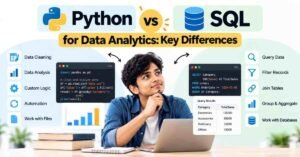
A data analyst may use SQL to pull the right records from a database and Python to do further work with those records. SQL is mainly used to ask databases for data; Python is a general-purpose programming language that can help process, inspect, and automate work with data. They’re different tools, and many analytics tasks use them together.
Quick Answer
If your task is… | A useful starting point |
Finding particular records in database tables | SQL |
Calculating totals or groups inside a database query | SQL |
Repeating several data-cleaning steps | Python |
Applying custom logic to a dataset | Python |
Retrieving data, then working with it in code | SQL and Python |
This is a guide to typical use, not a hard rule. The right choice depends on where your data is and what you need to do with it.
SQL: ask the database for what you need
SQL is used to work with relational databases. A query can request particular columns, limit which records are returned, and group results. For instance, a retail analyst could ask a database for orders placed in a chosen month, organized by product category. SQL’s SELECT statement retrieves rows and columns from database tables.
SQL is often a good fit when:
- The source data lives in a database.
- You need to filter records before analysing them.
- Information is spread across related tables.
- You want a query that can be run again with updated data.
Think of SQL as a precise request to the system holding the records: return these fields, for these rows, arranged in this way.
Python: work through a sequence of data tasks
Python is a general-purpose programming language. It can be used to write scripts, and data-focused libraries such as pandas add tools for handling tabular information.docs.python+1
An analyst might use Python to read a file, standardize inconsistent labels, check missing values, calculate new fields, and repeat those steps on another file. pandas supports reading data from sources including SQL and provides operations for selecting, grouping, reshaping, and combining tabular data.
Python is useful when:
- A task involves several processing steps.
- You need custom calculations or transformations.
- You want to reuse the same procedure on new data.
- Your analysis needs capabilities provided by Python libraries.
Python offers flexibility, but it also requires writing and checking code. A script can run without errors and still produce a misleading result if the assumptions or data are wrong.
One example: reviewing course enquiries
Imagine an education team wants to see which courses receive enquiries and how those enquiries change over time.
- Retrieve records: If enquiries and course details are held in database tables, SQL can select the relevant records and fields. SQL also supports clauses for filtering, grouping, and combining data.
- Continue the analysis: The analyst can bring the query result into Python and use pandas to clean labels, summarize the data, or repeat the same analysis when new records arrive. pandas supports reading SQL data and working with it as a DataFrame.pandas.pydata+1
- Check the output: Compare the results with the source or a trusted report. Confirm that the date range, filters, and category labels match the question.
The example describes a possible workflow, not a claim about how every company handles its data.
Python vs SQL: the practical difference
| | SQL | Python |
Main purpose in this comparison | Retrieve and work with database records | Write instructions for data processing and other tasks |
Typical input | Tables in a database | Files, query results, or other data sources |
Common analytics work | Select, filter, group, and join records | Clean, reshape, calculate, and automate steps |
How you interact | Write a query | Write a script or notebook code |
Can it work with the other tool? | Its query result can be used in a Python workflow | Python libraries can read data returned by SQL |
The boundary isn’t absolute. pandas documents similarities between common SQL operations and pandas operations—for example, filtering, grouping, and joining tables.
Which should you learn first?
Choose based on the work you want to practise:
- Begin with SQL if you want to learn how to retrieve and summarize database records.
- Begin with Python if you want to learn coding and automate a sequence of data tasks.
- Learn both over time if you want to practise moving from a database query to further analysis in code.
A beginner’s practice plan could be:
- Learn what tables, rows, and columns represent.
- Practise selecting and filtering a small set of database records with SQL.
- Load a small file or query result into Python.
- Use pandas to clean or summarize it.
- Check a few rows and totals manually so you understand what your code returned.
You don’t need to master both tools at once. Start with one practical task, then add the second tool when the task calls for it.
Common misconceptions
- “Python makes SQL unnecessary.” Python can work with data from databases, but SQL remains useful for asking the database for specific records.
- “SQL is only for database administrators.” Analysts can use SQL to retrieve and organize data for analysis.
- “Python means machine learning.” Python can also be used for everyday data processing and automation.docs.python+1
- “Both tools do exactly the same thing.” Some operations have equivalents, but the tools have different roles and working environments.
- “A successful run proves the result is right.” Check that the query, code, and interpretation answer the intended question.
A simple decision check
Before choosing a tool, ask yourself:
- Where are the records? If they’re in a database, SQL may be the natural first step.
- What work is required? Retrieving and grouping records may fit a query; a longer sequence of custom processing may call for Python.
- How will you verify the result? Check filters, sample rows, and totals before sharing conclusions.
If you’re exploring a structured way to build analytics skills, review FLM’s AI-powered Data Analytics training and see whether the course content matches your goals.
FAQs
- Is Python or SQL more useful for data analytics?
They’re useful for different tasks. SQL is commonly used to retrieve and organize data held in relational databases; Python can support further processing and automation. Many workflows use both. - Can Python connect to a SQL database?
Yes. Python data tools can read data from SQL sources; pandas documents functions for reading SQL queries or tables into a DataFrame. - Can SQL clean data?
SQL can filter, group, and transform data as part of a query. Whether that is enough depends on the cleaning task and the database workflow. - Is Python needed for every data analyst?
Not every task requires Python. The tools used depend on the organization, data source, and analysis requirements. Python can be useful when a workflow needs custom processing or automation. - Should a non-IT beginner learn SQL first?
If your immediate goal is to query database records, SQL is a practical place to begin. If your goal is to learn coding and process files through repeatable steps, Python may be a better starting point. Your learning path can include both. - Is Python harder to learn than SQL?
They involve different learning challenges. Python requires learning general programming concepts; SQL requires learning how to express requests to databases. Which feels easier depends on your prior experience and practice task. - Do Python and SQL have similar operations?
Some operations overlap. For example, both SQL and pandas can filter, group, and join tabular data, though the syntax and context differ.