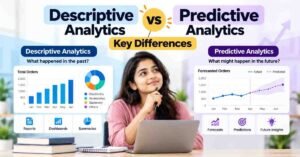
Descriptive vs Predictive Analytics Key Differences
Recommended Learning Path
What Is Descriptive & Predictive Analytics ?
Understanding Descriptive vs Predictive Analytics
Descriptive vs Predictive Analytics: What Is the Difference?
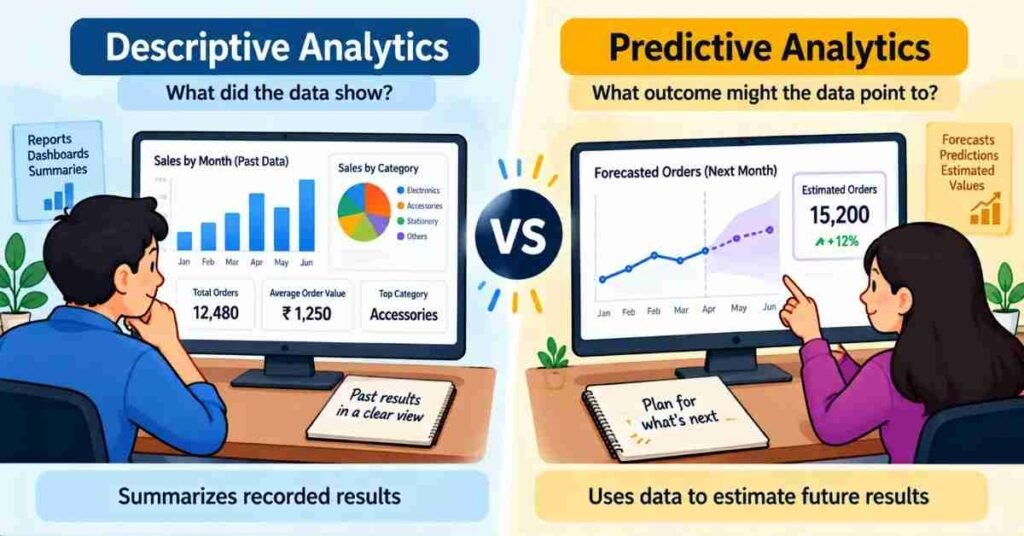
A monthly report showing how many orders a shop received describes past activity. An estimate of how many orders it might receive next month is predictive. In short, descriptive analytics summarizes recorded results; predictive analytics uses data to estimate a future result. The first helps you review what is known. The second helps you consider what may happen, with uncertainty.
Quick Answer
| | Descriptive analytics | Predictive analytics |
The question | What did the data show? | What outcome might the data point to? |
Main focus | Recorded results | Estimated future results |
Common output | Report, dashboard, summary | Forecast, score, or estimated value |
Example | Orders by month last year | Estimated orders next month |
These approaches can be used in sequence: first understand the records, then decide whether a forecast would help answer a planning question.
Descriptive analytics: making past results understandable
Descriptive analytics turns a set of records into a readable account of what happened. A team might count transactions, compare monthly totals, calculate averages, or display results in a chart.
For example, a small retailer could group last quarter’s receipts by product category. The resulting summary might show that phone accessories contributed more sales than stationery during that period. It gives the team a view of recorded sales; on its own, it does not explain why the difference occurred.
Questions suited to descriptive analysis include:
- How many orders were completed last week?
- Which product category had the highest recorded sales?
- Did website visits rise or fall compared with the previous month?
- What was the average time taken to resolve support requests?
Microsoft Learn describes reports and dashboards as possible ways to present descriptive analytics, including measures used to track business objectives.
Predictive analytics: estimating what may come next
Predictive analytics uses available data to estimate an outcome that has not yet been observed. Depending on the task, the approach might use a statistical method, forecasting technique, or machine-learning model.
Suppose the retailer wants to plan stock for an upcoming month. An analyst could examine past sales and relevant factors, then produce an estimate of future demand. The estimate can support planning, but it is not a promise about how many items customers will buy.
Predictive analysis can help explore questions such as:
- What might next month’s sales look like?
- Which orders may need closer attention because they could be delayed?
- How many support requests might arrive during a busy period?
- Which products may need replenishing soon?
Microsoft Learn lists forecasting, regression, decision trees, and neural networks among techniques that may be used for predictive analytics. The appropriate method depends on the question and available data.
One dataset, two useful views
Imagine a Hyderabad-based retailer has two years of order records.
First, a descriptive view: The analyst groups the records by month and category. This reveals which categories sold most in each recorded month.
Then, a predictive view: If the team needs to plan a future purchase, an analyst may use past patterns and relevant information to estimate possible demand for the next period.
The first view reports the history. The second uses it to estimate a future value. If the forecast is being made for conditions unlike those in the historical records, interpret it cautiously: NIST notes that predictions beyond the range of observed data require care.
What these approaches cannot tell you by themselves
A chart showing that orders declined answers, “What did the records show?” It does not, by itself, establish why orders declined. Investigating the cause is a different analytical question, often called diagnostic analytics.
Likewise, a forecast is not a fact about the future. Changes in customer behaviour, stock availability, pricing, or other conditions can make future results differ from an estimate. Treat predictive output as information for a decision—not as a guaranteed result.
A beginner’s way to practise
Try this with a small, clearly labelled dataset, such as a sample list of weekly orders:
- Summarize: Calculate the total orders for each week and display the results in a table or chart.
- Describe: Write one or two sentences saying what the records show, without guessing at causes.
- Ask a future-facing question: Decide whether an estimate would help with a practical decision, such as planning staff or stock.
- Qualify the estimate: State what information it uses and what could make the result differ.
This exercise builds a useful habit: distinguish what the data records from what an analysis estimates.
If you’re building broader analytics skills, explore FLM’s Data Analytics training and review whether the course content fits your learning goals.
FAQs
- What is the simplest difference between descriptive and predictive analytics?
Descriptive analytics summarizes recorded results. Predictive analytics uses data to estimate an outcome that has not yet happened. - Is a monthly sales report descriptive analytics?
It can be. A report that organizes and presents sales records for a past month is describing recorded results. Microsoft Learn identifies reports and dashboards as possible descriptive analytics outputs. - Is forecasting predictive analytics?
Forecasting is one technique that can be used for predictive analytics. Predictive work can also estimate other outcomes, depending on the question and method. - Does predictive analytics always use machine learning?
No. Predictive analytics can use different techniques. Microsoft Learn includes both statistical and machine-learning techniques in its examples. - Can a predictive model guarantee future results?
No. A prediction estimates a future or unobserved value; it is not the value already observed. NIST also cautions that predictions beyond the range of available observations require care. - Which type should a beginner learn first?
Start by learning to read, summarize, and question data. Understanding what a dataset says makes it easier to see what a future estimate is based on. The right learning sequence depends on your goal and current experience.