
How to Become a Business Analyst in 2026: Complete Career Guide
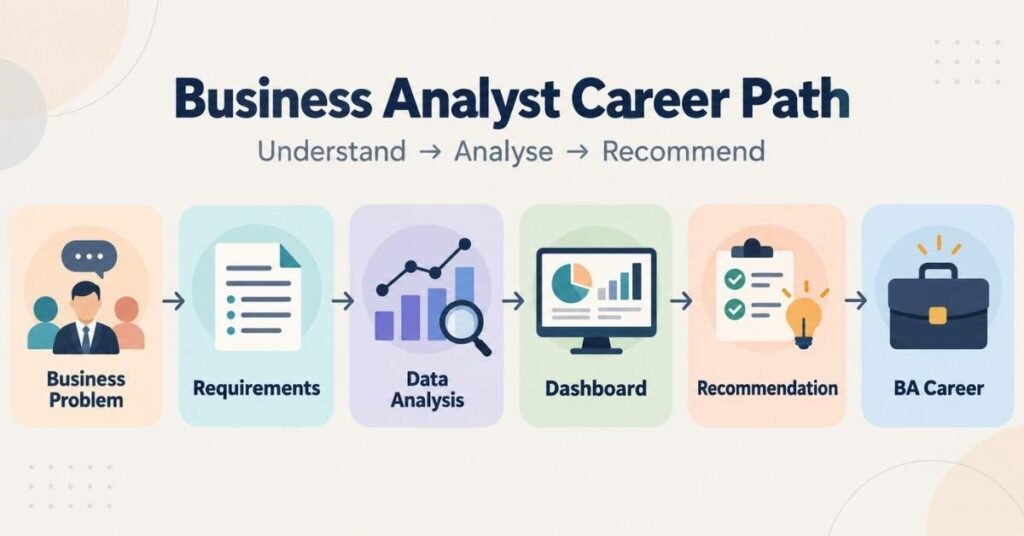
Table of Contents
Business Analysts help organizations understand business problems, gather requirements, improve processes, analyze information, define KPIs, and recommend practical solutions. In 2026, a job-ready Business Analyst should understand Business Analysis, BRD and FRD documentation, Agile, Excel, SQL, Power BI, Jira, stakeholder management and AI-assisted workflows. This guide gives you a practical 6–8 month roadmap, including what to learn, which projects to build, how to create a portfolio, how to prepare your resume and interviews, and which Business Analytics career paths you can target.
What Does a Business Analyst Actually Do?
A Business Analyst works between business stakeholders and technology teams to understand problems and define solutions.
Think about an e-commerce company where sales are falling.
A Business Analyst may need to find out:
- What changed in sales?
- Which products are affected?
- Which customers are dropping off?
- What are the business requirements?
- Which process is causing the problem?
- Which KPIs should management track?
- What solution should the technology team implement?
Core Responsibilities
- Requirement gathering
- Requirement analysis
- BRD and FRD documentation
- Stakeholder management
- Business process analysis
- KPI definition
- Excel and SQL analysis
- Power BI reporting
- Agile/Scrum collaboration
- User stories and acceptance criteria
- Business recommendations
Build Job-Ready Analytics Skills – Explore the Business Analyst Course
Business Analyst vs Data Analyst
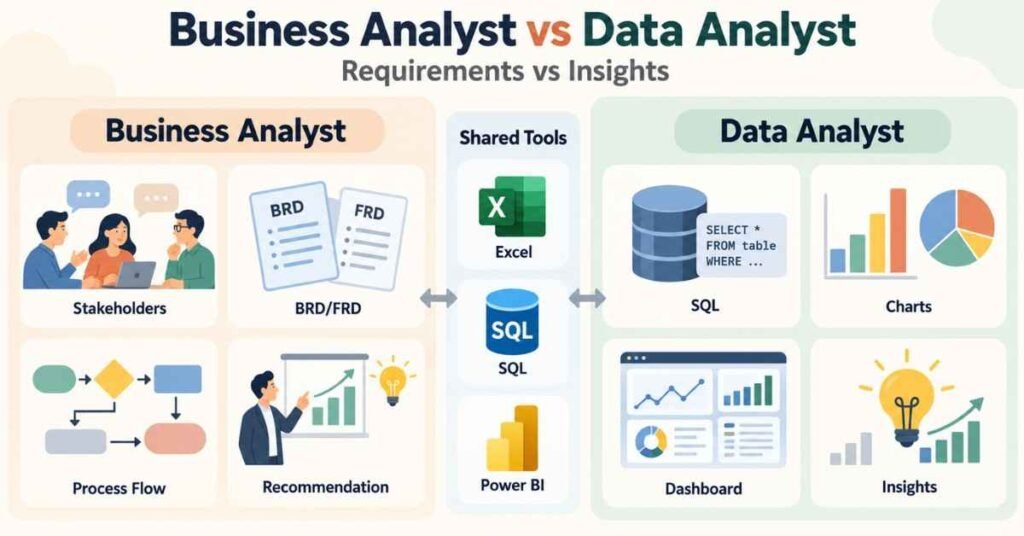
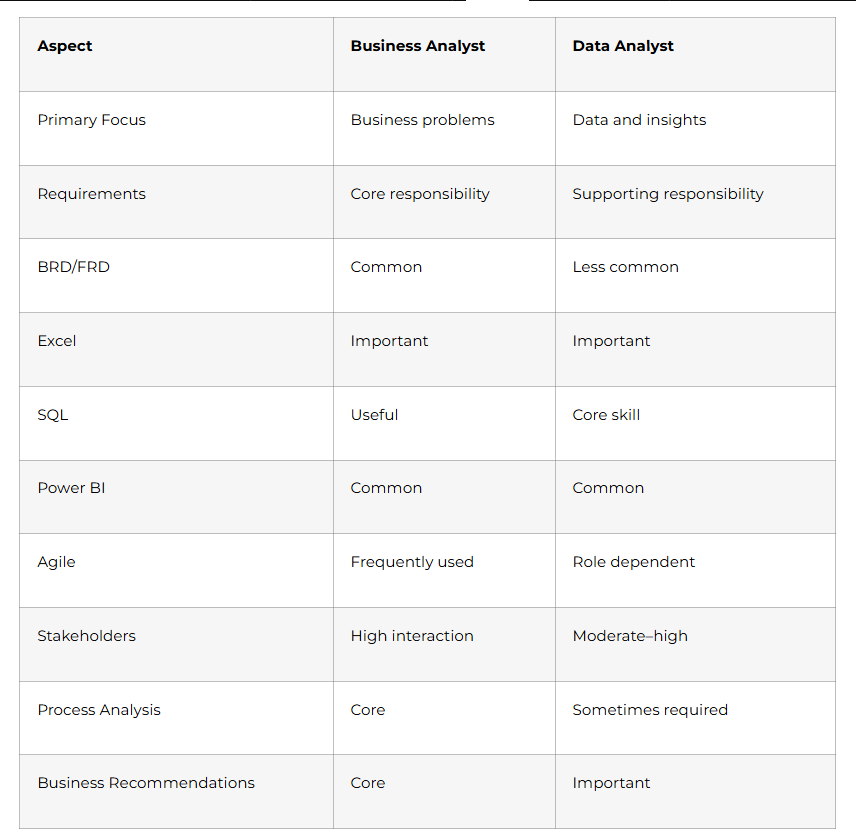
There is considerable overlap between the two roles. Your actual responsibilities depend on the company and job description.
Why Choose Business Analytics in 2026?
1. Multiple Career Opportunities
Business Analytics skills can lead to roles such as:
- Business Analyst
- Junior Business Analyst
- Data Analyst
- BI Analyst
- Power BI Analyst
- Product Analyst
- Process Analyst
- Functional Analyst
- MIS/Reporting Analyst
2. Useful Across Industries
Business Analysts can work in:
- Banking
- Finance
- IT services
- E-commerce
- Retail
- Healthcare
- Telecom
- Marketing
- Supply chain
3. AI Is Becoming Part of the Workflow
AI tools can support Business Analysts with:
- Requirement brainstorming
- User-story drafting
- Documentation
- Research
- SQL assistance
- Meeting summaries
- Process analysis
- Business communication
Business Analyst Salary in India
Role | Experience | Salary Range |
Business Analyst | Fresher | ₹4.5–₹6 LPA |
MIS / Reporting Analyst | Fresher | ₹3–₹6 LPA |
Data Analyst with BA Skills | Fresher | ₹3.5–₹7 LPA |
Data Associate | Fresher | ₹3.5–₹8 LPA |
Power BI Analyst | Fresher | ₹3.5–₹6 LPA |
Business Analyst | 3–5 Years | ₹9–₹15 LPA |
Product / Process Analyst | 3–5 Years | ₹10–₹18 LPA |
BI Analyst | 4–6 Years | ₹12–₹20 LPA |
Functional Analyst | 5–8 Years | ₹12–₹25 LPA |
Power BI Analyst | 5–8 Years | ₹8–₹25 LPA |
Four Business Analytics Career Tracks
1. Business Analyst
Best for: Students who enjoy requirements, processes and communication.
Focus on:
- Requirement gathering
- BRD/FRD
- Agile
- User stories
- Stakeholder management
- Process modelling
2. BI / Power BI Analyst
Best for: Students who enjoy dashboards and data visualization.
Focus on:
- Excel
- SQL
- Power BI
- Power Query
- DAX
- KPIs
3. Product / Process Analyst
Best for: Students interested in products and process improvement.
Focus on:
- Customer journeys
- Product KPIs
- Process analysis
- Gap analysis
- Agile
4. Data Analyst with Business Analysis Skills
Best for: Students who want a stronger data-focused career.
Focus on:
- Excel
- SQL
- Power BI
- Statistics
- Business insights
Complete Business Analytics Roadmap: 6–8 Months
Phase 1: Business Analytics Fundamentals & Agile
Months 1–2
Start with the fundamentals before moving into tools.
Learn
- Introduction to Business Analytics
- Business Analyst role
- Types of analytics
- Business KPIs
- KPI vs metrics
- Business Analysis lifecycle
- BA deliverables
- Business Analysis framework
- SDLC
- Waterfall
- Agile
- Scrum
- Sprint planning
- Product backlog
- User stories
- Acceptance criteria
Phase 1 Projects
Project 1: Business KPI Analysis
Define KPIs for an e-commerce or retail company.
Project 2: Agile User Story Project
Create:
- User stories
- Acceptance criteria
- Product backlog
- Sprint plan
Phase 1 Goal
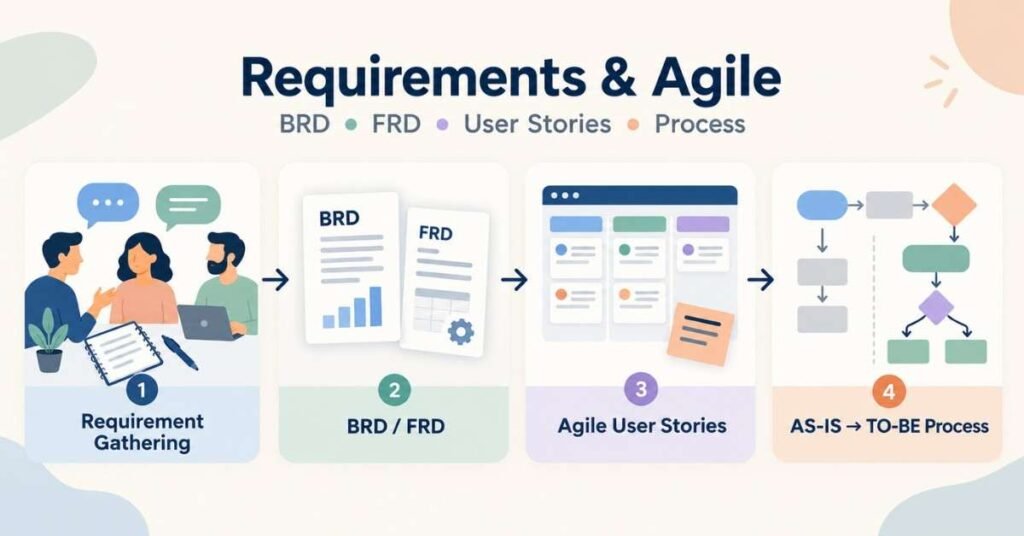
Understand how a business problem becomes a requirement and eventually a solution.
Phase 2: Requirement Engineering & Documentation
Months 2–3
Requirement engineering is one of the most important Business Analyst skills.
Learn
- Business requirement gathering
- Requirement elicitation
- Requirement analysis
- Functional requirements
- BRD
- FRD
- SRS
- Requirement prioritization
- MoSCoW
- RTM
- Gap analysis
- AS-IS process
- TO-BE process
- Stakeholder management
- Requirement workshops
- Process modelling
- Workflow analysis
- UML
Phase 2 Projects
Project 1: E-Commerce BRD & FRD
Create requirements for an online shopping application.
Project 2: AS-IS vs TO-BE Process
Document an existing process and propose an improved workflow.
Phase 2 Goal
Convert a business problem into clear, structured and understandable requirements.
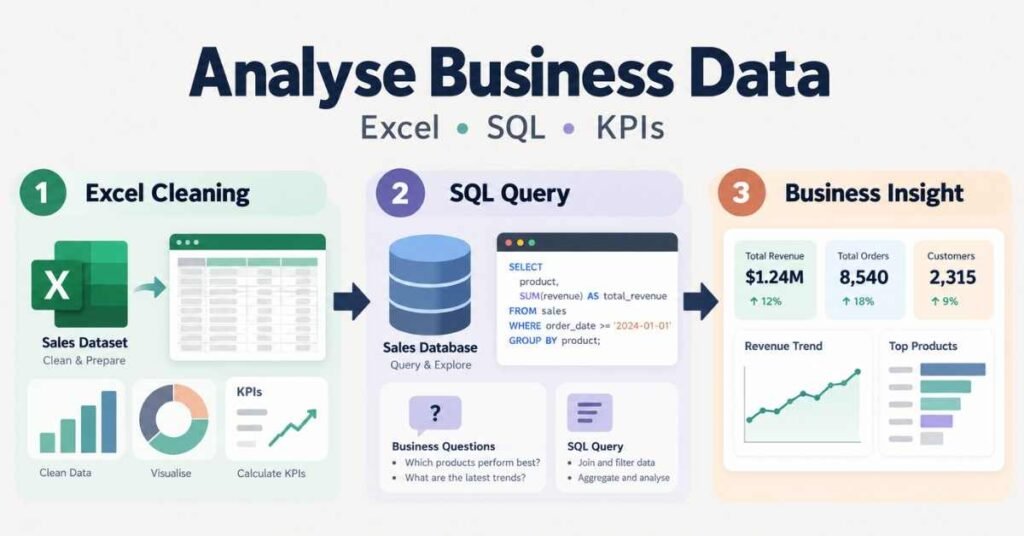
Phase 3: Excel & SQL for Business Analytics
Months 3–5
Now move into practical data analysis.
Advanced Excel
Learn:
- Data cleaning
- Excel formulas
- Lookup functions
- Pivot Tables
- Pivot Charts
- KPI calculations
- Dashboard development
- Sales dashboards
SQL
Learn:
- SELECT
- Filtering
- Aggregations
- GROUP BY
- CASE WHEN
- JOINs
- CTEs
- Window Functions
- Query optimization
- Business case studies
Phase 3 Projects
Project 1: Retail Sales Analysis
Analyze:
- Revenue
- Profit
- Products
- Regions
- Customers
Project 2: SQL Business Case Study
Create business questions and answer them using SQL.
Phase 3 Goal
Be able to take business data and answer practical questions using Excel and SQL.
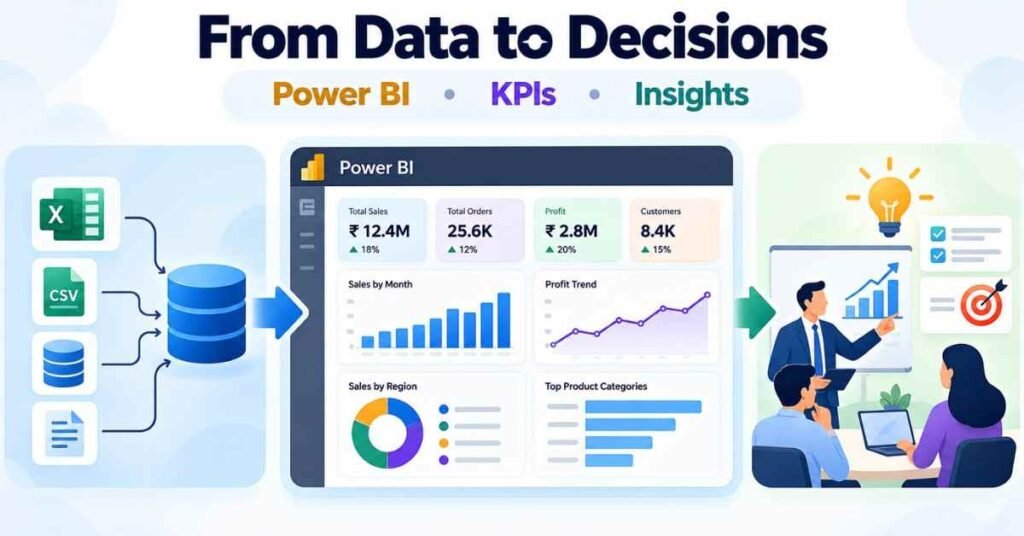
Phase 4: Power BI, Statistics & Dashboard Storytelling
Months 5–6
Once you can analyze data, learn to communicate it visually.
Power BI
Learn:
- Power BI fundamentals
- Data loading
- Power Query
- Data modelling
- DAX
- CALCULATE
- FILTER
- Time intelligence
- Dashboard design
- Interactive reports
- KPI dashboards
Statistics
Learn:
- Mean
- Median
- Mode
- Standard deviation
- Probability
- Correlation
- Trend analysis
Dashboard Storytelling
A good dashboard should answer:
- What happened?
- Why did it happen?
- Which KPI changed?
- Which segment is affected?
- What should the business do?
Phase 4 Projects
Project 1: Retail Sales Dashboard
Show revenue, profit, products and regional performance.
Project 2: Executive KPI Dashboard
Create a management-level dashboard with important KPIs.
Phase 4 Goal
Turn analysis into clear insights and business recommendations.
Phase 5: Domain Analytics, AI & Capstone
Months 6–8
This phase connects your skills to real business scenarios.
Business Domains
- Financial Analytics
- Sales Analytics
- Customer Analytics
- Marketing Analytics
- Retail Analytics
- Supply Chain Analytics
- HR Analytics
- Healthcare Analytics
- Banking Analytics
- Telecom Analytics
E-Commerce Analytics
Learn:
- Funnel analytics
- Conversion analytics
- Customer journey
- A/B testing
- REST APIs
- HTTP methods
- JSON
- Postman
Jira & Confluence
Practice:
- User stories
- Sprint boards
- Tasks
- Bugs
- Confluence documentation
AI for Business Analysts
Learn how AI can assist with:
- Requirement gathering
- Documentation
- User stories
- Research
- SQL assistance
- Business analysis
Phase 5 Projects
- E-Commerce Funnel & Conversion Analytics
Analyze the journey from website visit to purchase.
- Customer Loyalty Analytics
Analyze retention, churn, loyalty and customer value.
- Retail Sales & Performance Analytics
Analyze sales, profitability, inventory and store performance.
- End-to-End Business Analytics Project
Combine:
Excel + SQL + Power BI + Business Analysis
Build BA Skills Step by Step – Explore the Business Analyst Roadmap Guide
Business Analyst Certification Roadmap
Certification is useful, but it should support practical skills.
Beginner
- Business Analysis certification
- Agile/Scrum certification
Analytics Focus
- Microsoft Power BI certification
- Relevant analytics credentials
Best Combination
Certification + Projects + SQL + Excel + Power BI + Interview Preparation
Do not collect certificates without being able to demonstrate practical work.
Essential Business Analytics Toolkit
Business Analysis
- BRD
- FRD
- SRS
- RTM
- UML
- Process Modelling
Data Analysis
- Excel
- SQL
Visualization
- Power BI
- Power Query
- DAX
Agile & Collaboration
- Jira
- Confluence
- Scrum
AI
- ChatGPT
- Prompt Engineering
- AI-assisted documentation
Building a Business Analytics Portfolio That Gets You Hired
Your portfolio should show business thinking, not just screenshots.
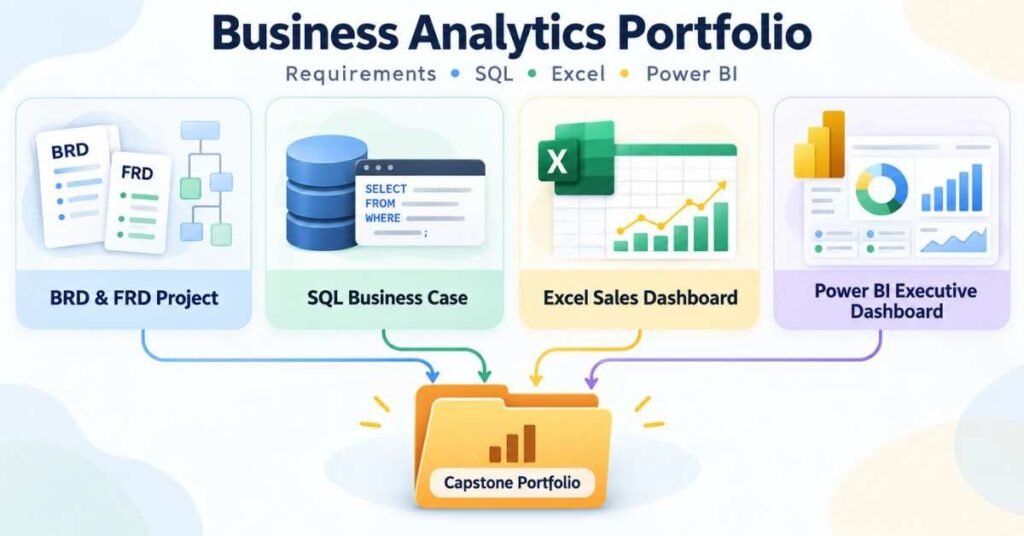
Portfolio Structure: 6 Projects
Foundation – Months 1–3
Business KPI Analysis
BRD & FRD Requirement Project
Intermediate – Months 3–5
SQL Business Case Study
Excel Sales Dashboard
Advanced – Months 5–8
Power BI Executive Dashboard
End-to-End Business Analytics Capstone
Recommended Project Structure
Project Name
├── Business Problem
├── Objective
├── Requirements
├── Dataset
├── Tools Used
├── Analysis
├── Dashboard
├── Key Insights
├── Recommendations
└── README
For every project, explain what problem you solved and what the business learned from your analysis.
Job Search Strategy for Business Analyst Roles in India
ATS-Ready Resume Skills
Business Analysis
Requirement Gathering | Requirement Elicitation | BRD | FRD | SRS | RTM | Gap Analysis | Stakeholder Management
Agile
Agile | Scrum | User Stories | Acceptance Criteria | Sprint Planning | Jira | Confluence
Analytics
Excel | SQL | Power BI | Power Query | DAX | KPI Analysis | Dashboard Development | Data Storytelling
AI
ChatGPT | Prompt Engineering | AI-Assisted Documentation | AI-Assisted Requirement Analysis
Prepare for BA Interviews – Explore the Business Analyst Interview Guide
Job Titles to Search
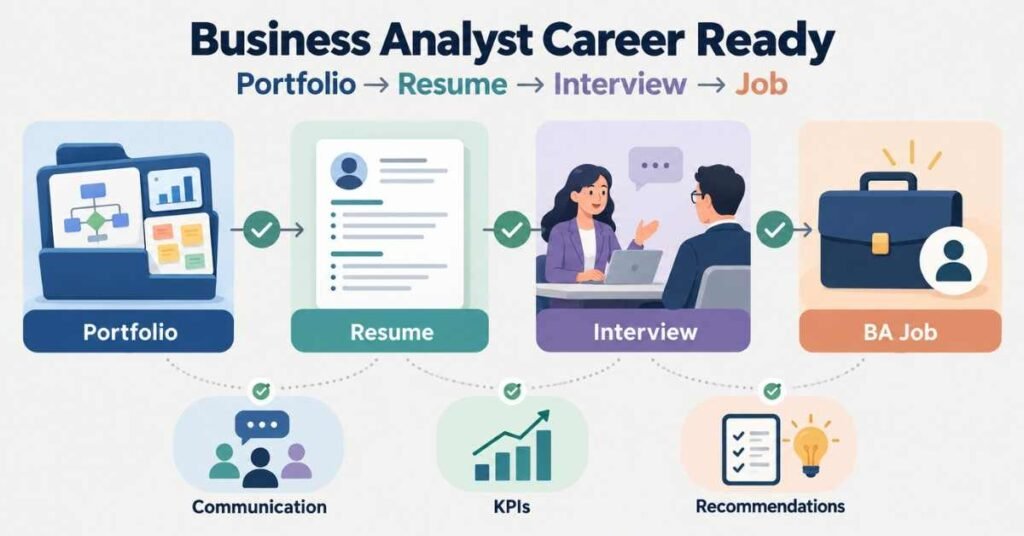
Do not search only for “Business Analyst.”
Also search:
- Junior Business Analyst
- Associate Business Analyst
- MIS Analyst
- Reporting Analyst
- Data Analyst
- BI Analyst
- Power BI Analyst
- Product Analyst
- Process Analyst
- Functional Analyst
- Business Analytics Associate
High-Demand Roles
Role | Key Skills |
Business Analyst | Requirements, Agile, BRD/FRD |
MIS Analyst | Excel, Reporting, KPIs |
Data Analyst | SQL, Excel, Power BI |
Power BI Analyst | Power BI, SQL, DAX |
BI Analyst | SQL, BI, Dashboards |
Product Analyst | Product KPIs, Analytics |
Process Analyst | Process Mapping, Requirements |
Functional Analyst | Business + Technical Understanding |
Building an Interview-Ready Profile
For every project, prepare answers to:
What was the business problem?
Who were the stakeholders?
What requirements did you gather?
Which data did you analyze?
Why did you choose those KPIs?
Which tools did you use?
What challenges did you face?
What did you discover?
What recommendation did you make?
What would you improve?
Interview Formula
Problem → Approach → Tools → Analysis → Insight → Recommendation
4 Biggest Business Analytics Learning Challenges
Challenge 1: “There Are Too Many Tools”
Fix
Follow one sequence:
Business Analysis → Excel → SQL → Power BI → Agile → AI
Do not try to learn everything simultaneously.
Challenge 2: “I Am From a Non-IT Background”
Fix
Focus on:
Business processes
Requirements
Excel
SQL
Power BI
Communication
Documentation
Challenge 3: “I Know Tools but Have No Projects”
Fix
Build projects while learning.
Do not wait until the course ends.
A simple Excel project + SQL analysis + Power BI dashboard is more useful than simply listing the tools on your resume.
Challenge 4: “I Am Not Confident in Interviews”
Fix
Practice explaining your projects in simple language.
You should be able to explain:
What was the problem? → What did you do? → What did you find? → What should the business do?
Your 7-Day Action Plan
Day 1
Learn Business Analytics fundamentals and KPIs.
Day 2
Learn SDLC, Agile and Scrum.
Day 3
Create a simple BRD and FRD.
Day 4
Practice Excel with a sales dataset.
Day 5
Solve 10 SQL business questions.
Day 6
Build a basic Power BI dashboard.
Day 7
Update your resume, LinkedIn and portfolio.
90-Day Target
3 completed projects
1 Power BI dashboard
SQL practice
BRD/FRD project
ATS-ready resume
Optimized LinkedIn profile
Interview preparation
First job applications
Why Learn Business Analytics at Frontlines Edutech?
The official Business Analytics program includes:
- 100% live training
- Telugu explanation
- Real-time projects
- Excel
- SQL
- Power BI
- Business Analysis
- Agile
- Jira & Confluence
- AI tools
- Resume preparation
- LinkedIn optimization
- Interview preparation
- Mock interviews
- Portfolio building
- Career roadmap
- Capstone project
Frequently Asked Questions (FAQs)
Q1: How long does it take to become a Business Analyst?
A structured 6–8 month roadmap is a practical target for building Business Analyst skills through consistent learning and hands-on projects.
Q2: Can freshers become Business Analysts?
Yes. Freshers can target junior Business Analyst, MIS, reporting and analytics roles by developing relevant skills and practical projects.
Q3: Can B.Com or BBA students become Business Analysts?
Yes. A non-technical background does not prevent you from entering Business Analysis. Build skills in requirements, Agile, Excel, SQL and Power BI.
Q4:Do I need coding to become a Business Analyst?
You do not need full-stack programming. However, SQL is an important and useful skill for analytics-focused Business Analyst roles.
Q5: Is Excel important for Business Analysts?
Yes. Excel is useful for data cleaning, calculations, reporting, KPI analysis and dashboards.
Q6: Is SQL required for Business Analysts?
SQL requirements vary by role, but SQL is highly valuable when the Business Analyst needs to work directly with business data.
Q7: Is Power BI required?
Not for every Business Analyst position, but it is a valuable skill for reporting, BI and analytics-focused roles.
Q8: What should I learn first?
Start with:
Business Analysis → Requirements → Excel → SQL → Power BI → Agile → AI
Q9: What projects should I build?
Build at least one BRD/FRD project, SQL case study, Excel dashboard, Power BI dashboard and an end-to-end Business Analytics project.
Q10: Can AI replace Business Analysts?
AI can automate parts of analysis and documentation, but Business Analysts still need business understanding, requirement judgment, stakeholder communication and decision-making skills.