Data Analyst vs Business Intelligence Analyst : Roles& Skills Guide
Recommended Learning Path
What Is Data Analyst vs BI Analyst?
Understanding Data Analyst vs Business Intelligence Analyst
Data Analyst vs Business Intelligence Analyst: Who Owns What?
Two job posts can carry the same title and describe different jobs. Others carry different titles and describe the same one. So instead of memorising definitions, this guide looks at the data analyst vs business intelligence analyst question through ownership: what each person is responsible for when something goes right, and when something goes wrong.
Quick Answer
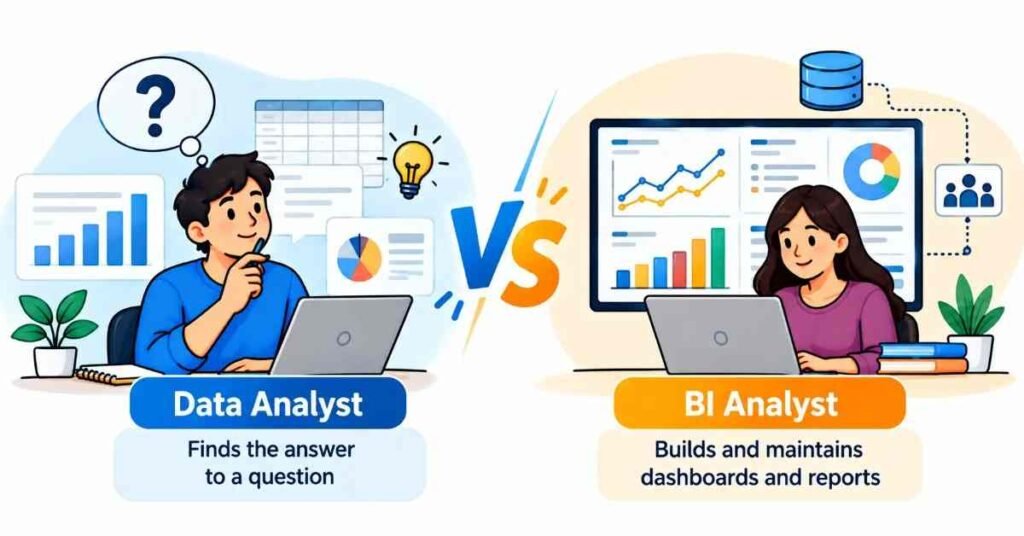
A data analyst owns an answer. Someone asks a question, and the analyst digs until the answer is clear enough to act on. A business intelligence (BI) analyst owns a shared view of the numbers: the reports and dashboards a team trusts every Monday without asking how they were made. Both use SQL and both turn data into business insights. If you enjoy chasing a question, lean toward the first. If you enjoy building something people rely on, lean toward the second. Many employers merge the two, so read the responsibilities, not just the title.
The Ownership Lens
| | Data analyst | BI analyst |
Owns | The answer to a specific question | The recurring numbers a team reads |
Usually asked by | A manager with a problem | Many people with the same standing need |
Breaks when | The conclusion is wrong or unclear | A number on the dashboard is wrong or late |
A good day | A finding changes a decision | Nobody has to ask “is this figure right?” |
This is a pattern seen in many organisations, not a rule. Some roles blend both columns.
A Monday Morning at a Restaurant Chain
Imagine a chain of twelve restaurants across Telangana. This is an illustrative scenario, not a real case.
The BI analyst opens the weekly sales dashboard before anyone else. One outlet’s revenue has doubled overnight. He doesn’t celebrate. He suspects a duplicate upload, checks the source table, confirms it, and fixes the load before the owner sees it. His work that morning is protecting trust in the numbers.
The data analyst gets a message from the owner: weekday lunch sales at one outlet have been sliding for a month. Why? She compares lunch hours across outlets, checks whether a menu change or a price change lines up with the slide, and finds that the drop began the week a nearby office moved. Her work that morning is following a question to its cause.
Same company, same data, two different kinds of responsibility.
Where the Two Roles Overlap
More than people expect. Both write SQL to fetch data, both need a visual tool such as Power BI or Tableau, both sanity-check numbers before sharing, and both have to explain results to someone who has never opened a database. A learner who builds these habits can apply for either title.
The real difference is emphasis. The analyst invests more in framing the question and reasoning about causes. The BI analyst invests more in data structure, metric definitions and report design, because small errors there spread to everyone who reads the report.
Which One Fits You? Three Honest Questions
- When a number looks odd, what do you want to do? If your instinct is “let me find out why,” think analyst. If it is “let me make sure this can never be wrong again,” think BI.
- Do you like variety or routine? Analysis tends to bring new questions each time. BI work tends to bring a steady rhythm with occasional fires.
- What would you be proud to show? A sharp finding or a dashboard your whole team uses?
If your answers split down the middle, you are in good company. Start with the shared skills and let two small projects, one of each type, show you which feels better.
Common Mistakes
- Ranking the roles. Neither is a promotion of the other. They are different jobs.
- Assuming BI means “just dashboards.” A large share of the work is data accuracy and agreeing on what each metric means.
- Assuming analysts skip reporting. Most still build visuals to share their findings.
- Trusting the title. Always read the duties section of the post.
- Delaying the start. The shared foundations take months to build, so begin before you decide.
FLM Expert Perspective: The “Finder or Keeper” Check
We find it helps to ask learners one question: do you prefer being the Finder or the Keeper?
- Finders enjoy the hunt: an unexplained drop, a surprising pattern, an open question.
- Keepers enjoy the craft of making numbers dependable for everyone else.
Most people are a little of both, which is fine. The point of the check is to choose your first project, not your lifelong title. Do one of each, notice which one you lose track of time in, and let that guide your next step.
A Practical Plan: Two Small Projects
- Cover the basics: Excel pivots and lookups, then SQL for filtering, joining and grouping.
- Pick one visual tool and learn to load data, build charts and arrange a clean page.
- Do the “Why” project (Finder). Take a public dataset, pose a question about a change or difference, and write up your answer in plain language.
- Do the “Monday” project (Keeper). Build a small dashboard that could be refreshed weekly. Write down how each metric is defined and how you would catch a wrong number.
- Reflect. Which project did you enjoy more, and which was harder? Use that to choose the roles you apply for.
If you would like guided practice with feedback on both kinds of project, AI Data Analytics training is one structured route.
FAQs
- What is the core difference between the two roles?
A data analyst typically answers specific questions. A BI analyst typically maintains the reports and dashboards a team relies on regularly. Overlap is common. - Which is easier to start with as a fresher?
Both need the same starting skills. Compare a few entry-level posts, because some lean toward reporting and others toward analysis. - Can I switch from one role to the other?
Yes. The shared skills make moves in either direction realistic, especially if you add the missing emphasis through projects. - Do BI analysts need programming?
Mostly SQL. Some posts add scripting or data modelling, so check the specific listing. - Do data analysts use dashboards?
Often, as a way to present findings. How heavily depends on the employer. - I’m from a non-IT background. Which should I choose?
You don’t have to decide yet. Learn the shared basics, try one project of each type, then decide with real experience. - Do titles always match the work?
No. Read the responsibilities before judging a role.