How to Become a Java Full Stack Developer in 2026 - Complete Career Guide
Table of Contents
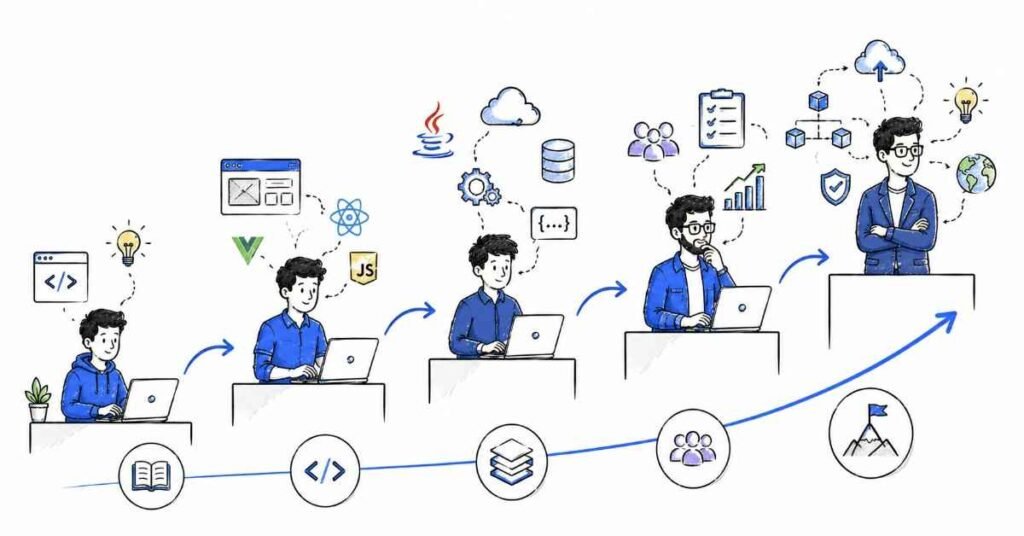
Java Full Stack Developers are among the most versatile professionals in tech because they can build complete web applications from front end to back end. If you can learn Java, Spring Boot, React, APIs, Databases, and deployment, you can build a strong career in India with solid salary growth and remote opportunities. This guide will show you the exact roadmap to become job-ready in 2026, whether you are a fresher, a developer switching stacks, or a working professional who wants to move into full stack development.
What a Java Full Stack Developer Does
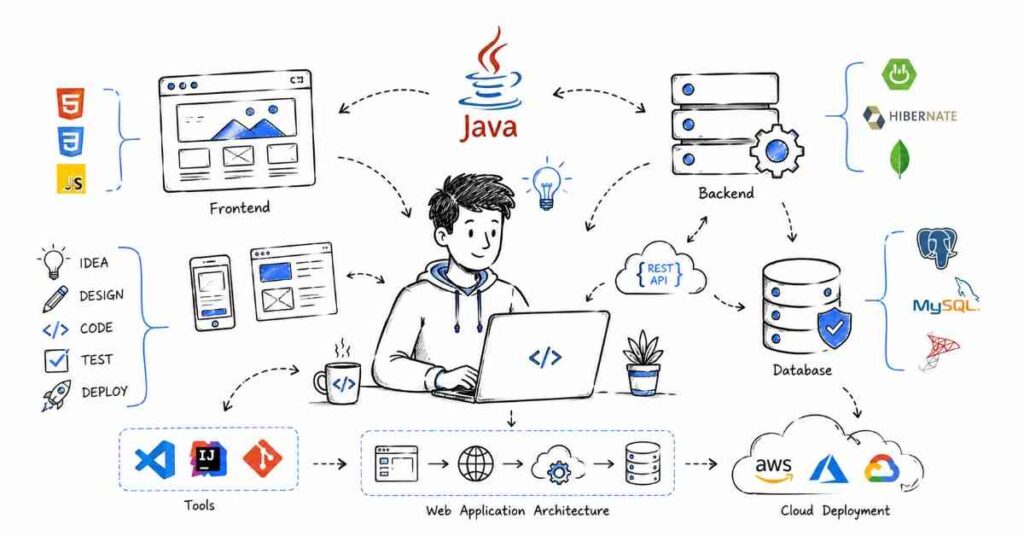
A Java Full Stack Developer builds both the user-facing side and the server-side of web applications. The role combines front-end development, back-end development, database work, and deployment responsibilities.
This is a practical career because companies want developers who can understand the entire application flow. That means one person can design the UI, write business logic, connect the database, and deploy the app.
🎯 New to coding?
Start with beginner-friendly Java, SQL & Web Dev fundamentals.
Main responsibilities
- Build responsive user interfaces.
- Develop back-end logic with Java and Spring Boot.
- Create and consume REST APIs.
- Design and manage databases.
- Handle authentication and authorization.
- Test and debug application features.
- Deploy web applications to live environments.
- Collaborate with designers, testers, and product teams.
Why Java Full Stack Is a Smart Career
Java full stack is a smart career because Java remains one of the most widely used backend languages in enterprise software. React adds a modern front-end layer, while Spring Boot makes backend development faster and cleaner.
The field also offers strong upward mobility. If you keep improving your skills, you can move into senior development, technical leadership, or solution architecture roles.
Why students choose it
- Strong demand in IT services and product companies.
- Beginner-friendly if you already know Java basics.
- Full application-building skills are highly practical.
- Good freelance and remote opportunities.
- Easy to build a portfolio with real projects.
Java Full Stack Roles Compared
Java full stack development includes several related roles, and each one focuses on a different part of the application.
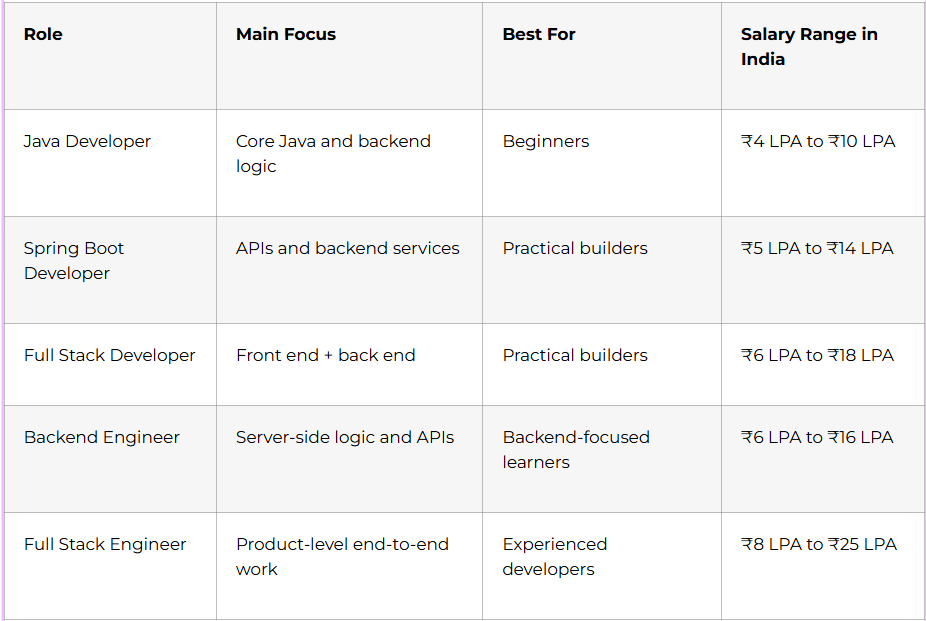
If you are starting out, the Java full stack path is a strong choice because it gives you broad career options and a clera learning path.
Complete Learning Roadmap
Phase 1: Java Foundations
Before jumping into frameworks, you need a strong Java base. Without core Java, advanced tools will feel confusing.
Focus on:
- Java syntax and data types.
- Operators, loops, and conditions.
- Classes and objects.
- Inheritance and polymorphism.
- Interfaces and abstraction.
- Exception handling.
- Collections framework.
- File handling.
- Java 8 basics.
Phase 2: Object-Oriented Design
Enterprise applications depend heavily on object-oriented thinking. Good design makes code easier to maintain and scale.
Learn:
- Encapsulation.
- Inheritance and composition.
- Loose coupling.
- SOLID principles.
- Design patterns.
- Layered architecture.
- Code reusability.
Phase 3: Spring and Spring Boot
Spring Boot is the main framework for modern Java backend development. It reduces configuration and makes application development faster.
Learn:
- Dependency injection.
- Spring Core.
- Spring Boot project structure.
- REST controllers.
- Service and repository layers.
- Validation.
- Exception handling.
- Properties and configuration profiles.
Phase 4: Front-End Development
A full stack developer must be able to build user interfaces that are simple and responsive. React is the most important front-end skill for this path.
Learn:
- HTML and CSS basics.
- JavaScript fundamentals.
- Responsive design.
- React components and props.
- State management.
- Hooks.
- Form handling.
- API integration from React.
Phase 5: Databases and APIs
Web applications need data storage and communication between front end and back end. This is where database and API knowledge becomes essential.
Learn:
- SQL basics.
- PostgreSQL or MySQL.
- Table design and relationships.
- CRUD operations.
- REST API design.
- JSON handling.
- Authentication tokens.
- Error handling in APIs.
Phase 6: Deployment and Dev Tools
A real developer should know how to move projects from local systems to live environments. Deployment knowledge makes you stand out in interviews.
Learn:
- Git workflows.
- Environment variables.
- Docker basics.
- Deployment on cloud or hosting platforms.
- Static file handling.
- Logging and debugging tools.
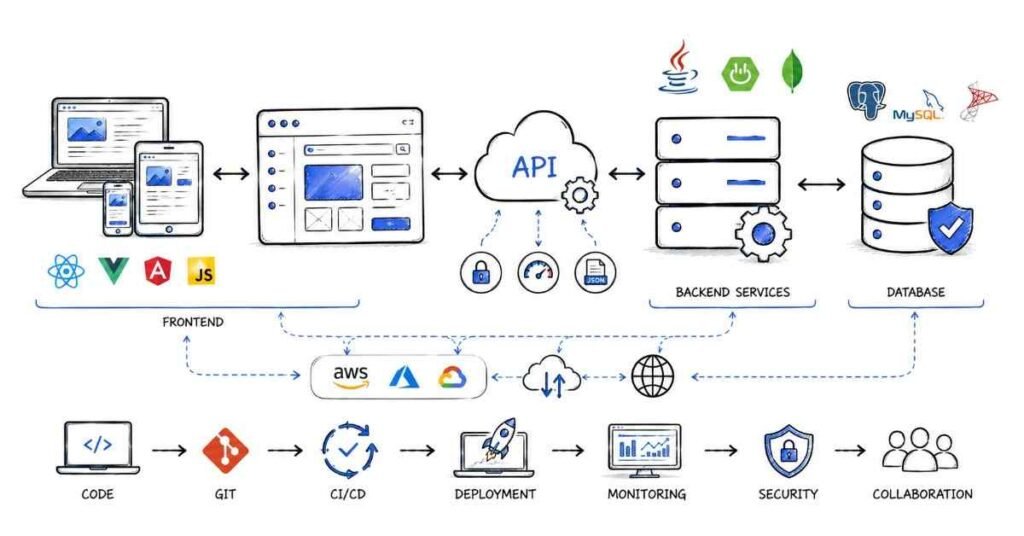
Java, Spring Boot, and React
These are the three most important pillars of the Java full stack path.
Java skills to master
- OOP concepts.
- Collections and streams.
- Exception handling.
- Multithreading basics.
- Java 8 features.
- Memory management basics.
Spring Boot skills to master
- Dependency injection.
- REST services.
- Profiles and properties.
- Validation and error handling.
- Logging.
- Actuator basics.
React skills to master
- Components.
- Props and state.
- Hooks.
- Event handling.
- Conditional rendering.
- API calls.
- Form validation.
Salary Expectations in India
Salary depends on your project quality, coding skill, and interview performance. Java full stack developers usually grow faster when they understand both front end and back end.
Experience Level | Typical Salary |
Fresher | ₹4 LPA to ₹6.5 LPA |
1–3 years | ₹6.5 LPA to ₹12 LPA |
3–5 years | ₹12 LPA to ₹18 LPA |
5+ years | ₹18 LPA to ₹30 LPA+ |
Engineers who also know cloud, Docker, and microservices architecture often earn more than developers who know only one layer of the stack.
Portfolio That Gets Interviews
A strong portfolio proves that you can build real applications, not just write classroom code.
What to include
- Login-based web app.
- CRUD dashboard.
- REST API project.
- Full stack e-commerce demo.
- Blog or CMS project.
- Deployment link and GitHub repository.
- Clear README files with screenshots.
Portfolio checklist
- Show both front end and back end.
- Use clean code and folder structure.
- Mention the technologies used.
- Include problem statements and outcomes.
- Deploy at least one project publicly.
- Add version control history on GitHub.
Job Search Strategy
A Java full stack resume should show both coding and product-building ability. Hiring teams want developers who can understand the user experience and the server logic.
Resume keywords
- Java
- Spring Boot
- React
- REST API
- Hibernate
- JPA
- SQL
- MySQL
- HTML
- CSS
- JavaScript
- Git
- Docker
- Deployment
Where to apply
- LinkedIn Jobs
- Naukri
- Indeed
- startup career pages
- software product companies
- internship portals
Interview preparation
Be ready to answer questions like:
- What is the difference between Spring and Spring Boot?
- How do you connect React with a Java backend?
- How do you design a REST API?
- What is the difference between SQL and NoSQL?
- How do you handle authentication?
- How do you deploy a full stack application?
🧪 Want real-time practice ? Explore full-stack interview scenarios & project-based questions.
30-Day Starter Plan
If you want to begin now, follow this simple plan.
Week 1
- Learn Java basics.
- Practice OOP concepts.
- Set up your IDE and GitHub.
- Write small Java programs.
Week 2
- Learn Spring Core and Spring Boot basics.
- Create a simple REST API.
- Practice request and response handling.
- Add validation and exception handling.
Week 3
- Connect your app to a database.
- Learn JPA and Hibernate.
- Build CRUD operations.
- Document your API endpoints.
Week 4
- Learn React basics.
- Connect the front end to the backend.
- Build one small full stack project.
- Update your resume and LinkedIn profile.
🚀 Kickstart your tech career with structured,
step-by-step roadmaps for every IT role.
Why Learn Java Full Stack at Frontlines Edutech
Frontlines Edutech is a practical choice for students and working professionals who want regional support, structured learning, and job-focused training. The best programs combine Java fundamentals, Spring Boot, React, database work, and project-based learning in a way that makes job readiness realistic.
What to look for in training
- Strong Java core revision.
- Spring Boot and API practice.
- Database and Hibernate training.
- React and frontend practice.
- Resume and interview support.
- Regional-language explanation if needed.
Frequently Asked Questions
1. How long does it take to become a Java full stack developer?
It usually takes 4 to 8 months of consistent learning to become job-ready, depending on your background and how much project work you complete.
2. Is Java full stack a good career in India?
Yes, it is one of the strongest backend-plus-frontend career paths in India because enterprise companies continue to use Java for large-scale systems.
3. Which skill should I learn first?
Start with Java core, OOP, and collections. After that, move into Spring Boot, REST APIs, databases, and React.
4. Do I need advanced coding to become a Java full stack developer?
You need strong programming fundamentals, but you do not need to be an expert in every topic before starting. Consistent practice and project building matter most.
5. What is the best specialization for beginners?
Spring Boot backend development is the best starting point because it teaches you enterprise application structure and API development before you move into the full stack.
6. Can I get a job without experience?
Yes, if you have a few practical projects, a good GitHub profile, and a clear understanding of Java full stack concepts. Internships and mock projects help a lot.
7. Which tools should I learn first?
Start with Java, Spring Boot, MySQL, Git, Postman, and an IDE like IntelliJ or Eclipse. Then move to React, Hibernate, and Docker.
8. Is Java full stack remote-friendly?
Yes, many backend and full stack roles are remote-friendly because the work can be done with standard development tools and online collaboration.
9. What kind of projects should I show in interviews?
Show REST APIs, CRUD applications, authentication systems, e-commerce demos, and full stack apps with deployment links. Employers want to see that you can build complete solutions.
💼 Make your portfolio job-ready—Use professional project documentation templates & GitHub guides.