
How to Become an SQL Expert in 2026: Complete Career Guide
Table of Contents
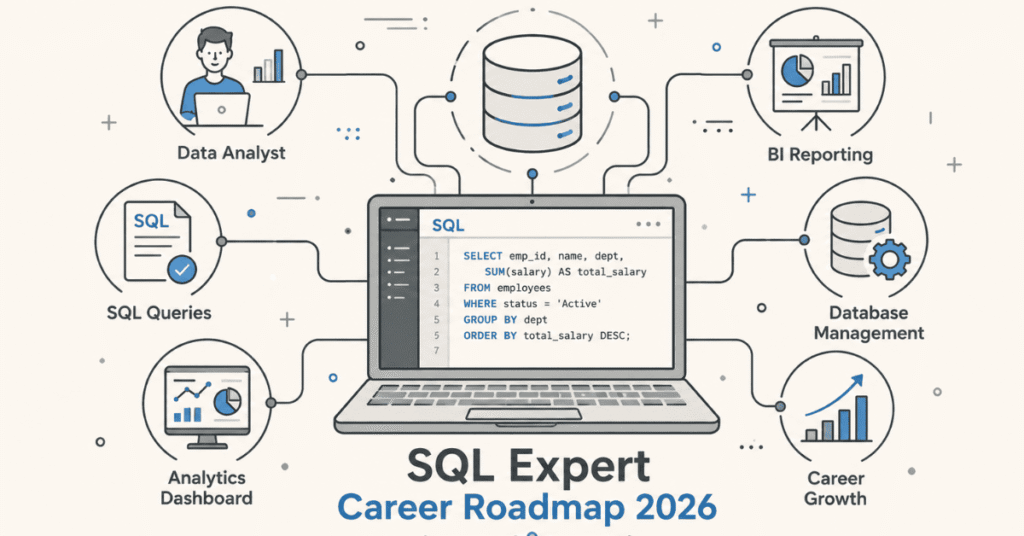
SQL is one of the most important skills in data, analytics, and software careers because it helps you fetch, clean, and analyze information from databases. If you can learn SQL well, you can support reporting, business intelligence, data analysis, and backend workflows with confidence. This guide gives you a practical roadmap to become job-ready in 2026, whether you are a fresher, a working professional, or someone moving into a data-focused role.
What an SQL Expert Does
An SQL expert writes queries to retrieve and manage data stored in relational databases. The role is not just about writing commands; it is about understanding data structures, business questions, and performance.
In simple terms, an SQL expert helps companies get the right data quickly so teams can make better decisions.
Main responsibilities
- Write queries to fetch data.
- Clean and filter records.
- Join tables and summarize results.
- Create reports for business teams.
- Optimize slow queries.
- Support analytics and dashboarding.
- Validate data and troubleshoot errors.
Why SQL Is a Smart Career Skill
SQL is a smart skill because almost every data-related job uses it. Whether the work is in analytics, BI, data engineering, product, or backend support, SQL is a common requirement.
It is also one of the best entry points into the data field because you can start with simple queries and gradually move into advanced analysis.
Looking for a Step-by-Step SQL Learning Plan?
Why students choose it
- Easy to start with basic queries.
- Useful in many job roles.
- Strong demand in India and abroad.
- Supports analytics and reporting careers.
- Helps build confidence in data interviews.
SQL Roles Compared
SQL is used across different career paths, and each one uses the skill a little differently.
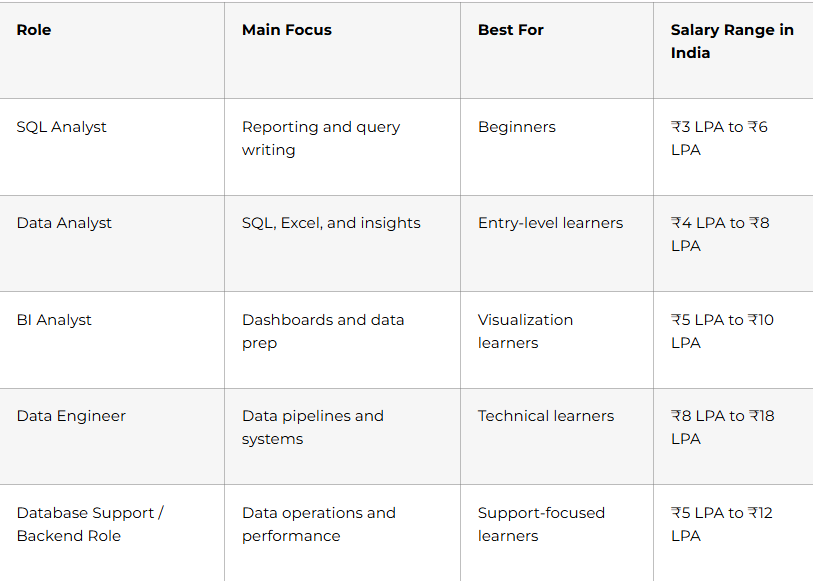
If you are starting out, SQL is a strong first skill because it opens the door to many job paths.
Complete Learning Roadmap
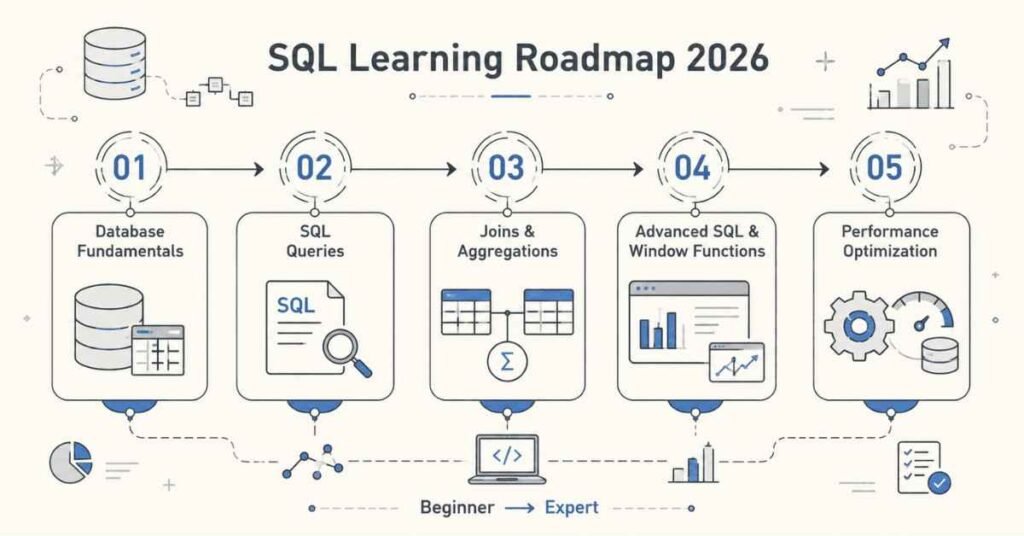
Phase 1: SQL Foundations
Before learning advanced queries, you need a strong base in database concepts. This makes query writing easier and more accurate.
Focus on:
- Relational database basics.
- Tables, rows, and columns.
- Primary keys and foreign keys.
- Data types.
- Database relationships.
- Simple filtering logic.
- Order of query execution.
Phase 2: Core SQL Queries
This is where you start writing practical queries for real business data.
Learn:
- SELECT statements.
- WHERE filters.
- ORDER BY sorting.
- LIMIT and TOP.
- DISTINCT.
- INSERT, UPDATE, DELETE.
- Basic aggregates.
Phase 3: Joins and Grouping
Joins and grouping are essential for analytics and reporting. These skills help you combine and summarize data from multiple tables.
Learn:
- INNER JOIN.
- LEFT JOIN.
- RIGHT JOIN.
- FULL JOIN.
- GROUP BY.
- HAVING.
- Aggregate functions like SUM, AVG, COUNT, MAX, and MIN.
Phase 4: Subqueries and Advanced SQL
Once you know the basics, move into deeper query patterns.
Learn:
- Subqueries.
- Nested SELECT statements.
- Common Table Expressions.
- Window functions.
- Ranking functions.
- Case expressions.
- Date and text functions.
Phase 5: Performance and Optimization
A strong SQL expert should know how to write queries that are not just correct, but also efficient.
Learn:
- Indexing basics.
- Execution plans.
- Query optimization.
- Avoiding unnecessary full scans.
- Choosing the right join type.
- Reducing repeated calculations.
Core SQL, Joins, and Window Functions
These are the three most important pillars of SQL expertise.
Core SQL skills to master
- Filtering.
- Sorting.
- Data modification.
- Table selection.
- Basic aggregates.
- Working with null values.
Join skills to master
- Combining tables.
- Matching keys correctly.
- Understanding one-to-one and one-to-many relationships.
- Choosing the right join for the problem.
Window function skills to master
- Row ranking.
- Running totals.
- Partition-based calculations.
- Percentage and comparative analysis.
- Business reporting use cases.
Salary Expectations in India
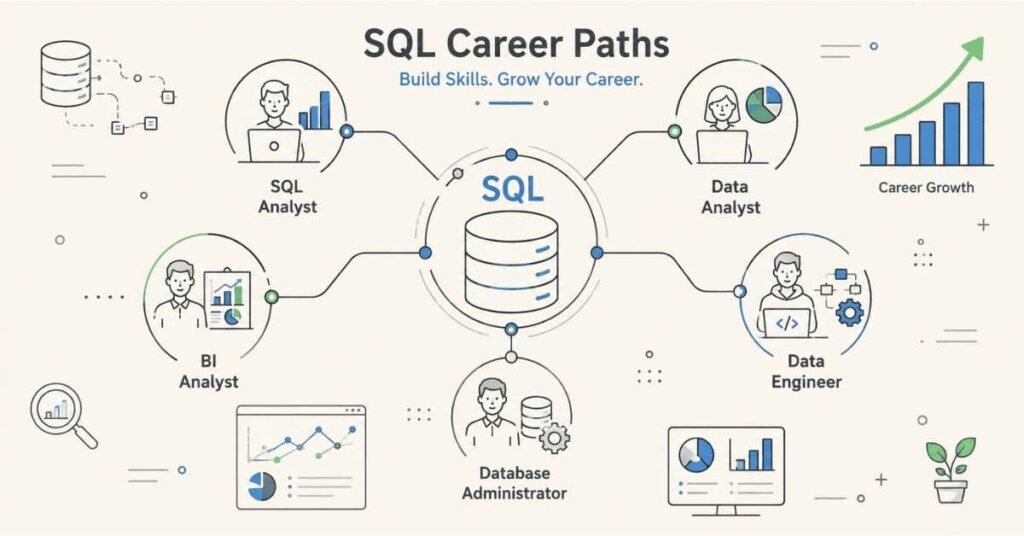
Salary depends on your SQL depth, problem-solving ability, and overall data skills. Candidates who can combine SQL with Excel, Python, BI tools, or analytics usually earn more.
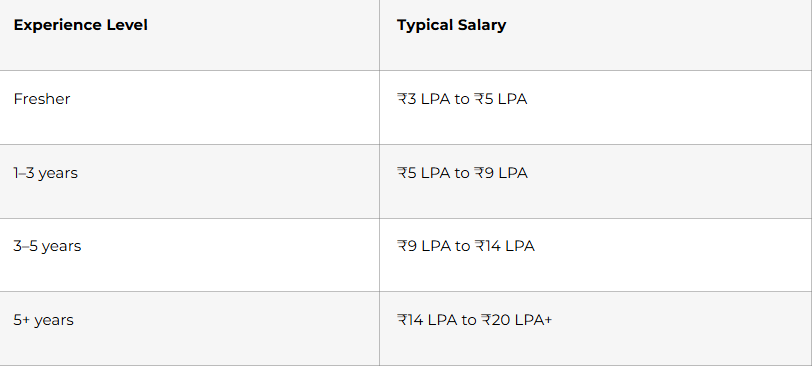
Professionals who move into data engineering or analytics engineering often see stronger salary growth.
Portfolio That Gets Interviews
A strong SQL portfolio shows that you can solve real problems with queries. Recruiters want to see practical work, not just theory.
What to include
- Customer sales analysis.
- HR attendance query project.
- Business reporting queries.
- Revenue and performance summary.
- Data cleaning examples.
- Join and window function exercises.
Portfolio checklist
- Explain the problem clearly.
- Show the query logic.
- Add sample output.
- Use real business-style tables.
- Keep your SQL readable.
- Include GitHub or documentation if possible.
Job Search Strategy
An SQL resume should show query strength and practical data thinking. Employers want someone who can handle data accurately and efficiently.
Resume keywords
- SQL
- Query writing
- Joins
- Window functions
- Aggregation
- Data cleaning
- Reporting
- Database analysis
- Performance tuning
- ETL basics
- Analytics support
Where to apply
- LinkedIn Jobs
- Naukri
- Indeed
- company career pages
- analytics teams
- business intelligence roles
- data support roles
Interview preparation
Be ready to answer questions like:
- What is the difference between WHERE and HAVING?
- What is the difference between INNER JOIN and LEFT JOIN?
- How do window functions work?
- What is a primary key?
- How do you find duplicate records?
- How do you optimize a slow SQL query?
30-Day Starter Plan
If you want to begin now, follow this simple plan.
Week 1
- Learn database basics.
- Understand tables and keys.
- Practice SELECT, WHERE, and ORDER BY.
- Try simple filters.
Week 2
- Practice joins.
- Learn GROUP BY and HAVING.
- Work with aggregate functions.
- Build small reporting queries.
Week 3
- Study subqueries and CTEs.
- Learn window functions.
- Practice ranking and running totals.
- Solve interview-style questions.
Week 4
- Review query performance basics.
- Build one portfolio project.
- Update your resume and LinkedIn.
- Start applying for SQL-related roles.
Why Learn SQL at Frontlines Edutech
Frontlines Edutech is a practical choice for students and working professionals who want structured learning, regional support, and career-focused training. The best programs combine SQL basics, advanced query practice, business examples, and project-based learning in a way that makes job readiness realistic.
What to look for in training
- Strong SQL foundation.
- Advanced joins and window functions.
- Reporting and analysis practice.
- Interview question preparation.
- Resume and career support.
- Regional-language explanation if needed.
Frequently Asked Questions
How long does it take to become an SQL expert?
It usually takes 2 to 4 months of consistent learning to become job-ready if you practice queries every day.
Is SQL a good career skill in India?
Yes, SQL is one of the most valuable skills in India because it is used in analytics, reporting, data engineering, and backend roles.
Which skill should I learn first?
Start with database basics and core SQL queries. After that, move into joins, grouping, and window functions.
Do I need coding to learn SQL?
No, you do not need advanced coding to start. SQL is beginner-friendly and one of the easiest technical skills to enter data careers with.
What is the best specialization for beginners?
Data analysis and reporting are the best starting points for SQL learners. They use SQL heavily and are easier to enter than highly technical backend roles.
Can I get a job without experience?
Yes, if you have practical query projects and can explain your logic clearly. Internships and portfolio work can help you start faster.
Which tools should I learn first?
Start with a database platform like MySQL or PostgreSQL, then practice SQL queries in a local or cloud environment.
Is SQL remote-friendly?
Yes, SQL-related work is highly remote-friendly because it is digital and often part of reporting or data analysis roles.
What kind of projects should I show in interviews?
Show sales analysis, customer segmentation, duplicate detection, and reporting projects. Employers want to see that you can turn raw data into useful answers.