
Java Interview Preparation Guide 2026
Table of Contents
Part 1: Introduction & 30-Day Study Plan
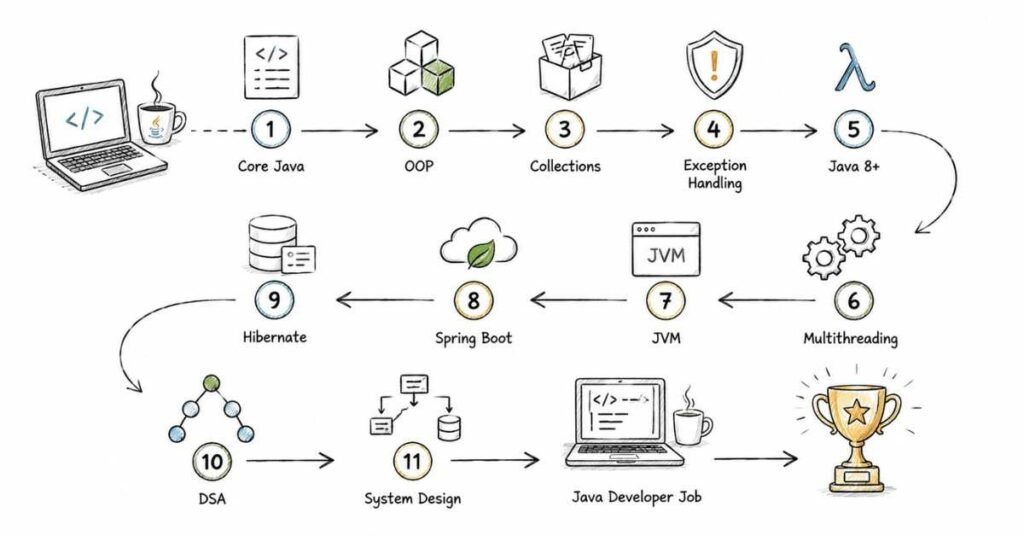
This first part sets up your roadmap for Java interview preparation, covering role clarity, core skills, interview stages, project expectations, and a practical 30-day study plan. Current India salary sources show meaningful variation depending on source and specialization, with Indeed reporting an average Java developer salary of ₹3,60,218 per year, PayScale reporting ₹588,732, and 2026 career-guide sources indicating that specializing in Spring Boot, microservices, and cloud can push pay into the ₹18–28 LPA band for experienced developers.
What this guide covers
This guide is designed to prepare you for Java developer interviews in a structured, layered way, starting from object-oriented fundamentals and moving toward frameworks, concurrency, JVM internals, and system design basics. It will cover OOP concepts, core Java, collections, exception handling, Java 8+ features, multithreading, JVM memory management, Spring and Hibernate basics, DSA and coding problems, design patterns, and career strategy.
The goal is not just to help you recite definitions like “polymorphism means many forms,” but to help you explain concepts with real code behavior, common pitfalls, and practical reasoning that interviewers actually probe for.
Who this guide is for
This guide is useful if you are:
- A fresher preparing for your first Java developer interview.
- A student targeting service-based or product-based companies.
- A developer moving from a different language into the Java ecosystem.
- A working professional targeting Java backend, Spring Boot, or full-stack roles.
- A candidate comfortable writing Java code but not yet confident explaining it under interview pressure.
The structure is meant to help both freshers and experienced developers build a clean progression from fundamentals to advanced interview execution.
What Java is and why it matters
Java is a widely used, object-oriented, platform-independent programming language known for its “write once, run anywhere” philosophy through the Java Virtual Machine. It remains a dominant choice for enterprise backend systems, Android development, and large-scale distributed applications, which is why Java developer roles remain consistently in demand across product and service-based companies.
A good beginner explanation is: Java combines strong OOP structure, a mature ecosystem, strong tooling, and JVM-based portability, which makes it reliable for large, long-lived business systems.
Where Java fits in real work
In real companies, Java is used heavily for backend services, enterprise applications, microservices, and Android apps. Common Java developer responsibilities include:
- Writing and maintaining backend business logic.
- Building REST APIs using frameworks like Spring Boot.
- Interacting with databases through JDBC or Hibernate/JPA.
- Handling concurrency and performance-sensitive code.
- Working within microservices architectures.
- Debugging production issues, including memory and performance problems.
This is why Java interviews test far more than syntax. Interviewers commonly explore OOP depth, collections behavior, concurrency understanding, and framework usage together, especially for mid-level and senior roles.
Common Java developer roles
Java interviews vary because role expectations differ significantly by seniority and specialization. Common role types include:
- Java Backend Developer: core Java, Spring Boot, REST APIs, databases.
- Full-Stack Java Developer: backend Java plus frontend frameworks like React or Angular.
- Android Developer: Java or Kotlin-based mobile development.
- Enterprise/Spring Developer: heavy focus on Spring ecosystem and enterprise patterns.
- Software Development Engineer (SDE): strong DSA plus Java fundamentals, common in product companies.
- Senior/Lead Developer: system design, architecture, mentoring, plus deep Java internals.
Deciding which role you’re targeting early helps you prioritize preparation, since a product-company SDE interview leans heavily on DSA, while a service-company Java role may focus more on Spring Boot and practical coding.
Common interview process
A typical Java interview process often includes:
- Recruiter or HR screening.
- Online coding assessment (especially for product companies and freshers).
- Core Java and OOP round.
- Collections, exception handling, and Java 8+ features round.
- Multithreading and concurrency round (more common for experienced roles).
- Framework round covering Spring Boot, Hibernate, and REST APIs.
- System design round (HLD and LLD basics, mainly for experienced candidates).
- Behavioral or hiring manager round.
Recent mock-interview content shows that many real Java interviews blend Core Java, Spring Boot, microservices, and basic system design into a single continuous conversation rather than strictly separate rounds, especially at mid-level.
Core skill areas interviewers usually check
Most Java interviews evaluate some combination of:
- OOP concepts and design thinking.
- Core Java syntax and behavior.
- Collections framework.
- Exception handling.
- String handling and immutability.
- Java 8+ features like lambdas and streams.
- Multithreading and concurrency.
- JVM internals and memory management.
- Spring Boot and Hibernate/JPA basics.
- Data structures, algorithms, and coding problems.
- Design patterns and SOLID principles.
Current Java interview guides consistently emphasize OOP fundamentals, collections, exception handling, multithreading, and coding problems as core recurring themes across experience levels.
Why OOP matters so much
Object-oriented programming is often the very first filter in Java interviews because it reflects how you think about designing software, not just how you write syntax. Interviewers frequently ask you to explain encapsulation, inheritance, polymorphism, and abstraction using real code examples rather than just definitions.
A candidate who can define “polymorphism” but cannot explain method overloading versus overriding with a code example will often struggle in practical rounds. That is why this guide gives OOP its own dedicated, detailed section early on.
Why collections and core Java matter
Collections questions test whether you understand the practical trade-offs behind everyday data structures like ArrayList, HashMap, and HashSet. Interviewers often ask you to compare these structures by performance, ordering behavior, and thread-safety rather than just list their names.
You should be comfortable explaining when to use a List versus a Set versus a Map, and why choices like HashMap versus TreeMap matter for performance and ordering.
Why multithreading and JVM internals matter
Many Java interviews, especially for mid-level and senior roles, test concurrency and memory management because production Java systems must handle multiple threads and manage memory carefully. Interviewers often use questions on thread safety, deadlocks, and garbage collection to see whether you understand what happens beneath simple code.
This guide will dedicate full sections to multithreading and JVM internals because these topics separate junior-level Java knowledge from more mature, production-ready understanding.
Why frameworks matter
Since most real Java jobs today involve Spring Boot, Hibernate, and REST API development, interviewers commonly test practical framework knowledge alongside core Java. Current 2026 career-roadmap guidance recommends treating Spring Boot as the “industry standard” for Java backend development after mastering core Java basics.
This guide will cover Spring Core, Dependency Injection, REST APIs, Spring Data JPA, and Hibernate basics so you can speak confidently about real backend development, not just theoretical Java.
Why coding problems and DSA still matter
Even for framework-heavy roles, many companies still test data structures and algorithms, especially in product-based companies and structured coding rounds. This guide will keep DSA practical and focused on commonly asked patterns rather than obscure edge cases, so you can build confidence without over-investing time.
Salary expectations in India
Indeed reports an average Java developer salary in India of ₹3,60,218 per year, though this figure and other sources vary widely depending on methodology, experience mix, and company type, with entry-level roles around ₹8,59,991 and senior roles around ₹8,72,335 on the same platform, and lead-level roles reaching ₹22,48,589. PayScale reports a broader average of ₹588,732 per year, with entry-level compensation around ₹310,399 and early-career compensation around ₹579,846. Additional 2026 career-guide sources place fresher Java salaries around ₹3.5–5 LPA, mid-level Spring Boot developers around ₹5–9 LPA, and senior developers around ₹9–17 LPA, with architects reaching ₹17–30 LPA or higher depending on specialization.
For preparation purposes, a practical range is:
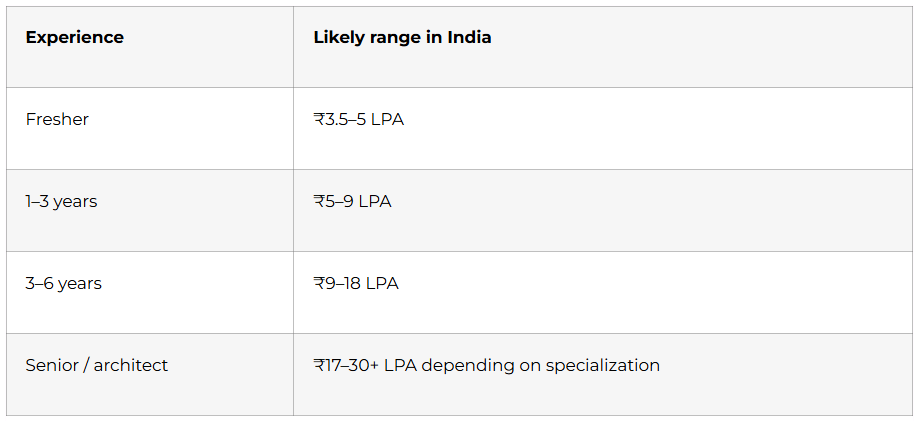
Use salary numbers as directional context rather than guaranteed outcomes, since Java compensation varies sharply based on company type, specialization in Spring Boot and microservices, cloud skills, and city.
30-day study plan
Week 1: OOP and core Java fundamentals
Focus on the four pillars of OOP, classes, objects, constructors, method overloading versus overriding, access modifiers, interfaces versus abstract classes, and key keywords like static, final, this, and super. Begin light DSA practice and make sure you can explain OOP concepts using real code examples.
Week 2: Collections, exception handling, and Java 8+ features
Study the collections framework in depth, including List, Set, Map, and Queue implementations, along with exception handling, string immutability, and Java 8+ features like lambdas, streams, and functional interfaces. Continue daily coding practice alongside concept revision.
Week 3: Multithreading, JVM internals, and frameworks
Revise multithreading basics, thread lifecycle, synchronization, and common concurrency issues like deadlocks. Then move into JVM internals, memory management, and garbage collection, followed by Spring Boot, Dependency Injection, REST APIs, and Hibernate/JPA basics.
Week 4: DSA, design patterns, and mock interviews
Focus on common coding patterns, time and space complexity, and design patterns like Singleton, Factory, and Observer along with SOLID principles. Spend the rest of the week on system design basics for experienced roles, behavioral question practice, and full mock interviews.
Follow the Complete Java Fullstack Roadmap
Daily study routine
A practical daily routine looks like this:
- 45 minutes of concept revision.
- 60 minutes of coding practice (DSA or framework-based tasks).
- 30 minutes of spoken explanation or mock interview practice.
- 15 minutes of notes, flashcards, or project refinement.
If you are a fresher, do not skip spoken explanation practice. Many candidates understand Java concepts privately but freeze when asked to explain them clearly in real time.
How to think in Java interviews
A strong Java interview answer often follows this structure:
- Give a clear, concise definition.
- Explain the practical behavior or mechanism.
- Give a short code example or real scenario.
- Mention common pitfalls or edge cases.
- Compare with a related concept if relevant.
For example, if asked about HashMap versus TreeMap, do not just say “one is ordered and one is not.” Explain that HashMap offers average constant-time operations but no ordering guarantee, while TreeMap maintains sorted order at the cost of logarithmic time complexity, then mention a scenario where each would be preferred. That structured, comparative thinking is often more impressive than a one-line definition.
Part 2: OOP Concepts & Core Java Basics Questions 1–40
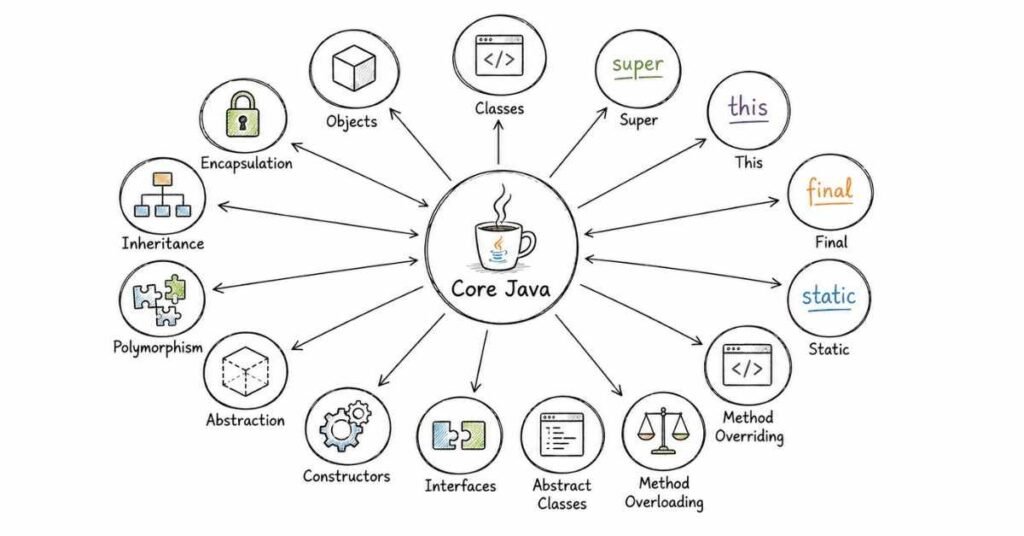
This part builds the foundation for the rest of the Java guide. Standard Java OOP references consistently center on classes, objects, abstraction, encapsulation, inheritance, and polymorphism, while practical Java overviews also treat constructors, access modifiers, interfaces, abstract classes, and object methods like equals() and hashCode() as core interview topics because they shape how Java code behaves in real applications.
Questions 1–40
1) What is Object-Oriented Programming in Java?
Object-Oriented Programming, or OOP, is a programming style that organizes software around objects, which combine data and behavior. In Java, OOP is a core design principle used to make code more modular, reusable, and easier to maintain.
2) What are the four pillars of OOP in Java?
The four pillars are encapsulation, inheritance, polymorphism, and abstraction. These concepts form the core of most Java interview discussions on design and code structure.
3) What is a class in Java?
A class is a blueprint or template used to create objects. It usually contains fields, methods, and constructors that define the state and behavior of its objects.
4) What is an object in Java?
An object is an instance of a class created using that class’s constructor. In simple terms, the class is the design and the object is the actual thing created from that design.
5) What is the difference between a class and an object?
A class is the template, while an object is a concrete instance created from that template. Interviewers ask this often because it tests whether you understand OOP at the most basic level.
6) Why is OOP important in Java?
OOP is important because it helps organize code into reusable, maintainable, and logically structured units. It also supports large-scale software development by separating responsibilities cleanly.
Encapsulation
7) What is encapsulation?
Encapsulation means hiding an object’s internal state and controlling access to it through methods. In Java, this is commonly done by making fields private and exposing controlled access through getters and setters.
8) Why is encapsulation useful?
Encapsulation protects data from unintended misuse and allows the class to control how its internal state changes. This improves safety, maintainability, and flexibility when code evolves.
9) How is encapsulation implemented in Java?
It is commonly implemented by declaring fields as private and providing public methods to read or update them. This pattern is one of the most basic Java interview expectations.
10) Is encapsulation only about getters and setters?
No, it is more broadly about controlling access and hiding implementation details. Getters and setters are only one common mechanism, not the full meaning of encapsulation.
Inheritance
11) What is inheritance in Java?
Inheritance is the mechanism by which one class acquires the properties and behavior of another class. In Java, this is done using the extends keyword for classes.
12) Why is inheritance useful?
Inheritance reduces code duplication and helps create logical class hierarchies. It is useful when there is a clear “is-a” relationship between classes.
13) What is a superclass and a subclass?
A superclass, or parent class, is the class being inherited from, while a subclass, or child class, inherits from it. This relationship is central to understanding Java OOP hierarchies.
14) Does Java support multiple inheritance with classes?
No, Java does not allow one class to directly extend multiple classes. Java supports single inheritance for classes, though a class can implement multiple interfaces.
15) What is the extends keyword used for?
The extends keyword is used when one class inherits from another class. It creates the parent-child relationship used in inheritance.
Polymorphism
16) What is polymorphism in Java?
Polymorphism means the same method name or interface can behave differently depending on context or object type. It is one of the most important concepts interviewers expect you to explain clearly.
17) What are the two main types of polymorphism in Java?
The two main types are compile-time polymorphism and runtime polymorphism. In interviews, these are usually explained through method overloading and method overriding respectively.
18) What is compile-time polymorphism?
Compile-time polymorphism usually refers to method overloading, where methods share the same name but have different parameter lists. The compiler decides which version to call based on the method signature.
19) What is runtime polymorphism?
Runtime polymorphism usually refers to method overriding, where a subclass provides its own implementation of a method already defined in the parent class. The actual method called depends on the object at runtime.
20) Why is polymorphism useful?
Polymorphism improves flexibility and reusability by allowing code to work with general parent types or interfaces while still supporting specific behavior in child classes. This is a key reason Java design relies so heavily on interfaces and inheritance.
Abstraction
21) What is abstraction in Java?
Abstraction means hiding implementation complexity and exposing only the essential behavior needed by the user of the code. In Java, abstraction is commonly achieved using abstract classes and interfaces.
22) Why is abstraction useful?
Abstraction reduces complexity and lets developers focus on what an object does rather than how it does it. It also makes systems easier to change because implementation details can evolve independently.
23) What is the difference between abstraction and encapsulation?
Abstraction is about hiding complexity and exposing essential behavior, while encapsulation is about hiding internal state and controlling access to it. Interviewers ask this often because candidates commonly mix them up.
Constructors and methods
24) What is a constructor in Java?
A constructor is a special method used to initialize objects when they are created. A class can have more than one constructor if the parameter lists differ.
25) What is the difference between a constructor and a method?
A constructor is used for object initialization and has the same name as the class, while a regular method defines behavior and can have any valid method name. Constructors do not have a return type.
26) What is constructor overloading?
Constructor overloading means defining multiple constructors in the same class with different parameter lists. It allows objects to be created in different ways depending on available input.
27) What is method overloading?
Method overloading means having multiple methods with the same name in the same class but different parameter lists. It is an example of compile-time polymorphism.
28) What is method overriding?
Method overriding happens when a subclass provides a new implementation for a method already defined in the parent class. It is an example of runtime polymorphism.
29) What is the difference between overloading and overriding?
Overloading happens in the same class with different parameter lists, while overriding happens in inheritance when a child class redefines a parent method. This is one of the most frequently asked Java interview comparisons.
Interfaces, abstract classes, and keywords
30) What is an interface in Java?
An interface defines a contract that classes can implement, describing what behavior they must provide. It is a major tool for abstraction in Java.
31) What is an abstract class in Java?
An abstract class is a class that cannot be instantiated directly and is meant to be extended by subclasses. It can contain both abstract methods and concrete methods.
32) What is the difference between an interface and an abstract class?
An interface is mainly for defining a contract, while an abstract class can provide partial implementation along with abstract behavior. In interviews, a strong answer also mentions that a class can implement multiple interfaces but extend only one class.
33) What is the static keyword in Java?
The static keyword means a member belongs to the class itself rather than to a specific object instance. Static members are shared at the class level.
34) What is the final keyword in Java?
The final keyword is used to restrict modification, such as making a variable constant, preventing method overriding, or preventing class inheritance. It is one of the most common Java keyword questions in interviews.
35) What is the this keyword in Java?
The this keyword refers to the current object. It is commonly used to distinguish instance variables from method parameters or to call another constructor in the same class.
36) What is the super keyword in Java?
The super keyword refers to the immediate parent class. It is often used to call a parent constructor or access a parent method or field.
Access modifiers and object methods
37) What are access modifiers in Java?
Access modifiers control the visibility of classes, methods, and fields. The main ones are public, private, protected, and default package-private access.
38) Why are access modifiers important?
They are important because they enforce encapsulation and control which parts of the codebase can access specific members. Good use of access modifiers helps design safer and cleaner APIs.
39) Why are equals() and hashCode() important?
These methods are important because they define object equality and strongly affect how objects behave in collections such as HashMap and HashSet. A strong interview answer mentions that if you override equals(), you should usually override hashCode() consistently.
40) What does toString() do?
toString() returns a string representation of an object, usually for logging, debugging, or readable display. Overriding it makes object output much more useful during development and interviews.
Revision focus
For this part, revise classes, objects, the four pillars of OOP, constructors, overloading versus overriding, interfaces versus abstract classes, access modifiers, and key Java keywords like static, final, this, and super. These topics matter because they form the language of almost every Java interview and strongly influence how you explain later topics like collections, multithreading, and frameworks.
Part 3: Collections Framework & Data Structures Questions 41–80
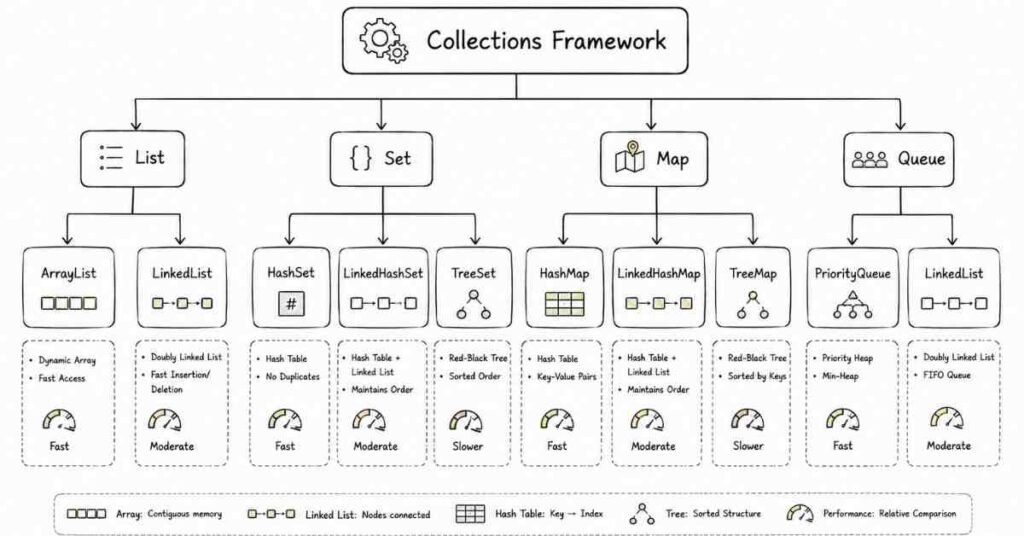
This part covers the Java Collections Framework, one of the most heavily tested areas in Java interviews. Standard Java collection references consistently organize the framework around interfaces such as List, Set, Queue, and Map, with common implementations like ArrayList, LinkedList, HashSet, TreeSet, HashMap, and TreeMap, while Oracle’s tutorial notes that HashSet, ArrayList, and HashMap are the default choices for many general-purpose use cases when all other things are equal.
Questions 41–80
41) What is the Java Collections Framework?
The Java Collections Framework is a set of interfaces and classes used to store and manipulate groups of objects efficiently. It provides ready-made data structures and common algorithms so developers do not have to build them from scratch.
42) Why is the Collections Framework important in Java interviews?
It is important because collections are used in almost every real Java application, and interviewers want to know whether you can choose the right structure for performance, ordering, uniqueness, and scalability. Many Java interview questions are really testing whether you understand trade-offs between collection types.
43) What are the main interfaces in the Java Collections Framework?
The main interfaces are List, Set, Queue, and Map. Technically, Map is part of the framework but not a subtype of Collection.
44) What is the difference between an interface and an implementation in collections?
An interface defines the behavior, while an implementation provides the actual data structure and internal logic. Oracle specifically recommends thinking in terms of interfaces first and implementations second.
45) Why should you program to interfaces in Java collections?
Because it makes your code more flexible and easier to change later if you need a different implementation. For example, using List instead of ArrayList in variable declarations reduces coupling to one specific class.
List basics
46) What is a List in Java?
A List is an ordered collection that allows duplicates and supports positional access by index. It is used when insertion order matters and duplicate elements are allowed.
47) What are common List implementations in Java?
Common List implementations include ArrayList, LinkedList, and legacy classes like Vector. In interviews, ArrayList and LinkedList are the most commonly compared implementations.
48) What is an ArrayList?
ArrayList is a resizable-array implementation of the List interface. It maintains insertion order, allows duplicates, and is usually the default list choice for many applications.
49) What are the strengths of ArrayList?
ArrayList provides fast random access and performs well when reads are frequent and insertions mostly happen at the end. This is one reason it is commonly preferred over LinkedList for general-purpose use.
50) What is a LinkedList?
LinkedList is a linked-node implementation of the List interface and can also implement queue-like behavior. It is useful in situations where insertions or removals at certain positions matter more than indexed access.
51) What is the difference between ArrayList and LinkedList?
ArrayList is backed by a resizable array and gives fast random access, while LinkedList is backed by linked nodes and is generally better suited for insertions or deletions at known positions rather than indexing. In interviews, a strong answer includes both internal structure and performance trade-offs.
52) Which should you use more often: ArrayList or LinkedList?
Oracle’s collections tutorial notes that ArrayList is generally the one to use for most applications when all else is equal. A strong interview answer is that LinkedList is more specialized, while ArrayList is the common default.
Set basics
53) What is a Set in Java?
A Set is a collection that does not allow duplicate elements. Different implementations vary in whether they preserve order or sorting.
54) What are common Set implementations?
Common Set implementations include HashSet, LinkedHashSet, and TreeSet. These differ mainly in ordering behavior and performance characteristics.
55) What is a HashSet?
HashSet is a hash-table-based implementation of Set that stores unique elements without guaranteeing insertion order. Oracle lists it as the general-purpose set implementation used in most applications.
56) What is a LinkedHashSet?
LinkedHashSet is a set implementation that maintains insertion order while still preventing duplicates. It is useful when uniqueness and predictable iteration order both matter.
57) What is a TreeSet?
TreeSet is a sorted set implementation that stores unique elements in natural order or according to a comparator. Its operations are typically based on tree structure rather than hashing.
58) What is the difference between HashSet and TreeSet?
HashSet is generally faster for basic add, remove, and contains operations and does not maintain sorted order, while TreeSet keeps elements sorted but usually with higher time complexity. This is a classic Java collections interview comparison.
Map basics
59) What is a Map in Java?
A Map stores data in key-value pairs, where keys are unique and each key maps to a value. It is part of the Collections Framework but not a subtype of the Collection interface.
60) What are common Map implementations?
Common Map implementations include HashMap, LinkedHashMap, and TreeMap. They differ mainly in ordering and internal structure.
61) What is a HashMap?
HashMap is a hash-table-based implementation of Map that stores key-value pairs without guaranteed ordering. Oracle lists it as the general-purpose map implementation for most applications.
62) Why is HashMap so important in interviews?
Because it is widely used in real applications and interviewers often use it to test understanding of hashing, equality, performance, and key uniqueness. It is one of the most frequently discussed Java collection classes.
63) What is a LinkedHashMap?
LinkedHashMap is a map implementation that maintains insertion order while storing key-value pairs. It is useful when predictable iteration order matters but tree-based sorting is not required.
64) What is a TreeMap?
TreeMap is a sorted map implementation that keeps keys in natural order or comparator-defined order. It is useful when ordered keys are more important than raw hash-based speed.
65) What is the difference between HashMap and TreeMap?
HashMap is usually chosen for faster average-time operations and no ordering guarantee, while TreeMap maintains sorted key order with typically logarithmic-time operations. A strong answer includes both ordering and complexity trade-offs.
Queue and iteration basics
66) What is a Queue in Java?
A Queue is a collection designed for holding elements prior to processing, often in FIFO order. Common general-purpose queue implementations include LinkedList and PriorityQueue, but they provide different semantics.
67) What is the difference between LinkedList and PriorityQueue as queues?
Oracle’s tutorial notes that LinkedList provides FIFO semantics, while PriorityQueue orders elements according to their values or priority rather than insertion order. This is a useful interview distinction because both are queue implementations but behave very differently.
68) What is an Iterator in Java?
An Iterator is an object used to traverse elements in a collection one by one. It provides a standard way to access elements without exposing the internal representation of the collection.
69) What is a ListIterator?
ListIterator is a specialized iterator for lists that supports bidirectional traversal and additional operations like modifying elements during iteration. It is more powerful than a basic Iterator but only works with list-based collections.
70) What is the difference between Iterator and ListIterator?
Iterator supports forward traversal for general collections, while ListIterator works only for lists and supports both forward and backward traversal plus extra list-specific operations. This is a standard Java interview comparison.
Comparable, Comparator, and iteration behavior
71) What is Comparable in Java?
Comparable is an interface used to define the natural ordering of objects by implementing the compareTo() method. It is typically used when a class has one obvious default sort order.
72) What is Comparator in Java?
Comparator is an interface used to define external or custom sorting logic separate from the class itself. It is useful when you need multiple sorting strategies for the same class.
73) What is the difference between Comparable and Comparator?
Comparable defines natural ordering inside the class, while Comparator defines external custom ordering outside the class. This is one of the most frequently asked collection-related Java interview questions.
74) What is a fail-fast iterator?
Oracle’s collections tutorial states that general-purpose collection implementations have fail-fast iterators that detect illegal concurrent modification during iteration and fail quickly rather than allowing unpredictable behavior later. This is a very common Java interview concept.
75) What is fail-safe iteration in simple interview terms?
In simple interview terms, fail-safe iteration usually refers to iterators over concurrent or copied collections that do not throw the same concurrent modification error when the underlying collection changes during iteration. A strong answer should note that fail-fast and fail-safe are interview terms used to explain different iterator behaviors, especially around concurrent access.
Complexity and collection choice
76) Why is time complexity important when choosing collections?
Because collection choice directly affects application performance, especially as data size grows. Interviewers often ask collection questions to test whether you understand these performance implications.
77) What is the general complexity advantage of ArrayList?
ArrayList is generally strong for random access and appending at the end, which is why it is often preferred for read-heavy list operations. Insertions and deletions in the middle can be more expensive because elements may need to shift.
78) What is the general complexity advantage of HashMap and HashSet?
HashMap and HashSet usually provide average constant-time performance for common operations like add, remove, and contains, which is why they are popular general-purpose choices. Their performance depends on good hashing behavior and proper equality contracts.
79) What is the general complexity characteristic of TreeMap and TreeSet?
TreeMap and TreeSet typically provide logarithmic-time operations because they maintain sorted order using tree-based structures. This makes them useful when ordering matters more than raw average lookup speed.
80) What is a strong answer if asked how to choose the right collection?
A strong answer is: choose based on whether you need ordering, uniqueness, key-value pairing, sorting, random access, frequent updates, or concurrency, then select the implementation that best matches those needs. That kind of answer shows real engineering judgment rather than memorized class names.
Revision focus
For this part, revise the main collection interfaces, ArrayList versus LinkedList, HashSet versus TreeSet, HashMap versus TreeMap, Iterator versus ListIterator, Comparable versus Comparator, fail-fast behavior, and common time-complexity trade-offs. These topics matter because collections are everywhere in Java code, and interviewers use them to test your understanding of both API usage and performance-aware design.
Part 4: Exception Handling, String Handling & Java 8+ Features Questions 81–120
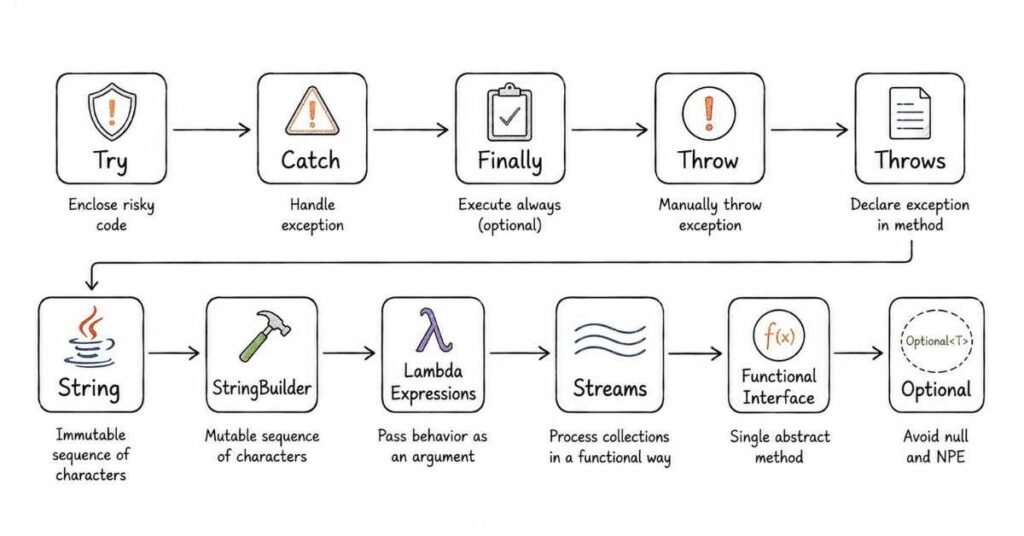
This part covers three high-frequency Java interview areas: exceptions, strings, and Java 8+ features. Current Java resources consistently describe checked versus unchecked exceptions, try-catch-finally, try-with-resources, String immutability, the String Pool, StringBuilder versus StringBuffer, and Java 8 features like lambdas, streams, method references, and Optional as core concepts interviewers expect candidates to explain clearly and use correctly.
Questions 81–120
81) What is exception handling in Java?
Exception handling is the mechanism Java uses to detect and manage runtime problems in a controlled way so the program does not fail unexpectedly. It helps separate normal application logic from error-handling logic.
82) Why is exception handling important?
It is important because real applications interact with files, databases, networks, and user input, all of which can fail in unpredictable ways. Good exception handling improves reliability, readability, and maintainability.
83) What is an exception in Java?
An exception is an event that interrupts the normal flow of a program during execution. In interviews, a simple answer is that exceptions represent problems the program must handle or propagate.
84) What is the difference between an error and an exception?
An exception is something an application may reasonably catch or handle, while an error usually represents more serious system-level problems that applications typically do not recover from. This distinction is a common Java interview expectation.
85) What are checked exceptions in Java?
Checked exceptions are exceptions the compiler forces you to handle or declare. They typically represent situations such as I/O or file-handling failures where recovery should be considered.
86) What are unchecked exceptions in Java?
Unchecked exceptions are exceptions that are not checked at compile time and usually represent programming mistakes, such as invalid access or illegal arguments. They are typically subclasses of RuntimeException.
87) What is the difference between checked and unchecked exceptions?
Checked exceptions must be handled or declared by the compiler, while unchecked exceptions do not require that enforcement. Interviewers often ask this to test whether you understand Java’s exception model rather than just syntax.
88) What is a try block?
A try block contains the code that may throw an exception. It is the starting point of structured exception handling.
89) What is a catch block?
A catch block handles an exception thrown from the associated try block. It allows the program to respond gracefully instead of crashing immediately.
90) What is a finally block?
A finally block contains code that is intended to run whether an exception occurs or not, often for cleanup work like closing resources. This makes it useful for cleanup that should happen regardless of success or failure.
Exception keywords and patterns
91) What is the difference between throw and throws?
throw is used to actually throw an exception from code, while throws is used in a method signature to declare that the method may pass an exception to the caller. This is one of the most common beginner-level Java interview comparisons.
92) What is exception propagation?
Exception propagation means an exception moves up the call stack until it is handled or the program terminates. A good interview answer mentions that throws is often involved when a method does not handle an exception itself.
93) What is try-with-resources?
try-with-resources is a Java feature used to manage resources automatically so they are closed after use. It reduces boilerplate and makes resource cleanup safer than manual closing in many cases.
94) Why is try-with-resources preferred?
It is preferred because it automatically closes eligible resources and reduces the chance of resource leaks. It also usually makes code shorter and easier to maintain.
95) What is a custom exception?
A custom exception is a user-defined exception class created to represent application-specific error conditions. It is useful when built-in exception types do not express the business problem clearly.
96) When should you create a custom exception?
You should create one when the application has a meaningful domain-specific failure case that deserves a clear, reusable type. A strong answer is that custom exceptions improve readability and error semantics.
97) Can you have multiple catch blocks?
Yes, Java allows multiple catch blocks so different exception types can be handled differently. This helps keep exception handling specific rather than overly generic.
98) Why is catching generic Exception often discouraged?
Because it can hide the real nature of the problem and make debugging or recovery logic too broad. Interviewers often prefer that you catch the most specific meaningful exception type possible.
99) What is a good exception-handling approach in interviews?
A good approach is to handle exceptions where recovery is meaningful, propagate them when necessary, use specific exception types, and avoid swallowing exceptions silently. This kind of answer shows mature Java thinking.
100) What is the difference between handling and declaring an exception?
Handling means catching it with try-catch, while declaring means using throws so the caller must deal with it. This is a very common Java interview distinction.
Strings in Java
101) What is a String in Java?
A String in Java is an object that represents a sequence of characters. It is one of the most commonly used classes in Java applications.
102) Why is String important in Java interviews?
Because Java strings are used everywhere and also test deeper understanding of immutability, memory usage, object comparison, and performance. Interviewers often use string questions to check both fundamentals and JVM-related reasoning.
103) What does it mean that String is immutable?
It means that once a String object is created, its value cannot be changed. Any apparent modification creates a new string object instead of changing the original one.
104) Why are strings immutable in Java?
Current Java string explanations consistently cite memory optimization through the String Pool, thread safety, and security as major reasons for immutability. This is one of the most frequently asked Java string interview questions.
105) What is the String Pool?
The String Pool is a special memory area where string literals are reused so duplicate literal values do not create unnecessary separate objects. This helps optimize memory usage.
106) Why is the String Pool useful?
It saves memory by reusing identical string literals instead of creating multiple duplicate objects. A strong interview answer connects this directly to why immutability matters.
107) What is the difference between == and .equals() for strings?
== compares references, while .equals() compares actual content. This is a classic Java interview question and one of the most important string distinctions to answer correctly.
108) Why can repeated string concatenation be inefficient?
Because each apparent modification of an immutable string can create a new object, leading to extra memory allocation and garbage collection overhead. This becomes especially inefficient in loops.
StringBuilder and StringBuffer
109) What is StringBuilder?
StringBuilder is a mutable sequence of characters used when you need to modify strings efficiently. It is usually preferred for repeated string operations in single-threaded contexts.
110) What is StringBuffer?
StringBuffer is also a mutable sequence of characters, but it is synchronized and designed to be thread-safe. Because of synchronization, it is generally slower than StringBuilder.
111) What is the difference between String, StringBuilder, and StringBuffer?
String is immutable, StringBuilder is mutable and typically faster in single-threaded use, and StringBuffer is mutable but synchronized for thread safety. This is one of the most common Java interview comparisons.
112) When should you use StringBuilder?
You should use StringBuilder when you need repeated string modification in a non-thread-safe context, such as loops or dynamic text assembly. It is usually the performance-oriented default for mutable string building.
113) When should you use StringBuffer?
You should use StringBuffer when mutable string operations need thread safety. In many interview answers, it is enough to say it is synchronized and therefore safer but slower.
Java 8+ features
114) Why is Java 8 important in interviews?
Java 8 introduced major language features such as lambda expressions, streams, functional interfaces, method references, and Optional, all of which are common interview topics and widely used in modern Java code. Candidates are often expected to understand both syntax and practical use cases.
115) What is a lambda expression?
A lambda expression is a concise way to represent an anonymous function-like block of behavior in Java. It is commonly used with functional interfaces and streams.
116) What is a functional interface?
A functional interface is an interface with exactly one abstract method and is the main target type for lambda expressions. This is a fundamental Java 8 interview topic.
117) What is the Stream API?
The Stream API is a Java 8 feature for processing sequences of data in a functional and expressive style using operations like filter, map, and collect. It helps write cleaner data-processing code compared with many manual loops.
118) What is the difference between a collection and a stream?
A collection stores data, while a stream is used to process data. This is a concise and strong interview answer because it captures their different roles clearly.
119) What is a method reference?
A method reference is a shorthand way to refer to an existing method when a lambda would simply call that method. It improves readability in many functional-style operations.
120) What is Optional in Java?
Optional is a container object used to represent the possible presence or absence of a value. It is commonly discussed as a way to make null-related logic more explicit and safer.
Revision focus
For this part, revise checked versus unchecked exceptions, try-catch-finally, throw versus throws, try-with-resources, custom exceptions, String immutability, the String Pool, StringBuilder versus StringBuffer, and Java 8 features like lambdas, streams, functional interfaces, method references, and Optional. These topics matter because they appear constantly in Java interviews and help show whether you understand both language fundamentals and modern Java coding style.
Part 5: Multithreading & Concurrency Questions 121–160
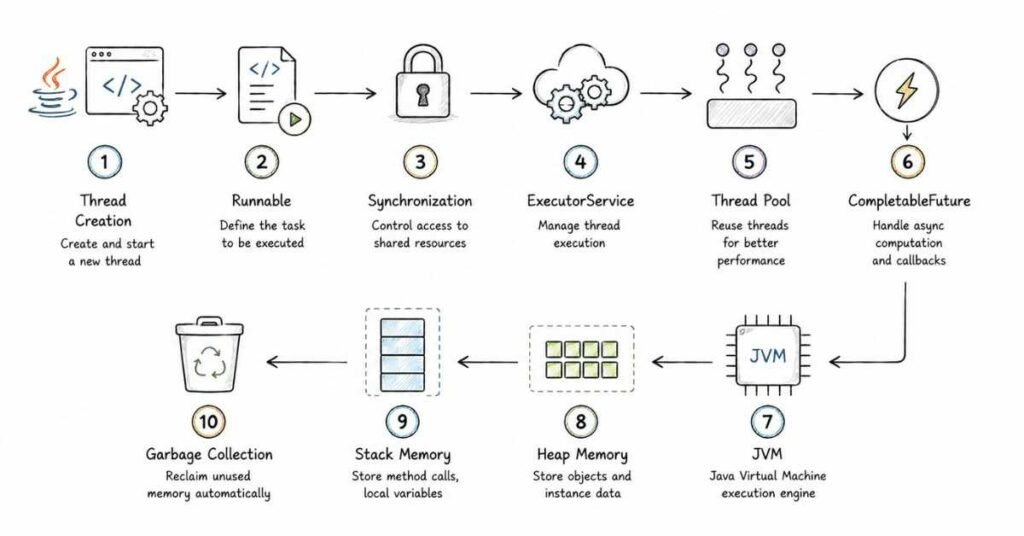
This part covers concurrency, one of the most important topics for backend-focused Java interviews. Current Java concurrency references consistently emphasize thread lifecycle, synchronization, race conditions, deadlocks, volatile, ExecutorService, thread pools, concurrent collections, and CompletableFuture as the practical concepts interviewers use to test whether a candidate understands safe and scalable Java execution beyond single-threaded code.
Questions 121–160
121) What is multithreading in Java?
Multithreading means running multiple threads of execution within the same process so tasks can make progress concurrently. In Java interviews, a good answer is that multithreading helps improve responsiveness and resource utilization, but it also introduces correctness risks.
122) Why is multithreading important?
It is important because many real applications handle multiple requests, background tasks, I/O operations, and shared resources at the same time. Backend and production Java roles especially value this topic because concurrency affects both performance and reliability.
123) What is a thread?
A thread is the smallest unit of execution within a process. Multiple threads in the same process can share memory, which is useful but also creates synchronization challenges.
124) What is the difference between a process and a thread?
A process is an independent running program with its own memory space, while threads are execution units inside a process that share the process’s memory. A strong interview answer mentions that threads are lighter than processes but more prone to shared-state issues.
125) What is concurrency in simple terms?
Concurrency means dealing with multiple tasks that can overlap in progress, even if they are not literally running at the exact same instant on one CPU. In interviews, this is often enough unless the interviewer wants a deeper distinction from parallelism.
126) What is the difference between concurrency and parallelism?
Concurrency is about managing multiple tasks that make progress over time, while parallelism is about multiple tasks executing at the same time on different processing units. This distinction matters because many Java interview questions use the terms loosely.
Thread lifecycle and creation
127) What are the main thread states in Java?
Java thread lifecycle discussions commonly include states such as NEW, RUNNABLE, BLOCKED, WAITING, TIMED_WAITING, and TERMINATED. Understanding these states is important for reasoning about thread behavior and debugging.
128) What does the NEW state mean?
It means a thread object has been created but not yet started. The thread exists, but its execution has not begun.
129) What does the RUNNABLE state mean?
It means the thread is ready to run or currently running, depending on scheduler availability. Java groups “ready” and “running” behavior under this state.
130) What does the BLOCKED state mean?
It means a thread is waiting to acquire a monitor lock so it can enter a synchronized block or method. This is a common sign of contention in concurrent code.
131) What do WAITING and TIMED_WAITING mean?
WAITING means the thread is waiting indefinitely for another thread’s action, while TIMED_WAITING means it is waiting for a specified amount of time. These states often appear with methods like wait(), join(), and sleep().
132) What does the TERMINATED state mean?
It means the thread has completed execution and exited. Once terminated, it cannot be restarted.
133) How can you create a thread in Java?
The two classic ways are extending the Thread class or implementing the Runnable interface. In modern interview answers, it is also good to mention that using executors is usually preferred in real applications.
134) What is the difference between extending Thread and implementing Runnable?
Implementing Runnable is usually preferred because it separates the task from the thread mechanism and still leaves your class free to extend another class. This is one of the most common Java concurrency interview questions.
135) Why is Runnable usually preferred?
Because Java supports single inheritance, and implementing Runnable gives better design flexibility than extending Thread. It also better reflects the idea that a task and a worker thread are different concerns.
Synchronization and shared data
136) What is synchronization in Java?
Synchronization is the mechanism used to control access to shared resources so only one thread can execute certain critical sections at a time. It helps prevent thread interference and memory consistency problems.
137) Why do we need synchronization?
We need it because multiple threads accessing shared mutable data can otherwise produce incorrect or inconsistent results. This is one of the core ideas behind safe concurrent programming.
138) What is a race condition?
A race condition happens when the correctness of a program depends on the unpredictable timing of thread execution, especially around shared data. It is one of the most common and dangerous concurrency bugs.
139) What is a critical section?
A critical section is a part of the code that accesses shared mutable data and therefore must be protected from simultaneous execution by multiple threads. Interviewers often expect you to connect this concept directly to synchronization.
140) What does the synchronized keyword do?
The synchronized keyword ensures that only one thread at a time can execute a synchronized method or block for a given monitor lock. It is one of Java’s most basic mechanisms for protecting critical sections.
141) What is the difference between a synchronized method and a synchronized block?
A synchronized method locks on the whole object or class context, while a synchronized block lets you lock only the specific code section and object you choose. A synchronized block is often more flexible and more precise.
142) What is static synchronization?
Static synchronization applies locking at the class level rather than the instance level, typically through synchronized static methods. This is useful when shared state belongs to the class itself.
Communication, visibility, and deadlocks
143) What is wait() in Java?
wait() causes the current thread to release the monitor and wait until another thread signals it using notify() or notifyAll(). It is used for inter-thread communication rather than just pausing execution.
144) What is notify() in Java?
notify() wakes one thread waiting on the same monitor object. It is used when one thread wants to signal another that a condition may now be true.
145) What is notifyAll() in Java?
notifyAll() wakes all threads waiting on the same monitor object. This is often safer than notify() when multiple waiting threads may need reevaluation.
146) What is a deadlock?
A deadlock happens when two or more threads wait indefinitely for resources held by each other, so none of them can proceed. This is a classic Java interview topic because it tests both theory and design awareness.
147) What is a simple way to avoid deadlocks?
A common approach is to acquire locks in a consistent order and minimize nested locking. Strong answers also mention reducing lock scope where possible.
148) What is the volatile keyword?
volatile is used to ensure visibility of a variable’s latest value across threads, so reads do not use stale cached values. It is mainly about visibility, not full mutual exclusion.
149) Does volatile replace synchronization?
No, volatile does not replace synchronization for compound operations because it does not make multi-step updates atomic. A strong answer is that volatile helps with visibility, while synchronization also handles mutual exclusion.
Executors, pools, and concurrent utilities
150) Why is creating threads manually often discouraged?
Because creating a new Thread for every task wastes resources and does not scale well in modern applications. Current Java concurrency guidance strongly favors executor-based task management instead.
151) What is ExecutorService?
ExecutorService is part of the executor framework used to manage and run asynchronous tasks using worker threads and thread pools. It separates task submission from low-level thread management.
152) What is a thread pool?
A thread pool is a managed group of reusable worker threads that execute submitted tasks. It improves performance and scalability by reusing threads instead of constantly creating new ones.
153) Why are thread pools useful?
They reduce thread creation overhead, improve resource control, and make concurrent task execution more scalable. This is one of the most practical concurrency concepts for backend interviews.
154) What is the difference between Runnable and Callable?
Runnable represents a task that does not return a result, while Callable can return a value and throw checked exceptions. This is a standard executor-framework interview comparison.
155) What is a Future?
A Future represents the result of an asynchronous computation that may complete later. It allows you to check status, wait for completion, or retrieve the result.
156) What is a limitation of Future?
A common limitation is that Future.get() blocks and simple Future usage is less flexible for composing multiple asynchronous steps. This is one reason CompletableFuture became popular.
157) What is CompletableFuture?
CompletableFuture is a more powerful API for asynchronous programming that supports non-blocking task composition, chaining, combination, and error handling. It is one of the most important modern Java concurrency topics.
158) Why is CompletableFuture useful?
It is useful because it lets you chain async workflows using methods like thenApply(), thenCompose(), and allOf() instead of relying only on blocking result retrieval. This makes async logic more expressive and scalable.
159) What are concurrent collections in Java?
Concurrent collections are thread-safe collection classes designed for use in concurrent programs, such as ConcurrentHashMap, CopyOnWriteArrayList, and BlockingQueue. They are often preferable to manually synchronizing ordinary collections.
160) What is a strong answer if asked how to write safer multithreaded Java code?
A strong answer is: minimize shared mutable state, protect critical sections, use synchronization or concurrent utilities appropriately, prefer executors over manual thread creation, and design carefully to avoid race conditions and deadlocks. That answer shows both conceptual and production-oriented understanding.
Revision focus
For this part, revise thread lifecycle, Thread versus Runnable, synchronization, race conditions, critical sections, wait()/notify(), deadlocks, volatile, ExecutorService, thread pools, Callable, Future, CompletableFuture, and concurrent collections. These topics matter because Java concurrency is a major interview differentiator for backend roles and shows whether you can reason about correctness, performance, and scalability under real-world conditions.
Part 6: JVM Internals & Memory Management Questions 161–200
This part covers the JVM internals that Java interviewers use to test whether you understand how Java code actually runs. Current JVM references consistently describe the JVM in terms of the class loader subsystem, runtime memory areas such as heap and stack, the execution engine with interpreter and JIT, and automatic garbage collection, while interview-focused sources also emphasize class loading phases, parent delegation, Metaspace, and the fact that garbage collection applies to heap objects rather than stack frames.
Questions 161–200
161) What is the JVM?
The JVM, or Java Virtual Machine, is the runtime environment that executes Java bytecode. It provides the platform layer that allows Java programs to run across operating systems without recompiling the source code for each one.
162) Why is the JVM important in Java?
The JVM is important because it loads classes, manages memory, executes bytecode, and handles garbage collection automatically. In interviews, a strong answer is that Java’s portability and much of its runtime behavior depend on the JVM.
163) What is the difference between JDK, JRE, and JVM?
The JVM executes bytecode, the JRE includes the JVM plus core libraries needed to run Java applications, and the JDK includes the JRE plus development tools used to build Java programs. This is one of the most common Java interview basics.
164) What does “write once, run anywhere” mean in Java?
It means Java source code is compiled into bytecode, and that bytecode can run on any platform that has a compatible JVM. This is one of the key ideas behind Java platform independence.
165) What happens before Java code runs on the JVM?
Java source code is first compiled into .class files containing bytecode, and then the JVM loads and executes that bytecode. The JVM itself works with bytecode rather than raw Java source.
JVM architecture
166) What are the main parts of JVM architecture?
JVM architecture is commonly described using the class loader subsystem, runtime data areas, execution engine, and native interface support. These are the high-level components interviewers usually expect you to know.
167) What does the class loader subsystem do?
The class loader subsystem loads .class files into the JVM and makes them available for execution. It is the first major step in turning bytecode into a running Java program.
168) What are the phases of class loading?
Interview-focused JVM sources commonly describe class loading phases as loading, linking, and initialization. Linking itself includes verification, preparation, and resolution.
169) What happens in the loading phase?
In the loading phase, the JVM reads the class file and creates the class representation in memory. This is the step where the bytecode is brought into the runtime environment.
170) What happens in the linking phase?
In the linking phase, the JVM verifies the bytecode, prepares memory for static fields with default values, and resolves symbolic references into direct references. This helps ensure the class is valid and ready for execution.
171) What happens in the initialization phase?
In the initialization phase, static blocks run and static variables receive their programmer-defined initial values. This is when the class becomes fully ready for use.
172) What is the parent delegation model?
The parent delegation model means a class loader first asks its parent to load a class before trying to load it itself. This improves consistency and helps protect core Java classes from being overridden by application code.
173) What are the common class loaders in Java?
Interview-oriented JVM explanations commonly mention the Bootstrap ClassLoader, Extension or Platform ClassLoader depending on Java version, and Application ClassLoader. These loaders divide responsibility for core, platform, and application classes.
Memory areas
174) What are JVM runtime data areas?
JVM runtime data areas include memory regions such as heap, stack, method area or Metaspace, PC register, and native method stack. These areas support class metadata, method execution, object storage, and native calls.
175) What is heap memory in Java?
Heap memory stores objects and instance-related data and is shared across threads. It is the primary area managed by garbage collection.
176) What is stack memory in Java?
Stack memory stores method frames, local variables, return data, and object references for a thread’s execution flow. Each thread has its own stack.
177) What is the difference between heap and stack?
Heap stores objects and is shared, while stack stores method-level execution data and is thread-specific. Interviewers commonly use this question to test whether you really understand Java memory layout.
178) Does the stack store objects?
Interview-focused JVM explanations explicitly warn that objects are stored in heap, while stack frames usually store local primitives and references to objects rather than the objects themselves. This is a common interview trap.
179) What is the method area?
The method area stores class-level information such as metadata, static variables, and bytecode-related information. In newer Java versions, Metaspace is used instead of PermGen for class metadata storage.
180) What is Metaspace?
Metaspace is the memory area introduced in Java 8+ for storing class metadata, replacing PermGen. It uses native memory rather than heap memory.
181) What is the PC register?
The program counter, or PC register, keeps track of the current instruction being executed for each thread. This is a thread-specific runtime area.
182) What is the native method stack?
The native method stack supports the execution of native methods written in non-Java languages through JNI-related operations. It is part of JVM runtime data areas but is not used for ordinary Java methods.
Execution engine and JIT
183) What is the execution engine in the JVM?
The execution engine is the part of the JVM that runs bytecode after classes are loaded into memory. It includes components such as the interpreter, JIT compiler, and garbage collector.
184) What does the interpreter do in the JVM?
The interpreter executes bytecode instruction by instruction. It is simple and direct, but not always the fastest option for repeatedly executed code.
185) What is JIT compilation?
JIT, or Just-In-Time compilation, converts frequently executed bytecode into optimized native machine code at runtime. This is one of the main reasons Java performance improves after code runs for a while.
186) Why does Java often become faster over time?
Interview-focused JVM explanations note that the JIT compiler identifies “hot” code paths and optimizes them into faster native code during runtime. This adaptive optimization is a major reason long-running Java applications can perform very well.
Garbage collection
187) What is garbage collection in Java?
Garbage collection is the automatic process of reclaiming memory from heap objects that are no longer reachable by the application. It removes the need for manual memory deallocation in normal Java code.
188) Why is garbage collection useful?
It helps manage memory automatically, reduces common manual-memory mistakes, and makes Java development safer and more productive. A strong answer also mentions that it does not eliminate all memory issues, such as leaks caused by lingering references.
189) Does garbage collection work on the stack?
Interview-focused JVM summaries explicitly state that garbage collection operates on heap memory, not stack frames. This is a very common interview correction point.
190) What is the young generation in heap memory?
The young generation is the heap area where newly created objects usually start their life, and many of them die quickly. JVM references commonly describe it as including Eden and Survivor spaces.
191) What is the old generation?
The old generation stores longer-lived objects that survive multiple young-generation collections. It is typically collected less frequently than the young generation.
192) What is a full GC?
A full GC is a broader garbage collection cycle that involves older heap regions and is generally more expensive than young-generation collection. In interviews, it is enough to say that it tends to have higher pause cost.
193) Can System.gc() force garbage collection?
No, it only requests garbage collection and does not guarantee that GC will run immediately. This is a strong interview answer because it avoids a common misconception.
Memory leaks and errors
194) Can Java have memory leaks even with garbage collection?
Yes, Java can still have memory leaks when objects remain reachable unintentionally, such as through static collections, caches, listeners, or class loader issues. Garbage collection only removes unreachable objects, not objects you forgot to release logically.
195) What is OutOfMemoryError?
OutOfMemoryError occurs when the JVM cannot allocate enough memory for an operation in a required memory area. A strong answer may mention that heap and Metaspace can fail for different reasons.
196) What is StackOverflowError?
StackOverflowError typically occurs when the call stack grows too deep, often due to deep or infinite recursion. This is one of the clearest examples of a stack-related runtime failure.
Java memory model and interview framing
197) What is the Java Memory Model in simple terms?
In simple terms, the Java Memory Model defines how threads interact with memory and what visibility and ordering guarantees Java provides for reads and writes. In interviews, it is often enough to connect it to concurrency, volatile, and synchronization.
198) Why is the Java Memory Model important?
It is important because multithreaded code can behave incorrectly if visibility and ordering rules are misunderstood. This topic connects JVM internals directly to concurrency correctness.
199) What is JNI?
JNI, or Java Native Interface, is the mechanism that allows Java code to interact with native code written in languages like C or C++. It is useful for low-level or platform-specific operations.
200) What is a strong answer if asked to summarize JVM internals?
A strong answer is: “The JVM loads bytecode through class loaders, stores execution data in runtime memory areas like heap and stack, runs bytecode through the execution engine using the interpreter and JIT, and manages heap memory automatically through garbage collection”. That answer is concise, correct, and interview-ready.
Revision focus
For this part, revise JVM architecture, class loading phases, parent delegation, heap versus stack, method area and Metaspace, execution engine, JIT, garbage collection, memory leaks, OutOfMemoryError, StackOverflowError, and basic Java Memory Model awareness. These topics matter because they show whether you understand not just Java syntax but also how Java programs behave internally at runtime, which is a major differentiator in strong backend interviews.
Part 7: Spring, Hibernate & Database Basics Questions 201–240
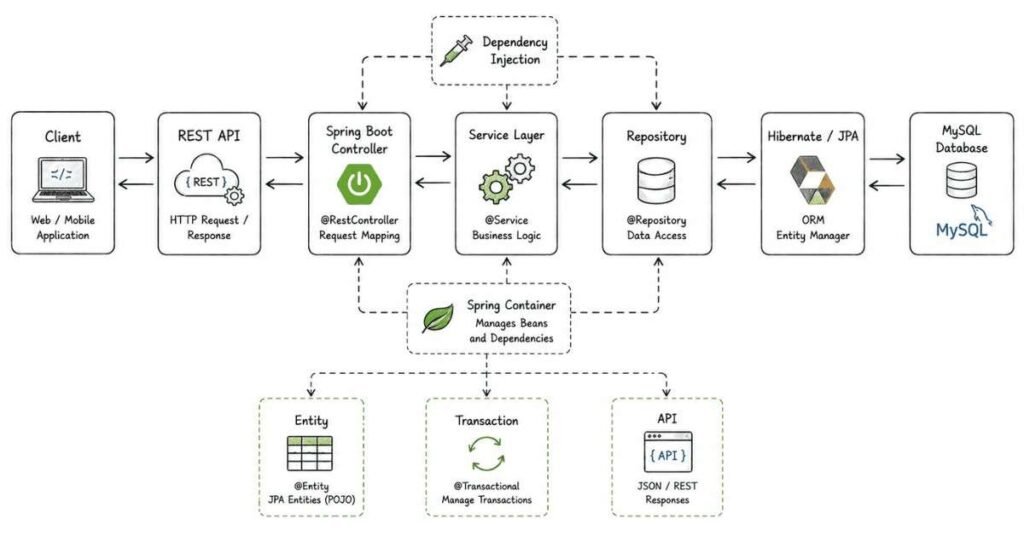
This part covers the framework and database topics that matter for most Java backend roles. Current Spring and JPA resources consistently emphasize dependency injection, transaction management, Spring Boot conventions, REST APIs, Spring Data JPA, Hibernate ORM, JDBC basics, and ACID-aware database reasoning as the practical knowledge interviewers expect for modern Java backend development.
Questions 201–240
201) What is the Spring Framework?
Spring is a Java framework used to build enterprise applications with features such as dependency injection, transaction management, data access support, and web development capabilities. It became popular because it helps developers write loosely coupled and more maintainable applications.
202) Why is Spring important in Java interviews?
It is important because many real Java backend roles use Spring or Spring Boot for building APIs and business applications. Interviewers often treat Spring knowledge as practical proof that you can work beyond core Java syntax.
203) What is Dependency Injection in Spring?
Dependency Injection, or DI, is a design pattern in which dependencies are provided to a class from outside rather than being created inside the class. Spring uses DI to reduce tight coupling and improve testability.
204) Why is Dependency Injection useful?
It is useful because it makes code more modular, easier to test, and easier to maintain by separating object creation from business logic. This is one of the most fundamental Spring interview concepts.
205) What is Inversion of Control?
Inversion of Control means the framework manages object creation and wiring instead of the application manually controlling everything. In Spring interviews, this is often explained together with Dependency Injection.
206) What is a bean in Spring?
A bean is an object managed by the Spring container. Spring creates, configures, and injects beans as needed in the application lifecycle.
207) What is the Spring container?
The Spring container is the component that manages beans and their dependencies, often through ApplicationContext. It is responsible for creating and wiring the objects used by the application.
208) What is the difference between constructor injection and field injection?
Constructor injection passes dependencies through the constructor, while field injection injects them directly into fields using annotations like @Autowired. Current Spring guidance commonly favors constructor injection because it makes dependencies explicit and harder to leave null accidentally.
209) Why is constructor injection often preferred?
Because it makes required dependencies explicit, improves testability, and avoids partially constructed objects. This is a strong practical answer in Spring interviews.
210) What does @Autowired do?
@Autowired tells Spring to inject a matching dependency automatically into a bean. It is commonly used in constructor, setter, or field injection styles.
Spring Boot basics
211) What is Spring Boot?
Spring Boot is a framework built on Spring that simplifies application setup through auto-configuration, opinionated defaults, and easier project bootstrapping. It reduces boilerplate configuration so developers can focus more on business logic.
212) Why is Spring Boot so popular?
It is popular because it makes it much faster to start and run Spring applications, especially REST APIs and microservices. In interviews, a strong answer is that it supports convention over configuration for common backend tasks.
213) What is auto-configuration in Spring Boot?
Auto-configuration means Spring Boot automatically configures many components based on classpath contents, dependencies, and common defaults. This is one reason Spring Boot applications require much less manual setup than older Spring applications.
214) What is @SpringBootApplication?
@SpringBootApplication is the main convenience annotation commonly used to mark the application entry class in Spring Boot. In interviews, it is often described as a combination of configuration and component-scanning behavior.
215) What is component scanning?
Component scanning is the process by which Spring automatically discovers classes annotated as components, services, repositories, or controllers and registers them as beans. This helps reduce manual bean registration.
216) What is the difference between Spring and Spring Boot?
Spring is the broader framework, while Spring Boot is a toolset built on top of Spring to simplify configuration, startup, and production-ready application development. A concise interview answer is that Spring Boot helps you use Spring faster and with less setup.
REST and web-layer basics
217) What is a REST API?
A REST API is a web service that exposes resources over HTTP using standard methods such as GET, POST, PUT, and DELETE. Spring Boot is widely used to build REST APIs in modern Java backend systems.
218) What does @RestController do?
@RestController is used in Spring Boot to define a controller whose methods typically return response bodies directly, often as JSON. It is one of the most common annotations in backend interview discussions.
219) What is the difference between @Controller and @RestController?
@Controller is typically used for MVC-style web applications, while @RestController is used for REST APIs where response data is usually returned directly rather than rendering a view. This is a standard Spring interview comparison.
220) What does @RequestMapping do?
@RequestMapping maps HTTP requests to controller classes or methods. In interviews, it is usually discussed along with specialized variants like @GetMapping and @PostMapping.
221) What are @GetMapping, @PostMapping, @PutMapping, and @DeleteMapping?
These are shortcut annotations in Spring MVC for mapping specific HTTP methods to controller methods. They make API endpoint definitions more readable than generic request mappings.
JDBC, JPA, and Hibernate
222) What is JDBC?
JDBC, or Java Database Connectivity, is the standard Java API for interacting directly with relational databases through SQL. It gives low-level control but usually requires more boilerplate than ORM-based approaches.
223) What is JPA?
JPA, or Java Persistence API, is the Java specification for object-relational mapping and persistence. It defines concepts and interfaces for working with relational data using Java objects rather than raw SQL everywhere.
224) What is Hibernate?
Hibernate is a popular ORM framework and a widely used implementation of JPA concepts in Java applications. It helps map Java objects to database tables and simplifies CRUD operations.
225) What is the difference between JPA and Hibernate?
JPA is a specification, while Hibernate is an implementation framework that can implement JPA behavior. This is one of the most common Java backend interview questions.
226) What is ORM?
ORM, or Object-Relational Mapping, is the technique of mapping Java objects to relational database tables. It reduces repetitive SQL-heavy boilerplate and makes database work more object-oriented.
227) Why is ORM useful?
ORM is useful because it simplifies persistence logic, reduces boilerplate code, and lets developers work with domain objects more naturally. A strong answer also mentions that SQL understanding is still important even when using ORM.
228) What is an entity in JPA?
An entity is a Java class mapped to a database table using JPA annotations. It represents persistent domain data in object form.
229) What does @Entity do?
@Entity marks a class as a JPA entity so it can be persisted to a relational database. It is one of the most fundamental annotations in JPA and Hibernate interview questions.
230) What does @Id do?
@Id marks the primary key field of an entity. This identifies the unique record corresponding to the entity in the database.
231) What is a repository in Spring Data JPA?
A repository is a data access abstraction used to interact with entities and databases more easily, often without writing all SQL manually. Spring Data JPA repositories simplify common CRUD operations significantly.
Transactions and database reasoning
232) What is a transaction?
A transaction is a logical unit of work that should complete fully or fail fully. In database-backed Java interviews, this usually connects directly to ACID properties and Spring transaction management.
233) What are ACID properties?
ACID stands for Atomicity, Consistency, Isolation, and Durability. These properties describe the reliability guarantees expected from database transactions.
234) What is atomicity?
Atomicity means a transaction is all-or-nothing: either all operations succeed or all are rolled back. This is one of the most important concepts behind transaction management.
235) What is consistency?
Consistency means the database should remain in a valid state before and after a transaction. Strong answers often mention that constraints and rules should still hold after the transaction completes.
236) What is isolation?
Isolation means concurrent transactions should not interfere in a way that breaks correctness. It is especially important in systems where multiple users act on shared data at the same time.
237) What is durability?
Durability means once a transaction is committed, the result should persist even if the system crashes afterward. This is usually guaranteed primarily by the database engine rather than application code alone.
238) What does @Transactional do in Spring?
@Transactional defines transaction boundaries so Spring can manage commit and rollback behavior automatically around a method or class. Current Spring references describe this as declarative transaction management that separates transaction handling from business logic.
239) Why is transaction management important in backend development?
It is important because many business operations involve multiple related database updates that must succeed together to preserve correctness. A strong answer connects transaction management directly to data integrity and failure handling.
240) What are microservices in simple terms?
Microservices are an architectural style in which an application is split into smaller independently deployable services that communicate over a network. In Java interviews, it is usually enough to explain that Spring Boot is commonly used to build such services, especially in modern backend systems.
Revision focus
For this part, revise Spring basics, Dependency Injection, IoC, beans, constructor injection, Spring Boot, REST annotations, JDBC, JPA, Hibernate, entities, repositories, transactions, ACID properties, and @Transactional. These topics matter because most modern Java backend interviews expect candidates to connect core Java skills with real application development using Spring Boot, databases, and transaction-aware service design.
Part 8: DSA, Coding Problems & System Design Basics Questions 241–280
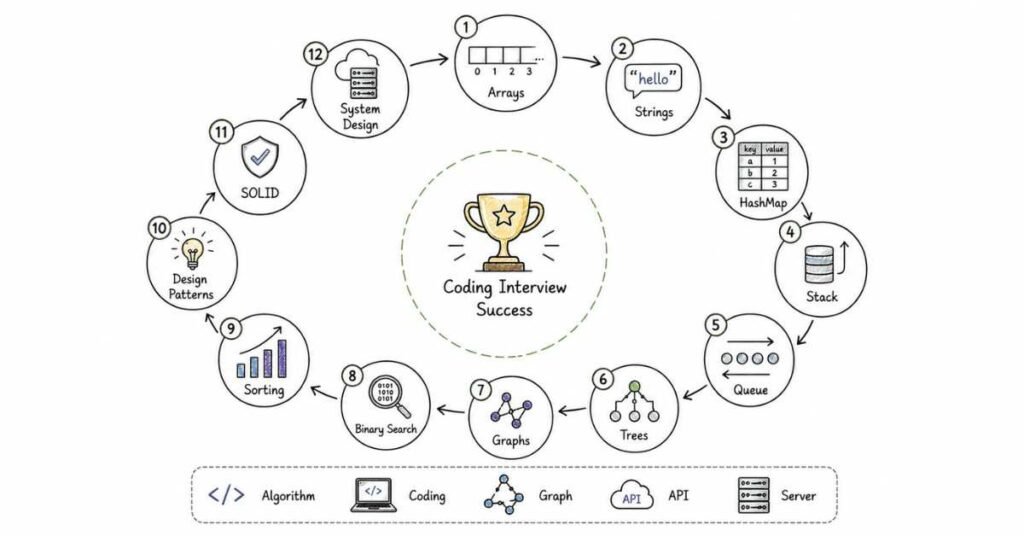
This part covers the practical problem-solving topics that many Java interviews use to evaluate coding clarity, algorithmic reasoning, and design maturity. Current coding-interview resources consistently emphasize arrays, strings, recursion, time and space complexity, sorting, searching, and common problem patterns, while broader Java interview guides also connect design patterns and basic system design awareness to backend interview readiness.
Questions 241–280
241) Why do Java interviews include DSA and coding rounds?
They include them because interviewers want to test how you think, not just what Java syntax you remember. Coding rounds reveal your problem-solving approach, correctness, complexity awareness, and communication under pressure.
242) What should you optimize for in a coding interview?
You should optimize for correctness first, then clarity, then time and space efficiency. A strong answer also mentions explaining trade-offs instead of rushing to a complicated solution.
243) What are the most common coding topics in Java interviews?
Common coding topics include arrays, strings, hashing, linked lists, stacks, queues, recursion, sorting, searching, trees, graphs, and dynamic programming. For many fresher and backend rounds, arrays, strings, hashing, recursion, and binary search are especially common.
244) Why are arrays and strings asked so often?
Because they are foundational, appear in many real problems, and reveal whether you understand indexing, iteration, edge cases, and optimization patterns. Many advanced problems are really array or string problems in disguise.
245) What are common patterns in array and string problems?
Common patterns include two pointers, sliding window, prefix sums, hashing for frequency counts, and sorting before searching. Strong interview prep materials recommend learning patterns rather than memorizing isolated problems.
Complexity and coding habits
246) What is time complexity?
Time complexity describes how the running time of an algorithm grows with input size. In interviews, candidates are usually expected to discuss it using Big-O notation.
247) What is space complexity?
Space complexity describes how much extra memory an algorithm uses relative to input size. A strong interview answer often compares time and space trade-offs together.
248) Why is Big-O important in coding interviews?
Because interviewers want to know whether you understand algorithmic scalability rather than only whether your code works for tiny inputs. Even simple problems often include a follow-up asking for a more efficient solution.
249) What is a brute-force solution?
A brute-force solution is the most direct approach that tries all possibilities or uses a straightforward but inefficient method. A strong answer is that brute force is often useful as a starting point before optimization.
250) Is it okay to explain the brute-force solution first?
Yes, that is often a good strategy because it shows structured thinking before optimization. Interviewers usually prefer a clear progression from naive to improved solution over silent guessing.
Searching and sorting
251) Why are sorting and searching important interview topics?
Because they appear in many coding problems directly and also enable other techniques like binary search and ordered processing. Sorting and searching are among the most reusable foundations in interview problem solving.
252) What is linear search?
Linear search checks elements one by one until it finds the target or reaches the end. It is simple but not efficient for large datasets.
253) What is binary search?
Binary search repeatedly checks the middle element of a sorted sequence and eliminates half the search space each step. Its time complexity is O(logn)O(\log n)O(logn) on sorted data.
254) When should binary search come to mind?
Tech Interview Handbook explicitly notes that when the input is sorted, binary search should be one of the first techniques you consider. This is a very common interview insight because many candidates miss the sorted-input clue.
255) Do interviewers expect you to implement sorting algorithms from scratch?
Tech Interview Handbook notes that in many algorithm interviews, you are unlikely to need to implement basic sorting algorithms from scratch and will more often rely on the language’s default sort appropriately. What matters more is understanding when sorting helps and knowing the complexity impact.
256) What should you know about Java sorting in interviews?
You should know how to sort arrays, lists, objects with Comparable, and custom orderings with Comparator. It is also useful to know that Java uses different optimized sorting strategies internally for objects and primitives.
Recursion and problem solving
257) What is recursion?
Recursion is a technique where a method calls itself to solve smaller versions of the same problem. It is common in tree problems, divide-and-conquer algorithms, and backtracking.
258) What are the two essential parts of recursion?
The two essential parts are a base case to stop the recursion and a recursive case that reduces the problem size. This is one of the most basic but most important interview explanations.
259) Why do candidates struggle with recursion?
Because they often lose track of the call stack or fail to define a clear base case. A strong interview approach is to explain the smaller subproblem before writing code.
260) What is backtracking in simple terms?
Backtracking is a recursive search technique that builds a solution step by step and undoes choices when they do not work. It commonly appears in problems like permutations, subsets, and constraint-based search.
Problem categories and interview execution
261) What kinds of DSA problems should Java candidates prioritize?
Java candidates should prioritize arrays, strings, hashing, linked lists, stacks, queues, recursion, binary search, trees, and basic graph traversal before moving heavily into advanced topics. That priority order gives better interview return than starting with obscure advanced algorithms.
262) Why is hashing so important in coding interviews?
Because HashMap and HashSet often turn slow repeated lookups into faster average-time operations, especially for counting, duplicate detection, grouping, and membership tests. Many array and string optimizations depend on this idea.
263) How should you approach a coding problem in an interview?
A strong approach is: clarify the problem, ask about edge cases, discuss a brute-force approach, improve it, explain complexity, and then write clean code. This process often matters almost as much as the final answer.
264) What should you do if you get stuck during a coding round?
Talk through your reasoning, simplify the problem, test with a small example, and state what you know so far. Interviewers usually prefer visible reasoning over complete silence.
265) Why are edge cases important?
Because many seemingly correct solutions fail on empty input, single-element input, duplicates, negative values, null cases, or extreme constraints. Strong interview resources repeatedly stress checking these cases.
Design patterns and SOLID
266) Why do Java interviews ask about design patterns?
Because Java is widely used in large codebases where reusable design structure matters, and design patterns help discuss recurring software design solutions. Interviewers often use pattern questions to see whether you understand maintainable code, not just APIs.
267) What is the Singleton pattern?
The Singleton pattern ensures that only one instance of a class exists and provides a global access point to it. It is a very common interview pattern, though strong answers also mention that careless Singleton use can create design problems.
268) What is the Factory pattern?
The Factory pattern centralizes object creation logic and hides the exact instantiation details from client code. It is useful when object creation may vary or expand over time.
269) What is the Builder pattern?
The Builder pattern helps construct complex objects step by step, especially when there are many optional parameters. In interviews, it is often contrasted with telescoping constructors.
270) What is the Observer pattern?
The Observer pattern defines a one-to-many relationship where changes in one object notify dependent objects. It is useful for event-driven and subscription-based behavior.
271) What are SOLID principles?
SOLID refers to five object-oriented design principles intended to improve maintainability, flexibility, and clarity in software design. Java interviews often expect at least a high-level explanation even if they do not ask for all five in depth.
272) What does the Single Responsibility Principle mean?
It means a class should have one clear reason to change. A strong interview answer is that classes should not mix unrelated concerns like persistence, validation, and UI formatting all together.
273) What does the Open/Closed Principle mean?
It means software entities should be open for extension but closed for modification. In simple terms, you should be able to add new behavior without constantly rewriting old working code.
274) Why do SOLID principles matter in interviews?
Because they show that you can think about scalable, maintainable design rather than only getting code to compile. They are especially relevant in Java because object-oriented architecture is such a central part of the ecosystem.
System design basics
275) Why do some Java interviews include system design?
Because backend Java roles often involve building APIs, handling scale, integrating databases, and thinking about reliability beyond single classes. Even when the role is not senior, basic system design awareness can be a strong differentiator.
276) What should a beginner say in a basic system design answer?
A beginner should describe the main components clearly: clients, API layer, service layer, database, caching if needed, and how data flows through the system. A simple structured answer is usually better than throwing around advanced buzzwords.
277) What are common system design topics for Java backend interviews?
Common topics include API design, database selection, caching, scalability, authentication, load handling, logging, monitoring, and service communication. For experienced roles, microservices and messaging may also appear.
278) Why do scalability and caching come up in interviews?
Because a design that works for 100 users may fail for 1 million users, and caching is one of the most common ways to reduce repeated load on services and databases. Interviewers use these questions to test practical engineering thinking.
279) What is a strong answer if asked how to prepare for Java coding rounds?
A strong answer is: “I focus on arrays, strings, hashing, recursion, binary search, and common data structures first, practice writing clean Java solutions, explain complexity out loud, and solve problems by pattern rather than memorizing answers”. That shows strategy, not just effort.
280) What is a strong answer if asked how to improve at coding interviews?
A strong answer is: “I improve by solving a manageable number of high-quality problems repeatedly, reviewing patterns like sliding window and hashing, practicing edge cases, and explaining my approach clearly while coding”. Current interview-prep guidance strongly favors pattern recognition and explanation over random-volume practice.
Revision focus
For this part, revise arrays, strings, hashing, recursion, binary search, sorting, searching, complexity, design patterns like Singleton and Builder, SOLID principles, and basic system design structure. These topics matter because they test whether you can solve problems cleanly, reason about performance, and design maintainable Java-based systems rather than only answer theory questions.
Part 9: Behavioral, Resume, LinkedIn & Career Strategy Java Interview Preparation Guide
This final part focuses on presenting yourself well for Java roles, not just answering technical questions. Current 2026 resume and hiring guidance for Java roles emphasizes exact stack keywords such as Java, Spring Boot, Hibernate, REST APIs, microservices, SQL, Docker, Kubernetes, CI/CD, and testing frameworks rather than vague phrases, while salary sources continue to show wide variation based on experience, stack depth, and company type in India.
STAR method
The STAR method means answering behavioral questions with:
- Situation.
- Task.
- Action.
- Result.
This works especially well for Java interviews because many behavioral questions are really trying to understand how you handled bugs, production issues, requirement changes, API design decisions, team collaboration, database problems, or deadline pressure.
Use this Java-friendly STAR approach:
- Situation: A backend issue, feature request, API bug, concurrency problem, or project challenge.
- Task: What you were responsible for.
- Action: What you debugged, designed, optimized, coded, tested, or coordinated.
- Result: What improved, what was fixed, or what was learned.
Example:
- Situation: A Spring Boot API was responding slowly during testing.
- Task: I had to identify the cause and improve response time before release.
- Action: I checked SQL queries, reviewed service-layer logic, reduced unnecessary database calls, and added pagination to one endpoint.
- Result: API response time improved significantly and the team was able to release on time.
20 behavioral questions
Below are 20 common behavioral questions with answer direction.
- Tell me about yourself.
Framework: background → Java skills → role target. - Why do you want to work as a Java developer?
Framework: interest in backend/problem-solving/OOP → Java ecosystem → long-term fit. - Tell me about a challenging bug you fixed.
Framework: problem → diagnosis → fix → result. - Describe a time you worked with legacy code.
Framework: issue → understanding → safe changes → result. - Tell me about a time you missed or nearly missed a deadline.
Framework: pressure → prioritization → communication → outcome. - Describe a difficult database issue you handled.
Framework: issue → investigation → resolution. - Tell me about a project you are proud of.
Framework: project goal → stack used → your contribution → impact. - Describe a time you explained a technical issue to a non-technical person.
Framework: complexity → simplification → decision/result. - Tell me about a mistake you made in development.
Framework: mistake → ownership → fix → lesson. - Describe a disagreement with a teammate over implementation.
Framework: disagreement → reasoning → collaboration → resolution. - Tell me about a time you improved performance.
Framework: bottleneck → approach → measurable improvement. - Describe a time you had to learn a framework quickly.
Framework: gap → learning → delivery. - Tell me about a time you handled production pressure.
Framework: issue → debugging → stabilization → follow-up. - Describe a time your code review feedback changed your approach.
Framework: feedback → adjustment → learning. - Tell me about a repetitive task you automated.
Framework: repetitive issue → script/tool/process → benefit. - Describe a time you handled unclear requirements.
Framework: ambiguity → clarification → implementation. - Tell me about a failure in testing or deployment.
Framework: failure → diagnosis → prevention. - Describe a time you worked across teams.
Framework: communication → dependency → result. - Why should we hire you for this Java role?
Framework: Java fundamentals + backend stack + problem-solving + reliability. - Where do you see yourself in 3 years?
Framework: deeper backend ownership + stronger system design + production impact.
Keep answers specific and realistic. For freshers, academic or personal projects are acceptable if you explain them honestly.
50 AI self-preparation prompts
Use these prompts with an AI assistant or for self-practice.
- Ask me Java behavioral questions one by one.
- Evaluate my “Tell me about yourself” answer for a Java developer role.
- Rewrite my introduction for a Java backend developer role.
- Rewrite my introduction for a Spring Boot developer role.
- Conduct a mock HR interview for a Java role.
- Conduct a mock technical interview for Core Java.
- Ask me OOP interview questions one by one.
- Ask me Java collections interview questions one by one.
- Ask me Java exception handling interview questions.
- Ask me Java multithreading interview questions.
- Ask me Spring Boot interview questions.
- Ask me Hibernate and JPA interview questions.
- Ask me DSA questions in Java.
- Turn my Java project into a STAR answer.
- Improve my Java developer resume bullet points.
- Convert my internship work into backend resume language.
- Create a 30-second Java elevator pitch.
- Create a 60-second Java elevator pitch.
- Ask follow-up questions after every answer I give.
- Score my answers for clarity and confidence.
- Find weak spots in my Java interview preparation.
- Simulate a Java backend coding round.
- Simulate a Spring Boot API interview round.
- Simulate a debugging interview for Java.
- Simulate a multithreading interview round.
- Simulate a basic system design round for Java backend.
- Improve my LinkedIn headline for Java developer roles.
- Improve my LinkedIn About section for backend roles.
- Ask me why I chose Java.
- Ask me why I want to move into backend development.
- Ask me why I am changing jobs.
- Ask me how HashMap works internally.
- Ask me how Spring Boot works in simple terms.
- Ask me how I would explain transactions in an interview.
- Help me explain a REST API project clearly.
- Help me explain a JDBC or Hibernate project clearly.
- Make my Java interview answers sound more natural.
- Shorten my long answers into interview-ready versions.
- Help me answer “What is your weakness?” for a Java role.
- Help me answer “Why this company?” for a backend role.
- Create 20 likely HR questions for Java freshers.
- Create 20 likely HR questions for Spring Boot developers.
- Cross-examine my resume like an interviewer.
- Check whether my project claims sound realistic.
- Turn my college project into an industry-style backend project summary.
- Build a 7-day Java mock interview plan.
- Create a thank-you email after a Java interview.
- Create a recruiter outreach message for Java backend roles.
- Create a no-response follow-up after 5 days.
- Create a final revision checklist from my weak Java areas.
Resume optimization
Current 2026 ATS-focused resume guidance for Java roles stresses that exact technology names matter, especially Spring Boot, Microservices, REST APIs, Hibernate, JPA, SQL, Kafka, Docker, Kubernetes, and CI/CD, because resume filters and recruiters often treat these as distinct keywords rather than assuming they are implied by “Java developer”.
Use this structure:
- Name and contact details.
- Resume headline.
- 3–4 line summary.
- Technical skills.
- Experience or projects.
- Education.
- Certifications.
- GitHub or portfolio if relevant.
Useful keywords to include naturally:
- Java, Core Java, OOP, Collections Framework, Multithreading, Exception Handling, Java 8+, Spring Boot, Spring MVC, Spring Security, REST API, Microservices, Hibernate, JPA, JDBC, Maven, Gradle, MySQL, PostgreSQL, Oracle, JUnit, Mockito, Git, Docker, Kubernetes, Kafka, Redis, CI/CD, System Design, SOLID, Design Patterns.
Current ATS advice also emphasizes listing Spring modules separately when applicable because tools may score Spring Boot, Spring Security, Spring Data JPA, and Spring MVC independently. Resume guidance for 2026 further recommends showing real usage context, such as transaction volume, API reliability, service count, test coverage, or performance impact, instead of just listing buzzwords.
Better bullet style:
- Built REST APIs using Spring Boot, Hibernate, and MySQL for CRUD and business workflows.
- Developed backend modules using Java and Spring Boot with validation, exception handling, and layered architecture.
- Implemented database operations using JPA and Hibernate and optimized SQL queries for improved response time.
- Used HashMap, collections, and Java 8 streams to simplify service-layer processing and data transformation.
- Wrote unit tests using JUnit and Mockito for service and controller logic.
- Designed backend features with clean code practices, SOLID principles, and reusable components.
- Containerized backend services with Docker and participated in CI/CD-based deployment workflows.
- Built or maintained microservices communicating through REST or messaging tools where applicable.
Avoid these mistakes:
- Writing only “worked on Java project.”
- Listing Spring without specifying Spring Boot or related modules.
- Claiming microservices or Kafka experience without being able to explain them.
- Listing too many tools with no project evidence.
- Skipping testing, database, or API details in backend projects.
Resume summary example
For fresher:
“Entry-level Java developer with strong foundations in Core Java, OOP, collections, exception handling, multithreading basics, SQL, and Spring Boot. Hands-on project experience building backend applications and REST APIs using Java-based tools and frameworks. Seeking an opportunity to contribute to backend development while growing in system design, microservices, and production-ready engineering.”
For experienced candidate:
“Java backend developer with experience building and maintaining scalable applications using Core Java, Spring Boot, REST APIs, JPA/Hibernate, and relational databases. Comfortable with end-to-end backend workflows including API development, debugging, performance tuning, testing, and deployment awareness. Interested in roles that combine strong Java engineering with scalable backend architecture and business impact.”
LinkedIn profile optimization
For Java roles, your LinkedIn profile should quickly show your backend identity, stack, and project depth. Recruiters usually scan your headline, About section, recent experience, and listed technologies before deciding whether to contact you.
Use these upgrades:
- Headline: include role target plus stack keywords.
- About: 3 short paragraphs with background, technical stack, and role focus.
- Experience: use action-based, technical bullets.
- Featured: add GitHub, portfolio, APIs, or demos if available.
- Skills: list frameworks, databases, tools, and Java concepts.
- URL: customize it.
- Open to Work: enable it if relevant.
Headline examples
General backend:
- Java Developer | Spring Boot, REST APIs, Hibernate, SQL | Backend Engineering
Fresher:
- Aspiring Java Backend Developer | Core Java, OOP, SQL, Spring Boot, REST APIs
Experienced:
- Java Backend Developer | Spring Boot, Microservices, JPA, Docker, Kafka, CI/CD
About section template
“I build backend applications using Java with a focus on clean design, maintainable code, and practical problem solving. My core stack includes Core Java, OOP, collections, multithreading basics, SQL, and frameworks such as Spring Boot, Hibernate, and JPA.
My projects and experience include REST API development, database integration, exception handling, layered application design, and backend debugging. I am especially interested in backend roles where Java is used to build scalable and reliable business systems.
I am currently targeting opportunities in Java backend development where I can contribute across design, development, testing, and production-aware engineering.”
Project and portfolio strategy
Projects are extremely important for Java candidates because they give interviewers something concrete to question. A strong Java project does not need to be massive, but it should show architecture awareness, API design, database interaction, clean code, and realistic problem solving.
Strong project categories:
- Employee management system.
- E-commerce backend.
- Ticket booking or reservation system.
- Banking backend simulation.
- Authentication and authorization system.
- Inventory management system.
- URL shortener or note service.
- Spring Boot CRUD project with layered architecture.
- Microservices demo with service communication.
- Kafka-based event or notification demo.
For each project, prepare these six points:
- Problem statement.
- Stack used.
- Architecture or layers.
- Your contribution.
- Key technical challenges.
- Result and next step.
Example explanation:
“I built a Spring Boot backend for an employee management system using Java, Spring Boot, JPA, and MySQL. I created REST APIs for CRUD operations, used layered architecture with controller, service, and repository classes, and added exception handling and validation. I also used JPA to simplify database operations and tested endpoints using Postman.”
Salary guidance in India
Java salary data in India varies significantly by source and methodology, with Indeed reporting an average Java developer salary of ₹3,60,218 per year, PayScale reporting ₹588,732, and broader 2026 market guides placing Java compensation much higher for developers with Spring Boot, microservices, and cloud skills. Current 2026 career-roadmap sources suggest fresher Java pay often starts around ₹3.5–5 LPA, rising to roughly ₹5–9 LPA for 1–3 years, ₹9–18 LPA for 3–6 years, and ₹17–30+ LPA for strong senior or architect-level profiles with modern backend specialization.
A practical planning range is:
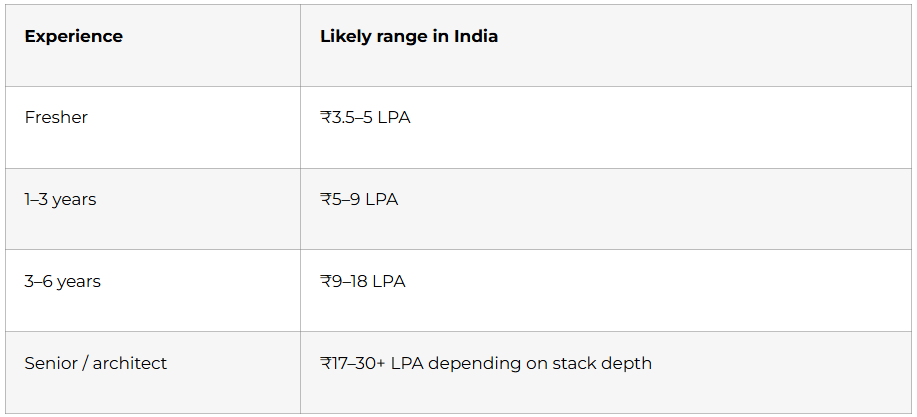
Use salary discussions carefully and base expectations on your actual profile, because Java pay changes a lot depending on company type, backend specialization, distributed systems knowledge, and cloud or DevOps exposure.
Sample line:
“Based on my Java backend skills, project depth, and the current market range for similar roles in India, I am looking for a fair opportunity in the range of X to Y LPA, while also considering the role scope and long-term growth.”
Thank-you and follow-up emails
Thank-you and follow-up emails
Subject: Thank you Java Developer interview
Hello [Interviewer Name],
Thank you for taking the time to speak with me today regarding the Java Developer role. I enjoyed our discussion, especially the conversation around [Core Java / Spring Boot / REST APIs / multithreading / backend design].
The role aligns strongly with my background in Java, backend development, and problem solving, and I would be excited about the opportunity to contribute.
Thank you again for your time and consideration.
Best regards,
[Your Name]
[Phone Number]
[Email]
Follow-up email after 4–7 days
Subject: Follow-up on Java Developer interview
Hello [Interviewer Name],
I hope you are doing well. I wanted to follow up on the interview process for the Java Developer position. I remain very interested in the role and wanted to check whether there are any updates regarding the next steps.
Thank you for your time and consideration.
Best regards,
[Your Name]
These kinds of professional follow-ups remain standard post-interview best practice for technical roles.
Final 30-day checklist
Week 1
- Revise OOP, classes, objects, constructors, overloading, overriding, interfaces, and abstract classes.
- Practice explaining Java fundamentals aloud.
- Finalize 2 Java project stories.
- Update resume summary and skills.
Week 2
- Revise collections, exception handling, strings, Java 8+ features, and SQL basics.
- Solve small Java coding problems daily.
- Strengthen one backend or Spring Boot project explanation.
- Update LinkedIn headline and About section.
Week 3
- Revise multithreading, JVM internals, Spring Boot, Hibernate, JPA, REST APIs, and transactions.
- Practice framework-based interview questions.
- Prepare answers around HashMap, dependency injection, and ACID properties.
- Practice debugging and scenario-based answers.
Week 4
- Revise DSA patterns, system design basics, design patterns, and behavioral answers using STAR.
- Do full mock interviews: HR, Core Java, Spring, coding, and project round.
- Review salary range and recruiter communication.
- Apply consistently and track responses.
Final 3 days
- Review only your condensed notes and project summaries.
- Practice concise spoken answers.
- Keep resume, GitHub, project links, and documents ready.
- Focus on clarity, calmness, and consistency.