
90-Day Java Full Stack Developer Roadmap: From Zero to Job-Ready
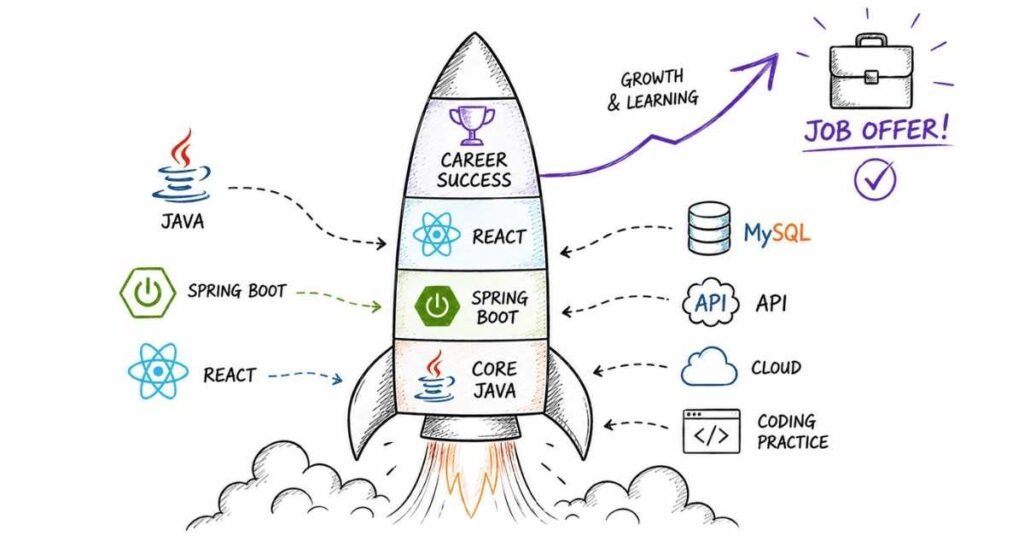
Table of Contents
This is a structured, day-by-day 90-day roadmap to become a job-ready Java Full Stack Developer covering Core Java, Spring Boot, React, MySQL, MongoDB, Microservices, and Spring AI. Built on Frontlines Edutech’s proven Java Full Stack course curriculum, this plan is designed for fresh graduates, career switchers, and non-IT students across India who want to land their first tech job even if they’ve never written a single line of code. By Day 90, you’ll have 14 real-world projects in your portfolio, an ATS-ready resume, and the technical skills to crack interviews at Infosys, TCS, Wipro, Accenture, and top Hyderabad startups.
Why Java Full Stack Development Is Worth Your 90 Days
Java isn’t going anywhere. It remains the backbone of enterprise software at every major IT company in India. Here’s why Full Stack Java developers are in the highest demand:
- Freshers earn ₹3.5–7 LPA to start and experienced developers command ₹12–25 LPA
- Full Stack means double the value you can build the frontend and the backend, making you hireable for twice the roles
- Java powers 3 billion devices banks, hospitals, e-commerce platforms, and government systems all run on it
- Cities like Hyderabad, Bangalore, Pune, Mumbai, and Chennai post thousands of Java developer openings every month
- Adding Spring AI and Microservices to your resume puts you in the top 10% of fresher candidates
The bottom line: Java Full Stack development gives you the fastest path from zero coding experience to a ₹5 LPA+ offer letter.
Access Java Full Stack Learning Resources →
The 3-Month Learning Structure at a Glance
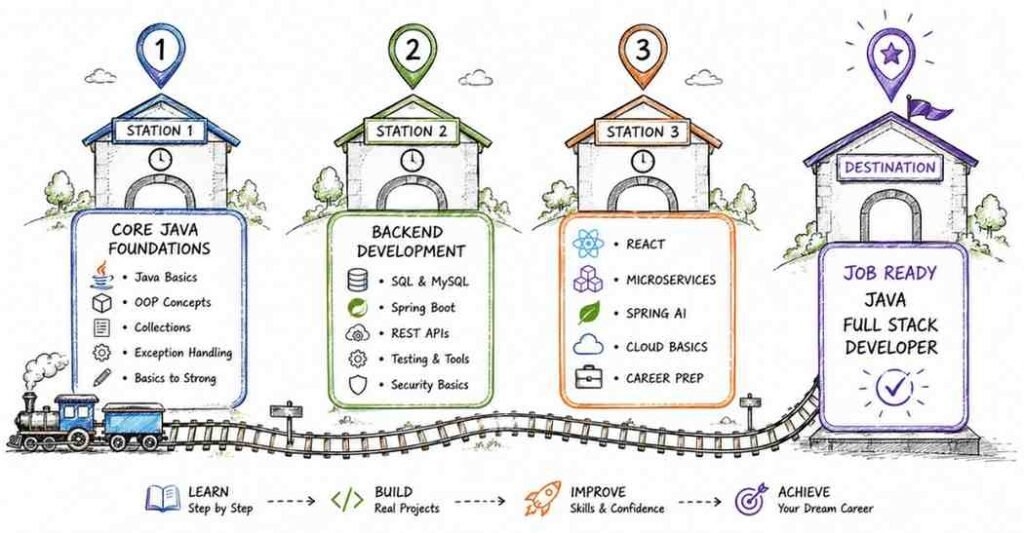
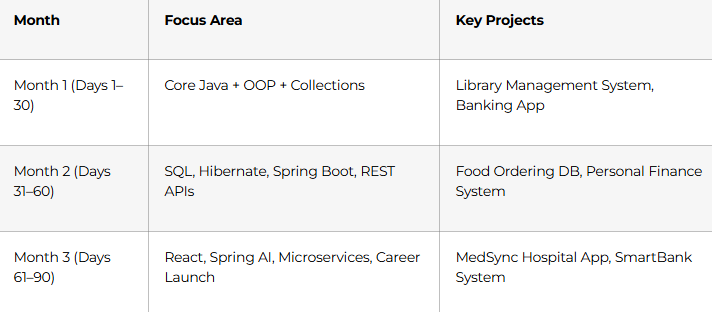
Month 1: Core Java Foundation (Days 1–30)
Every expert Java developer started exactly here. Month 1 builds the thinking patterns and coding instincts you’ll use for the rest of your career. Do not skip or rush this month.
Week 1: Java Basics & Environment Setup (Days 1–7)
- Days 1–2 Install JDK, Eclipse IDE, Anaconda. Understand JVM, JRE, JDK differences. Write your first “Hello World” program
- Days 3–4 Variables, data types (int, String, boolean, double), operators, naming conventions. Complete 10–15 coding exercises
- Days 5–7 Control statements (if-else, switch), loops (for, while, do-while). Build a simple calculator and decision-making programs
💡 Daily Habit: Spend 30 minutes daily on HackerRank or LeetCode Easy problems. Logical thinking is a muscle you build it with daily reps, not weekend cramming.
Week 2: Object-Oriented Programming The Most Important Week (Days 8–14)
OOP is the foundation of every Spring Boot application, every enterprise Java system, and every interview. Take your time here.
- Days 8–9 Classes and Objects: blueprints vs instances, constructors, method creation. Build a Student/Employee class
- Days 10–11 The 4 Pillars of OOP: Encapsulation (data hiding), Inheritance (code reuse), Polymorphism (one interface, many forms), Abstraction (hiding complexity)
- Days 12–13 Access modifiers (public, private, protected), static variables and methods, Bank Account system with encapsulation
- Day 14 Interfaces vs. Abstract Classes; build a Payment System supporting Credit Card, UPI, and Net Banking
Week 2 Project: Library Management System using full OOP your first portfolio piece.
Week 3: Advanced Java Concepts (Days 15–21)
- Days 15–16 Exception handling: try-catch-finally, checked vs. unchecked exceptions, custom exceptions
- Days 17–18 Collections Framework: ArrayList, LinkedList, HashSet, HashMap, TreeMap when to use which and why
- Days 19–20 Multithreading: creating threads with Runnable and Thread class, synchronisation basics
- Day 21 Java 8 Features: Lambda Expressions, Functional Interfaces, Stream API, Optional class
Week 4: File Handling, Strings & Month 1 Capstone (Days 22–30)
- Days 22–24 File I/O: read, write, different file types, exception handling for file operations
- Days 25–27 String mastery: StringBuilder vs StringBuffer, string methods, wrapper classes, palindrome and pattern programs
- Days 28–30 Month 1 Capstone: Banking Application with account creation, deposits, withdrawals, file-stored transaction history, and menu-driven interface
🏆 Month 1 Milestone: 500+ lines of code written. 3 projects completed. Core Java: done.
Month 2: Databases, Spring Boot & REST APIs (Days 31–60)
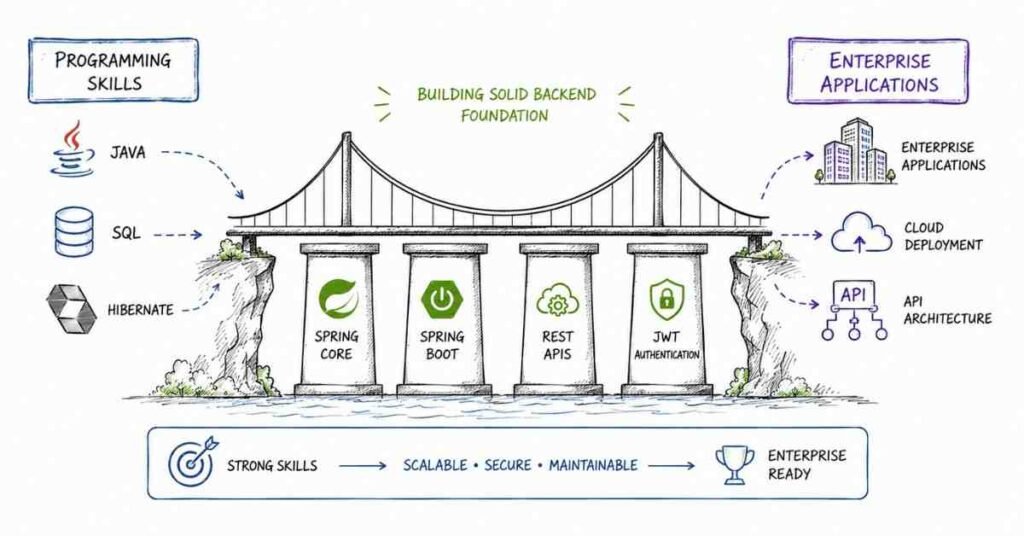
Month 2 is where you transform from a Java programmer into a backend developer. By Day 60, you’ll be building production-ready APIs that companies actually deploy.
Week 5: Database Mastery SQL & MongoDB (Days 31–37)
Every backend developer must know databases. No exceptions.
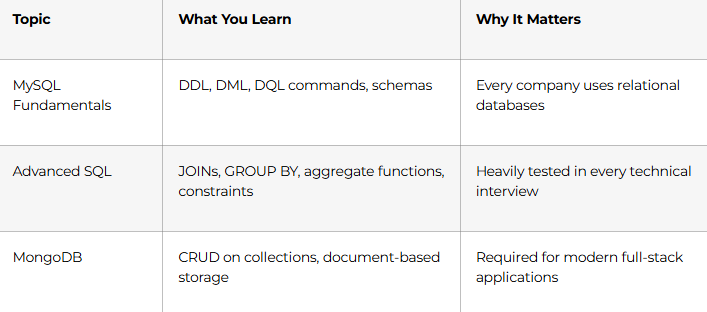
Week 5 Project: Design a complete database schema for an Online Food Ordering System customers, restaurants, menus, orders, and delivery tracking.
Week 6: JDBC, Hibernate & ORM (Days 38–44)
- Days 38–40 JDBC: connect Java to MySQL, execute queries using Statement and PreparedStatement, build a full CRUD application
- Days 41–43 Hibernate ORM: map Java objects to database tables automatically, Session, SessionFactory, entity annotations, transaction management
- Day 44 Hibernate Relationships: One-to-One, One-to-Many, Many-to-Many with Eager vs. Lazy loading strategies
Week 7: Spring Framework The Enterprise Standard (Days 45–51)
Spring is what separates hobby projects from enterprise code.
- Days 45–46 Spring Core: IoC, Dependency Injection, Bean Scopes (Singleton vs. Prototype), Bean Lifecycle using XML and annotations
- Days 47–48 Spring JDBC & Spring ORM: JdbcTemplate, HibernateTemplate cut boilerplate code by 70%
- Days 49–50 Spring MVC: DispatcherServlet, @Controller, @RequestMapping, Model-View-Controller architecture, dynamic JSP pages
- Day 51 Spring AOP: add automatic logging, security, and transaction management across the app without touching existing code
Week 7 Project: Employee Management Web Application add, edit, delete, and view employees using Spring MVC.
Week 8: Spring Boot Build APIs in Minutes (Days 52–60)
Spring Boot is what every Java job listing actually wants. This week is gold.
- Days 52–53 Spring Boot fundamentals: auto-configuration, embedded Tomcat, Spring Boot Starters. Build your first REST API in 30 minutes
- Days 54–55 REST API mastery: @RestController, GET/POST/PUT/DELETE methods, ResponseEntity, status codes, Postman testing
- Days 56–57 Spring Data JPA: auto-generated CRUD repositories, custom finder methods, JPQL queries
- Days 58–59 Global exception handling with @RestControllerAdvice; intro to Spring Security with JWT authentication
Month 2 Capstone: Personal Finance Management System (PFMS) user registration, expense tracking, budget management, category reports, and JWT authentication. This is enterprise-level backend development.
🏆 Month 2 Milestone: You can now build production-ready REST APIs with database integration and security. You are a backend developer.
Explore the Java Full Stack Career Guide →
Month 3: Frontend, Spring AI, Microservices & Career Launch (Days 61–90)
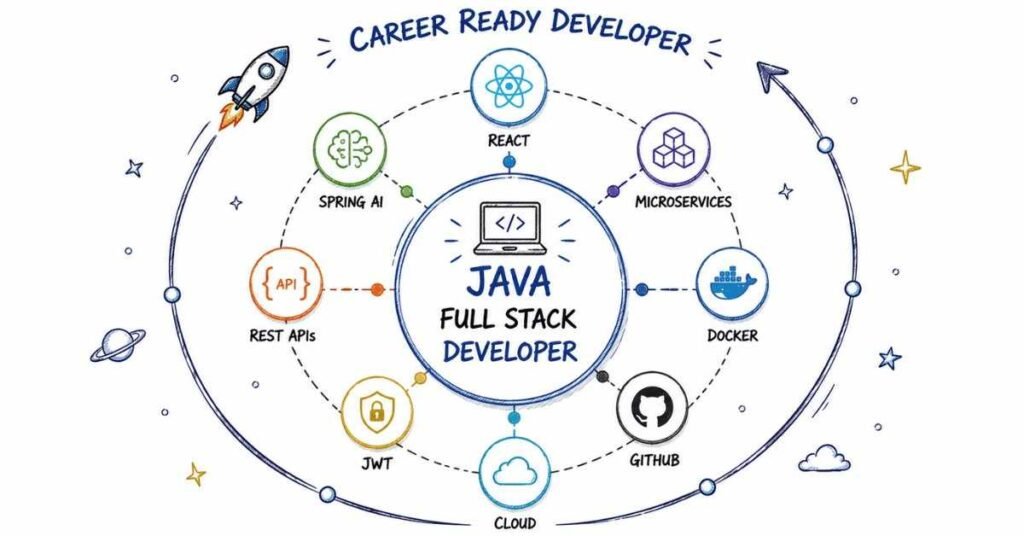
The final month adds React to your stack, introduces cutting-edge Spring AI, covers Microservices architecture, and ends with a full career launch sprint.
Week 9: Frontend Foundation HTML, CSS & JavaScript (Days 61–67)
- Days 61–62 How the internet works, HTTP request-response, HTML5 semantic structure, forms, and input types
- Days 63–64 CSS box model, Flexbox layouts, responsive design with media queries, Bootstrap components (navbars, cards, buttons)
- Days 65–67 JavaScript: variables, loops, functions, DOM manipulation, event handling (click, scroll, keypress), form validation
Week 10: Advanced JavaScript & React (Days 68–74)
React is the most in-demand frontend framework. This week makes you a Full Stack developer for real.
- Days 68–69 OOP in JavaScript, Promises, async/await, Fetch API for calling backend services
- Days 70–71 React setup with Node.js + npm, component architecture, JSX, props, useState hook, conditional rendering
- Days 72–73 useEffect, useContext, React Router for single-page applications (SPA), programmatic navigation
- Day 74 Connect React to Spring Boot: Axios API calls, CORS configuration, JWT token handling in frontend
Full Stack Project: Weather Application React frontend + Spring Boot backend + external weather API integration.
Week 11: Spring AI, Testing & Microservices (Days 75–81)
This is the week that separates Frontlines Edutech graduates from everyone else.
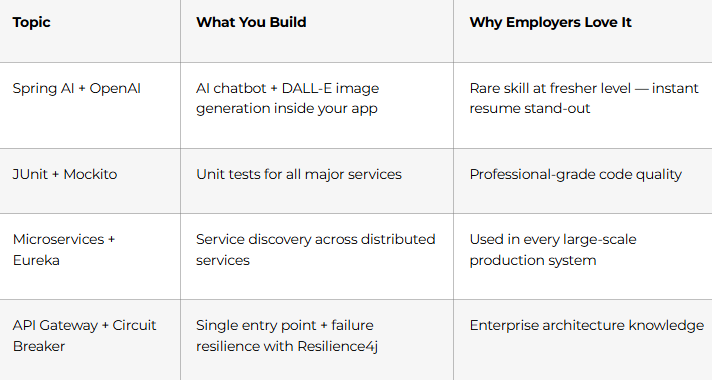
Week 11 Capstone: Microservices-Based E-commerce System separate services for users, products, orders, and payments communicating through an API Gateway.
Week 12: Career Launch (Days 82–90)
- Days 82–83 Git + GitHub mastery: commits, branches, pull requests, merge conflicts, professional README files, open-source contributions
- Days 84–86 Complete your 2 major capstone projects:
- MedSync AI-Powered Hospital Management System (Spring Boot + React + Spring AI + MySQL + JWT)
- SmartBank Management System Account management, fund transfers, loans, role-based access with Spring Security
- Days 87–88 ATS-optimised resume (quantify: “Built REST API handling 1,000+ daily requests”), LinkedIn headline: “Java Full Stack Developer | Spring Boot | React | Open to Opportunities in Hyderabad”
- Days 89–90 Interview prep sprint: Core Java concepts, Spring Boot architecture, project walkthroughs, STAR behavioural answers + mock interview
🏆 Day 90 Milestone: 14 projects. 1 portfolio. 1 resume. 1 LinkedIn. You’re ready to apply.
Explore the Java Full Stack Career Guide →
Interview Preparation: What to Expect at Each Round
Round 1: Technical Screening
Questions on OOP principles, exception handling, Collections, Java 8 features, Spring Boot auto-configuration, REST API principles, and SQL vs. NoSQL. Prepare to walk through your projects in detail.
Round 2: Coding Assessment
2–3 problems on arrays, strings, sorting, hashing, basic recursion. Practice on HackerRank, LeetCode Easy, GeeksforGeeks. Think aloud interviewers evaluate your problem-solving process, not just the answer.
Round 3: System Design
Explain your MedSync or SmartBank architecture. Questions like “Design a URL shortener” or “How would you scale this API?” Discuss frontend-backend separation, database schema, authentication flow, and caching strategy.
Round 4: HR & Behavioural
STAR format stories about teamwork, handling challenges, and why you chose development. Research the company beforehand and prepare 2–3 genuine questions about their tech stack.
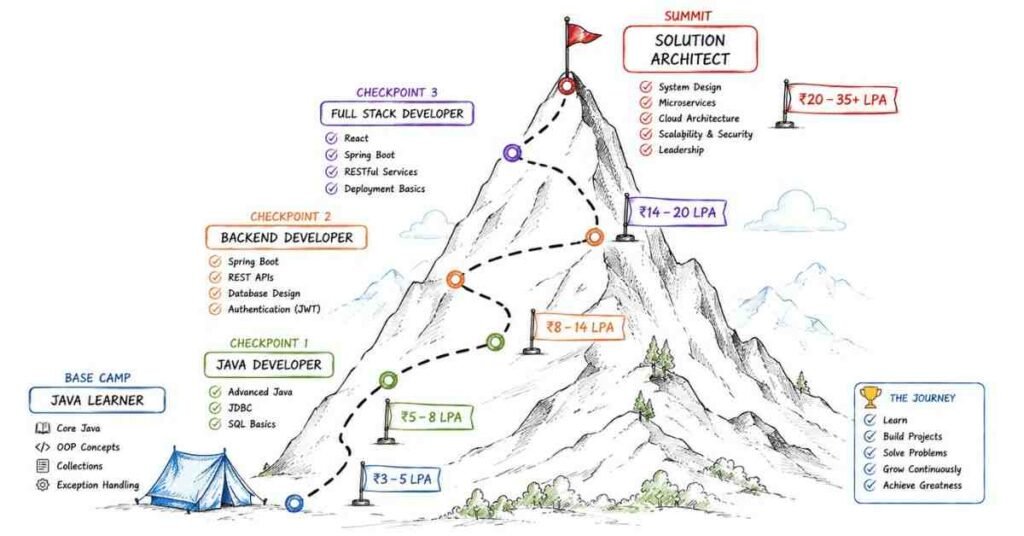
Java Full Stack Career Paths & Salary Guide (India 2026)
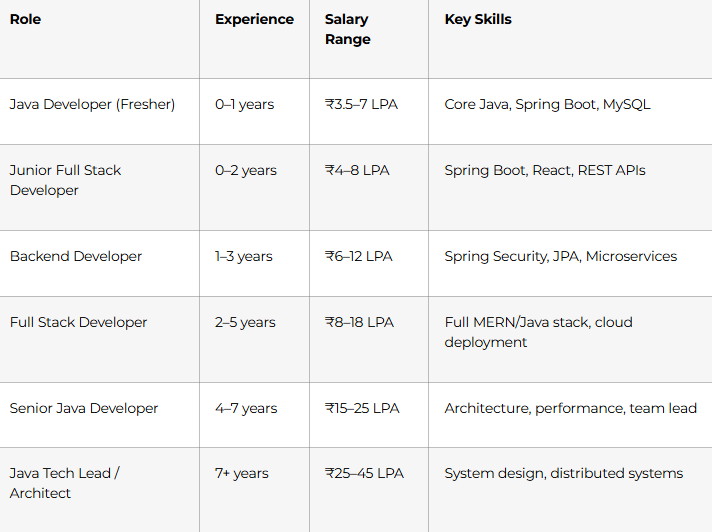
Top hiring cities: Hyderabad, Bangalore, Pune, Mumbai, Chennai, Gurgaon, Noida
Active hirers: Infosys, TCS, Wipro, Accenture, Cognizant, IBM, Capgemini, Mphasis, KPMG, and hundreds of funded startups in fintech, edtech, and healthtech.
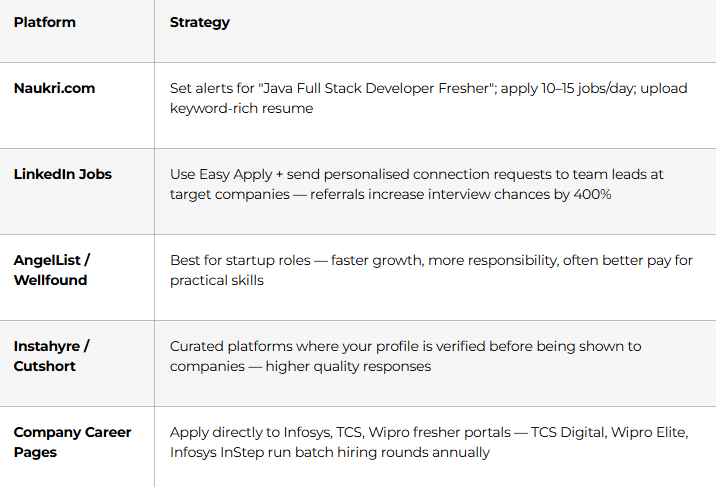
Top Job Platforms for Java Full Stack Freshers
Why Choose Frontlines Edutech?
Frontlines Edutech is headquartered in Somajiguda, Hyderabad and has placed 3,000+ students at companies including TCS, Infosys, Wipro, Accenture, Cognizant, and IBM.
- 14 real-world projects including AI-powered apps not toy examples
- Industry mentors who write production code, not career trainers who only teach theory
- Telugu-friendly teaching complex Spring Boot and React concepts explained in the language you think in
- Mock interviews + resume workshops built into the course, not sold separately
- Placement support until you’re hired not just for 3 months after course completion
- Flexible batches weekday, weekend, and evening options for working professionals
- Lifetime access to recordings, code repositories, and the alumni community
Frequently Asked Questions (FAQs)
Q1.Do I need prior programming experience to join this Java Full Stack course?
A.No prior coding knowledge is needed. The course starts from Day 1 basics what programming is, how to install Java, and how to write your first program. It is designed specifically for complete beginners, non-IT graduates, and career switchers.
Q2.How many hours per day do I need to study to complete this roadmap in 90 days?
A.Plan for 3–4 hours of focused learning and coding daily. Working professionals and college students can follow weekend batches and may take up to 120 days. Consistency matters more than hours do not skip days.
Q3.What is the salary for a Java Full Stack Developer fresher in India?
A.Freshers typically earn ₹3.5–7 LPA depending on company, city, and interview performance. Hyderabad and Bangalore offer the most competitive packages. Students with strong portfolios and 2+ capstone projects consistently land higher offers.
Q4.What projects will I build in this Java Full Stack course?
A.You’ll build 14 projects including MedSync (AI-powered hospital management system), SmartBank (secure banking app), StayEase (accommodation booking system), Personal Finance Management System, Weather App with React + Spring Boot, and 7 additional mini-projects covering core skills.
Q5.Is Spring Boot covered in this Java Full Stack roadmap?
A.Yes. Spring Boot is covered in depth during Week 8 (Days 52–60) including REST API development, Spring Data JPA, Spring Security with JWT authentication, and global exception handling. Spring AI and Microservices are covered in Week 11.
Q6.Does Frontlines Edutech provide placement support after the Java Full Stack course?
A.Yes. Placement support includes resume building, LinkedIn optimisation, mock interviews, and active job leads from 200+ partner companies. The team supports you until you land your first role not just for a fixed period.
Q7.What is the difference between Java Full Stack and MERN Full Stack?
A.Java Full Stack uses Java + Spring Boot (backend) + React (frontend) + MySQL/MongoDB (database). MERN uses MongoDB + Express + React + Node.js. Java Full Stack pays more at enterprise companies like Infosys and TCS, while MERN is popular at startups. Both are excellent career choices.
Q8.Can I learn Java Full Stack while working a full-time job?
A.Yes. Frontlines Edutech offers weekend and evening batches specifically for working professionals. All live sessions are recorded, so you can revise at your own pace. The 90-day timeline can be extended to 120 days for working professionals without any penalty.
Published by Frontlines Edutech | blog.frontlinesedutech.com
support@frontlinesedutech.com