ServiceNow Career Path for Beginners and Job Roles
Recommended Learning Path
What is ServiceNow
Understanding ServiceNow Career Beginners
What Is the ServiceNow Career Path for Beginners?
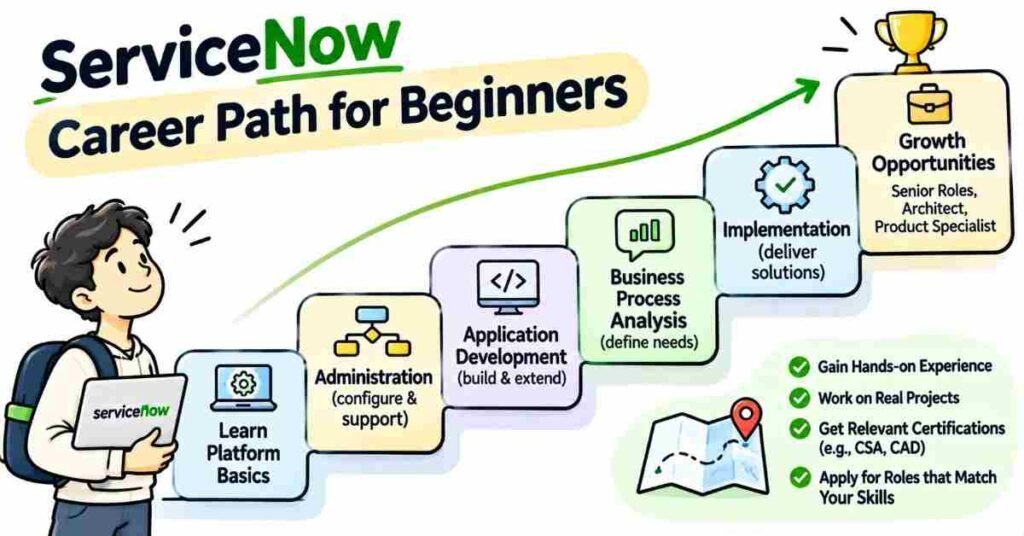
The ServiceNow career path usually starts with platform fundamentals, followed by a role direction such as administration, application development, business process analysis, or implementation. It is not a compulsory ladder where everyone must become an administrator, then a developer, then an architect.
ServiceNow University provides separate journeys for these roles. Its guidance also distinguishes a broad career journey from a learning path designed around a particular credential.learning.
Quick answer
A practical beginner sequence is:
- Understand how the platform stores information and supports work.
- Practise a small process in an authorized learning environment.
- Explore the tasks associated with different roles.
- Choose one direction for deeper study.
- Build project evidence and consider relevant certification.
- Compare your preparation with actual vacancy requirements.
This is a suggested learning approach not a guaranteed employment sequence.
What should every beginner understand?
Before choosing a title, learn to follow a record through a process.
For example, an employee submits a request. Where is it stored? Who can read it? Who approves it? What happens after rejection? How does the employee know what is happening?
Useful foundations include:
- Tables, records, fields, forms, and lists.
- Users, groups, roles, and access concepts.
- Basic ITSM terminology.
- Requests, approvals, notifications, and tasks.
- Testing and documenting changes.
You do not need to study every ServiceNow product immediately. Choose a manageable process and understand its behavior.
Which ServiceNow career directions can beginners explore?
1. Administration: configure and support platform use
Administration may suit someone interested in access, configuration, data quality, reports, and troubleshooting.
Typical questions include:
- Why can this user not see an expected record?
- Is the report using the correct filter?
- Did an import update the intended information?
- Did a configuration change affect another process?
ServiceNow describes its administrator journey around platform setup, maintenance, and troubleshooting.
2. Application development: build and extend behavior
Development may interest someone who enjoys translating requirements into application logic.
Work can involve designing records, building interfaces, writing scripts, creating automation, and connecting systems.
ServiceNow’s application developer journey focuses on designing and building platform solutions.
For a beginner, the goal is not to produce the longest script. It is to explain why an implementation fits the requirement and how it was tested.
3. Business process analysis: clarify what needs to change
Business process analysis may suit someone who enjoys asking questions, mapping processes, and explaining requirements.
For example:
- What problem is the current process causing?
- Who needs to participate?
- Which exceptions must be handled?
- How will the team decide whether the change meets the requirement?
ServiceNow describes this role as collecting requirements and bridging business needs with platform solutions.
It is not simply “a ServiceNow role without technical knowledge.” You still need enough platform understanding to discuss feasible behavior and useful acceptance criteria.
4. Implementation: configure a solution for a defined need
Implementation work combines product knowledge with understanding a customer’s requirements.
ServiceNow’s implementer journey describes working with clients to understand technical requirements and configure solutions.
Do not assume every implementation role is entry-level. Product-specific training and credentials can have additional prerequisites. Choose a specialization after understanding its expectations.
How do these roles work together?
Imagine an organization wants a structured process for requesting temporary software access.
In an illustrative team:
Perspective | Contribution |
Business process analyst | Clarifies who requests access, who approves it, and what exceptions matter |
Administrator | Supports the relevant groups, access, configuration, and operational reporting |
Developer | Builds additional application behavior or integration logic where required |
Implementer | Helps configure and deliver the agreed product solution |
This is a simplified example, not a universal staffing model. One person may cover several responsibilities, and job titles vary.
The important point is that these are connected disciplines—not four completely separate worlds.
How can you choose a direction?
Try one small project before making a permanent decision.
Create a synthetic “Training Access Request” exercise:
- Write the requirement and acceptance criteria.
- Define the records and fields.
- Configure appropriate access.
- Add a simple approval process.
- Test approval, rejection, and restricted actions.
- Document one problem you investigated.
Then reflect on the work:
- Did you most enjoy clarifying the requirement?
- Configuring the platform?
- Writing and debugging logic?
- Connecting the pieces into a usable process?
These questions suggest what to explore next. They are not aptitude tests or guarantees about career fit.
Where can you practise?
ServiceNow offers free Personal Developer Instances for learning and experimentation, subject to availability. They are not intended for production or business use.
Use synthetic records and preserve your work. Official guidance warns that inactive instances can be reclaimed and recommends regular backups. Some products or capabilities may need different access arrangements.
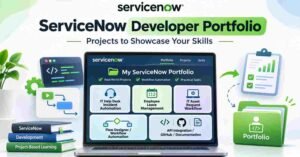
A portfolio can contain screenshots, a short demonstration, configuration notes, and test results. Clearly identify it as practice work rather than client experience.
How should you plan certifications?
Choose a credential because it supports your intended work—not because it appears next in an unofficial checklist.
Common directions include:
- CSA for platform administration knowledge.
- CAD for application-development knowledge.
- Product-specific CIS credentials for implementation specializations.
ServiceNow’s official guidance distinguishes career journeys from credential-focused paths and recommends focusing on one journey and level at a time.
Check each credential’s current requirements separately. For example, the published ITSM implementation route includes a required Data Foundations certification alongside recommended platform and ITSM training. Do not assume CSA alone satisfies every specialization’s conditions.
A training provider’s completion certificate is separate from an official ServiceNow credential.
What comes after the first learning stage?
Progression depends on the responsibilities you can handle—not simply time spent studying.
Later development might involve:
- Handling more complex configuration or application changes.
- Developing deeper knowledge of a product area.
- Reviewing other people’s work.
- Leading a defined implementation workstream.
- Taking responsibility for technical design decisions.
Architecture is a later direction, not an automatic next step after a beginner course. ServiceNow’s CTA program requires implementation experience and several current credentials, among other conditions.
Do not treat those requirements as a promotion schedule.
Proposed FLM perspective: follow the work, not the title
Use evidence to guide your next step.
If you can demonstrate configuration but cannot yet explain scripts, deepen the relevant foundation. If you can code but struggle to clarify requirements, practise writing acceptance criteria and discussing exceptions.
A useful career plan identifies the next capability to build—not only the next title to place on a profile.
FLM advertises administration, scripting, workflows, integrations, and project topics. Review its option to learn ServiceNow in Telugu, then confirm which learning direction, practice environment, and feedback arrangements it supports.
Common mistakes to avoid
- Assuming everyone must follow the same role sequence.
- Studying several specializations before completing one small project.
- Treating administration as permanently coding-free.
- Treating business analysis as only writing meeting notes.
- Collecting credentials without practical work.
- Describing training exercises as production experience.
- Assuming a course or certification guarantees selection.
FAQs
- Is administration the only starting point?
No. ServiceNow provides several role-based learning journeys. Platform foundations are useful across them, but there is no single mandatory employment sequence. - Can a non-IT beginner explore ServiceNow?
You can begin with platform concepts and practical exercises. Check course prerequisites and the education or experience requirements of individual vacancies separately. - Should I choose developer or administrator immediately?
You can first explore a small project covering both configuration and application behavior. Use that experience to choose a focused direction. - Must I earn CSA before every other credential?
Do not assume a universal rule. Review the current requirements for the specific credential and specialization. - Can I practise without an employer’s instance?
Yes. PDIs provide learning sandboxes, subject to availability and usage rules. - How long does a ServiceNow career transition take?
There is no universal timeline. Prior experience, available practice time, learning progress, and employer requirements differ. - Does certification guarantee a job?
No. Treat it as one part of preparation. Review each vacancy and be ready to demonstrate your work honestly.