How to Become a DevOps Engineer : Complete Career Guide 2025 [₹12L Average Salary]

devops engineer

Master Devops Engineer The bridge between development and operations for seamless software delivery

DevOps engineers are among the most sought-after professionals in the technology industry, with average salaries ranging from ₹6-22 LPA in India and senior DevOps architects earning ₹35+ LPA. As organizations accelerate their digital transformation and embrace continuous delivery, the ability to automate, monitor, and optimize software development lifecycles has become one of the most critical and well-compensated skills in technology.

Whether you’re a system administrator looking to modernize your skills, a developer seeking infrastructure expertise, or an IT professional transitioning to cloud-native operations, this comprehensive guide provides the proven roadmap to building a successful DevOps career. Having trained over 200 DevOps professionals at Frontlines EduTech with a 91% job placement rate, I’ll share the strategies that consistently deliver results in the rapidly evolving DevOps landscape.

What you’ll master in this guide:

  • Complete DevOps learning roadmap from infrastructure basics to advanced automation
  • Essential tools and technologies for CI/CD, monitoring, and infrastructure as code
  • Hands-on projects demonstrating real-world DevOps implementations
  • Certification strategies and interview preparation frameworks
  • Career advancement opportunities in platform engineering and site reliability

1. What is DevOps Engineering?

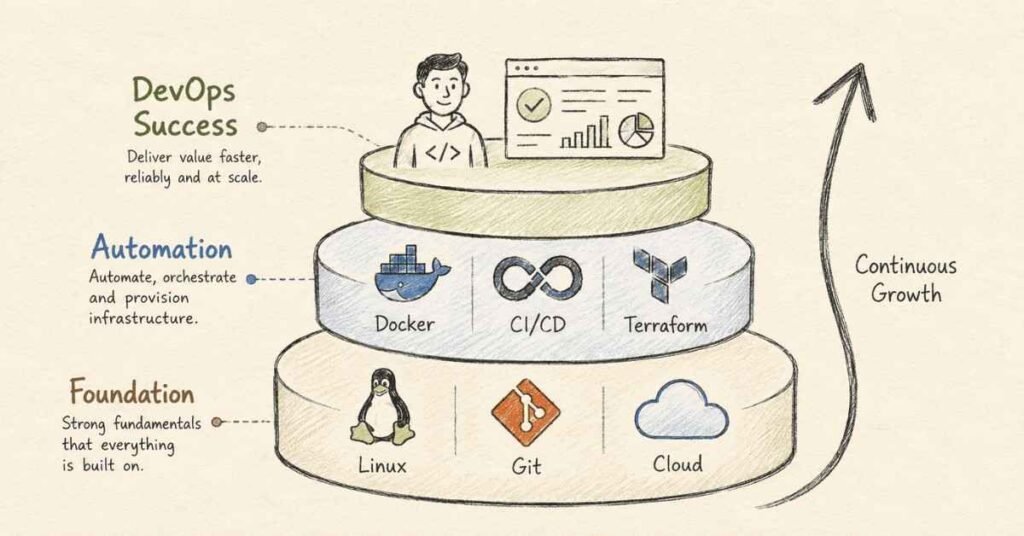
DevOps engineering is the practice of combining software development (Dev) and IT operations (Ops) to shorten the development lifecycle while delivering high-quality software continuously. DevOps engineers focus on automation, collaboration, and monitoring throughout the entire software development and deployment process, from initial code commit to production monitoring and maintenance.

Core Responsibilities of DevOps Engineers:

Continuous Integration and Deployment (CI/CD):

  • Pipeline Development – Design and implement automated build, test, and deployment processes
  • Version Control Management – Git workflows, branching strategies, and code review processes
  • Automated Testing Integration – Unit tests, integration tests, and quality gates
  • Release Management – Deployment strategies, rollback procedures, and release coordination
 

Infrastructure as Code (IaC):

  • Infrastructure Automation – Terraform, CloudFormation, ARM templates for resource provisioning
  • Configuration Management – Ansible, Puppet, Chef for system configuration and compliance
  • Container Orchestration – Kubernetes, Docker Swarm for containerized application management
  • Cloud Platform Management AWS, Azure, GCP resource optimization and cost management
 

Monitoring and Observability:

  • Application Performance Monitoring – APM tools, custom metrics, alerting systems
  • Log Management – Centralized logging, log analysis, and correlation
  • Infrastructure Monitoring – Server metrics, network monitoring, capacity planning
  • Incident Response – On-call procedures, troubleshooting, and root cause analysis
 

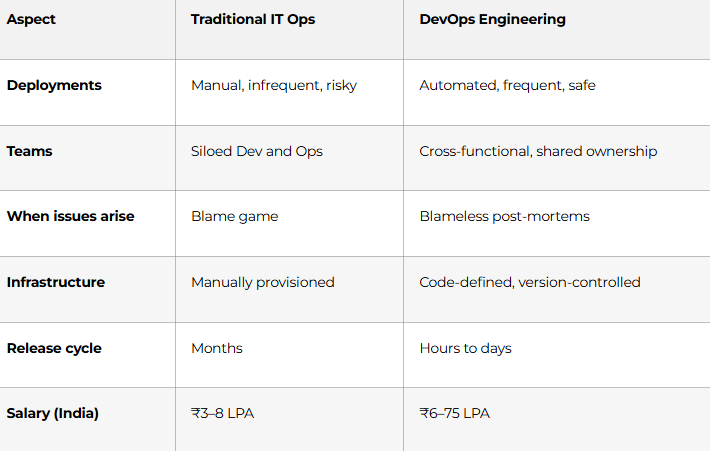
DevOps vs Traditional IT Operations

Traditional IT Operations:

  • Manual deployment processes and change management
  • Siloed development and operations teams
  • Reactive monitoring and incident response
  • Lengthy release cycles with infrequent deployments
 

DevOps Approach:

  • Automated deployment pipelines with continuous delivery
  • Cross-functional teams with shared responsibilities
  • Proactive monitoring with predictive analytics
  • Frequent, small releases with rapid feedback loops
 

Modern DevOps Evolution:
Today’s DevOps engineer often specialize in areas like Platform Engineering (building developer platforms), Site Reliability Engineering (ensuring system reliability), or Cloud Engineering (cloud-native architecture and optimization).

2 .Why Choose DevOps in 2025?

how to become a devops engineer

Critical Role in Digital Transformation

According to Puppet’s State of DevOps Report 2025, high-performing organizations deploy code 208 times more frequently than low performers while maintaining superior reliability. In India specifically, DevOps adoption has accelerated dramatically:

Enterprise DevOps Transformation:

  • Banking and Financial Services – HDFC Bank, ICICI Bank implementing DevOps for digital banking platforms
  • E-commerce Platforms – Flipkart, Amazon India scaling DevOps practices for high-volume transactions
  • Technology Companies – TCS, Infosys, Wipro establishing DevOps centers of excellence
  • Startup Ecosystem – Razorpay, CRED, Dream11 using DevOps for rapid scaling and reliability
 

Cloud-Native Adoption:

  • Microservices Architecture – Organizations breaking monoliths into scalable, manageable services
  • Container Adoption – Docker and Kubernetes becoming standard for application deployment
  • Serverless Computing – Functions-as-a-Service requiring new deployment and monitoring approaches
  • Multi-Cloud Strategies – Organizations avoiding vendor lock-in through diversified cloud usage
 

Premium Compensation and Job Security

DevOps engineers command among the highest salaries in IT due to their cross-functional expertise:

how to become a devops engineer guide by frontlinesedutech

Source: PayScale India 2025, Glassdoor Business Analyst Salaries

Recession-Resistant Career Path

DevOps skills are considered essential infrastructure, making professionals recession-resistant:

  • Operational Efficiency – Organizations need DevOps to reduce operational costs and improve efficiency
  • Digital Resilience – Companies invest in automation and monitoring during economic uncertainty
  • Cost Optimization – DevOps practices directly impact cloud costs and resource utilization
  • Innovation Enablement – DevOps enables faster product development and competitive advantage
 

Multiple Specialization Opportunities

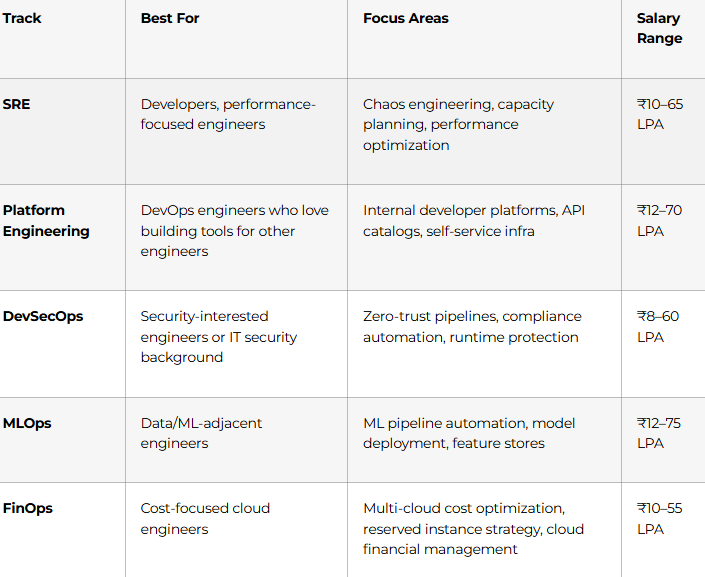
DevOps offers diverse career specialization paths:

  • Site Reliability Engineering (SRE) – Focus on system reliability, scalability, and performance
  • Platform Engineering – Build internal developer platforms and tooling
  • Cloud Engineering – Specialize in cloud architecture and optimization
  • Security Engineering (DevSecOps) – Integrate security practices into DevOps workflows
  • Data Engineering – Apply DevOps practices to data pipelines and analytics infrastructure

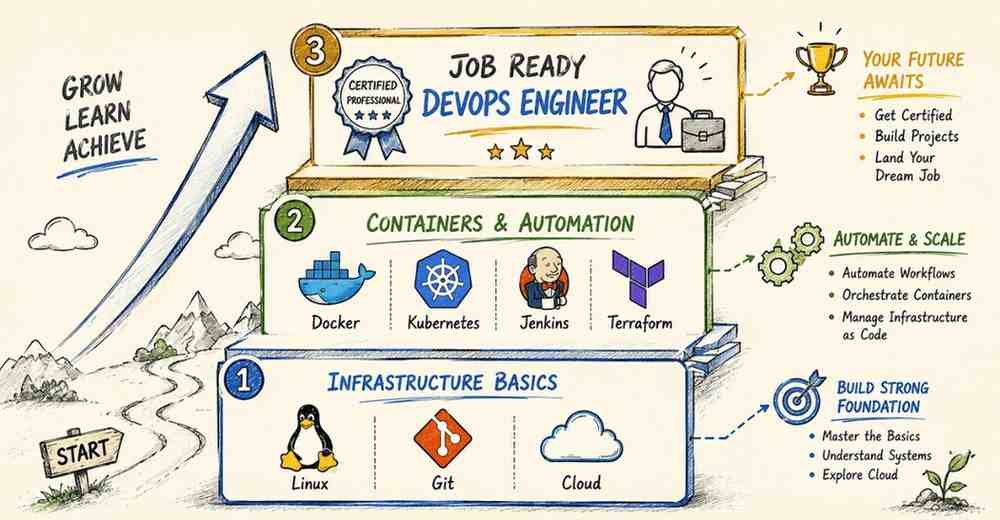
3. Complete Learning Roadmap (6-8 Months)

devops engineer roadmap

Phase 1: Infrastructure Fundamentals (Months 1-2)

Linux System Administration (3-4 weeks)
Strong Linux foundation is crucial for DevOps success:

  • Command Line Mastery – File operations, text processing, system monitoring
  • System Administration – User management, permissions, process management
  • Networking Basics – TCP/IP, DNS, load balancing, firewall configuration
  • Shell Scripting – Bash scripting for automation tasks and system maintenance
 

Version Control and Collaboration (2-3 weeks)

  • Git Fundamentals – Repository management, branching, merging, conflict resolution
  • Git Workflows – GitFlow, GitHub Flow, trunk-based development
  • Collaboration Tools – Pull requests, code reviews, issue tracking
  • Advanced Git – Rebasing, cherry-picking, hooks, submodules
 

Cloud Platform Basics (2-3 weeks)
Choose primary platform for deep learning:

  • Amazon Web Services (AWS) – EC2, S3, VPC, IAM, CloudWatch basics
  • Microsoft Azure – Virtual Machines, Storage, Virtual Networks, Active Directory
  • Google Cloud Platform – Compute Engine, Cloud Storage, VPC, Identity and Access Management
 

Practical Foundation Projects:

  1. Linux Server Setup – Configure web server with security hardening and monitoring
  2. Git Repository Management – Multi-branch development workflow with automated testing
  3. Cloud Infrastructure Deployment – Basic three-tier architecture in chosen cloud platform
 

Phase 2: Containerization and Orchestration (Months 2-4)

Docker Mastery (3-4 weeks)

  • Container Fundamentals – Images, containers, registries, networking, volumes
  • Dockerfile Creation – Multi-stage builds, optimization, security best practices
  • Docker Compose – Multi-container applications, service definitions, networking
  • Container Security – Image scanning, runtime security, least privilege principles
 

Kubernetes Deep Dive (4-6 weeks)

  • Kubernetes Architecture – Master/worker nodes, API server, etcd, scheduler, kubelet
  • Core Objects – Pods, Services, Deployments, ConfigMaps, Secrets, Ingress
  • Advanced Concepts – Namespaces, RBAC, Network Policies, Persistent Volumes
  • Cluster Management – Installation, upgrades, backup, monitoring, troubleshooting
 

Container Security and Best Practices (1-2 weeks)

  • Image Security – Vulnerability scanning, base image selection, dependency management
  • Runtime Security – Pod security policies, network segmentation, monitoring
  • Supply Chain Security – Signed images, admission controllers, compliance scanning
 

Containerization Projects:

  1. Microservices Application – Containerize multi-service application with Docker and Docker Compose
  2. Kubernetes Cluster – Deploy production-ready Kubernetes cluster with monitoring and logging
  3. Container Security Implementation – Implement security scanning and policy enforcement
 

Phase 3: CI/CD and Automation (Months 4-6)

CI/CD Pipeline Development (4-5 weeks)

  • Jenkins Mastery – Pipeline as Code, Jenkinsfile, plugins, distributed builds
  • GitLab CI/CD – YAML pipelines, runners, artifacts, environments
  • GitHub Actions – Workflow automation, marketplace actions, secrets management
  • Azure DevOps – Build pipelines, release pipelines, artifact management
 

Infrastructure as Code (3-4 weeks)

  • Terraform – Resource provisioning, state management, modules, workspaces
  • CloudFormation/ARM – Cloud-native infrastructure automation
  • Ansible – Configuration management, playbooks, roles, inventory management
  • Pulumi – Modern IaC with programming languages
 

Testing and Quality Assurance (2-3 weeks)

  • Automated Testing Integration – Unit tests, integration tests, end-to-end tests
  • Quality Gates – Code coverage, security scanning, performance testing
  • Test Environment Management – Ephemeral environments, data management
  • Shift-Left Testing – Early testing integration, developer feedback loops
 

CI/CD Implementation Projects:

  1. Complete CI/CD Pipeline – Source-to-production automation with multiple environments
  2. Infrastructure as Code Project – Full infrastructure provisioning and management
  3. Multi-Cloud Deployment – Application deployment across different cloud providers
 

Phase 4: Monitoring and Observability (Months 6-7)

Monitoring Stack Implementation (3-4 weeks)

  • Prometheus and Grafana – Metrics collection, visualization, alerting
  • ELK/EFK Stack – Elasticsearch, Logstash/Fluentd, Kibana for log management
  • APM Solutions – New Relic, DataDog, Dynatrace for application monitoring
  • Jaeger/Zipkin – Distributed tracing for microservices architectures
 

Incident Management and SRE (2-3 weeks)

  • SLI/SLO/SLA Definition – Service reliability measurement and targets
  • Error Budgets – Balancing reliability and feature velocity
  • Incident Response – On-call procedures, escalation, post-mortem analysis
  • Capacity Planning – Resource forecasting, auto-scaling, cost optimization
 

Security and Compliance (2-3 weeks)

  • DevSecOps Integration – Security scanning in CI/CD pipelines
  • Compliance Automation – Policy as code, audit trails, governance
  • Secrets Management – HashiCorp Vault, cloud-native secret stores
  • Network Security – Service mesh, zero-trust networking, encryption
 

Monitoring and Reliability Projects:

  1. Comprehensive Monitoring Solution – Full-stack observability with alerting and dashboards
  2. SRE Implementation – SLI/SLO definition with error budget management
  3. Security Automation – Automated security scanning and compliance reporting
 

Phase 5: Advanced Topics and Specialization (Months 7-8)

Choose Specialization Track:

Site Reliability Engineering (SRE):

  • Advanced monitoring and alerting strategies
  • Chaos engineering and fault injection testing
  • Performance optimization and capacity management
  • Incident management and post-mortem culture
 

Platform Engineering:

  • Developer platform design and implementation
  • Self-service infrastructure and tooling
  • API management and service catalogs
  • Developer experience optimization
 

Cloud-Native Architecture:

  • Serverless computing and Functions-as-a-Service
  • Event-driven architecture and messaging systems
  • Multi-cloud and hybrid cloud strategies
  • Cloud cost optimization and FinOps practices
  •  

Security Engineering (DevSecOps):

  • Security-first CI/CD pipeline design
  • Container and Kubernetes security hardening
  • Compliance automation and governance
  • Threat modelling and security testing

4. Essential DevOps Tools and Technologies

devops engineer tools

Core DevOps Toolchain

Version Control and Collaboration:

  • Git – Distributed version control with branching and merging capabilities
  • GitHub – Cloud-based Git repositories with collaboration features and CI/CD
  • GitLab – Complete DevOps platform with built-in CI/CD and security scanning
  • Bitbucket – Atlassian ecosystem integration with Jira and Confluence
 

CI/CD Platforms:

  • Jenkins – Open-source automation server with extensive plugin ecosystem
  • GitLab CI – Integrated CI/CD with GitLab repositories and Kubernetes integration
  • GitHub Actions – Native GitHub CI/CD with marketplace of pre-built actions
  • Azure DevOps – Microsoft ecosystem integration with comprehensive tooling
 

Infrastructure and Configuration Management

Infrastructure as Code:

  • Terraform – Multi-cloud infrastructure provisioning with declarative syntax
  • AWS CloudFormation – AWS-native infrastructure automation with JSON/YAML templates
  • Azure Resource Manager – Azure infrastructure deployment with ARM templates
  • Google Cloud Deployment Manager – GCP infrastructure automation and templating
 

Configuration Management:

  • Ansible – Agentless automation with YAML playbooks and extensive module library
  • Puppet – Declarative configuration management with model-driven approach
  • Chef – Infrastructure as code with Ruby-based recipes and cookbooks
  • SaltStack – Event-driven automation with remote execution capabilities
 

Containerization and Orchestration

Container Technologies:

  • Docker – Industry-standard containerization platform with comprehensive ecosystem
  • Podman – Daemonless container engine with rootless operation capabilities
  • Containerd – Container runtime with Kubernetes integration and OCI compliance
  • CRI-O – Lightweight container runtime optimized for Kubernetes workloads
 

Container Orchestration:

  • Kubernetes – Leading container orchestration platform with extensive ecosystem
  • Docker Swarm – Docker-native orchestration with simplified cluster management
  • Amazon ECS – AWS-managed container service with Fargate serverless option
  • Azure Container Instances – Serverless container deployment without cluster management
 

Monitoring and Observability

Metrics and Monitoring:

  • Prometheus – Time-series database with powerful query language and alerting
  • Grafana – Visualization platform with support for multiple data sources
  • DataDog – Cloud-scale monitoring with AI-powered insights and integrations
  • New Relic – Application performance monitoring with full-stack observability
 

Logging and Analysis:

  • Elasticsearch – Distributed search and analytics engine for log data
  • Logstash – Data processing pipeline for log ingestion and transformation
  • Fluentd – Unified logging layer with plugin architecture and cloud-native design
  • Splunk – Enterprise log analysis with machine learning and security features
 

Distributed Tracing:

  • Jaeger – End-to-end distributed tracing with performance monitoring
  • Zipkin – Distributed tracing system for troubleshooting microservices
  • AWS X-Ray – Distributed application tracing with AWS service integration

Google Cloud Trace – Latency reporting and performance insights for GCP applications

devops engineer tools

5. Building Your DevOps Portfolio

devops engineer portfolio

Portfolio Strategy and Architecture

Comprehensive DevOps Expertise:
Demonstrate proficiency across the entire DevOps lifecycle:

  1. Infrastructure Automation – Cloud resource provisioning and management
  2. CI/CD Implementation – Automated build, test, and deployment pipelines
  3. Monitoring and Observability – Comprehensive monitoring solutions with alerting
  4. Security Integration – DevSecOps practices and compliance automation
 

Foundation Level Projects (Months 1-3)

  1. Infrastructure as Code Implementation
  • Scope: Complete infrastructure provisioning for three-tier web application
  • Technologies: Terraform, AWS/Azure/GCP, networking, security groups, databases
  • Deliverables: Reusable Terraform modules, environment-specific configurations, documentation
  • Skills Demonstrated: Cloud platform proficiency, infrastructure automation, security best practices
  • Business Value: Reproducible infrastructure, faster environment provisioning, cost optimization
 

Terraform Implementation Example:

# terraform/modules/web-app/main.tf
resource “aws_vpc” “main” {
  cidr_block           = var.vpc_cidr
  enable_dns_hostnames = true
  enable_dns_support   = true

  tags = {
    Name        = “${var.project_name}-vpc”
    Environment = var.environment
  }
}

resource “aws_subnet” “public” {
  count             = length(var.availability_zones)
  vpc_id            = aws_vpc.main.id
  cidr_block        = cidrsubnet(var.vpc_cidr, 8, count.index + 1)
  availability_zone = var.availability_zones[count.index]

  map_public_ip_on_launch = true

  tags = {
    Name = “${var.project_name}-public-${count.index + 1}”
    Type = “public”
  }
}

resource “aws_launch_template” “web” {
  name_prefix   = “${var.project_name}-web-“
  image_id      = var.ami_id
  instance_type = var.instance_type

  vpc_security_group_ids = [aws_security_group.web.id]

  user_data = base64encode(templatefile(“${path.module}/user-data.sh”, {
    app_version = var.app_version
  }))

  tag_specifications {
    resource_type = “instance”
    tags = {
      Name = “${var.project_name}-web-server”
      Environment = var.environment
    }
  }
}

  1. CI/CD Pipeline for Microservices
  • Application Architecture: Multi-service application with database and API gateway
  • Pipeline Features: Automated testing, security scanning, multi-environment deployment
  • Technologies: Jenkins/GitLab CI, Docker, Kubernetes, Helm charts
  • Quality Gates: Unit tests, integration tests, code coverage, security scans
  • Deployment Strategy: Blue-green deployment with automated rollback
 

Intermediate Level Projects (Months 4-6)

  1. Kubernetes Production Cluster
  • Cluster Setup: Production-ready Kubernetes cluster with high availability
  • Networking: Service mesh implementation with Istio or Linkerd
  • Security: RBAC, network policies, pod security policies, image scanning
  • Storage: Persistent volume management with backup and disaster recovery
  • Monitoring: Comprehensive observability with Prometheus, Grafana, and Jaeger 

Kubernetes Deployment Example:

# k8s/microservice/deployment.yaml
apiVersion: apps/v1
kind: Deployment
metadata:
  name: user-service
  namespace: production
  labels:
    app: user-service
    version: v1.2.0
spec:
  replicas: 3
  strategy:
    type: RollingUpdate
    rollingUpdate:
      maxUnavailable: 1
      maxSurge: 1
  selector:
    matchLabels:
      app: user-service
  template:
    metadata:
      labels:
        app: user-service
        version: v1.2.0
    spec:
      securityContext:
        runAsNonRoot: true
        runAsUser: 10001
      containers:
      – name: user-service
        image: myregistry/user-service:v1.2.0
        ports:
        – containerPort: 8080
          protocol: TCP
        env:
        – name: DATABASE_URL
          valueFrom:
            secretKeyRef:
              name: database-credentials
              key: url
        resources:
          requests:
            memory: “256Mi”
            cpu: “250m”
          limits:
            memory: “512Mi”
            cpu: “500m”
        livenessProbe:
          httpGet:
            path: /health
            port: 8080
          initialDelaySeconds: 30
          periodSeconds: 10
        readinessProbe:
          httpGet:
            path: /ready
            port: 8080
          initialDelaySeconds: 5
          periodSeconds: 5

apiVersion: v1
kind: Service
metadata:
  name: user-service
  namespace: production
spec:
  selector:
    app: user-service
  ports:
  – protocol: TCP
    port: 80
    targetPort: 8080
  type: ClusterIP

  1. Comprehensive Monitoring and Alerting Solution
  • Metrics Collection: Prometheus with custom metrics and business KPIs
  • Visualization: Grafana dashboards for different stakeholder groups
  • Alerting: PagerDuty integration with escalation policies and runbooks
  • Log Analysis: ELK stack with anomaly detection and correlation
  • Application Tracing: Jaeger implementation for microservices troubleshooting
 

Advanced Level Projects (Months 6-8)

  1. Multi-Cloud DevOps Platform
  • Cloud Providers: AWS, Azure, and GCP resource management
  • Abstraction Layer: Terraform modules for cross-cloud compatibility
  • Networking: VPN connections and hybrid cloud connectivity
  • Disaster Recovery: Cross-region and cross-cloud backup strategies
  • Cost Optimization: Multi-cloud cost monitoring and optimization automation
 
  1. DevSecOps Implementation
  • Security Scanning: Integrated SAST, DAST, and dependency scanning
  • Compliance Automation: Policy as code with Open Policy Agent (OPA)
  • Secrets Management: HashiCorp Vault with dynamic secret rotation
  • Runtime Security: Falco for container runtime security monitoring
  • Incident Response: Automated security incident response workflows
 

Portfolio Presentation and Documentation

GitHub Repository Structure:

devops-portfolio/
├── README.md (Portfolio overview and navigation)
├── infrastructure/
│   ├── terraform-modules/
│   ├── ansible-playbooks/
│   └── cloud-formation-templates/
├── ci-cd-pipelines/
│   ├── jenkins-pipelines/
│   ├── gitlab-ci/
│   └── github-actions/
├── kubernetes/
│   ├── manifests/
│   ├── helm-charts/
│   └── operators/
├── monitoring/
│   ├── prometheus-config/
│   ├── grafana-dashboards/
│   └── alerting-rules/
├── security/
│   ├── policies/
│   ├── scanning-configs/
│   └── compliance-reports/
└── documentation/
    ├── architecture-diagrams/
    ├── runbooks/
    └── troubleshooting-guides/

Professional Documentation Standards:

  • Architecture Diagrams – Clear visual representation of system design and data flow
  • Deployment Guides – Step-by-step instructions for environment setup and application deployment
  • Runbooks – Operational procedures for common tasks and incident response
  • Performance Metrics – Benchmarking results, scalability testing, and optimization outcomes
  • Security Analysis – Threat modeling, vulnerability assessments, and mitigation strategies


Live Demo Environment:

  • Infrastructure Automation – One-click infrastructure provisioning and destruction
  • CI/CD Demonstration – Working pipelines with real application deployments
  • Monitoring Dashboards – Live metrics and alerting demonstrations
  • Documentation Portal – Comprehensive documentation with search and navigation

6. Job Search Strategy

devops engineer job analysis

Resume Optimization for DevOps Roles

Technical Skills Section:

DevOps & Infrastructure:
• Cloud Platforms: AWS (EC2, S3, RDS, Lambda, VPC), Azure (VMs, Storage, AKS), GCP
• Containerization: Docker, Kubernetes, Helm, Container Security, Service Mesh (Istio)
• Infrastructure as Code: Terraform, CloudFormation, ARM Templates, Ansible, Puppet
• CI/CD: Jenkins, GitLab CI, GitHub Actions, Azure DevOps, Pipeline as Code
• Monitoring: Prometheus, Grafana, ELK Stack, DataDog, New Relic, Jaeger
• Scripting: Bash, Python, PowerShell, YAML, JSON, Go (basics)
• Version Control: Git, GitLab, GitHub, Branching Strategies, Code Review

Project Experience Examples:

Multi-Cloud DevOps Platform Migration

  • Challenge: Legacy on-premises infrastructure causing scalability issues and high operational costs
  • Solution: Designed and implemented multi-cloud DevOps platform with automated CI/CD and monitoring
  • Technologies: Terraform, Kubernetes, Jenkins, Prometheus, AWS, Azure, Docker
  • Results: Reduced deployment time from 6 hours to 15 minutes, improved system uptime to 99.9%, decreased infrastructure costs by 35%
 

Microservices CI/CD Pipeline Implementation

  • Challenge: Monolithic application deployment taking 2-3 days with high failure rates
  • Solution: Decomposed monolith into microservices with automated testing and deployment pipeline
  • Technologies: Docker, Kubernetes, GitLab CI, Helm, Istio, Prometheus, ELK Stack
  • Impact: Increased deployment frequency from monthly to daily, reduced rollback time from hours to minutes, improved developer productivity by 40%
 

DevOps Job Market Analysis

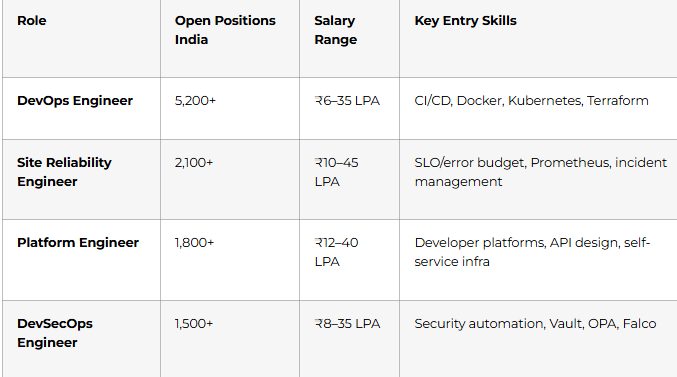
High-Demand Role Categories:

  1. DevOps Engineer (All Levels)
  • Salary Range: ₹6-35 LPA
  • Open Positions: 5,200+ across India
  • Key Skills: CI/CD, containerization, cloud platforms, infrastructure automation
  • Growth Path: Senior DevOps → DevOps Architect → Platform Engineering Lead
  1. Site Reliability Engineer (SRE)
  • Salary Range: ₹10-45 LPA
  • Open Positions: 2,100+ across India
  • Key Skills: System reliability, performance optimization, incident management
  • Growth Path: Senior SRE → SRE Manager → VP Engineering/Infrastructure
  1. Platform Engineer (Emerging Role)
  • Salary Range: ₹12-40 LPA
  • Open Positions: 1,800+ across India
  • Key Skills: Developer platforms, self-service infrastructure, API design
  • Growth Path: Senior Platform Engineer → Platform Architect → Director of Engineering
  1. DevSecOps Engineer (High Growth)
  • Salary Range: ₹8-35 LPA
  • Open Positions: 1,500+ across India
  • Key Skills: Security automation, compliance, vulnerability management
  • Growth Path: Senior DevSecOps → Security Architect → CISO
 

Top Hiring Companies and Opportunities

Cloud-Native Technology Companies:

  • Amazon Web Services (AWS) – Cloud platform engineering and customer solutions
  • Microsoft Azure – Cloud infrastructure and developer tools teams
  • Google Cloud Platform – Site reliability engineering and platform development
  • Red Hat – OpenShift, Kubernetes, and enterprise Linux solutions
 

Indian Technology Giants:

  • Flipkart – E-commerce platform infrastructure and scalability engineering
  • Paytm – Payment platform reliability and security engineering
  • Zomato – Food delivery platform and logistics optimization
  • BYJU’S – Education technology platform and content delivery infrastructure
 

Consulting and Professional Services:

  • Accenture – Digital transformation and cloud migration services
  • Deloitte – DevOps consulting and platform implementation
  • ThoughtWorks – Agile engineering and continuous delivery consulting
  • Cognizant – Infrastructure modernization and automation services
 

Financial Services and Fintech:

  • HDFC Bank – Digital banking platform and payment systems
  • Razorpay – Payment gateway infrastructure and merchant platform
  • Zerodha – Trading platform reliability and performance optimization
  • PolicyBazaar – Insurance technology platform and customer experience
 

Interview Preparation Framework

Technical Competency Areas:

Infrastructure and Cloud Platforms:

  1. “Design a scalable, highly available architecture for a web application expecting 1 million concurrent users”
    • Multi-tier architecture with load balancing and auto-scaling
    • Database replication and caching strategies
    • CDN implementation for global content delivery
    • Disaster recovery and backup procedures
  2. “Explain how you would migrate a monolithic application to microservices”
    • Decomposition strategy and service boundaries
    • Data migration and consistency challenges
    • Service communication patterns and API design
    • Monitoring and observability for distributed systems
 

CI/CD and Automation:
3. “Walk through your approach to implementing CI/CD for a microservices architecture”

# Example GitLab CI pipeline structure
stages:
  – build
  – test
  – security-scan
  – deploy-staging
  – integration-test
  – deploy-production

variables:
  DOCKER_REGISTRY: “registry.gitlab.com/project”
  KUBERNETES_NAMESPACE: “production”

build-service:
  stage: build
  script:
    – docker build -t $DOCKER_REGISTRY/user-service:$CI_COMMIT_SHA .
    – docker push $DOCKER_REGISTRY/user-service:$CI_COMMIT_SHA
  only:
    – main
    – develop

security-scan:
  stage: security-scan
  script:
    – trivy image $DOCKER_REGISTRY/user-service:$CI_COMMIT_SHA
    – snyk test –docker $DOCKER_REGISTRY/user-service:$CI_COMMIT_SHA
  allow_failure: false

deploy-production:
  stage: deploy-production
  script:
    – helm upgrade user-service ./helm-chart
      –set image.tag=$CI_COMMIT_SHA
      –namespace $KUBERNETES_NAMESPACE
  when: manual
  only:
    – main

Monitoring and Troubleshooting:

4. “How would you troubleshoot a performance issue in a distributed system?”

  • Monitoring and observability tools utilization
  • Distributed tracing analysis and bottleneck identification
  • Log correlation and analysis techniques
  • Performance profiling and optimization strategies
 

Security and Compliance:

5. “Implement security best practices in a DevOps pipeline”

  • Secrets management and rotation
  • Container image security scanning
  • Infrastructure security hardening
  • Compliance automation and auditing
 

Scenario-Based Questions:

6. “A critical production service is down. Walk through your incident response process”

  • Immediate triage and impact assessment
  • Communication and escalation procedures
  • Root cause analysis and mitigation steps
  • Post-incident review and improvement implementation
 

Salary Negotiation and Career Advancement

DevOps-Specific Value Propositions:

  • Operational Efficiency – Demonstrate cost savings and process improvements from automation
  • Reliability Metrics – Show uptime improvements and incident reduction achievements
  • Cross-Functional Skills – Highlight ability to bridge development, operations, and security teams
  • Innovation Leadership – Examples of implementing new technologies and improving team productivity


Negotiation Strategy:

DevOps Compensation Package Analysis:
Base Salary: ₹X LPA (Market rate research from multiple sources)
Performance Bonus: X% of base (Infrastructure reliability, automation goals)
Stock Options: X shares (Especially valuable in growth-stage technology companies)
Learning Budget: ₹50,000-1,00,000 annually (Certifications, conferences, training)
On-Call Compensation: Additional payment for after-hours support responsibilities
Flexible Benefits: Remote work, conference attendance, sabbatical opportunities

Career Advancement Factors:

  1. Technical Leadership – Mentoring junior engineers, architecture decision making
  2. Process Innovation – Implementing new tools, methodologies, and best practices
  3. Business Impact – Quantified improvements in deployment frequency, reliability, costs
  4. Cross-Functional Collaboration – Success working with product, engineering, and business teams
  5. Industry Recognition – Conference speaking, open-source contributions, thought leadership
devops job market

7. Salary Expectations and Career Growth

devops engineer salary & career growth

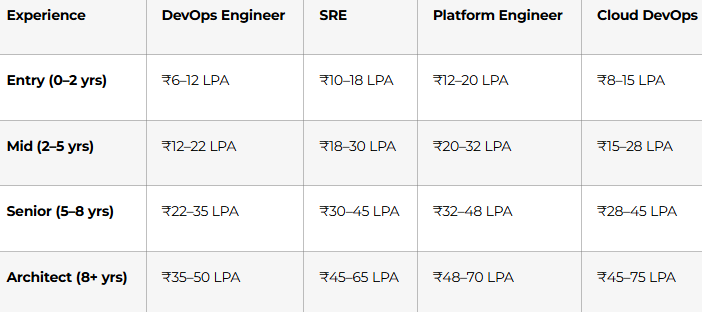
2025 Compensation Benchmarks by Specialization

General DevOps Engineering:

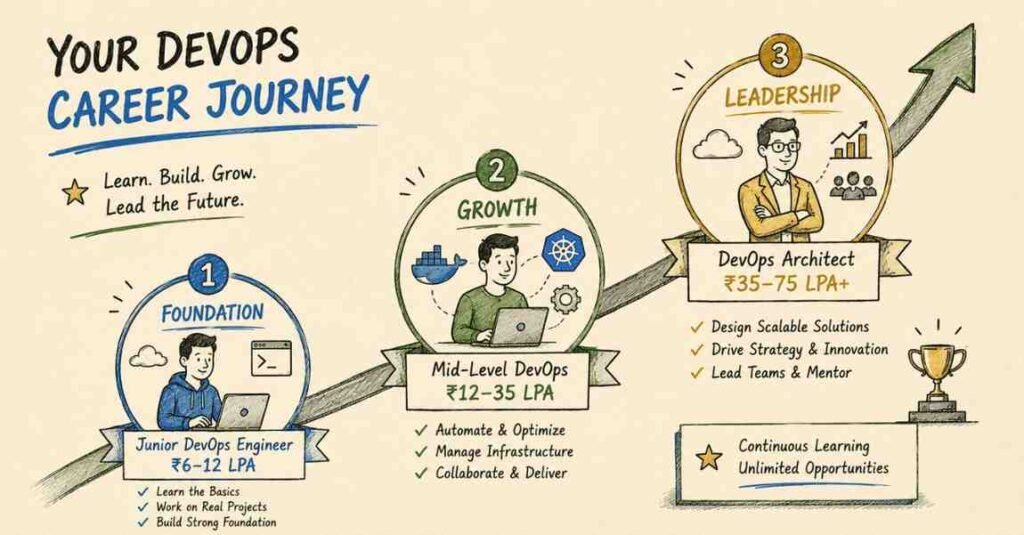
  • Junior DevOps Engineer (0-2 years): ₹6-12 LPA
  • DevOps Engineer (2-5 years): ₹12-22 LPA
  • Senior DevOps Engineer (5-8 years): ₹22-35 LPA
  • Principal DevOps Engineer (8+ years): ₹35-50 LPA
 

Site Reliability Engineering (SRE):

  • SRE I (0-2 years): ₹10-18 LPA
  • SRE II (2-5 years): ₹18-30 LPA
  • Senior SRE (5-8 years): ₹30-45 LPA
  • Staff SRE (8+ years): ₹45-65 LPA
 

Platform Engineering:

  • Platform Engineer (1-3 years): ₹12-20 LPA
  • Senior Platform Engineer (3-6 years): ₹20-32 LPA
  • Principal Platform Engineer (6-10 years): ₹32-48 LPA
  • Distinguished Engineer (10+ years): ₹48-70 LPA
 

DevSecOps/Security Engineering:

  • DevSecOps Engineer (1-3 years): ₹8-16 LPA
  • Senior DevSecOps Engineer (3-6 years): ₹16-28 LPA
  • Security Architect (6-10 years): ₹28-42 LPA
  • Principal Security Engineer (8+ years): ₹40-60 LPA
 

Industry and Geographic Variations

High-Paying Industries:

  • Financial Technology – 25-35% premium for payment and banking infrastructure
  • E-commerce Platforms – 20-30% premium for scale and performance requirements
  • Cloud Platform Vendors – 30-40% premium for platform engineering roles
  • Gaming and Entertainment – 15-25% premium for real-time, high-scale systems
 

Geographic Salary Distribution:

  • Bangalore – Highest DevOps job concentration, 15-25% above national average
  • Mumbai – Financial services DevOps hub, 12-20% above average
  • Pune – Automotive and manufacturing DevOps, 8-15% above average
  • Hyderabad – Government and healthcare technology, 6-12% above average
 

Career Progression Pathways

Technical Individual Contributor Track:

DevOps Engineer (0-3 years)
    ↓
Senior DevOps Engineer (2-6 years)
    ↓
Staff DevOps Engineer (5-9 years)
    ↓
Principal Engineer (8-12 years)
    ↓
Distinguished Engineer (12+ years)

Site Reliability Engineering Track:

SRE (0-3 years)
    ↓
Senior SRE (2-6 years)
    ↓
Staff SRE (5-9 years)
    ↓
Principal SRE (7-12 years)
    ↓
Distinguished SRE (10+ years)

Management and Leadership Track:

Senior DevOps Engineer (3-6 years)
    ↓
DevOps Team Lead (5-8 years)
    ↓
Engineering Manager (7-12 years)
    ↓
Director of Engineering (10-18 years)
    ↓
VP Engineering/CTO (15+ years)

Platform and Product Track:

Platform Engineer (1-4 years)
    ↓
Senior Platform Engineer (3-7 years)
    ↓
Platform Architect (6-10 years)
    ↓
Principal Platform Architect (8-15 years)
    ↓
VP Platform/Chief Architect (12+ years)

Skills for Accelerated Career Growth

Technical Mastery (Years 1-3):

  • Multi-Cloud Proficiency – AWS, Azure, GCP expertise with infrastructure automation
  • Container Orchestration – Advanced Kubernetes skills with service mesh and security
  • CI/CD Excellence – Pipeline design, testing integration, deployment strategies
  • Monitoring and Observability – Full-stack monitoring with custom metrics and alerting
 

Systems Thinking (Years 3-6):

  • Architecture Design – Scalable, resilient system design and capacity planning
  • Performance Optimization – System tuning, bottleneck identification, cost optimization
  • Security Integration – DevSecOps practices, compliance automation, threat modeling
  • Incident Management – SRE practices, post-mortem culture, reliability engineering
 

Leadership and Strategy (Years 6+):

  • Team Leadership – Technical mentoring, hiring, performance management
  • Technology Strategy – Platform roadmap, tool evaluation, technology adoption
  • Business Partnership – Stakeholder management, ROI demonstration, strategic planning
  • Industry Influence – Open source contribution, conference speaking, thought leadership
 

Emerging Opportunities and Future Trends

High-Growth DevOps Specializations:

  • FinOps Engineering – Cloud cost optimization and financial operations
  • MLOps Engineering – Machine learning pipeline automation and model deployment
  • GitOps and Progressive Delivery – Git-based deployment with advanced rollout strategies
  • Edge Computing DevOps – IoT and edge infrastructure management and automation
  • Quantum Computing Infrastructure – Emerging quantum cloud platforms and tooling
 

Market Trends Creating New Opportunities:

  • Platform Engineering – Internal developer platforms and self-service infrastructure
  • Cloud-Native Security – Zero-trust architecture, service mesh security, policy automation
  • Sustainable Computing – Green cloud practices, energy-efficient infrastructure, carbon footprint optimization
  • AI-Powered Operations – AIOps, predictive maintenance, automated incident response
devops job market

8. Success Stories from Our Students

Vikram Patel – From System Administrator to DevOps Architect

Background: 6 years as Windows system administrator in traditional IT infrastructure environment
Challenge: Legacy skills becoming obsolete, limited growth in manual system administration
Transformation Strategy: Systematic transition to cloud-native DevOps practices with automation focus
Timeline: 16 months from course enrollment to DevOps architect position
Current Position: Principal DevOps Engineer at Razorpay
Salary Progression: ₹9.2 LPA → ₹14.8 LPA → ₹22.5 LPA → ₹34.2 LPA (over 28 months)

Vikram’s Strategic Transformation:

  • Cloud Foundation – Dedicated 4 months to AWS fundamentals and infrastructure automation
  • Automation Mindset – Converted manual processes to Infrastructure as Code using Terraform
  • Container Adoption – Deep dive into Docker and Kubernetes with hands-on production projects
  • Monitoring Expertise – Comprehensive observability implementation with Prometheus and Grafana

Key Success Factors:

  • Practical Application – “I automated every manual task I encountered, building a portfolio of real solutions that solved actual business problems.”
  • Continuous Learning – “I spent 2 hours daily learning new tools and practicing automation. The DevOps field evolves rapidly, so staying current is essential.”
  • Business Impact Focus – “I learned to measure and communicate the business value of automation – cost savings, reliability improvements, and developer productivity gains.”

Current Impact: Leading DevOps transformation for payment platform processing ₹2,00,000+ crores annually, managing infrastructure supporting 400+ million users, responsible for 99.99% uptime SLA across multiple regions.


Priya Sharma – From Developer to Site Reliability Engineer

Background: 5 years as Java developer with strong programming skills but limited operations experience
Challenge: Wanted to expand beyond application development into infrastructure and reliability engineering
Strategic Focus: Site Reliability Engineering specialization with emphasis on scalability and performance
Timeline: 14 months from career pivot to SRE leadership role
Career Trajectory: Java Developer → DevOps Engineer → SRE → Senior SRE → SRE Team Lead
Current Role: Staff Site Reliability Engineer at Flipkart

Compensation and Impact Growth:

  • Pre-transition: ₹13.5 LPA (Senior Java Developer)
  • Year 1: ₹18.8 LPA (DevOps Engineer at mid-size startup)
  • Year 2: ₹26.5 LPA (SRE at e-commerce platform)
  • Current: ₹38.7 LPA + equity (Staff SRE at Flipkart)

Priya’s SRE Specialization:

  • Reliability Engineering – Implemented SLI/SLO framework reducing incident frequency by 78%
  • Performance Optimization – System tuning and capacity planning supporting 100M+ daily requests
  • Automation Excellence – Built self-healing systems and predictive scaling algorithms
  • Incident Management – Established blameless post-mortem culture and learning from failures

Technical Innovation and Leadership:

  • Chaos Engineering – Implemented fault injection testing improving system resilience
  • Observability Platform – Built comprehensive monitoring reducing mean time to resolution by 65%
  • Developer Tools – Created internal platform improving deployment frequency by 400%
  • Team Development – Mentored 8 junior SREs, established SRE practices across multiple teams

Success Philosophy: “My development background gave me unique insights into application behavior and performance characteristics. Understanding code helps me design better infrastructure and troubleshoot issues more effectively.”


Arjun Gupta – From Fresher to DevOps Consultant

Background: Recent computer science graduate with academic projects but no professional experience
Challenge: Competitive fresher job market with limited practical DevOps experience
Entrepreneurial Vision: Building independent DevOps consulting practice specializing in startup infrastructure
Timeline: 18 months from graduation to established consulting business
Business Evolution: DevOps Trainee → Junior DevOps Engineer → Senior DevOps Consultant → Founder

Revenue and Business Growth:

  • Months 1-6: ₹3.5 LPA (DevOps trainee at service company)
  • Months 7-12: ₹8.8 LPA (Junior DevOps Engineer at fintech startup)
  • Months 13-18: ₹1,45,000/month (Independent consulting projects)
  • Current: ₹2,85,000/month (DevOps consultancy with team of 4 engineers)

Arjun’s Market Positioning Strategy:

  • Startup Focus – Specialized in early-stage company infrastructure and scalability challenges
  • Cost-Effective Solutions – Cloud-native architecture optimized for startup budgets and growth
  • Rapid Implementation – 30-60 day infrastructure setup with comprehensive documentation
  • Knowledge Transfer – Training client teams for self-sufficiency and long-term success

Business Development and Growth:

  • Content Marketing – Technical blog with 15,000+ monthly readers, YouTube channel with DevOps tutorials
  • Open Source Contribution – Created Terraform modules for startup infrastructure, 2,000+ GitHub stars
  • Community Building – Organizer of Mumbai DevOps meetup with 800+ members
  • Strategic Partnerships – Alliances with cloud providers, tool vendors, and startup accelerators

Client Impact and Recognition:

  • Infrastructure Scaling – Helped 12 startups scale from MVP to Series A without infrastructure rewrites
  • Cost Optimization – Average 40% cloud cost reduction through infrastructure optimization
  • Reliability Improvement – Clients achieved 99.9%+ uptime with automated monitoring and alerting
  • Developer Productivity – CI/CD implementations reducing deployment time from hours to minutes

Entrepreneurial Insights: “The startup ecosystem has huge unmet needs for DevOps expertise. By focusing on this market and building scalable, cost-effective solutions, I created a differentiated value proposition that larger consulting firms couldn’t match.”

👉 Frontlines Edutech offers an AI‑powered DevOps Engineer course in Telugu and English with low fees, live classes, and real projects. Learn Linux, Git, Docker, Kubernetes, CI/CD, Terraform, and AWS/Azure with interview prep, flexible schedules, recordings, and placement guidance for job‑ready skills.

9.Common Challenges and Solutions 

devops challenges

Challenge 1: Overwhelming Technology Landscape and Tool Proliferation

Problem: DevOps ecosystem includes hundreds of tools creating analysis paralysis and shallow learning
Impact: Difficulty choosing focus areas, superficial knowledge across many tools, poor job market positioning
Symptoms: Constantly switching between tools, inability to demonstrate deep expertise, scattered portfolio

Strategic Learning and Tool Selection Framework:

Core Foundation First (80% effort):

  • Master Fundamentals: Linux, networking, scripting, cloud platforms (choose one primary)
  • Essential Tools: Git, Docker, Kubernetes, Terraform, Jenkins/GitLab CI, Prometheus
  • Deep Expertise: Become expert in 3-4 tools rather than beginner in 20 tools
  • Practical Application: Build production-ready solutions demonstrating tool mastery
 

Tool Evaluation Matrix:

Evaluation Criteria:
1. Market Adoption – Job posting frequency and industry usage
2. Learning Curve – Time investment required for proficiency 
3. Ecosystem Integration – Compatibility with other tools and platforms
4. Career Impact – Salary premium and advancement opportunities
5. Long-term Viability – Vendor stability and community support

Decision Framework:
High Impact + Low Learning Curve = Priority 1 (Learn immediately)
High Impact + High Learning Curve = Priority 2 (Plan for deep learning)
Low Impact + Low Learning Curve = Priority 3 (Learn as needed)
Low Impact + High Learning Curve = Priority 4 (Avoid unless specific need)

Structured Learning Approach:

  • Week 1-2: Tool overview and basic functionality
  • Week 3-4: Intermediate features and best practices
  • Week 5-6: Advanced usage and production considerations
  • Week 7-8: Integration with other tools and troubleshooting
 

Challenge 2: Bridging Development and Operations Cultural Divide

Problem: Traditional silos between development and operations teams creating collaboration challenges
Impact: Resistance to DevOps adoption, communication barriers, blame culture during incidents
Solution: Cultural transformation alongside technical implementation

Cultural Bridge-Building Strategies:

Shared Responsibility Model:

  • Joint Ownership: Development and operations teams share responsibility for application lifecycle
  • Cross-Training: Developers learn infrastructure, operations learns application architecture
  • Embedded Teams: DevOps engineers embedded within development teams
  • Shared Metrics: Common KPIs around deployment frequency, reliability, and customer satisfaction
 

Communication and Process Improvement:

DevOps Culture Implementation Plan:

Week 1-4: Assessment and Baseline
– Current state analysis of team collaboration
– Identify pain points and communication gaps
– Establish baseline metrics for improvement tracking
– Stakeholder alignment on DevOps goals and objectives

Week 5-8: Process Integration
– Implement shared tools and workflows
– Establish communication channels and protocols
– Create cross-functional incident response procedures
– Introduce blameless post-mortem culture

Week 9-12: Automation and Tooling
– Deploy shared CI/CD pipeline
– Implement collaborative monitoring and alerting
– Establish infrastructure as code practices
– Create self-service capabilities for developers

Week 13-16: Measurement and Optimization
– Track and report on collaboration metrics
– Gather feedback and identify improvement areas
– Celebrate successes and learn from failures
– Continuous process refinement and tool optimization

Challenge 3: Keeping Up with Rapid Technology Evolution and Cloud Services

Problem: Cloud platforms release new services weekly, creating continuous learning pressure
Challenge: Fear of skill obsolescence, difficulty prioritizing learning areas, information overload
Solution: Strategic technology adoption and learning framework

Technology Trend Management:

Tier-Based Learning Strategy:

Tier 1: Core Technologies (Master completely)
– Container orchestration (Kubernetes)
– Infrastructure automation (Terraform)
– CI/CD platforms (Jenkins, GitLab CI)
– Monitoring and observability (Prometheus, Grafana)

Tier 2: Platform-Specific Services (Functional proficiency)
– Cloud-native databases and storage
– Serverless computing and Functions-as-a-Service
– Managed Kubernetes services (EKS, AKS, GKE)
– Cloud security and compliance services

Tier 3: Emerging Technologies (Awareness level)
– Service mesh technologies (Istio, Linkerd)
– GitOps and progressive delivery
– AI/ML operations and MLOps
– Edge computing and IoT platforms

Continuous Learning System:

  • Daily (30 minutes): Industry news, release notes, community discussions
  • Weekly (3 hours): Deep dive into one new service or feature
  • Monthly (8 hours): Hands-on experimentation with emerging technologies
  • Quarterly (16 hours): Comprehensive skill assessment and learning plan update
 

Challenge 4: Demonstrating Business Value and ROI of DevOps Initiatives

Problem: Difficulty quantifying DevOps impact in business terms and securing executive support
Impact: Limited budget allocation, reduced team size, undervaluation of DevOps contributions
Solution: Metrics-driven approach with business-focused communication

DevOps Metrics and Business Impact Framework:

Technical Metrics with Business Translation:

Deployment Frequency:
– Technical: Deployments per day/week
– Business: Faster time-to-market, competitive advantage, revenue impact

Lead Time for Changes:
– Technical: Code commit to production deployment time
– Business: Reduced opportunity cost, faster response to market changes

Mean Time to Recovery (MTTR):
– Technical: Time to restore service after incident
– Business: Reduced revenue loss, customer satisfaction, brand protection

Change Failure Rate:
– Technical: Percentage of deployments causing production issues
– Business: Reduced operational costs, improved customer experience

Cost Optimization:
– Technical: Infrastructure cost per transaction/user
– Business: Improved profit margins, cost competitiveness

Executive Communication Template:

DevOps ROI Report Structure:

Executive Summary:
– Business impact in revenue/cost terms
– Key achievements and improvements
– Strategic recommendations

Investment Analysis:
– DevOps tool and training costs
– Team time investment
– Infrastructure and cloud expenses
– Total investment calculation

Returns and Benefits:
– Operational cost savings
– Developer productivity improvements
– Reduced downtime and incident costs
– Faster feature delivery value

Risk Mitigation:
– Improved system reliability
– Enhanced security posture
– Reduced compliance risks
– Better disaster recovery capabilities

Future Opportunities:
– Additional automation possibilities
– Scalability improvements
– Innovation enablement
– Competitive advantage creation

10. Your Action Plan

Week 1: Foundation and Environment Setup

Day 1-2: Development Environment and Tool Installation

  1. Linux Environment Setup – Install Ubuntu/CentOS VM or use Windows Subsystem for Linux (WSL2)
  2. Version Control – Create GitHub account, install Git, practice basic commands and workflows
  3. Cloud Platform Account – Create AWS/Azure/GCP free tier account with billing alerts configured
  4. Terminal and Editor – Configure terminal (iTerm2, Windows Terminal) and code editor (VS Code with extensions)
 

Day 3-4: Cloud and Infrastructure Basics

  1. Cloud Console Exploration – Navigate AWS/Azure console, understand service categories and pricing
  2. Basic Resource Creation – Launch virtual machine, create storage, configure networking and security
  3. CLI Tool Installation – AWS CLI, Azure CLI, or gcloud CLI with authentication configuration
  4. Infrastructure Documentation – Document learning progress, create knowledge management system
 

Day 5-7: Learning Path Planning and Community Engagement

  1. Career Goal Setting – Define 30, 60, 90-day learning milestones and certification targets
  2. Join DevOps Communities – Reddit r/devops, DevOps Discord servers, local meetup groups
  3. Follow Industry Leaders – Kelsey Hightower, Kris Nova, Julia Evans on social media and blogs
  4. Create Learning Schedule – Allocate daily study time, weekend project work, and skill practice
 

Month 1: Infrastructure Fundamentals and Version Control

Week 1-2: Linux System Administration

  • Command Line Mastery – File operations, text processing, system monitoring, process management
  • System Configuration – User management, permissions, services, networking, security hardening
  • Shell Scripting – Bash scripting for automation, error handling, logging, best practices
  • System Monitoring – htop, iotop, netstat, monitoring system performance and troubleshooting
 

Week 3-4: Version Control and Collaboration

  • Git Fundamentals – Repository creation, branching, merging, conflict resolution, remote repositories
  • Git Workflows – Feature branches, pull requests, code reviews, collaborative development
  • Advanced Git – Rebasing, cherry-picking, hooks, submodules, repository maintenance
  • Documentation – README files, commit messages, issue tracking, project documentation
 

Month-End Project: “Automated Server Setup”

  • Create shell scripts for complete server configuration
  • Version control all scripts with proper documentation
  • Include security hardening, monitoring setup, and backup procedures
  • Document installation and usage instructions
 

Month 2: Containerization and Cloud Fundamentals

Week 1-2: Docker Mastery

  • Container Basics – Images, containers, registries, networking, volumes, security considerations
  • Dockerfile Creation – Multi-stage builds, optimization techniques, security best practices
  • Docker Compose – Multi-container applications, service definitions, environment management
  • Container Registry – Docker Hub, AWS ECR, Azure ACR, image management and security scanning
 

Week 3-4: Cloud Platform Deep Dive

  • Compute Services – Virtual machines, auto-scaling, load balancers, pricing optimization
  • Storage and Databases – Object storage, block storage, managed databases, backup strategies
  • Networking – Virtual networks, subnets, security groups, VPN connectivity, DNS management
  • Identity and Security – IAM, access controls, encryption, compliance, security monitoring
 

Advanced Learning Goals:

  • Containerize Applications – Convert existing applications to containers with optimization
  • Cloud Resource Management – Create, manage, and optimize cloud infrastructure resources
  • Security Implementation – Apply security best practices across containers and cloud infrastructure
  • Cost Optimization – Understand pricing models and implement cost-saving strategies
 

Month 3: Infrastructure as Code and CI/CD Implementation

Week 1-2: Infrastructure as Code with Terraform

  • Terraform Basics – Resources, providers, variables, outputs, state management
  • Advanced Terraform – Modules, workspaces, remote state, team collaboration
  • Cloud Integration – AWS, Azure, GCP resource provisioning with Terraform
  • Best Practices – Code organization, security, version control, testing infrastructure code
 

Week 3-4: CI/CD Pipeline Development

  • Pipeline Design – Build, test, deploy stages, quality gates, approval processes
  • Jenkins/GitLab CI – Pipeline as code, parallel execution, artifact management, notifications
  • Testing Integration – Unit tests, integration tests, security scans, quality metrics
  • Deployment Strategies – Blue-green, rolling updates, canary deployments, rollback procedures
 

Practical Implementation Focus:

  • Complete Infrastructure Automation – Provision entire application infrastructure using code
  • End-to-End Pipeline – Source code to production deployment with testing and quality gates
  • Documentation and Runbooks – Comprehensive documentation for infrastructure and processes
  • Security Integration – Security scanning and compliance checks in automated workflows
 

Long-Term Milestones (6-12 Months)

Professional Certification and Expertise:

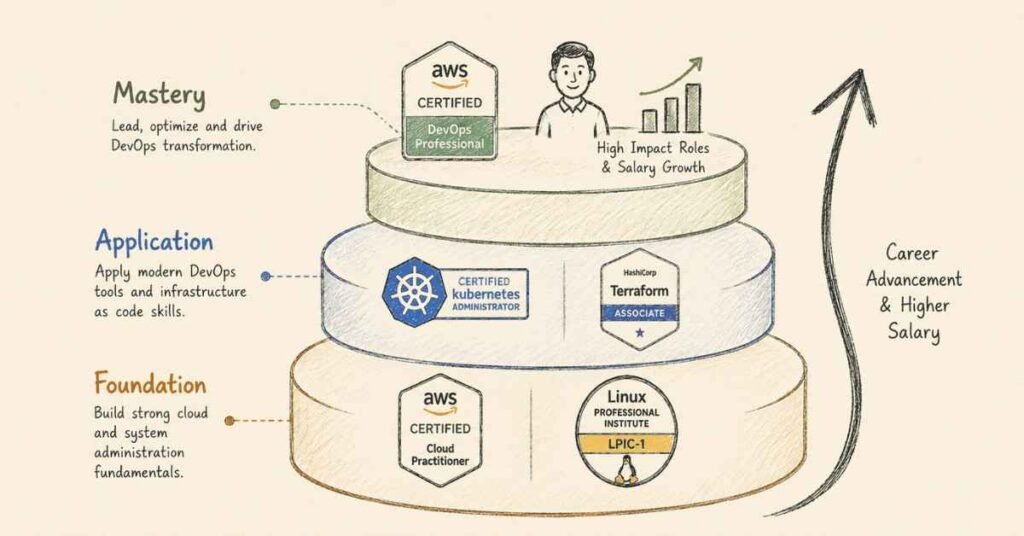
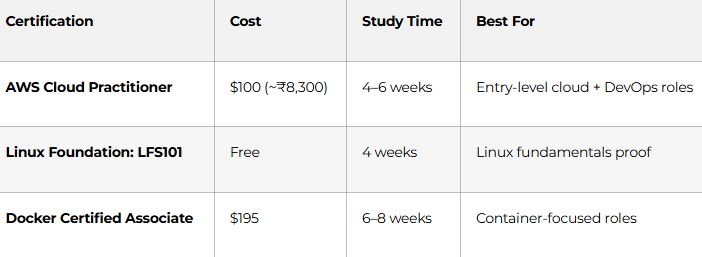
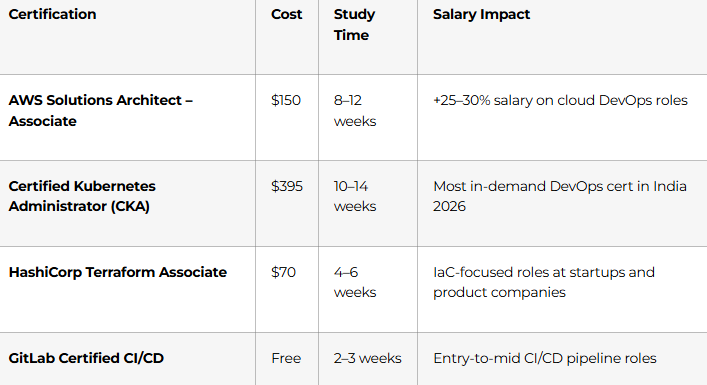
  • Cloud Certification – AWS Solutions Architect Associate, Azure Administrator, or GCP Associate
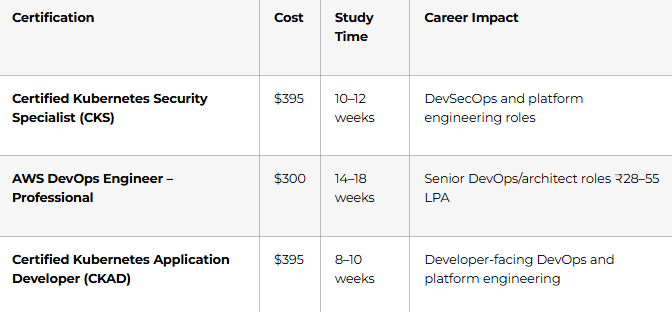
  • Kubernetes Certification – Certified Kubernetes Administrator (CKA) or Application Developer (CKAD)
  • DevOps Specialization – Choose focus area: SRE, Platform Engineering, or DevSecOps
  • Advanced Automation – Complex multi-cloud, multi-environment infrastructure automation

Career Development and Portfolio:

  • Professional Portfolio – 5-7 comprehensive DevOps projects with documentation and demos
  • Open Source Contribution – Contribute to DevOps tools, create useful automation scripts
  • Technical Writing – Blog posts, tutorials, documentation of learning journey and best practices
  • Community Engagement – Regular meetup attendance, conference participation, networking
 

Job Search Preparation and Transition:

  • Resume Optimization – Technical skills highlight, project impact quantification, certification display
  • Interview Preparation – Technical scenarios, architectural discussions, troubleshooting exercises
  • Salary Research – Market rate analysis, negotiation preparation, total compensation evaluation
  • Professional Network – Industry connections, referral opportunities, mentorship relationships

Conclusion

DevOps engineering represents one of the most impactful and well-compensated career paths in modern technology, sitting at the critical intersection of software development, infrastructure management, and business operations. As organizations continue their digital transformation journeys and embrace cloud-native architectures, DevOps professionals serve as the essential bridge enabling faster, more reliable software delivery.

The journey from infrastructure beginner to DevOps professional typically requires 6-8 months of dedicated learning and hands-on practice, but the investment delivers exceptional returns through high-demand job opportunities, competitive compensation, and the satisfaction of solving complex technical challenges that directly impact business success.

Critical Success Factors for DevOps Excellence:

  • Automation-First Mindset – Approach every manual process as an opportunity for automation and improvement
  • Cross-Functional Collaboration – Bridge technical and business stakeholders while fostering shared responsibility
  • Continuous Learning – Stay current with rapidly evolving tools, platforms, and methodologies
  • Business Impact Focus – Connect technical work to measurable business outcomes and competitive advantages
  • Reliability and Security – Balance speed of delivery with system reliability and security requirements

The most successful DevOps engineers combine deep technical expertise with strong communication skills and business acumen. As software systems become increasingly complex and critical to business operations, DevOps professionals who can navigate technical complexity while driving cultural transformation will be most valued by organizations.

Whether you choose traditional DevOps engineering, Site Reliability Engineering specialization, Platform Engineering focus, or DevSecOps security integration, DevOps skills provide a foundation for diverse career opportunities including technical leadership, cloud architecture, and engineering management.

Ready to launch your DevOps career and become the bridge between development and operations?

Explore our comprehensive DevOps Engineering Program designed for system administrators, developers, and IT professionals seeking DevOps expertise:

  • 6-month intensive curriculum covering Linux, cloud platforms, containers, CI/CD, and infrastructure automation
  • Hands-on lab environment with AWS, Azure, Kubernetes, Terraform, and Jenkins for practical learning
  • Real-world project portfolio with automated infrastructure, monitoring solutions, and deployment pipelines
  • Certification preparation for AWS Solutions Architect, Kubernetes Administrator, and Docker certifications
  • Job placement assistance with resume optimization, technical interview coaching, and employer connections
  • Industry mentorship from experienced DevOps architects and site reliability engineers
  • Lifetime learning support including tool updates, best practices, and career advancement guidance

Unsure which DevOps specialization matches your background and career goals? Schedule a free DevOps career consultation with our experienced DevOps architects to receive personalized guidance and a customized learning roadmap.

Connect with our DevOps community: Join our DevOps Engineers WhatsApp Group with 190+ students, alumni, and working DevOps professionals for daily learning support, project collaboration, and job referrals.