
Data Science With GEN AI Interview Preparation Guide 2026
Table of Contents
Part 1: Introduction and 30-Day Study Plan
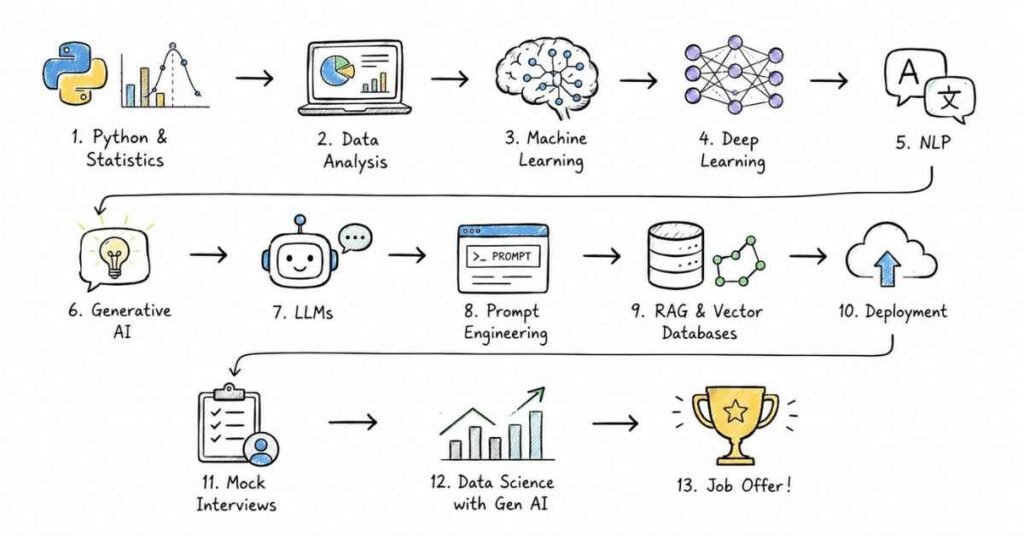
This first part sets the direction for Data Science With Gen AI interview preparation. It explains what interviewers usually test, where data science and generative AI fit in real work, and how to build a practical 30-day plan that makes you interview-ready.
What this guide covers
This guide is designed to prepare you for data science and GenAI interviews in a structured way. It starts with Python, statistics, and data analysis, then moves into machine learning, deep learning, NLP, generative AI, LLMs, prompting, embeddings, RAG, deployment thinking, and interview strategy. The goal is not just to help you memorize terms, but to help you explain how and why data science and GenAI solutions are built the way they are.
Interviewers usually care as much about your reasoning and project understanding as they do about definitions. A strong candidate can explain a model choice, an evaluation metric, a prompt strategy, or a GenAI use case clearly and confidently.
Who this guide is for
This guide is useful if you are a fresher preparing for your first data science interview. It also helps students, analysts, ML beginners, Python developers, and professionals moving into AI or GenAI roles who want a clearer interview structure.
It is especially helpful if you already know the basics but are not fully confident discussing statistical concepts, model evaluation, embeddings, RAG, prompt engineering, or practical project trade-offs. The structure is meant to help both beginners and job seekers build confidence step by step.
What data science with Gen AI is
Data science with Gen AI combines data analysis, machine learning, and generative AI to solve business problems. Data science helps extract patterns and predictions from data, while GenAI helps generate text, summaries, insights, code, images, or decisions using large language models and related tools.
A simple way to think about it is this: data science helps you understand and predict, while GenAI helps you generate and interact intelligently. If you understand how those pieces connect, interview questions become much easier to answer.
Where it fits in real work
In real companies, data science and GenAI are used for forecasting, classification, recommendation, anomaly detection, customer support automation, document summarization, knowledge assistants, analytics copilots, and workflow automation. Common tasks include cleaning data, training models, evaluating performance, designing prompts, building RAG pipelines, and explaining results to business stakeholders.
This is why interviews test more than just theory. Interviewers often want to see whether you can connect data, models, and business outcomes in a practical way.
Common role types
Data Science With Gen AI interviews vary depending on the role. Common role types include data scientist, machine learning engineer, GenAI engineer, NLP engineer, AI analyst, applied scientist, and analytics consultant.
A data scientist role may focus more on statistics, SQL, Python, ML, and business insights. A GenAI or applied AI role may focus more on LLMs, prompting, embeddings, vector databases, RAG, evaluation, and deployment thinking. Understanding the role early helps you focus your preparation.
Common interview process
A typical interview process often includes HR screening, Python or SQL basics, statistics, machine learning fundamentals, project discussion, NLP or GenAI concepts, scenario-based questions, and behavioral rounds.
In many interviews, questions are mixed with practical reasoning. You may be asked to explain a project, compare models, discuss evaluation metrics, describe a RAG workflow, or troubleshoot a GenAI use case. That is why practical understanding matters more than memorized definitions alone.
Core skill areas interviewers usually check
Most data science and GenAI interviews evaluate some combination of these areas:
- Python and data handling.
- Statistics and probability.
- SQL and data extraction.
- Machine learning fundamentals.
- Feature engineering and model evaluation.
- Deep learning and NLP basics.
- LLMs, embeddings, and prompting.
- RAG and vector databases.
- Deployment and inference thinking.
- Business problem solving.
- Communication and project explanation.
These topics appear often because they reflect real work in data and AI. If you are comfortable with them, you can handle most interview rounds with more confidence.
Why project understanding matters
Data science and GenAI interviews often depend heavily on how well you explain your projects. Even if your project is from a course, lab, internship, or self-built system, present it clearly and professionally.
A strong project explanation should include:
- What problem the project solves.
- What data was used.
- What model, prompt, or GenAI setup you used.
- How you evaluated the output.
- What challenges you faced.
- What you personally contributed.
- What business or user value it created.
30-day study plan
A practical 30-day study plan looks like this:
Week 1: Python, data handling, and statistics
Focus on Python basics, NumPy, Pandas, data cleaning, exploratory data analysis, probability, descriptive statistics, distributions, hypothesis basics, and data interpretation.
Week 2: Machine learning fundamentals
Study supervised learning, regression, classification, clustering basics, train-test split, overfitting, underfitting, bias-variance trade-off, and model evaluation metrics.
Week 3: Deep learning, NLP, and GenAI basics
Move into neural networks, embeddings, NLP fundamentals, transformers, LLM basics, prompting, and GenAI use cases. Continue practicing with project examples.
Week 4: RAG, deployment thinking, projects, and mock interviews
Focus on RAG pipelines, vector databases, evaluation of GenAI responses, project explanation, resume review, and scenario-based practice. Spend the rest of the week on mock interviews and revision.
Daily study routine
A practical daily routine looks like this:
- 45 minutes of concept revision.
- 60 minutes of coding, analysis, or project practice.
- 30 minutes of spoken explanation or mock interview practice.
- 15 minutes of notes, review, or scenario work.
If you are a fresher, do not skip speaking practice. Many candidates understand concepts privately but freeze when asked to explain a metric, model, or GenAI workflow in real time.
How to prepare effectively
The best way to prepare for Data Science With Gen AI interviews is to build from Python and statistics to machine learning, then move into deep learning, NLP, LLMs, embeddings, and RAG. Start simple, then layer complexity gradually.
You should also practice explaining your work out loud. In many interviews, the explanation matters almost as much as the technical answer.
Revision focus
Revise what data science with Gen AI is, where it is used, the common role types, the usual interview format, the core skill areas, and the 30-day study plan before moving to Python, data handling, and statistics basics.
Part 2: Python, Data Handling, Statistics, and Data Analysis Basics
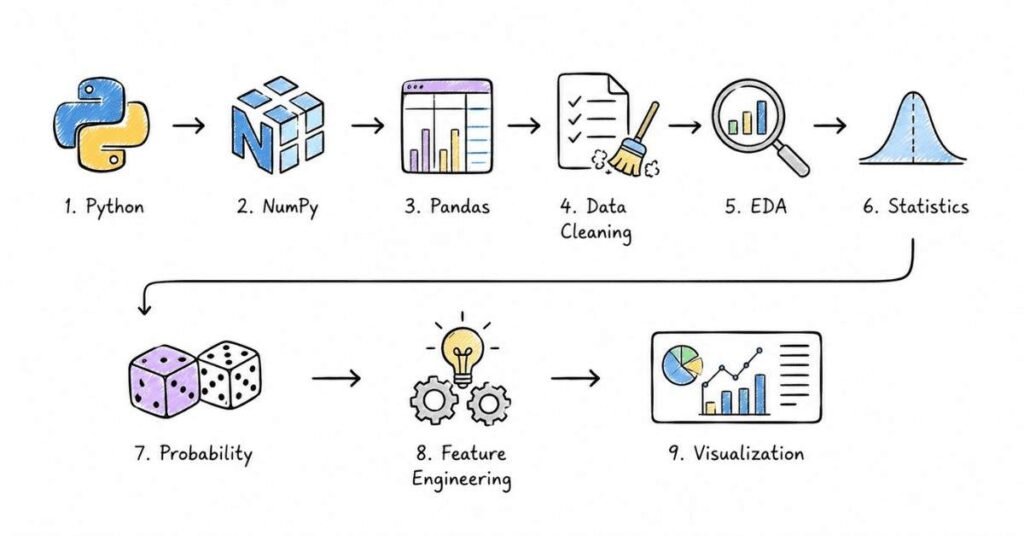
This part builds the foundation for the rest of the Data Science With Gen AI guide. It covers the core Python, data, and statistical concepts interviewers expect you to understand before moving into machine learning, deep learning, and generative AI.
Questions 1–40
1. What is data science?
Data science is the process of using data, statistics, programming, and domain knowledge to solve problems and make decisions. It combines analysis, modeling, and communication.
2. Why is data science important?
Data science is important because it helps organizations find patterns, make predictions, and improve decisions using data. It is used in many industries and business functions.
3. What is Python?
Python is a general-purpose programming language widely used in data science, machine learning, and AI. It is popular because it is readable and has strong libraries.
4. Why is Python popular in data science?
Python is popular because it is easy to learn, flexible, and supported by powerful libraries like NumPy, Pandas, Matplotlib, Scikit-learn, and TensorFlow. It is one of the most common interview languages.
5. What are Python data types?
Python data types include integers, floats, strings, booleans, lists, tuples, sets, and dictionaries. Each type stores data differently.
6. What is a list in Python?
A list is an ordered, mutable collection of items. It is commonly used to store multiple values.
7. What is a tuple?
A tuple is an ordered, immutable collection of items. It is useful when data should not change.
8. What is a dictionary?
A dictionary stores data as key-value pairs. It is useful for structured and fast lookup-based access.
9. What is a set?
A set is an unordered collection of unique items. It is useful when duplicate values are not needed.
10. What is mutability in Python?
Mutability means an object can be changed after creation. Lists and dictionaries are mutable, while tuples are immutable.
11. What is a function in Python?
A function is a reusable block of code that performs a task. It helps organize and simplify programs.
12. Why are functions important in data science?
Functions help make analysis code reusable, cleaner, and easier to debug. They are useful for data processing and modeling workflows.
13. What is a loop?
A loop repeats a block of code multiple times. Common loops in Python are for and while.
14. Why are loops useful?
They help process multiple records or repeated operations efficiently. They are often used in data handling tasks.
15. What is NumPy?
NumPy is a Python library used for numerical computing. It provides fast arrays and mathematical operations.
16. Why is NumPy important?
NumPy is important because it enables efficient numerical computation, which is useful in data science and machine learning. Many ML libraries depend on it.
17. What is a NumPy array?
A NumPy array is a fast, memory-efficient structure for numerical data. It is often preferred over standard Python lists for computation.
18. What is Pandas?
Pandas is a Python library used for data manipulation and analysis. It provides DataFrame and Series structures.
19. Why is Pandas important?
Pandas is important because most real-world data analysis involves cleaning, transforming, and exploring tabular data. It is a core library in data science interviews.
20. What is a DataFrame?
A DataFrame is a two-dimensional table-like structure in Pandas with rows and columns. It is one of the most commonly used data structures in analysis.
21. What is a Series?
A Series is a one-dimensional labeled data structure in Pandas. It is like a single column of data.
22. What is data cleaning?
Data cleaning is the process of fixing incorrect, missing, duplicate, or inconsistent data. It improves data quality before analysis.
23. Why is data cleaning important?
Clean data produces better analysis and better model performance. Bad data can lead to wrong conclusions.
24. What are missing values?
Missing values are empty or unavailable data points in a dataset. They must be handled carefully during analysis.
25. How can missing values be handled?
They can be removed, filled with summary values, or imputed using logic or models. The best approach depends on the situation.
26. What are duplicates in data?
Duplicates are repeated rows or records in a dataset. They can bias analysis if not handled properly.
27. What is exploratory data analysis?
Exploratory data analysis, or EDA, is the process of examining data to understand patterns, distributions, relationships, and anomalies. It is usually done before modeling.
28. Why is EDA important?
EDA helps you understand the data before making assumptions or building models. It often reveals quality issues and useful patterns.
29. What is a variable in statistics?
A variable is a measurable characteristic that can take different values. It may represent age, income, price, or other quantities.
30. What is a numerical variable?
A numerical variable contains measurable numeric values. It can be discrete or continuous.
31. What is a categorical variable?
A categorical variable contains labels or groups. Examples include color, gender, or product category.
32. What is mean?
Mean is the average of a set of numbers. It is calculated by adding values and dividing by the count.
33. What is median?
Median is the middle value when data is sorted. It is less affected by extreme values than mean.
34. What is mode?
Mode is the most frequently occurring value in a dataset. A dataset can have one mode, multiple modes, or none.
35. What is standard deviation?
Standard deviation measures how spread out values are around the mean. It shows variability in the data.
36. What is variance?
Variance measures how much values differ from the mean on average. It is the square of standard deviation.
37. What is probability?
Probability is the measure of how likely an event is to happen. It is a core concept in statistics and machine learning.
38. What is correlation?
Correlation measures the strength and direction of a relationship between two variables. It does not prove causation.
39. What is a strong answer for Python and data basics questions?
A strong answer explains the concept clearly and connects it to analysis or modeling work. Interviewers want practical understanding, not only definitions.
40. How should you practice Python and data basics?
Practice by cleaning a dataset, computing summary statistics, and explaining what the data tells you. Repetition helps these concepts become natural.
Revision focus
Revise data science, Python data types, lists, tuples, dictionaries, sets, mutability, functions, loops, NumPy, Pandas, DataFrames, Series, data cleaning, missing values, duplicates, EDA, variables, numerical and categorical data, mean, median, mode, standard deviation, variance, probability, and correlation before moving to machine learning fundamentals, supervised learning, and evaluation metrics.
Explore the Data Science with Generative AI Roadmap →
Part 3: Machine Learning Fundamentals, Supervised Learning, and Evaluation Metrics
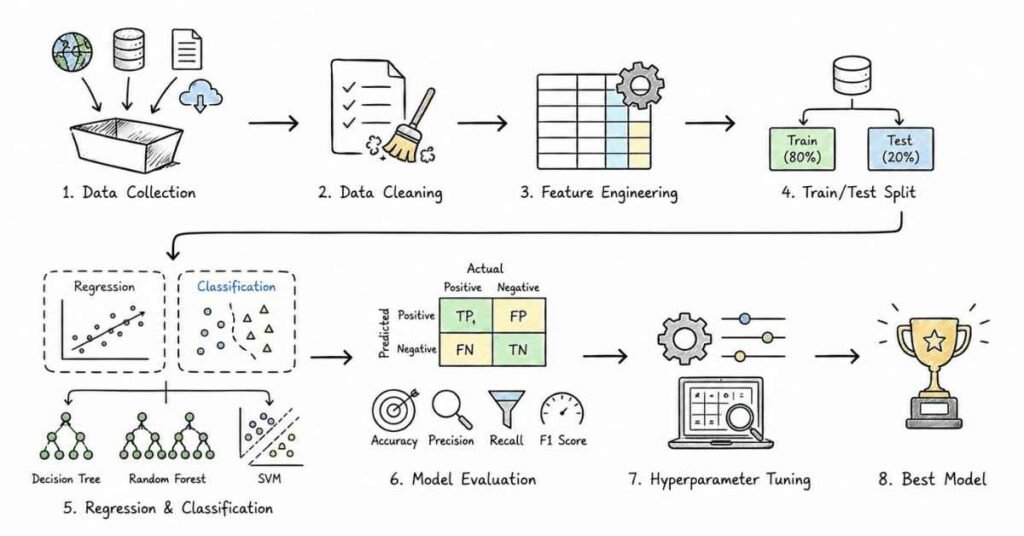
This part covers the machine learning layer that data science interviews test very often. It explains how models learn from data, common supervised learning tasks, and the metrics interviewers expect before moving into unsupervised learning, feature engineering, and tuning.
Questions 41–80
41. What is machine learning?
Machine learning is a method where computers learn patterns from data and make predictions or decisions without being explicitly programmed for every rule. It is one of the core areas of data science.
42. Why is machine learning important?
Machine learning is important because it helps solve prediction, classification, recommendation, and automation problems at scale. It is widely used in business and AI applications.
43. What is supervised learning?
Supervised learning is a machine learning approach where the model learns from labeled data. The input and the correct output are both known during training.
44. What is unsupervised learning?
Unsupervised learning uses unlabeled data to find hidden patterns or structures. It is often used for clustering and dimensionality reduction.
45. What is the difference between supervised and unsupervised learning?
Supervised learning predicts known targets using labeled data, while unsupervised learning discovers patterns without labels. They are used for different kinds of problems.
46. What is a training dataset?
A training dataset is the data used to teach the model. The model learns patterns from this data.
47. What is a test dataset?
A test dataset is data used to evaluate the model after training. It helps estimate how well the model works on unseen data.
48. Why do we split data into train and test sets?
We split data to check whether the model generalizes to new data. This helps prevent overly optimistic results.
49. What is validation data?
Validation data is used during model development to tune settings and compare models. It helps guide model selection.
50. What is overfitting?
Overfitting happens when a model learns the training data too well, including noise. It performs well on training data but poorly on new data.
51. What is underfitting?
Underfitting happens when a model is too simple to capture the pattern in the data. It performs poorly on both training and test data.
52. What is the bias-variance trade-off?
The bias-variance trade-off is the balance between a model being too simple and too sensitive to data noise. Good models aim for a balanced level.
53. What is regression in machine learning?
Regression is a supervised learning task where the output is continuous. Examples include predicting house prices or sales.
54. What is classification?
Classification is a supervised learning task where the output is a category or label. Examples include spam detection and disease prediction.
55. What is linear regression?
Linear regression is a model used to predict a continuous value by fitting a straight-line relationship between input and output. It is one of the simplest regression methods.
56. What is logistic regression?
Logistic regression is used for classification, especially binary classification. It predicts probabilities and maps them to class labels.
57. What is a decision tree?
A decision tree is a model that makes predictions by splitting data into branches based on conditions. It is easy to interpret.
58. What is random forest?
Random forest is an ensemble of decision trees whose predictions are combined. It usually improves accuracy and reduces overfitting compared to a single tree.
59. What is a support vector machine?
A support vector machine is a supervised learning algorithm used for classification and sometimes regression. It tries to find the best separating boundary between classes.
60. What is k-nearest neighbors?
K-nearest neighbors is a simple algorithm that predicts based on the closest data points. It uses similarity to make predictions.
61. What is model evaluation?
Model evaluation is the process of checking how well a model performs. It helps compare models and choose the best one.
62. What is accuracy?
Accuracy is the percentage of correct predictions out of all predictions. It is easy to understand but not always enough.
63. Why is accuracy not always enough?
Accuracy can be misleading when classes are imbalanced. A model may look good overall while failing on the important class.
64. What is precision?
Precision measures how many predicted positives are actually positive. It is important when false positives are costly.
65. What is recall?
Recall measures how many actual positives were correctly identified. It is important when missing positives is costly.
66. What is F1 score?
F1 score is the harmonic mean of precision and recall. It gives a balanced measure when both false positives and false negatives matter.
67. What is a confusion matrix?
A confusion matrix is a table that shows prediction results compared with actual labels. It helps understand classification performance in detail.
68. What is ROC-AUC?
ROC-AUC measures how well a classifier distinguishes between classes across thresholds. It is often used for binary classification.
69. What is mean squared error?
Mean squared error measures the average squared difference between predicted and actual values. It is commonly used in regression.
70. What is root mean squared error?
Root mean squared error is the square root of MSE. It is easier to interpret because it is in the same unit as the target variable.
71. What is mean absolute error?
Mean absolute error measures the average absolute difference between predicted and actual values. It is simpler and less sensitive to large errors than MSE.
72. What is cross-validation?
Cross-validation is a technique for evaluating a model on multiple data splits. It gives a more reliable estimate of performance.
73. Why is cross-validation useful?
It reduces dependence on one specific train-test split. It helps estimate how a model may perform on new data.
74. What is hyperparameter tuning?
Hyperparameter tuning is the process of selecting the best model settings before training. It helps improve performance.
75. What is a hyperparameter?
A hyperparameter is a setting chosen before training, such as tree depth, learning rate, or number of neighbors. It is not learned directly from data.
76. What is a feature?
A feature is an input variable used by the model. It represents a measurable property of the data.
77. What is a target variable?
A target variable is the output the model tries to predict. It is also called the label in supervised learning.
78. What is a strong answer for machine learning questions?
A strong answer explains the concept clearly and connects it to model behavior or evaluation. Interviewers want practical model understanding, not just theory.
79. What is a common beginner mistake in ML interviews?
A common mistake is memorizing model names without understanding when to use them. Another is mixing up metrics like precision, recall, and accuracy.
80. How should you practice machine learning basics?
Practice by training a simple model, evaluating it with different metrics, and explaining why one model performed better than another. Repetition helps these ideas become intuitive.
Revision focus
Revise machine learning, supervised learning, unsupervised learning, train-test split, validation data, overfitting, underfitting, bias-variance trade-off, regression, classification, linear regression, logistic regression, decision trees, random forests, SVM, KNN, model evaluation, accuracy, precision, recall, F1 score, confusion matrix, ROC-AUC, MSE, RMSE, MAE, cross-validation, hyperparameter tuning, features, and target variables before moving to unsupervised learning, feature engineering, and model tuning.
Part 4: Unsupervised Learning, Feature Engineering, and Model Tuning
This part covers the next layer of data science interviews after machine learning basics are clear. It explains clustering, dimensionality reduction, feature preparation, scaling, and tuning concepts that interviewers expect before moving into deep learning, NLP, and GenAI.
Questions 81–120
81. What is unsupervised learning?
Unsupervised learning is a machine learning approach where the data has no labels. The model tries to find patterns or structure on its own.
82. Why is unsupervised learning important?
It helps discover hidden groups, patterns, and relationships in data. It is useful when labeled examples are not available.
83. What is clustering?
Clustering is the process of grouping similar data points together. It is a common unsupervised learning task.
84. What is k-means clustering?
K-means is a clustering algorithm that divides data into K groups based on similarity. It is one of the most commonly used clustering methods.
85. What is a centroid in k-means?
A centroid is the center point of a cluster. The algorithm tries to place centroids so that points are close to their assigned cluster center.
86. What is hierarchical clustering?
Hierarchical clustering builds clusters in a tree-like structure. It can be agglomerative or divisive.
87. What is dimensionality reduction?
Dimensionality reduction is the process of reducing the number of input features while keeping important information. It helps simplify data.
88. Why is dimensionality reduction useful?
It can improve visualization, reduce noise, and sometimes improve model performance. It also helps with very high-dimensional data.
89. What is PCA?
PCA, or Principal Component Analysis, is a dimensionality reduction technique that creates new features called principal components. It keeps the most important variance in the data.
90. Why is PCA used?
PCA is used to simplify data while preserving as much information as possible. It is common in preprocessing and visualization.
91. What is feature engineering?
Feature engineering is the process of creating, selecting, and transforming input features to improve model performance. It is one of the most important parts of ML work.
92. Why is feature engineering important?
Better features often improve model quality more than changing the model itself. Good feature engineering can make a big difference.
93. What is feature scaling?
Feature scaling is the process of bringing numeric features to a similar range. It helps models that are sensitive to feature magnitudes.
94. What is normalization?
Normalization usually scales values into a fixed range such as 0 to 1. It is often used when features have different scales.
95. What is standardization?
Standardization transforms data to have mean 0 and standard deviation 1. It is useful for many machine learning algorithms.
96. Why is scaling important?
Some models, such as distance-based or gradient-based methods, work better when features are scaled. Without scaling, one feature can dominate others.
97. What is one-hot encoding?
One-hot encoding converts categorical values into binary columns. It is used when categories have no natural order.
98. What is label encoding?
Label encoding assigns numerical values to categories. It is useful when categories have an order or when the model can handle encoded labels carefully.
99. What is missing value imputation?
Missing value imputation is the process of filling missing data using a rule or estimate. It helps avoid losing too much data.
100. What is feature selection?
Feature selection is choosing the most useful features for a model. It helps reduce complexity and may improve performance.
101. Why is feature selection useful?
It can reduce noise, speed up training, and improve interpretability. It helps keep models simpler and more focused.
102. What is regularization?
Regularization adds a penalty to model complexity to reduce overfitting. It helps the model generalize better.
103. What is L1 regularization?
L1 regularization adds a penalty based on the absolute values of coefficients. It can drive some coefficients to zero.
104. What is L2 regularization?
L2 regularization adds a penalty based on the squared values of coefficients. It shrinks coefficients but usually does not make them exactly zero.
105. What is the difference between L1 and L2 regularization?
L1 can create sparse models by removing some features, while L2 usually keeps all features but reduces their size. They are used for different purposes.
106. What is hyperparameter tuning?
Hyperparameter tuning is the process of finding the best settings for a model before training. It improves performance and stability.
107. Why is hyperparameter tuning important?
The right settings can significantly improve model results. Poor settings can hurt accuracy or generalization.
108. What is grid search?
Grid search tries all combinations of a set of hyperparameters. It is thorough but can be slow.
109. What is random search?
Random search tests random combinations of hyperparameters. It is often faster and sometimes effective than grid search.
110. What is overfitting control?
Overfitting control means using techniques that reduce a model’s tendency to memorize training data. Regularization, cross-validation, and simpler models are common methods.
111. What is bias in a model?
Bias is error caused by overly simple assumptions in a model. High bias can lead to underfitting.
112. What is variance in a model?
Variance is error caused by a model being too sensitive to the training data. High variance can lead to overfitting.
113. Why is the bias-variance trade-off important here?
It helps explain why feature choice and tuning affect model generalization. Good tuning balances simplicity and flexibility.
114. What is model selection?
Model selection is the process of choosing the best algorithm for a given problem. It often depends on data size, complexity, and business needs.
115. Why is model selection important?
Different problems need different models. Choosing the right one improves both performance and interpretability.
116. What is a strong answer for unsupervised learning and tuning questions?
A strong answer explains the concept clearly and connects it to data preparation or model quality. Interviewers want practical understanding, not only formulas.
117. What is a common beginner mistake in these interviews?
A common mistake is ignoring preprocessing and feature preparation while focusing only on the model. Another is not understanding why tuning matters.
118. How should you practice these topics?
Practice by clustering a dataset, applying PCA, encoding categories, scaling values, and comparing tuned versus untuned models. Repetition helps these ideas become natural.
119. What should you remember before moving on?
Remember the main unsupervised learning ideas, clustering, k-means, hierarchical clustering, PCA, feature engineering, scaling, encoding, missing value handling, feature selection, regularization, grid search, random search, bias, variance, and model selection.
120. What connects feature engineering and tuning to the rest of ML?
They help transform raw data into stronger inputs and help models generalize better. They are often what separates basic models from strong practical ones.
Revision focus
Revise unsupervised learning, clustering, k-means, centroid, hierarchical clustering, dimensionality reduction, PCA, feature engineering, scaling, normalization, standardization, one-hot encoding, label encoding, missing value imputation, feature selection, regularization, L1 versus L2, hyperparameter tuning, grid search, random search, bias, variance, model selection, and overfitting control before moving to deep learning, neural networks, and NLP basics.
Part 5: Deep Learning, Neural Networks, and NLP Basics
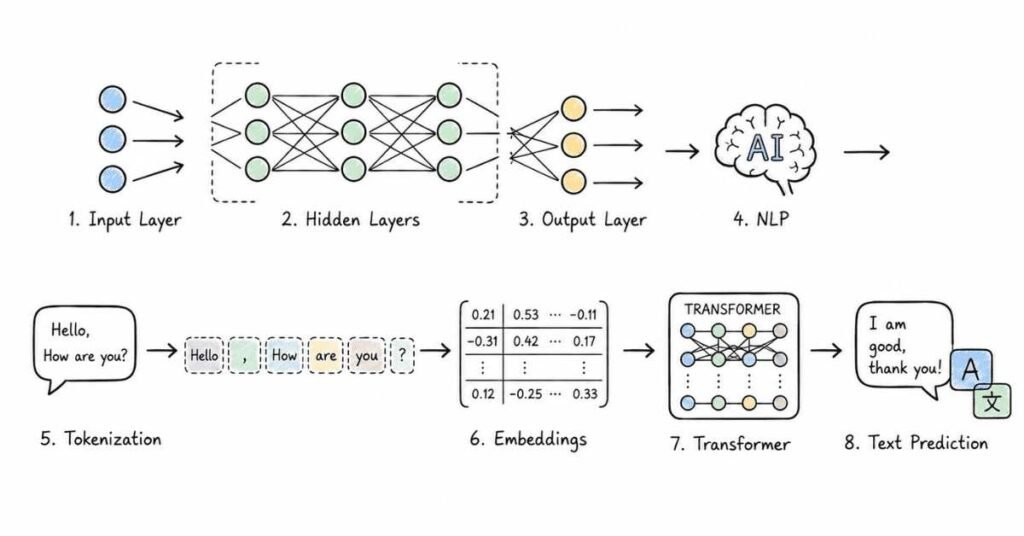
This part covers the modeling layer that supports modern AI and GenAI work. It focuses on neural networks, deep learning, and NLP concepts interviewers expect before moving into generative AI, LLMs, prompting, embeddings, and RAG.
Questions 121–160
121. What is deep learning?
Deep learning is a machine learning approach that uses neural networks with multiple layers. It is especially useful for complex patterns in data such as images, text, and speech.
122. Why is deep learning important?
Deep learning is important because it powers many modern AI systems, including language models and vision models. It can learn complex representations from large datasets.
123. What is a neural network?
A neural network is a model inspired by the structure of the human brain. It consists of connected layers of nodes that learn patterns from data.
124. What are the main layers in a neural network?
The main layers are the input layer, hidden layers, and output layer. Data flows through these layers during prediction.
125. What is an input layer?
The input layer receives the raw features of the data. It is the starting point of the network.
126. What is a hidden layer?
A hidden layer processes information between the input and output layers. Multiple hidden layers allow the network to learn more complex patterns.
127. What is an output layer?
The output layer produces the final prediction. Its form depends on the problem, such as classification or regression.
128. What is an activation function?
An activation function introduces non-linearity into a neural network. It helps the model learn more complex relationships.
129. Why are activation functions important?
Without them, the network would behave like a simple linear model. They make deep learning powerful.
130. What is ReLU?
ReLU, or Rectified Linear Unit, is a common activation function that returns zero for negative values and the input itself for positive values. It is widely used in hidden layers.
131. What is sigmoid?
Sigmoid is an activation function that maps values between 0 and 1. It is often used in binary classification output layers.
132. What is softmax?
Softmax converts model outputs into probabilities across multiple classes. It is commonly used in multiclass classification.
133. What is forward propagation?
Forward propagation is the process of moving input data through the network to get an output. It is how predictions are made.
134. What is backpropagation?
Backpropagation is the process of calculating how much each weight contributed to the error and adjusting it during training. It helps the network learn.
135. What is a loss function?
A loss function measures how far the model’s prediction is from the actual answer. Training tries to minimize this loss.
136. Why is loss important?
Loss tells the model how wrong it is. It guides the learning process.
137. What is gradient descent?
Gradient descent is an optimization method used to reduce loss by updating model parameters step by step. It is a core training algorithm.
138. What is learning rate?
Learning rate controls how big each update step is during training. It affects how quickly and safely the model learns.
139. What is overfitting in deep learning?
Overfitting in deep learning happens when the network learns the training data too specifically. It performs well on training data but poorly on new data.
140. How can overfitting be reduced in deep learning?
It can be reduced using dropout, regularization, early stopping, data augmentation, and more data. Simpler models can also help.
141. What is dropout?
Dropout randomly disables some neurons during training. It helps prevent overfitting by reducing dependence on specific nodes.
142. What is batch size?
Batch size is the number of samples used in one training step. It affects training speed and stability.
143. What is an epoch?
An epoch is one full pass through the training dataset. Multiple epochs are usually needed for learning.
144. What is natural language processing?
Natural language processing, or NLP, is the field that helps computers work with human language. It includes tasks such as classification, translation, and text generation.
145. Why is NLP important?
NLP is important because much of real-world data is text. It is a foundation for chatbots, search, and GenAI systems.
146. What is tokenization?
Tokenization is the process of splitting text into smaller units called tokens. Tokens can be words, subwords, or characters.
147. Why is tokenization important?
It prepares text for model input. Most language models work on tokenized text rather than raw sentences.
148. What is stemming?
Stemming reduces words to a root form by removing endings. It is a basic text preprocessing technique.
149. What is lemmatization?
Lemmatization reduces words to their dictionary form. It is more linguistically accurate than stemming.
150. What is stop word removal?
Stop word removal removes common words that may not carry much meaning, such as “the” or “is.” It can help text processing in some tasks.
151. What is TF-IDF?
TF-IDF stands for Term Frequency-Inverse Document Frequency. It measures how important a word is in a document relative to a collection of documents.
152. Why is TF-IDF useful?
It helps represent text numerically for search, classification, and simple NLP tasks. It is a common baseline method.
153. What is Word2Vec?
Word2Vec is a technique that learns vector representations of words based on context. Words with similar meanings get similar vectors.
154. Why are word embeddings important?
They capture semantic relationships better than simple count-based representations. They are a key step toward modern NLP and GenAI.
155. What is embedding?
An embedding is a numerical vector representation of text, images, or other data. It captures meaning in a form models can use.
156. What is a strong answer for deep learning and NLP questions?
A strong answer explains the concept clearly and connects it to practical text or model behavior. Interviewers want to see that you understand how these ideas power modern AI.
157. What is a common beginner mistake in these interviews?
A common mistake is memorizing terms like ReLU or TF-IDF without understanding where they are used. Another is mixing up preprocessing and modeling concepts.
158. How should you practice these topics?
Practice by building a small text classification pipeline, tokenizing text, and explaining how a neural network learns from data. Repetition makes these ideas easier to remember.
159. What should you remember before moving on?
Remember neural networks, hidden layers, activation functions, ReLU, sigmoid, softmax, forward propagation, backpropagation, loss, gradient descent, learning rate, dropout, epochs, batch size, NLP, tokenization, stemming, lemmatization, stop words, TF-IDF, Word2Vec, and embeddings.
160. What connects deep learning to GenAI?
Deep learning provides the architecture and training ideas behind modern language models and many GenAI systems. Understanding it helps explain how large models learn from text.
Revision focus
Revise deep learning, neural networks, input and hidden layers, output layer, activation functions, ReLU, sigmoid, softmax, forward propagation, backpropagation, loss functions, gradient descent, learning rate, overfitting control, dropout, batch size, epoch, NLP, tokenization, stemming, lemmatization, stop words, TF-IDF, Word2Vec, and embeddings before moving to generative AI, LLMs, embeddings, and prompting.
Part 6: Generative AI Foundations, LLMs, Embeddings, and Prompting
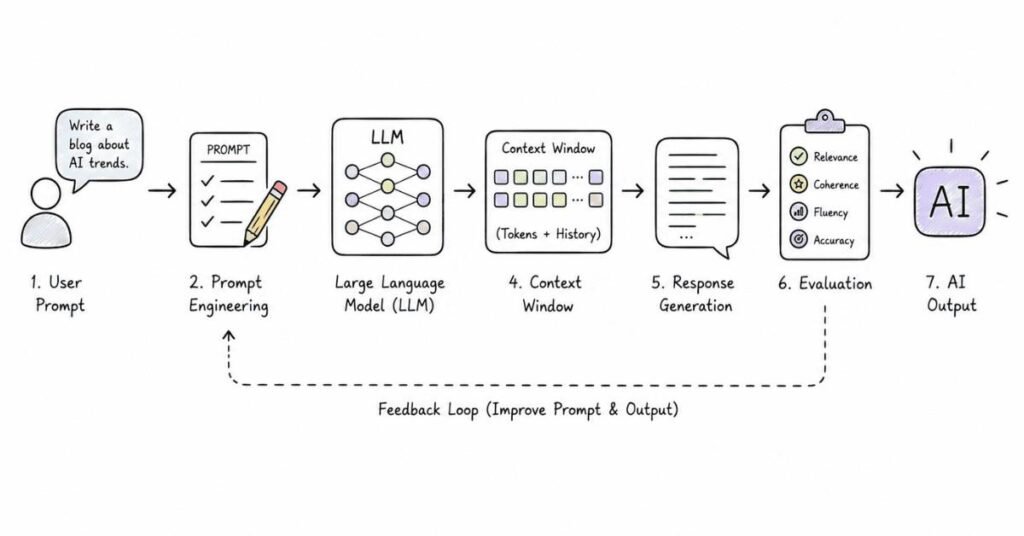
This part covers the GenAI layer that makes this guide different from a standard data science interview prep series. It focuses on LLMs, prompt engineering, embeddings, and the concepts interviewers expect before moving into RAG, vector databases, and GenAI architecture.
Questions 161–200
161. What is generative AI?
Generative AI is a type of AI that can create new content such as text, images, code, or audio. It learns patterns from existing data and generates new outputs.
162. Why is generative AI important?
Generative AI is important because it can automate content creation, assist decision-making, and build intelligent assistants. It is widely used in modern AI products.
163. What is an LLM?
LLM stands for Large Language Model. It is a model trained on large amounts of text to understand and generate human language.
164. Why are LLMs important?
LLMs power chatbots, copilots, summarization systems, and many GenAI applications. They are the core of most modern text-based GenAI products.
165. What is the difference between traditional ML and LLMs?
Traditional ML usually solves narrower prediction tasks using structured features, while LLMs are built to understand and generate language at a broader scale. LLMs are typically much larger and more flexible.
166. What is a transformer?
A transformer is a neural network architecture designed to process sequential data efficiently. It is the foundation of most modern LLMs.
167. Why are transformers important?
They handle context better than older sequence models and scale well to large datasets. They are the main architecture behind many GenAI systems.
168. What is attention in transformers?
Attention helps the model focus on the most relevant parts of the input when generating output. It improves context understanding.
169. Why is attention important?
It allows the model to connect words and ideas across long text sequences. This makes language understanding much stronger.
170. What is a token in an LLM?
A token is a unit of text used by the model, such as a word, part of a word, or punctuation mark. LLMs process tokens instead of raw text.
171. Why are tokens important?
Tokens determine how the model reads, counts, and generates text. Token limits also affect prompt and output size.
172. What is prompt engineering?
Prompt engineering is the practice of designing input prompts to get better outputs from an LLM. It is a practical skill in GenAI work.
173. Why is prompt engineering important?
The quality of the prompt often affects the quality of the output. Good prompts can make answers more accurate, structured, and useful.
174. What is zero-shot prompting?
Zero-shot prompting asks the model to perform a task without examples. It relies only on the instruction given.
175. What is few-shot prompting?
Few-shot prompting provides a few examples in the prompt to guide the model. It helps improve task performance and format.
176. What is role prompting?
Role prompting tells the model to behave like a specific expert or persona. It can improve tone and focus.
177. What is chain-of-thought prompting?
Chain-of-thought prompting encourages the model to reason step by step. It can improve performance on reasoning tasks.
178. What is an embedding in GenAI?
An embedding is a vector representation of text or other data that captures meaning. Similar items have nearby vectors.
179. Why are embeddings important in GenAI?
They help models and search systems compare meaning rather than exact words. They are central to retrieval and semantic search.
180. What is cosine similarity?
Cosine similarity measures how close two vectors are in direction. It is often used to compare embeddings.
181. What is semantic search?
Semantic search finds results based on meaning rather than exact keyword matching. Embeddings make this possible.
182. What is hallucination in LLMs?
Hallucination is when an LLM generates information that sounds correct but is actually wrong or unsupported. It is a known GenAI challenge.
183. Why do LLMs hallucinate?
They generate text based on learned patterns and probabilities, not guaranteed truth. Missing context or vague prompts can increase hallucinations.
184. What is temperature in LLMs?
Temperature controls how random or creative the model’s output is. Higher temperature usually produces more varied responses.
185. What is top-p sampling?
Top-p sampling limits token selection to the most probable options whose total probability reaches a threshold. It helps balance creativity and coherence.
186. What is context window?
The context window is the amount of text an LLM can process at once. It limits how much input and output the model can handle in one request.
187. What is fine-tuning?
Fine-tuning is the process of adapting a pretrained model to a specific task or domain using additional training data. It improves specialization.
188. Why is fine-tuning useful?
It helps the model perform better on domain-specific language or tasks. It is useful when general models are not enough.
189. What is transfer learning?
Transfer learning uses knowledge learned from one task and applies it to another. It is a major reason deep learning and GenAI are so powerful.
190. What is an API call to an LLM?
It is a request sent to a language model service to generate or process text. Many GenAI apps use APIs instead of hosting models themselves.
191. What is a system prompt?
A system prompt gives high-level instructions that guide the model’s behavior. It helps define style, role, and constraints.
192. What is a strong answer for GenAI basics questions?
A strong answer explains the concept clearly and connects it to practical applications like chatbots, search, or copilots. Interviewers want to see both concept and use case understanding.
193. What is a common beginner mistake in GenAI interviews?
A common mistake is using buzzwords without understanding tokens, embeddings, hallucination, or prompting. Another is not knowing how LLM outputs are controlled.
194. How should you practice GenAI basics?
Practice by testing prompts, comparing outputs, and explaining why a prompt works better than another. Hands-on experimentation helps a lot.
195. What should you remember before moving on?
Remember the main ideas of generative AI, LLMs, transformers, attention, tokens, prompt engineering, zero-shot, few-shot, role prompting, chain-of-thought, embeddings, cosine similarity, semantic search, hallucination, temperature, top-p, context window, fine-tuning, transfer learning, API calls, and system prompts.
196. Why are embeddings and prompting so important?
Because many GenAI use cases depend on how information is retrieved and how the model is instructed. These two ideas are central to practical GenAI systems.
197. What makes GenAI different from older NLP systems?
GenAI can generate fluent, flexible, and context-aware outputs across many tasks. Older NLP systems were often narrower and more rule-based.
198. What is a good interview answer style here?
Explain the concept, then connect it to a real app or business use case. That makes your answer sound practical and credible.
199. What should you not do in these interviews?
Do not memorize definitions without understanding how LLMs are applied. Interviewers usually probe practical knowledge and trade-offs.
200. What connects this section to the next one?
Embeddings and prompting are the base for retrieval-augmented generation, vector databases, and GenAI architecture. Understanding them makes the next section much easier.
Revision focus
Revise generative AI, LLMs, transformers, attention, tokens, prompt engineering, zero-shot, few-shot, role prompting, chain-of-thought, embeddings, cosine similarity, semantic search, hallucination, temperature, top-p sampling, context window, fine-tuning, transfer learning, LLM APIs, and system prompts before moving to RAG pipelines, vector databases, and GenAI architecture.
Part 7: RAG Pipelines, Vector Databases, and GenAI Architecture
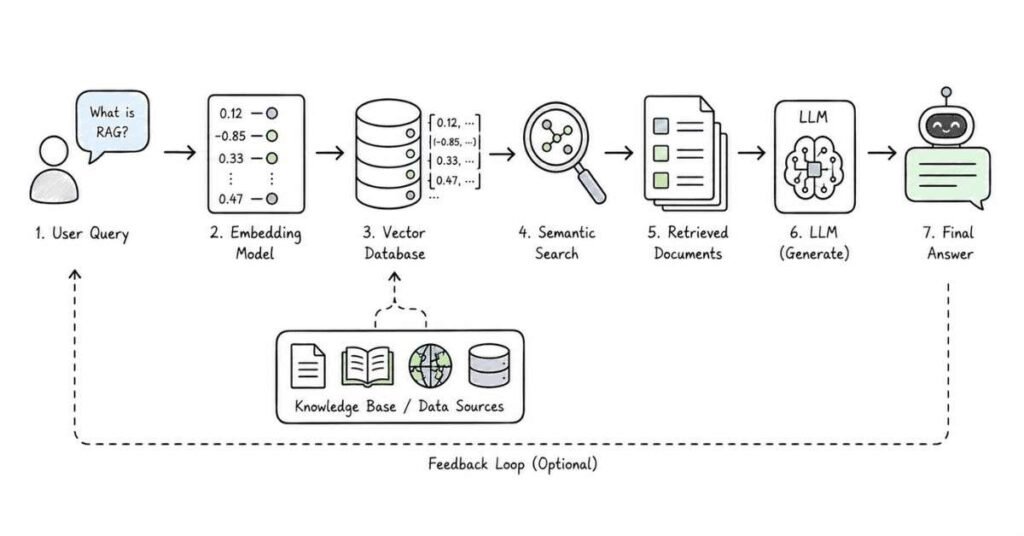
This part covers the practical architecture layer that interviewers often ask about after GenAI basics are clear. It focuses on retrieval-augmented generation, vector databases, orchestration, evaluation, and the system design ideas behind real GenAI applications.
Questions 201–240
201. What is RAG?
RAG stands for Retrieval-Augmented Generation. It is a method where an LLM retrieves relevant information from external sources before generating an answer.
202. Why is RAG important?
RAG is important because it helps LLMs use current or domain-specific information without retraining the model. It improves usefulness and reduces hallucination risk.
203. How does RAG work?
A user query is converted into a search request, relevant documents are retrieved, and the LLM uses those documents to generate a response. Retrieval and generation work together.
204. What is a vector database?
A vector database stores embeddings and helps search them efficiently by similarity. It is commonly used in RAG systems.
205. Why are vector databases useful?
They allow semantic search over documents, knowledge bases, and content. They are essential for retrieval-driven GenAI applications.
206. What is chunking?
Chunking is the process of splitting large documents into smaller pieces before embedding or retrieval. It helps improve search and context handling.
207. Why is chunking important in RAG?
Small chunks are easier to search and fit better into model context windows. Poor chunking can reduce retrieval quality.
208. What is embedding generation in RAG?
Embedding generation converts text chunks into vectors that represent meaning. These vectors are stored in the vector database.
209. What is retrieval?
Retrieval is the step where the system finds the most relevant chunks or documents for a user query. It is the search part of RAG.
210. What is generation?
Generation is the step where the LLM creates the final answer using the retrieved context. It is the response part of RAG.
211. What is a retriever?
A retriever is the component that finds relevant documents or chunks from storage. It can use keyword search, vector search, or both.
212. What is a reranker?
A reranker reorders retrieved results to improve relevance before they are sent to the LLM. It can improve answer quality.
213. Why is reranking useful?
It helps the system choose the best context from a larger set of retrieved results. Better context usually means better answers.
214. What is a knowledge base in GenAI?
A knowledge base is a collection of documents or information sources used by a GenAI system. It can be internal policies, manuals, or product documentation.
215. Why is a knowledge base important?
It gives the model access to domain-specific information. This is often necessary for enterprise applications.
216. What is prompt injection?
Prompt injection is an attack or misuse where malicious instructions try to override the system’s intended behavior. It is a security risk in GenAI systems.
217. Why is prompt injection important to understand?
It can cause unsafe or unwanted model behavior. Security-aware GenAI design must account for it.
218. What is guardrails in GenAI?
Guardrails are rules or controls that limit unsafe, irrelevant, or policy-breaking model outputs. They help make GenAI systems safer and more reliable.
219. What is a hallucination mitigation strategy?
It is a method to reduce wrong or unsupported model outputs. RAG, better prompts, source grounding, and validation are common approaches.
220. What is grounding in GenAI?
Grounding means tying the model’s response to reliable external sources or retrieved context. It improves factuality.
221. What is an AI agent?
An AI agent is a system that can plan and take actions toward a goal, often using tools, memory, and reasoning steps. It goes beyond simple text generation.
222. What is the difference between an LLM app and an AI agent?
An LLM app usually responds to prompts, while an AI agent can decide on actions and use tools dynamically. Agents are more autonomous.
223. What is tool use in GenAI?
Tool use means the model can call external functions such as search, calculators, APIs, or databases. It extends the model’s ability beyond text generation.
224. Why is tool use useful?
It helps the system access fresh data and perform actions that the LLM itself cannot do directly. It makes GenAI applications more practical.
225. What is orchestration in a GenAI pipeline?
Orchestration is the coordination of retrieval, prompt creation, LLM calls, ranking, and post-processing. It controls the full workflow.
226. Why is orchestration important?
It ensures the GenAI system behaves consistently and efficiently. Good orchestration improves response quality and reliability.
227. What is latency in GenAI systems?
Latency is the time taken to produce an output. In GenAI, it includes retrieval time, inference time, and post-processing time.
228. Why does latency matter in GenAI?
Users expect fast responses, and slow systems reduce usability. Latency is a major production concern.
229. What is evaluation in GenAI?
Evaluation is the process of measuring how well a GenAI system performs. It may include correctness, relevance, faithfulness, and user satisfaction.
230. What is BLEU score?
BLEU is a metric often used to compare generated text with reference text based on overlap. It has been used in translation and generation tasks.
231. What is ROUGE score?
ROUGE is a metric commonly used for summarization and text comparison. It measures overlap between generated and reference text.
232. Why are BLEU and ROUGE not always enough?
They do not fully capture meaning, usefulness, or factual correctness. Human judgment or task-specific evaluation is often also needed.
233. What is an evaluation dataset?
An evaluation dataset is a set of examples used to test model or system quality. It should reflect real-world usage as closely as possible.
234. What is a strong answer for RAG and GenAI architecture questions?
A strong answer explains the flow clearly: chunk, embed, retrieve, rerank, prompt, generate, and evaluate. Interviewers want system thinking, not just definitions.
235. What is a common beginner mistake in these interviews?
A common mistake is describing RAG only as vector search without explaining the full pipeline. Another is ignoring chunking, reranking, and evaluation.
236. How should you practice RAG concepts?
Practice by sketching a pipeline for a chatbot or knowledge assistant and explaining each step. That helps you understand real system design.
237. What should you remember before moving on?
Remember RAG, vector databases, chunking, embedding generation, retrieval, generation, retrievers, rerankers, knowledge bases, prompt injection, guardrails, grounding, AI agents, tool use, orchestration, latency, and evaluation metrics.
238. Why is RAG so common in GenAI projects?
Because it gives the model access to external knowledge without requiring full retraining. It is practical for enterprise and dynamic information use cases.
239. What is the main design goal of GenAI architecture?
The goal is to deliver accurate, useful, safe, and fast responses. Good architecture balances retrieval, generation, and control.
240. What should you think about when designing a GenAI system?
Think about data sources, chunking, retrieval quality, prompt quality, safety, latency, and how the output will be evaluated. Those are the main system design concerns.
Revision focus
Revise RAG, retrieval-augmented generation, vector databases, chunking, embeddings, retrieval, generation, retriever, reranker, knowledge base, prompt injection, guardrails, grounding, AI agents, tool use, orchestration, latency, BLEU, ROUGE, evaluation datasets, and the full GenAI pipeline before moving to scenario-based problem solving, project discussion, and deployment thinking.
Part 8: Scenario-Based Problem Solving, Project Discussion, and Deployment Thinking
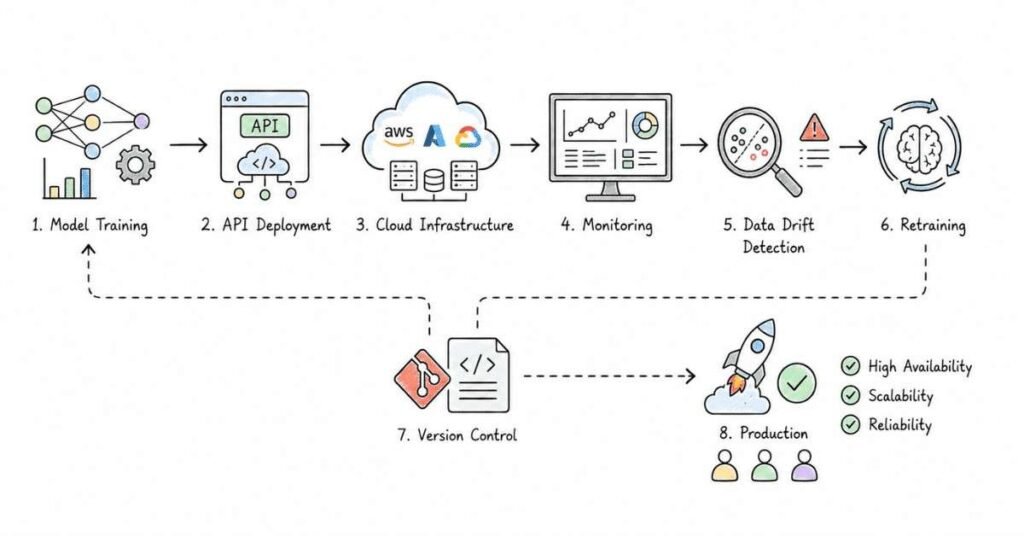
This part focuses on how to think in real interviews. It covers common data science and GenAI scenarios, troubleshooting approach, project discussion, and deployment ideas that help interviewers judge your practical understanding.
Questions 241–280
241. What is a scenario-based interview question?
A scenario-based question asks how you would solve a real problem in data science or GenAI. It checks your reasoning, not just your memory.
242. Why are scenario questions important?
They show whether you can apply concepts in practical situations. Real data and GenAI work involves trade-offs, debugging, and business decisions.
243. How should you answer scenario-based questions?
Start by understanding the problem, then explain your thought process, mention likely methods or tools, and describe how you would validate the solution. A clear step-by-step answer works best.
244. What would you do if your model performs well on training data but poorly on test data?
Check for overfitting, review feature quality, reduce model complexity, add regularization, and validate with cross-validation. The issue is usually generalization.
245. What would you do if class distribution is highly imbalanced?
Use appropriate metrics like precision, recall, F1 score, or ROC-AUC, and consider resampling or class weighting. Accuracy alone may be misleading.
246. What would you do if a feature looks useful but hurts performance?
Check for noise, leakage, multicollinearity, or scaling issues. Not all seemingly useful features improve the model.
247. What would you do if a GenAI response is inaccurate?
Check the prompt, retrieval quality, context quality, hallucination risk, and whether the answer is grounded in source data. Better retrieval or prompting may fix it.
248. What would you do if an LLM gives inconsistent answers?
Review prompt wording, temperature settings, context window usage, and whether the retrieved context is stable. Model randomness and poor context can cause inconsistency.
249. What would you do if a RAG system returns irrelevant documents?
Check chunking strategy, embedding quality, retrieval method, vector search setup, and reranking. Retrieval quality is often the root issue.
250. What would you do if a GenAI system becomes too slow?
Profile retrieval time, embedding search time, LLM inference time, and post-processing overhead. Latency may come from multiple parts of the pipeline.
251. How would you discuss a data science project in an interview?
Explain the problem, the data, the approach, the model or method, the evaluation, and the business impact. Keep the story structured and practical.
252. How would you discuss a GenAI project in an interview?
Explain the use case, prompt design, retrieval or embedding setup, evaluation, safety measures, and the user or business outcome. Show how the system works end to end.
253. What should a strong project explanation include?
It should include the problem, data sources, methods used, challenges, your contribution, evaluation results, and impact. Interviewers want both technical and business clarity.
254. Why is evaluation important in projects?
Because it shows whether the solution actually works. Good projects explain metrics, validation, and limitations.
255. What is deployment in data science and GenAI?
Deployment is the process of making a model or GenAI system available for use. It may involve APIs, web apps, containers, cloud services, or model endpoints.
256. Why is deployment important?
A model is only useful if it can be used in a real system. Deployment connects experimentation to production.
257. What should be considered before deployment?
Consider latency, scalability, monitoring, security, cost, versioning, and rollback. These affect real-world reliability.
258. What is model monitoring?
Model monitoring checks whether the model continues to perform well after deployment. It can track drift, errors, and quality changes.
259. What is data drift?
Data drift happens when the input data changes over time compared with training data. It can reduce model performance.
260. What is concept drift?
Concept drift happens when the relationship between inputs and outputs changes over time. It may require retraining or redesign.
261. Why is drift important in GenAI systems?
Because content, user behavior, and knowledge sources can change quickly. Systems need updates and monitoring to stay relevant.
262. What is versioning in ML or GenAI?
Versioning means tracking model versions, prompt versions, data versions, and evaluation results. It helps reproducibility and rollback.
263. What is a strong answer for scenario-based questions?
A strong answer is calm, structured, and practical. It should show how you investigate, improve, and validate the solution.
264. What is a strong answer for project questions?
A strong answer explains the business problem, the technical approach, and the result clearly. Interviewers want to see ownership and impact.
265. What is a strong answer for deployment questions?
A strong answer mentions APIs, latency, scaling, monitoring, drift, and rollback readiness. Interviewers want to see production thinking.
266. What is a common beginner mistake in these rounds?
A common mistake is focusing only on the model and ignoring data quality, evaluation, and production concerns. Another is not explaining trade-offs.
267. How should you think during an interview?
Think aloud in a structured way, stay practical, and connect your answer to data, model behavior, retrieval, or business impact. That approach makes your answers sound more confident and professional.
268. Why does practical judgment matter?
Because data science and GenAI are not just about building models. They are about building useful, reliable, and maintainable systems.
269. What should you do when requirements are unclear?
Ask clarifying questions, define assumptions, and validate them with examples or data. Never assume too much.
270. What should you do when results are not as expected?
Check the data, features, prompt, evaluation method, and baseline comparison. Problems often come from multiple parts of the pipeline.
271. What should you do when a GenAI answer seems too generic?
Add more context, improve the prompt, use retrieval, and guide the model with better instructions. Generic outputs usually need stronger grounding.
272. What should you do when a model seems over-optimized for metrics?
Check whether the evaluation metric matches the business goal. Sometimes a good score does not mean a useful solution.
273. What should your answer always include?
Your answer should include the issue, the likely cause, the checks you would perform, and the expected fix or improvement.
274. Why is practical reasoning important?
Because real data science and GenAI work is about making systems that perform well in real usage. Practical reasoning shows you understand that responsibility.
275. What is the best way to practice scenario questions?
Practice by taking sample project failures, inaccurate GenAI outputs, slow pipelines, or poor model results and explaining how you would investigate them. Speaking the solution out loud helps build confidence.
276. What is a common interview trap?
A common trap is answering with buzzwords instead of a clear method. Interviewers usually value clarity and reasoning more than fancy terms.
277. What should you remember when discussing a project?
Remember to explain the business value, your role, the technical choices, and the outcome. That is what makes a project memorable.
278. Why does deployment thinking matter?
Because interviewers want people who can build systems that work in production, not just in notebooks. Production thinking shows maturity.
279. What is the main goal of these rounds?
The goal is to see whether you can solve problems logically and communicate your thinking clearly. That matters as much as technical knowledge.
280. What should you remember before the final part?
Remember that scenario rounds test both knowledge and judgment. If you can explain how you investigate, validate, and communicate issues clearly, you will answer more confidently.
Revision focus
Revise scenario-based questions, overfitting, class imbalance, feature issues, inaccurate GenAI responses, inconsistent LLM answers, poor RAG retrieval, latency problems, project discussion structure, evaluation, deployment, model monitoring, data drift, concept drift, versioning, and structured problem solving before moving to behavioral, resume, LinkedIn, and career strategy.
Part 9: Behavioral, Resume, LinkedIn, and Career Strategy
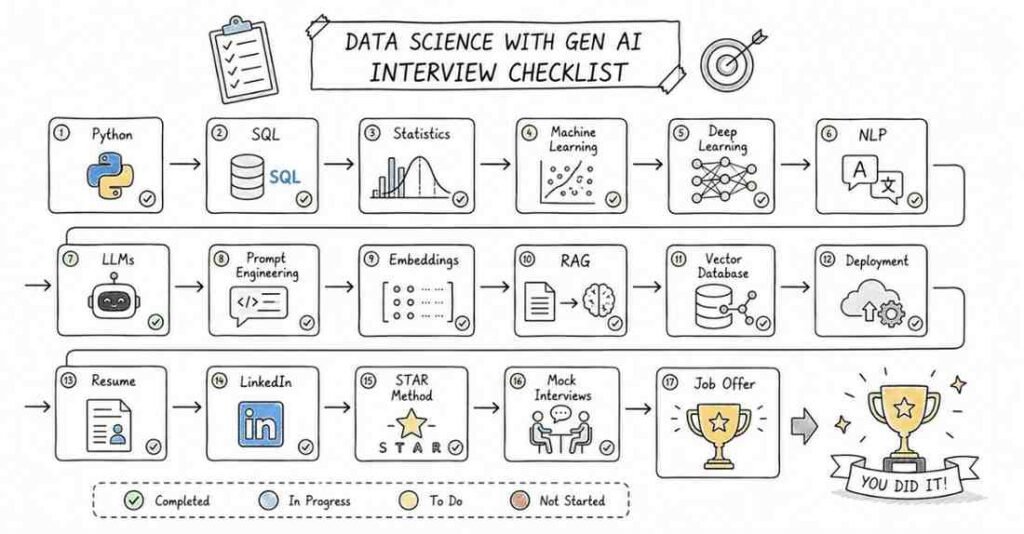
This final part helps turn Data Science With Gen AI preparation into interview success. It covers the STAR method, behavioral questions, mock-interview prompts, resume and LinkedIn optimization, salary framing in India, follow-up emails, and a practical closing checklist for job search execution.
STAR method
The STAR method stands for Situation, Task, Action, and Result. It is one of the best ways to answer behavioral interview questions because it keeps your answer structured, specific, and outcome-focused.
Use STAR like this:
- Situation: Explain the context.
- Task: Explain your responsibility.
- Action: Describe what you did.
- Result: Share the outcome, impact, or learning.
A good behavioral answer should sound calm, honest, and clear. Interviewers usually respond well when you show ownership and explain what changed because of your work.
20 behavioral questions
- Tell me about a time you solved a data problem.
- Tell me about a time you built or improved a model.
- Describe a time you worked with a difficult teammate or stakeholder.
- Tell me about a time you handled messy data.
- Describe a time you made a mistake and fixed it.
- Tell me about a time you explained an AI concept to a non-technical person.
- Describe a time you worked under pressure.
- Tell me about a time you had multiple tasks and had to prioritize.
- Describe a time you improved a GenAI prompt or workflow.
- Tell me about a time you improved model evaluation.
- Describe a time you handled feedback.
- Tell me about a time you found a requirement gap.
- Describe a time requirements were unclear.
- Tell me about a time you learned a new ML or GenAI tool quickly.
- Describe a time you managed a change in scope.
- Tell me about a time you influenced a decision without authority.
- Describe a time you resolved a user issue quickly.
- Tell me about a time you improved an analysis or report.
- Describe a time you balanced accuracy and speed.
- Tell me about a time you turned a data challenge into a useful solution.
50 AI self-preparation prompts
Use these prompts with AI tools to rehearse interviews, refine your answers, and tighten your project storytelling.
- Act as a data science interviewer and ask me 10 questions.
- Act as a GenAI interviewer and ask me 10 questions.
- Ask me behavioral data science questions using STAR.
- Improve my answer to “Tell me about yourself” for a data science role.
- Help me explain my data science project in under 2 minutes.
- Help me explain my GenAI project in under 5 minutes.
- Turn my project notes into an interview-ready STAR answer.
- Ask me scenario-based data science questions one by one.
- Challenge my answer to an overfitting scenario.
- Challenge my answer to an imbalanced dataset scenario.
- Challenge my answer to a feature engineering scenario.
- Challenge my answer to a model evaluation scenario.
- Challenge my answer to an LLM hallucination scenario.
- Challenge my answer to a prompt engineering scenario.
- Challenge my answer to a RAG retrieval scenario.
- Challenge my answer to a vector database scenario.
- Challenge my answer to a latency scenario.
- Challenge my answer to a deployment scenario.
- Ask me Python and data handling interview questions.
- Ask me statistics interview questions.
- Ask me machine learning interview questions.
- Ask me unsupervised learning interview questions.
- Ask me deep learning interview questions.
- Ask me NLP interview questions.
- Ask me GenAI and LLM interview questions.
- Ask me prompt engineering questions.
- Ask me RAG and vector database questions.
- Ask me evaluation and monitoring questions.
- Ask me project explanation follow-up questions.
- Tell me where my project explanation is weak.
- Rewrite my answer to sound more professional and concise.
- Help me write stronger data science resume bullets.
- Suggest better ML and GenAI keywords for my resume.
- Help me write a LinkedIn headline for a data scientist role.
- Help me write a LinkedIn headline for a GenAI engineer role.
- Help me write my LinkedIn About section for data and AI jobs.
- Ask me 20 rapid-fire data science fundamentals questions.
- Ask me 10 ML scenario questions.
- Ask me 10 GenAI scenario questions.
- Ask me 10 RAG and architecture scenario questions.
- Ask me 10 deployment and monitoring scenario questions.
- Score my answers for clarity and confidence.
- Convert my weak answer into a strong answer format.
- Help me answer “Why should we hire you?” for data science.
- Help me answer “Why data science and GenAI?” convincingly.
- Help me write a thank-you email after a data science interview.
- Help me write a follow-up email after no response.
- Create a 7-day mock interview plan for data science with GenAI.
- Create a 30-day data science and GenAI interview revision plan.
- Build a complete mock interview using my resume and project details.
Resume optimization
A strong data science with GenAI resume should show practical analysis, model work, AI understanding, and impact. It should not read like a generic list of buzzwords.
Useful keywords
- Data Science
- Machine Learning
- Deep Learning
- NLP
- Generative AI
- LLM
- Prompt Engineering
- Embeddings
- RAG
- Vector Database
- Python
- Pandas
- NumPy
- SQL
- Statistics
- Feature Engineering
- Model Evaluation
- Regression
- Classification
- Clustering
- TensorFlow
- PyTorch
- Scikit-learn
- Data Analysis
- Model Deployment
- Monitoring
- Data Drift
- Concept Drift
- Business Insights
- Visualization
Resume bullet examples
- Cleaned and analyzed structured and unstructured data using Python, Pandas, and SQL to support model development.
- Built and evaluated machine learning models for prediction and classification use cases.
- Designed prompt-based GenAI workflows to improve response quality and usability.
- Implemented retrieval-augmented generation pipelines using embeddings and vector search.
- Evaluated model performance using accuracy, precision, recall, F1 score, and task-specific metrics.
- Supported deployment thinking by considering latency, monitoring, and versioning.
- Communicated insights and model outcomes to technical and non-technical stakeholders.
- Improved data quality and feature preparation to strengthen model performance.
Resume summary example
Data science and GenAI professional with hands-on experience in Python, statistics, machine learning, NLP, prompt engineering, embeddings, and RAG. Strong interest in building useful AI systems, improving model quality, and communicating results clearly. Comfortable with analysis, experimentation, project work, and practical problem solving.
LinkedIn profile optimization
LinkedIn should clearly position you for the data science or GenAI role you want. It should match your resume, projects, certifications, and target title.
Headline examples
Data Scientist | Python, ML, SQL, GenAI
GenAI Engineer | LLMs, Prompt Engineering, RAG, Embeddings
Machine Learning Engineer | Python, Deep Learning, NLP, AI Systems
AI Analyst | Data Science, ML, GenAI, Business Insights
About section example
Data science and GenAI professional focused on solving practical problems with data, models, and AI systems. I enjoy working on analysis, machine learning, NLP, prompt engineering, embeddings, and retrieval-based GenAI workflows. My strengths include structured thinking, experimentation, communication, and turning technical work into business value.
LinkedIn checklist
- Use a clear data or AI role title in the headline.
- Add certifications, project highlights, and relevant tools.
- Keep the About section focused on strengths and target role.
- Keep resume and LinkedIn keywords aligned.
- Highlight real projects, labs, or internship work.
Project strategy
Data science and GenAI interviews often depend heavily on how well you explain your projects. Even if your project is from a course, lab, internship, or self-built system, present it clearly and professionally.
What a strong project explanation should include
- Problem statement.
- Data sources.
- Method or model used.
- Prompt, embedding, or RAG setup if relevant.
- Evaluation approach.
- Challenges faced.
- Your specific contribution.
- Result, learning, or business impact delivered.
Project explanation structure
Use this flow in interviews:
- What was the problem?
- Which data or AI methods were used?
- What did you personally build or analyze?
- What challenges came up?
- What was the result?
Salary guidance in India 2026
Data science and GenAI salary in India varies by role, company type, city, specialization, and practical project depth. Salary data sources differ a lot, so use them as directional guidance rather than exact truth.
Directional ranges
- Fresher or entry level: around 4–8 LPA in many market listings.
- Mid-level: often around 8–20 LPA depending on role and company.
- Senior or specialized roles: can go significantly higher, especially with strong ML, NLP, or GenAI experience.
The exact number depends on your practical skills, project depth, math and coding comfort, and interview performance. Strong hands-on work in ML and GenAI usually improves compensation.
Thank-you email templates
A thank-you email should usually be sent within 24 hours and should be short, personalized, and professional.
Template 1: After interview
Subject: Thank you for your time
Hi [Interviewer Name],
Thank you for taking the time to speak with me today about the [Role Name] position. I appreciated learning more about the team and the data science and GenAI work you are doing.
Our conversation increased my interest in the opportunity, especially around [specific topic discussed]. I believe my experience in [relevant strength] would help me contribute effectively.
Thank you again for your time and consideration.
Best regards,
[Your Name]
Template 2: After final round
Subject: Thank you for the discussion
Hi [Interviewer Name],
Thank you again for the opportunity to meet with the team. I enjoyed learning more about the role, the environment, and the goals behind the position.
The discussion reinforced my interest in the opportunity, and I would be glad to contribute with my experience in [relevant strength].
Best regards,
[Your Name]
Follow-up email template
If you have not heard back after the expected timeline, a short and polite follow-up is appropriate.
Subject: Following up on the [Role Name] interview
Hi [Interviewer Name],
I hope you are doing well. I wanted to follow up regarding the [Role Name] interview and thank you again for the opportunity to speak with the team. I remain very interested in the role.
If there are any updates on the hiring timeline, I would appreciate them.
Best regards,
[Your Name]
Rejection feedback email template
If you are not selected, you can still ask for feedback politely.
Subject: Thank you and feedback request
Hi [Interviewer Name],
Thank you for letting me know about the decision. I appreciate the chance to interview and learn more about your team.
If you are able to share any feedback on my interview performance or areas I could improve, I would sincerely appreciate it. I value the opportunity to learn and grow for future roles.
Best regards,
[Your Name]
Final 30-day checklist
Week 1
Use this checklist in the last month before data science and GenAI interviews:
- Finalize 1 to 3 projects you can explain clearly.
- Prepare a 60-second and 2-minute self-introduction.
- Practice at least 20 behavioral questions using STAR.
- Review Python, Pandas, NumPy, statistics, ML, NLP, LLMs, prompting, embeddings, and RAG.
- Practice speaking answers out loud, not just reading notes.
- Review scenario questions such as overfitting, hallucination, retrieval issues, and deployment thinking.
- Update resume with ML and GenAI keywords and impact-focused bullets.
- Update LinkedIn headline, About section, certifications, and project highlights.
- Prepare salary expectations using India 2026 directional guidance.
- Draft thank-you and follow-up emails before interviews begin.
- Do at least 3 mock interviews with spoken answers.
- Practice explaining one project in business language, not only technical language.
Revision focus
Revise the STAR method, behavioral questions, AI mock interview prompts, data science and GenAI resume keywords, impact-based bullet writing, LinkedIn positioning, project storytelling, salary framing for India in 2026, thank-you emails, follow-up messages, and the final 30-day checklist before publishing the full data science with GenAI interview guide.