
How to Become a Data Scientist with Gen AI in 2026 Complete Career Guide
Table of Contents
Data science is evolving fast, and GenAI is becoming one of the biggest career accelerators in the field because it helps professionals build smarter workflows, automate analysis, and create AI-powered solutions. If you can learn Python, statistics, machine learning, GenAI tools, LLM basics, RAG, and MLOps, you can build a strong future-proof career in India. This guide shows you the exact roadmap to become job-ready in 2026, whether you are a fresher, a working professional, or someone moving from analytics into advanced AI work.
What a Data Scientist with GenAI Does
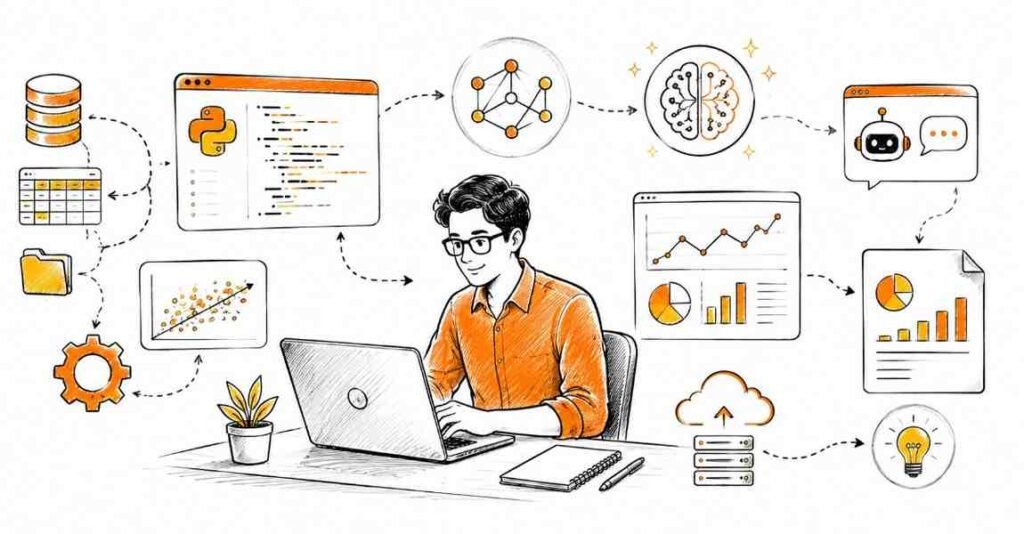
A data scientist with GenAI uses data science fundamentals along with generative AI tools and frameworks to solve business problems more efficiently. The role combines traditional analytics, machine learning, and modern AI application building.
In simple terms, this professional analyzes data, trains models, and also uses GenAI to summarize information, create copilots, improve automation, and build intelligent workflows.
Main responsibilities
- Collect and clean data.
- Analyze trends and build predictive models.
- Use Python and statistics for decision making.
- Work with LLMs and GenAI tools.
- Build RAG-based applications.
- Create AI-assisted analytics workflows.
- Test and evaluate model performance.
- Communicate insights to business teams.
🎓 Want to Build a High-Demand AI Career? Join Our GenAI Course! →
Why Data Science with GenAI Is a Smart Career
Data science is already a strong career, and GenAI makes it even more valuable. Companies now want professionals who understand both data and AI-powered application building.
The field is attractive because it sits at the intersection of analytics, machine learning, automation, and product innovation. That means your skill set stays relevant across many industries and use cases.
Why students choose it
- Strong demand in tech and business teams.
- Good salary growth with experience.
- Combines coding, analytics, and AI.
- Useful for product, analytics, and AI roles.
- Creates opportunities for research and applied AI work.
Data Science Roles Compared
Data science with GenAI includes several related roles, and each one focuses on a different layer of the AI stack.
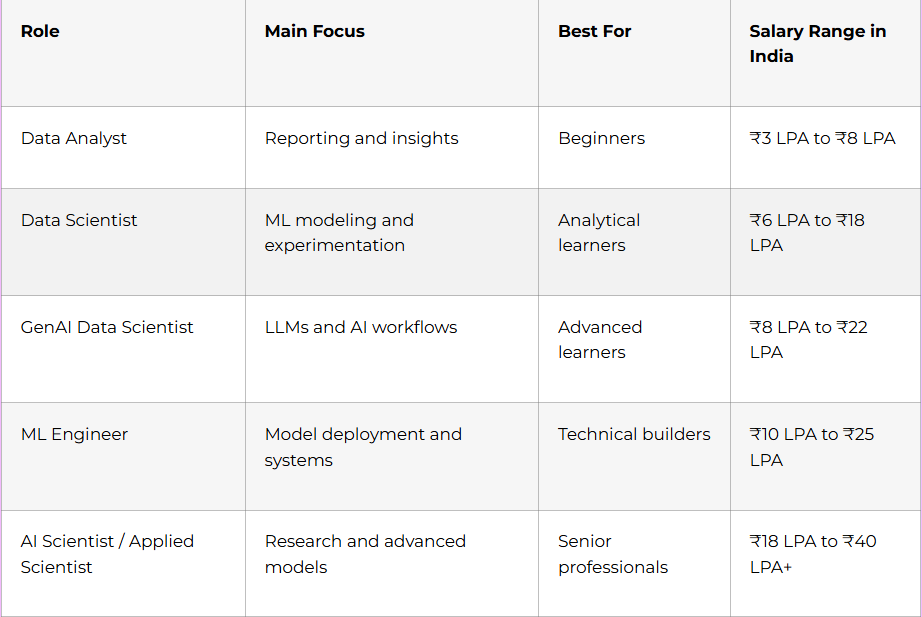
If you are starting out, the data scientist with GenAI path is a strong choice because it gives you traditional data science depth plus modern AI skills that employers are actively seeking.
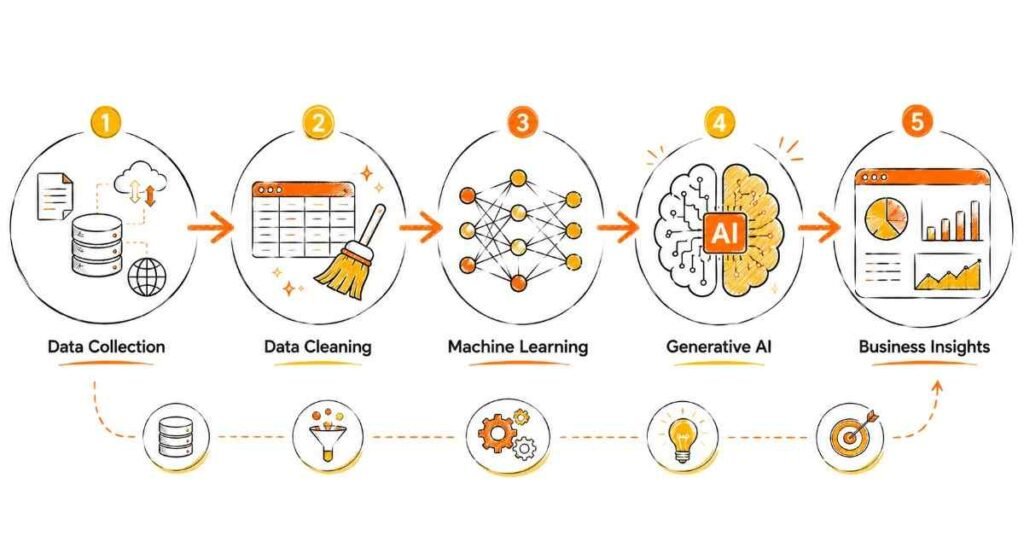
Complete Learning Roadmap
Phase 1: Data Science Foundations
Before jumping into GenAI, you need a solid base in data science fundamentals. These basics make it easier to understand model behavior and business problems.
Focus on:
- Python basics.
- Data types and structures.
- Statistics and probability.
- Data cleaning.
- Exploratory data analysis.
- Visualization.
- Problem framing.
Phase 2: Machine Learning Core
Machine learning is still the core of most data science roles. GenAI adds new capabilities, but ML remains essential.
Learn:
- Supervised learning.
- Unsupervised learning.
- Regression and classification.
- Clustering.
- Model evaluation.
- Feature engineering.
- Overfitting and bias-variance tradeoff.
- Cross-validation.
Phase 3: GenAI and LLM Fundamentals
This is where your career moves into modern AI. You need to understand how generative models work and how they are used in business.
Learn:
- What LLMs are.
- Prompt engineering basics.
- Tokens and context windows.
- Embeddings.
- Vector search.
- Model selection.
- Fine-tuning basics.
- Safety and hallucination handling.
Phase 4: RAG and AI Apps
Retrieval-Augmented Generation, or RAG, is one of the most useful GenAI patterns in real-world applications. It allows AI systems to answer using your own data.
Learn:
- Document ingestion.
- Chunking strategies.
- Vector databases.
- Retrieval methods.
- Prompt assembly.
- RAG evaluation.
- Chatbot workflows.
- Search-augmented assistants.
Phase 5: MLOps and Deployment
A model is only useful when it can run reliably in real environments. That is why deployment and monitoring matter.
Learn:
- Model packaging.
- API creation.
- Docker basics.
- Cloud deployment.
- Versioning.
- Monitoring.
- Logging.
- Experiment tracking.
Phase 6: Business and Communication
A strong data scientist also knows how to explain findings clearly. This is especially important in GenAI, where business teams need simple answers.
Learn:
- Stakeholder communication.
- Business problem framing.
- Data storytelling.
- Presentation design.
- Recommendation writing.
- ROI thinking.
🗺️ See the Complete Data Scientist Roadmap →
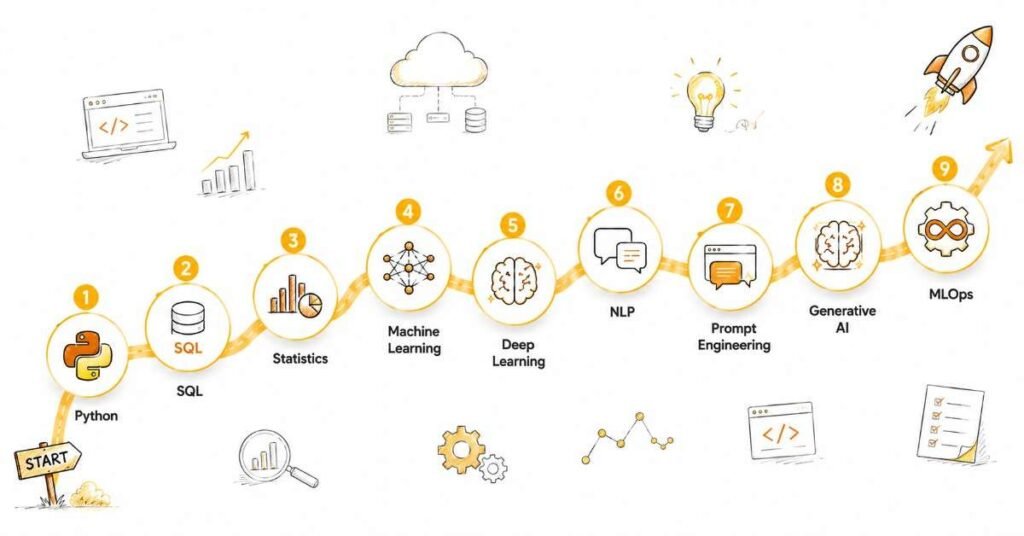
Python, ML, and GenAI Tools
These are the three pillars of the modern data science path.
Python skills to master
- Data structures.
- Functions and loops.
- Pandas.
- NumPy.
- Matplotlib and Seaborn.
- Notebook workflows.
- API integration.
Machine learning skills to master
- Regression and classification.
- Tree-based models.
- Model validation.
- Feature selection.
- Metrics and error analysis.
- Hyperparameter tuning.
GenAI skills to master
- Prompt engineering.
- LLM usage.
- RAG pipelines.
- Embeddings.
- Vector databases.
- Agent workflows.
- Model evaluation and guardrails
Salary Expectations in India
Salary depends on your background, portfolio, and how well you can combine data science with GenAI. Candidates who know both traditional ML and modern AI workflows usually have a stronger market position.
Experience Level | Typical Salary |
Fresher | ₹4 LPA to ₹7 LPA |
1–3 years | ₹7 LPA to ₹14 LPA |
3–5 years | ₹14 LPA to ₹22 LPA |
5+ years | ₹22 LPA to ₹40 LPA+ |
Professionals with strong project work in LLM apps, RAG systems, or MLOps often command higher pay than standard analytics candidates.
Portfolio That Gets Interviews
A strong portfolio is the fastest way to show that you can work with real data and GenAI tools. Recruiters want practical proof, not just certificates.
What to include
- EDA project with Python.
- Predictive ML project.
- RAG chatbot project.
- AI-assisted analytics dashboard.
- Model deployment demo.
- Business case study.
- GitHub repository with documentati
Portfolio checklist
- Explain the problem clearly.
- Show data cleaning and analysis steps.
- Include model results and metrics.
- Add screenshots or demo links.
- Document your GenAI workflow.
- Keep the project story simple and business-focused.
Job Search Strategy
A data science with GenAI resume should show both classical data science and modern AI ability. Employers want someone who can analyze, build, and deploy useful AI solutions.
Resume keywords
- Python
- Data science
- Machine learning
- LLMs
- GenAI
- RAG
- Embeddings
- Vector databases
- MLOps
- Pandas
- Scikit-learn
- Model deployment
Where to apply
- LinkedIn Jobs
- Naukri
- Indeed
- startup career pages
- AI product companies
- analytics and ML roles
- research and applied AI teams
Interview preparation
Be ready to answer questions like:
- What is the difference between ML and GenAI?
- How does RAG work?
- What are embeddings?
- How do you evaluate an LLM application?
- What is the difference between fine-tuning and prompting?
- How do you deploy a model?
- How do you explain a machine learning result to a business team?
💼 Prepare for
GenAI Interviews With Our Expert Guides →
30-Day Starter Plan
If you want to begin now, follow this simple plan.
Week 1
- Revise Python basics.
- Review statistics and probability.
- Practice Pandas and data cleaning.
- Start one EDA notebook.
Week 2
- Build a simple ML model.
- Practice classification or regression.
- Learn evaluation metrics.
- Document results clearly.
Week 3
- Study LLM basics.
- Learn embeddings and vector databases.
- Build a small RAG demo.
- Test prompt variations.
Week 4
- Add deployment basics.
- Create one GitHub portfolio project.
- Update your resume and LinkedIn.
- Start applying for internships and junior roles.
Why Learn Data Science with GenAI at Frontlines Edutech
Frontlines Edutech is a practical choice for students and working professionals who want structured learning, regional support, and career-focused training. The best programs combine Python, statistics, machine learning, GenAI workflows, RAG, and project-based learning in a way that makes job readiness realistic.
What to look for in training
- Strong Python and ML foundation.
- GenAI and LLM practice.
- RAG and vector database projects.
- MLOps and deployment exposure.
- Resume and interview support.
- Regional-language explanation if needed.
Frequently Asked Questions
1. How long does it take to become a data scientist with GenAI?
It usually takes 6 to 10 months of consistent learning to become job-ready, depending on your background and how much practical project work you complete.
2. Is data science with GenAI a good career in India?
Yes, it is a strong career because companies want professionals who can work with data, machine learning, and GenAI-based solutions.
3. Which skill should I learn first?
Start with Python, statistics, and data analysis. After that, move into machine learning, LLMs, and RAG.
4. Do I need coding to become a data scientist with GenAI?
Yes, basic Python is essential. You do not need to be an expert programmer at the beginning, but you must be comfortable writing and reading code.
5. What is the best specialization for beginners?
Data science with a strong ML base is the best starting point. Once you are comfortable, move into GenAI applications and RAG systems.
6. Can I get a job without experience?
Yes, if you have practical projects, a strong GitHub profile, and a clear understanding of Python, ML, and GenAI tools. Internships and demos can help a lot.
7. Which tools should I learn first?
Start with Python, Pandas, NumPy, Scikit-learn, Jupyter Notebook, and a basic LLM platform. Then move into vector databases, RAG frameworks, and deployment tools.
8. Is GenAI data science remote-friendly?
Yes, many AI and data science roles are remote-friendly because the work is digital and can be done with standard development and collaboration tools.
9. What kind of projects should I show in interviews?
Show EDA notebooks, predictive models, RAG chatbots, and deployed AI demos. Employers want to see that you can solve real-world problems with data and GenAI.