
90-Day Cyber Security Course Roadmap: From Complete Beginner to Job-Ready
Table of Contents
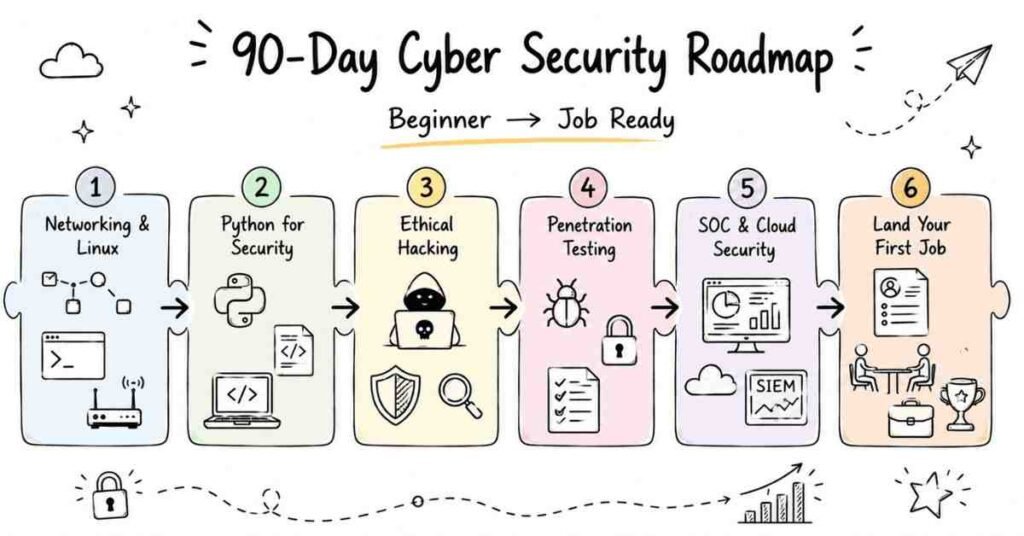
This is a structured, day-by-day 90-day roadmap to become a job-ready Cyber Security professional covering Networking, Linux, Python for Security, Ethical Hacking, Penetration Testing, Web Application Security, SOC/SIEM operations, and Cloud Security, with a full CEH certification prep track built in. Built on Frontlines Edutech’s Cyber Security course curriculum, this plan is designed for students, freshers, and IT professionals across India who want to break into one of the highest-demand tech careers of the decade even with zero prior security experience. India’s cybersecurity job market is growing at an explosive pace, with ethical hacker freshers earning ₹4.5–6 LPA and senior professionals commanding ₹25–40 LPA. By Day 90, you’ll have hands-on lab experience, a professional GitHub security portfolio, and the interview confidence to crack roles at Infosys, TCS, IBM, banking giants, and fast-growing cybersecurity firms in Hyderabad and beyond.
Why Cyber Security Is the Career of the Decade
Right now, while you’re reading this, organizations worldwide are under attack. India alone sees millions of cyberattacks annually and there are simply not enough trained professionals to stop them. That gap is your opportunity.
- Demand massively outpaces supply — India’s cybersecurity talent shortage is among the largest in Asia
- Every sector is hiring — banking, healthcare, IT services, e-commerce, government, defence, and telecom
- Salaries are premium from Day 1 — ethical hacker freshers earn ₹4.5–6 LPA; senior professionals earn ₹25–40 LPA
- AI is creating more threats, not fewer — every AI deployment creates new attack surfaces that need trained defenders
- Cities like Hyderabad, Bangalore, Mumbai, Pune, Chennai, and Delhi-NCR are posting thousands of security openings monthly
The honest truth: a trained cybersecurity professional from Hyderabad can compete with candidates from any metro in India and this 90-day roadmap is how you get there.
Explore Cyber Security Courses →
The 3-Month Learning Structure at a Glance
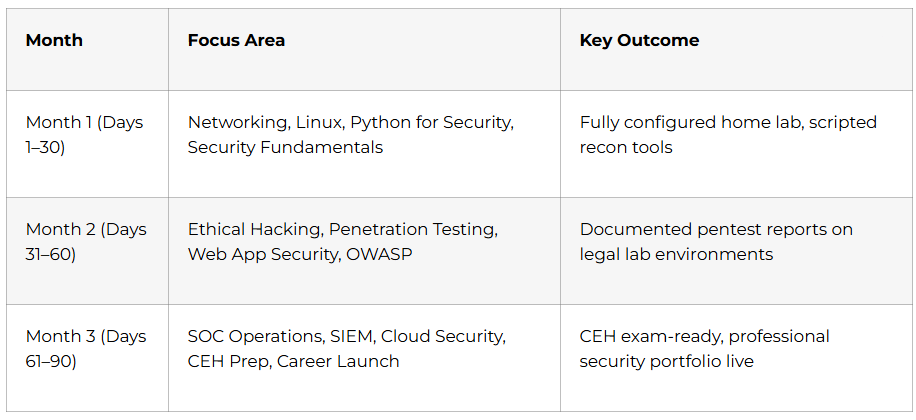
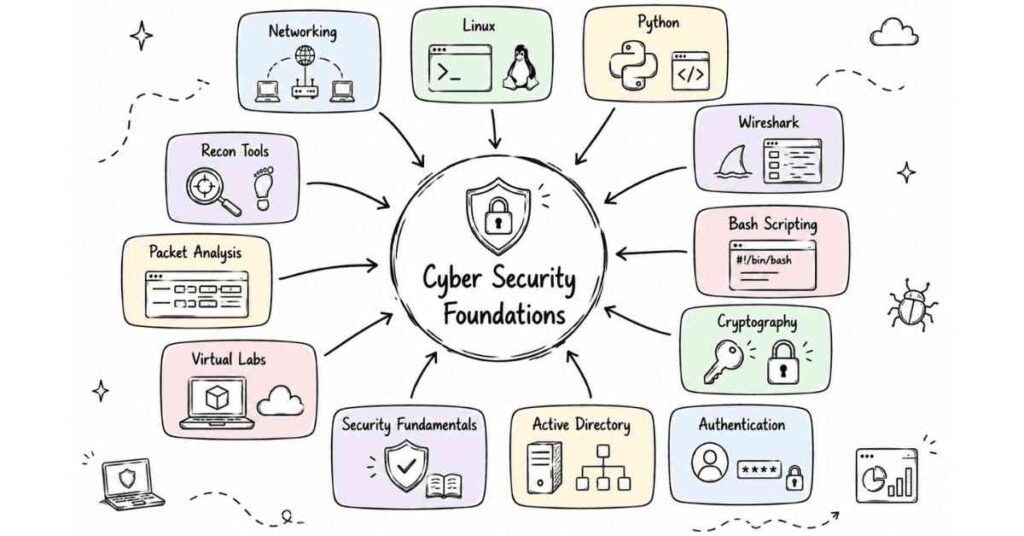
Month 1: Build Your Security Foundation (Days 1–30)
Every penetration tester, ethical hacker, and SOC analyst starts exactly here. The attackers you’ll eventually defend against understand these fundamentals deeply so must you.
Week 1: Cybersecurity Fundamentals & Networking (Days 1–7)
Day 1–2: What Cybersecurity Actually Means
- The CIA Triad (Confidentiality, Integrity, Availability) the foundation of every security decision you’ll ever make
- Types of threats: malware, ransomware, phishing, social engineering, insider threats, APTs
- How attackers think: the Cyber Kill Chain and MITRE ATT&CK framework overview
- Career paths: Ethical Hacker, Penetration Tester, SOC Analyst, Security Architect, Bug Bounty Hunter, Incident Responder
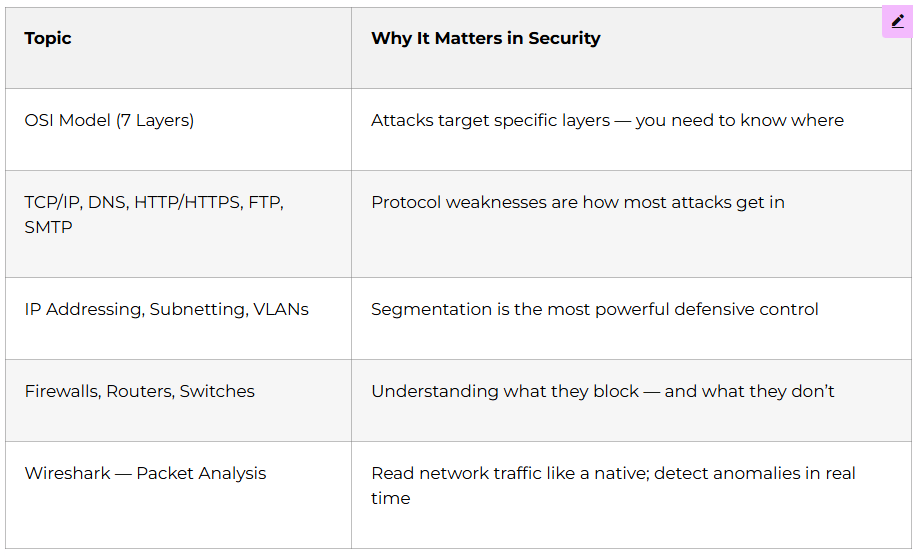
Days 3–5: Networking Fundamentals — The Language of Security
Every attack and every defence travels across a network. You must understand this before you can hack or defend anything.
Days 6–7: Setting Up Your Home Lab
- Install VirtualBox or VMware, Kali Linux (the attacker OS), and a Windows Server target VM
- Configure an isolated network so your lab never touches real systems
- First capture: use Wireshark to analyse your own traffic and identify protocols
💡 Lab Rule: Always use your private lab environment for practice. Never test tools on systems you don’t own or have explicit written permission to test. Ethical hacking is legal only with authorisation.
Week 2: Linux for Security Professionals (Days 8–14)
Kali Linux is the primary operating system for ethical hackers. Every serious security tool runs on Linux. This week makes it second nature.
- Days 8–9 — Linux CLI mastery: filesystem navigation (cd, ls, pwd, chmod, chown), file operations, user and permission management
- Day 10 — Process management, network commands (ifconfig, netstat, ss, nmap basics), and package management (apt)
- Day 11 — Bash scripting fundamentals: variables, loops, conditionals write your first automated recon script
- Day 12 — Log analysis: reading /var/log files, grep and awk for searching logs critical for SOC work
- Day 13 — File permissions deep dive: SUID, SGID, sticky bit the misconfigurations attackers love to exploit
- Day 14 — Week 2 Project: Write a Bash recon script that automates: host discovery with map, open port listing, and basic OS detection save output to a timestamped report file
Week 3: Python for Security Automation (Days 15–21)
Manual hacking is slow. Professionals write tools. Python is the scripting language of every serious security engineer.
- Days 15–16 — Python essentials review: variables, functions, loops, file I/O, error handling
- Day 17 — Socket programming: TCP/UDP connections, port scanners, banner grabbing build a simple port scanner from scratch
- Day 18 — HTTP requests with the requests library: automated web scraping, login form testing, header analysis
- Day 19 — Scapy for packet crafting: send custom packets, craft ARP requests, build a network scanner
- Day 20 — Regular expressions for log parsing: extract IPs, URLs, credentials patterns from log files automatically
- Day 21 — Week 3 Project: Build a full Python Network Scanner that takes an IP range, pings each host, identifies open ports on live hosts, grabs service banners, and exports results to CSV
Week 4: Security Fundamentals & Cryptography (Days 22–30)
- Days 22–23 — Cryptography essentials: symmetric (AES, DES) vs. asymmetric (RSA, ECC), hashing (MD5, SHA-256), digital signatures, PKI
- Days 24–25 — Authentication and access control: MFA, SSO, OAuth, LDAP, Active Directory basics how identity attacks work
- Day 26 — Vulnerability management lifecycle: identification, scoring (CVSS), prioritisation, patching, verification
- Day 27 — Security frameworks: NIST Cybersecurity Framework, ISO 27001, OWASP what companies actually follow
- Days 28–29 — Introduction to Metasploit: understanding the framework, modules, payloads, sessions in your isolated lab only
- Day 30 — Month 1 Assessment: Documented lab report network map of your lab environment, Bash recon script output, Python scanner results, written explanation of 5 cryptographic concepts
🏆 Month 1 Milestone: You understand how networks and systems work, you can script your own tools, and you’ve run your first controlled penetration test. You think like a security professional.
Month 2: Ethical Hacking & Penetration Testing (Days 31–60)
Month 2 is where you learn to think like an attacker legally and ethically. This is the content that gets you the job title “Ethical Hacker” or “Penetration Tester.
Week 5: Ethical Hacking Methodology (Days 31–37)
Every professional penetration test follows a structured methodology. Knowing this process is what separates ethical hackers from script kiddies.
The Five Phases of Ethical Hacking:
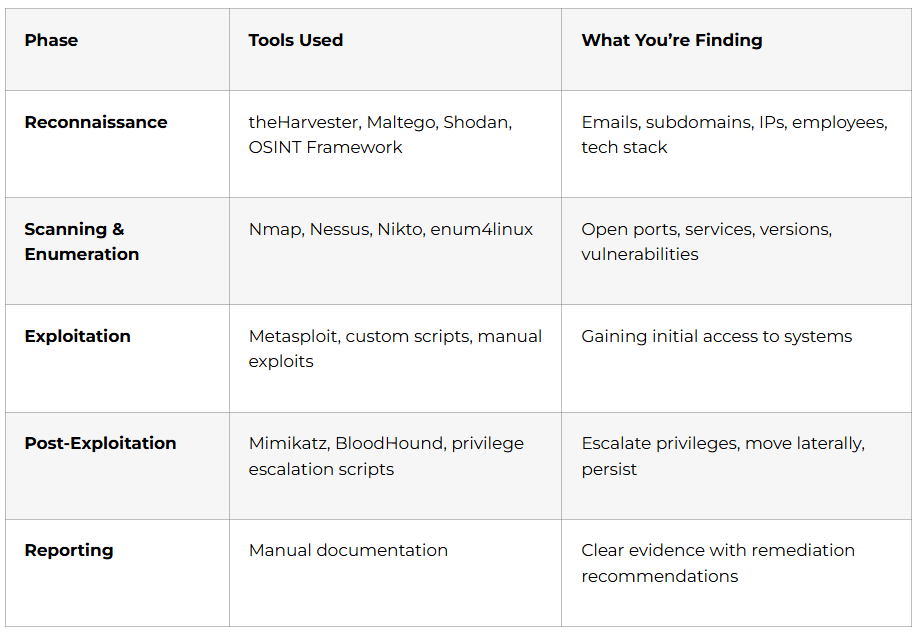
- Days 31–32 — Passive and active reconnaissance: OSINT techniques, Google Dorking, Shodan, theHarvester, Maltego
- Days 33–34 — Scanning deep dive: Nmap scan types (SYN, UDP, version, script), Nessus vulnerability scanner setup and use
- Days 35–36 — Enumeration: SMB enumeration with enum4linux, SNMP enumeration, DNS zone transfers, LDAP enumeration
- Day 37 — Week 5 Lab: Full reconnaissance report on a legal CTF target from TryHackMe — document every finding with screenshots
Week 6: System Exploitation & Post-Exploitation (Days 38–44)
- Days 38–39 — Metasploit framework deep dive: auxiliary modules, exploit modules, payload types (staged vs. stageless), Meterpreter sessions
- Day 40 — Manual exploitation: searching CVEs on Exploit-DB, compiling and running public exploits, understanding what’s happening in the code
- Days 41–42 — Privilege escalation — Linux: SUID binaries, cron job abuse, writable /etc/passwd, sudo misconfigurations
- Day 43 — Privilege escalation — Windows: unquoted service paths, DLL hijacking, token impersonation, AlwaysInstallElevated
- Day 44 — Week 6 Lab: Complete a TryHackMe or HackTheBox machine — initial access → privilege escalation → root/system → written report with remediation steps
Week 7: Web Application Security & OWASP Top 10 (Days 45–51)
Web applications are the most attacked surface in the world. Every company has one. This week makes you an expert at finding their weaknesses.
OWASP Top 10 — Covered in Full:
- Days 45–46 — Injection attacks: SQL Injection (manual + SQLMap), Command Injection, LDAP injection find and exploit vulnerable forms
- Day 47 — Authentication flaws: broken auth, session fixation, credential stuffing, password spraying test login forms systematically
- Day 48 — XSS (Cross-Site Scripting): reflected, stored, DOM-based inject payloads, steal cookies, demonstrate impact
- Day 49 — IDOR (Insecure Direct Object Reference), Broken Access Control access other users’ data by changing IDs in requests
- Day 50 — Security Misconfiguration, Sensitive Data Exposure, XXE (XML External Entity) attacks
- Day 51 — Week 7 Project: Complete an OWASP Juice Shop or DVWA challenge covering all 10 categories write a professional web application pentest report
Week 8: Network Penetration Testing & Wireless Security (Days 52–60)
- Days 52–53 — Man-in-the-Middle attacks: ARP spoofing, DNS poisoning, SSL stripping using Bettercap and Ettercap
- Days 54–55 — Password attacks: dictionary attacks with Hashcat, John the Ripper, rainbow tables, credential dumping with Mimikatz
- Day 56 — Wireless security: WPA2 handshake capture and offline cracking, WPS attacks with Reaver, evil twin access points
- Day 57 — Pivoting and tunnelling: port forwarding, SSH tunnels, using a compromised machine to attack internal network segments
- Days 58–59 — Evasion techniques: AV bypass fundamentals, encoding payloads, living-off-the-land binaries (LOLBins)
- Day 60 — Month 2 Capstone: Full penetration test on a multi-machine lab — recon → enumeration → exploitation → post-exploitation → detailed client-ready report with executive summary, technical findings, CVSS scores, and remediation recommendations
🏆 Month 2 Milestone: You can conduct structured penetration tests, write professional findings reports, and exploit web application and network vulnerabilities in controlled environments. You are an ethical hacker.
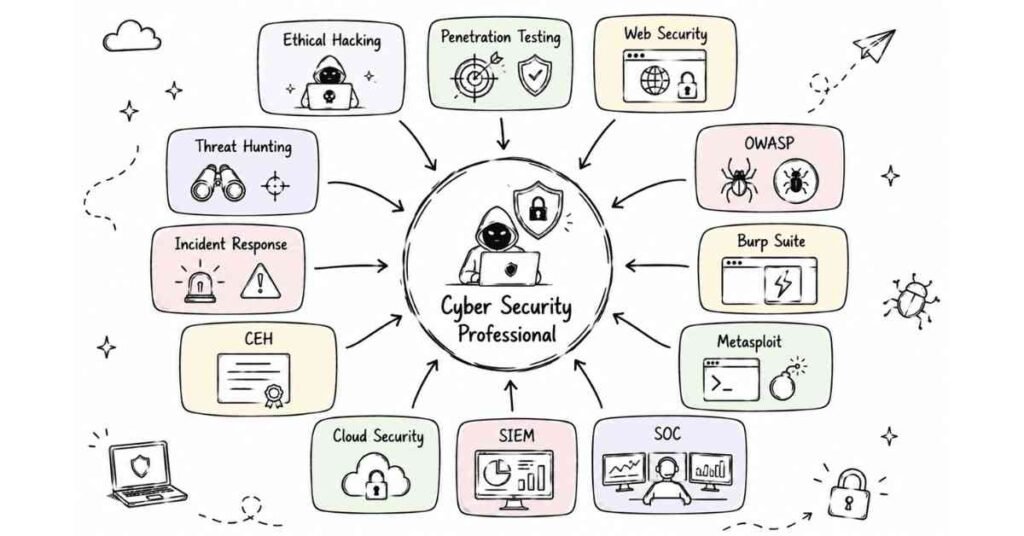
Month 3: Defensive Security, Cloud, CEH Prep & Career Launch (Days 61–90)
The final month adds blue team skills, cloud security, CEH examination preparation, and a complete career launch sprint. Knowing both attack and defence makes you the most valuable candidate in any interview.
Want to Become a Cyber Security Professional? Read the Complete Career Guide →
Week 9: SOC Operations & SIEM (Days 61–67)
SOC (Security Operations Centre) Analysts are the most consistently hired cybersecurity role in India. Every IT company, bank, and government department is hiring them.
- Day 61 — SOC fundamentals: Tier 1/2/3 analyst roles, alert triage, incident classification, escalation procedures
- Day 62 — Log analysis deep dive: Windows Event Logs (Event IDs 4624, 4625, 4688, 4720), Linux syslog, Apache/Nginx access logs
- Day 63 — SIEM with Splunk: installing Splunk, ingesting logs, creating dashboards, writing SPL (Search Processing Language) queries
- Day 64 — SIEM with ELK Stack (Elastic + Logstash + Kibana): data pipeline setup, Kibana visualisations, detecting anomalies
- Day 65 — Writing detection rules: sigma rules, Splunk alerts, threshold-based and behaviour-based detections
- Day 66 — Incident response process: PICERL (Preparation → Identification → Containment → Eradication → Recovery → Lessons Learned)
- Day 67 — Week 9 Lab: Investigate a simulated security incident — ingest logs into Splunk, identify the attack timeline, document the full incident report
Week 10: Cloud Security & Advanced Threat Defence (Days 68–74)
Cloud is where India’s IT infrastructure has moved. Cloud security is one of the fastest-growing specialisations in Indian cybersecurity.
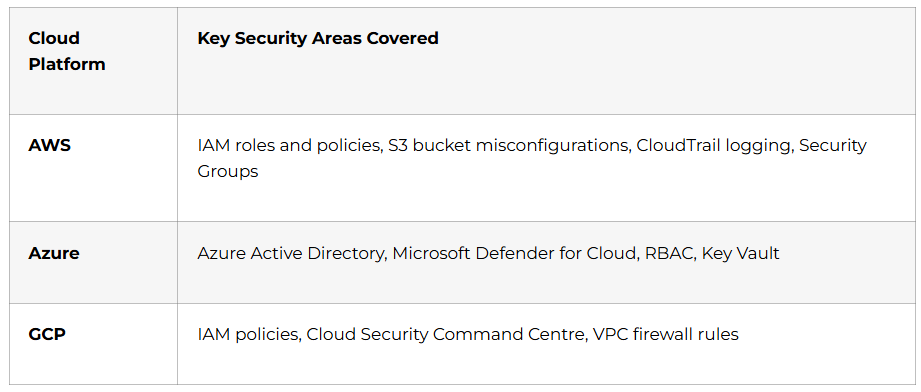
- Days 68–69 — AWS security: IAM least-privilege analysis, S3 bucket audits, finding and fixing common misconfigurations
- Days 70–71 — Azure security: Azure AD attack paths (BloodHound for Azure), Conditional Access policies, Defender for Cloud alerts
- Day 72 — Cloud penetration testing: tools (Pacu for AWS, ScoutSuite for multi-cloud), methodology, scope limitations
- Day 73 — Container and DevSecOps security: Docker image scanning with Trivy, Kubernetes RBAC, integrating security into CI/CD pipelines
- Day 74 — Cloud Security Project: Audit a deliberately misconfigured AWS or Azure environment, document all findings, and produce a remediation checklist
Week 11: CEH Exam Preparation (Days 75–81)
The Certified Ethical Hacker (CEH) certification is the most recognised ethical hacking credential in India and is explicitly requested in thousands of job postings. This week is your exam sprint.
CEH Exam at a Glance:
- Format: 125 multiple-choice questions
- Duration: 4 hours
- Passing score: ~70% (varies by exam version)
- Issued by: EC-Council
- Value: Required or preferred by TCS, Wipro, Infosys, L&T, KPMG, and almost every BFSI company
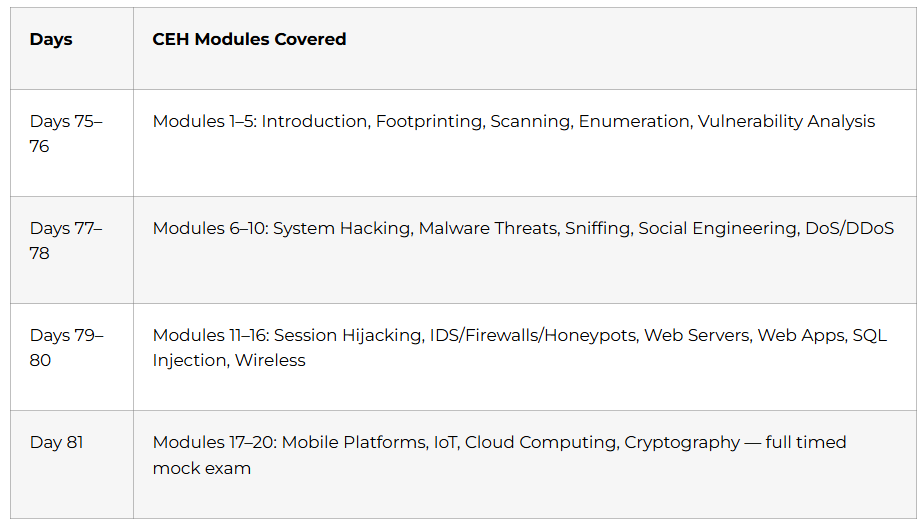
CEH Module Review Schedule:
CEH Prep Tip: Use EC-Council’s official courseware and MatProf or Boson mock tests. Focus on scenario-based questions — the CEH exam tests application, not just memorisation.
Week 12: Career Launch Sprint (Days 82–90)
- Days 82–83 — GitHub security portfolio: 4–5 polished repositories (Python scanner, Bash recon tool, pentest report template, SIEM detection rules, CTF writeups) with professional READMEs
- Day 84 — LinkedIn optimisation: headline: “Cyber Security Analyst | Ethical Hacking | Penetration Testing | CEH | Open to Opportunities in Hyderabad” add portfolio links to featured section
- Days 85–86 — ATS-ready resume: structure (Summary → Skills → Projects → Certifications → Education), quantify impact (“Identified 12 critical vulnerabilities in simulated pentest; CVSS score 9.2”), attach GitHub link
- Day 87 — Job platform strategy: Naukri.com (set alerts for “Security Analyst Fresher”, “Ethical Hacker”), LinkedIn Jobs, Internshala for internships, company career pages (Wipro CyberShark, TCS, IBM Security, KPMG)
- Day 88 — Freelance and bug bounty: create HackerOne and Bugcrowd profiles, understand responsible disclosure, start with private programmes for beginners
- Days 89–90 — Full Mock Interview Day: Technical (CEH concepts + tool walkthroughs), Pentest scenario question, SOC alert triage simulation, Behavioural (STAR format) recorded for self-review
🏆 Day 90 Milestone: CEH exam-ready. Security portfolio live. Resume submitted. LinkedIn active. Cyber security career begins.
Cybersecurity Career Paths & Salary Guide (India 2025)
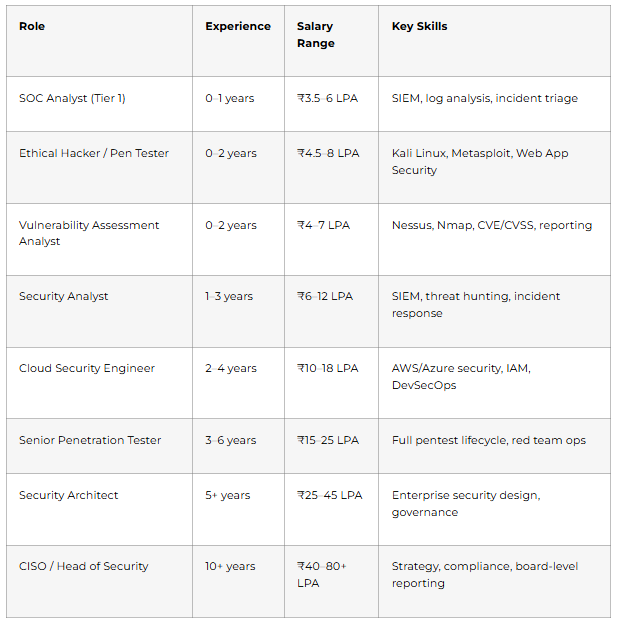
Top hiring cities: Hyderabad, Bangalore, Mumbai, Pune, Chennai, Delhi-NCR, Noida
Active hirers: TCS, Wipro, Infosys, HCL, IBM, Accenture, Capgemini, KPMG, Deloitte, BFSI companies (HDFC, SBI, ICICI), and hundreds of dedicated cybersecurity firms and AI startups
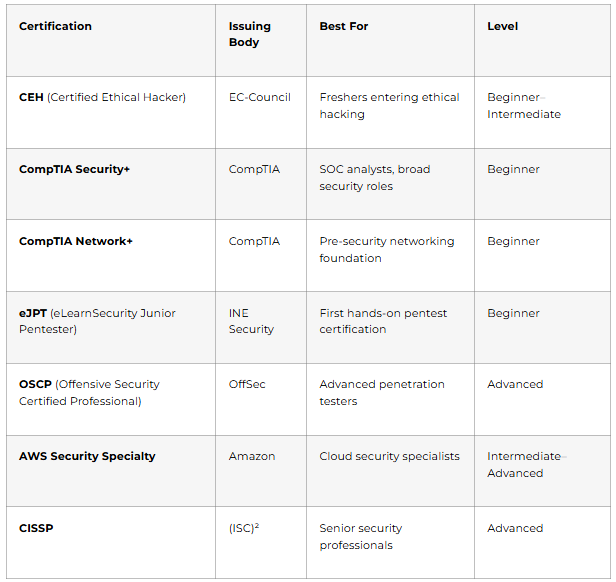
Certifications That Boost Your Cybersecurity Career
Beyond the CEH, these are the most valuable certifications for Indian cyber security professionals at different stages:
Why Choose Frontlines Edutech
Frontlines Edutech is headquartered in Somajiguda, Hyderabad and has helped thousands of students across the Telugu states launch technology careers — including freshers, non-IT graduates, and IT professionals pivoting to security.
- Hands-on lab-first approach — every concept is immediately practised in a real lab environment, not just watched in a video
- CEH exam preparation built into the curriculum — structured revision, mock exams, and exam strategy included
- Telugu-friendly teaching — complex concepts like privilege escalation, SIEM rule writing, and cryptography explained in the language you think in
- Red team AND blue team coverage — you learn to attack AND defend, which doubles your employability
- Career support until you’re placed — resume building, LinkedIn, mock interviews, and placement updates from 200+ hiring partners
- Affordable fees — world-class cybersecurity training at a fraction of what other institutes charge
Frequently Asked Questions
Q1: Do I need programming experience to start a cyber security course?
No. This roadmap starts from zero networking basics, Linux fundamentals, and beginner Python are all covered from scratch in Month 1. A basic understanding of computers is helpful but not required. Many successful security professionals came from non-IT backgrounds.
Q2: What is the salary for a cyber security fresher in India?
Ethical hacker and SOC analyst freshers in India typically earn ₹4.5–6 LPA. With the CEH certification and a strong project portfolio, many candidates land ₹6–8 LPA at their first role. Senior professionals with 5+ years of experience earn ₹25–40 LPA or more.
Q3: Is CEH certification covered in this cyber security roadmap?
Yes. The CEH (Certified Ethical Hacker) examination is covered comprehensively in Week 11 (Days 75–81) with a module-by-module review, timed mock exam, and exam strategy session. The entire 90-day curriculum is structured to build the practical skills the CEH exam tests.
Q4: What tools will I learn in this cyber security course?
You’ll get hands-on with Kali Linux, Nmap, Wireshark, Metasploit, Burp Suite, Nessus, SQLMap, Hydra, Hashcat, Mimikatz, Splunk, ELK Stack, Pacu (AWS), ScoutSuite, and Bash/Python scripting for automation the exact toolkit used by professional penetration testers and SOC analysts.
Q5: What is the difference between ethical hacking and cybersecurity?
Ethical hacking is a specific discipline within cybersecurity focused on offensive skills finding vulnerabilities by simulating real attacks. Cybersecurity is the broader field that includes defensive work (SOC analysis, incident response, security architecture) as well as offensive work. This course covers both.
Q6: Can I get a job as a fresher after this 90-day cyber security roadmap?
Yes provided you complete the hands-on lab work, build your portfolio on GitHub, earn the CEH certification, and prepare properly for interviews. Entry-level roles like SOC Analyst Tier 1, Junior Penetration Tester, and Vulnerability Assessment Analyst are all achievable for freshers with this skillset and credential.
Q7: Does Frontlines Edutech provide placement support after the cyber security course?
Yes. Placement support includes resume building, LinkedIn and GitHub profile optimisation, mock interviews with technical and behavioural rounds, and active job leads from 200+ partner companies including TCS, Wipro, Infosys, KPMG, and dedicated cybersecurity firms.
Q8: What is ethical hacking and is it legal?
Ethical hacking also called penetration testing is the authorised practice of testing computer systems, networks, or applications for security vulnerabilities. It is 100% legal when performed with explicit written permission from the system owner. Practising on your own lab environment (as this course teaches) is always safe and legal.
Published by Frontlines Edutech | blog.frontlinesedutech.com
For enrollments: +91-83330 77727 | support@frontlinesedutech.com