What Does a ServiceNow Developer Do and What Skills Matter
Recommended Learning Path
What Is a Dataset ?
Understanding Data for Analytics Beginners
What Does a ServiceNow Developer Do?
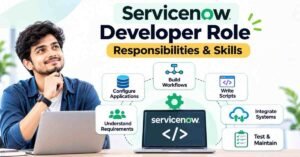
A ServiceNow developer builds and improves applications and workflows on the ServiceNow platform. The work can include configuring forms and tables, automating approvals, writing scripts, connecting external systems, and testing that a change behaves correctly.
The role is not simply “writing code for tickets.” ServiceNow’s developer resources describe work across data models, business logic, interfaces, workflows, testing, and deployment.
The role in one example
Imagine employees request laptops by emailing several teams. Approvals get lost, people ask for updates, and nobody has a reliable view of the request’s progress.
A ServiceNow developer might help turn that process into a structured application:
- Employees submit the required information.
- The request follows an agreed approval route.
- A fulfillment team receives its task.
- The requester can see the status.
- Access rules determine who can view or change records.
This is an illustrative example, not a claim about a particular customer implementation.
The developer’s job is to make the process work reliably—including when the request is rejected, information is missing, or an approval cannot be assigned.
What are the main responsibilities?
1. Understand the request before building
“Automate laptop requests” is not yet a complete requirement.
The developer needs answers to questions such as:
- Who can submit a request?
- Can someone request equipment for another employee?
- Who approves it?
- What happens if an approver is unavailable?
- Which team fulfills it?
- What information must remain restricted?
An official ServiceNow developer vacancy describes working with product owners to understand requirements and taking work through design, implementation, testing, and delivery. The exact division of responsibilities varies by team.
2. Configure data and user interactions
The developer works out what information the application needs and how people will interact with it.
That may involve tables, fields, forms, catalog items, and user-facing interfaces. ServiceNow’s official developer resources identify data models, logic, interfaces, and workflows as core development areas.
The important decision is not merely where a field appears. It is what the field means, who maintains it, and how the process uses it.
3. Build automation and write scripts where appropriate
Some requirements can be implemented through platform configuration and visual automation. Others require scripted behavior.
ServiceNow University’s developer curriculum includes JavaScript fundamentals, platform scripting, client-side customization, and application development practices
Beginners will encounter terms such as:
Component | Basic purpose |
Client Script | Scripted behavior in the client interface |
Business Rule | Server-side logic associated with record operations |
Script Include | Reusable server-side code |
Flow or subflow | Reusable process automation |
Access control | Rules governing permitted access to records or fields |
Learning the distinction matters. Hiding something on a form should not be treated as a substitute for enforcing access permissions.
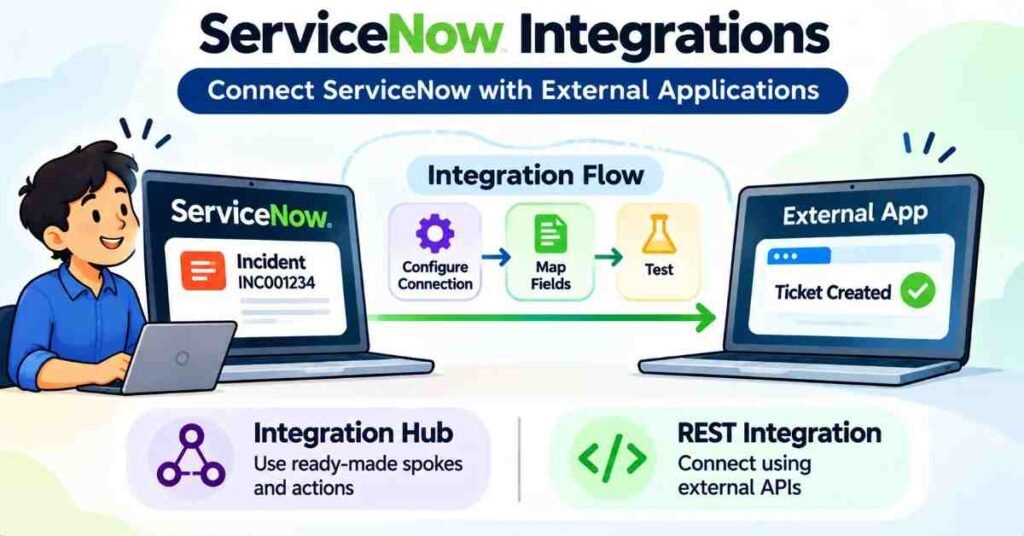
4. Connect systems when the process requires it
A workflow may need information from another application or need to send an update elsewhere.
For example, an equipment request might exchange information with an inventory system. The developer must consider authentication, field mapping, response handling, and failures—not just whether a request returns a successful status.
Integration and web services are included in ServiceNow University’s application developer coverage.
5. Test, troubleshoot, and maintain
A developer checks more than the expected path through an application.
For the laptop-request example, useful tests include:
- An authorized employee submits a valid request.
- A required value is missing.
- Approval is rejected.
- A user tries to open someone else’s restricted record.
- A repeated action would otherwise create duplicate work.
- An external system is unavailable.
Testing and maintainability are part of the role, not optional finishing touches. ServiceNow’s official developer vacancy emphasizes clean, reusable code, code reviews, unit testing, and ownership through delivery.
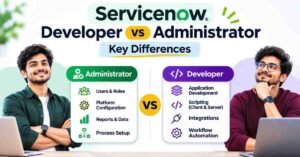
ServiceNow administrator vs developer: what is the difference?
A useful starting distinction is:
Administrator emphasis | Developer emphasis |
Operating and configuring the platform | Building or extending application behavior |
Managing users, groups, roles, and settings | Designing application logic and integrations |
Supporting platform use and routine changes | Implementing and testing more involved requirements |
These are not strict boundaries. Smaller teams may combine responsibilities, and administrators can build automations.
ServiceNow University’s CSA coverage includes configuration, security, reporting, and workflow concepts. Its CAD coverage places greater emphasis on scripting, APIs, client-side customization, and application development.
Read a vacancy’s responsibilities rather than relying on its title alone.
Which skills should beginners prioritize?
- Platform foundations
Understand tables, records, reference fields, forms, users, groups, and roles. Learn basic ITSM terminology so that incidents, requests, problems, and changes do not all sound interchangeable. - JavaScript and platform APIs
Practise variables, conditions, functions, arrays, and objects. Then learn how those concepts are used within ServiceNow. - JavaScript and platform API knowledge appear in both ServiceNow University’s developer training and an official developer job specification.learning.
- Debugging and testing
Learn to reproduce a problem, inspect relevant logs, isolate a cause, and verify a correction. Avoid changing several things at once and guessing which change worked. - Communication
Be able to explain a requirement, a design decision, and a limitation. A teammate should understand your work without having to reverse-engineer it.
How can a beginner prepare?
Build one small application in an authorized non-production environment.
A suggested sequence is:
- Write a short requirement.
- Define the records and fields.
- Create the basic interface.
- Add a simple automation.
- Introduce a small scripting requirement.
- Test permissions and failure cases.
- Document the result.
Use synthetic records. Do not experiment on an employer’s production instance without authorization.
If Telugu explanations help, learn the concepts in Telugu while also practising the English labels and technical terms used in the platform.
Proposed FLM perspective: demonstrate behavior, not just screens
Editorial recommendation for an FLM reviewer to approve.
Assess a beginner project through behavior:
- What happens when the user submits valid information?
- What happens when the request cannot proceed?
- What prevents unauthorized access?
- How can another developer understand the implementation?
Screenshots show what an application looks like. A walkthrough with test cases shows what it does.
FLM’s advertised curriculum includes scripting, Flow Designer, integrations, and projects such as onboarding and laptop-request workflows. Review its ServiceNow course with practical projects, and confirm current lab access and project-review arrangements before enrolling.courses.frontlinesedutech
Common misunderstandings
- “Low-code means developers never write scripts.” Visual tools and scripting both appear in ServiceNow’s development curriculum.
- “A working form means the application is finished.” Permissions, rejected requests, failures, and maintenance still need attention.
- “Every ServiceNow developer does the same work.” Responsibilities vary by application area, experience, and team.
- “A certificate guarantees a job.” Evaluate training, official credentials, practical ability, and employer requirements separately.
FAQs
- Does a ServiceNow developer need coding skills?
Development work can involve JavaScript, server-side scripting, client-side customization, and APIs. Beginners do not need to know everything immediately, but should expect to build coding skills. - Is the role limited to ITSM?
No. ServiceNow development includes applications and workflows beyond a single service-management module. The particular product area depends on the assignment.
- Can someone from a non-IT background prepare?
They can start by learning platform and programming foundations. Course admission and job eligibility are separate questions, so check each provider and employer’s requirements. - What should a first project include?
A clear requirement, a small data model, an interface, an automation, access checks, and documented tests. Keep the scope small enough to explain your decisions. - Should beginners learn administration first?
Platform administration concepts provide useful foundations. ServiceNow University’s curriculum introduces administration and configuration before deeper development topics. This is a learning approach, not a universal hiring rule. - Is a training certificate the same as CAD?
No. A provider’s course-completion certificate is different from ServiceNow’s Certified Application Developer credential. ServiceNow University describes CAD as a separate certification examination. Verify current eligibility and exam arrangements through official channels. - What should I check in a developer vacancy?
Look at required experience, platform areas, scripting expectations, integration work, testing responsibilities, and any stated certification or education criteria.