
ServiceNow Developer vs Java Developer: What Is Different?
Table of Contents
Recommended Learning Path
ServiceNow Developer vs Java Developer: What Is Different?
understanding the difference between ServiceNow vs JAVA
Introduction
A ServiceNow developer and a Java developer both create software solutions, but their work environments, programming tools, and development responsibilities are different.
A ServiceNow developer typically builds and customizes applications, automation, and workflows within the ServiceNow platform. A Java developer builds software applications and services using the Java programming language and related technologies.
Understanding ServiceNow developer vs Java developer helps students and career switchers identify which technical skills, projects, and development approaches they want to learn.
🚀 Want to Become a ServiceNow Specialist? Follow Our Step-by-Step Guide to Build Your ServiceNow Career!
Quick Answer: ServiceNow vs Salesforce
A ServiceNow developer specializes in building and extending applications within the ServiceNow platform, primarily using JavaScript, platform APIs, configuration, and workflow tools. A Java developer uses Java and related frameworks to build applications, backend services, APIs, and other software systems.
The main difference is the development environment.
- ServiceNow Developer: Platform-based application development and automation.
- Java Developer: General-purpose software development using Java.
Both roles require programming knowledge, problem-solving ability, debugging, testing, and an understanding of business requirements.
What Does a ServiceNow Developer Do?
A ServiceNow developer designs, builds, customizes, and maintains applications within the ServiceNow ecosystem.
ServiceNow supports enterprise processes involving IT Service Management, employee services, customer service, and workflow automation.
Common developer responsibilities include:
- Creating and configuring application tables
- Developing Client Scripts
- Writing Business Rules
- Creating reusable Script Includes
- Working with Glide APIs
- Configuring workflow automation
- Developing integrations using REST APIs
- Testing and troubleshooting applications
Example
Imagine a company wants to automate employee laptop requests.
A ServiceNow developer might configure a request form, create approval logic, generate fulfilment tasks, and send notifications.
Employee Request → Manager Approval → IT Task → Completion Notification
The developer works within ServiceNow’s application architecture rather than building an entirely new service-management platform from scratch.
What Does a Java Developer Do?
A Java developer creates and maintains applications using the Java programming language.
Java is used in backend services, enterprise systems, APIs, and other software applications.
Common responsibilities include:
- Writing Java application code
- Applying object-oriented programming concepts
- Developing backend services
- Building REST APIs
- Working with databases
- Implementing business logic
- Testing and debugging applications
- Managing application dependencies
- Integrating external services
Java developers may work with Spring Boot, SQL databases, build tools, and testing frameworks.
Example
Imagine an online shopping website that needs to process orders.
A Java developer might build backend services responsible for receiving orders, checking inventory, calculating totals, storing transactions, and returning responses to the frontend.
Customer Order → Java API → Business Logic → Database → Response
The developer controls much of the application logic and backend design.
ServiceNow Developer vs Java Developer: Key Differences
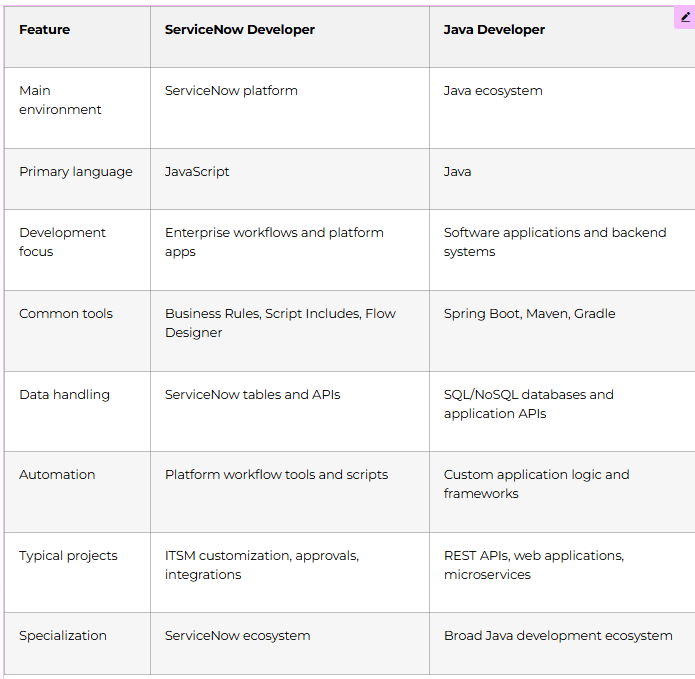
These are typical differences, not strict limitations. ServiceNow developers can build complex applications, while Java developers may also work with workflow systems and enterprise platforms.
Programming Languages and Technical Skills
ServiceNow Developer Skills
ServiceNow development primarily uses JavaScript and platform-specific APIs.
Important skills include:
JavaScript: Used for client-side and server-side scripting within supported ServiceNow contexts.
Business Rules: Execute configured server-side logic when relevant database operations occur.
Client Scripts: Control supported client-side form behavior.
Script Includes: Organize reusable server-side code.
Glide APIs: Provide platform-specific methods for working with records and other ServiceNow functions.
Flow Designer: Helps create automated processes using triggers, actions, and flow logic.
Developers also benefit from understanding HTML, CSS, REST APIs, application security, and data relationships.
Java Developer Skills
🎯 Preparing for ServiceNow Interviews? Follow Our Step-by-Step ServiceNow Interview Guide →
Java developers commonly learn:
Core Java: Syntax, methods, classes, objects, inheritance, and interfaces.
Collections Framework: Lists, sets, maps, and related data structures.
Exception Handling: Managing errors and application failures.
Spring Boot: Developing applications and REST services.
SQL: Querying and managing relational databases.
REST APIs: Enabling communication between applications.
Git and Testing: Managing source code and checking application behavior.
Other useful concepts include concurrency, authentication, deployment, and system design.
Which Developer Role Requires More Coding?
Java development generally requires more direct programming when building custom applications and backend services.
For example, a Java developer implementing an order-processing system may need to design classes, write business logic, implement APIs, handle database access, and test multiple components.
ServiceNow provides built-in application capabilities and low-code workflow tools, so developers can configure some functionality without writing every component themselves.
However, ServiceNow development is not a no-code profession.
Complex ServiceNow solutions may require substantial JavaScript, API integrations, access controls, debugging, and application architecture.
The amount of coding depends on the project, not simply the job title.
Real-World Project Comparison
Consider a company developing an employee leave management system.
ServiceNow Developer Approach
The developer might:
- Create a leave request table.
- Configure the employee request form.
- Add validation using platform features.
- Configure manager approvals.
- Automate notifications and status updates.
- Apply appropriate access controls.
The application uses ServiceNow’s existing platform services.
Java Developer Approach
The developer might:
- Design application classes and database tables.
- Build REST APIs using Spring Boot.
- Implement leave balance calculations.
- Develop approval business logic.
- Configure database access.
- Implement authentication and testing.
The Java solution requires assembling and managing the necessary application components.
Both approaches solve a similar business problem through different development models.
Which Is Better for Beginners?
Neither role is universally easier.
Consider ServiceNow Development If You Enjoy:
- Business process automation
- ITSM and enterprise applications
- JavaScript
- Platform configuration
- Workflow development
- Integrating enterprise services
Consider Java Development If You Enjoy:
- Programming fundamentals
- Object-oriented programming
- Backend application development
- Algorithms and data structures
- APIs and databases
- Building software components
A beginner who enjoys understanding business workflows may prefer exploring ServiceNow first.
Someone who wants broader programming foundations and backend engineering experience may prefer Java.
However, both paths require consistent practical learning.
FLM Learning Framework: P-C-B
Use three questions when comparing developer roles.
P — Platform: Do I want to specialize in an enterprise platform or work with a general-purpose programming ecosystem?
C — Coding: Do I enjoy platform scripting and automation, or developing application components directly?
B — Business Problem: Am I more interested in enterprise service workflows or building software products and backend systems?
This framework helps learners make decisions based on their interests rather than unsupported salary comparisons.
Beginner Learning Roadmap
Stage | ServiceNow Developer | Java Developer |
1 | ServiceNow fundamentals | Core Java |
2 | Tables, forms, records | OOP concepts |
3 | ITSM basics | Collections and exceptions |
4 | JavaScript | SQL and JDBC |
5 | Client Scripts, Business Rules | Spring Boot |
6 | Script Includes and Glide APIs | REST APIs |
7 | Flow Designer | Testing and security |
8 | Integrations | Microservices fundamentals |
9 | Practical ServiceNow application | Complete backend project |
Recommended Beginner Projects
For ServiceNow, create an employee service request application with approval automation, notifications, and access controls.
For Java, build a simple banking or library management backend with CRUD operations, database integration, REST APIs, and validation.
These projects provide practical evidence of what learners can build.
Can a Java Developer Become a ServiceNow Developer?
Yes.
Java developers already understand programming concepts such as variables, control flow, functions, object-oriented design, debugging, and APIs.
However, Java and JavaScript are different programming languages.
A Java developer transitioning into ServiceNow needs to learn JavaScript, ServiceNow tables, scripting APIs, security, application architecture, and workflow configuration.
Similarly, a ServiceNow developer moving toward Java backend development needs to learn Java syntax, frameworks, databases, testing, and application design.
Existing software-development experience can help, but platform-specific learning remains necessary.
Career Growth and Certification
ServiceNow provides official application-development learning paths, including its Certified Application Developer (CAD) credential.
Java developers generally develop their skills through programming, frameworks, projects, testing, deployment, and specialization rather than following a single mandatory Java developer certification.
Both career paths can lead to more advanced development, integration, architecture, and technical leadership responsibilities.
Salary and job opportunities depend on experience, skills, specialization, employer, location, and current market conditions. Neither path guarantees employment or a particular salary.
Common Misconceptions
ServiceNow developers must know Java
Incorrect. JavaScript is the primary scripting language used in ServiceNow development.
ServiceNow developers do not write code
Incorrect. Platform development can involve extensive scripting and integration work.
Java developers only create websites
Incorrect. Java is used for many types of software, including enterprise applications, backend services, and distributed systems.
ServiceNow is always easier than Java
Not necessarily. Platform development introduces its own architecture, APIs, configuration practices, and technical challenges.
Frequently Asked Questions
1. What is the main difference between a ServiceNow developer and a Java developer?
A ServiceNow developer builds solutions on the ServiceNow platform, while a Java developer builds software using Java and its ecosystem.
2. Does ServiceNow use Java or JavaScript?
ServiceNow application scripting primarily uses JavaScript, along with platform-specific APIs.
3. Is coding required for ServiceNow development?
Yes. Although some features support low-code configuration, developers need scripting skills for many advanced requirements.
4. Is Java harder than ServiceNow?
Difficulty depends on previous knowledge, learning goals, and the complexity of the applications being developed.
5. Can Java developers switch to ServiceNow?
Yes. Programming and API knowledge can transfer, but JavaScript and ServiceNow-specific skills must be learned.
6. What should a ServiceNow developer learn first?
Begin with platform fundamentals, tables, forms, records, JavaScript, and basic ITSM concepts.
7. What should a Java developer learn first?
Start with Core Java, OOP, collections, exception handling, and basic problem-solving.
8. Is Spring Boot required for Java development?
Not for all Java jobs. Spring Boot is commonly used for Java backend and REST API development.
9. Do ServiceNow developers work with APIs?
Yes. Developers may use platform APIs and integrate ServiceNow with external systems using REST APIs and other supported integration methods.
10. Which role should a fresher choose?
Choose based on your interest in enterprise platform development versus broader application programming, and test both through small projects.
Conclusion
The main distinction in ServiceNow developer vs Java developer is the technology environment and the type of applications commonly built.
ServiceNow developers focus on enterprise platform applications, workflows, integrations, and automation using JavaScript and ServiceNow-specific tools.
Java developers use Java and related technologies to build software applications, backend services, APIs, and other systems.
Both paths require technical understanding, problem-solving, debugging, and practical project experience.
Learners interested in enterprise workflows, ITSM, and ServiceNow application development can explore the ServiceNow course alongside hands-on learning and development exercises.
Rather than choosing based on salary expectations alone, beginners should explore both development approaches and select the path that matches their interests and long-term learning goals.