
How to Become a .NET Core Developer with Microservices in 2026: Complete Career Guide
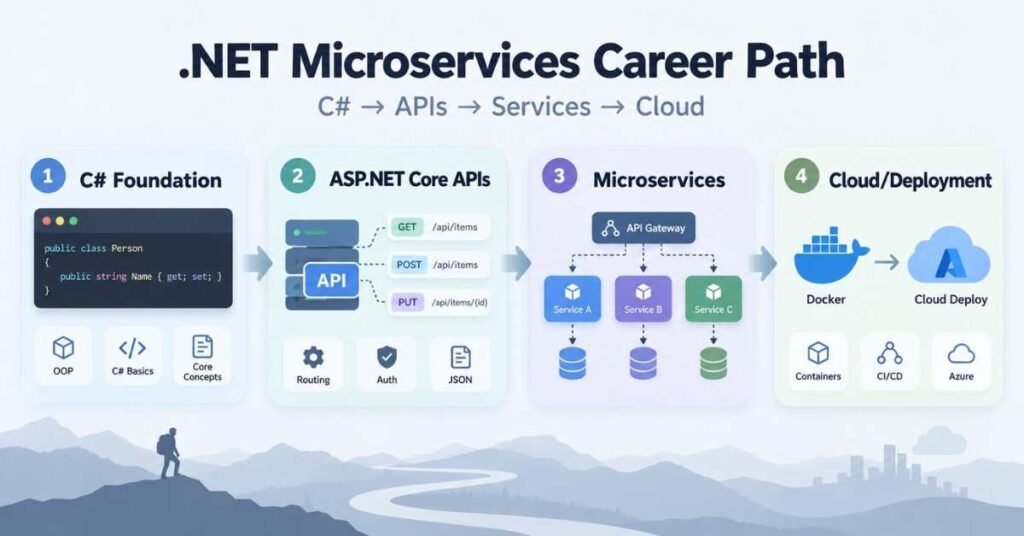
Table of Contents
Becoming a .NET Core Developer with Microservices is not about learning C# syntax and immediately splitting one application into many services. A strong backend developer first understands programming, APIs, databases, application structure, and how different parts of a system communicate. Microservices become useful when an application grows and different business functions need to work independently while still remaining connected. Beginners can begin with C# and ASP.NET Core fundamentals, and gradually put them into practice by developing APIs and working with databases. Once these foundations are familiar, they can explore how different services communicate within an application. Containers, messaging, and cloud deployment. This guide explains that journey from the foundation to career preparation.
What Does a .NET Core Developer with Microservices Skills Do?
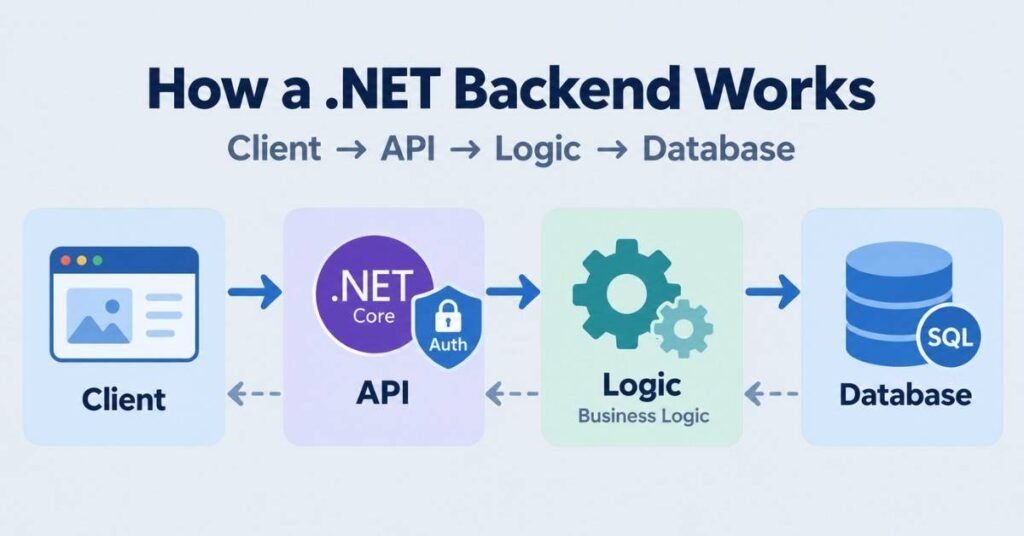
A .NET backend developer builds the part of an application that users usually do not see directly.
When someone logs into an application, places an order, makes a payment, updates a profile, or searches for information, backend services process those requests.
In a simple application, many features may exist in one codebase.
As the system grows, some organisations separate important business functions into smaller services.
For example, an online shopping system may contain separate services for:
- Customers
- Products
- Orders
- Payments
- Notifications
Each service handles a specific responsibility.
A .NET Developer working in this environment may:
- Write C# backend logic
- Build REST APIs
- Work with databases
- Create and maintain ASP.NET Core applications
- Design service boundaries
- Connect different services
- Handle validation and errors
- Implement authentication and authorization
- Test APIs
- Debug production issues
- Work with containers
- Support cloud deployments
- Review and improve application performance
The role needs more than coding speed. Developers must understand how each part of an application affects the rest of the system.
Why Choose .NET Core with Microservices?
Many organisations use .NET for business applications, internal systems, web platforms, APIs, and cloud-based services.
For a learner, .NET provides a structured way to understand backend development.
C# gives you the programming foundation.
ASP.NET Core helps you build web applications and APIs.
Microservices introduce you to larger system design.
This makes the learning path useful for students who want to move towards backend or enterprise application development.
Why Learners Choose This Career Path
- C# supports strong object-oriented programming.
- ASP.NET Core is designed for modern web development.
- Backend development teaches practical application logic.
- REST APIs are used across many software systems.
- Microservices introduce distributed application concepts.
- Cloud and container skills can be added later.
- The same foundation supports several developer roles.
The important part is the order.
Microservices should come after you understand how to build a complete application.
Build Scalable Backends – Explore the .NET Core Microservices Course
.NET Career Roles Compared
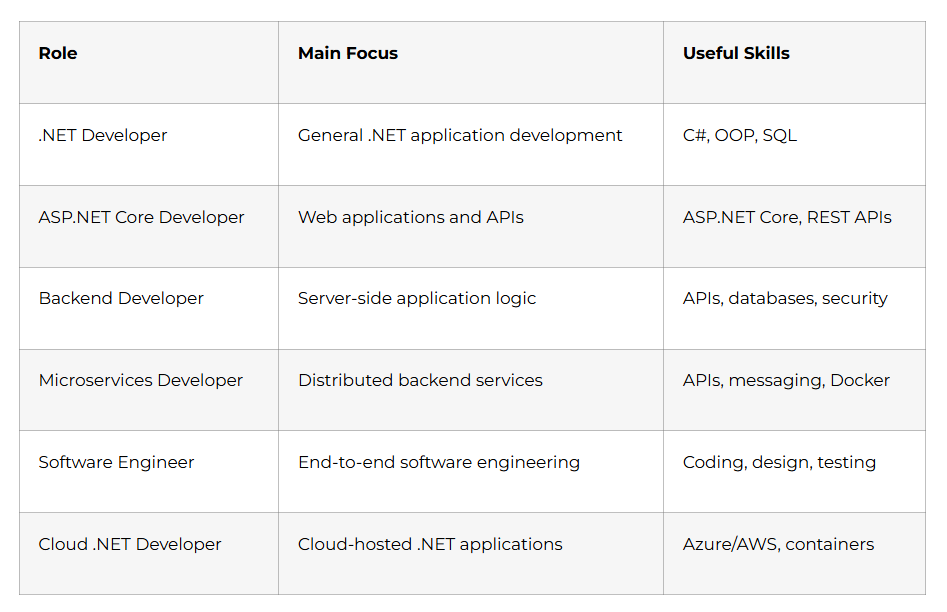
For a fresher, .NET Developer, Junior Backend Developer, and ASP.NET Core Developer roles are usually more realistic starting points than highly specialised Microservices positions.
How to Become a .NET Core Developer with Microservices
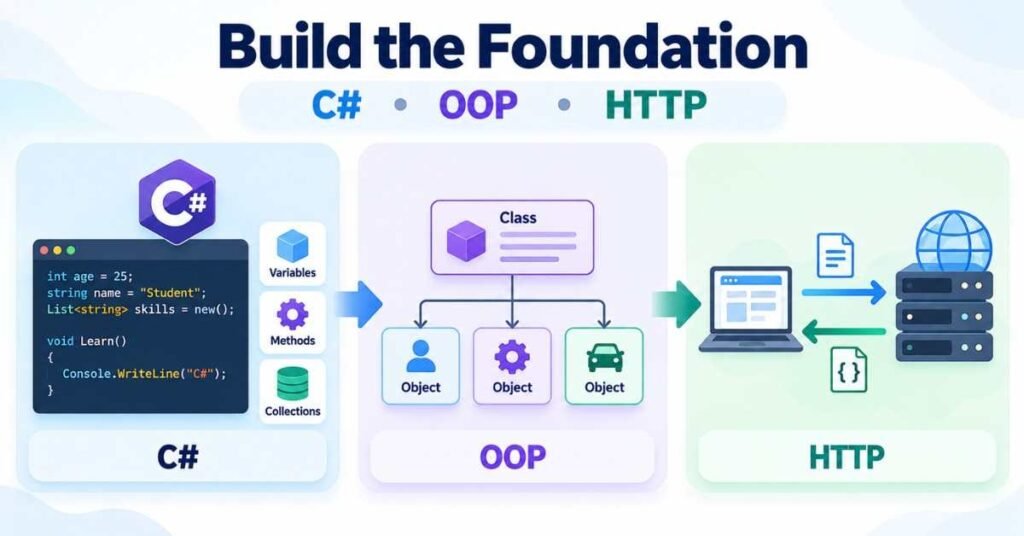
Step 1: Build a Strong C# Foundation
Before working with ASP.NET Core, become comfortable writing C# programs.
Start with:
- Variables
- Data types
- Operators
- Conditions
- Loops
- Methods
- Arrays
- Strings
- Classes
- Objects
Then improve your understanding of:
- Constructors
- Encapsulation
- Inheritance
- Polymorphism
- Abstraction
- Interfaces
Do not study OOP only for interview definitions.
Use it in code.
For example, imagine a shopping application.
You might create classes such as:
- Customer
- Product
- Order
- Payment
Then think about what information and behaviour belong to each class.
That makes object-oriented design more meaningful.
Step 2: Learn Collections, LINQ, and Exception Handling
Real applications work with groups of data.
Become comfortable with collections such as:
- List
- Dictionary
- HashSet
- Queue
- Stack
Then learn LINQ.
LINQ allows developers to query and transform collections in a clean way.
For example, if you have a list of orders, you may need to:
- Find orders above a certain amount
- Sort orders by date
- Group orders by customer
- Calculate total sales
This is much closer to real backend work than memorising syntax alone.
Also understand:
- Try
- Catch
- Finally
- Custom exceptions
A backend service should handle errors carefully instead of crashing whenever something unexpected occurs.
Step 3: Understand Web and HTTP Fundamentals
Before building APIs, understand how the web works.
Learn the meaning of:
- Client
- Server
- HTTP
- Request
- Response
- URL
- Headers
- JSON
Become familiar with common HTTP methods:
- GET
- POST
- PUT
- PATCH
- DELETE
Also understand basic status codes such as:
- 200
- 201
- 400
- 401
- 403
- 404
- 500
These concepts become part of your daily work when building backend APIs.
Step 4: Learn ASP.NET Core
Once C# fundamentals are comfortable, move into ASP.NET Core.
Understand:
- Project structure
- Controllers
- Routing
- Models
- Dependency Injection
- Configuration
- Middleware
- Logging
- Validation
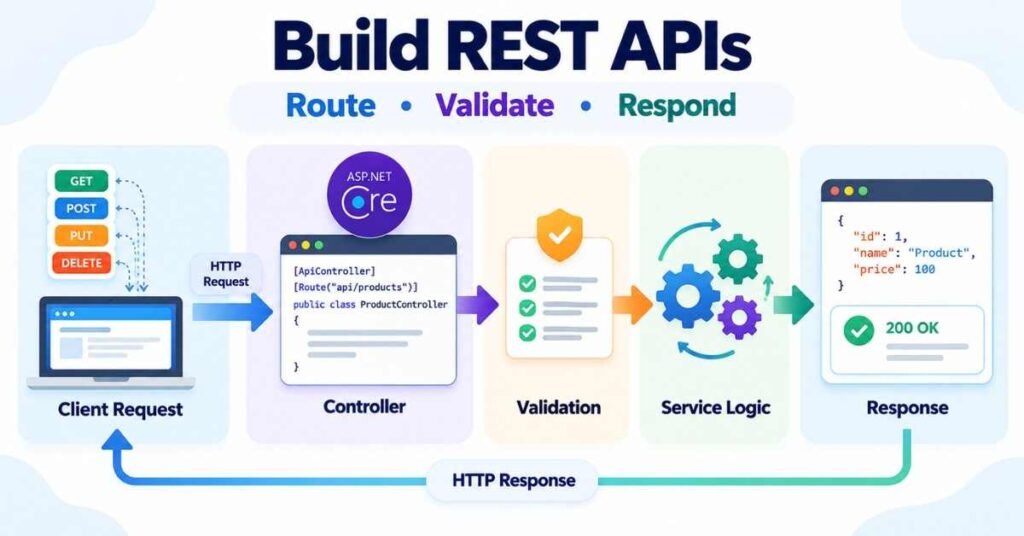
Your first goal should be simple:
Build an API that accepts a request, processes data, and returns the correct response.
For example, create a Product API.
The application could allow users to:
- Add a product
- View products
- Find a product by ID
- Update a product
- Delete a product
Once you can build these operations independently, backend development starts to make more sense.
Step 5: Build REST APIs
REST API development is one of the most useful skills in .NET backend roles.
You should know how to:
- Design endpoints
- Accept request data
- Validate input
- Return meaningful responses
- Handle errors
- Use appropriate HTTP methods
- Return correct status codes
Avoid creating APIs only because a tutorial gives you the code.
Think about the business action.
For example:
POST /orders
is not just an endpoint.
The system may need to:
- Validate the customer.
- Check product availability.
- Calculate the order amount.
- Save the order.
- Return the order information.
Thinking this way prepares you for real projects.
Step 6: Learn SQL and Database Fundamentals
Backend applications usually need persistent data.
Build strong SQL basics.
Learn:
- Tables
- Primary keys
- Foreign keys
- Relationships
- SELECT
- INSERT
- UPDATE
- DELETE
- JOINs
- GROUP BY
- Subqueries
- Index basics
Understand database relationships such as:
- One-to-One
- One-to-Many
- Many-to-Many
For example, one customer may place many orders.
One order may contain many products.
Understanding these relationships helps you design better backend applications.
Step 7: Learn Entity Framework Core
Entity Framework Core helps .NET applications work with databases using C# objects.
Learn:
- DbContext
- DbSet
- Entities
- Migrations
- Relationships
- CRUD operations
- LINQ queries
- Code First concepts
Do not treat Entity Framework as a replacement for SQL knowledge.
Both are useful.
A developer who understands the generated database behaviour can troubleshoot problems more effectively.
Step 8: Learn Application Architecture
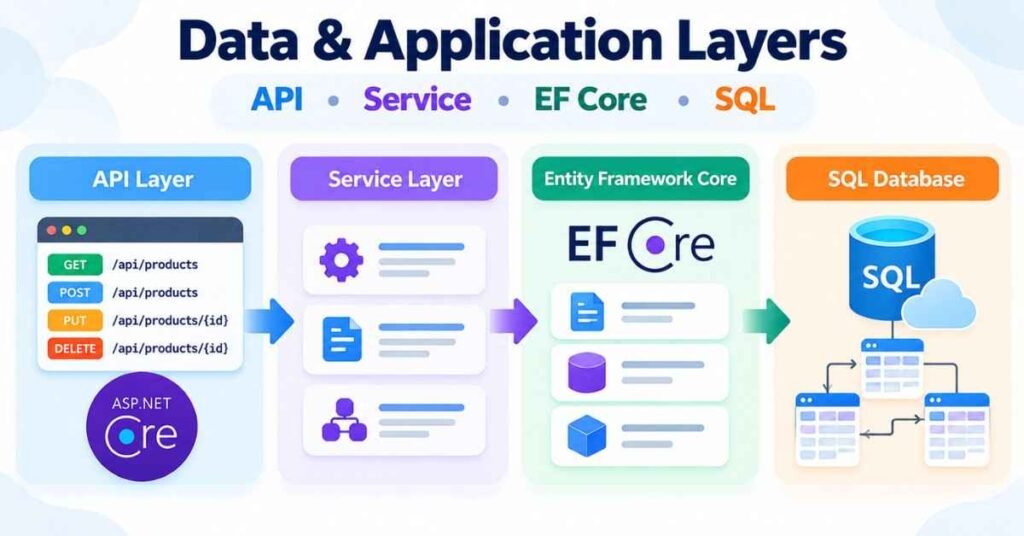
Before learning Microservices, understand how to organise a backend application properly.
Become familiar with separation of concerns.
A basic application may have layers such as:
- API layer
- Business or service layer
- Data-access layer
You may also come across patterns such as:
- Repository Pattern
- Dependency Injection
- DTOs
- Service abstractions
The purpose of architecture is not to add more folders.
It is to keep responsibilities clear.
If database logic, API logic, and business rules are all placed in one controller, maintaining the application becomes harder.
Step 9: Understand Microservices Fundamentals
Once you can build a complete backend application, begin Microservices.
First understand why a business may divide a system into services.
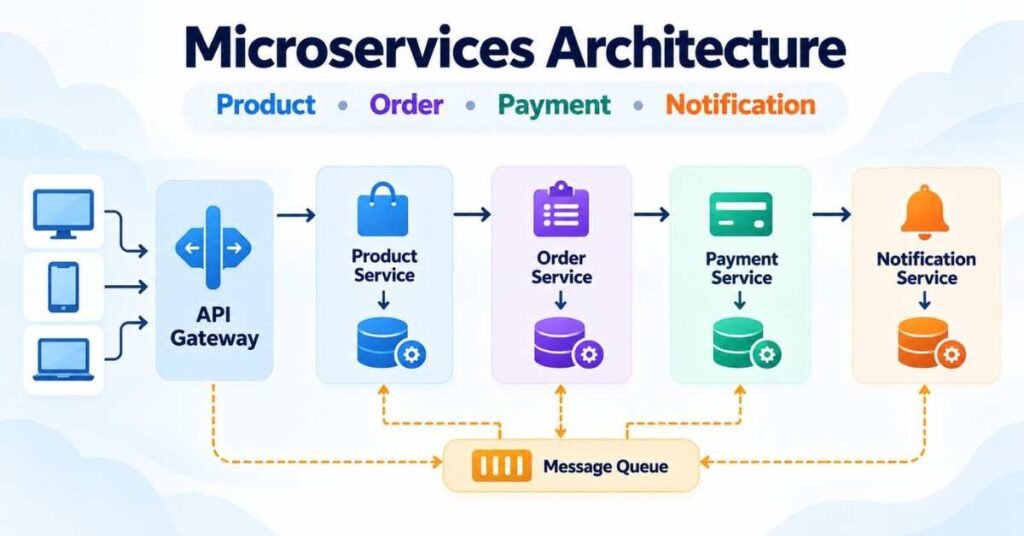
Suppose an e-commerce platform has:
- User Service
- Product Service
- Order Service
- Payment Service
- Notification Service
Each service has a clear responsibility.
This can allow teams to develop and deploy parts of the system independently.
However, Microservices also introduce new challenges.
You now need to think about:
- Service communication
- Data consistency
- Failures
- Monitoring
- Deployment
- Security
- Network issues
That is why Microservices are not automatically better for every application.
Step 10: Learn Service-to-Service Communication
Microservices need to communicate.
One approach is synchronous communication using HTTP APIs.
For example:
Order Service → Product Service
The Order Service may ask whether a product is available.
Another approach is asynchronous communication using messaging.
For example:
Order Created → Message → Notification Service
The Notification Service receives the event and sends the confirmation.
Understand the difference between:
- Synchronous communication
- Asynchronous communication
Both have different use cases.
Step 11: Learn Messaging Concepts
Messaging becomes useful when services should not depend on an immediate response from one another.
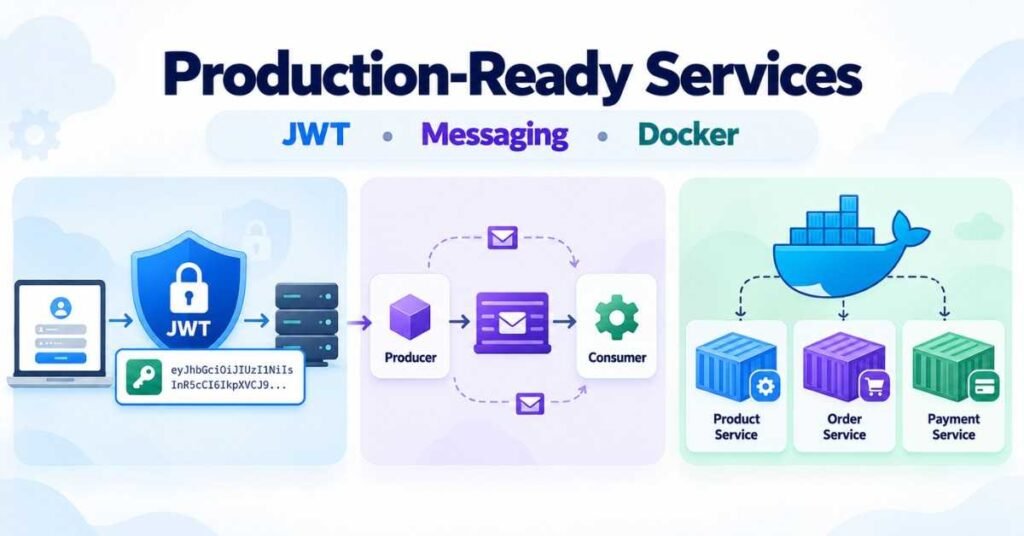
Learn concepts such as:
- Message queues
- Producers
- Consumers
- Events
- Event-driven communication
Common platforms may include technologies such as RabbitMQ or cloud-based messaging services.
Do not start with complex configurations.
First understand the flow:
Service A creates an event → Message is published → Service B receives and processes it
That simple idea is the foundation.
Step 12: Learn Authentication and Authorization
Backend applications need to protect data and endpoints.
Understand:
- Authentication
- Authorization
- Tokens
- JWT basics
- Roles
- Claims
Authentication answers:
Who is the user?
Authorization answers:
What is this user allowed to do?
For example, both a customer and an administrator may log into an application, but only the administrator should be allowed to delete products.
Step 13: Learn Docker Basics
Microservices usually involve multiple applications.
Containers make it easier to package and run these services in consistent environments.
Begin with:
- Container concepts
- Images
- Dockerfiles
- Containers
- Ports
- Environment variables
Try containerising a simple ASP.NET Core API.
After that, you can explore running multiple services together.
The goal is to understand deployment consistency rather than memorising Docker commands.
Step 14: Understand Cloud Deployment
Modern .NET applications are often hosted in cloud environments.
At a beginner level, understand:
- Cloud hosting
- Application configuration
- Managed databases
- Secrets
- Logs
- Scaling basics
You may later explore platforms such as Microsoft Azure.
For a .NET learner, cloud deployment becomes easier once the application itself is already clear.
Build Backend Skills Step by Step – Explore the .NET Core Roadmap Guide
Essential Skills for a .NET Microservices Developer
A balanced profile includes programming, backend, database, and distributed-system skills.
Core Programming
- C#
- OOP
- Collections
- LINQ
- Exception handling
- Asynchronous programming basics
Backend Development
- ASP.NET Core
- REST APIs
- Dependency Injection
- Middleware
- Validation
- Logging
Database Skills
- SQL
- Database design
- Entity Framework Core
- Relationships
- Query fundamentals
Microservices Skills
- Service boundaries
- Inter-service communication
- Messaging
- Authentication
- API Gateway concepts
- Resilience basics
DevOps and Cloud Basics
- Git
- GitHub
- Docker
- CI/CD awareness
- Cloud fundamentals
Do not try to master all of these in one week.
Build them in layers.
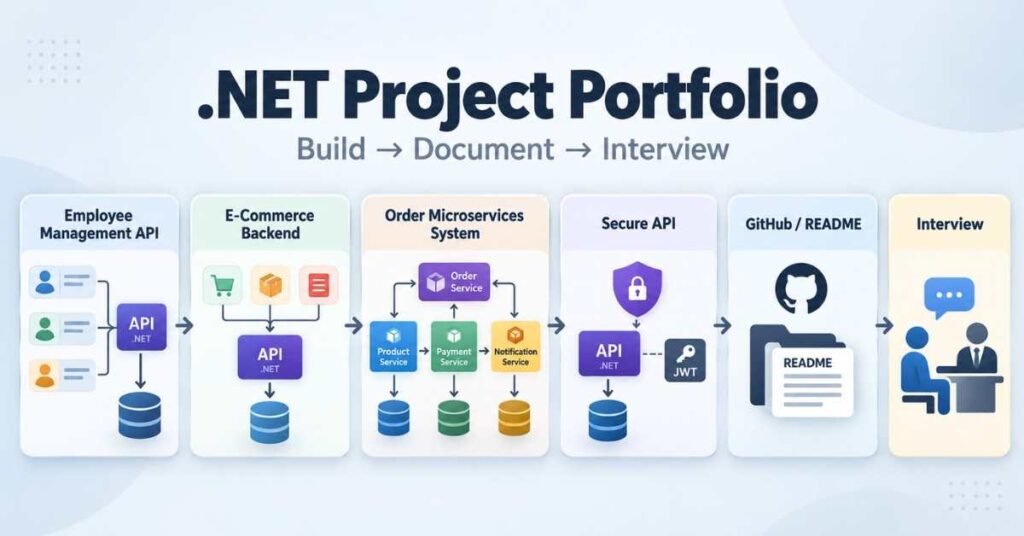
Real Projects to Build
Projects should show that you can connect concepts instead of listing them separately.
Project 1: Employee Management API
Build a REST API where users can:
- Add employees
- View employee details
- Update information
- Remove employees
Use:
- ASP.NET Core
- SQL
- Entity Framework Core
- Validation
- Error handling
This is a useful first backend project.
Project 2: E-Commerce Backend
Build modules for:
- Customers
- Products
- Orders
- Payments
Begin as one application.
Once the complete flow works, think about how the modules could later become separate services.
This teaches why Microservices may be introduced.
Project 3: Order Microservices System
Create separate:
- Product Service
- Order Service
- Notification Service
Use APIs for communication.
Then add asynchronous messaging for order notifications.
This project demonstrates actual Microservices thinking.
Project 4: Secure API
Create an application with:
- Registration
- Login
- JWT authentication
- Role-based authorization
For example:
- Customer can view products.
- Admin can add or remove products.
This gives you useful security experience.
Salary Expectations in India
Compensation for .NET developers depends on experience, backend depth, cloud exposure, system-design skills, employer, location, and project responsibility.
Experience Level | Broad Salary Range |
Fresher | ₹3 LPA to ₹6 LPA |
1–3 Years | ₹5 LPA to ₹10 LPA |
3–5 Years | ₹8 LPA to ₹16 LPA |
5+ Years | ₹14 LPA to ₹25 LPA+ |
These are broad estimates rather than guaranteed packages.
A fresher with strong C#, API, database, Git, and project skills may be better positioned than someone who lists many advanced technologies without practical understanding.
Portfolio That Gets Interviews
Your portfolio should prove that you can build backend applications.
Include:
- Two or three complete .NET projects
- GitHub repositories
- Clear README files
- API documentation
- Database structure
- Architecture explanation
- Screenshots or API examples where useful
For a Microservices project, clearly show:
Client → API/Service → Database → Other Services
If messaging is used, show that flow as well.
Project Explanation Format
For each project, explain:
Problem → Architecture → Technologies → Your Work → Challenge → Solution
Do not upload code and expect the recruiter to understand everything automatically.
Good documentation improves the value of the project.
Job Search Strategy
Once you are comfortable with C#, ASP.NET Core, REST APIs, SQL, Entity Framework Core, Git, and at least two projects, begin looking at entry-level opportunities.
Search for roles such as:
- Junior .NET Developer
- .NET Developer
- ASP.NET Core Developer
- Backend Developer
- Software Engineer
- .NET Intern
- Associate Software Developer
Microservices may appear as a preferred skill in many backend job descriptions.
For freshers, it is better to demonstrate strong backend fundamentals and one good Microservices project than to search only for jobs titled “Microservices Developer.”
Resume Keywords
Use relevant terms such as:
- C#
- .NET
- ASP.NET Core
- REST API
- Entity Framework Core
- SQL
- LINQ
- Microservices
- Docker
- Git
- JWT
- Dependency Injection
Include only the skills you can explain during an interview.
Prepare for .NET Roles – Explore the .NET Core Interview Guide
Interview Preparation
.NET interviews commonly test both programming knowledge and practical backend understanding.
C# Topics
Prepare:
- OOP
- Classes and objects
- Interfaces
- Abstract classes
- Collections
- LINQ
- Exception handling
- Async/await basics
ASP.NET Core Topics
Understand:
- Request pipeline
- Controllers
- Routing
- Dependency Injection
- Middleware
- Configuration
- Logging
- Model validation
API Topics
Be ready to explain:
- REST
- HTTP methods
- Status codes
- Authentication
- Authorization
- JWT
- API versioning basics
Database Topics
Practise:
- SQL JOINs
- GROUP BY
- Subqueries
- Relationships
- Index basics
- Entity Framework Core
Microservices Topics
Prepare simple explanations for:
- What Microservices are
- Monolith vs Microservices
- Service communication
- API Gateway
- Messaging
- Independent deployment
- Database-per-service concept
- Handling service failures
Scenario-based questions are especially important.
For example:
“An Order Service needs product information. How would you design the communication?”
A good answer starts by understanding the requirement.
Ask whether the response is needed immediately.
If yes, synchronous API communication may be suitable.
If the action can happen later, event-based messaging may make more sense.
This shows design thinking rather than memorising definitions.
30-Day Starter Plan
Thirty days should give you a solid beginning, not complete mastery.
Week 1
Focus on:
- C# syntax
- OOP
- Methods
- Collections
- LINQ
- Exception handling
Build small console applications.
Week 2
Move to:
- Web fundamentals
- ASP.NET Core
- Controllers
- Routing
- REST APIs
- Dependency Injection
Build one CRUD API.
Week 3
Learn:
- SQL
- Database relationships
- Entity Framework Core
- Authentication
- JWT
- Git and GitHub
Connect your API to a database.
Week 4
Understand:
- Microservices fundamentals
- Service communication
- Messaging basics
- Docker
- Basic architecture
Split a small application into two or three services and document how they communicate.
After the first month, continue with deeper Microservices practice, cloud deployment, testing, system design, and larger projects.
Why Learn .NET Core with Microservices at Frontlines Edutech?
Backend development can become confusing when C#, APIs, databases, Microservices, and deployment are taught as completely separate subjects.
A practical learning path should show how these pieces connect inside one application.
Useful training should include:
- C# fundamentals
- OOP
- ASP.NET Core
- REST APIs
- SQL
- Entity Framework Core
- Authentication
- Microservices concepts
- Service communication
- Messaging
- Docker basics
- Real projects
- Interview preparation
- Resume guidance
For Telugu-speaking learners, regional-language explanations can make backend architecture and Microservices concepts easier to follow during the beginning stage.
At the same time, students should practise standard English technical terminology because documentation, interviews, and development teams commonly use it.
Frequently Asked Questions (FAQs)
Q1: What is .NET Core?
.NET is Microsoft’s development platform for building different types of applications. ASP.NET Core is commonly used for modern web applications and APIs.
Q2: Is C# required for .NET development?
Yes. C# is one of the main languages used for .NET application development, so strong C# fundamentals are important for backend roles.
Q3: Should I learn Microservices before ASP.NET Core?
No. First, learn C#, ASP.NET Core, REST APIs, and databases. Microservices become much easier once you understand how a complete backend application works.
Q4: Is SQL necessary for a .NET Developer?
Yes. Many backend applications use relational databases, so developers should understand SQL queries, relationships, and basic database design.
Q5: What is the difference between a monolith and Microservices?
A monolithic application usually keeps several business functions inside one application. Microservices divide selected business capabilities into independent services that communicate with one another.
Q6: Is Docker required for Microservices?
Docker is not required to understand the basic Microservices concept, but container knowledge is highly useful when running and deploying multiple services.
Q7: Can a fresher become a .NET Developer?
Yes. A fresher can begin with C#, OOP, ASP.NET Core, REST APIs, SQL, Entity Framework Core, Git, and practical projects.
Q8: What projects are useful for .NET interviews?
CRUD APIs, employee-management systems, e-commerce backends, authentication projects, and small Microservices applications are useful when you can explain the architecture clearly.
Q9: Is coding enough for a Microservices role?
No. Developers also need to understand APIs, databases, service communication, failures, security, containers, and application architecture.
Q10: How should I prepare for a .NET Microservices interview?
Revise C#, OOP, ASP.NET Core, REST APIs, SQL, Entity Framework Core, authentication, dependency injection, Microservices fundamentals, service communication, messaging, and the projects you built.