
MERN Stack Interview Preparation Guide 2026
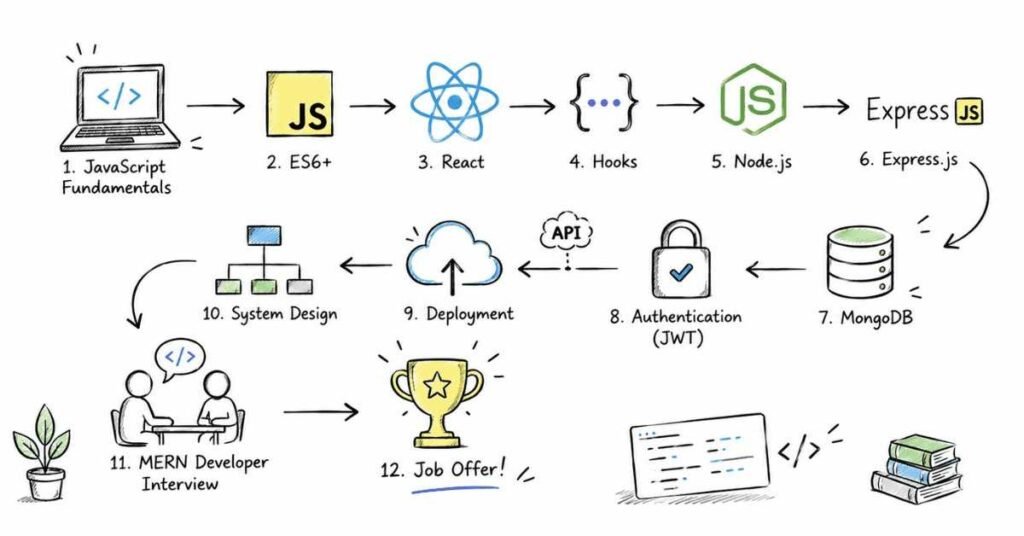
Table of Contents
Part 1: Introduction & 30-Day Study Plan
This first part sets the direction for MERN stack interview preparation. It explains what MERN interviews test, where MERN fits in real work, and how to build a practical 30-day plan that makes you interview-ready.
What this guide covers
This guide is designed to prepare you for MERN stack interviews in a structured, layered way. It starts with JavaScript and React basics, then moves into backend development, MongoDB, authentication, deployment, system design, and interview strategy.
The goal is not just to help you memorize definitions, but to help you explain how and why you build full-stack applications. Interviewers usually care as much about your reasoning, architecture choices, and project experience as they do about syntax.
Who this guide is for
This guide is useful if you are:
- A fresher preparing for your first MERN interview.
- A student targeting full-stack internships or entry-level roles.
- A frontend developer moving into backend development.
- A backend developer learning React for full-stack roles.
- A candidate who knows parts of the MERN stack but is not yet confident discussing integration, deployment, or project architecture.
The structure is meant to help both beginners and experienced candidates build confidence step by step. It gives you a clear path from fundamentals to interview execution.
What MERN is and why it matters
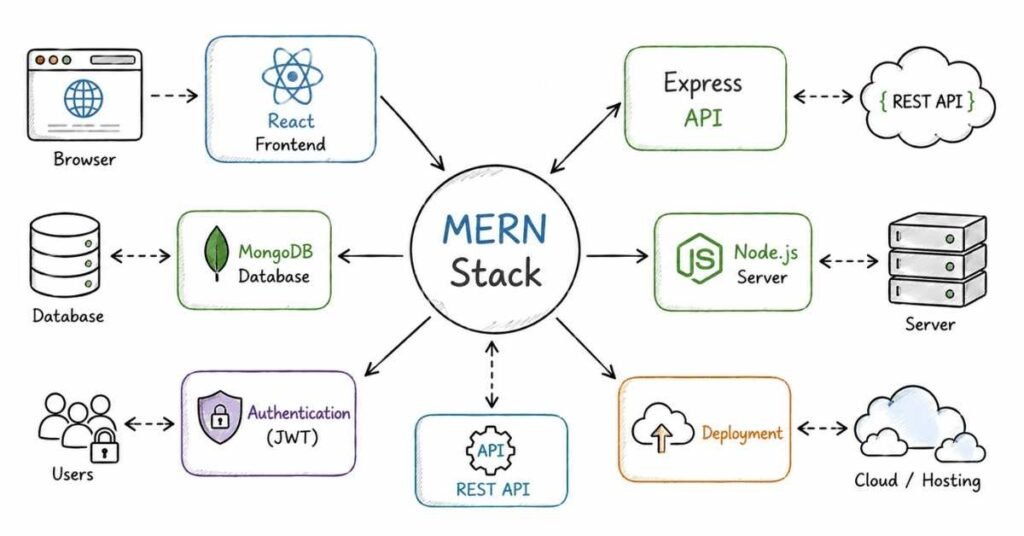
MERN stands for MongoDB, Express.js, React, and Node.js. It is a JavaScript-based full-stack stack used to build dynamic web applications from frontend to backend to database.
MERN matters because it lets developers use one language across the stack, which simplifies development and team coordination. It is especially common in startups, product teams, and modern web application projects.
A simple way to think about MERN is this: React handles the user interface, Node and Express handle the server and APIs, and MongoDB stores the data.
Where MERN fits in real work
In real companies, MERN is used for dashboards, admin panels, e-commerce apps, social platforms, chat applications, CMS systems, booking apps, and internal business tools.
Common tasks include:
- Building React components and managing state.
- Creating REST APIs with Node.js and Express.
- Designing MongoDB schemas and queries.
- Connecting frontend and backend.
- Implementing authentication and authorization.
- Deploying apps and handling production issues.
This is why MERN interviews test more than just coding. Interviewers often want to see whether you can connect the UI, API layer, and database into a reliable product.
Common MERN-related roles
MERN interviews vary depending on the role. Common role types include:
- MERN Stack Developer: full-stack app development.
- Full-Stack Developer: frontend and backend ownership.
- React Developer: frontend-heavy role with some API integration.
- Node.js Developer: backend APIs and server logic.
- Frontend Developer: React-first role with MERN awareness.
- Web Developer: broader product or website development.
Understanding the role early helps you focus your preparation. A React-heavy role may focus more on hooks and state management, while a full-stack role may focus more on APIs, database design, and deployment.
Common interview process
A typical MERN interview process often includes:
- HR or recruiter screening.
- JavaScript fundamentals round.
- React round.
- Node.js and Express round.
- MongoDB and database round.
- Full-stack integration and authentication round.
- Coding or take-home task.
- System design or scalability round.
- Behavioral or hiring manager round.
In many interviews, MERN questions are mixed with practical reasoning. You may be asked to explain a project, debug a React state issue, design an API, or describe how you would secure and deploy the app.
Core skill areas interviewers usually check
Most MERN interviews evaluate some combination of:
- JavaScript fundamentals and ES6+ features.
- React components, hooks, routing, and state management.
- Node.js runtime and async behavior.
- Express APIs, middleware, and error handling.
- MongoDB, Mongoose, schema design, and queries.
- Authentication and authorization.
- Full-stack integration and deployment.
- Performance and scalability.
- Coding ability and problem solving.
These areas appear repeatedly because they reflect real MERN development work. If you are comfortable with these topics, you can handle most interview rounds with confidence.
Why JavaScript matters so much
MERN is built around JavaScript, so weak JavaScript fundamentals often become the main reason candidates struggle. Concepts like closures, promises, async/await, callbacks, scope, and array methods are frequently tested because they affect React and Node.js work directly.
A strong candidate does not just know frameworks. They understand the language that powers the stack.
How to think in MERN interviews
A strong MERN answer usually follows this structure:
- Define the concept clearly.
- Explain where it is used.
- Mention how it affects development or scalability.
- Give a short project or app example.
- Mention a practical trade-off or best practice.
For example, if asked about React state management, do not only define state. Explain how it affects rendering, prop flow, and user interaction in a real application.
30-day study plan
A practical 30-day MERN study plan looks like this:
Week 1: JavaScript fundamentals and React basics
Focus on JavaScript syntax, ES6+ features, and React essentials. Learn components, props, state, and rendering behavior.
Week 2: React hooks and Node.js fundamentals
Study hooks like useState, useEffect, useContext, and routing. Start learning Node.js, Express basics, and asynchronous JavaScript in backend work.
Week 3: APIs, MongoDB, and full-stack integration
Move into REST APIs, middleware, MongoDB CRUD, Mongoose, authentication, and connecting frontend to backend.
Week 4: Deployment, system design, coding, and mock interviews
Focus on scalability, caching, deployment, behavioral questions, coding challenges, and project explanation. Spend the last days revising weak areas and doing mock interviews.
Daily study routine
A practical daily routine looks like this:
- 45 minutes of concept revision.
- 60 minutes of coding or project practice.
- 30 minutes of spoken explanation or mock interview practice.
- 15 minutes of notes, review, or debugging.
If you are a fresher, do not skip speaking practice. Many candidates understand MERN privately but freeze when asked to explain their code in real time.
Salary expectations in India
MERN salary expectations vary by role, company type, and whether the work is frontend-heavy, backend-heavy, or full-stack. Market sources for MERN and related full-stack roles suggest that compensation can vary widely by experience and specialization, with stronger project and system design skills improving outcomes.
A practical approach is to treat salary numbers as directional context rather than guaranteed outcomes. In interviews, your project depth, problem-solving, and communication often matter as much as the title itself.
How to prepare effectively
The best way to prepare for MERN interviews is to build from JavaScript basics to React, then move into Node.js, Express, MongoDB, and integration. Start simple, then add authentication, deployment, and scalability gradually.
You should also practice explaining your projects out loud. In many interviews, the explanation matters almost as much as the code itself.
Revision focus
Revise what MERN is, where it is used, the common role types, the usual interview format, the key skill areas, and the 30-day study plan before moving to JavaScript fundamentals and ES6+ basics.
Part 2: JavaScript Fundamentals & ES6+ Basics — Questions 1–40
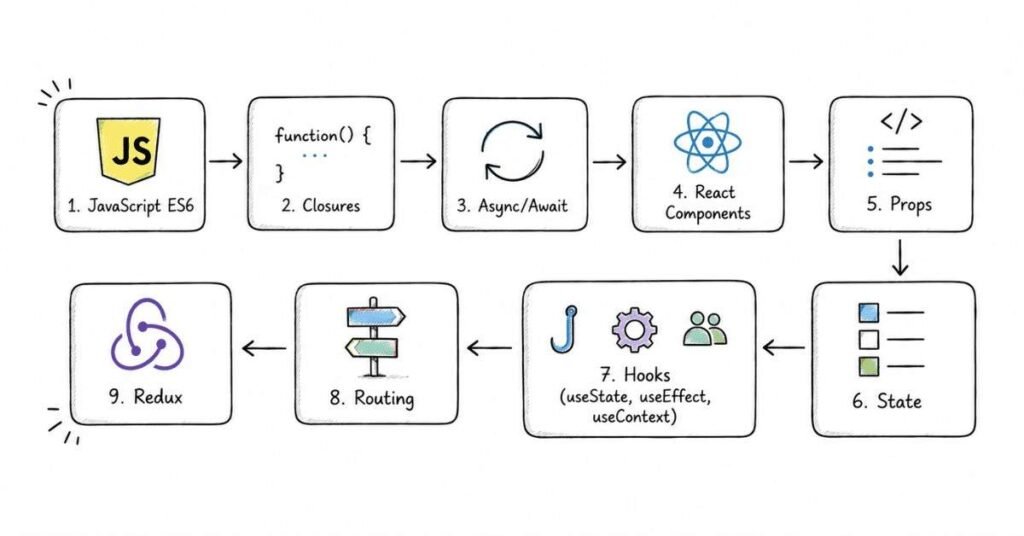
This part builds the foundation for the rest of the MERN guide. It covers the JavaScript concepts interviewers expect you to know before moving into React, Node.js, Express, MongoDB, and full-stack integration.
1) What is JavaScript?
JavaScript is a programming language used to build interactive web applications. In MERN, it powers both the frontend and backend.
2) Why is JavaScript important in MERN?
Because MERN is built around JavaScript across the stack. If you understand JavaScript well, React and Node.js become much easier to learn.
3) What is a variable?
A variable is a named container used to store data. In JavaScript, variables can be declared using var, let, or const.
4) What is the difference between var, let, and const?
var has function scope and is older, let is block-scoped and can be reassigned, and const is block-scoped but cannot be reassigned. Modern JavaScript usually prefers let and const.
5) What is scope?
Scope defines where a variable can be accessed. Common types are global scope, function scope, and block scope.
6) What is hoisting?
Hoisting is JavaScript’s behavior of moving declarations to the top of their scope during execution. It mainly affects var and function declarations.
7) What is a data type?
A data type defines the kind of value a variable holds. JavaScript has primitive and non-primitive types.
8) What are primitive data types in JavaScript?
Primitive types include string, number, boolean, null, undefined, symbol, and bigint. They store simple values.
9) What are non-primitive data types?
Non-primitive types include objects, arrays, and functions. They store more complex data structures.
10) What is an array?
An array is an ordered collection of values. It is commonly used to store lists of items.
11) What is an object?
An object stores data as key-value pairs. It is one of the most important structures in JavaScript.
12) What is the difference between array and object?
An array is ordered and indexed, while an object stores named properties. Arrays are usually used for lists, and objects for structured data.
13) What is a function?
A function is a reusable block of code that performs a task. Functions are central to JavaScript programming.
14) What is a function parameter?
A parameter is a variable defined in a function’s declaration. It receives input values when the function is called.
15) What is an arrow function?
An arrow function is a shorter syntax for writing functions. It also handles this differently from regular functions.
16) What is the difference between regular function and arrow function?
Regular functions have their own this binding, while arrow functions inherit this from the surrounding scope. Arrow functions are commonly used in modern JavaScript.
17) What is a callback?
A callback is a function passed into another function to be executed later. It is commonly used in asynchronous programming.
18) What is a promise?
A promise represents a value that may be available now, later, or never. It helps handle asynchronous operations more cleanly than callbacks.
19) What are the states of a promise?
A promise can be pending, fulfilled, or rejected. These states show whether the asynchronous operation is ongoing, successful, or failed.
20) What is async/await?
Async/await is a syntax built on promises that makes asynchronous code easier to read. It is widely used in MERN applications.
21) What is the event loop?
The event loop is the mechanism that manages asynchronous execution in JavaScript. It allows non-blocking behavior.
22) Why is the event loop important?
Because JavaScript is single-threaded but still handles async tasks efficiently. Understanding it helps explain Node.js and frontend behavior.
23) What is closure?
A closure is when a function remembers variables from its outer scope even after that outer function has finished. It is a very common interview topic.
24) Why are closures useful?
They help create private data, function factories, and cleaner logic. They are used heavily in JavaScript and React patterns.
25) What is this in JavaScript?
this refers to the object that is currently executing the function. Its value depends on how the function is called.
26) Why can this be confusing?
Because this behaves differently in regular functions, arrow functions, methods, and event handlers. It is one of the most commonly misunderstood concepts.
27) What is destructuring?
Destructuring is a shorthand for extracting values from arrays or objects. It makes code cleaner and easier to read.
28) What is the spread operator?
The spread operator (…) expands elements of an array or properties of an object. It is often used for copying and merging data.
29) What is the rest parameter?
The rest parameter collects multiple values into one array. It is useful when a function accepts a variable number of arguments.
30) What is template literal?
A template literal is a string written with backticks that supports embedded expressions. It is useful for cleaner string formatting.
31) What is map?
map creates a new array by transforming each item in an existing array. It is one of the most used array methods.
32) What is filter?
filter creates a new array containing only items that match a condition. It is used for selection and search logic.
33) What is reduce?
reduce combines array values into a single output such as a sum, object, or grouped result. It is powerful but often harder for beginners.
34) What is forEach?
forEach runs a function on every array item but does not return a new array. It is useful for side effects like logging.
35) What is the difference between map and forEach?
map returns a new transformed array, while forEach is used for iteration without returning a new array. They serve different purposes.
36) What is truthy and falsy?
Truthy values behave like true in conditions, while falsy values behave like false. Examples of falsy values include 0, empty string, null, undefined, NaN, and false.
37) What is type coercion?
Type coercion is JavaScript automatically converting one data type to another. It can be helpful but also cause bugs.
38) What is equality operator difference between == and ===?
== checks value after type conversion, while === checks both value and type. In modern JavaScript, === is preferred.
39) What is a strong answer for JavaScript basics questions?
A strong answer explains the concept clearly and gives a short code or usage example. Interviewers want both theory and practical understanding.
40) What is the best way to practice JavaScript fundamentals?
Practice array methods, functions, scope, closures, promises, async/await, and destructuring through small coding tasks. Repetition and explanation aloud help most.
Revision focus
Revise variables, scope, hoisting, data types, arrays, objects, functions, arrow functions, callbacks, promises, async/await, event loop, closures, this, destructuring, spread/rest operators, template literals, array methods, truthy/falsy, and equality before moving to React fundamentals and component basics.
Part 3: React Fundamentals, Hooks & State Management — Questions 41–80
This part covers the frontend framework that makes MERN applications interactive and component-based. It focuses on React concepts interviewers expect you to understand before moving into routing, backend APIs, and full-stack integration.
41) What is React?
React is a JavaScript library used to build user interfaces. It helps developers create reusable UI components for web applications.
42) Why is React important in MERN?
Because React handles the frontend in MERN. It makes it easier to build dynamic and maintainable interfaces.
43) What is a component?
A component is a reusable piece of UI. In React, applications are built by combining components.
44) What are the two main types of components?
The two main types are functional components and class components. Modern React mainly uses functional components.
45) What is JSX?
JSX is a syntax that lets you write HTML-like code inside JavaScript. It makes React components easier to write and read.
46) Why is JSX used?
Because it makes UI code more expressive and readable. JSX is one of the first React concepts interviewers ask about.
47) What is props?
Props are inputs passed from one component to another. They are used to send data from parent to child.
48) What is state?
State is data managed inside a component. It changes over time and affects what the user sees.
49) What is the difference between props and state?
Props are passed from outside and are read-only, while state is managed inside the component and can change. Both are essential in React.
50) What is the virtual DOM?
The virtual DOM is a lightweight copy of the real DOM used by React to improve performance. React compares changes and updates only what is needed.
51) Why is the virtual DOM useful?
It reduces unnecessary page updates and improves UI performance. It is one of React’s core ideas.
52) What is reconciliation?
Reconciliation is the process React uses to compare the virtual DOM with the real DOM and update efficiently. It helps React render changes faster.
53) What is a functional component?
A functional component is a JavaScript function that returns UI. It is the standard component style in modern React.
54) Why are functional components preferred?
Because they are simpler and work well with hooks. They are easier to write and maintain.
55) What is useState?
useState is a React hook used to manage component state. It lets functional components store and update values.
56) What is useEffect?
useEffect is a hook used for side effects such as API calls, subscriptions, and DOM updates. It runs after rendering based on dependencies.
57) Why is useEffect important?
Because many real applications need data fetching and side-effect handling. It is one of the most common React hooks.
58) What is dependency array in useEffect?
The dependency array controls when useEffect runs. It tells React which values to watch for changes.
59) What is useContext?
useContext is a hook used to share data across components without passing props deeply. It is often used for themes, authentication, or global state.
60) What is useRef?
useRef is a hook that stores a mutable value or a reference to a DOM element. It does not cause re-render when changed.
61) What is useMemo?
useMemo memoizes a computed value so it does not recalculate unnecessarily. It helps improve performance in some cases.
62) What is useCallback?
useCallback memoizes a function so the same function reference can be reused between renders. It is useful for optimization.
63) What is lifting state up?
Lifting state up means moving shared state to a common parent component. It helps multiple components stay in sync.
64) What is conditional rendering?
Conditional rendering means showing different UI based on conditions. It is commonly used in login states, loading states, and feature flags.
65) What is list rendering?
List rendering means displaying a collection of items using map. It is used frequently in React apps.
66) Why is the key prop important?
The key prop helps React identify list items efficiently. It improves rendering performance and stability.
67) What is event handling in React?
Event handling means responding to user actions like clicks, input changes, or form submits. It is a core part of interactivity.
68) What is controlled component?
A controlled component is a form element whose value is managed by React state. It gives full control over input behavior.
69) What is uncontrolled component?
An uncontrolled component manages its own internal state, usually accessed through refs. It is less common in modern React forms.
70) What is routing in React?
Routing lets users move between different pages or views in a React app. It is commonly handled by React Router.
71) What is React Router?
React Router is a library used to manage client-side navigation. It enables single-page application routing.
72) What is SPA?
SPA stands for Single Page Application. It loads one page and updates content dynamically without full page reloads.
73) Why is SPA useful?
Because it creates a smoother user experience. React is often used to build SPAs.
74) What is state management?
State management is the process of handling application data across components. It becomes important as apps grow larger.
75) Why is state management important?
Because complex apps need predictable data flow. Poor state handling can make applications hard to maintain.
76) What is Redux?
Redux is a state management library used to manage global application state. It is often used in larger React apps.
77) Why do developers use Redux?
Because it centralizes state and makes behavior more predictable. It is useful in apps with shared data across many components.
78) What is a common React mistake?
A common mistake is using state too much or passing props inefficiently. Another is not understanding component re-renders.
79) What is a strong answer for React questions?
A strong answer explains the concept clearly and connects it to a real application. Interviewers want to know how you think about components, state, and rendering.
80) How should you practice React?
Build small apps with forms, routing, API calls, hooks, and reusable components. Practice explaining why you chose each hook or component structure.
Revision focus
Revise React basics, JSX, functional versus class components, props versus state, virtual DOM, reconciliation, hooks, useState, useEffect, useContext, useRef, useMemo, useCallback, conditional rendering, list rendering, keys, forms, routing, SPA, and Redux before moving to Node.js, Express.js, and API development.
Part 4: Node.js, Express.js & API Development — Questions 81–120
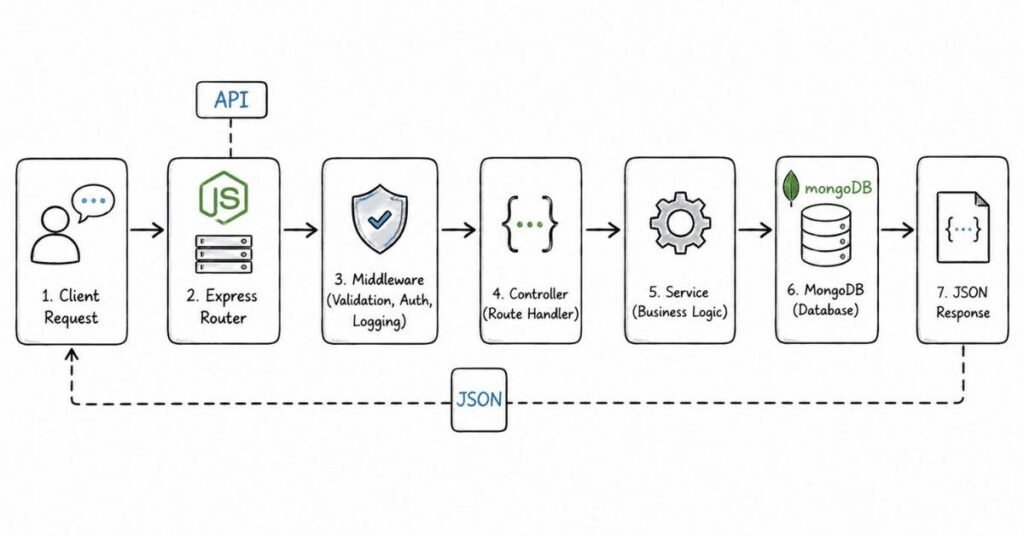
This part covers the backend layer of MERN applications. It focuses on how Node.js works, how Express simplifies server development, and how APIs are built, handled, and secured.
81) What is Node.js?
Node.js is a JavaScript runtime that lets you run JavaScript on the server side. It is used to build backend applications and APIs.
82) Why is Node.js important in MERN?
Because it powers the backend of MERN. It allows developers to use JavaScript on both frontend and backend.
83) What is the Node.js event loop?
The event loop is what allows Node.js to handle asynchronous operations efficiently. It helps Node remain non-blocking.
84) Why is Node.js considered non-blocking?
Because it can handle other tasks while waiting for I/O operations to complete. This makes it efficient for many web applications.
85) What is single-threaded in Node.js?
Node.js uses a single main thread to process JavaScript execution. It still manages concurrency using the event loop and async mechanisms.
86) What is npm?
npm stands for Node Package Manager. It is used to install and manage JavaScript packages.
87) Why is package.json important?
It stores project metadata, dependencies, scripts, and configuration. It is the central file for Node projects.
88) What is a module in Node.js?
A module is a reusable piece of code that can be imported into other files. It helps organize backend applications.
89) What is require?
require is used to import modules in CommonJS style. It is commonly used in Node.js projects.
90) What is Express.js?
Express.js is a web framework for Node.js used to build server-side applications and APIs. It simplifies routing and middleware handling.
91) Why is Express.js useful?
Because it reduces boilerplate and makes backend development easier. It is one of the most popular Node frameworks.
92) What is routing in Express?
Routing maps HTTP requests to specific handlers. It decides which code runs for a given URL and method.
93) What is middleware in Express?
Middleware is a function that runs during the request-response cycle. It can modify requests, responses, or control flow.
94) Why is middleware important?
Because it helps handle logging, authentication, validation, and error processing. It is a core Express concept.
95) What is next in Express middleware?
next is a function used to pass control to the next middleware or route handler. It keeps the request pipeline moving.
96) What is a REST API?
A REST API is an API built around resources and HTTP methods like GET, POST, PUT, and DELETE. It is the common style for backend services.
97) What is an endpoint?
An endpoint is a specific URL path where an API can be accessed. Each endpoint usually performs one action or returns one resource.
98) What is GET used for?
GET retrieves data from the server. It should not change server state.
99) What is POST used for?
POST creates new data on the server. It is commonly used for registration, forms, and new records.
100) What is PUT used for?
PUT updates an entire resource. It usually replaces the existing record.
101) What is PATCH used for?
PATCH updates part of a resource. It is used for partial modifications.
102) What is DELETE used for?
DELETE removes a resource from the server. It is used for deletion operations.
103) What is request body?
The request body contains data sent from client to server, usually in POST or PUT requests. It often contains JSON.
104) What is request params?
Request params are values included in the URL path. They are often used for IDs or resource identifiers.
105) What are query parameters?
Query parameters are added after the question mark in a URL. They are often used for filtering, sorting, or pagination.
106) What is JSON?
JSON is a lightweight format used to exchange data between client and server. It is the standard format for APIs.
107) What is middleware used for in APIs?
Middleware is used for tasks like authentication, validation, logging, error handling, and request parsing. It helps keep route handlers clean.
108) What is body-parser?
body-parser is middleware used to parse incoming request bodies. In modern Express, built-in JSON parsing is often enough.
109) What is CORS?
CORS stands for Cross-Origin Resource Sharing. It controls which frontend origins can access the backend.
110) Why is CORS important?
Because frontend and backend often run on different domains or ports. CORS helps prevent unauthorized cross-origin access.
111) What is error handling in Express?
Error handling is the process of catching and responding to runtime errors gracefully. It prevents crashes and improves API reliability.
112) What is an error-handling middleware?
It is middleware designed specifically to process errors. It usually has four parameters in Express.
113) What is status code?
A status code is the number returned by the server to show the result of a request. Examples include 200, 201, 400, 401, 404, and 500.
114) Why are status codes important?
Because they help the client understand whether the request succeeded or failed. Good APIs use status codes correctly.
115) What is a strong API response?
A strong response is clear, consistent, and includes the right status code and message. It may also include useful data or error details.
116) What is a route handler?
A route handler is the function that runs when a route is matched. It contains the logic for that endpoint.
117) What is a controller in Express?
A controller is a function or module that handles request logic. It helps separate route definitions from business logic.
118) What is a strong answer for Node.js and Express questions?
A strong answer explains the runtime, event-driven behavior, middleware, routing, and API logic. Interviewers want practical understanding, not just definitions.
119) What is a common backend mistake?
A common mistake is mixing route, business, and database logic in one file. Another is ignoring validation and error handling.
120) How should you practice Node.js and Express?
Build simple CRUD APIs, add middleware, handle errors, and connect your server to a database. Practice explaining your API structure clearly.
Revision focus
Revise Node.js runtime, event loop, single-threaded execution, npm, package.json, modules, Express, routing, middleware, next, REST APIs, endpoints, HTTP verbs, request body, params, query parameters, JSON, CORS, error handling, status codes, and route/controller structure before moving to MongoDB, Mongoose, and data modeling.
Part 5: MongoDB, Mongoose & Data Modeling — Questions 121–160
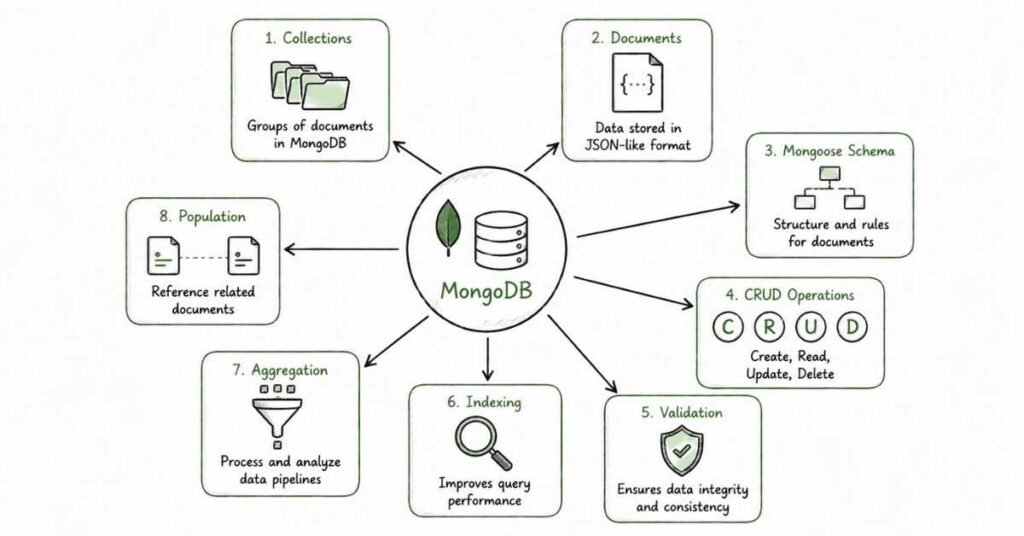
This part covers the database layer of MERN applications. It focuses on MongoDB basics, schema design, Mongoose concepts, and the data modeling choices interviewers expect you to understand before moving into authentication and deployment.
121) What is MongoDB?
MongoDB is a NoSQL database that stores data in flexible document format. It is widely used in MERN applications.
122) Why is MongoDB used in MERN?
Because it works naturally with JavaScript objects and supports flexible data structures. It fits modern web app development well.
123) What is NoSQL?
NoSQL refers to databases that do not use traditional relational table structure. They are often better for flexible or rapidly changing data.
124) What is a document in MongoDB?
A document is a single record stored in JSON-like format. It is the basic unit of data in MongoDB.
125) What is a collection?
A collection is a group of documents. It is similar to a table in relational databases.
126) What is BSON?
BSON stands for Binary JSON. It is the internal format MongoDB uses to store data efficiently.
127) What is the difference between JSON and BSON?
JSON is a text-based data format, while BSON is MongoDB’s binary storage format. BSON supports more data types and better performance.
128) What is a database?
A database is a container that holds collections. It is the top-level data storage unit in MongoDB.
129) What is CRUD in MongoDB?
CRUD stands for Create, Read, Update, and Delete. These are the basic operations performed on data.
130) What is Mongoose?
Mongoose is an ODM library for MongoDB and Node.js. It provides schema-based modeling and easier data handling.
131) Why is Mongoose useful?
Because it adds structure, validation, and helper methods to MongoDB work. It simplifies backend development.
132) What is schema in Mongoose?
A schema defines the structure of documents in a collection. It specifies fields, types, and validation rules.
133) What is a model in Mongoose?
A model is a compiled version of a schema used to interact with a collection. It is used to perform queries and operations.
134) What is the difference between schema and model?
Schema defines the structure, while model provides the interface to work with the database. Both are required in Mongoose-based apps.
135) Why is schema design important?
Because it affects data quality, validation, and query design. Good schema design improves maintainability.
136) What is validation in Mongoose?
Validation checks whether incoming data meets defined rules. It helps prevent bad data from entering the database.
137) What is a required field?
A required field is a field that must have a value before saving the document. It is a basic validation rule.
138) What is population in Mongoose?
Population replaces referenced IDs with actual documents from another collection. It is used to simulate relationships.
139) Why is population useful?
Because it helps connect related data without manually querying multiple collections. It is common in MERN applications.
140) What is indexing in MongoDB?
Indexing is a way to speed up queries by creating searchable structures on fields. It improves performance on large data.
141) Why are indexes important?
Because they reduce query time when searching by specific fields. They matter a lot in production apps.
142) What is embedded data?
Embedded data stores related information inside the same document. It is useful when data is accessed together often.
143) What is referenced data?
Referenced data stores links between documents using IDs. It is better when data is reused across many records.
144) When should embedding be used?
Embedding is useful when related data is small and usually retrieved together. It can reduce query complexity.
145) When should referencing be used?
Referencing is useful when data is large, reused, or frequently updated independently. It avoids duplication.
146) What is aggregation in MongoDB?
Aggregation is a way to process and analyze data using multiple stages. It is used for grouping, filtering, and transforming data.
147) Why is aggregation useful?
Because it helps generate reports and summaries directly from MongoDB. It is powerful for analytics.
148) What is a common MongoDB mistake?
A common mistake is poor schema design or storing too much unrelated data in one document. Another is missing indexes for frequent queries.
149) What is a strong answer for MongoDB questions?
A strong answer explains document structure, schema design, validation, indexing, and how the database fits the app. Interviewers want practical understanding of data modeling.
150) What is a strong answer for Mongoose questions?
A strong answer explains schema, model, validation, and population with a real project example. It should show how Mongoose improves development.
151) What is a good MongoDB design principle?
Design based on how the data will be read and updated. In MongoDB, query patterns matter a lot.
152) Why is MongoDB good for MERN projects?
Because it works well with JSON and JavaScript-based applications. It simplifies full-stack development.
153) What is a unique index?
A unique index ensures that duplicate values are not allowed in a field. It is often used for emails or usernames.
154) What is ObjectId?
ObjectId is MongoDB’s default unique identifier for documents. It is commonly used as the _id field.
155) What is the difference between find and findOne?
find returns multiple documents, while findOne returns a single document. They are used for different query needs.
156) What is updateOne?
updateOne updates a single document that matches a condition. It is commonly used in CRUD APIs.
157) What is deleteOne?
deleteOne removes one matching document from a collection. It is used for deletion requests.
158) What is a strong answer for CRUD database questions?
A strong answer explains the operation, the schema, and how the API uses the database. Interviewers want to see end-to-end understanding.
159) What is the best way to practice MongoDB?
Build CRUD apps with Mongoose schemas, validation, population, and indexes. Practice both write and read operations.
160) Why does schema design matter in interviews?
Because schema choices affect performance, code simplicity, and maintainability. Interviewers want to know that you can design practical data structures.
Revision focus
Revise MongoDB, NoSQL, documents, collections, BSON, CRUD, Mongoose, schema, model, validation, required fields, population, indexing, embedding versus referencing, aggregation, ObjectId, and common query methods before moving to authentication, integration, deployment, and security.
Explore MERN Career Paths
Part 6: Full-Stack Integration, Authentication & Deployment — Questions 161–200
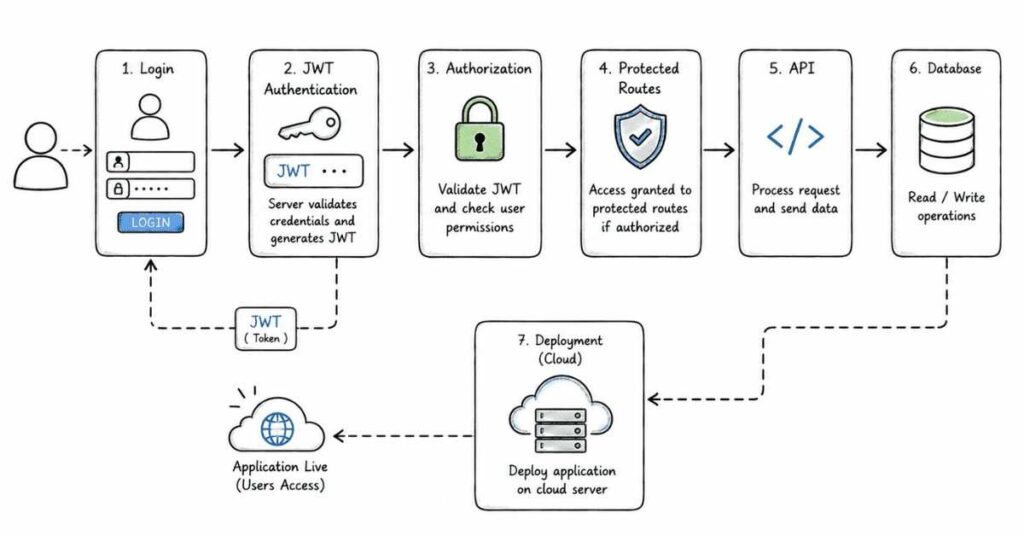
This part covers the practical layer where frontend, backend, database, and deployment come together. It focuses on authentication, API integration, security, file handling, and production readiness in MERN applications.
161) What is API integration?
API integration means connecting the React frontend with Node/Express backend APIs. It allows the frontend to send and receive data.
162) Why is API integration important?
Because full-stack apps depend on communication between client and server. Without it, the app is not truly connected.
163) What is fetch?
fetch is a built-in JavaScript function used to make HTTP requests. It is commonly used to call backend APIs.
164) What is axios?
axios is a library used for making HTTP requests. Many developers prefer it for its cleaner syntax and additional features.
165) What is the difference between fetch and axios?
Both are used for API calls, but axios provides easier defaults, automatic JSON handling, and better error handling support. Either can be used in MERN apps.
166) What is CORS again in integration context?
CORS allows the frontend and backend running on different origins to communicate safely. It is often needed during local development.
167) What is authentication?
Authentication is the process of verifying a user’s identity. It is the first step in securing an app.
168) What is authorization?
Authorization determines what an authenticated user is allowed to do. It controls access to resources and actions.
169) What is the difference between authentication and authorization?
Authentication checks who the user is, while authorization checks what the user can access. They are related but distinct.
170) What is JWT?
JWT stands for JSON Web Token. It is commonly used to authenticate users in MERN applications.
171) Why is JWT used?
Because it allows stateless authentication between client and server. It is popular for APIs and SPAs.
172) What is a token-based login flow?
The server authenticates the user and returns a token. The client stores the token and sends it in future requests.
173) What is password hashing?
Password hashing converts a password into a secure fixed-length value. It helps protect user credentials.
174) Why should passwords be hashed?
Because storing plain text passwords is unsafe. Hashing improves security significantly.
175) What is bcrypt?
bcrypt is a library used to hash passwords securely. It is commonly used in Node.js authentication systems.
176) What is middleware in authentication?
Authentication middleware checks whether a request has valid credentials or token. It protects private routes.
177) What is role-based access control?
Role-based access control gives different permissions based on user roles such as admin or user. It is common in business apps.
178) What is session-based authentication?
Session-based authentication stores user state on the server. It is less common in modern SPA-based MERN apps than JWT.
179) What is file upload in MERN?
File upload means sending files like images or documents from frontend to backend. It is common in profile or content applications.
180) What is multer?
multer is middleware used for handling file uploads in Node.js and Express. It is widely used for image or document upload features.
181) What is environment variable?
An environment variable stores configuration outside the code. It is often used for secrets, ports, and API keys.
182) Why are environment variables important?
Because they keep sensitive or environment-specific values out of source code. They are part of good deployment practice.
183) What is .env file?
.env is a file used to store environment variables locally. It helps separate configuration from application code.
184) What is deployment?
Deployment is the process of making an app available to users on a live server or cloud platform. It is a key step in real projects.
185) Why is deployment important?
Because a project is not complete until it runs in production. Interviewers often ask where and how you deployed your app.
186) What is frontend deployment?
Frontend deployment means publishing the React app to a hosting platform. It makes the UI accessible online.
187) What is backend deployment?
Backend deployment means hosting the Node/Express server and connecting it to a live database. It allows the API to run in production.
188) What is a production build?
A production build is an optimized version of the app prepared for deployment. It is smaller and faster than a development build.
189) What is logging?
Logging records important app events and errors. It helps with debugging and monitoring.
190) Why is logging important?
Because it makes it easier to understand failures and user actions. It is useful in both development and production.
191) What is rate limiting?
Rate limiting restricts how many requests a client can make in a time period. It helps protect APIs from abuse.
192) Why is rate limiting useful?
Because it improves API safety and stability. It can prevent spam and overload.
193) What is validation?
Validation checks whether user input follows the required rules. It helps prevent bad data and security issues.
194) Why is validation important?
Because unvalidated input can break logic or create security problems. Good apps validate both frontend and backend input.
195) What is a strong answer for integration questions?
A strong answer explains how the React app communicates with the API, how auth works, and how data moves through the app. Interviewers like answers that describe the full flow.
196) What is a strong answer for authentication questions?
A strong answer explains login flow, token handling, secure storage, and protected routes. It should show real implementation understanding.
197) What is a common deployment mistake?
A common mistake is forgetting environment variables or production configuration. Another is not checking CORS, build, or route issues after deployment.
198) What should you remember about security?
Remember hashing, token protection, validation, rate limiting, and careful handling of secrets. Security is a basic expectation in full-stack work.
199) What is a common integration mistake?
A common mistake is mixing API logic, auth logic, and frontend state too loosely. Clean separation makes full-stack apps easier to maintain.
200) What is a strong answer for this section overall?
A strong answer shows that you can connect frontend, backend, security, and deployment into one working system. That is the essence of full-stack development.
Revision focus
Revise API integration, fetch versus axios, authentication versus authorization, JWT, token flow, password hashing, bcrypt, auth middleware, role-based access control, session versus token authentication, file upload, multer, environment variables, deployment, production build, logging, rate limiting, validation, and common integration mistakes before moving to system design, performance, and scalability.
Part 7: System Design, Performance & Scalability — Questions 201–240
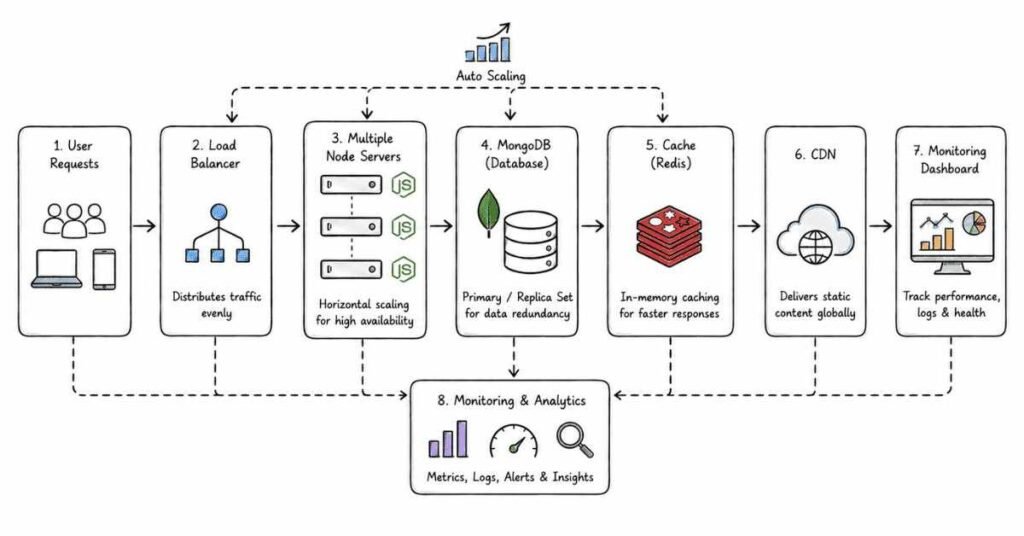
This part covers how to think beyond basic MERN features and explain how an application behaves under growth. It includes architecture, optimization, scalability, caching, and interview-level system thinking.
201) What is system design?
System design is the process of planning how an application is structured and how its parts interact. It focuses on performance, scalability, and maintainability.
202) Why is system design important in MERN?
Because real applications must handle users, data, traffic, and failures efficiently. It shows that you can build beyond simple CRUD apps.
203) What is scalability?
Scalability is the ability of an application to handle growth in users, requests, or data. A scalable app keeps working well as demand increases.
204) What is horizontal scaling?
Horizontal scaling means adding more servers or instances to share the load. It is common in production systems.
205) What is vertical scaling?
Vertical scaling means increasing the power of a single server, such as CPU, RAM, or storage. It has limits compared to horizontal scaling.
206) What is performance optimization?
Performance optimization means making an app faster and more efficient. It can apply to frontend, backend, database, or infrastructure.
207) Why is performance important?
Because slow apps reduce user satisfaction and can increase server cost. Performance is a major part of production readiness.
208) What is caching?
Caching stores frequently used data so it can be served faster later. It reduces repeated work and improves speed.
209) Why is caching useful?
Because it reduces database load and improves response time. It is especially helpful for repeated requests.
210) What is CDN?
A CDN is a content delivery network that serves static assets from locations closer to users. It improves speed and reliability for frontend delivery.
211) What is load balancing?
Load balancing distributes incoming traffic across multiple servers. It helps prevent overload and improves availability.
212) Why is load balancing important?
Because no single server should become a bottleneck under heavy traffic. It supports better resilience and scaling.
213) What is database indexing in performance context?
Indexing creates faster lookup paths for frequently queried fields. It improves read performance significantly when used correctly.
214) What is query optimization?
Query optimization means writing database queries in a more efficient way. It reduces response time and resource usage.
215) Why are slow queries a problem?
Because they can make the whole application feel slow. In many systems, the database becomes the main bottleneck.
216) What is pagination?
Pagination splits large result sets into smaller pages. It improves usability and reduces load on the server and client.
217) Why is pagination important?
Because returning too much data at once hurts performance. Pagination is standard in APIs and admin dashboards.
218) What is lazy loading?
Lazy loading delays loading of content until it is needed. It helps reduce initial load time.
219) What is code splitting?
Code splitting divides frontend code into smaller bundles. It improves app startup performance.
220) What is memoization?
Memoization stores results of expensive computations so they can be reused. It helps avoid repeated processing.
221) What is throttling?
Throttling limits how often a function can run in a given time. It is useful for events like scroll or resize.
222) What is debouncing?
Debouncing delays execution until a user stops triggering an event. It is often used for search input or resize handling.
223) What is memory leak?
A memory leak happens when unused memory is not released properly. It can degrade app performance over time.
224) Why are memory leaks bad?
Because they can slow down the server or crash the app under load. They are a serious production issue.
225) What is concurrency?
Concurrency is the ability to handle multiple tasks in overlapping time periods. It helps applications stay responsive.
226) What is the event loop role in scalability?
The event loop lets Node.js handle many async tasks without blocking. It is one reason Node works well for I/O-heavy apps.
227) What is microservices?
Microservices is an architecture where an app is split into smaller independent services. Each service handles one business capability.
228) What is monolith architecture?
A monolith keeps the whole application in one codebase and deployment unit. It is simpler at the start.
229) Monolith vs microservices?
A monolith is easier to build and deploy early, while microservices can scale teams and features better at large scale. Each has trade-offs.
230) What is API rate limiting in scaling?
Rate limiting controls traffic so the API does not get overwhelmed. It protects performance and stability during spikes.
231) What is backend clustering?
Backend clustering runs multiple Node processes to use more CPU cores. It improves throughput on multi-core machines.
232) What is process manager?
A process manager keeps backend processes running and can restart them on failure. It helps with reliability in production.
233) Why is monitoring important?
Because you need visibility into errors, latency, and system health. Monitoring helps detect problems before users do.
234) What is logging in system design?
Logging records important events, warnings, and errors. It is essential for debugging and auditing.
235) What is a bottleneck?
A bottleneck is the part of the system that slows everything else down. It might be the database, network, or a slow API.
236) What is fault tolerance?
Fault tolerance is the ability of a system to continue operating even when some parts fail. It improves reliability.
237) What is redundancy?
Redundancy means having backup components or duplicate resources. It supports fault tolerance and availability.
238) What is high availability?
High availability means the system stays accessible with minimal downtime. It is an important production goal.
239) What is a strong answer for scalability questions?
A strong answer explains how the app grows in traffic, what bottlenecks may appear, and which tools or patterns help solve them. Interviewers want practical reasoning, not just definitions.
240) How should you practice system design for MERN?
Start with a simple app, then explain how you would scale it with caching, pagination, indexing, load balancing, monitoring, and modular architecture. Practice describing trade-offs clearly.
Revision focus
Revise scalability, horizontal versus vertical scaling, caching, CDN, load balancing, indexing, query optimization, pagination, lazy loading, code splitting, memoization, throttling, debouncing, memory leaks, concurrency, monolith versus microservices, rate limiting, clustering, process managers, monitoring, bottlenecks, fault tolerance, redundancy, and high availability before moving to advanced interview strategy and final revision.
Part 8: Advanced Interview Questions — Questions 241–280
This part focuses on deeper, interview-level concepts that often separate basic familiarity from real understanding. These questions test how well you can explain architecture, trade-offs, debugging, and real-world decision-making.
241) What makes a good MERN developer?
A good MERN developer understands frontend, backend, database, and deployment as one system. They can build features, fix issues, and explain design choices clearly.
242) What is full-stack thinking?
Full-stack thinking means considering how UI, API, database, and infrastructure affect each other. It helps you build better solutions instead of isolated features.
243) What is the difference between a beginner and an advanced MERN answer?
A beginner answer gives a definition, while an advanced answer adds reasoning, trade-offs, and practical examples. Interviewers usually prefer answers that show applied understanding.
244) Why do interviewers ask “why” questions?
Because they want to know whether you understand the reason behind a technology choice. Knowing what something is matters, but knowing why it is used matters more.
245) What is a trade-off?
A trade-off is a compromise between two advantages. For example, embedding data can be faster to read but harder to update in some cases.
246) Why are trade-offs important in interviews?
Because real software decisions are rarely perfect. Interviewers want to see that you can choose the right option for the situation.
247) What is separation of concerns?
It means keeping different parts of the app responsible for different tasks. For example, routes, controllers, services, and database logic should not all live in one place.
248) Why is separation of concerns useful?
Because it makes code easier to read, test, and maintain. It also reduces bugs caused by tightly coupled logic.
249) What is reusable code?
Reusable code is code written once and used in multiple places. It saves time and keeps behavior consistent.
250) Why is reusable code important in MERN?
Because large apps have many repeated patterns. Reusable components, helpers, and middleware make the project cleaner.
251) What is code maintainability?
Maintainability is how easily code can be updated, fixed, and extended. It is a major quality factor in real projects.
252) What improves maintainability?
Clear structure, naming, modular design, validation, and proper error handling all improve maintainability. Avoiding duplicated logic also helps.
253) What is testability?
Testability is how easy it is to test code correctly. Well-structured code is easier to unit test and integration test.
254) Why should MERN apps be testable?
Because testing catches bugs before users do. It also gives confidence when adding new features.
255) What is a unit test?
A unit test checks a small piece of code in isolation. It usually tests a function, utility, or component behavior.
256) What is an integration test?
An integration test checks whether multiple parts work together correctly. It is useful for API routes, database calls, and user flows.
257) What is a common debugging approach?
A common debugging approach is to reproduce the issue, isolate the cause, inspect logs, and test a fix. This method works well in both frontend and backend code.
258) Why are logs useful in debugging?
Logs help you see what happened before an error occurred. They are often the fastest way to understand backend failures.
259) What is a memory leak?
A memory leak happens when unused memory is not released properly. Over time, this can slow down or crash an application.
260) Why do memory leaks matter?
Because they become serious in long-running server processes. A small leak can grow into a major production problem.
261) What is asynchronous programming?
Asynchronous programming allows tasks to run without blocking the rest of the app. It is essential in JavaScript backend development.
262) Why is asynchronous code important?
Because web apps spend a lot of time waiting on network, file, or database operations. Async code keeps the app responsive.
263) What is a promise?
A promise represents the future result of an asynchronous operation. It can be pending, fulfilled, or rejected.
264) What is async/await?
async/await is syntax that makes asynchronous code easier to read. It lets you write async logic in a more sequential style.
265) What is error-first handling?
It is a Node.js pattern where the first argument in a callback is an error object. It helps separate failure handling from success handling.
266) What is the event-driven model?
The event-driven model responds to actions or events as they happen. Node.js is built around this style.
267) What is the importance of HTTP?
HTTP is the protocol used for communication between client and server. It is the foundation of web APIs.
268) What is a RESTful design principle?
A RESTful design uses resources, standard HTTP methods, and predictable routes. It makes APIs easier to understand and use.
269) What is idempotency?
Idempotency means repeating the same operation gives the same result. PUT and DELETE are often designed to be idempotent.
270) Why is idempotency useful?
Because it makes APIs safer and more predictable. It matters especially when requests are retried.
271) What is a service layer?
A service layer contains business logic separate from routes and controllers. It helps keep the application structure clean.
272) Why use a service layer?
Because it makes code easier to test and reuse. It also keeps controllers thinner.
273) What is MVC?
MVC stands for Model-View-Controller. It is a design pattern that separates data, presentation, and control logic.
274) Is MVC used in MERN?
Yes, the idea is often adapted in MERN apps, especially on the backend. Controllers, models, and views or responses map well to this structure.
275) What is centralized error handling?
Centralized error handling means handling errors in one place instead of repeating logic everywhere. It makes APIs cleaner and more consistent.
276) Why is centralized error handling important?
Because it reduces duplicate code and makes responses more uniform. It is a common best practice in Express apps.
277) What is input sanitization?
Input sanitization means cleaning user input before using it. It helps reduce security risks and bad data.
278) Why is security important in advanced interviews?
Because production applications must handle real users and real attacks. Interviewers want to know that you think beyond functionality.
279) What is a strong advanced MERN answer?
A strong advanced answer explains the concept, gives a real use case, and mentions trade-offs or implementation details. It should sound practical, not memorized.
280) How should you prepare for advanced questions?
Practice explaining your own projects, decisions, bugs, and fixes. Real examples make your answers much stronger than definitions alone.
Revision focus
Revise trade-offs, separation of concerns, maintainability, testability, unit and integration tests, debugging, memory leaks, promises, async/await, event-driven programming, REST principles, idempotency, service layers, MVC, centralized error handling, input sanitization, and how to answer with practical examples.
Part 9: Behavioral, Resume, LinkedIn & Career Strategy — MERN Stack Developer Interview Preparation Guide
This final part focuses on presenting yourself well for MERN roles, not just answering technical questions. Strong candidates are expected to explain project decisions, show backend ownership, and position their resume and LinkedIn profile around React, Node.js, Express, MongoDB, APIs, databases, and maintainable system design.
STAR method
The STAR method means answering behavioral questions with Situation, Task, Action, and Result. It is a standard way to structure behavioral answers clearly and concisely.[capd.mit]
Use this MERN-friendly STAR approach:
- Situation: A production issue, feature request, deployment problem, database bottleneck, or API bug.
- Task: What you were responsible for in that project or issue.
- Action: What you designed, debugged, optimized, tested, or coordinated.
- Result: What improved, what was fixed, or what you learned.
Example:
- Situation: A Node.js API was slowing down during peak usage because database calls were increasing too much.
- Task: The goal was to identify the bottleneck and improve response time without breaking existing endpoints.
- Action: The slow queries were profiled, unnecessary data fetching was reduced, and the API logic was adjusted to use more efficient querying and response shaping.
- Result: Response time improved, the API became more stable under load, and the team had a clearer performance baseline for future work.
20 behavioral questions
Below are 20 common behavioral questions with answer direction. These kinds of questions are common in MERN and full-stack interviews, where interviewers want real examples of collaboration, debugging, and ownership.
- Tell me about yourself.
Framework: background → MERN stack → role target. - Why do you want to work as a MERN stack developer?
Framework: interest in backend + frontend development → stack fit → long-term direction. - Tell me about a project you are proud of.
Framework: problem → architecture or API work → your contribution → result. - Describe a time you fixed a production bug.
Framework: issue → diagnosis → fix → learning. - Tell me about a time you improved API performance.
Framework: bottleneck → investigation → optimization → result. - Describe a time you worked with a database issue.
Framework: issue → query or schema analysis → improvement. - Tell me about a time you handled unclear requirements.
Framework: ambiguity → clarification → implementation. - Describe a time you worked with a team on a feature.
Framework: collaboration → ownership → delivery. - Tell me about a mistake you made in development.
Framework: mistake → ownership → fix → lesson. - Describe a time you handled authentication or authorization logic.
Framework: access requirement → implementation → validation. - Tell me about a time you used reusable components well.
Framework: design need → modularity → maintainability benefit. - Describe a time you wrote or improved tests.
Framework: issue risk → testing approach → outcome. - Tell me about a time you optimized a MongoDB or SQL query.
Framework: slow data access → diagnosis → improvement. - Describe a time you supported deployment or release activity.
Framework: environment → deployment step → result. - Tell me about a time you explained a technical issue to a non-technical person.
Framework: problem → simplification → understanding. - Describe a time you handled code review feedback.
Framework: feedback → revision → improvement. - Why should we hire you for this MERN role?
Framework: React + Node + database + reliability. - Where do you see yourself in 3 years?
Framework: stronger full-stack ownership → architecture → production impact. - How do you keep yourself updated in MERN?
Framework: docs → hands-on practice → project application. - How do you approach debugging in MERN?
Framework: reproduce → isolate → inspect logs/data/code → fix.
Keep answers specific and realistic. For freshers, college projects, internships, self-built APIs, or CRUD applications are acceptable if they are explained honestly and clearly.
50 AI self-preparation prompts
Use these prompts with an AI assistant or for self-practice. They are useful for simulating interviews, improving answers, and tightening your project storytelling.
- Ask me MERN behavioral questions one by one.
- Evaluate my “Tell me about yourself” answer for a MERN role.
- Rewrite my introduction for a MERN developer role.
- Rewrite my introduction for a React + Node.js role.
- Conduct a mock HR interview for a MERN developer.
- Conduct a mock technical interview for React and Node.js.
- Ask me JavaScript fundamentals questions one by one.
- Ask me React interview questions.
- Ask me Node.js interview questions.
- Ask me Express.js interview questions.
- Ask me MongoDB interview questions.
- Ask me REST API interview questions.
- Ask me MongoDB indexing questions.
- Ask me JWT authentication interview questions.
- Ask me middleware interview questions.
- Ask me microservices and Docker interview questions.
- Turn my MERN project into a STAR answer.
- Improve my MERN resume bullet points.
- Convert my internship project into stronger backend resume language.
- Create a 30-second MERN developer elevator pitch.
- Create a 60-second full-stack developer elevator pitch.
- Ask follow-up questions after every answer I give.
- Score my answers for clarity and confidence.
- Find weak spots in my MERN interview preparation.
- Simulate a MERN backend interview round.
- Simulate a React interview round.
- Simulate a MongoDB and Express round.
- Simulate a system design round for a MERN developer.
- Improve my LinkedIn headline for MERN roles.
- Improve my LinkedIn About section for full-stack roles.
- Ask me how I optimized an API.
- Ask me how I handled exception logging in a project.
- Ask me how I use middleware in Express.
- Ask me how I explain JWT in simple terms.
- Help me explain a CRUD API project clearly.
- Help me explain a MongoDB project clearly.
- Make my MERN interview answers sound more natural.
- Shorten my long answers into interview-ready versions.
- Help me answer “What is your weakness?” for a developer role.
- Help me answer “Why this company?” for a MERN role.
- Create 20 likely HR questions for MERN freshers.
- Create 20 likely technical questions for MERN backend developers.
- Cross-examine my resume like a MERN interviewer.
- Check whether my project claims sound realistic.
- Turn my college project into an industry-style API project summary.
- Build a 7-day MERN mock interview plan.
- Create a thank-you email after a MERN interview.
- Create a recruiter outreach message for MERN roles.
- Create a no-response follow-up after 5 days.
- Create a final revision checklist from my weak MERN areas.
Resume optimization
Current MERN resume guidance strongly favors exact stack keywords, especially around JavaScript, React, Node.js, Express, MongoDB, REST APIs, authentication, state management, and deployment, because recruiters and ATS tools screen for those terms directly. Modern guides also emphasize MongoDB, Express, React, Node.js, Git, Docker, testing, and cloud-adjacent delivery skills for current-market relevance.
Use this structure:
- Name and contact details.
- Resume headline.
- 3–4 line summary.
- Technical skills.
- Experience or projects.
- Education.
- Certifications.
- GitHub, portfolio, or project links if relevant.
Useful keywords to include naturally:
- JavaScript, React, Node.js, Express.js, MongoDB, REST API, JWT Authentication, Middleware, Redux, Context API, Mongoose, SQL, Git, Docker, Testing, Logging, CORS, Deployment.
Better bullet style:
- Built RESTful APIs using Node.js, Express.js, and MongoDB for CRUD and business workflow operations.
- Designed database access using Mongoose and MongoDB queries for efficient backend processing.
- Implemented JWT-based authentication and role-based authorization for secure API access.
- Used middleware, validation, and structured logging to improve maintainability and debugging.
- Optimized slow queries and improved API response time through better data access and query design.
- Wrote unit tests for service-layer logic and supported reliable deployment workflows.
- Containerized application components with Docker and supported environment-based configuration.
- Collaborated with frontend, QA, or product teams to deliver backend features and bug fixes.
Avoid these mistakes:
- Writing only “worked on MERN application development.”
- Listing React, Node, and MongoDB without describing what you built.
- Claiming microservices or cloud experience without project proof.
- Adding too many outdated or unrelated technologies.
- Skipping GitHub or project links for fresher roles.
Resume summary example:
For fresher:
“Entry-level MERN stack developer with strong foundations in JavaScript, React, Node.js, Express.js, MongoDB, REST APIs, and backend application development. Hands-on project experience building CRUD APIs, database-driven applications, and secure backend features using modern MERN development practices. Seeking an opportunity to contribute to full-stack engineering, API development, and scalable application design.”
For experienced candidate:
“MERN stack developer with experience building full-stack applications using React, Node.js, Express.js, MongoDB, and REST APIs. Comfortable with application architecture, secure API development, logging, state management, and production-focused problem solving across modern JavaScript environments. Interested in roles that combine clean full-stack design with performance, reliability, and long-term maintainability.”
LinkedIn profile optimization
For MERN roles, your LinkedIn profile should show your full-stack identity quickly through role title, stack keywords, and project depth. Recruiters often screen first for skill relevance, stack alignment, and production-facing technologies before reading detailed experience.
Use these upgrades:
- Headline: include role target plus stack keywords.
- About: 3 short paragraphs with background, tools, and role focus.
- Experience: use action-based backend and frontend bullets.
- Featured: add GitHub, APIs, architecture notes, or project demos if available.
- Skills: list both platform and engineering concepts.
- URL: customize it.
- Open to Work: enable it if relevant.
Headline examples:
- General full-stack: MERN Stack Developer | React, Node.js, Express.js, MongoDB
- Fresher: Aspiring MERN Stack Developer | JavaScript, React, Node.js, Express.js, MongoDB
- Experienced: Full-Stack Developer | React, Node.js, Express.js, MongoDB, REST APIs
About section template:
“I build full-stack applications and APIs using JavaScript, React, Node.js, Express.js, MongoDB, and REST APIs. My core strengths include backend development, database integration, authentication, reusable UI components, and clean application design.
My experience and projects include CRUD APIs, secure backend workflows, MongoDB-based data access, and production-style debugging and performance improvement. I am especially interested in roles where maintainable architecture, API reliability, and scalable full-stack development matter.
I am currently targeting opportunities in MERN stack development, full-stack JavaScript engineering, and modern web application development.”
Project and portfolio strategy
Project explanations matter heavily in MERN interviews because recruiters and technical interviewers often validate whether you actually understand the stack you mention. Realistic project storytelling is often more valuable than listing many technologies without depth.
Strong project categories:
- CRUD Web API project.
- Authentication and authorization project.
- E-commerce backend.
- Employee management system.
- Booking or ticketing API.
- Inventory or order management backend.
- Microservice-style demo project.
- MongoDB and Express-based admin system.
- Dockerized Node.js API project.
- Logging and exception-handling focused API project.
For each project, prepare these six points:
- Problem statement.
- System or module purpose.
- Tech stack used.
- Your contribution.
- Key challenge.
- Result and learning.
Example explanation:
“I built a backend employee management API using Node.js, Express.js, MongoDB, and Mongoose. The project included CRUD endpoints, JWT-based authentication, role-based authorization, and database migrations. I used middleware, dependency injection-style service separation, and structured exception handling to keep the application maintainable, and I learned how to organize service, repository, and controller layers more cleanly.”
Salary guidance in India
Salary data for MERN stack developers in India varies by source, but current market trackers generally place entry-level and early-career compensation in a broad lower-to-mid single-digit range, with strong growth for developers who can own APIs, performance, and deployment. Because MERN salaries depend heavily on city, company size, and project depth, it is better to anchor expectations to your actual backend and full-stack ownership than to a single headline number.
A practical planning range is:
- Fresher: ₹3–6 LPA.
- 1–3 years: ₹5–10 LPA.
- 3–6 years: ₹8–18 LPA.
- Senior / specialized roles: ₹15 LPA and above depending on architecture, cloud, and business-critical system depth.
Use salary discussions carefully and anchor them to your actual MERN depth, project quality, API ownership, and production readiness rather than inflated market stories. Higher-paying city and company bands do exist, but compensation varies sharply by employer, location, and specialization.
Sample line:
“Based on my experience with JavaScript, React, Node.js, Express.js, and MongoDB, I am looking for a fair opportunity in the range of X to Y LPA, while also considering the role scope, engineering quality, and long-term growth.”
Thank-you emails
Thank-you email template
Subject: Thank you — MERN Stack Developer interview
Hello [Interviewer Name],
Thank you for taking the time to speak with me today regarding the MERN Stack Developer role. I enjoyed our discussion, especially the conversation around [React / Node.js / MongoDB / authentication / backend design].
The role aligns strongly with my background in JavaScript full-stack development, and I would be excited about the opportunity to contribute.
Thank you again for your time and consideration.
Best regards,
[Your Name]
[Phone Number]
[Email]
Follow-up email after 4–7 days
Subject: Follow-up on MERN Stack Developer interview
Hello [Interviewer Name],
I hope you are doing well. I wanted to follow up on the interview process for the MERN Stack Developer position. I remain very interested in the role and wanted to check whether there are any updates regarding the next steps.
Thank you for your time and consideration.
Best regards,
[Your Name]
Final 30-day checklist
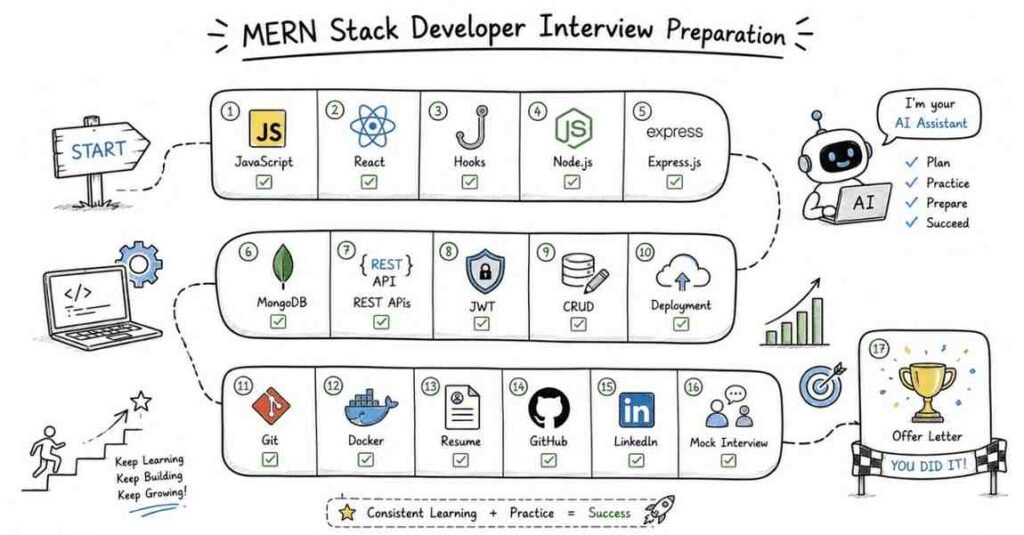
Week 1
- Revise MERN basics, JavaScript syntax, data types, OOP, and collections.
- Practice speaking about JavaScript concepts aloud.
- Finalize 2 project stories.
- Update resume summary and technical skills.
Week 2
- Revise React, hooks, props, state, routing, and component design.
- Practice API-related interview questions daily.
- Strengthen one full-stack or CRUD project explanation.
- Update LinkedIn headline and About section.
Week 3
- Revise Node.js, Express.js, MongoDB, authentication, middleware, logging, and security.
- Practice backend, database, and JWT questions.
- Prepare answers around performance, debugging, and maintainability.
- Review deployment and configuration basics.
Week 4
- Revise microservices, Docker, testing, caching, system design, and scenario-based questions.
- Do full mock interviews: HR, frontend, backend, database, and architecture rounds.
- Review salary range and recruiter communication.
- Apply consistently and track responses.
Final 3 days
- Review only your condensed notes and project summaries.
- Practice concise spoken answers.
- Keep resume, GitHub, project links, and documents ready.
- Focus on clarity, calmness, and consistency.