
Java DSA Interview Preparation Guide 2026
Table of Contents
Part 1: Introduction & 30-Day Study Plan
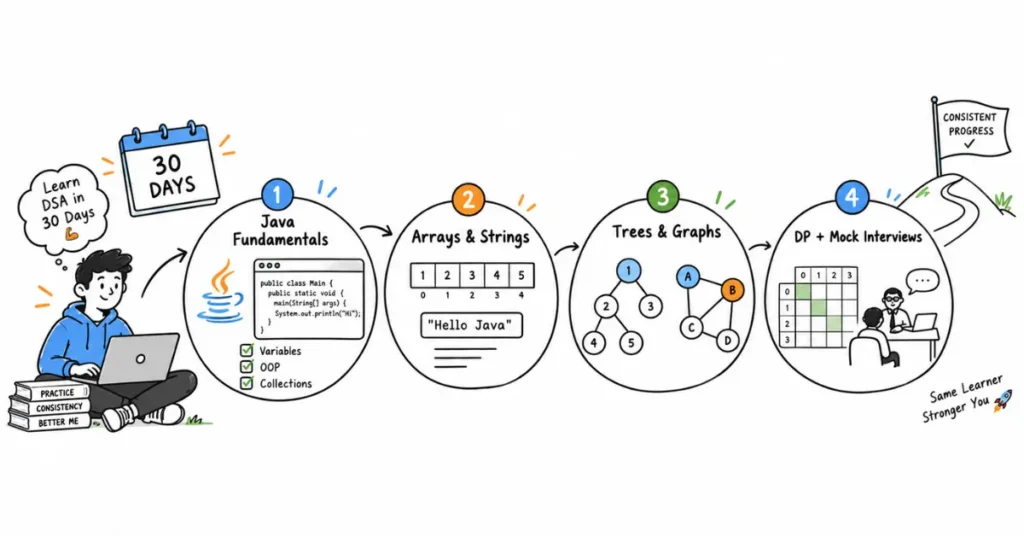
Introduction
Java DSA preparation helps you build strong programming logic and problem-solving skills for coding interviews.
However, knowing Java syntax alone is not enough.. In technical rounds, you may need to understand a problem, select the right data structure, write an efficient solution, and explain its time and space complexity.
This guide covers Java fundamentals, Data Structures, Algorithms, coding patterns, interview preparation, and career guidance in a structured format.
What This Guide Covers
This guide includes 280 Java DSA interview questions and answers covering:
- Java fundamentals
- Arrays and Strings
- Searching and Sorting
- Recursion and Backtracking
- Linked Lists
- Stacks and Queues
- Trees and BST
- Heaps and Tries
- Graphs
- Dynamic Programming
- Coding interview preparation
- Resume and career strategy
The main focus is to understand concepts and apply them in coding interviews.
Who This Guide Is For
In addition this guide is useful for:
- Students preparing for placements
- Freshers preparing for software jobs
- Java beginners learning DSA
- Candidates preparing for coding rounds
- Working professionals preparing for job switches
- Candidates targeting Java Developer or Software Developer roles
Basic Java knowledge is helpful before starting DSA preparation.
What Is Java DSA?
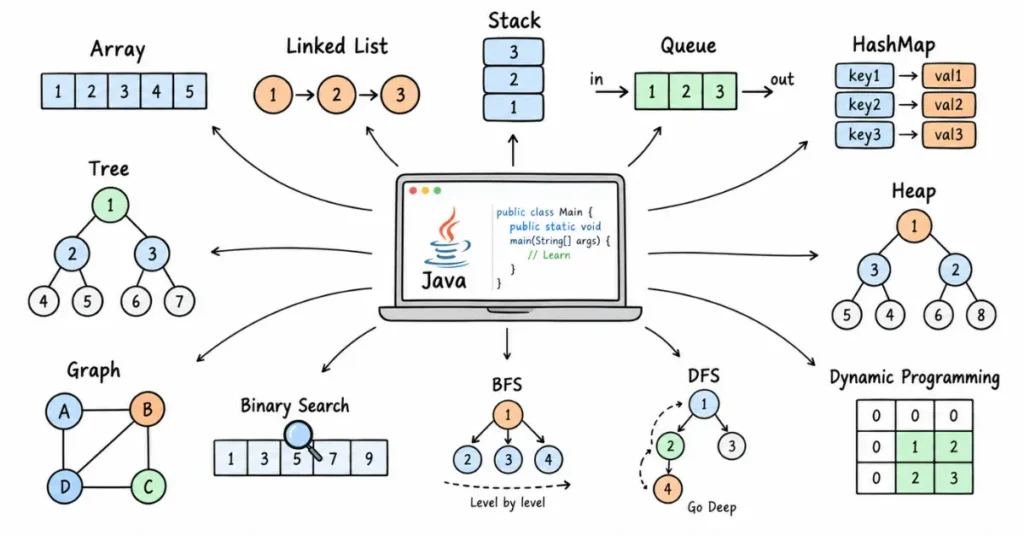
DSA means learning Data Structures and Algorithms.
A Data Structure is a method of organizing data.
Examples:
- Array
- Linked List
- Stack
- Queue
- HashMap
- Tree
- Heap
- Graph
An Algorithm is a set of steps used to solve a problem.
Examples:
- Binary Search
- Merge Sort
- BFS
- DFS
- Dynamic Programming
Java also provides useful collections such as ArrayList, HashMap, HashSet, Deque, and PriorityQueue.
Why Learn Java DSA?
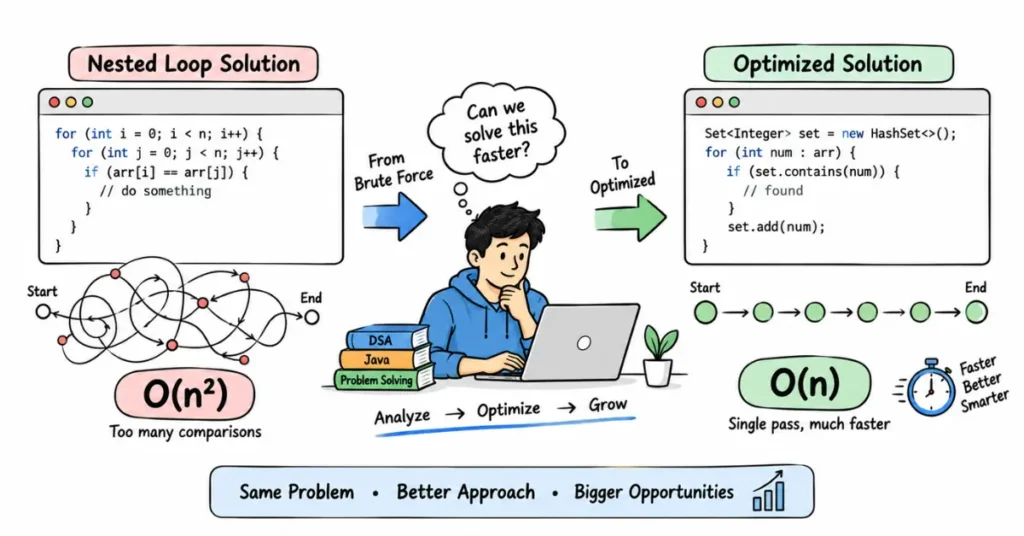
The Java DSA helps you solve programming problems efficiently.
For example, a simple solution may require multiple nested loops & take O(n²) time. Using a better data structure or algorithm may reduce to O(n) or O(n log n).
In addition, DSA helps you learn how to:
- Understand coding problems
- Select the right data structure
- Reduce unnecessary operations
- Improve slow solutions
- Calculate time complexity
- Calculate space complexity
- Handle edge cases
- Explain solutions clearly
These skills are commonly tested in coding interviews.
Where Java DSA Is Used
Moreover, DSA concepts are useful in both interviews and real software development.
Concept | Common Use |
Arrays | Store and process ordered data |
HashMap | Fast lookup and frequency counting |
Stack | Nested operations and expression problems |
Queue | Task processing and BFS |
Heap | Priority-based processing |
Tree | Hierarchical data |
Trie | Prefix-based searching |
Graph | Networks and relationships |
Dynamic Programming | Repeated subproblems |
The exact coding problem may change, but the underlying problem-solving logic remains useful.
Common Career Roles
Java DSA preparation can help candidates targeting different software roles.
Role | Main Focus |
Java Developer | Java applications and backend logic |
Backend Developer | APIs, databases and services |
Software Developer | Application development |
Software Engineer | Coding and problem solving |
SDE | Software engineering and coding rounds |
Full-Stack Java Developer | Frontend and Java backend development |
However, the level of DSA required depends on the company and role.
Common Java DSA Interview Process
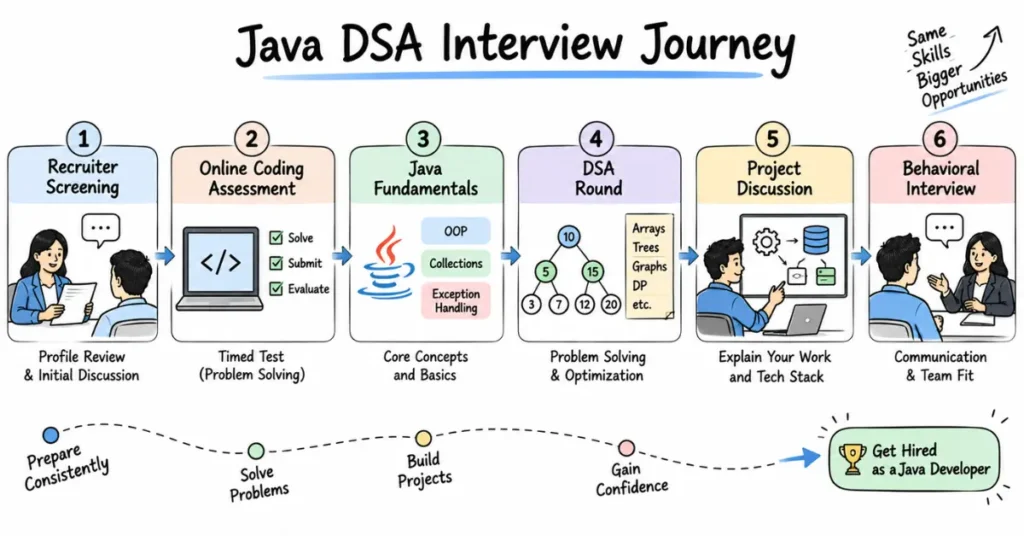
A typical interview process may include:
- HR or recruiter screening
- Online coding assessment
- Java fundamentals round
- DSA coding round
- Project or technical discussion
- Behavioral or managerial round
Additionally, some companies may combine Java, DSA, SQL, projects, and development questions in one technical round.
Skills Interviewers Usually Check
Interviewers may check your knowledge of:
- Core Java
- Collections
- Arrays and Strings
- Hashing
- Searching and Sorting
- Recursion
- Linked Lists
- Stacks and Queues
- Trees
- Graphs
- Dynamic Programming
- Time and Space Complexity
- Problem-solving ability
- Code readability
- Edge-case handling
You should be able to explain both the solution and the reason for choosing it.
Important Java DSA Topics
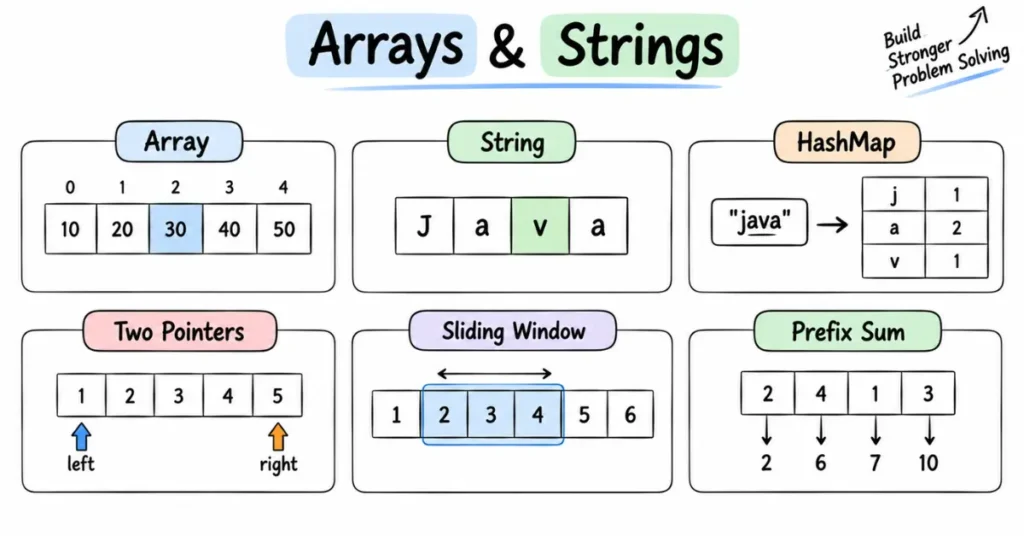
1.Arrays and Strings
Arrays and Strings are common in coding interviews.
For example, important areas include:
- Traversal
- Frequency counting
- Two pointers
- Sliding window
- Prefix sum
- Subarrays
- Substrings
2.Searching and Sorting
Searching helps locate data, while sorting arranges data in a specific order.
For example, important algorithms include:
- Linear Search
- Binary Search
- Bubble Sort
- Selection Sort
- Insertion Sort
- Merge Sort
- Quick Sort
Binary Search is especially important because it can search suitable sorted data in O(log n) time.
3.Recursion and Backtracking
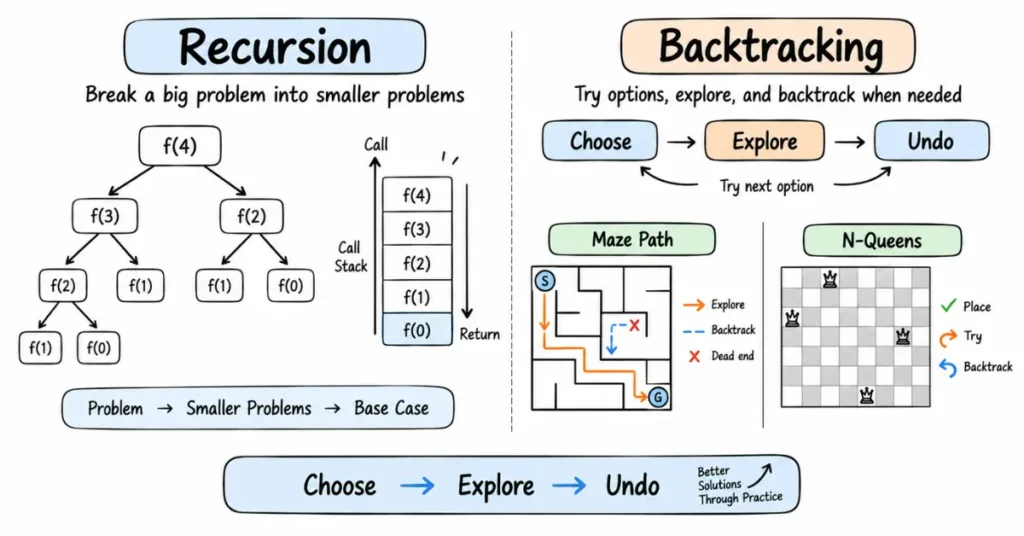
Recursion is a method where a function calls itself to solve smaller versions of a problem.
Backtracking explores different choices and removes a choice when it does not lead to the required result.
Common problems include:
- Subsets
- Permutations
- Combinations
- Maze problems
- N-Queens
4.Linked Lists
A Linked List stores data using connected nodes.
Important interview problems include:
- Reverse a Linked List
- Find the middle node
- Detect a cycle
- Merge two sorted lists
- Fast and slow pointer problems
5.Stacks and Queues
A Stack follows LIFO — Last In, First Out.
A Queue follows FIFO — First In, First Out.
Stacks are commonly used for parentheses and next-greater-element problems.
Queues are commonly used for BFS and level-order traversal.
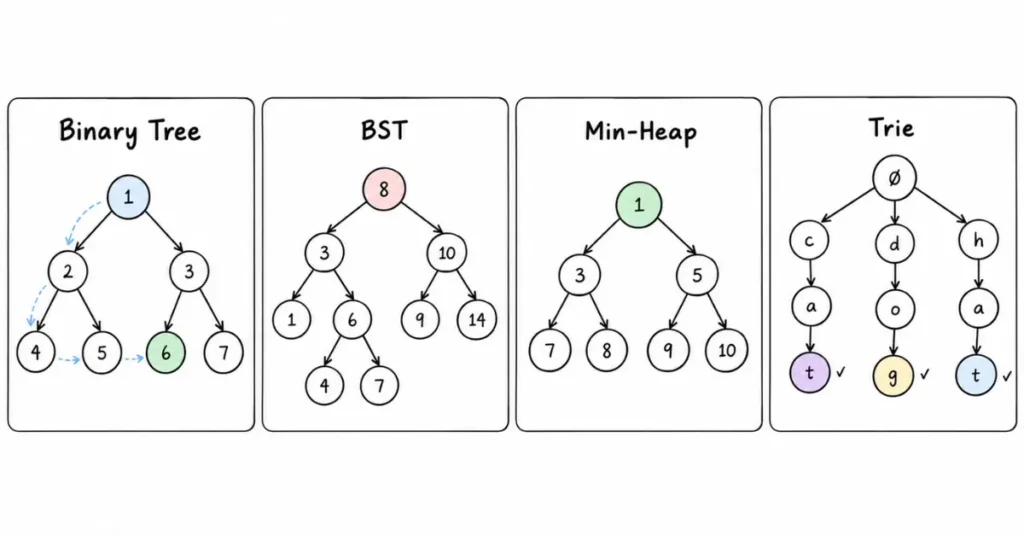
6.Trees, Heaps and Tries
A Tree stores hierarchical data.
Important topics include:
- Preorder
- Inorder
- Postorder
- Level-order traversal
- Height
- Binary Search Tree
A Heap is useful when you repeatedly need the smallest or largest element.
A Trie is useful for word and prefix searching.
7.Graphs
A Graph contains vertices and edges representing relationships.
Important topics include:
- BFS
- DFS
- Connected Components
- Cycle Detection
- Topological Sorting
- Shortest Paths
- Disjoint Set Union
8.Dynamic Programming
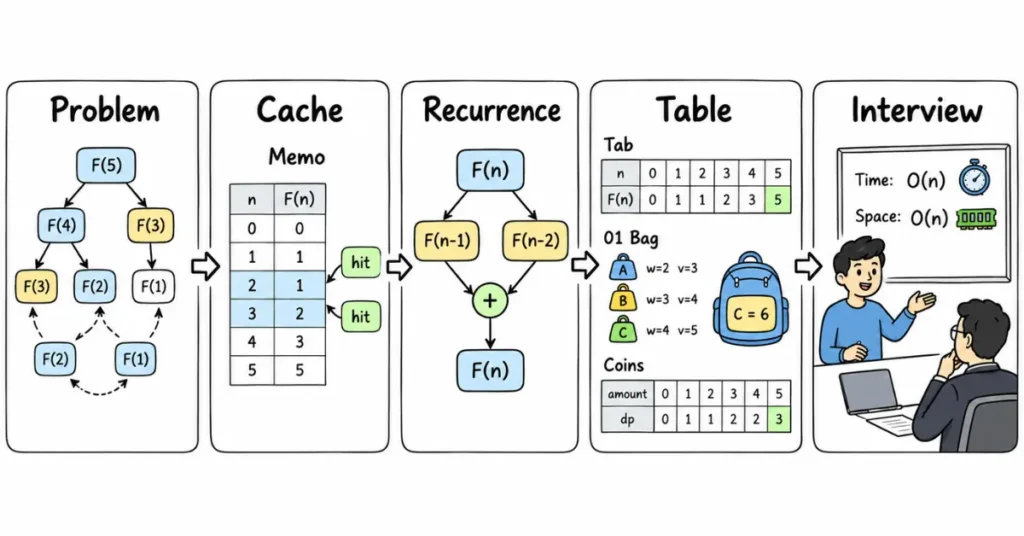
Dynamic Programming is useful when the same smaller problems are solved repeatedly.
Two common methods are:
Memoization: Top-down approach using recursion and caching.
Tabulation: Bottom-up approach using a table or array.
Common DP topics include:
- Fibonacci
- Climbing Stairs
- Coin Change
- Knapsack
- Subset Sum
- Longest Common Subsequence
Salary Expectations in India
Salary depends on the job role, experience, company, location, Java skills, projects, and interview performance.
Java DSA Career Salary Range
Experience | Typical Roles | Approx. Salary |
Fresher | Junior Java Developer, Associate Software Engineer | ₹3.5–6 LPA |
1–3 Years | Java Developer, Backend Developer | ₹5–10 LPA |
3–6 Years | Senior Java Developer, Software Engineer | ₹9–18 LPA |
6+ Years | Lead Developer, Senior Software Engineer | ₹15–30+ LPA |
These are general estimates and should not be considered guaranteed salary packages.
For freshers, a stronger profile usually combines Java + DSA + SQL + Projects + Development Skills + Communication.
30-Day Java DSA Study Plan
Week 1: Java, Arrays and Strings
Focus on:
- Java fundamentals
- Collections
- Big-O notation
- Arrays
- Strings
- Hashing
- Two pointers
- Sliding window
Solve basic problems and understand the logic behind each solution.
Week 2: Searching and Linear Data Structures
Focus on:
- Binary Search
- Sorting
- Recursion
- Backtracking
- Linked Lists
- Stacks
- Queues
Practice dry-running your solution before writing code.
Week 3: Trees and Graphs
Focus on:
- Trees
- BST
- Heaps
- Tries
- BFS
- DFS
- Cycle Detection
- Topological Sorting
Start practicing mixed interview questions.
Week 4: Dynamic Programming and Interviews
Focus on:
- Memoization
- Tabulation
- 1D and 2D DP
- Knapsack patterns
- Mixed DSA revision
- Mock coding interviews
Use the final days to revise weak topics.
Daily Study Routine
A simple daily schedule:
- 45 minutes: Concept revision
- 60 minutes: Coding practice
- 30 minutes: Re-solve previous problems
- 20 minutes: Explain solutions aloud
- 15 minutes: Review mistakes
Do not focus only on the number of problems solved. For example, common patterns to check include:
How to Approach a DSA Interview Question
Follow these steps:
- Understand the problem.
- Check input and output.
- Understand the constraints.
- Explain a basic solution.
- Identify the slow part.
- Find a better DSA pattern.
- Explain time and space complexity.
- Write clean Java code.
- Test normal and edge cases.
For example, common patterns to check include:
- Hashing
- Two Pointers
- Sliding Window
- Binary Search
- Stack
- Queue
- Heap
- BFS
- DFS
- Dynamic Programming
The interviewer wants to understand how you think, not only whether your final code works.
Part 1 Revision Focus
Before moving to the interview questions, make sure you understand:
- What Java DSA is
- Why DSA is important
- Major DSA topics
- Common software roles
- Interview process
- Time and space complexity
- 30-day preparation plan
- How to approach a coding question
Part 2: Java Fundamentals for DSA — Questions 1–40
This part builds the Java programming foundation required before solving data structure and algorithm problems. For Java DSA interviews, candidates should be comfortable with variables, data types, operators, loops, methods, arrays, strings, classes, objects, and the Java collection utilities commonly used while implementing algorithms.
The goal is not to study every Java feature in depth, but to become comfortable enough with Java that language syntax does not slow down your problem-solving during coding rounds.
Questions 1–40
Java Programming Basics
1) Why is Java commonly used for DSA?
Java is commonly used for DSA because it provides clear syntax, automatic memory management, strong object-oriented support, and built-in data structures through the Collections Framework. It is also widely accepted in coding assessments and technical interviews.
2) What are the main data types used in Java DSA problems?
The most commonly used data types are int, long, double, char, and boolean. For example, int is used for most integer problems, while long is important when calculations can exceed the integer range.
3) What is the difference between int and long in Java?
int is a 32-bit signed integer type, while long is a 64-bit signed integer type. Therefore, in DSA problems involving large sums, multiplication, or large constraints, using long can prevent integer overflow.
4) What is type casting in Java?
Type casting means converting a value from one data type to another. In addition, Java supports automatic widening conversions and explicit narrowing conversions, which become important when coding problems involve mixed numeric types.
5) What are operators in Java?
Operators are symbols used to perform calculations, comparisons, assignments, and logical operations. For example, arithmetic, relational, logical, increment, decrement, and modulus operators appear frequently in DSA solutions.
6) Why is the modulus operator important in DSA?
The modulus operator % returns the remainder after division. It is commonly used for checking even or odd numbers, extracting digits, circular indexing, modular arithmetic, and problems involving very large values.
Loops and Conditional Statements
7) What is an if-else statement?
An if-else statement executes different blocks of code depending on whether a condition is true or false. DSA solutions use conditional statements constantly for comparisons, boundary checks, and decision-making.
8) What is a for loop?
A for loop repeatedly executes a block of code while a given condition remains true. It is especially useful when the number of iterations is known, such as traversing an array from index 0 to n-1.
9) What is a while loop?
A while loop continues executing as long as its condition remains true. It is commonly used in two-pointer problems, binary search, linked-list traversal, and situations where the number of iterations is not known in advance.
10) What is the difference between for and while loops?
A for loop is generally preferred when initialization, condition, and update logic naturally belong together, while a while loop is convenient when repetition depends on a changing condition. Both can usually express the same logic.
11) What are nested loops?
Nested loops are loops placed inside other loops. They commonly appear in matrix traversal and brute-force comparisons, and two full loops over an input of size n often lead to O(n²) time complexity.
12) What do break and continue do?
break immediately exits the current loop, while continue skips the remaining statements of the current iteration and moves to the next one. Both are useful when controlling traversal based on specific conditions.
Methods and Parameters
13) What is a method in Java?
A method is a reusable block of code designed to perform a specific operation. In DSA, methods help separate tasks such as searching, sorting, traversal, swapping, or calculating a result.
14) Why should DSA solutions be divided into methods?
Separating logic into methods improves readability, testing, and debugging. It also helps candidates explain individual parts of an algorithm more clearly during an interview.
15) Is Java pass-by-value or pass-by-reference?
Java is always pass-by-value. When an object or array is passed to a method, Java passes a copy of its reference value, which allows the method to modify the object’s contents but does not make Java pass-by-reference.
16) What is method overloading?
Method overloading means defining multiple methods with the same name but different parameter lists. Java determines which method to call at compile time based on the arguments provided.
Arrays
17) What is an array in Java?
An array is a fixed-size structure used to store multiple values of the same type. Array elements are accessed using indexes, beginning from index 0.
18) Why are arrays important in DSA?
Arrays are one of the most fundamental data structures and form the basis of many interview problems. For example, they are used to teach traversal, searching, sorting, prefix sums, sliding windows, and two pointers.
19) What is the time complexity of accessing an array element?
Accessing an array element using its index takes O(1) time. This is possible because the required element can be located directly from its index.
20) What is the time complexity of searching an unsorted array?
Searching an unsorted array generally takes O(n) time using linear search because, in the worst case, every element may need to be checked.
21) What is a two-dimensional array?
A two-dimensional array represents data using rows and columns. It is commonly used in matrix problems, grid traversal, pathfinding, dynamic programming, and graph-like problems.
22) What is ArrayIndexOutOfBoundsException?
ArrayIndexOutOfBoundsException occurs when code tries to access an array using an invalid index. Boundary checking is therefore important when solving array, matrix, and two-pointer problems.
Strings
23) What is a String in Java?
A String is an object representing a sequence of characters. String problems are common in coding interviews because they test traversal, comparison, frequency counting, pattern recognition, and substring logic.
24) Why are Strings immutable in Java?
String immutability means the contents of a String object cannot be changed after creation. Operations that appear to modify a String generally produce another String object instead.
25) What is the difference between == and equals() for Strings?
== compares object references, while equals() compares the actual character content of Strings. In most DSA problems where two strings need to be compared by value, equals() is the correct choice.
26) What is StringBuilder?
StringBuilder is a mutable sequence of characters designed for efficient string modification. It is particularly useful when repeatedly appending, deleting, inserting, or reversing characters.
27) Why is StringBuilder useful in coding problems?
Repeated String concatenation can create many temporary String objects because Strings are immutable. StringBuilder avoids much of that unnecessary object creation and is therefore useful when constructing results inside loops.
Classes and Objects for DSA
28) What is a class in Java?
A class is a blueprint that defines data and behavior for objects. In DSA, custom classes are frequently created for structures such as linked-list nodes, tree nodes, graph edges, and custom pairs.
29) What is an object?
An object is an instance of a class containing actual values for the fields defined by that class. DSA implementations often connect multiple objects together to construct linked structures.
30) Why are custom Node classes important in DSA?
Custom Node classes allow data and references to other nodes to be stored together. They form the foundation for implementing linked lists, binary trees, binary search trees, tries, and several graph representations.
Java Collections for Problem Solving
31) What is the Java Collections Framework?
The Java Collections Framework provides interfaces and classes for storing and manipulating groups of objects. In DSA, commonly used structures include ArrayList, HashMap, HashSet, Queue, Deque, and PriorityQueue.
32) What is an ArrayList?
ArrayList is a resizable-array implementation of the List interface. It provides fast index-based access and is useful when the number of elements can change during execution.
33) What is a HashMap?
HashMap stores information as key-value pairs and provides fast average-time lookup, insertion, and deletion. It is heavily used in DSA for frequency counting, index mapping, caching values, and reducing repeated searches.
34) What is a HashSet?
HashSet stores unique elements and provides fast average-time membership checking. It is useful for detecting duplicates, tracking visited values, and determining whether an element has already appeared.
35) What is a Queue?
A Queue generally follows FIFO, or First In First Out, processing. It is one of the most important structures for Breadth-First Search, level-order tree traversal, and problems that process elements in arrival order.
36) What is a Deque?
A Deque allows insertion and removal from both the front and rear. In Java DSA solutions, ArrayDeque is commonly used to implement stack behavior, queue behavior, and monotonic deque patterns.
37) What is a PriorityQueue?
A PriorityQueue processes elements according to priority instead of normal insertion order. Java’s default PriorityQueue behaves as a min-heap and is widely used in heap problems, top-K problems, shortest-path algorithms, and scheduling problems.
Complexity and Recursion Basics
38) What is time complexity?
Time complexity describes how an algorithm’s running work grows as the input size increases. Common complexities include O(1), O(log n), O(n), O(n log n), and O(n²).
39) What is space complexity?
Space complexity describes how much additional memory an algorithm requires as input size grows. Interviewers commonly expect candidates to discuss both time and space complexity when explaining a solution.
40) What is recursion?
Recursion is a technique where a method solves a problem by calling itself with a smaller version of that problem. A correct recursive solution needs a base case to stop execution and a recursive case that moves toward that base case.
Revision Focus
For this part, revise Java data types, operators, conditional statements, loops, methods, arrays, two-dimensional arrays, Strings, StringBuilder, classes, objects, ArrayList, HashMap, HashSet, Queue, Deque, PriorityQueue, time complexity, space complexity, and recursion.
These topics matter because Java syntax should become almost automatic before you begin solving more complex DSA problems. Once the language fundamentals are comfortable, you can focus your attention on identifying patterns, designing algorithms, and optimizing solutions rather than struggling with implementation syntax.
Part 3: Collections Framework & Core Data Structures — Questions 41–80
This part covers the Java Collections Framework and the core data structures commonly used while solving DSA problems. In Java coding interviews, choosing the correct collection is important because the choice between structures such as ArrayList, LinkedList, HashSet, HashMap, TreeSet, TreeMap, Queue, and PriorityQueue can directly affect the efficiency of a solution.
The goal is to understand what each structure does, when to use it, and its basic performance characteristics rather than simply memorizing class names.
Questions 41–80
Collections Framework Basics
41) What is the Java Collections Framework?
The Java Collections Framework is a group of interfaces and classes used to store and manage multiple objects efficiently. It provides ready-made data structures such as lists, sets, queues, and maps.
42) Why are Java collections important for DSA?
Collections help implement DSA solutions without building every data structure from scratch. They are commonly used for dynamic storage, frequency counting, duplicate detection, BFS, heap operations, and many other coding patterns.
43) What are the main interfaces in the Java Collections Framework?
The main interfaces include List, Set, and Queue. Map is also part of the Collections Framework, although it is not a subtype of the Collection interface.
44) What is the difference between Collection and Collections?
Collection is an interface that represents a group of objects. Collections is a utility class containing methods such as sorting, reversing, finding minimum or maximum values, and other operations on collections.
45) Why should we choose the correct collection in DSA?
Different collections provide different performance characteristics. Choosing the right one can reduce unnecessary operations and improve the overall time or space complexity of a solution.
List and ArrayList
46) What is a List in Java?
A List is an ordered collection that allows duplicate elements. Elements can usually be accessed using their index position.
47) What are the common List implementations?
The most common implementations are ArrayList and LinkedList. Both maintain element order and allow duplicates, but their internal structures and performance characteristics differ.
48) What is an ArrayList?
ArrayList is a resizable-array implementation of the List interface. It provides dynamic sizing while still supporting fast index-based access.
49) What is the difference between an array and an ArrayList?
An array has a fixed size after creation, while an ArrayList can grow or shrink dynamically. Arrays can directly store primitives, while an ArrayList stores objects or wrapper types.
50) What is the time complexity of accessing an ArrayList element?
Accessing an element using its index generally takes O(1) time. This makes ArrayList useful when frequent random access is required.
51) What is the time complexity of inserting into an ArrayList?
Adding an element at the end is generally O(1) amortized. Inserting at the beginning or middle can take O(n) because existing elements may need to be shifted.
52) When should you use ArrayList in DSA?
Use ArrayList when you need dynamic storage with frequent index-based access. It is commonly used for storing results, adjacency lists, subsets, paths, and dynamically generated values.
LinkedList
53) What is a LinkedList?
A LinkedList stores elements as connected nodes rather than in a contiguous array. Each node maintains references that connect it with neighboring nodes.
54) What is the difference between ArrayList and LinkedList?
ArrayList uses a dynamic array and provides fast random access. LinkedList uses connected nodes and is better suited to operations where elements are added or removed through known node positions or at the ends.
55) Is LinkedList always faster for insertion and deletion?
No. Although node insertion itself can be efficient, finding the required position may still take O(n). This is why LinkedList is not automatically better than ArrayList for every insertion or deletion problem.
56) When is a linked structure useful in DSA?
Linked structures are useful when solving problems involving node connections, frequent pointer changes, list reversal, cycle detection, merging lists, and similar operations.
Set and HashSet
57) What is a Set in Java?
A Set is a collection that stores unique elements. It is useful when duplicate values should not be stored.
58) What is a HashSet?
HashSet is a hash-based implementation of the Set interface. It stores unique elements and provides fast average-time insertion, deletion, and membership checking.
59) Why is HashSet useful in DSA?
HashSet is useful for duplicate detection, tracking visited values, checking whether an element already exists, and avoiding repeated processing.
60) What is the average time complexity of HashSet operations?
Operations such as add(), remove(), and contains() generally take O(1) average time. This makes HashSet useful when fast membership checking is required.
61) What is a LinkedHashSet?
LinkedHashSet stores unique elements while maintaining insertion order. It is useful when both uniqueness and predictable iteration order are required.
62) What is a TreeSet?
TreeSet stores unique elements in sorted order. Its common operations generally take O(log n) time.
63) What is the difference between HashSet and TreeSet?
HashSet focuses on fast average-time operations and does not maintain sorted order. TreeSet maintains sorted elements but generally requires O(log n) for insertion, deletion, and searching.
Map and HashMap
64) What is a Map in Java?
A Map stores information as key-value pairs. Each key is unique and is associated with a corresponding value.
65) What is a HashMap?
HashMap is a hash-based implementation of the Map interface. It provides fast average-time insertion, lookup, and deletion using keys.
66) Why is HashMap important in DSA?
HashMap is one of the most useful structures for frequency counting, mapping values to indexes, grouping data, caching results, and replacing repeated searches with faster lookups.
67) What is frequency counting using HashMap?
Frequency counting means storing each value as a key and the number of times it appears as its value. This pattern is frequently used in array and string problems.
68) What is the average time complexity of HashMap operations?
put(), get(), containsKey(), and remove() generally provide O(1) average-time performance. Performance can vary depending on hashing and collisions.
69) What is the difference between HashMap and HashSet?
HashMap stores key-value pairs, while HashSet stores only unique values. Use HashMap when information must be associated with a key and HashSet when only membership or uniqueness matters.
70) What is a TreeMap?
TreeMap stores key-value pairs with keys maintained in sorted order. Its common operations generally take O(log n) time.
Queue and Deque
71) What is a Queue?
A Queue is a data structure that generally follows FIFO, or First In First Out, order. The element inserted first is normally processed first.
72) Why is Queue important in DSA?
Queues are heavily used in Breadth-First Search, level-order tree traversal, shortest-path problems on unweighted graphs, and problems where elements must be processed in arrival order.
73) What is a Deque?
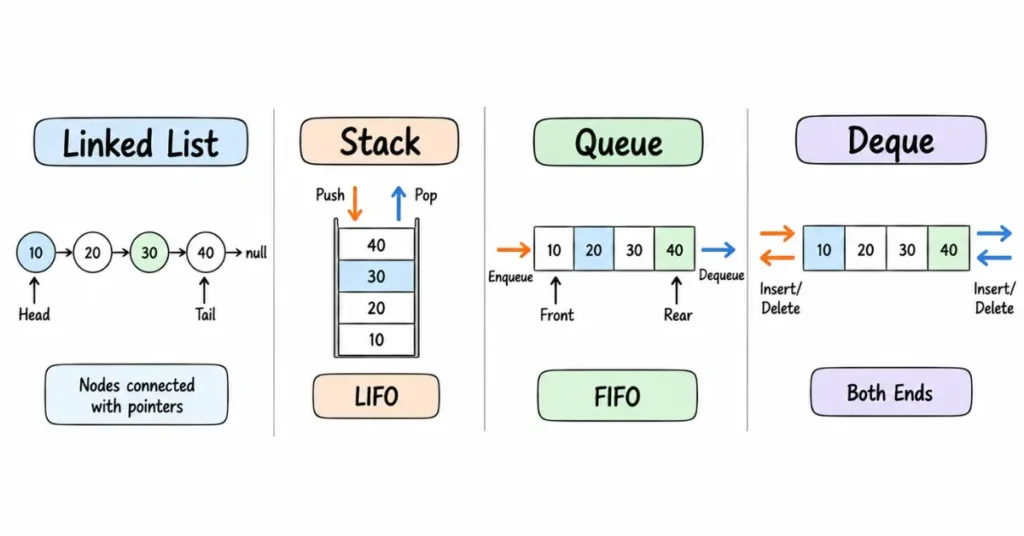
A Deque, or Double-Ended Queue, allows insertion and removal from both the front and rear. It can therefore support both queue-like and stack-like operations.
74) What is ArrayDeque?
ArrayDeque is a resizable-array implementation of the Deque interface. It is commonly used in Java DSA solutions for implementing stacks, queues, and monotonic deque techniques.
75) Why is ArrayDeque useful for stack operations?
ArrayDeque supports efficient insertion and removal at the front or rear. It is commonly preferred when implementing LIFO behavior without using the older Stack class.
PriorityQueue and Heap Usage
76) What is a PriorityQueue?
A PriorityQueue processes elements according to their priority rather than normal insertion order. In Java, the default PriorityQueue behaves like a min-heap.
77) What is a min-heap?
A min-heap is a structure where the smallest element remains at the top. In Java, calling peek() on a default PriorityQueue gives access to the smallest element.
78) How can you create max-heap behavior in Java?
Max-heap behavior can be created by supplying a reverse-order comparator to PriorityQueue. This makes larger elements receive higher priority.
79) Where is PriorityQueue used in DSA?
PriorityQueue is commonly used in Kth largest or smallest problems, Top-K problems, heap-based sorting logic, scheduling problems, merging sorted data, and shortest-path algorithms such as Dijkstra’s algorithm.
80) How do you choose the right Java collection in a coding interview?
Choose based on the operation the problem requires most. Use ArrayList for dynamic indexed data, HashSet for uniqueness, HashMap for key-value lookup, Queue for FIFO processing, Deque for both-end operations, and PriorityQueue when priority-based processing is required.
Revision Focus
For this part, revise the Java Collections Framework, List, ArrayList, LinkedList, Set, HashSet, LinkedHashSet, TreeSet, Map, HashMap, TreeMap, Queue, Deque, ArrayDeque, and PriorityQueue.
Pay special attention to when each structure should be used and its basic time complexity. In DSA interviews, knowing a collection’s definition is useful, but choosing the correct structure for a problem is more important.
Part 4: Searching, Sorting, Recursion & Backtracking — Questions 81–120
This part covers searching, sorting, recursion, and backtracking concepts commonly tested in Java DSA interviews. These topics help you understand how to find data efficiently, arrange elements, break problems into smaller subproblems, and explore multiple possible solutions.
The focus is on understanding the logic, identifying the correct technique, and explaining time and space complexity clearly.
Questions 81–120
Searching Algorithms
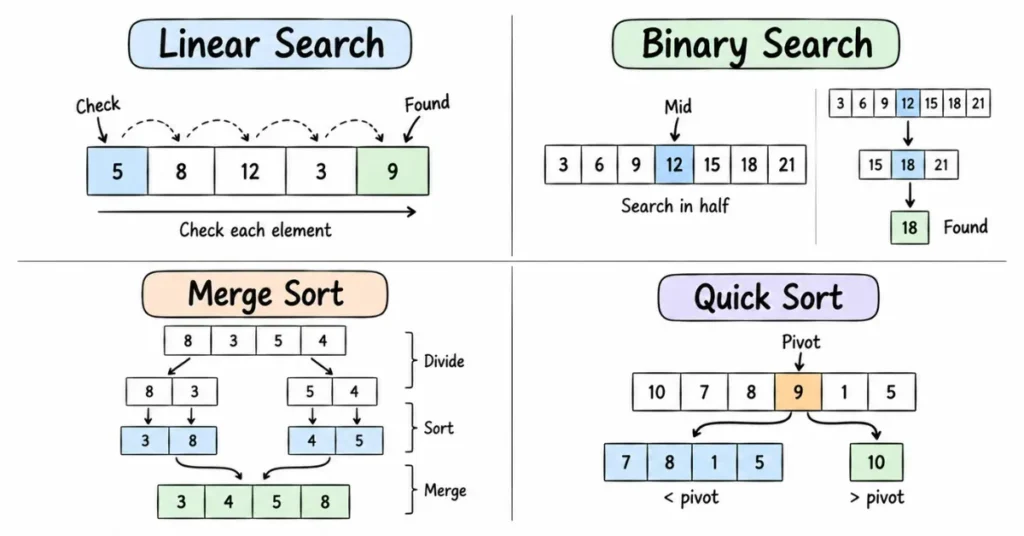
81) What is Linear Search?
Linear Search checks elements one by one until the required value is found or the input ends.
Its time complexity is O(n) in the worst case.
82) When should you use Linear Search?
Linear Search is useful when the data is small or unsorted and there is no special structure that supports faster searching.
It is simple and does not require the input to be sorted.
83) What is Binary Search?
Binary Search finds an element in sorted data by repeatedly reducing the search space by half.
Its time complexity is O(log n).
84) What is the main requirement for Binary Search?
The search space should have a usable sorted or monotonic property.
For a standard array search, the array is normally sorted before Binary Search is applied.
85) How does Binary Search work?
Binary Search compares the target with the middle element.
If the target is smaller, it searches the left half. If the target is larger, it searches the right half. This continues until the target is found or the search space becomes empty.
86) What is the difference between Linear Search and Binary Search?
Linear Search may inspect elements one by one and takes O(n) time.
Binary Search repeatedly halves an appropriate sorted search space and takes O(log n) time.
Binary Search Patterns
87) How do you find the first occurrence of an element in a sorted array?
Use Binary Search and continue searching toward the left even after finding the target.
Store the current matching index and try to find an earlier occurrence.
88) How do you find the last occurrence of an element?
Use Binary Search and continue searching toward the right after finding the target.
Keep the matching index while checking whether another occurrence exists later.
89) What is lower bound?
Lower bound generally refers to the first position where a value is greater than or equal to the target.
It is a common Binary Search variation.
90) What is upper bound?
Upper bound generally refers to the first position where a value is greater than the target.
It can be used for range and frequency-related operations on sorted data.
91) What is Binary Search on Answer?
Binary Search on Answer is used when the answer lies in a numeric or ordered search space and the problem has a monotonic feasibility condition.
Instead of searching for an array element, you search for the smallest or largest value satisfying the condition.
92) What are common mistakes in Binary Search?
Common mistakes include incorrect boundary updates, wrong loop conditions, missing edge cases, and calculating mid carelessly.
A safer midpoint calculation is:
mid = low + (high – low) / 2
Sorting Basics
93) What is sorting?
Sorting means arranging elements in a particular order, usually ascending or descending.
Sorting can simplify searching, duplicate detection, interval processing, and many two-pointer problems.
94) What is Bubble Sort?
Bubble Sort repeatedly compares adjacent elements and swaps them when they are in the wrong order.
Its worst-case time complexity is O(n²).
95) What is Selection Sort?
Selection Sort repeatedly finds the smallest element from the unsorted portion and places it in the correct position.
Its time complexity is O(n²).
96) What is Insertion Sort?
Insertion Sort builds the sorted portion one element at a time by inserting each new element into its correct position.
Its worst-case time complexity is O(n²).
97) When can Insertion Sort perform well?
Insertion Sort can perform well for small or nearly sorted inputs.
In the best case, when the data is already sorted, its running time can approach O(n).
Efficient Sorting Algorithms
98) What is Merge Sort?
Merge Sort uses divide and conquer.
It divides the array into smaller halves, sorts them recursively, and merges the sorted halves.
Its time complexity is O(n log n).
99) What is the space complexity of Merge Sort for arrays?
A standard Merge Sort implementation for arrays generally requires O(n) additional space for merging.
It also uses recursion stack space.
100) What is Quick Sort?
Quick Sort selects a pivot, partitions elements around the pivot, and recursively sorts the resulting partitions.
Its average time complexity is O(n log n).
101) What is the worst-case complexity of Quick Sort?
Quick Sort can take O(n²) time in the worst case.
This can happen when partitioning repeatedly produces highly unbalanced partitions.
102) What is a pivot in Quick Sort?
A pivot is the element used to divide the input during partitioning.
Elements are rearranged according to their relationship with the pivot before the resulting partitions are processed.
103) What is a stable sorting algorithm?
A stable sorting algorithm preserves the original relative order of elements that have equal keys.
Stability can matter when objects are sorted using multiple attributes.
104) What is an in-place sorting algorithm?
An in-place sorting algorithm uses only a small amount of additional memory beyond the input structure.
Selection Sort and many implementations of Quick Sort are examples of in-place sorting approaches.
105) What is the difference between Merge Sort and Quick Sort?
Merge Sort provides O(n log n) worst-case time but normally needs additional memory for arrays.
Quick Sort is often space-efficient for array partitioning, but its worst-case running time can become O(n²).
Recursion Basics
106) What is recursion?
Recursion is a technique where a method calls itself to solve a smaller version of the same problem.
Every correct recursive solution requires a stopping condition.
107) What is a base case?
A base case is the condition that stops further recursive calls.
Without a valid base case, recursion may continue until the program runs out of stack space.
108) What is a recursive case?
The recursive case reduces the original problem and calls the same method again with a smaller or simpler input.
It should move the computation toward the base case.
109) What happens internally during recursion?
Each recursive call creates a new stack frame in the call stack.
When the base case is reached, the calls begin returning in reverse order.
110) What is StackOverflowError in recursion?
StackOverflowError can occur when too many recursive calls are created without returning.
Common causes include a missing base case or recursion that does not properly move toward termination.
111) What is the difference between recursion and iteration?
However, recursion can make some tree, divide-and-conquer, and backtracking solutions easier to express.
112) Where is recursion commonly used in DSA?
Recursion is commonly used in:
- Tree traversal
- DFS
- Merge Sort
- Quick Sort
- Backtracking
- Divide and Conquer
- Dynamic Programming
Backtracking
113) What is backtracking?
Backtracking is a problem-solving technique that explores possible choices and returns when a choice does not lead to a valid solution.
It is often used when a problem requires exploring multiple combinations or arrangements.
114) What is the basic pattern of backtracking?
A common backtracking pattern is:
Choose → Explore → Undo
Select a choice, recursively explore it, undo the choice, and then try another possibility.
115) What is the difference between recursion and backtracking?
Recursion is a general programming technique where a function calls itself.
Backtracking is a problem-solving strategy that commonly uses recursion to explore choices and undo them when necessary.
116) What is the subset problem in backtracking?
In a subset problem, each element usually gives two choices: include it or exclude it.
Backtracking explores these decisions to generate the possible subsets.
117) How are permutations generated using backtracking?
Permutation generation selects one available element for the current position, recursively builds the remaining arrangement, and then undoes the choice.
This process continues until a complete arrangement is formed.
118) What is pruning in backtracking?
Pruning means stopping the exploration of a branch when it is already clear that the branch cannot produce a valid or useful answer.
Good pruning can significantly reduce unnecessary work.
119) What types of problems commonly use backtracking?
Backtracking is commonly used for:
- Subsets
- Permutations
- Combinations
- Combination Sum
- Maze problems
- N-Queens
- Sudoku-style problems
- Word-search problems
120) How do you identify a backtracking problem in an interview?
Consider backtracking when the problem asks you to generate or explore many possible choices, combinations, arrangements, or paths under constraints.
A useful question is: Can I make a choice, explore it, undo it, and try another choice?
Revision Focus
For this part, revise Linear Search, Binary Search, first and last occurrence, lower and upper bound, Binary Search on Answer, Bubble Sort, Selection Sort, Insertion Sort, Merge Sort, Quick Sort, recursion, call stack, base cases, backtracking, subsets, permutations, and pruning.
Part 5: Linked Lists, Stacks & Queues — Questions 121–160
This part covers Linked Lists, Stacks, and Queues, which are important linear data structures in Java DSA interviews. These topics test how well you understand node connections, pointer manipulation, LIFO and FIFO operations, and common patterns such as fast and slow pointers and monotonic stacks.
Questions 121–160
Linked List Basics
121) What is a Linked List?
A Linked List is a linear data structure where elements are stored in separate nodes.
Each node contains data and a reference to the next node.
122) What is a node in a Linked List?
A node is the basic element of a Linked List.
It normally contains:
- Data
- Reference to the next node
In a doubly linked list, it can also contain a reference to the previous node.
123) What is the difference between an array and a Linked List?
An array stores elements in indexed positions and supports O(1) random access.
A Linked List stores connected nodes and requires sequential traversal to reach a particular position.
124) What is a Singly Linked List?
A Singly Linked List contains nodes where each node points to the next node.
The final node normally points to null.
125) What is a Doubly Linked List?
A Doubly Linked List contains two references in each node:
- Previous node
- Next node
This allows traversal in both directions.
126) What is a Circular Linked List?
A Circular Linked List is a Linked List where the last node connects back to the first node instead of pointing to null.
It can be useful in circular processing and scheduling-style problems.
Linked List Operations
127) What is the time complexity of traversing a Linked List?
Traversing a Linked List takes O(n) time because nodes must be visited sequentially.
Unlike an array, a Linked List does not provide direct index-based access.
128) How do you insert a node at the beginning of a Linked List?
Create a new node, point its next reference to the current head, and update the head to the new node.
When the head reference is available, this operation takes O(1) time.
129) How do you insert a node at the end of a Linked List?
Traverse to the last node and connect its next reference to the new node.
Without a tail reference, this generally takes O(n) time.
130) How do you delete a node from a Linked List?
Locate the required node and update the surrounding references so that the node is skipped.
Special care is required when deleting the head node.
131) How do you reverse a Singly Linked List?
Use three references:
- previous
- current
- next
Reverse each next reference while traversing the list.
The time complexity is O(n) and iterative extra space is O(1).
132) How do you find the middle of a Linked List?
Use slow and fast pointers.
The slow pointer moves one node at a time, while the fast pointer moves two nodes at a time. When the fast pointer reaches the end, the slow pointer is around the middle.
Fast and Slow Pointer Pattern
133) What is the fast and slow pointer technique?
It is a Linked List pattern where two pointers move at different speeds.
It is commonly used to find the middle node, detect cycles, and solve other position-related Linked List problems.
134) How do you detect a cycle in a Linked List?
Use Floyd’s Cycle Detection algorithm.
Move one pointer one step at a time and another pointer two steps at a time. If they meet, the Linked List contains a cycle.
135) What is Floyd’s Cycle Detection Algorithm?
Floyd’s algorithm uses slow and fast pointers to detect a cycle without additional storage.
Its time complexity is O(n) and extra space complexity is O(1).
136) How can you find the starting node of a cycle?
After slow and fast pointers meet inside the cycle, move one pointer back to the head.
Then move both pointers one step at a time. The node where they meet again is the cycle’s starting point.
Common Linked List Problems
137) How do you merge two sorted Linked Lists?
Compare the current nodes of both lists and repeatedly attach the smaller node to the result.
Continue until one list ends, then attach the remaining nodes.
138) How do you remove the Nth node from the end of a Linked List?
Use two pointers separated by an appropriate gap.
Move them together until the leading pointer reaches the end. The second pointer can then identify the node that needs to be removed.
139) How do you find the intersection of two Linked Lists?
One common approach uses two pointers that switch to the other list’s head after reaching the end.
If the lists intersect, the pointers eventually meet at the shared node.
140) How do you check whether a Linked List is a palindrome?
Find the middle of the list, reverse the second half, and compare both halves.
This can achieve O(n) time with O(1) extra space when performed carefully.
Stack Basics
141) What is a Stack?
A Stack is a linear data structure that follows LIFO — Last In, First Out.
The most recently inserted element is removed first.
142) What are the basic Stack operations?
Common Stack operations are:
- push — insert an element
- pop — remove the top element
- peek — view the top element
- isEmpty — check whether the stack is empty
These operations are generally expected to be efficient.
143) How can a Stack be implemented?
A Stack can be implemented using:
- Array
- Dynamic array
- Linked List
- Deque
In modern Java DSA solutions, ArrayDeque is commonly used for stack behavior.
144) Why is Deque commonly preferred for Stack operations in Java?
Deque provides efficient insertion and removal at the ends.
ArrayDeque can perform stack operations using methods such as push(), pop(), and peek().
Stack Interview Patterns
145) How do you solve the Balanced Parentheses problem?
Use a Stack.
Push opening brackets onto the stack. For every closing bracket, check whether it correctly matches the most recent opening bracket.
At the end, the stack should be empty.
146) What is the Next Greater Element problem?
For each element, the goal is to find the next element on its right that is greater.
A monotonic stack can solve this efficiently instead of checking every possible pair.
147) What is a Monotonic Stack?
A Monotonic Stack maintains elements in increasing or decreasing order while processing the input.
It is commonly used for next greater, next smaller, stock span, and histogram-style problems.
148) Why can a Monotonic Stack achieve O(n) time?
Although a loop may contain stack operations, each element is generally pushed and popped at most once.
Therefore, the total number of stack operations remains proportional to n.
149) What is a Min Stack?
A Min Stack supports normal Stack operations while also returning the minimum element efficiently.
It can be implemented by storing additional minimum information along with stack values.
150) Where are Stacks commonly used in DSA?
Stacks are commonly used for:
- Balanced parentheses
- Next greater or smaller elements
- Expression processing
- Monotonic patterns
- DFS implementations
- Backtracking support
Queue Basics
151) What is a Queue?
A Queue is a linear data structure that generally follows FIFO — First In, First Out.
The element inserted first is processed first.
152) What are the common Queue operations?
Common operations include:
- offer() — insert an element
- poll() — remove the front element
- peek() — view the front element
These operations are commonly used in Java DSA implementations.
153) How can a Queue be implemented?
A Queue can be implemented using:
- Array
- Circular Array
- Linked List
- Deque
Java also provides the Queue interface for queue-based operations.
154) What is a Circular Queue?
A Circular Queue connects the end of an array-based queue back to the beginning.
It allows previously freed positions to be reused efficiently.
Queue Interview Patterns
155) Why is a Queue used in BFS?
BFS explores nodes level by level.
A Queue maintains the order in which nodes are discovered, allowing earlier discovered nodes to be processed before later ones.
156) What is Level-Order Traversal?
Level-Order Traversal visits a tree one level at a time.
A Queue is used to store nodes that need to be processed at upcoming levels.
157) How can you implement a Queue using Stacks?
A Queue can be implemented using two Stacks.
One common method uses one Stack for incoming elements and another for outgoing elements, allowing FIFO behavior to be created using LIFO structures.
158) How can you implement a Stack using Queues?
A Stack can be implemented using one or two Queues.
The Queue operations are rearranged so that the most recently inserted element becomes the next element removed.
159) What is a Monotonic Queue?
A Monotonic Queue maintains elements in increasing or decreasing order while removing values that are no longer useful.
It is commonly implemented using a Deque.
160) How is a Monotonic Queue used in Sliding Window Maximum?
Maintain useful candidates in decreasing order inside a Deque.
Remove elements outside the current window and remove smaller values from the rear. The front then represents the maximum value for the current window.
Revision Focus
For this part, revise Singly Linked List, Doubly Linked List, Circular Linked List, insertion, deletion, Linked List reversal, middle node, fast and slow pointers, cycle detection, merging lists, Stack, Queue, Deque, Monotonic Stack, Balanced Parentheses, Next Greater Element, Circular Queue, BFS, and Monotonic Queue.
Part 6: Trees, Binary Search Trees, Heaps & Tries — Questions 161–200
This part covers Trees, Binary Trees, Binary Search Trees, Heaps, and Tries. These data structures are important in Java DSA interviews because they test recursion, hierarchical data processing, searching, traversal, and priority-based problem solving.
The focus is on understanding tree structure, common traversals, BST properties, heap operations, and prefix-based searching using Tries.
Questions 161–200
Tree Basics
161) What is a Tree in DSA?
A Tree is a non-linear data structure that stores elements in a hierarchical form using nodes and edges.
Unlike linear structures, a node can connect to multiple child nodes.
162) What is the root node of a Tree?
The root is the topmost node of a Tree.
Every other node can be reached from the root through one or more edges.
163) What is a parent and child node?
If two nodes are directly connected, the upper node is called the parent and the lower node is called the child.
A parent can have one or more children depending on the type of Tree.
164) What is a leaf node?
A leaf node is a node that has no children.
It represents an endpoint of a path in the Tree.
165) What is the depth of a node?
Depth is the number of edges from the root to a particular node.
The root therefore has a depth of 0.
166) What is the height of a Tree?
The height of a Tree is the length of the longest path from the root to a leaf, usually measured in edges.
Height is important when analyzing many tree algorithms.
Binary Trees
167) What is a Binary Tree?
A Binary Tree is a Tree in which each node can have at most two children.
These are usually called the left child and right child.
168) What is a Full Binary Tree?
A Full Binary Tree is a Binary Tree where every node has either zero children or exactly two children.
No node has only one child.
169) What is a Complete Binary Tree?
A Complete Binary Tree has all levels completely filled except possibly the last level.
Nodes on the last level are filled from left to right.
170) What is a Perfect Binary Tree?
A Perfect Binary Tree has every internal node with exactly two children and all leaf nodes at the same level.
Every level of the Tree is completely filled.
Tree Traversals
171) What is Tree Traversal?
Tree Traversal means visiting the nodes of a Tree in a specific order.
Common traversals are Preorder, Inorder, Postorder, and Level-Order.
172) What is Preorder Traversal?
Preorder follows:
Root → Left → Right
It processes the current node before visiting its child subtrees.
173) What is Inorder Traversal?
Inorder follows:
Left → Root → Right
For a valid Binary Search Tree, Inorder Traversal visits values in sorted order.
174) What is Postorder Traversal?
Postorder follows:
Left → Right → Root
It processes child subtrees before processing the current node.
175) What is Level-Order Traversal?
Level-Order Traversal visits nodes level by level from top to bottom.
It is commonly implemented using a Queue and follows the Breadth-First Search approach.
176) What is the time complexity of Tree Traversal?
A complete traversal generally takes O(n) time because every node is visited once.
Here, n represents the number of nodes in the Tree.
Common Binary Tree Problems
177) How do you find the height of a Binary Tree?
Recursively calculate the height of the left and right subtrees and take the larger value.
Then include the current node or connecting edge according to the height definition being used.
178) How do you count the nodes in a Binary Tree?
Count the nodes in the left subtree and right subtree recursively, then include the current node.
This requires O(n) time when every node is visited.
179) How do you check whether two Trees are identical?
Two Trees are identical when their corresponding nodes have the same values and the same structure.
Compare the roots and recursively compare their left and right subtrees.
180) What is a balanced Binary Tree?
A height-balanced Binary Tree is one where the heights of the left and right subtrees of every node differ by at most one.
Balanced Trees help prevent operations from becoming unnecessarily deep.
181) What is the diameter of a Binary Tree?
The diameter is the length of the longest path between any two nodes in the Tree.
The path may or may not pass through the root.
182) What is the Lowest Common Ancestor?
The Lowest Common Ancestor, or LCA, is the lowest node in a Tree that has two given nodes as descendants, where a node may also be considered a descendant of itself.
It is a common Tree interview problem.
Binary Search Trees
183) What is a Binary Search Tree?
A Binary Search Tree, or BST, is a Binary Tree that maintains an ordering property.
For the common distinct-key definition, values in the left subtree are smaller and values in the right subtree are larger than the node’s value.
184) Why is a Binary Search Tree useful?
A BST organizes values so searching, insertion, and deletion can be efficient when the Tree remains reasonably balanced.
Its ordering property helps eliminate unnecessary parts of the search space.
185) What is the average search complexity in a BST?
Searching in a reasonably balanced BST generally takes O(log n) time.
In a highly skewed BST, the worst case can become O(n).
186) How do you search for an element in a BST?
Compare the target with the current node.
Move left when the target is smaller and right when it is larger, continuing until the value is found or the search reaches null.
187) How do you insert a value into a BST?
Start from the root and compare the new value with each node.
Move left or right according to the BST rule until an empty position is found, then insert the new node there.
188) What are the main cases when deleting a node from a BST?
BST deletion usually has three cases:
- Node has no children
- Node has one child
- Node has two children
The two-child case commonly uses the inorder successor or predecessor.
189) How can you validate a Binary Search Tree?
Check that every node satisfies valid lower and upper bounds inherited from its ancestors.
Only comparing a node with its immediate children is not sufficient for complete BST validation.
190) Why does Inorder Traversal of a BST produce sorted values?
Inorder visits the left subtree first, then the node, and then the right subtree.
Keep it because Because acts as a connector. this traversal processes its values in sorted order.
Heaps
191) What is a Heap?
A Heap is a Complete Binary Tree that follows a heap-order property.
The two common types are Min-Heap and Max-Heap.
192) What is a Min-Heap?
In a Min-Heap, every parent has a value less than or equal to its children.
Therefore, the minimum element is available at the root.
193) What is a Max-Heap?
In a Max-Heap, every parent has a value greater than or equal to its children.
Therefore, the maximum element is available at the root.
194) What are the common time complexities of Heap operations?
Accessing the top element is generally O(1).
Insertion and removal of the top element generally take O(log n).
195) How is a Heap implemented in Java?
Java commonly provides heap behavior through PriorityQueue.
A default PriorityQueue acts as a Min-Heap, while a custom comparator can provide Max-Heap behavior.
196) Where are Heaps commonly used in DSA?
Heaps are commonly used for:
- Kth largest or smallest element
- Top-K elements
- Priority scheduling
- Merging sorted data
- Dijkstra’s algorithm
- Maintaining minimum or maximum candidates
Tries
197) What is a Trie?
A Trie is a Tree-based data structure used to store strings based on their characters.
Each path through the Trie represents a prefix or word.
198) Why is a Trie useful?
A Trie is useful when a problem requires efficient prefix-based searching.
Common applications include autocomplete, dictionaries, prefix matching, and word-search problems.
199) What operations are commonly performed on a Trie?
Common Trie operations include:
- Insert a word
- Search for a complete word
- Check whether a prefix exists
Their cost is typically related to the length of the word or prefix being processed.
200) What is the difference between a Trie and a HashMap for string searching?
A HashMap is useful for direct key lookup, while a Trie is designed around shared prefixes.
If the problem asks for prefix search or autocomplete-style operations, a Trie can be more suitable than storing only complete words as HashMap keys.
Revision Focus
For this part, revise Tree terminology, Binary Trees, Tree height, Preorder, Inorder, Postorder, Level-Order Traversal, balanced Trees, diameter, Lowest Common Ancestor, Binary Search Trees, BST search, insertion, deletion, BST validation, Min-Heap, Max-Heap, PriorityQueue, and Tries.
Part 7: Graphs & Advanced Problem Solving — Questions 201–240
This part covers Graphs and the important graph algorithms used in Java DSA interviews. Graph questions test whether you can represent relationships, traverse connected data, detect cycles, find shortest paths, and solve dependency-based problems.
The focus is on graph representation, BFS, DFS, connected components, cycle detection, topological sorting, shortest paths, and Disjoint Set Union.
Questions 201–240
Graph Basics
201) What is a Graph in DSA?
A Graph is a non-linear data structure made of vertices and edges.
Vertices represent objects, while edges represent connections between those objects.
202) What is a vertex in a Graph?
A vertex, also called a node, represents an individual element in a Graph.
For example, in a social network, each person can be represented as a vertex.
203) What is an edge in a Graph?
An edge represents a connection between two vertices.
Depending on the problem, an edge can be directed, undirected, weighted, or unweighted.
204) What is a Directed Graph?
A Directed Graph contains edges with a specific direction.
For example, an edge from A to B does not automatically mean there is an edge from B to A.
205) What is an Undirected Graph?
An Undirected Graph contains edges without direction.
If A is connected to B, then B is also connected to A.
206) What is a Weighted Graph?
A Weighted Graph assigns a value or cost to each edge.
Weights may represent distance, time, price, or another measurement.
207) What is an Unweighted Graph?
An Unweighted Graph does not assign different costs to its edges.
For shortest-path purposes, its edges can usually be treated as having equal cost.
Graph Representation
208) What is an Adjacency Matrix?
An Adjacency Matrix represents a Graph using a two-dimensional matrix.
If two vertices are connected, the corresponding matrix position stores that connection.
209) What is the space complexity of an Adjacency Matrix?
For V vertices, an Adjacency Matrix requires O(V²) space.
It can therefore consume unnecessary memory for sparse Graphs.
210) What is an Adjacency List?
An Adjacency List stores the neighbors of each vertex separately.
It is commonly used for Graph problems because it efficiently represents sparse Graphs.
211) What is the space complexity of an Adjacency List?
An Adjacency List generally requires O(V + E) space.
Here, V represents vertices and E represents edges.
212) What is the difference between an Adjacency Matrix and an Adjacency List?
An Adjacency Matrix uses O(V²) space and makes checking a specific edge direct.
An Adjacency List uses O(V + E) space and is generally preferred when the Graph has relatively few edges.
Graph Traversal
213) What is Graph Traversal?
Graph Traversal means systematically visiting the vertices of a Graph.
The two main traversal techniques are:
- Breadth-First Search
- Depth-First Search
214) What is Breadth-First Search?
Breadth-First Search, or BFS, explores vertices level by level.
It normally uses a Queue to maintain the order of traversal.
215) What is Depth-First Search?
Depth-First Search, or DFS, explores one path as deeply as possible before returning to explore other paths.
It can be implemented using recursion or an explicit Stack.
216) What is the time complexity of BFS?
Using an Adjacency List, BFS generally takes:
O(V + E)
Each vertex and edge is processed a limited number of times.
217) What is the time complexity of DFS?
Using an Adjacency List, DFS generally takes:
O(V + E)
Like BFS, it processes the vertices and edges of the Graph.
218) What is the difference between BFS and DFS?
BFS explores level by level and normally uses a Queue.
DFS explores depth-wise and normally uses recursion or a Stack.
219) Why do we need a visited array or set in Graph traversal?
Graphs can contain cycles and multiple paths to the same vertex.
A visited structure prevents the same vertex from being processed repeatedly and helps avoid infinite traversal.
BFS and DFS Applications
220) When should you consider using BFS?
BFS is useful for:
- Level-wise traversal
- Shortest paths in unweighted Graphs
- Minimum-step problems
- Multi-source traversal
- Grid-based problems
Its level-by-level nature is especially useful when minimum edge count matters.
221) When should you consider using DFS?
DFS is useful for:
- Connected components
- Cycle detection
- Path exploration
- Topological concepts
- Grid traversal
- Backtracking-style Graph problems
It is often convenient when recursive exploration naturally fits the problem.
222) How can Graph problems appear as matrix problems?
A matrix can be treated as a Graph where each cell represents a vertex.
Neighboring cells can be considered connected based on allowed movements such as up, down, left, and right.
223) What is the Number of Islands problem?
The Number of Islands problem asks you to count separate connected groups of land cells in a grid.
Each unvisited land cell can start a BFS or DFS that marks its entire connected component.
Connected Components
224) What is a Connected Component?
A Connected Component is a group of vertices in an undirected Graph where each vertex can reach the others in that component.
A Graph may contain one or multiple connected components.
225) How do you count Connected Components?
Iterate through all vertices.
Whenever an unvisited vertex is found, start BFS or DFS and mark all reachable vertices. Each new traversal represents another component.
Cycle Detection
226) What is a cycle in a Graph?
A cycle is a path that starts from a vertex and eventually returns to that vertex through connected edges.
Cycle detection is a common Graph interview problem.
227) How do you detect a cycle in an Undirected Graph?
One common method uses DFS while tracking both the current vertex and its parent.
If an already visited neighbor is found and that neighbor is not the parent, a cycle exists.
228) How do you detect a cycle in a Directed Graph?
A common DFS approach tracks nodes currently present in the active recursion path.
If traversal reaches a node already in that active path, the Directed Graph contains a cycle.
Topological Sorting
229) What is Topological Sorting?
Topological Sorting creates a linear ordering of vertices such that for every directed edge u → v, u appears before v.
It applies to a Directed Acyclic Graph, or DAG.
230) What is a DAG?
DAG stands for Directed Acyclic Graph.
It is a Directed Graph that contains no directed cycle.
231) Where is Topological Sorting used?
Topological Sorting is useful for:
- Task scheduling
- Course prerequisites
- Dependency resolution
- Build ordering
- Workflow processing
It is useful whenever one task must be completed before another.
232) What is Kahn’s Algorithm?
Kahn’s Algorithm performs Topological Sorting using indegrees and a Queue.
It repeatedly processes vertices with indegree 0 and reduces the indegree of their neighbors.
Shortest Path Algorithms
233) How do you find the shortest path in an Unweighted Graph?
BFS can find the shortest path measured by the number of edges in an unweighted Graph.
This works because BFS explores vertices in increasing distance levels from the source.
234) What is Dijkstra’s Algorithm?
Dijkstra’s Algorithm finds shortest paths from a source vertex in a weighted Graph when edge weights are non-negative.
It is commonly implemented using an Adjacency List and a PriorityQueue.
235) Why is PriorityQueue used in Dijkstra’s Algorithm?
A PriorityQueue helps efficiently select the vertex with the smallest currently known distance.
This avoids repeatedly scanning every vertex to find the next best candidate.
236) Can standard Dijkstra’s Algorithm handle negative edge weights?
No. Standard Dijkstra’s Algorithm assumes non-negative edge weights.
Graphs containing negative edges require a different shortest-path approach.
Minimum Spanning Tree
237) What is a Minimum Spanning Tree?
A Minimum Spanning Tree, or MST, connects all vertices of a connected weighted undirected Graph with minimum total edge weight and without cycles.
Common MST algorithms include Prim’s and Kruskal’s algorithms.
238) What is Kruskal’s Algorithm?
Kruskal’s Algorithm builds an MST by processing edges in increasing order of weight.
An edge is selected only when adding it does not create a cycle.
Disjoint Set Union
239) What is Disjoint Set Union?
Disjoint Set Union, or DSU, is a data structure used to manage groups of connected elements.
Its main operations are:
- find — identify the representative of a group
- union — combine two groups
It is commonly used in connectivity and cycle-detection problems.
240) What are Path Compression and Union by Rank or Size?
Path Compression shortens the paths between nodes and their set representative during find operations.
Union by Rank or Size attaches the smaller or shallower structure under the larger one. Together, these optimizations make DSU operations very efficient.
Revision Focus
For this part, revise Graph terminology, Directed and Undirected Graphs, Weighted Graphs, Adjacency Matrix, Adjacency List, BFS, DFS, visited tracking, grid traversal, Number of Islands, Connected Components, cycle detection, DAG, Topological Sorting, Kahn’s Algorithm, shortest paths, Dijkstra’s Algorithm, Minimum Spanning Tree, Kruskal’s Algorithm, and Disjoint Set Union.
Part 8: Dynamic Programming & Coding Interview Practice — Questions 241–280
This part covers Dynamic Programming and important coding interview problem-solving techniques. Dynamic Programming is commonly tested because it checks whether you can identify repeated subproblems, define states, build recurrence relations, and optimize recursive solutions.
The focus is on understanding Memoization, Tabulation, 1D and 2D DP, Knapsack patterns, subsequence problems, and practical coding interview strategy.
Questions 241–280
Dynamic Programming Basics
241) What is Dynamic Programming?
Dynamic Programming, or DP, is a technique used to solve problems by breaking them into smaller overlapping subproblems and storing their results.
This prevents the same subproblem from being solved repeatedly.
242) When should you consider using Dynamic Programming?
Consider DP when a problem contains:
- Overlapping subproblems
- Repeated calculations
- Multiple choices at each step
- An optimization or counting requirement
Common examples include Fibonacci, Knapsack, Coin Change, and Longest Common Subsequence.
243) What are overlapping subproblems?
Overlapping subproblems occur when the same smaller problem is calculated multiple times.
DP stores previously calculated results so they can be reused.
244) What is optimal substructure?
Optimal substructure means the solution to a larger problem can be constructed using solutions to smaller subproblems.
This property appears in many optimization problems.
245) What are the two main approaches to Dynamic Programming?
The two main approaches are:
- Memoization — Top-Down
- Tabulation — Bottom-Up
Therefore, both avoid repeated computation by storing previously calculated results.
Memoization
246) What is Memoization?
Memoization is a top-down DP approach that combines recursion with caching.
Before solving a subproblem, the algorithm checks whether its result has already been calculated.
247) How does Memoization improve recursion?
Normal recursion may solve the same subproblem many times.
Memoization stores each result and reuses it, which can significantly reduce the running time.
248) What data structures can be used for Memoization?
Depending on the state, Memoization can use:
- Arrays
- 2D arrays
- HashMaps
Arrays are commonly used when DP states can be represented using integer indexes.
249) What is the main disadvantage of Memoization?
Memoization uses recursion, so it also consumes call-stack space.
For very deep recursion, this can become a limitation.
Tabulation
250) What is Tabulation?
Tabulation is a bottom-up DP approach.
It starts with known base cases and iteratively calculates larger states using previously computed values.
251) What is the difference between Memoization and Tabulation?
Memoization uses recursion and solves states when needed.
Tabulation uses iteration and usually fills a DP table from smaller states toward the final answer.
252) Which is better: Memoization or Tabulation?
Neither approach is always better.
Memoization can be easier to derive from a recursive solution, while Tabulation avoids recursion overhead and may allow easier space optimization.
1D Dynamic Programming
253) What is a 1D DP problem?
A 1D DP problem uses one main changing state that can usually be represented using a one-dimensional array.
Examples include Fibonacci and Climbing Stairs.
254) How is Fibonacci solved using Dynamic Programming?
Store previously calculated Fibonacci values instead of recalculating them recursively.
This reduces the exponential recursive approach to O(n) time.
255) What is the Climbing Stairs DP problem?
In the standard version, you can climb one or two steps at a time.
The number of ways to reach step n depends on the number of ways to reach the previous two steps.
256) What is a DP state?
A DP state represents the information required to describe a subproblem.
For example, dp[i] may represent the best answer or number of ways up to index i.
257) What is a recurrence relation?
A recurrence relation defines how the current DP state is calculated from smaller states.
Finding the correct recurrence is one of the most important steps in solving a DP problem.
258) What is a base case in Dynamic Programming?
A base case represents the smallest subproblem whose answer is already known.
Correct base cases are required for both Memoization and Tabulation.
2D Dynamic Programming
259) What is 2D Dynamic Programming?
2D DP uses two changing state variables.
The results are commonly stored in a two-dimensional table such as dp[i][j].
260) Where is 2D DP commonly used?
2D DP is commonly used in:
- Grid problems
- String comparison
- Knapsack problems
- Subsequence problems
- Problems involving two indexes or states
261) What is a Grid DP problem?
A Grid DP problem involves moving through cells while calculating paths, minimum cost, maximum value, or another result.
The DP state commonly represents the answer for reaching or leaving a particular cell.
Knapsack Patterns
262) What is the 0/1 Knapsack problem?
In 0/1 Knapsack, each item can either be selected once or not selected.
The goal is usually to maximize value while staying within a given capacity.
263) Why is it called 0/1 Knapsack?
Each item has two choices:
- 0 — do not take it
- 1 — take it
An item cannot be selected multiple times in the standard 0/1 version.
264) What is Unbounded Knapsack?
In Unbounded Knapsack, an item can be selected multiple times.
This creates a different recurrence from the 0/1 Knapsack problem.
265) What is the Subset Sum problem?
Subset Sum asks whether a subset of the given numbers can produce a specific target sum.
It is an important DP pattern related to 0/1 Knapsack.
266) What is the Partition Equal Subset Sum problem?
The problem asks whether an array can be divided into two subsets with equal sums.
It can be transformed into checking whether a subset with half of the total sum exists.
Coin Change and Subsequence Problems
267) What is the Coin Change problem?
Coin Change usually asks you to find either the minimum number of coins needed for an amount or the number of ways to form that amount.
It is a common Unbounded Knapsack-style DP problem.
268) What is a subsequence?
A subsequence is created by removing zero or more elements while maintaining the relative order of the remaining elements.
The selected elements do not need to be adjacent.
269) What is the Longest Common Subsequence?
Longest Common Subsequence, or LCS, finds the longest sequence that appears in the same relative order in two sequences.
It is commonly solved using 2D Dynamic Programming.
270) What is the Longest Increasing Subsequence?
Longest Increasing Subsequence, or LIS, asks for the longest subsequence whose values are in increasing order.
A standard DP solution takes O(n²) time, while more optimized approaches can achieve O(n log n).
DP Optimization
271) What is space optimization in Dynamic Programming?
Space optimization reduces the memory used by a DP solution.
If the current state depends only on a small number of previous states, storing the entire DP table may not be necessary.
272) How can Fibonacci DP be space optimized?
Fibonacci only depends on the previous two values.
Instead of storing an entire array, two variables can be maintained, reducing extra space from O(n) to O(1).
273) What are common mistakes while solving DP problems?
Common mistakes include:
- Incorrect state definition
- Wrong base cases
- Incorrect recurrence
- Invalid iteration order
- Missing boundary conditions
- Using unnecessary DP dimensions
Understanding what each DP state represents helps prevent these mistakes.
Coding Interview Problem Solving
274) What should you do first when given a coding problem?
First understand the problem clearly.
Identify the input, expected output, constraints, examples, and edge cases before writing code.
275) Why are constraints important in coding interviews?
Constraints help determine which algorithm is practical.
For large inputs, an O(n²) solution may be too slow, which indicates that a more efficient approach may be required.
276) Should you explain the brute-force solution first?
Yes, when appropriate.
A simple approach shows that you understand the problem. You can then identify its bottleneck and explain how to optimize it.
277) How do you choose the correct DSA pattern?
Look at what the problem is asking.
Common clues include:
- Fast lookup → HashMap or HashSet
- Sorted search space → Binary Search
- Contiguous range → Sliding Window
- Two ends → Two Pointers
- Level traversal → BFS
- Deep exploration → DFS
- Top-K → Heap
- Repeated subproblems → Dynamic Programming
278) Why should you explain time and space complexity?
Complexity shows whether your solution can handle the given constraints efficiently.
After explaining the algorithm, mention both its time complexity and additional space complexity.
279) What edge cases should you test before finishing a coding solution?
Common edge cases include:
- Empty input
- Single element
- Duplicate values
- Negative numbers
- Already sorted input
- Very large values
- Minimum and maximum constraints
The exact edge cases depend on the problem.
280) How should you explain a DSA solution during an interview?
Start by explaining your understanding of the problem and the basic approach.
Next, explain the optimized algorithm, chosen data structure, important steps, and complexity. Finally, test the code with a small example or edge case.
Revision Focus
For this part, revise Dynamic Programming, overlapping subproblems, optimal substructure, Memoization, Tabulation, DP states, recurrence relations, 1D DP, 2D DP, Fibonacci, Climbing Stairs, Grid DP, 0/1 Knapsack, Unbounded Knapsack, Subset Sum, Coin Change, LCS, LIS, and space optimization.
Part 9: Behavioral, Resume, LinkedIn & Career Strategy
Technical skills can help you clear coding rounds, but final interview success also depends on how clearly you explain your projects, problem-solving approach, achievements, and career goals.
This final part follows the career-preparation structure of the reference guide: behavioral interview preparation, STAR method, 20 behavioral questions, 50 AI self-preparation prompts, resume optimization, LinkedIn optimization, project strategy, salary guidance, follow-up communication, and a final 30-day checklist.
Behavioral Interview Preparation
Behavioral interviews evaluate how you communicate, solve problems, work with others, handle pressure, learn from mistakes, and respond to difficult situations.
For Java DSA candidates, prepare examples from:
- Academic projects
- Internships
- Coding practice
- Hackathons
- Team projects
- Work experience
- Placement preparation
Avoid giving only theoretical answers. Use a real situation whenever possible.
STAR Method
The STAR method provides a simple structure for answering behavioral questions.
Situation: Explain the background.
Task: Describe your responsibility.
Action: Explain what you personally did.
Result: Mention the outcome and what you learned.
Keep the Situation and Task short. Spend more time explaining your Action and Result.
20 Behavioral Interview Questions
1) Tell me about yourself.
Give a short professional introduction covering your education or experience, Java and DSA skills, important projects, and the type of role you are targeting.
2) Why did you choose Java?
Explain why Java fits your learning or development journey. You can mention object-oriented programming, backend development, the Collections Framework, and its usefulness for DSA practice.
3) Why are you learning Data Structures and Algorithms?
Explain that DSA improves logical thinking and helps you design efficient solutions rather than only writing code that works.
4) Tell me about a challenging coding problem you solved.
Explain the problem, your initial approach, the difficulty you faced, how you improved the solution, and the final complexity.
5) Tell me about a project you are proud of.
Describe the project’s purpose, your role, technologies used, important features, challenges, and final result.
6) What is your biggest strength?
Choose a strength relevant to the role, such as problem solving, consistency, debugging, communication, or learning ability, and support it with an example.
7) What is one weakness you are improving?
Mention a genuine but manageable weakness and explain the specific steps you are taking to improve it.
8) How do you handle a coding problem you cannot solve?
Explain that you clarify the problem, study constraints, try a simple approach, identify patterns, test smaller examples, and improve the solution step by step.
9) Tell me about a mistake you made.
Use the STAR method. Focus on what you learned and what you changed afterward rather than trying to hide the mistake.
10) How do you handle deadlines?
Explain how you prioritize tasks, divide work into smaller steps, track progress, and communicate early when a dependency could affect the deadline.
11) Tell me about a disagreement with a teammate.
Focus on communication and problem solving. Explain how you understood the other person’s perspective and worked toward a practical solution.
12) How do you learn a new technical concept?
Describe your actual learning process, such as understanding fundamentals, implementing examples, solving problems, reviewing mistakes, and applying the concept in a project.
13) How do you handle interview pressure?
Explain that you clarify the problem, think aloud, start with a correct basic approach, and optimize systematically instead of immediately trying to produce perfect code.
14) What do you do when your code fails?
Explain how you reproduce the issue, inspect inputs and edge cases, trace the logic, isolate the failure, correct it, and test again.
15) How do you improve your DSA skills?
Mention consistent problem solving, pattern-based revision, re-solving difficult questions, complexity analysis, and mock interviews.
16) Why should we hire you?
Connect your Java knowledge, DSA problem-solving ability, projects, learning attitude, and relevant strengths directly to the job requirements.
17) Where do you see yourself in the next few years?
Give a realistic answer focused on becoming stronger in software development, problem solving, system understanding, and taking greater technical responsibility.
18) Why do you want to work for our company?
Connect your answer to the company’s role, technology, products, learning opportunities, or engineering environment rather than giving a generic response.
19) What motivates you as a developer?
You can discuss solving real problems, building useful applications, improving code, learning technologies, or seeing your work create measurable results.
20) Do you have any questions for us?
Ask meaningful questions about the role, team, projects, technology stack, expectations, learning opportunities, or interviewer’s experience with the team.
50 AI Self-Preparation Prompts
The reference guide also uses AI prompts as a self-practice tool. You can use the following prompts during Java DSA preparation.
Here They Are:
- Explain Big-O notation with simple Java examples.
- Give me 10 beginner Java DSA interview questions.
- Quiz me on arrays one question at a time.
- Give me five String coding problems for practice.
- Explain HashMap using a real coding example.
- Compare ArrayList and LinkedList for interviews.
- Teach me the Two Pointers pattern.
- Teach me Sliding Window with a simple example.
- Give me five Hashing problems.
- Explain Prefix Sum for a beginner.
- Quiz me on Binary Search.
- Give me Binary Search edge cases.
- Explain Merge Sort step by step.
- Compare Merge Sort and Quick Sort.
- Give me recursion questions from easy to hard.
- Explain the recursion call stack.
- Give me five backtracking problems.
- Teach me the Choose–Explore–Undo pattern.
- Quiz me on Linked Lists.
- Explain Linked List reversal step by step.
- Give me fast-and-slow-pointer problems.
- Explain Floyd’s Cycle Detection.
- Give me Stack interview problems.
- Explain Monotonic Stack simply.
- Give me Queue and Deque problems.
- Explain Sliding Window Maximum.
- Quiz me on Binary Trees.
- Ask me Tree traversal questions.
- Give me five BST interview problems.
- Explain Lowest Common Ancestor.
- Explain Heap and PriorityQueue in Java.
- Give me Top-K Heap problems.
- Explain Trie with an example.
- Quiz me on Graph basics.
- Compare BFS and DFS.
- Give me grid-based BFS and DFS problems.
- Explain cycle detection in Graphs.
- Explain Topological Sorting.
- Teach me Dijkstra’s Algorithm.
- Explain Disjoint Set Union.
- Teach me Dynamic Programming from recursion.
- Compare Memoization and Tabulation.
- Give me five 1D DP problems.
- Explain 0/1 Knapsack.
- Explain Coin Change.
- Teach me Longest Common Subsequence.
- Review my DSA solution and identify its complexity.
- Give me a 30-minute Java DSA mock interview.
- Act as an interviewer and ask follow-up questions on my solution.
- Create a revision plan based on the DSA topics I struggle with.
Resume Optimization for Java DSA Roles
The reference guide emphasizes keeping the resume relevant to the target role and clearly presenting skills, projects, and measurable work.
For a Java-focused fresher or entry-level candidate, a simple structure is:
Header: Name, phone number, professional email, LinkedIn and GitHub.
Summary: Keep it short. Mention Java, DSA, relevant development skills, projects, and career objective.
Technical Skills: Include only skills you can explain confidently.
Example categories:
- Languages: Java, SQL
- DSA: Arrays, Strings, Linked Lists, Trees, Graphs, Dynamic Programming
- Java: OOP, Collections, Exception Handling
- Development: Spring Boot, REST APIs
- Database: MySQL
- Tools: Git, GitHub, Postman
Projects: Mention the problem, technologies, your contribution, important features, and measurable results where genuine.
Instead of:
“Created a Java application.”
Prefer:
“Developed a Java-based application with structured backend logic, database integration, validation, and modular components.”
Do not add DSA topics merely to increase keywords. Every skill listed on the resume can become an interview question.
LinkedIn Optimization
The reference guide also includes LinkedIn and project-profile preparation as part of interview readiness.
Keep your LinkedIn profile consistent with your resume.
A simple headline can be:
Java Developer | DSA | Spring Boot | SQL | REST APIs
Your About section should briefly explain:
- Your current background
- Technical skills
- Projects or experience
- What you are learning
- Roles you are targeting
Also complete your education, experience, projects, skills, certifications, and contact information.
Project & Coding Profile Strategy
Projects prove that you can apply programming concepts beyond isolated coding questions.
For each important project, be prepared to explain:
Problem → Architecture → Technologies → Your Contribution → Challenge → Solution → Result
Interviewers may ask why you selected a particular technology, how data flows through the application, what problem you faced, and what you would improve.
For coding profiles, quality matters more than displaying a large problem count. Maintain consistent practice and make sure you can re-solve and explain important problems without depending on memorized code.
Salary Discussion
The reference guide treats salary preparation as part of the overall interview strategy.
Before discussing compensation, research the role, company, experience level, location, and required skills.
For this guide, the general planning ranges used earlier are:
Experience | Typical Roles | Approx. Salary |
Fresher | Junior Java Developer, Associate Software Engineer | ₹3.5–6 LPA |
1–3 Years | Java Developer, Backend Developer | ₹5–10 LPA |
3–6 Years | Senior Java Developer, Software Engineer | ₹9–18 LPA |
6+ Years | Lead Developer, Senior Software Engineer | ₹15–30+ LPA |
These are general estimates, not guaranteed packages. Actual compensation varies significantly by company, location, role, skills, and interview performance.
When asked for salary expectations, avoid giving a random number. Understand the complete compensation structure and provide a reasonable range based on the opportunity.
Thank-You Email After Interview
The reference guide includes post-interview thank-you and follow-up communication.
Subject: Thank You for the Interview
Dear [Interviewer Name],
Thank you for taking the time to speak with me regarding the [Role Name] position.
I enjoyed discussing the role, technical expectations, and the team’s work. The conversation increased my interest in the opportunity, and I appreciate the chance to explain my Java, DSA, and project experience.
Thank you again for your time and consideration.
Best regards,
[Your Name]
Follow-Up Email
Subject: Follow-Up Regarding [Role Name] Interview
Dear [Recruiter/Interviewer Name],
Hope you are doing well.
I wanted to follow up regarding my interview for the [Role Name] position. The opportunity remains very interesting to me, and I would appreciate any update you can share regarding the next steps.
Thank you for your time.
Best regards,
[Your Name]
Final 30-Day Java DSA Interview Checklist
The reference guide closes with a final preparation checklist, combining technical revision with interview and career readiness.
Days 1–7: Strengthen Fundamentals
Revise:
- Core Java
- Complexity
- Arrays
- Strings
- Hashing
- Two Pointers
- Sliding Window
Focus on understanding patterns instead of memorizing solutions.
Days 8–14: Build Core DSA Skills
Revise:
- Binary Search
- Sorting
- Recursion
- Backtracking
- Linked Lists
- Stacks
- Queues
Re-solve problems you previously found difficult.
Days 15–21: Practice Advanced Structures
Revise:
- Trees
- BST
- Heaps
- Tries
- Graphs
- BFS
- DFS
- Topological Sorting
- Shortest Paths
Practice explaining every solution aloud.
Days 22–26: Dynamic Programming
Revise:
- Memoization
- Tabulation
- 1D DP
- 2D DP
- Knapsack
- Subset Sum
- Coin Change
- LCS
Focus on identifying the state, base case, recurrence, and complexity.
Days 27–28: Mock Interviews
Practice complete coding rounds.
For each problem:
Understand → Explain Brute Force → Optimize → Code → Complexity → Test
Do not immediately look at the solution when you get stuck.
Day 29: Career Preparation
Review:
- Resume
- GitHub/coding profile
- Projects
- Self-introduction
- Behavioral questions
- Salary discussion
Make sure information is consistent across your profiles.
Day 30: Final Revision
Do not try to learn many new topics on the final day.
Revise important patterns, common mistakes, complexity, project explanations, and behavioral answers. Solve a few familiar problems to maintain confidence.
Final Preparation Strategy
Java DSA interview preparation is not about memorizing hundreds of solutions. The goal is to develop a repeatable problem-solving process.