
90-Day Java DSA Roadmap : Zero to Interview-Ready
Table of Contents
Introduction
This 90-day Java DSA roadmap takes you from basic Java programming to interview-ready problem-solving through a clear weekly plan. You will learn Java fundamentals, OOP, Collections, arrays, strings, linked lists, stacks, queues, hashing, trees, graphs, sorting, searching, recursion, backtracking, greedy algorithms and dynamic programming. The roadmap is designed for students, freshers and career switchers preparing for coding rounds in India. By Day 90, you should be able to write structured Java solutions, identify common DSA patterns, calculate time and space complexity, complete coding assessments and confidently explain your approach during technical interviews.
Why Java DSA Is Worth Your 90 Days
Java teaches you how to write structured programs, while DSA teaches you how to solve problems efficiently. Together, they create a strong foundation for Java development, backend development and Software Development Engineer roles.
Companies test DSA to understand whether you can analyse a problem, select an appropriate data structure and improve an inefficient solution. A structured 90-day plan is more effective than randomly solving unrelated coding questions.
Major Benefits of Learning Java DSA
- Improves programming logic and analytical thinking.
- Prepares you for technical interviews and coding assessments.
- Helps you compare brute-force and optimised solutions.
- Strengthens your understanding of Java Collections.
- Supports service- and product-company job preparation.
- Helps you write efficient and maintainable programs.
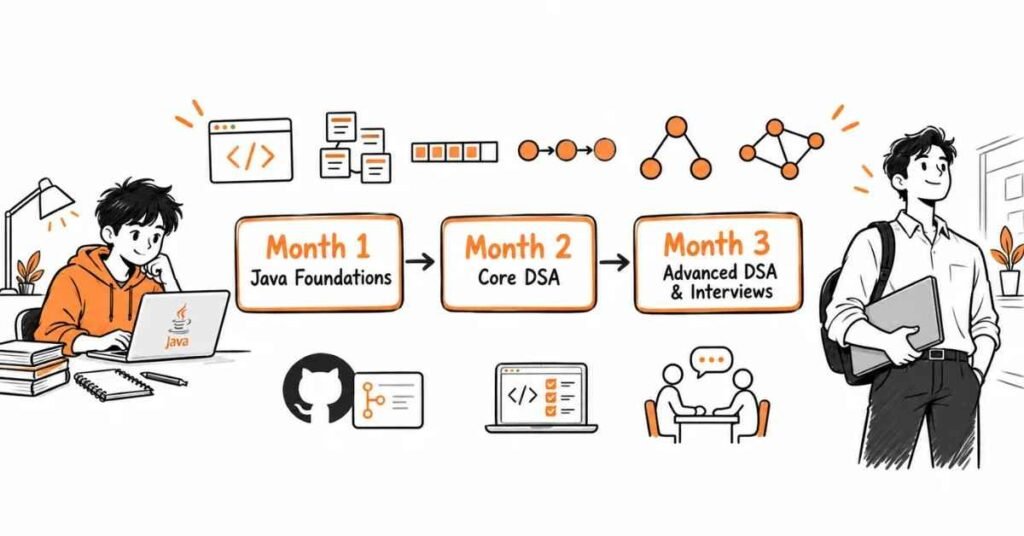
The 3-Month Learning Structure at a Glance
Month | Focus Area | Expected Outcome |
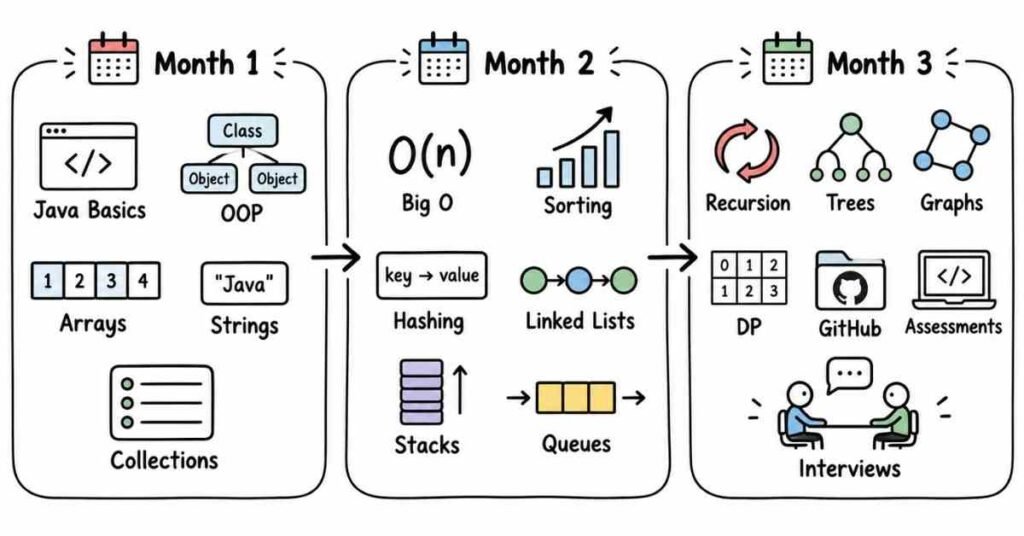
Month 1: Days 1–30 | Java, OOP, methods, arrays, strings and Collections | Write structured Java programs |
Month 2: Days 31–60 | Complexity, sorting, hashing and linear data structures | Solve common coding patterns |
Month 3: Days 61–90 | Trees, graphs, advanced algorithms and interviews | Become assessment and interview-ready |
Month 1: Core Java Foundation — Days 1–30
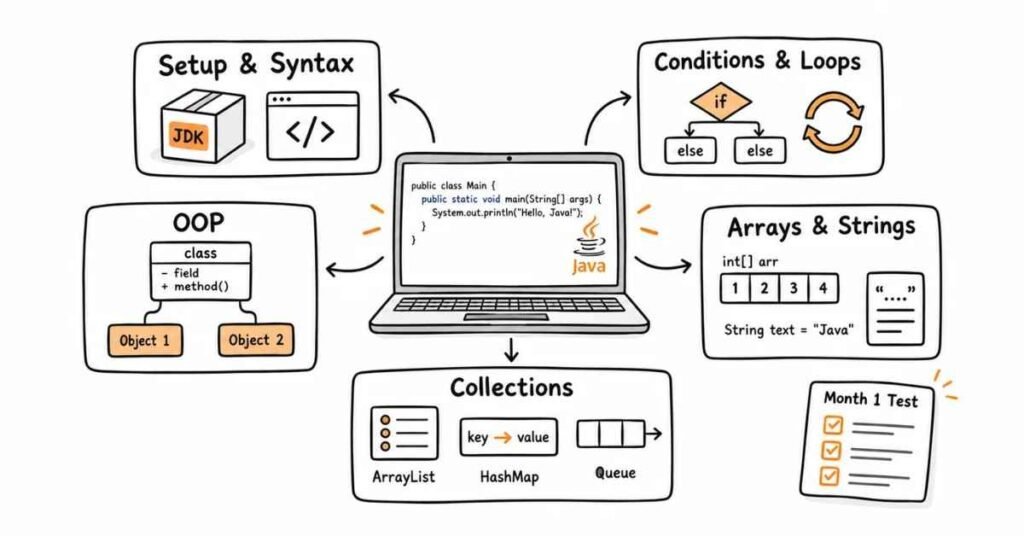
The first month builds the Java knowledge required for DSA. Students should not move directly into advanced algorithms without becoming comfortable with conditions, loops, methods, arrays and objects.
Week 1: Java Basics and Environment Setup — Days 1–7
Days 1–2: Java Setup and Program Structure
Install the JDK and configure IntelliJ IDEA or Eclipse. Understand the difference between JDK, JRE and JVM before writing and executing your first Java program.
Practise:
- Hello World
- Basic arithmetic
- Temperature conversion
- Area calculation
Days 3–4: Variables, Data Types and Operators
Learn variables, early data types, type casting and arithmetic, relational and logical operators. These concepts help you store information and perform calculations inside a program.
Practise programs for:
- Simple interest
- Average marks
- Number swapping
- Unit conversion
Days 5–7: Conditions and Loops
Learn if-else, switch, for, while and do-while. Conditions control decisions, while loops help repeat an operation until a requirement is satisfied.
Practise:
- Odd or even
- Largest of three numbers
- Factorial
- Fibonacci series
- Prime number
- Armstrong number
- Palindrome number
Week 1 milestone: You should be able to convert a simple requirement into a Java program using variables, conditions and loops.
Week 2: Object-Oriented Programming — Days 8–14
Days 8–9: Classes, Objects and Constructors
Learn how classes act as blueprints and objects represent actual data. Understand instance variables, methods, constructors, constructor overloading and the this keyword.
Build a Student class containing:
- Student ID
- Name
- Course
- Marks
- Result
Days 10–11: The Four Pillars of OOP
Learn encapsulation, inheritance, polymorphism and abstraction. Write a small Java example for every concept instead of memorising only theoretical definitions.
Days 12–13: Access Modifiers and Static Members
Understand public, private, protected and default access. Learn how static variables and methods belong to a class rather than an individual object.
Day 14: Interfaces and Abstract Classes
Learn the difference between interfaces and abstract classes. Build a payment system supporting card, UPI and net-banking payments through a common interface.
Week 2 project: Create a Library Management System using classes, objects, encapsulation, inheritance and interfaces.
Week 3: Methods, Arrays and Strings Days 15–21
Days 15–16: Methods and Modular Programming
Learn parameters, arguments, return values, method overloading and variable scope. Divide large programs into smaller reusable methods instead of writing all logic inside main().
Days 17–19: Arrays
Learn how to declare, initialise, traverse and modify arrays. Practise one-dimensional and two-dimensional arrays and learn how to pass an array to a method.
Solve:
- Maximum and minimum
- Array reversal
- Duplicate elements
- Second-largest number
- Missing number
- Array rotation
- Merge sorted arrays
Days 20–21: Strings
Learn String immutability, common String methods, character arrays, StringBuilder and StringBuffer. Strings are frequently tested in fresher coding rounds.
Solve:
- Reverse a string
- String palindrome
- Character frequency
- First non-repeating character
- Anagram checking
- Duplicate characters
Week 3 project: Create a text analyser that counts words, characters, vowels and repeated words.
Week 4: Collections and Month 1 Assessment — Days 22–30
Days 22–24: Java Collections Framework
Learn ArrayList, LinkedList, HashSet, TreeSet, HashMap, TreeMap, Queue, Deque and PriorityQueue. Understand when to use each collection instead of memorising only its methods.
Days 25–26: Comparable and Comparator
Learn how to sort custom objects using Comparable and Comparator. Practise sorting employees or students by ID, name, marks and salary.
Days 27–28: Exception Handling and Generics
Learn checked and unchecked exceptions, try-catch-finally, throw, throws and custom exceptions. Study generics to write reusable and type-safe classes and methods.
Days 29–30: Month 1 Assessment
Complete one Java test, one OOP assignment, ten array questions, ten string questions and five Collections questions. Finish the month with a timed coding assessment.
Month 1 milestone: You should now be able to write structured Java programs using methods, objects, arrays, strings and Collections.
Month 2: Core Data Structures and Algorithms Days 31–60
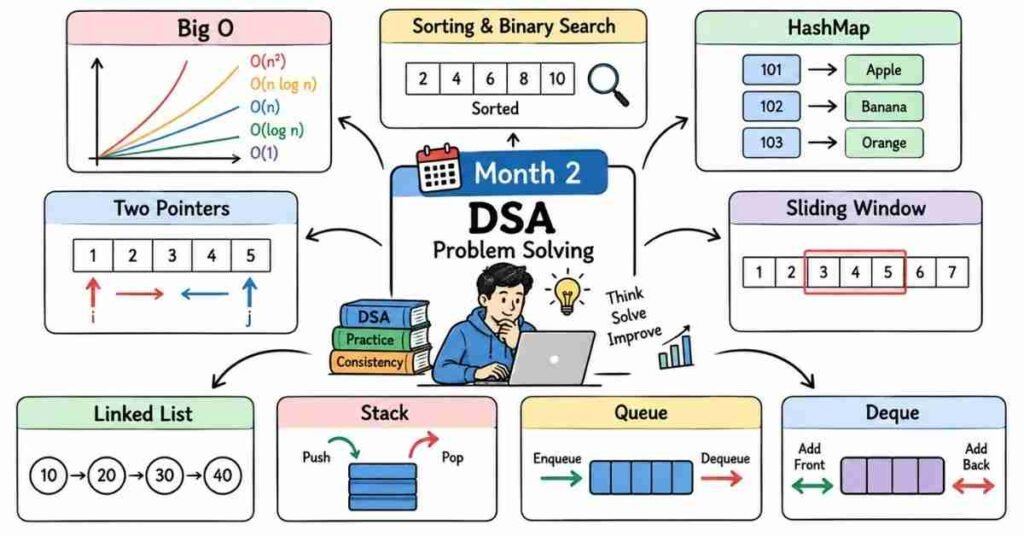
Month 2 introduces complexity analysis and the most frequently tested data structures. The focus should be on recognising problem patterns and comparing different approaches.
Week 5: Time Complexity, Sorting and Searching — Days 31–37
Days 31–32: Time and Space Complexity
Time complexity measures how execution grows with the input. Space complexity measures the extra memory required by an algorithm.
Complexity | Meaning | Example |
O(1) | Constant work | Accessing an array element |
O(log n) | Input reduces at every step | Binary search |
O(n) | Every element is processed | Array traversal |
O(n log n) | Efficient sorting | Merge sort |
O(n²) | Nested comparisons | Bubble sort |
O(2ⁿ) | Multiple possibilities | Recursive subsets |
Days 33–35: Sorting Algorithms
Learn bubble sort, selection sort, insertion sort, merge sort and quick sort. For each algorithm, understand the approach, time complexity, space complexity and suitable use case.
Days 36–37: Searching Algorithms
Learn linear search, binary search, first and last occurrence, search insertion position and searching in rotated arrays. Binary search should be applied only when the search space follows an ordered or monotonic condition.
Week 5 project: Create a student-ranking system that sorts records by marks and searches for a student using an ID.
Week 6: Hashing and Problem-Solving Patterns — Days 38–44
Days 38–40: HashSet and HashMap
Hashing supports quick lookup and frequency counting. Practise duplicate detection, two-sum, character frequency, common elements, anagrams and longest consecutive sequences.
Days 41–42: Two-Pointer Pattern
The two-pointer technique processes an array or string from two positions. Use it for pair sum, palindrome checking, reversal, duplicate removal and moving zeroes.
Days 43–44: Sliding-Window Pattern
Sliding window is useful for continuous subarrays and substrings. Practise maximum subarray sum, longest unique substring and minimum-size subarray problems.
Week 6 project: Develop a text-frequency analyser using HashMap, strings and sorting.
Week 7: Linked Lists — Days 45–51
Days 45–46: Singly Linked List
Learn node creation, head, tail, insertion, deletion, traversal and searching. Implement a linked list manually before using Java’s built-in LinkedList.
Days 47–48: Doubly and Circular Linked Lists
A doubly linked list stores both previous and next references. A circular linked list connects the last node to the first node and is useful for repeated rotations.
Days 49–51: Linked-List Problems
Practise:
- Reverse a linked list
- Find the middle node
- Detect a cycle
- Merge sorted linked lists
- Remove the nth node
- Find the intersection
- Check whether a list is a palindrome
Week 7 project: Build a music-playlist manager using a doubly linked list.
Week 8: Stacks, Queues and Deques — Days 52–60
Days 52–54: Stacks
A stack follows the Last-In, First-Out principle. It is commonly used for undo operations, expression evaluation, recursion and backtracking.
Practise:
- Valid parentheses
- Next greater element
- Min stack
- Stock span
- Postfix evaluation
- Infix-to-postfix conversion
Days 55–57: Queues and Deques
A queue follows the First-In, First-Out principle. A deque allows insertion and deletion from both ends and is useful for sliding-window problems.
Practise:
- Circular queue
- Queue using stacks
- Stack using queues
- First non-repeating character
- Sliding-window maximum
- Task scheduling
Days 58–60: Month 2 Assessment
Complete five sorting questions, ten hashing questions, five linked-list questions, five stack questions and five queue questions. Finish with a 90-minute coding assessment.
Month 2 milestone: You should be able to use common linear data structures, recognise coding patterns and calculate basic time and space complexity.
Month 3: Advanced DSA and Career Launch - Days 61–90
The final month covers recursion, backtracking, trees, graphs, greedy algorithms, dynamic programming and technical-interview preparation.
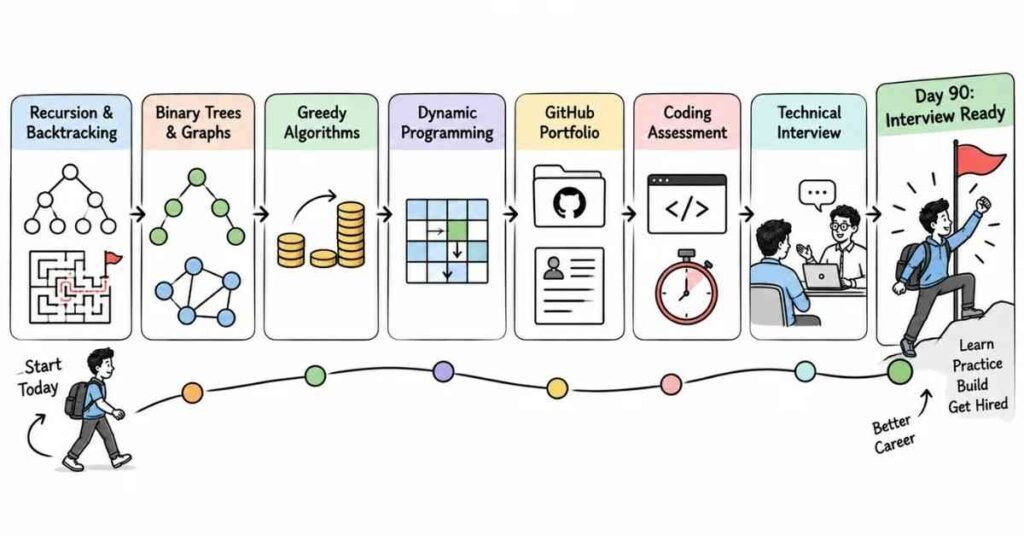
Week 9: Recursion and Backtracking — Days 61–67
Days 61–63: Recursion Fundamentals
Learn the base condition, recursive call, call stack and recursion tree. Practise factorial, Fibonacci, digit sum, string reversal, subsequences and subsets.
Days 64–67: Backtracking
Backtracking explores a possible decision and reverses it if it cannot produce a valid answer. Practise permutations, N-Queens, rat in a maze, combination sum and word search.
Week 9 project: Create a maze-path finder that displays all valid routes between the start and destination.
Week 10: Trees and Binary Search Trees — Days 68–74
Days 68–69: Tree Fundamentals
Learn root, parent, child, leaf, depth, height, subtree and balanced-tree concepts. Draw trees manually before implementing them in Java.
Days 70–71: Tree Traversals
Learn preorder, inorder, postorder and level-order traversal. Practise both recursive and iterative implementations.
Days 72–74: Binary Tree and BST Problems
Solve tree height, diameter, balanced-tree checking, tree views, lowest common ancestor and BST validation. Also practise inserting, searching and deleting BST nodes.
Week 10 project: Build a student-record system using a binary search tree.
Week 10: Trees and Binary Search Trees — Days 68–74
Days 68–69: Tree Fundamentals
Learn root, parent, child, leaf, depth, height, subtree and balanced-tree concepts. Draw trees manually before implementing them in Java.
Days 70–71: Tree Traversals
Learn preorder, inorder, postorder and level-order traversal. Practise both recursive and iterative implementations.
Days 72–74: Binary Tree and BST Problems
Solve tree height, diameter, balanced-tree checking, tree views, lowest common ancestor and BST validation. Also practise inserting, searching and deleting BST nodes.
Week 10 project: Build a student-record system using a binary search tree.
Week 11: Graphs and Greedy Algorithms — Days 75–81
Days 75–77: Graph Fundamentals
Learn vertices, edges, directed and undirected graphs, weighted graphs, adjacency matrices and adjacency lists. Understand how real networks can be represented as graphs.
Days 78–79: Graph Traversal
Learn breadth-first search and depth-first search. Practise connected components, cycle detection, bipartite graphs and shortest paths in unweighted graphs.
Days 80–81: Greedy Algorithms
Greedy algorithms select the best immediate choice. Practise activity selection, meeting scheduling, job sequencing, minimum platforms and interval-merging problems.
Week 11 project: Build a route-finding program using graph representation and BFS.
Week 12: Dynamic Programming and Career Launch — Days 82–90
Days 82–84: Dynamic Programming Fundamentals
Learn memoisation, tabulation, state definition, recurrence relations and base cases. Start with Fibonacci, climbing stairs, house robber, coin change and subset sum.
Days 85–86: Intermediate Dynamic Programming
Practise knapsack, longest common subsequence, longest increasing subsequence, minimum path sum and grid-path problems. Focus on defining the state before writing code.
Days 87–88: GitHub, Resume and Portfolio
Organise solutions into topic-based folders and include explanations, complexity and test cases. Add only the skills and projects you can confidently explain during interviews.
Days 89–90: Interview Preparation Sprint
Complete two timed assessments, one Java interview, one DSA interview and one project discussion. Revise weak patterns and practise explaining your solutions aloud.
Day 90 milestone: You should have a structured Java DSA foundation, completed coding assessments, documented projects and an interview-ready portfolio.
Interview Preparation: What to Expect at Each Round
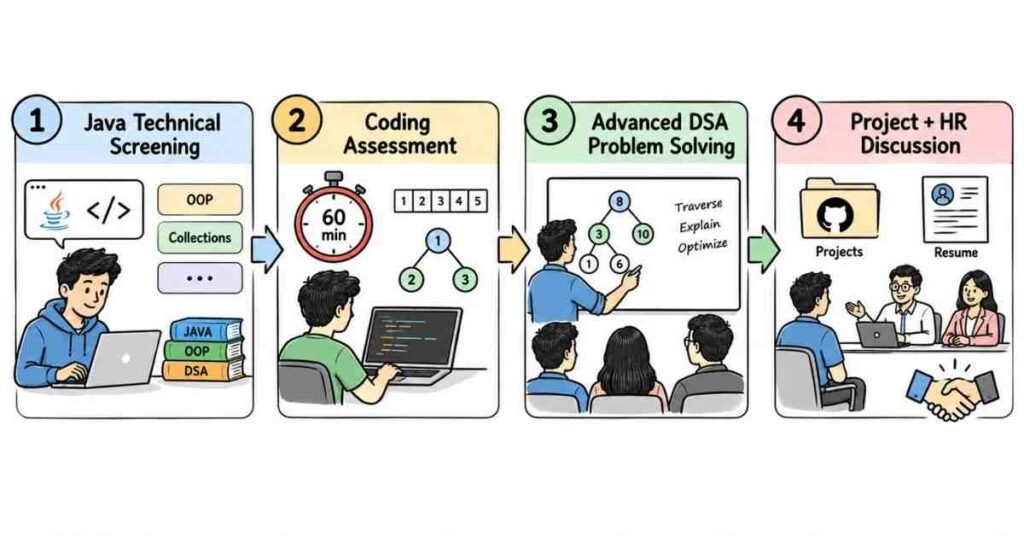
Round 1: Technical Screening — 30 to 45 Minutes
This round generally covers Java fundamentals, OOP, exceptions, strings, Collections and basic complexity. Prepare short explanations supported by practical examples.
Round 2: Coding Assessment — 60 to 90 Minutes
Expect two or three problems based on arrays, strings, hashing, sorting, searching or recursion. Explain the basic solution before moving to an optimised approach.
Round 3: Advanced DSA or Problem-Solving Round
This round may cover trees, graphs, heaps, backtracking, greedy algorithms and dynamic programming. Interviewers evaluate how you approach an unfamiliar problem.
Round 4: Project and HR Discussion
Explain your project, technical decisions, challenges and personal contribution. For behavioural questions, use genuine examples from your education, projects or work.
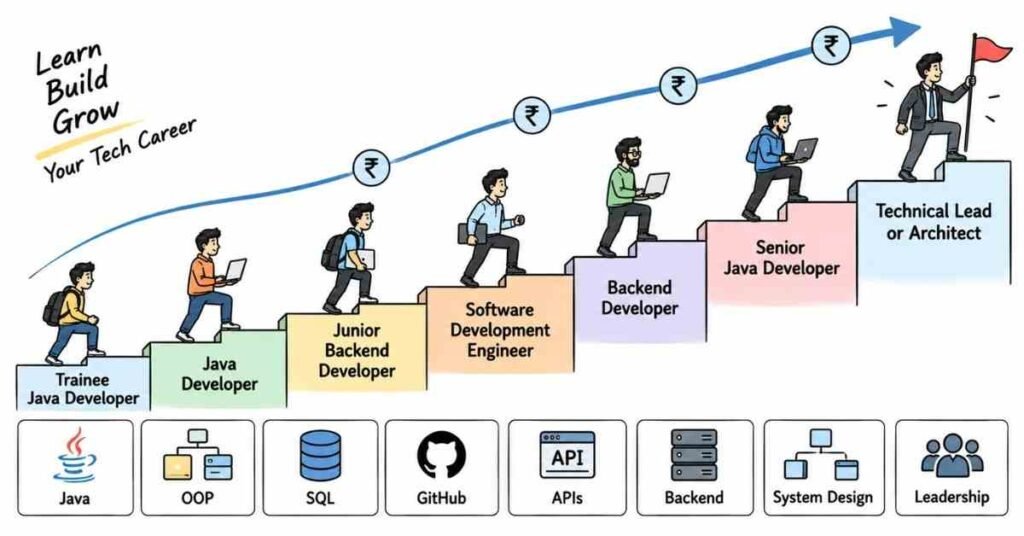
Java DSA Career Paths and Salary Guide in India
Role | Experience | Typical Salary Range | Supporting Skills |
Trainee Java Developer | 0–1 year | ₹3–5 LPA | Java, OOP and basic DSA |
Java Developer | 0–2 years | ₹4–8 LPA | Core Java, Collections, SQL and Git |
Junior Backend Developer | 0–2 years | ₹5–9 LPA | Java, APIs, databases and frameworks |
Software Development Engineer | 0–3 years | ₹6–15 LPA | Strong DSA, projects and development |
Backend Developer | 2–5 years | ₹8–20 LPA | Backend frameworks and system design |
Senior Java Developer | 4–7 years | ₹15–30 LPA | Architecture and technical ownership |
Technical Lead or Architect | 7+ years | ₹25–45 LPA+ | Distributed systems and leadership |
These figures are approximate. Actual salary depends on the company, location, experience, projects, technical skills and interview performance.
Top Job Platforms for Java DSA Freshers
Platform | Application Strategy |
Naukri | Create alerts for fresher Java and software developer roles |
LinkedIn Jobs | Apply to relevant jobs and connect professionally with recruiters |
Indeed | Search for trainee, junior and entry-level positions |
Wellfound | Target startup roles requiring practical coding skills |
Company Career Pages | Apply directly through verified recruitment portals |
Campus Placements | Prepare for aptitude, Java MCQs and coding assessments |
Why Choose Frontlines Edutech?
Frontlines Edutech provides structured Java DSA learning with Telugu-friendly explanations and standard English technical terminology. The course focuses on concept clarity, live coding and continuous practice.
Students receive support through assignments, coding assessments, real-world problems, interview preparation and career guidance. This helps regional learners understand difficult topics and prepare for professional interviews.
Frequently Asked Questions (FAQs)
1.Can beginners join the Java DSA Course in Telugu?
Yes. The roadmap begins with Java basics before moving into OOP, Collections and data structures. Previous DSA experience is not required.
2.How long does it take to learn Java DSA?
You can build a strong foundation in 90 days with consistent practice. Complete mastery requires further revision and exposure to different problems.
3.How many hours should I study every day?
Spend approximately two to three focused hours daily. Divide the time between concept learning, coding practice and revision.
4.Is Java suitable for learning DSA?
Yes. Java provides strong typing, OOP and a useful Collections Framework, making it suitable for learning and implementing DSA.
5.How many problems should I solve?
There is no fixed number. Focus on important patterns and ensure that you can solve variations without copying the solution.
6.Is DSA enough to get a Java job?
No. DSA helps you clear coding rounds, but you also need projects, Git, databases, communication and job-specific development skills.
7.Which topics are important for freshers?
Arrays, strings, hashing, sorting, binary search, linked lists, stacks, queues, trees and recursion are commonly tested.
8.Should I memorise DSA solutions?
No. Understand the pattern, approach and complexity. Memorised code usually fails when the interviewer changes the question.
9.Can non-IT students learn Java DSA?
Yes. Non-IT students can begin with Java programming fundamentals and gradually follow the roadmap in the given sequence.
10.How can I avoid forgetting DSA concepts?
Maintain short notes and revise problems by pattern. Solve important questions again without checking your previous code.