
How to Become a Java DSA Developer in 2026: Complete Career Guide
Table of Contents
Introduction
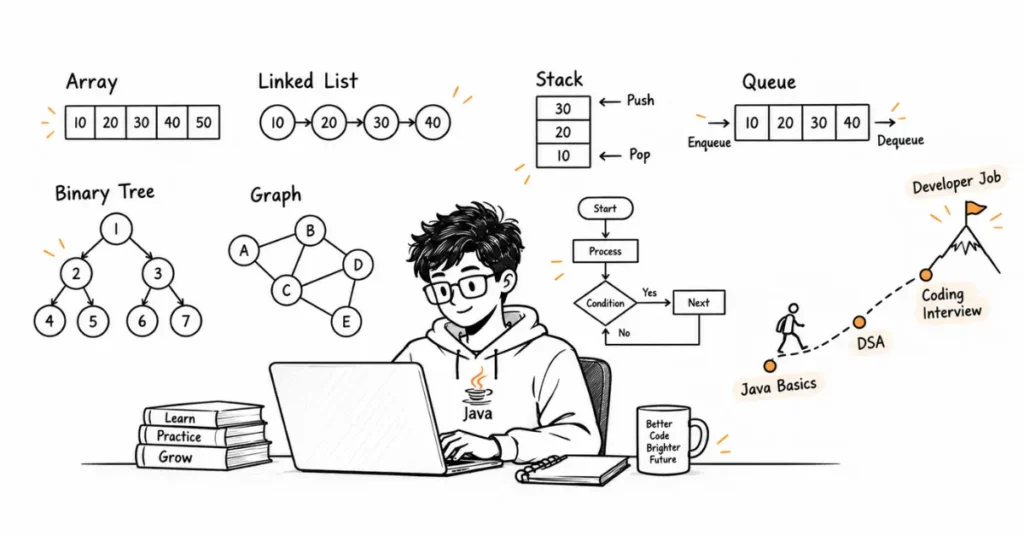
A Java DSA developer uses Java, data structures, algorithms, object-oriented programming, Collections and problem-solving techniques to write efficient code and solve coding-interview questions. To become job-ready in 2026, first build strong Java fundamentals and then learn complexity analysis, arrays, strings, linked lists, stacks, queues, trees, graphs, recursion, sorting, searching, greedy algorithms and dynamic programming. Practise problems by pattern, explain time and space complexity, maintain tested solutions and complete interview-style assessments. This guide provides students and freshers in India with a structured roadmap, role comparison, salary guidance, portfolio checklist, job-search plan and 30-day starter schedule.
What Does a Java DSA Developer Do?
A Java DSA developer is not a separate job title in every company. The term generally describes a software developer who combines practical Java programming skills with strong knowledge of data structures and algorithms.
These skills help developers choose suitable ways to organise data, reduce unnecessary processing and create programs that perform efficiently.
In product- and service-based company interviews, Java DSA knowledge is commonly tested through coding assessments and technical rounds. In real projects, the same knowledge is useful when developers process collections, search records, manage task queues, traverse hierarchical information or optimise repeated operations.
Main Responsibilities
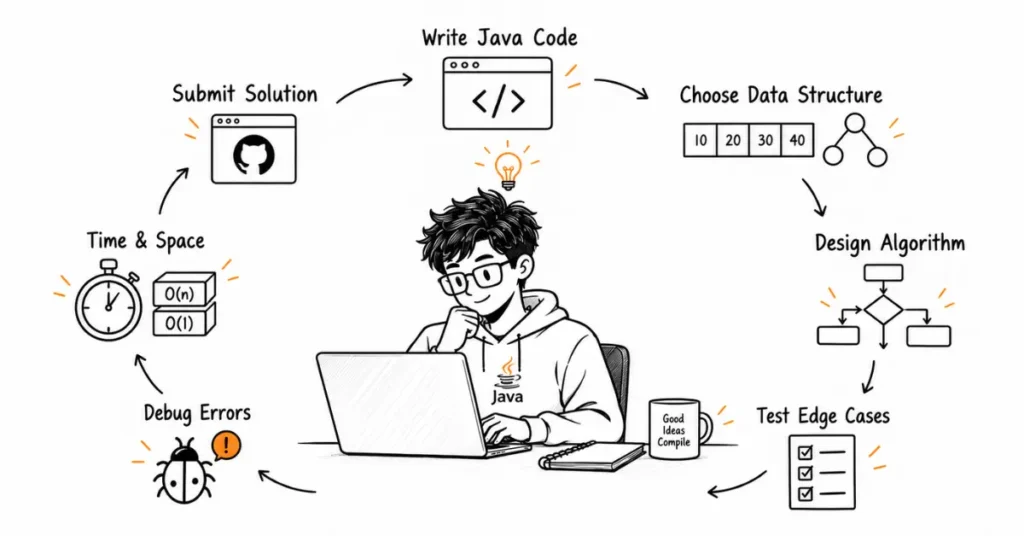
- Write readable Java programs using classes, methods, interfaces and Collections.
- Select appropriate data structures instead of relying only on brute-force solutions.
- Design algorithms and explain their time and space complexity.
- Test edge cases such as empty input, duplicate values, overflow and invalid values.
- Debug logical errors and improve inefficient solutions.
- Complete coding assessments and explain the chosen approach.
- Maintain structured and documented code in GitHub repositories
What Does a Java DSA Developer Do?
Java is widely used in backend systems, enterprise applications and large-scale software platforms. DSA develops the logical thinking required to solve programming problems and perform well in technical interviews.
Together, Java and DSA provide a strong foundation for students who want to enter software development and confidently face coding rounds.
Why Do Students Choose Java DSA?
- Java provides a clear object-oriented programming structure.
- Java has a mature and widely used Collections Framework.
- DSA improves logical thinking across different programming roles.
- Java DSA is commonly tested by service- and product-based companies.
- A pattern-based learning roadmap is easier to follow than random problem-solving.
- The foundation supports backend development, system design and competitive programming.
Who Should Learn Java DSA?
Java DSA is suitable for:
- B.Tech and BE students.
- BCA and MCA students.
- Degree students interested in software development.
- Freshers preparing for placement coding rounds.
- Professionals planning to move into development roles.
- Java learners who understand syntax but struggle with problem-solving.
- Candidates preparing for service- or product-based company interviews.
Beginners can start with Java fundamentals. Previous competitive programming experience is not required.
Java DSA Roles Compared
Java DSA skills support several career paths. The exact designation depends on the company, project requirements and additional technologies you know.
Role | Main Focus | Best For | Typical Salary Range in India |
Java Developer | Core Java and application logic | Beginners with Java foundations | ₹4–10 LPA |
Backend Developer | APIs, services and database logic | Practical application builders | ₹5–14 LPA |
Software Development Engineer | Problem-solving and scalable product features | Candidates with strong DSA and projects | ₹6–20 LPA |
Competitive Programming or Coding Mentor | Algorithms and advanced problem patterns | Learners with deep problem-solving knowledge | Varies by role |
Senior Java Engineer | Design, performance and technical ownership | Experienced Java developers | ₹15–35 LPA+ |
If you are starting out, the enterprise Java path is ideal because it gives you a strong base in backend engineering and long-term career growth.
Complete Java DSA Learning Roadmap
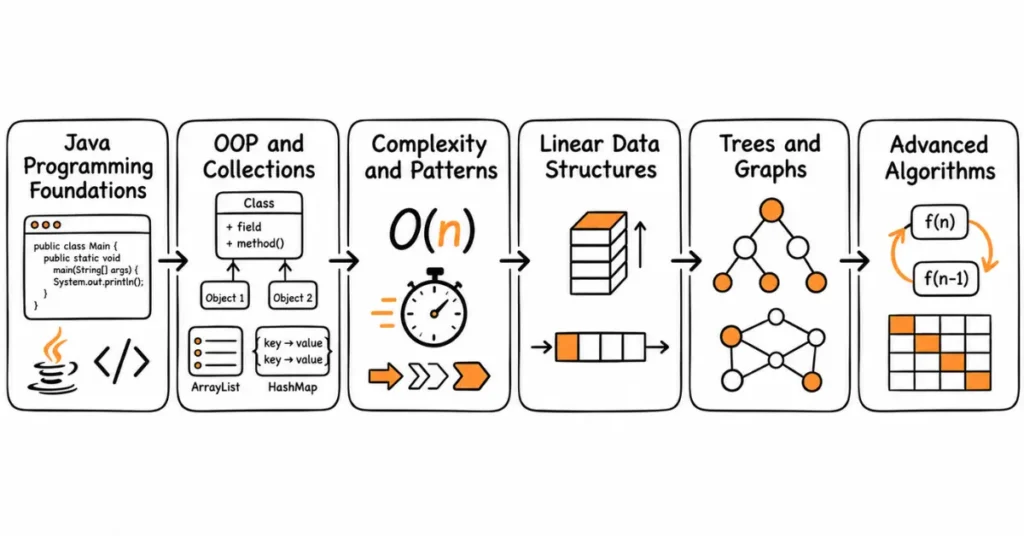
Phase 1: Java Programming Foundations
Before solving data-structure problems, become comfortable writing and debugging Java programs without copying complete solutions.
A weak Java foundation makes every algorithm appear more difficult than it is.
Focus on:
- Variables and data types.
- Operators and expressions.
- Input and output.
- Conditional statements.
- Loops and iterations.
- Methods and parameters.
- Arrays and strings.
- Classes and objects.
- Constructors.
- Access modifiers.
- Inheritance.
- Polymorphism.
- Abstraction.
- Interfaces.
- Exception handling.
- Generics.
- Basic debugging.
Phase 2: Object-Oriented Programming and Collections
DSA problems may appear mathematical, but Java solutions still require proper structure.
Learn how objects represent information and how the Java Collections Framework provides ready-to-use implementations of common data structures.
Focus on:
- Encapsulation.
- Inheritance and composition.
- Interfaces and abstraction.
- Comparable and Comparator.
- List.
- Set.
- Map.
- Queue.
- Deque.
- ArrayList.
- LinkedList.
- HashSet.
- HashMap.
- PriorityQueue.
- Iterators.
- Enhanced for-loops.
- Choosing between custom data structures and Java Collections.
Phase 3: Complexity and Problem-Solving Patterns
Complexity analysis helps you understand how an algorithm behaves when the input size increases.
Learn to estimate the performance of an approach before writing code and compare different solutions after implementation.
Focus on:
- Big O notation.
- Time complexity.
- Auxiliary space complexity.
- Best-case complexity.
- Average-case complexity.
- Worst-case complexity.
- Single-loop analysis.
- Nested-loop analysis.
- Logarithmic behaviour.
- Two-pointer pattern.
- Sliding-window pattern.
- Prefix-sum technique.
- Hashing for counting and lookup.
- Binary-search decision patterns.
Phase 4: Linear Data Structures
Linear data structures are the most accessible bridge between Java programming and structured DSA.
Study both the implementation and practical application of each structure.
Focus on:
- Arrays.
- Strings.
- Linked lists.
- Stacks.
- Queues.
- Deques.
- Hash tables.
Phase 5: Trees and Graphs
Trees and graphs help you understand relationships that cannot always be represented using simple left-to-right data.
Begin with traversal and then move towards common problem patterns.
Focus on:
- Binary trees.
- Binary search trees.
- Tree terminology.
- Tree height and depth.
- Depth-first traversal.
- Breadth-first traversal.
- Preorder traversal.
- Inorder traversal.
- Postorder traversal.
- Level-order traversal.
- Tree path problems.
- Subtree problems.
- Heaps.
- Priority queues.
- Graph representation.
- Adjacency lists.
- Breadth-first search.
- Depth-first search.
- Connected components.
- Cycle detection.
- Shortest-path foundations.
Phase 6: Advanced Algorithms
Advanced topics become easier once you understand recursion, state and problem constraints.
Concentrate on the decision-making process rather than memorising final code.
Focus on:
- Recursion.
- Backtracking.
- Divide-and-conquer.
- Greedy algorithms.
- Dynamic programming.
- Memoisation.
- Tabulation.
- Sorting variations.
- Binary-search variations.
- Bit-manipulation foundations.
- Constraint-based optimisation.
- Interview revision strategies.
The number of completed problems is not a reliable measurement if you cannot explain the reasoning behind them.
Core Java, Data Structures and Algorithms
Core Java, data structures and algorithms are the three main pillars of Java DSA mastery.
A weakness in any one pillar usually becomes visible during coding assessments.
Core Java Skills to Master
- Object-oriented programming.
- Method design.
- Arrays and strings.
- Collections Framework.
- Generics.
- Exception handling.
- Debugging.
- Comparable and Comparator.
- Custom classes.
- Basic memory awareness.
- Immutable values.
Data-Structure Skills to Master
- Data-structure operations.
- Performance trade-offs.
- Practical use cases.
- Arrays.
- Linked lists.
- Stacks.
- Queues.
- Deques.
- Hash tables.
- Trees.
- Heaps.
- Graphs.
- Custom implementation.
- Java library implementation.
- Traversal state.
- Edge-case handling.
Algorithm Skills to Master
- Sorting.
- Searching.
- Tree traversal.
- Graph traversal.
- Two pointers.
- Sliding window.
- Prefix sums.
- Hashing.
- Recursion.
- Backtracking.
- Greedy algorithms.
- Dynamic programming.
- Time-complexity analysis.
- Space-complexity analysis.
- Solution optimisation.
- Correctness explanation.
What Is the Interview-Ready Standard?
Salary depends on your Java knowledge, DSA performance, project experience, communication, location, academic background and company type.
Strong DSA knowledge can help you clear coding rounds, but the final offer also depends on practical development skills and your performance in other interview rounds.
Experience Level | Typical Salary Range in India | Common Role Level | What Usually Improves the Profile |
Fresher | ₹3.5–7 LPA | Trainee, Associate or Junior Java Developer | Java fundamentals, DSA patterns, projects and coding assessments |
1–3 Years | ₹6–14 LPA | Java Developer, Backend Developer or Software Engineer | Production experience, frameworks, APIs and stronger DSA |
3–5 Years | ₹12–24 LPA | Senior Developer or Software Development Engineer | System design, performance optimisation and feature ownership |
5+ Years | ₹20–40 LPA+ | Lead Engineer, Senior Engineer or Architect | Architecture, scalable systems, mentoring and technical leadership |
Portfolio That Gets Interviews
A strong portfolio proves that you can apply Java and DSA instead of only watching lessons or collecting certificates.
A recruiter should be able to open your GitHub repository and quickly understand the problem, solution and result.
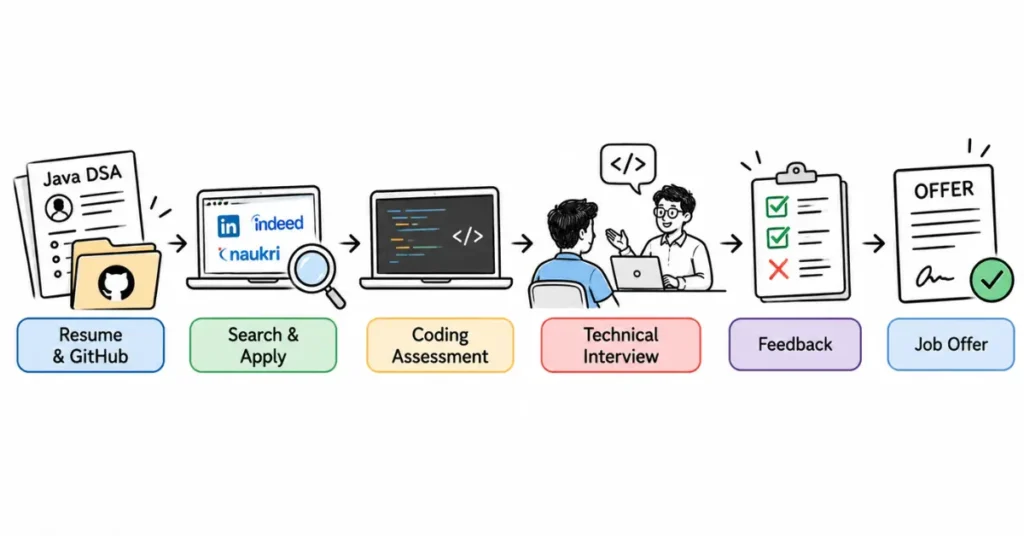
Java DSA Job-Search Strategy
Your professional profile should connect Java DSA knowledge to the actual role.
A recruiter hiring a Java developer expects programming knowledge, practical projects and familiarity with development tools. A list of solved coding questions is not enough.
Resume Keywords
Use relevant keywords naturally:
- Java
- Data Structures and Algorithms
- Object-Oriented Programming
- Collections Framework
- Problem-Solving
- Time Complexity
- Space Complexity
- Arrays
- Linked Lists
- Stacks
- Queues
- Trees
- Graphs
- Dynamic Programming
- Git
- GitHub
- SQL
- Backend Development
Do not add technologies you cannot explain during an interview.
Where Can You Apply?
- LinkedIn Jobs.
- Naukri.
- Indeed.
- Company career pages.
- Campus placement drives.
- Pooled placement drives.
- Internship platforms.
- Apprenticeship programmes.
- Verified professional referrals.
- Product-company coding challenges.
- Service-company recruitment drives.
After every coding assessment, write down the topics that slowed you down. Revise those patterns before attempting the next assessment.
Profile Positioning Example
A useful fresher headline can be:
Java Developer | DSA and OOP | Built Practical Java Projects
This headline tells recruiters what you know and points towards evidence without presenting unrealistic expertise.
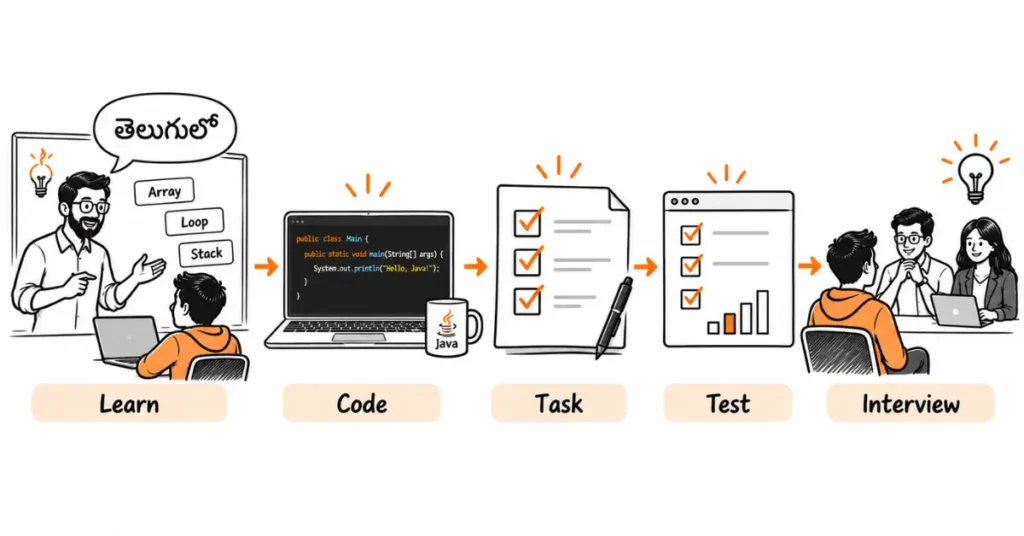
Java DSA Interview Preparation
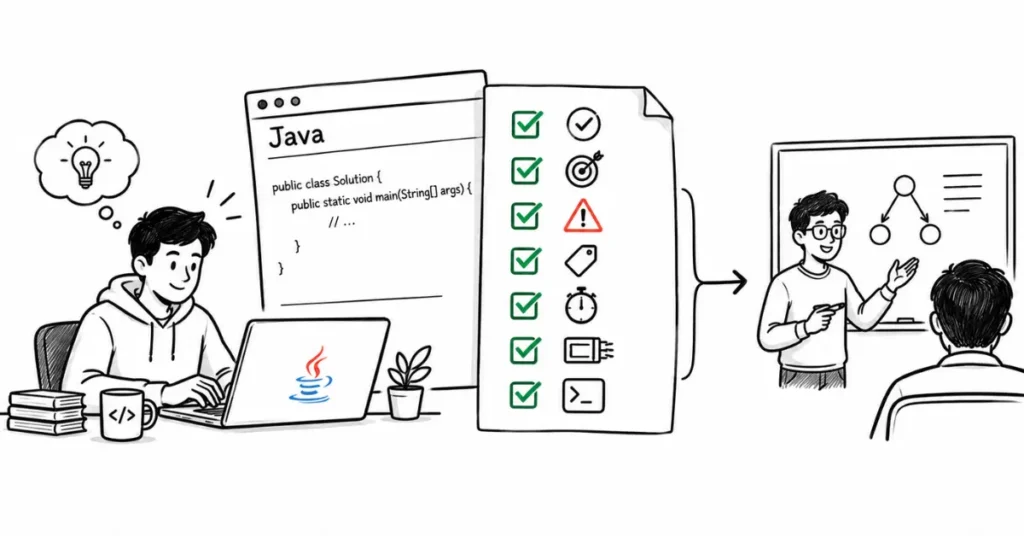
Prepare for explanation as seriously as you prepare for coding.
An interviewer may interrupt you, change a constraint or ask for a better solution. A structured approach helps you respond calmly.
Questions You Should Be Ready to Answer
- When would you choose ArrayList instead of LinkedList?
- How does HashMap handle keys and collisions at a high level?
- What is the difference between a stack and a queue?
- When should you use a priority queue?
- How do BFS and DFS differ?
- When would you use BFS instead of DFS?
- How do you calculate time complexity?
- What is auxiliary space?
- What makes a problem suitable for dynamic programming?
- What is the difference between memoisation and tabulation?
- How would you improve a brute-force solution?
- How do you test a coding solution?
The goal is reliable interview performance, not one lucky correct answer.
30-Day Java DSA Starter Plan
Use the following plan to build momentum. It is a starter schedule and not a promise of complete mastery within one month.
Week 1: Strengthen Java Fundamentals
- Revise variables and data types.
- Practise conditions and loops.
- Write methods.
- Revise classes and objects.
- Learn OOP principles.
- Solve basic array questions.
- Solve basic string questions.
Week 2: Learn Core DSA Patterns
- Understand Big O notation.
- Learn Collections.
- Practise sorting.
- Practise binary search.
- Solve hashing problems.
- Learn two-pointer problems.
- Practise sliding-window questions.
Week 3: Practise Important Data Structures
- Implement linked lists.
- Learn stacks.
- Learn queues and deques.
- Practise recursion.
- Learn tree traversal.
- Solve binary-tree problems.
- Learn binary search trees.
Week 4: Prepare for Assessments
- Learn graph representation.
- Practise BFS and DFS.
- Learn greedy-algorithm foundations.
- Study dynamic-programming basics.
- Take timed coding assessments.
- Revise weak patterns.
- Organise your GitHub repository.
- Update your professional profile.
Why Learn Java DSA at Frontlines Edutech?
Frontlines Edutech is suitable for students and working professionals who want structured learning, Telugu-language explanations and job-focused preparation.
A useful Java DSA learning programme should connect conceptual understanding with live coding, assignments, assessments and interview preparation.
Telugu explanations can help students understand difficult concepts, while English technical terms prepare them for interviews, documentation and workplace communication.
Frequently Asked Questions
1. How long does it take to learn Java DSA?
Most beginners need approximately four to eight months of consistent learning and coding practice. The exact duration depends on your Java foundation, daily schedule, revision quality and target job difficulty.
2. Is Java DSA good for freshers in India?
Yes. Java DSA helps freshers prepare for placement coding assessments and entry-level developer interviews. It should be combined with practical projects, Git, basic SQL and communication skills.
3. Should I learn Java before starting DSA?
Learn basic Java first, including syntax, methods, arrays, strings, OOP and Collections. You can then study DSA while strengthening your Java skills through problem-solving.
4. How many DSA problems should I solve?
There is no fixed number. Focus on covering important patterns, revising representative questions, explaining complexity and solving unfamiliar variations independently.
5. Is DSA enough to get a Java developer job?
No. DSA helps you clear coding rounds, but Java developer roles also require OOP, projects, Git, databases, debugging and often backend frameworks or other role-specific technologies.
6. Which DSA topics should beginners learn first?
Start with arrays, strings, basic complexity, sorting, searching and hashing. Then progress to linked lists, stacks, queues, recursion, trees, graphs, greedy algorithms and dynamic programming.
7. Can I learn Java DSA in Telugu?
Yes. Telugu explanations can make difficult concepts easier to understand. Maintain standard English technical terminology in your notes because interviews and documentation commonly use it.
8. Do I need competitive programming experience?
No. Competitive programming can improve speed, but job preparation mainly requires strong fundamentals, common problem patterns, readable code and clear explanations.
9. What projects can demonstrate Java DSA skills?
You can build a route finder, task scheduler, search tool, recommendation prototype or custom Collections library. Clearly explain the data structures, algorithms and complexity used.
10. Is Java DSA difficult for beginners?
It can initially feel difficult because it combines programming with logical thinking. Start with simple problems, trace examples manually and progress topic by topic instead of jumping directly into advanced questions.
11. How should I revise Java DSA before interviews?
Revise pattern notes, redo representative problems without assistance, take timed mock tests, practise speaking through your solutions and review mistakes from previous assessments.
12. Should I use Java Collections in coding interviews?
You can generally use Java Collections unless the interviewer specifically asks for a custom implementation. You should still understand how the main data structures work internally.
13. What is more important: speed or correctness?
Correctness comes first. Develop a clear and correct solution, test it and explain the complexity. Speed improves naturally through pattern-based practice and repeated revision.
14. Can non-CSE students learn Java DSA?
Yes. Students from non-CSE backgrounds can learn Java DSA by first building basic programming knowledge and then following a structured roadmap with consistent coding practice.
15. What is the best way to avoid forgetting DSA concepts?
Use spaced revision. Revisit solved problems after a few days, maintain short pattern notes and attempt important questions again without looking at the previous solution.1