How to Become an AWS & Azure Cloud Engineer: Complete Career Guide 2025 [₹15L Average Salary]
Master cloud computing and unlock the highest-paying tech careers
Cloud engineers specializing in AWS and Azure are among the highest-paid professionals in the technology industry, with average salaries ranging from ₹8-25 LPA in India and senior architects earning ₹40+ LPA. As organizations worldwide accelerate their cloud migration journeys, cloud expertise has become not just valuable but essential for modern business operations.
Whether you’re a system administrator looking to modernize your skills, a developer seeking infrastructure knowledge, or a fresh graduate entering the cloud computing field, this comprehensive guide provides the proven roadmap to building a successful cloud engineering career. Having trained over 250 cloud professionals at Frontlines EduTech with a 94% job placement rate, I’ll share the strategies that consistently deliver results in the rapidly evolving cloud landscape.
What you’ll master in this guide:
1. What is Cloud Engineering?
Cloud engineering involves designing, implementing, and managing cloud-based infrastructure and services that enable organizations to run applications, store data, and deliver services with improved scalability, reliability, and cost-effectiveness. Cloud engineers work with platforms like Amazon Web Services (AWS) and Microsoft Azure to create robust, secure, and efficient cloud solutions.
Core Responsibilities of Cloud Engineers:
Infrastructure Design and Implementation:
- Cloud Architecture – Design scalable, resilient, and cost-effective cloud solutions
- Resource Provisioning – Deploy and configure virtual machines, databases, storage, and networking
- Security Implementation – Identity management, encryption, compliance, and access controls
- Performance Optimization – Monitor, analyse, and optimize cloud resource utilization
DevOps and Automation:
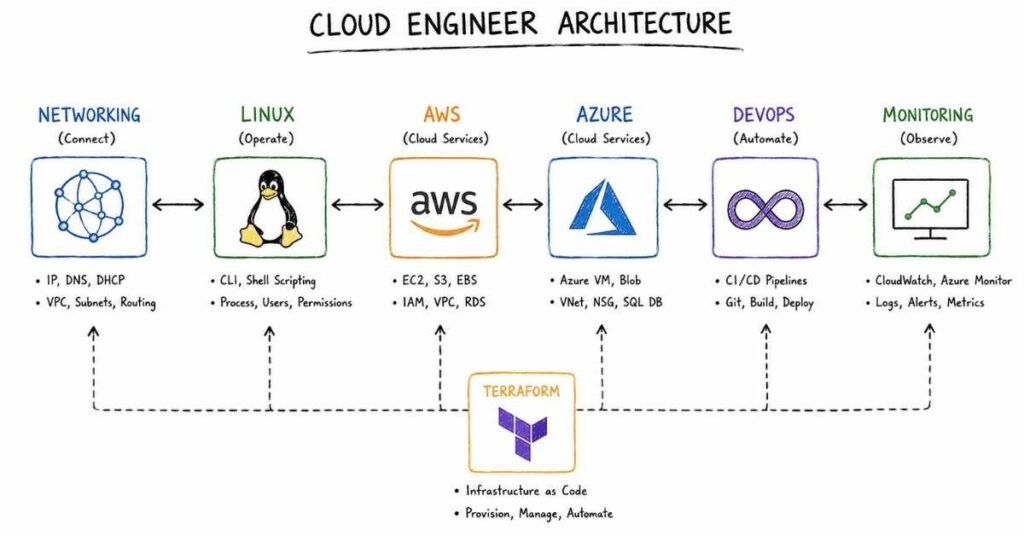
- Infrastructure as Code (IaC) – Terraform, CloudFormation, ARM templates for automated provisioning
- CI/CD Pipelines – Automated deployment and delivery processes
- Monitoring and Logging – CloudWatch, Azure Monitor, application performance management
- Container Orchestration – Docker, Kubernetes, AWS ECS, Azure Container Instances
Cost Management and Optimization:
- Resource Right-sizing – Optimize compute, storage, and network resources for cost efficiency
- Auto-scaling Configuration – Dynamic resource allocation based on demand
- Reserved Instance Management – Long-term capacity planning and cost savings
- Multi-cloud Strategy – Leverage best services from different cloud providers
AWS vs Azure: Platform Comparison
Amazon Web Services (AWS):
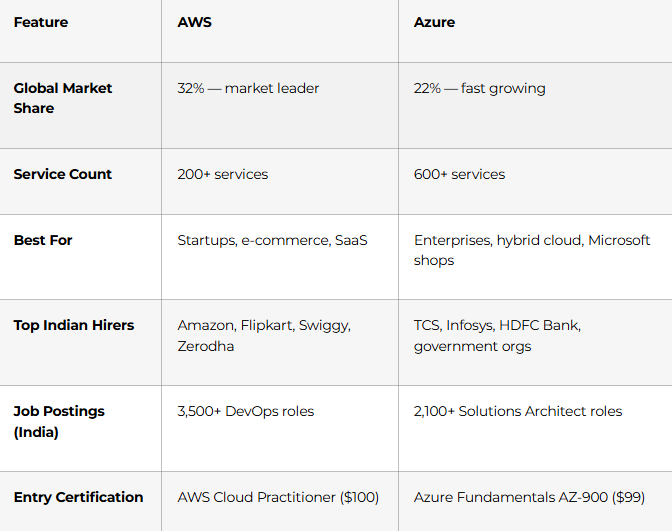
- Market Leader – 32% global market share, largest ecosystem of services
- Service Breadth – 200+ services covering compute, storage, databases, AI/ML
- Enterprise Adoption – Netflix, Airbnb, NASA, start-ups to Fortune 500 companies
- Innovation Speed – Rapid feature releases and cutting-edge service introductions
Microsoft Azure:
- Enterprise Integration – Seamless integration with Microsoft ecosystem (Office 365, Windows Server)
- Hybrid Cloud Leadership – Strong on-premises to cloud migration capabilities
- AI and Analytics – Advanced machine learning and data analytics services
- Global Presence – Available in 60+ regions worldwide with strong compliance coverage
2. Why Choose AWS & Azure in 2025?
Unprecedented Market Growth and Demand
According to Gartner’s latest Infrastructure as a Service report, the global cloud services market is projected to grow by 20.4% annually, reaching $679 billion by 2025. In India specifically, cloud adoption has accelerated dramatically:
Enterprise Cloud Migration:
- Banking and Financial Services – State Bank of India, HDFC Bank, ICICI Bank moving core operations to cloud
- E-commerce and Retail – Flipkart, Amazon India, Reliance Digital scaling cloud infrastructure
- Government Initiatives – Digital India, MeitY cloud adoption policies driving public sector transformation
- Startups and SMBs – 78% of Indian startups are cloud-first, creating massive demand for cloud expertise
Post-Pandemic Digital Transformation:
- Remote Work Infrastructure – Organizations scaling cloud-based collaboration and productivity tools
- Digital Customer Engagement – Migration from traditional channels to cloud-native digital platforms
- Data-Driven Decision Making – Cloud-based analytics and business intelligence implementations
- Cybersecurity Enhancement – Cloud-native security solutions and zero-trust architectures
Premium Compensation and Job Security
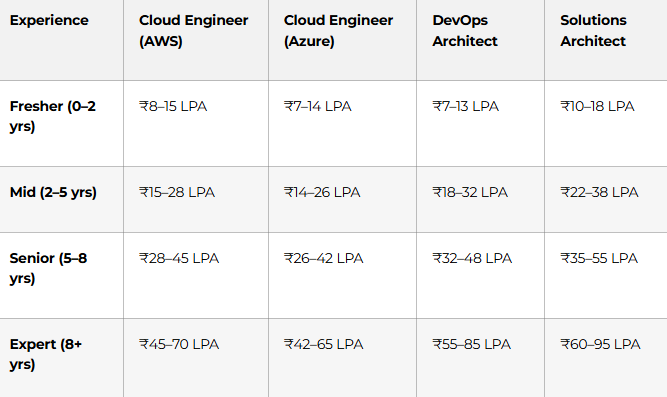
Cloud engineers consistently command the highest salaries in the technology sector:
Source: PayScale India 2025, Glassdoor Cloud Engineer Salaries
Future-Proof Career Path
Cloud engineering offers multiple specialization opportunities:
- Solutions Architecture – Design enterprise-scale cloud solutions
- DevOps Engineering – Automation, CI/CD, and deployment optimization
- Security Engineering – Cloud security, compliance, and risk management
- Data Engineering – Big data, analytics, and machine learning infrastructure
- Site Reliability Engineering – High-availability systems and performance optimization
Recession-Resistant Industry Demand
Cloud computing is considered essential infrastructure, making cloud engineers recession-resistant:
- Cost Optimization Focus – Organizations need cloud experts to reduce infrastructure costs
- Digital Transformation Acceleration – Economic pressures drive cloud adoption for efficiency
- Remote Work Requirements – Cloud infrastructure enables distributed workforce
- Innovation Investment – Companies invest in cloud technologies for competitive advantage
3. Complete Learning Roadmap (6-8 Months)
Phase 1: Cloud Fundamentals and Networking (Months 1-2)
Cloud Computing Concepts (2-3 weeks)
Understanding cloud fundamentals is essential before diving into specific platforms:
- Service Models – IaaS, PaaS, SaaS distinctions and use cases
- Deployment Models – Public, private, hybrid, multi-cloud strategies
- Cloud Economics – CAPEX vs OPEX, total cost of ownership, ROI calculations
- Shared Responsibility Model – Security and compliance boundaries between provider and customer
Networking Fundamentals (3-4 weeks)
Network knowledge is crucial for cloud architecture:
- TCP/IP and OSI Model – Understanding network layers and protocols
- DNS and Load Balancing – Domain name resolution and traffic distribution
- VPNs and Security – Site-to-site, point-to-site connectivity, encryption
- Subnetting and VLANs – Network segmentation and isolation strategies
Linux and Windows Server Basics (2-3 weeks)
- Command Line Proficiency – Essential commands for system administration
- File Systems and Permissions – Security models and access control
- Process Management – Services, background processes, resource monitoring
- Basic Scripting – Bash, PowerShell for automation tasks
Phase 2: AWS Core Services Mastery (Months 2-4)
Compute Services (3-4 weeks)
- Amazon EC2 – Instance types, pricing models, security groups, key pairs
- Auto Scaling – Horizontal and vertical scaling, launch configurations
- Elastic Load Balancing – Application, Network, and Classic load balancers
- AWS Lambda – Serverless computing, event-driven architecture, cost optimization
Storage and Databases (3-4 weeks)
- Amazon S3 – Storage classes, lifecycle policies, cross-region replication
- EBS and EFS – Block storage, file systems, backup and snapshot strategies
- Amazon RDS – Relational databases, Multi-AZ deployments, read replicas
- DynamoDB – NoSQL databases, partition keys, global secondary indexes
Networking and Security (2-3 weeks)
- Amazon VPC – Virtual private clouds, subnets, route tables, NAT gateways
- AWS IAM – Users, groups, roles, policies, multi-factor authentication
- AWS CloudTrail – Logging, monitoring, compliance, and audit trails
- AWS Config – Configuration management, compliance monitoring
Practical AWS Projects:
- Three-Tier Web Application – Web servers, application servers, database tier with load balancing
- Disaster Recovery Solution – Cross-region backup and failover implementation
- Cost Optimization Analysis – Right-sizing instances, reserved instance planning
Phase 3: Azure Platform Mastery (Months 4-6)
Azure Core Services (3-4 weeks)
- Azure Virtual Machines – VM sizes, availability sets, scale sets
- Azure App Service – Web apps, API apps, mobile backends, deployment slots
- Azure Functions – Serverless computing, triggers, bindings, durable functions
- Azure Container Instances – Container deployment, orchestration with AKS
Storage and Data Services (3-4 weeks)
- Azure Storage – Blob storage, file shares, queues, tables, data lake storage
- Azure SQL Database – Managed SQL, elastic pools, SQL Managed Instance
- Azure Cosmos DB – Globally distributed NoSQL, multiple consistency levels
- Azure Synapse Analytics – Data warehousing, big data analytics, machine learning
Networking and Security (2-3 weeks)
- Azure Virtual Network – VNets, subnets, network security groups, peering
- Azure Active Directory – Identity management, conditional access, B2B/B2C
- Azure Key Vault – Secrets management, encryption keys, certificates
- Azure Security Center – Security posture, threat detection, compliance
Azure-Specific Projects:
- Hybrid Identity Solution – On-premises Active Directory integration with Azure AD
- Microservices Architecture – Container-based application with Azure Kubernetes Service
- Data Analytics Pipeline – Ingestion, processing, and visualization with Azure services
Phase 4: DevOps and Infrastructure as Code (Months 6-8)
Infrastructure as Code (3-4 weeks)
- Terraform – Multi-cloud infrastructure provisioning, state management
- AWS CloudFormation – AWS-native infrastructure automation, stack management
- Azure Resource Manager – ARM templates, Bicep language, deployment automation
- Configuration Management – Ansible, Puppet, Chef for system configuration
CI/CD and DevOps (3-4 weeks)
- Git and Version Control – Branching strategies, pull requests, code review
- Jenkins/Azure DevOps – Build pipelines, automated testing, deployment pipelines
- Docker and Containers – Containerization, image management, registry services
- Kubernetes – Container orchestration, service mesh, monitoring and logging
Monitoring and Observability (2-3 weeks)
- AWS CloudWatch – Metrics, logs, alarms, dashboards, custom metrics
- Azure Monitor – Application Insights, log analytics, service health
- Third-party Tools – DataDog, New Relic, Splunk integration
- Alerting and Incident Response – On-call procedures, runbook automation
Advanced DevOps Projects:
- Multi-Environment CI/CD Pipeline – Development, staging, production with automated testing
- Infrastructure Monitoring Dashboard – Comprehensive observability and alerting system
- Blue-Green Deployment – Zero-downtime deployment strategy implementation
4.Essential Certfications and Career paths
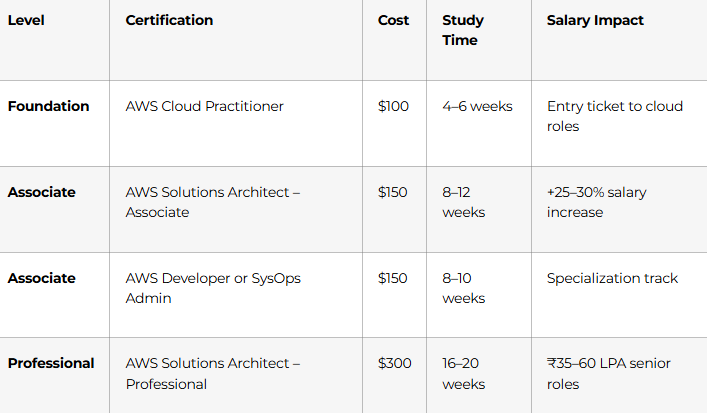
AWS Certification Roadmap
Foundation Level:
AWS Certified Cloud Practitioner
- Investment: $100 USD
- Prerequisites: None (beginner-friendly)
- Duration: 90 minutes, 65 questions
- Pass Rate: 88% (industry average)
- Focus Areas: Cloud concepts (26%), security and compliance (25%), technology (33%), billing and pricing (16%)
Associate Level:
AWS Certified Solutions Architect – Associate
- Investment: $150 USD
- Prerequisites: Cloud Practitioner recommended but not required
- Duration: 130 minutes, 65 questions
- Pass Rate: 72% (most popular AWS certification)
- Career Impact: Average salary increase of 25-30% upon completion
AWS Certified Developer – Associate
- Focus: Application development, deployment, and debugging on AWS
- Ideal for: Developers wanting to add cloud infrastructure skills
AWS Certified SysOps Administrator – Associate
- Focus: System operations on AWS, monitoring, troubleshooting
- Ideal for: System administrators transitioning to cloud
Professional Level:
AWS Certified Solutions Architect – Professional
- Investment: $300 USD
- Prerequisites: Associate-level certification and hands-on experience
- Duration: 180 minutes, 75 questions
- Pass Rate: 43% (highly challenging)
- Salary Impact: Senior architect roles with ₹35-60 LPA potential
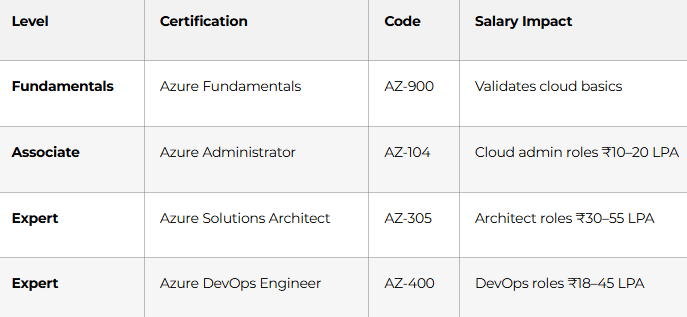
Azure Certification Pathway
Fundamentals:
Microsoft Azure Fundamentals (AZ-900)
- Investment: $99 USD
- Prerequisites: None
- Duration: 85 minutes, 40-60 questions
- Focus: Cloud concepts, Azure services, security, compliance, pricing
Role-Based Certifications:
Azure Administrator Associate (AZ-104)
- Focus: Managing Azure subscriptions, implementing storage, configuring networking
- Career Path: Azure Administrator → Senior Cloud Engineer → Cloud Architect
Azure Solutions Architect Expert (AZ-305)
- Prerequisites: Azure Administrator Associate
- Focus: Design monitoring, design identity and security, design data storage
- Salary Impact: Architect-level positions with ₹30-55 LPA compensation
Azure DevOps Engineer Expert (AZ-400)
- Focus: DevOps practices, CI/CD, infrastructure as code, monitoring
- Career Path: DevOps Engineer → Site Reliability Engineer → DevOps Architect
Certification Strategy and ROI
Certification Sequence Recommendation:
- Start with Fundamentals – AWS Cloud Practitioner OR Azure Fundamentals
- Choose Primary Platform – Focus on either AWS or Azure for associate level
- Add Complementary Skills – DevOps, security, or data specializations
- Professional Level – After 2-3 years of hands-on experience
Certification Preparation Timeline:
- Fundamentals: 4-6 weeks with consistent daily study
- Associate Level: 8-12 weeks with hands-on lab practice
- Professional Level: 16-20 weeks with real-world project experience
ROI Analysis:
- Immediate Impact: 15-25% salary increase upon first certification
- Career Acceleration: Faster promotions and leadership opportunities
- Global Recognition: Certifications valid worldwide for remote opportunities
- Continuous Learning: Access to exclusive training and beta programs
5. Building Your Cloud Portfolio
Portfolio Strategy and Architecture
Multi-Cloud Approach:
Demonstrate versatility by building projects that showcase both AWS and Azure capabilities:
- Infrastructure Solutions – Scalable, secure, and cost-optimized architectures
- DevOps Implementations – Automated deployment and monitoring systems
- Security and Compliance – Identity management, encryption, and audit solutions
- Data and Analytics – Big data processing and machine learning pipelines
Foundation Level Projects (Months 1-3)
- Static Website Hosting with Global CDN
- AWS Implementation: S3 + CloudFront + Route 53 + ACM
- Azure Implementation: Storage Account + CDN + Traffic Manager + Key Vault
- Skills Demonstrated: DNS management, SSL certificates, global distribution
- Business Value: Cost-effective web hosting with high performance and availability
- Technical Challenges: Custom domain setup, HTTPS configuration, cache optimization
- Three-Tier Web Application
- Architecture: Web tier (load balancer), application tier (auto-scaling), database tier (managed service)
- AWS Stack: ALB + EC2 Auto Scaling + RDS Multi-AZ
- Azure Stack: Application Gateway + VM Scale Sets + Azure SQL Database
- Security Features: Network isolation, encryption at rest and in transit, IAM policies
- Monitoring: CloudWatch/Azure Monitor dashboards, alerting, log aggregation
Intermediate Level Projects (Months 4-6)
- Disaster Recovery and Business Continuity
- Scenario: Multi-region deployment with automated failover capabilities
- AWS Implementation: Primary region (us-east-1), DR region (us-west-2), Route 53 health checks
- Azure Implementation: Primary region (East US), DR region (West US), Traffic Manager
- Recovery Objectives: RTO < 30 minutes, RPO < 5 minutes
- Cost Optimization: Use of cheaper storage tiers for backup, reserved instances for always-on resources
Implementation Example:
- DevOps Pipeline with Infrastructure as Code
- Source Control: Git repository with infrastructure code and application code
- CI/CD Platform: AWS CodePipeline + CodeBuild OR Azure DevOps
- Infrastructure Automation: Terraform or CloudFormation templates
- Testing Strategy: Unit tests, integration tests, security scanning, performance testing
- Deployment Strategy: Blue-green deployment with automated rollback capabilities
Advanced Level Projects (Months 6-8)
- Microservices Architecture with Container Orchestration
- Container Platform: Docker containers managed by Kubernetes (EKS/AKS)
- Service Mesh: Istio for service-to-service communication, security, and monitoring
- API Gateway: AWS API Gateway or Azure API Management for external access
- Data Persistence: Combination of relational and NoSQL databases for different services
- Observability: Prometheus + Grafana for metrics, ELK stack for centralized logging
Architecture Diagram:
- Data Lake and Analytics Platform
- Data Ingestion: Real-time streaming data from multiple sources
- Storage: AWS S3 Data Lake OR Azure Data Lake Storage Gen2
- Processing: AWS Glue + Athena OR Azure Synapse Analytics
- Machine Learning: SageMaker OR Azure Machine Learning
- Visualization: QuickSight OR Power BI embedded analytics
- Governance: Data catalog, lineage tracking, access controls
Portfolio Presentation and Documentation
GitHub Repository Structure:
Documentation Standards:
- Architecture Diagrams – Visual representation using draw.io or Lucidchart
- Cost Analysis – Detailed breakdown of resource costs and optimization strategies
- Security Assessment – Security controls implemented and compliance considerations
- Performance Metrics – Load testing results, response times, scalability measurements
- Lessons Learned – Challenges faced, solutions implemented, and future improvements
Live Demo Environment:
- Infrastructure Automation – One-click deployment using Terraform or ARM templates
- Clean-up Scripts – Automated resource deletion to minimize costs
- Demo Data – Realistic but anonymized datasets for functionality demonstration
- Monitoring Dashboards – Real-time metrics and health status displays
6. Job Search Strategy
Resume Optimization for Cloud Roles
Technical Skills Section:
Project Experience Examples:
Multi-Region Cloud Migration for E-commerce Platform
- Challenge: Legacy on-premises infrastructure causing 15% downtime during peak seasons, limited scalability
- Solution: Designed and implemented AWS multi-region architecture with auto-scaling, load balancing, and disaster recovery
- Technologies: EC2 Auto Scaling Groups, Application Load Balancer, RDS Multi-AZ, CloudFront CDN, Route 53
- Business Impact: Achieved 99.99% uptime, reduced infrastructure costs by 32%, improved page load times by 45%
DevOps Transformation and Automation Initiative
- Challenge: Manual deployment processes taking 4-6 hours, high error rates, no rollback capabilities
- Solution: Implemented end-to-end CI/CD pipeline with infrastructure as code and automated testing
- Technologies: Jenkins, Docker, Kubernetes, Terraform, AWS CodePipeline, CloudFormation
- Results: Reduced deployment time from 6 hours to 15 minutes, decreased deployment failures by 89%, enabled 20+ deployments per day
Cloud Job Market Landscape
High-Demand Role Categories:
- Cloud Solutions Architect (Mid to Senior Level)
- Salary Range: ₹18-45 LPA
- Open Positions: 2,100+ across India
- Key Responsibilities: Solution design, technical leadership, client consultation
- Growth Path: Senior Architect → Principal Architect → CTO/VP Engineering
- DevOps Engineer (All Levels)
- Salary Range: ₹8-35 LPA
- Open Positions: 3,500+ across India
- Key Responsibilities: CI/CD implementation, infrastructure automation, monitoring
- Growth Path: Senior DevOps → DevOps Architect → Site Reliability Engineering Lead
- Cloud Security Engineer (High Demand)
- Salary Range: ₹12-40 LPA
- Open Positions: 1,800+ across India
- Key Responsibilities: Security architecture, compliance, incident response
- Growth Path: Senior Security Engineer → Security Architect → CISO
Top Hiring Companies and Opportunities
Cloud-Native Companies:
- Amazon Web Services – Direct employment with cloud platform vendor
- Microsoft Azure – Cloud platform development and customer success roles
- Google Cloud Platform – Emerging market presence with aggressive hiring
- Salesforce – Cloud-based CRM platform requiring AWS/Azure expertise
Traditional Enterprises (Cloud Transformation):
- Banks and Financial Services – HDFC Bank, ICICI Bank, Axis Bank digital transformation
- Retail and E-commerce – Reliance Digital, Future Group, BigBasket cloud migration
- Healthcare – Apollo Hospitals, Fortis Healthcare patient data platforms
- Government – Digital India initiatives, smart city projects, e-governance platforms
Consulting and System Integrators:
- Accenture – Largest cloud consulting practice globally with 40,000+ cloud professionals
- Deloitte – Enterprise cloud transformation and modernization projects
- TCS, Infosys, Wipro – Cloud services delivery for global clients
- Cognizant, HCL – Digital engineering and cloud-native application development
Interview Preparation Framework
Technical Competency Areas:
Cloud Architecture and Design:
- “Design a highly available web application architecture on AWS/Azure”
- Multi-tier architecture with load balancing, auto-scaling, database replication
- Network design with public/private subnets, security groups, routing
- Disaster recovery strategy with cross-region backup and failover
- Cost optimization through reserved instances, spot instances, right-sizing
- “How would you migrate a legacy application to the cloud?”
- Assessment phase: application dependencies, data requirements, compliance needs
- Migration strategies: lift-and-shift, re-platforming, refactoring, rebuilding
- Risk mitigation: pilot migration, rollback procedures, parallel running
- Success metrics: performance, cost reduction, reliability improvements
Infrastructure as Code and Automation:
3. “Explain the benefits of Infrastructure as Code and demonstrate with an example”
Security and Compliance:
4. “How do you implement security best practices in cloud environments?”
- Identity and Access Management: least privilege principle, MFA, role-based access
- Network security: VPCs, security groups, NACLs, WAF, DDoS protection
- Data protection: encryption at rest and in transit, key management, backup strategies
- Compliance: audit logging, compliance frameworks, security monitoring
Cost Optimization and Performance:
5. “Describe strategies for optimizing cloud costs without compromising performance”
- Right-sizing: monitoring utilization, selecting appropriate instance types
- Purchasing options: reserved instances, savings plans, spot instances
- Resource lifecycle: automated start/stop, scheduled scaling, lifecycle policies
- Performance monitoring: identifying bottlenecks, optimization opportunities
Scenario-Based Questions:
6. “Your application is experiencing high latency during peak hours. How would you troubleshoot and resolve this?”
- Monitoring and metrics: CloudWatch, Application Insights, performance baselines
- Bottleneck identification: database queries, network latency, resource constraints
- Scaling strategies: horizontal vs vertical scaling, caching implementation
- Long-term solutions: architecture optimization, database tuning, CDN implementation
Salary Negotiation and Career Advancement
Market Research and Positioning:
- Geographic Premium – Bangalore and Mumbai offer 15-20% higher compensation
- Industry Variations – Financial services and healthcare pay 10-25% premiums
- Company Size Impact – Large enterprises offer stability, startups offer equity upside
- Remote Work Value – Global remote positions offer 40-60% higher compensation
Negotiation Strategy:
Value Proposition Framework:
- Certification Portfolio – AWS and Azure certifications with continuous learning commitment
- Project Impact – Quantified business results from cloud implementations
- Multi-Cloud Expertise – Ability to work across platforms and avoid vendor lock-in
- Leadership Potential – Experience mentoring teams and driving technical decisions
- Industry Knowledge – Understanding of specific business domains and compliance requirements
7. Salary Expectations and Career Growth
2025 Compensation Benchmarks by Experience
Entry Level (0-2 years):
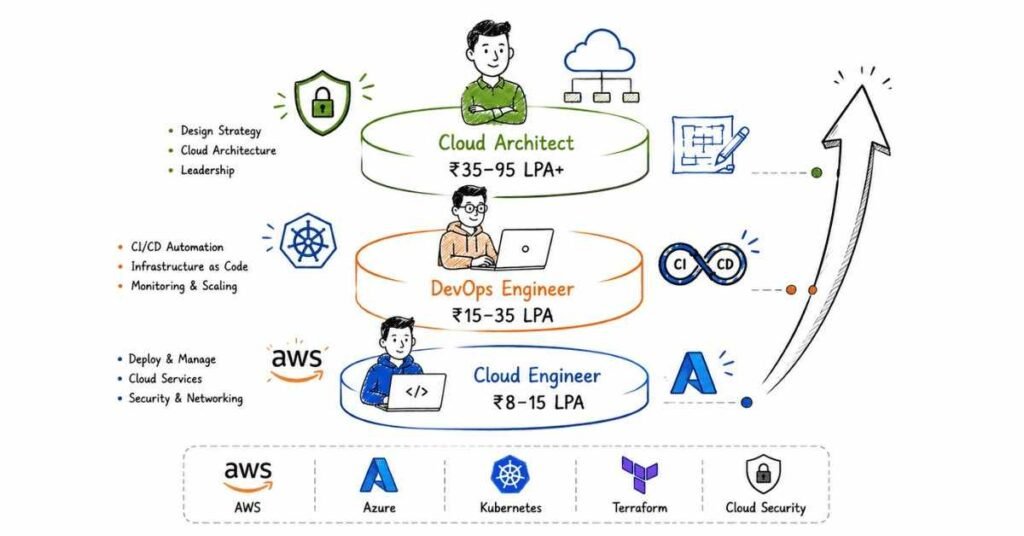
- Cloud Engineer: ₹8-15 LPA
- Junior DevOps Engineer: ₹7-13 LPA
- Associate Solutions Architect: ₹10-18 LPA
- Cloud Security Analyst: ₹9-16 LPA
Mid Level (2-5 years):
- Senior Cloud Engineer: ₹15-28 LPA
- DevOps Engineer: ₹18-32 LPA
- Solutions Architect: ₹22-38 LPA
- Cloud Security Engineer: ₹20-35 LPA
Senior Level (5-8 years):
- Principal Cloud Engineer: ₹28-45 LPA
- Senior DevOps Architect: ₹32-48 LPA
- Senior Solutions Architect: ₹35-55 LPA
- Cloud Security Architect: ₹38-58 LPA
Expert Level (8+ years):
- Distinguished Engineer: ₹45-70 LPA
- VP Engineering: ₹55-85 LPA
- Chief Architect: ₹60-95 LPA
- CTO/VP Cloud: ₹70-120 LPA
Industry and Geographic Variations
High-Paying Industries:
- Financial Services – 20-30% premium over general IT roles
- Healthcare and Life Sciences – 15-25% premium for compliance expertise
- E-commerce and Retail – 10-20% premium for scalability and performance
- Government and Defense – 25-35% premium for security clearance requirements
Geographic Salary Distribution:
- Bangalore – Highest cloud job concentration, 15-20% above national average
- Mumbai – Financial services hub, 12-18% premium for fintech cloud roles
- Pune and Hyderabad – Emerging cloud hubs, 8-12% above national average
- Delhi/NCR – Government and enterprise focus, 10-15% above national average
Career Progression Pathways
Technical Leadership Track:
Cloud Engineer (0-2 years)
↓
Senior Cloud Engineer (2-5 years)
↓
Principal Cloud Engineer (4-8 years)
↓
Distinguished Engineer (7-12 years)
↓
Chief Technology Officer (10+ years)
Solutions Architecture Track:
Associate Solutions Architect (1-3 years)
↓
Solutions Architect (3-6 years)
↓
Senior Solutions Architect (5-9 years)
↓
Principal Architect (8-15 years)
↓
VP/Director of Architecture (12+ years)
DevOps and Site Reliability Track:
DevOps Engineer (0-3 years)
↓
Senior DevOps Engineer (2-6 years)
↓
DevOps Architect (5-9 years)
↓
Site Reliability Engineering Lead (7-12 years)
↓
VP Infrastructure/Platform Engineering (10+ years)
Entrepreneurial and Consulting Track:
Cloud Consultant (2-5 years)
↓
Senior Consultant (4-8 years)
↓
Principal Consultant (6-12 years)
↓
Practice Lead (8-15 years)
↓
Independent Consultancy/Cloud Services Company (10+ years)
Skills for Accelerated Career Growth
Technical Mastery (Years 1-3):
- Multi-Cloud Proficiency – Avoid vendor lock-in, maximize opportunities
- Automation Excellence – Infrastructure as Code, CI/CD, configuration management
- Security Integration – Security-first architecture, compliance automation
- Cost Optimization – FinOps practices, resource optimization, budget management
Business and Leadership (Years 3-6):
- Solution Architecture – End-to-end design thinking, scalability planning
- Stakeholder Management – Executive communication, requirement gathering
- Project Leadership – Technical team coordination, delivery management
- Industry Expertise – Deep knowledge of 2-3 business verticals
Strategic Impact (Years 6+):
- Technology Strategy – Cloud-first transformation planning, vendor management
- Team Building – Hiring, mentoring, culture development, performance management
- Innovation Leadership – Emerging technology adoption, competitive differentiation
- Business Partnership – C-level engagement, strategic planning, ROI demonstration
Emerging Opportunities and Future Trends
High-Growth Specializations (2025-2028):
- FinOps Engineering – Cloud cost management and financial operations
- Kubernetes Platform Engineering – Container orchestration and service mesh
- Edge Computing – IoT, 5G, distributed computing architectures
- AI/ML Infrastructure – Machine learning operations, model deployment pipelines
- Sustainability Engineering – Green cloud, carbon footprint optimization
Market Trends Creating New Roles:
- Cloud-Native Security – Zero-trust architecture, container security, DevSecOps
- Multi-Cloud Management – Cloud orchestration, data portability, vendor optimization
- Serverless Architecture – Function-as-a-Service, event-driven computing
- Hybrid Cloud Integration – On-premises to cloud connectivity, edge computing
8. Success Stories from Our Students
Vikash Singh – From System Administrator to Cloud Architect
Background: 8 years as Windows system administrator in traditional IT infrastructure
Challenge: Legacy skills becoming obsolete, limited career growth in on-premises infrastructure
Transformation Strategy: Systematic transition to cloud architecture with focus on AWS
Timeline: 14 months from course enrollment to AWS Solutions Architect role
Current Position: Principal Cloud Architect at Tech Mahindra
Salary Progression: ₹12.5 LPA → ₹18.2 LPA → ₹26.8 LPA → ₹38.5 LPA (over 30 months)
Vikash’s Strategic Approach:
- Certification Roadmap – AWS Cloud Practitioner → Solutions Architect Associate → Professional
- Hands-on Experience – Built 15+ portfolio projects during learning phase
- Industry Specialization – Focused on healthcare and compliance-heavy implementations
- Community Leadership – Became AWS User Group organizer in Delhi, regular conference speaker
Key Success Factors:
- Bridge Legacy Knowledge – “My Windows Server experience actually helped with EC2 and hybrid cloud scenarios. I could speak the language of traditional IT teams and help them understand cloud benefits.”
- Practical Application – “I didn’t just study for certifications—I built real solutions. My portfolio showed actual architectures I could deploy, not just theoretical knowledge.”
- Network Building – “Joining the AWS community in Delhi connected me with hiring managers and led to multiple job opportunities. Community involvement is essential for career acceleration.”
Current Impact: Leading cloud transformation initiatives for Fortune 500 healthcare companies, managing architectural decisions for $5M+ annual cloud spend, responsible for compliance across 12 countries.
Priya Agarwal – From Developer to DevOps Architect
Background: 6 years as Java developer with limited infrastructure knowledge
Challenge: Wanted to expand beyond application development into full-stack engineering
Strategic Focus: DevOps practices with strong emphasis on automation and site reliability
Timeline: 16 months from course start to DevOps Architect role at fintech startup
Career Trajectory: Java Developer → Cloud Developer → DevOps Engineer → DevOps Architect
Current Role: Head of Platform Engineering at Razorpay
Compensation and Equity Growth:
- Pre-transition: ₹14.2 LPA (Senior Java Developer)
- Year 1: ₹19.8 LPA (Cloud Developer at mid-size company)
- Year 2: ₹28.5 LPA (DevOps Engineer at fintech startup)
- Current: ₹42.3 LPA + equity worth ₹1.2 crores (Head of Platform Engineering)
Priya’s DevOps Transformation:
- Technology Mastery – Kubernetes, Terraform, AWS EKS, monitoring stack (Prometheus, Grafana, ELK)
- Cultural Change – Implemented DevOps practices across 8 development teams, reduced deployment failures by 94%
- Scale Management – Built platform supporting 100M+ transactions per month with 99.99% uptime
- Team Leadership – Grew platform engineering team from 3 to 18 engineers across multiple specializations
Innovation and Impact:
- Cost Optimization – Reduced AWS spending by ₹2.4 crores annually through rightsizing and automation
- Developer Productivity – Decreased time-to-market for new features from 6 weeks to 3 days
- Reliability Engineering – Implemented SRE practices, achieved industry-leading availability metrics
- Open Source Contribution – Created internal tools later open-sourced, gaining 2,000+ GitHub stars
Leadership Insights: “The combination of development experience and cloud infrastructure knowledge is incredibly powerful. I understood both sides—what developers need and what operations requires. This bridge perspective accelerated my career into leadership roles.”
Rohit Kumar – From Fresher to Independent Cloud Consultant
Background: Recent computer science graduate with academic cloud projects but no industry experience
Challenge: Competitive fresher market with limited practical experience beyond coursework
Entrepreneurial Vision: Building independent consulting practice specializing in small-to-medium business cloud adoption
Timeline: 20 months from graduation to established consultancy with recurring clients
Business Evolution: Freelancer → Consultant → Boutique Firm Owner
Revenue Growth Trajectory:
- Months 1-6: ₹25,000/month (part-time projects while job searching)
- Months 7-12: ₹78,000/month (full-time consulting with 3-4 active clients)
- Months 13-18: ₹1,85,000/month (team of 2, handling larger implementations)
- Current: ₹3,25,000/month (5-person team, enterprise client engagements)
Rohit’s Market Positioning Strategy:
- Niche Focus – Small business cloud adoption, specifically restaurants and retail chains
- Value Proposition – “Enterprise-grade cloud solutions at SMB-friendly prices”
- Service Model – Fixed-price implementations with ongoing managed services
- Geographic Expansion – Started in Jaipur, now serving clients across 6 states
Business Development Approach:
- Content Marketing – YouTube channel with 45,000+ subscribers, teaching cloud basics to business owners
- Partnership Strategy – Alliances with local IT vendors, accounting firms, business consultants
- Customer Success Focus – 98% client retention rate, average engagement duration 24+ months
- Scalable Processes – Developed cloud adoption accelerators, reducing implementation time by 60%
Technical and Business Growth:
- Certification Portfolio – AWS Solutions Architect Professional, Azure Solutions Architect Expert
- Industry Recognition – AWS Community Builder, speaker at 8 regional conferences
- Thought Leadership – Published research on cloud adoption challenges for Indian SMBs
- Team Development – Mentored 12 junior engineers, 8 now working at major cloud consulting firms
Entrepreneurial Success Factors: “I realized that while everyone focuses on enterprise cloud, small businesses have huge unmet needs. By specializing in this market and building repeatable processes, I created a sustainable business model that scales without competing directly with large consulting firms.”
9. Common Challenges and Solutions
Challenge 1: Information Overload and Service Complexity
Problem: AWS offers 200+ services, Azure offers 600+ services, creating analysis paralysis
Impact: Students struggle to know where to focus, leading to surface-level knowledge across many services
Symptoms: Jumping between services without mastering fundamentals, poor architectural decisions
Strategic Learning Framework:
Phase 1: Core Services Mastery (80% of time)
Focus on services that form the foundation of most architectures:
- Compute: EC2/Virtual Machines, Lambda/Functions, Auto Scaling
- Storage: S3/Blob Storage, EBS/Managed Disks, databases (RDS/SQL Database)
- Networking: VPC/Virtual Networks, Load Balancers, CDN
- Security: IAM/Azure AD, security groups, encryption
Phase 2: Specialized Services (20% of time)
Add services based on career path and industry focus:
- DevOps Path: CodePipeline/Azure DevOps, ECS/Container Instances, CloudFormation/ARM
- Data Path: Redshift/Synapse, EMR/HDInsight, Kinesis/Event Hubs
- AI/ML Path: SageMaker/Machine Learning, Rekognition/Cognitive Services
Practical Implementation Strategy:
Weekly Learning Schedule:
Monday-Wednesday: Deep dive into 1 core service with hands-on labs
Thursday: Integration practice – combine 2-3 services in a project
Friday: Documentation and knowledge consolidation
Weekend: Industry reading and architecture case studies
Challenge 2: Hands-On Experience Without Enterprise Access
Problem: Many cloud concepts require enterprise-scale implementations to understand fully
Limitation: Free tier limitations, cost concerns, lack of realistic data and scenarios
Solution: Creative approaches to simulate enterprise environments
Cost-Effective Practice Strategies:
Free Tier Maximization:
- AWS Free Tier: 12 months of free compute, storage, and database services
- Azure Free Account: $200 credit for first 30 days, then always-free services
- Multi-Account Strategy: Use multiple email addresses for extended free tier access
- Spot Instances: Use spot instances for development and testing at 60-90% discount
Simulation Techniques:
# Example: Simulating high-availability architecture on free tier
# Primary region (us-east-1)
aws ec2 run-instances –image-id ami-0abcdef1234567890 \
–instance-type t2.micro –subnet-id subnet-12345 \
–security-group-ids sg-12345 –tag-specifications \
‘ResourceType=instance,Tags=[{Key=Name,Value=web-primary-1}]’
# Secondary region (us-west-2) – simulated DR
aws ec2 run-instances –region us-west-2 \
–image-id ami-0fedcba0987654321 –instance-type t2.micro \
–subnet-id subnet-67890 –security-group-ids sg-67890
Open Source and Community Resources:
- LocalStack – Run AWS services locally for development and testing
- Azure CLI/PowerShell – Practice infrastructure automation without cloud costs
- Terraform Providers – Test infrastructure code with terraform plan without deployment
- Community Labs – A Cloud Guru, Linux Academy sandbox environments
Challenge 3: Certification Preparation vs. Real-World Skills Gap
Problem: Certification exams focus on breadth of knowledge, real jobs require depth of implementation
Symptom: Passing certifications but struggling with practical implementation in interviews
Solution: Balanced approach combining certification study with hands-on project work
Integrated Learning Approach:
Certification-Driven Project Selection:
For each certification objective, create a corresponding hands-on project:
AWS Solutions Architect Associate Example:
- Domain 1 (Design Resilient Architectures): Build multi-AZ web application with auto-scaling
- Domain 2 (Design High-Performing Architectures): Implement caching layers and CDN
- Domain 3 (Design Secure Applications): Implement IAM policies and encryption
- Domain 4 (Design Cost-Optimized Architectures): Analyze and optimize resource costs
Real-World Scenario Integration:
Certification Question: “Which AWS service provides the lowest latency for static content?”
Answer: CloudFront
Real-World Implementation:
1. Set up S3 bucket for static website hosting
2. Configure CloudFront distribution with custom domain
3. Implement SSL certificate with ACM
4. Set up invalidation automation for content updates
5. Monitor performance improvements and cost impact
Interview Preparation Strategy:
- Technical Storytelling – Prepare 5-7 detailed project stories with challenges, solutions, results
- Architecture Diagrams – Practice drawing solutions on whiteboard or digital tools
- Troubleshooting Scenarios – Prepare for “What would you do if…” questions
- Cost Justification – Always include business impact and cost considerations
Challenge 4: Staying Current with Rapid Platform Evolution
Problem: AWS and Azure release new services and features weekly, creating continuous learning pressure
Challenge: Fear of knowledge becoming obsolete, difficulty prioritizing learning areas
Solution: Strategic approach to continuous learning and knowledge management
Information Management Framework:
Tier 1: Must-Know Updates (High Priority)
- Service updates affecting core infrastructure (EC2, compute, networking)
- Security and compliance changes
- Pricing model modifications
- Certification exam updates
Tier 2: Should-Know Updates (Medium Priority)
- New services in your specialization area
- Performance improvements and new features
- Regional expansion and availability
- Integration improvements with existing services
Tier 3: Nice-to-Know Updates (Low Priority)
- Experimental services and previews
- Services outside your career focus
- Minor feature enhancements
- Marketing and naming changes
Continuous Learning System:
Daily (15 minutes):
– Scan AWS/Azure blogs and release notes
– Check community forums for trending discussions
Weekly (2 hours):
– Deep dive into 1 relevant new service or feature
– Update personal knowledge base and lab environment
– Participate in community discussions
Monthly (4 hours):
– Evaluate and plan learning priorities for next month
– Update portfolio projects with new capabilities
– Review and update certification study materials
Knowledge Management Tools:
- Personal Wiki – Notion, Obsidian, or OneNote for organized knowledge capture
- Code Repository – GitHub for infrastructure code samples and templates
- Practice Environment – Dedicated AWS/Azure accounts for experimentation
Learning Network – Slack communities, LinkedIn groups, local meetups
10. Your Next Steps
Week 1: Foundation and Environment Setup
Day 1-2: Account Creation and Free Tier Setup
- Create AWS Free Tier Account – 12 months of free compute, storage, and database services
- Create Azure Free Account – $200 credit for first 30 days plus always-free services
- Set up Billing Alerts – Prevent accidental charges, set $10-20 monthly budgets
- Install CLI Tools – AWS CLI, Azure CLI, kubectl for command-line management
Day 3-4: Core Service Exploration
- Launch First Virtual Machine – EC2 instance and Azure VM with web server
- Create Storage Resources – S3 bucket and Azure Storage Account with sample files
- Configure Basic Networking – Security groups, network security groups, public/private access
- Practice Console Navigation – Familiarize with both AWS and Azure management portals
Day 5-7: Learning Path Planning
- Choose Primary Platform – Decide between AWS-first or Azure-first learning approach
- Set Certification Goals – Select first certification target with 3-month timeline
- Join Communities – AWS/Azure user groups, Reddit communities, Discord servers
- Create Study Schedule – Allocate daily learning time and weekend project work
Month 1: Cloud Fundamentals and Core Services
Week 1-2: Compute and Storage Mastery
- Virtual Machines – Instance types, pricing models, security, scaling strategies
- Storage Services – Object storage, block storage, file systems, backup strategies
- Basic Networking – VPCs, subnets, routing, load balancing fundamentals
- Identity Management – User accounts, roles, permissions, multi-factor authentication
Week 3-4: Database and Application Services
- Managed Databases – Relational and NoSQL options, backup, scaling, performance
- Application Services – Load balancers, content delivery, API gateways
- Security Fundamentals – Encryption, certificates, compliance, monitoring
- Cost Management – Pricing models, cost optimization, budgeting, reporting
Month-End Project: “Three-Tier Web Application”
- Web tier with load balancer and auto-scaling
- Application tier with multiple servers and session management
- Database tier with managed service and backup strategy
- Complete documentation and cost analysis
Month 2: Advanced Services and Automation
Week 1-2: Infrastructure as Code
- Terraform Basics – Resource definition, state management, modularconstruction
- Platform-Native Tools – CloudFormation (AWS) or ARM Templates (Azure)
- Version Control – Git workflows for infrastructure code, collaboration practices
- Deployment Automation – CI/CD pipelines for infrastructure deployment
Week 3-4: Monitoring and DevOps
- Monitoring Services – CloudWatch, Azure Monitor, custom metrics, alerting
- Log Management – Centralized logging, search, analysis, retention policies
- Container Services – Docker, Kubernetes, managed container platforms
- CI/CD Platforms – Jenkins, AWS CodePipeline, Azure DevOps integration
Advanced Learning Goals:
- Complete Cloud Practitioner/Fundamentals Certification – Validate basic knowledge
- Build Infrastructure Automation – Terraform or CloudFormation templates
- Contribute to Open Source – Submit improvements to cloud-related projects
Month 3: Specialization and Certification Preparation
Week 1-2: Choose Specialization Path
- Solutions Architecture – Design patterns, scalability, disaster recovery
- DevOps Engineering – Automation, monitoring, reliability, performance optimization
- Security Engineering – Compliance, identity, encryption, incident response
- Data Engineering – Big data, analytics, machine learning, data pipelines
Week 3-4: Certification Intensive Preparation
- Official Study Materials – AWS/Azure training courses, documentation deep-dives
- Practice Exams – Multiple providers, identify knowledge gaps, time management
- Hands-On Labs – Certification-specific scenarios, timed practical exercises
- Study Groups – Join online communities, local meetups, peer learning
Portfolio Expansion:
- Specialty Projects – Build 2-3 projects demonstrating chosen specialization
- Architecture Documentation – Create detailed diagrams and technical specifications
- Blog Writing – Document learning journey, share insights and challenges
- Community Engagement – Answer questions in forums, help other learners
Long-Term Milestones (6-12 Months)
Professional Certification Achievement:
- Associate Level Certification – AWS Solutions Architect Associate or Azure Administrator
- Advanced Certifications – Professional level or specialized certifications
- Multi-Cloud Competency – Demonstrate skills across both AWS and Azure platforms
- Continuous Learning – Stay updated with platform changes and new services
Career Transition Activities:
- Resume Optimization – Highlight cloud projects, certifications, measurable impact
- Interview Preparation – Technical scenarios, architectural discussions, problem-solving
- Network Building – Professional connections through conferences, meetups, online communities
- Salary Research – Market rates, negotiation strategies, total compensation analysis
Portfolio and Professional Presence:
- GitHub Portfolio – 8-10 comprehensive projects with documentation and automation
- Professional Blog – Regular technical writing demonstrating expertise and learning
- Conference Speaking – Present at local meetups, user groups, technology conferences
- Mentoring Others – Guide newcomers, contribute to learning communities
Conclusion
Cloud engineering represents the pinnacle of career opportunities in today’s technology landscape, offering exceptional compensation, job security, and the chance to work on transformational projects that shape how organizations operate in the digital age. The convergence of digital transformation, remote work adoption, and data-driven business models has made cloud expertise not just valuable but absolutely essential.
The journey from cloud beginner to professional typically requires 6-8 months of dedicated learning and hands-on practice, but the investment delivers immediate returns through high-demand job opportunities and long-term career growth potential. Unlike many technology specializations that become obsolete within a few years, cloud engineering skills compound over time, with each certification and project adding cumulative value to your professional profile.
Critical Success Factors for Cloud Engineering Excellence:
- Multi-Platform Proficiency – Master both AWS and Azure to maximize opportunities and avoid vendor lock-in
- Hands-On Experience – Build real solutions that demonstrate practical problem-solving abilities
- Certification Strategy – Systematic progression through vendor certifications for credibility and knowledge validation
- Automation Mindset – Infrastructure as Code, CI/CD, and operational automation are core competencies
- Business Impact Focus – Understand how cloud solutions drive cost reduction, scalability, and competitive advantage
The most successful cloud engineers combine deep technical expertise with business acumen and communication skills. As organizations become increasingly cloud-native, the role of cloud engineers evolves from infrastructure implementers to strategic advisors who influence technology decisions and business outcomes.
Whether you choose the solutions architecture path, DevOps engineering track, or specialized areas like security or data engineering, cloud skills provide a foundation for long-term career growth and financial security in an increasingly digital world.
Ready to launch your cloud engineering career and join the highest-paid professionals in technology?
Explore our comprehensive AWS & Azure Cloud Engineering Program designed for career changers and aspiring cloud professionals:
6-month intensive curriculum covering AWS, Azure, DevOps, and Infrastructure as Code
Dual-certification preparation for AWS Solutions Architect and Azure Administrator exams
Hands-on portfolio projects with real-world scenarios and business impact documentation
Industry mentorship from certified cloud architects and principal engineers
Job placement assistance with resume optimization, technical interview coaching, and employer connections
Cloud lab environment with 24/7 access to AWS and Azure resources for practical learning
Lifetime learning support including platform updates, new certification paths, and alumni network
Unsure which cloud specialization aligns with your background and career goals? Schedule a free cloud career assessment with our certified cloud architects to receive personalized guidance and a customized learning roadmap.
Connect with our cloud engineering community: Join our Cloud Engineers WhatsApp Group with 280+ students, alumni, and working cloud professionals for daily learning support, project collaboration, and job referrals.