How to Become a Salesforce Developer: Complete Career Guide 2025 [₹12L Average Salary]
Master the world’s #1 CRM platform and unlock premium career opportunities with Salesforce
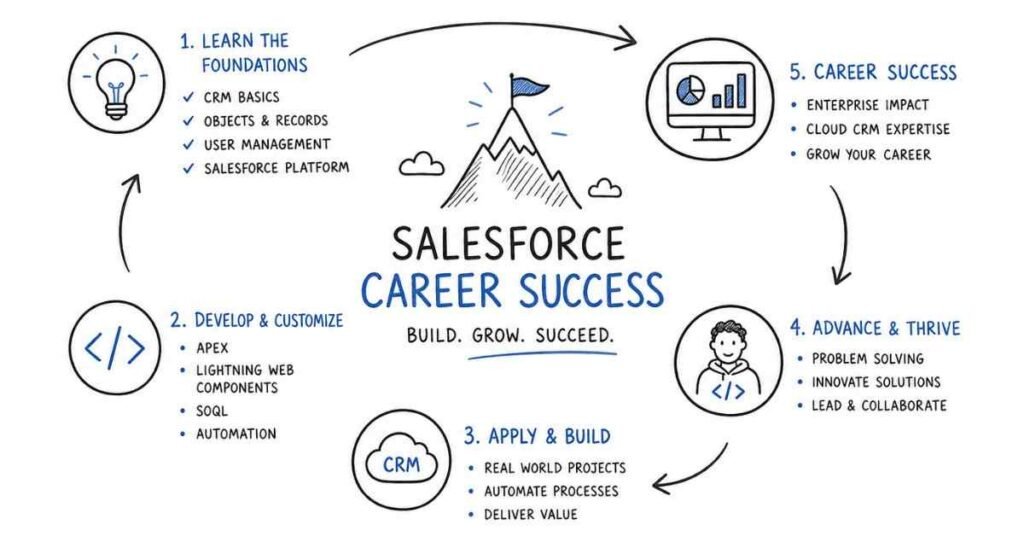
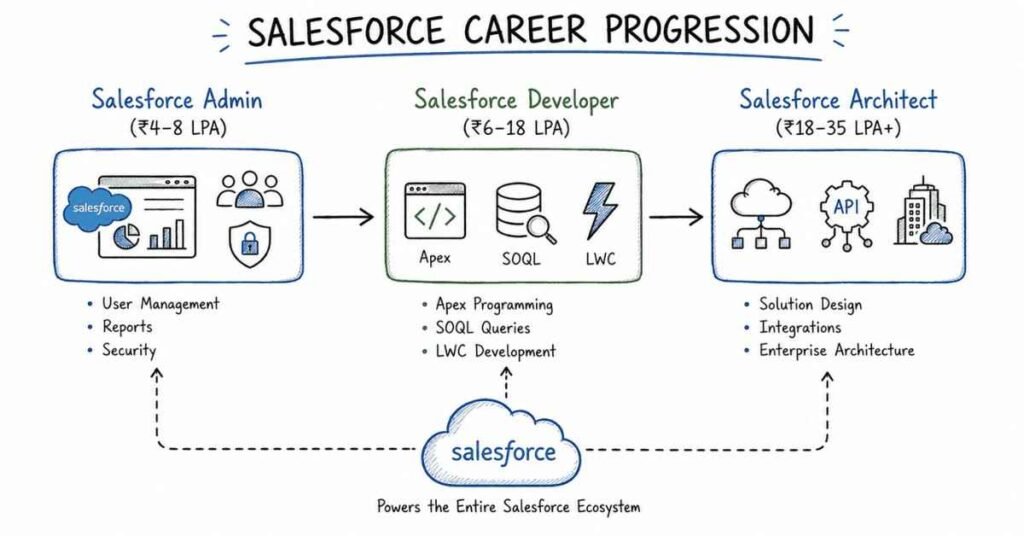
Salesforce developers are among the highest-paid professionals in the CRM industry, with average salaries ranging from ₹6-18 LPA in India and potentially reaching ₹35+ LPA for architects and consultants. As organizations worldwide accelerate their digital transformation journeys, Salesforce expertise has become one of the most valuable and recession-proof skills in technology.
Whether you’re a recent graduate, career switcher, or IT professional looking to specialize, this comprehensive guide reveals the exact roadmap to building a successful Salesforce development career. Having trained over 300 Salesforce professionals at Frontlines EduTech with an 92% job placement rate, I’ll share the proven strategies that consistently work in 2025.
What you’ll master in this guide:
- Complete Salesforce developer roadmap with certification paths
- Essential skills and technologies for different Salesforce roles
- Salary benchmarks and career progression opportunities
- Job search tactics and interview preparation strategies
- Real success stories and lessons from our top performers
1. What is Salesforce Development?
Salesforce development involves customizing and extending the Salesforce platform to meet specific business requirements using both declarative (point-and-click) and programmatic (code-based) approaches. Unlike traditional software development, Salesforce developers work within a powerful ecosystem that provides built-in security, scalability, and integration capabilities.
Types of Salesforce Development:
Declarative Development (Configuration Focus):
- Custom Objects and Fields – Business-specific data models
- Workflow Rules and Process Builder – Automated business processes
- Flow Builder – Complex automation and user interfaces
- Reports and Dashboards – Business intelligence and analytics
- Permission Sets and Profiles – Security and access control
Programmatic Development (Custom Code Focus):
- Apex Programming – Server-side business logic development
- Lightning Web Components (LWC) – Modern UI component framework
- Visualforce Pages – Custom user interfaces (legacy but still used)
- API Integrations – External system connectivity
- Custom Applications – Complete business solutions
Salesforce Platform Ecosystem:
Core Clouds:
- Sales Cloud – Lead management, opportunity tracking, sales process automation
- Service Cloud – Case management, knowledge base, customer service automation
- Marketing Cloud – Email marketing, customer journeys, campaign automation
- Commerce Cloud – E-commerce platform for B2B and B2C businesses
- Platform/App Cloud – Custom application development environment
Development Tools:
- Salesforce CLI (SFDX) – Command-line development interface
- Visual Studio Code + Extensions – Modern development environment
- Developer Console – In-platform development and debugging
- Workbench – Web-based tool for API testing and data operations
- Postman – REST API testing and documentation
2. Why Choose Salesforce in 2025?
Massive Global Market Demand
According to Salesforce‘s latest Ecosystem Report, the Salesforce ecosystem will create 4.2 million new jobs globally by 2026, with India being the fastest-growing market. Major Indian companies across industries are rapidly adopting Salesforce:
Banking and Financial Services:
- HDFC Bank, ICICI Bank, Axis Bank, Kotak Mahindra Bank, Yes Bank
Technology and Consulting:
- Accenture (15,000+ Salesforce professionals), Deloitte, IBM, Capgemini, TCS, Wipro
Healthcare and Life Sciences:
- Apollo Hospitals, Fortis Healthcare, Dr. Reddy’s Laboratories, Cipla
Retail and E-commerce:
- Future Group, Shoppers Stop, Myntra, BigBasket, Urban Ladder
Premium Compensation Packages
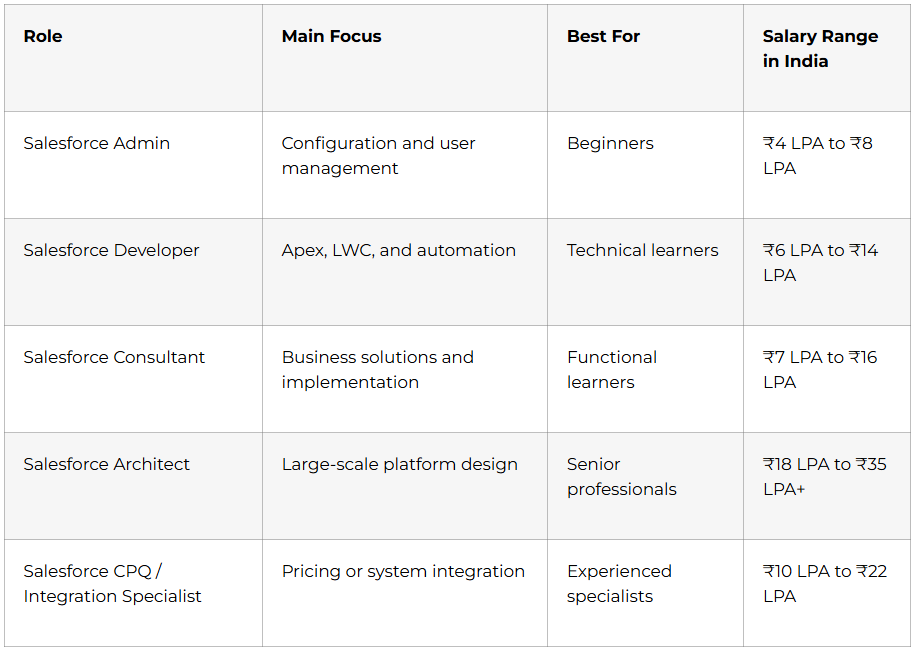
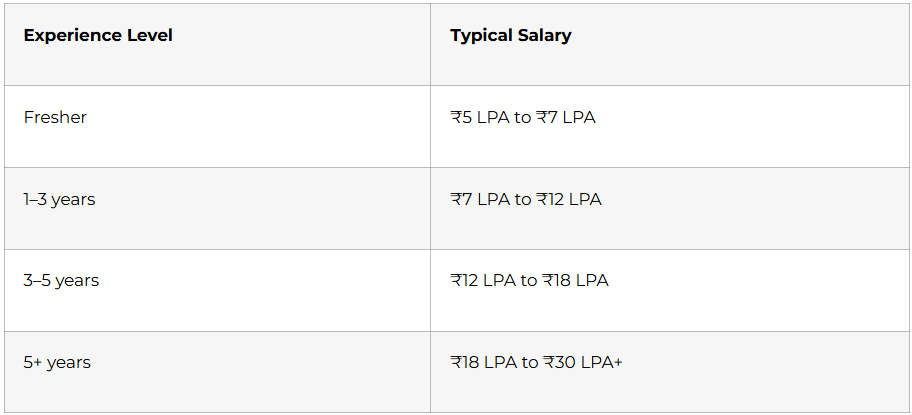
Salesforce professionals consistently command among the highest salaries in the Indian IT market:
Source: PayScale India 2025 and Glassdoor Salary Insights
Multiple Career Progression Paths
Salesforce expertise opens diverse career trajectories:
Technical Specialization Track:
- Developer → Senior Developer → Technical Architect → Principal Architect → CTO
Functional Expertise Track:
- Admin → Senior Admin → Business Analyst → Solution Architect → VP of Operations
Consulting and Implementation Track:
- Associate Consultant → Senior Consultant → Principal Consultant → Practice Lead → Partner
Product and Innovation Track:
- Product Specialist → Product Manager → Senior Product Manager → VP of Product
Platform Stability and Innovation
Salesforce has consistently maintained its position as the world’s #1 CRM platform for over 8 years running, with:
- 150,000+ companies using Salesforce globally
- $26+ billion annual revenue demonstrating platform stability
- 3 major releases per year with continuous innovation
- 99.9% uptime guarantee ensuring reliability for business-critical applications
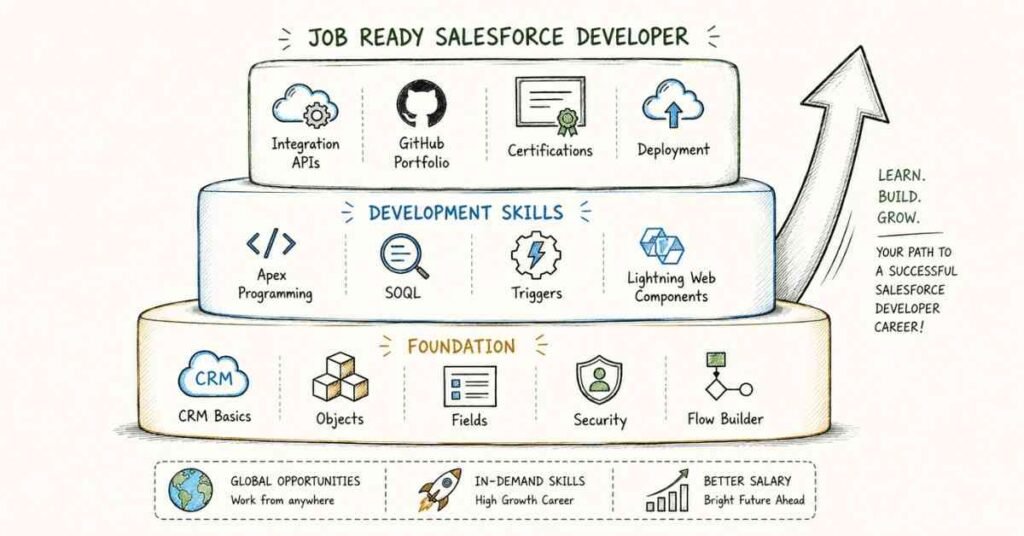
3. Complete Learning Roadmap (4-6 Months)
Phase 1: Salesforce Fundamentals (Month 1)
Platform Basics and Navigation (2-3 weeks)
- Salesforce Architecture – Multi-tenant platform, metadata-driven development
- User Interface Mastery – Lightning Experience navigation, app builder, setup menu
- Standard Objects Deep Dive – Accounts, Contacts, Leads, Opportunities, Cases
- Data Model Understanding – Object relationships, field types, record types
- Security Framework – Organization-wide defaults, role hierarchy, profiles, permission sets
Configuration Essentials (1-2 weeks)
- Custom Objects and Fields – Business requirement analysis and implementation
- Page Layouts and Record Types – User experience optimization
- Validation Rules – Data integrity and business rule enforcement
- Formula Fields – Automated calculations and data derivation
- Roll-up Summary Fields – Automated aggregation across related records
Hands-on Learning Project:
Build a “Student Management System” covering:
- Custom objects (Students, Courses, Enrollments)
- Relationships between objects
- Validation rules for data quality
- Formula fields for GPA calculations
- Page layouts optimized for different user types
Phase 2: Process Automation and Analytics (Month 2)
Workflow and Process Automation (3-4 weeks)
- Workflow Rules – Field updates, email alerts, task creation
- Process Builder – Complex business process automation
- Flow Builder – Advanced automation with decision logic
- Approval Processes – Multi-step approval workflows
- Assignment Rules – Automated record routing
Reports and Dashboards (1-2 weeks)
- Report Types and Formats – Tabular, summary, matrix, joined reports
- Advanced Reporting – Cross-filters, bucket fields, custom formulas
- Dashboard Creation – Interactive visualizations and KPI tracking
- Einstein Analytics Basics – AI-powered insights and predictions
Practical Implementation Project:
Create a “Sales Performance Management System”:
- Lead to opportunity conversion automation
- Automated sales stage progression workflows
- Commission calculation using formula fields
- Sales performance dashboards with drill-down capabilities
- Manager approval processes for discount requests
Phase 3: Salesforce Development (Months 3-4)
Apex Programming Mastery (4-6 weeks)
- Apex Syntax and Fundamentals – Variables, operators, control structures
- Object-Oriented Programming in Apex – Classes, interfaces, inheritance
- SOQL and SOSL Queries – Database operations and search functionality
- Triggers and Trigger Frameworks – Event-driven programming best practices
- Exception Handling – Error management and debugging techniques
- Governor Limits – Platform constraints and bulkification strategies
- Testing in Salesforce – Unit tests, test data creation, code coverage
Lightning Development (4-5 weeks)
- Lightning Web Components (LWC) – Modern component framework
- Component Lifecycle – Creation, rendering, and destruction phases
- Data Binding and Event Handling – Two-way data flow and user interactions
- Lightning Data Service – Standardized data access without Apex
- Component Communication – Parent-child and sibling component interaction
- Lightning App Builder – Drag-and-drop application creation
Advanced Development Projects:
- Custom Trigger Framework – Reusable trigger handler for multiple objects
- Lightning Web Component Suite – Interactive components for opportunity management
- API Integration Project – Connect Salesforce with external payment system
- Batch Processing Application – Handle large data volumes efficiently
Phase 4: Integration and Advanced Topics (Months 5-6)
API Integration and External Connectivity (3-4 weeks)
- REST API Development – Creating and consuming RESTful services
- SOAP API Integration – Legacy system connectivity
- Platform Events – Real-time event-driven architecture
- Salesforce Connect – External data integration without ETL
- Streaming API – Real-time data synchronization
Advanced Development Concepts (2-3 weeks)
- Custom Metadata Types – Configuration-driven development
- Packaging and Deployment – Change sets, unmanaged/managed packages
- Salesforce DX – Modern development lifecycle and source control
- Performance Optimization – Query optimization, caching strategies
- Security Best Practices – Secure coding, CRUD/FLS enforcement
Capstone Project Options:
Choose one comprehensive project demonstrating full-stack Salesforce skills:
- Complete CRM Solution for Real Estate
- Property management with custom objects
- Lead nurturing automation workflows
- Client portal using Experience Cloud
- Integration with property listing APIs
- Advanced reporting and analytics dashboard
- Employee Onboarding and HR Management System
- Multi-step onboarding process automation
- Document management and e-signature integration
- Performance review workflows
- Employee self-service portal
- Integration with payroll and HRMS systems
- Event Management Platform
- Event registration and payment processing
- Automated email marketing campaigns
- Mobile-responsive registration forms
- Real-time attendance tracking
- Post-event survey automation and analysis
4. Essential Salesforce Certifications
Administrator Certification Track
- Salesforce Certified Administrator
- Investment: $200 USD (₹16,000 approximately)
- Prerequisites: None (beginner-friendly)
- Exam Format: 65 multiple-choice questions, 105 minutes
- Passing Score: 65% (42 correct answers)
- Key Topics: Configuration and setup (20%), object manager and Lightning App Builder (20%), sales and marketing applications (12%), service and support applications (11%), activity management and collaboration (7%), data and analytics management (14%), workflow/process automation (16%)
Preparation Strategy:
- Study Duration: 2-3 months with consistent daily practice
- Official Resources: Trailhead modules, Salesforce Administrator Study Guide
- Hands-on Practice: Minimum 40 hours in Developer/Playground orgs
- Practice Tests: Take multiple mock exams to identify weak areas
- Success Rate: 68% pass rate (industry average)
- Salesforce Certified Advanced Administrator
- Investment: $200 USD
- Prerequisites: Valid Salesforce Administrator certification
- Exam Complexity: Significantly more difficult than Administrator exam
- Key Focus Areas: Advanced configuration, complex business processes, data management, analytics, and security implementation
Developer Certification Track
- Platform Developer I
- Investment: $200 USD
- Prerequisites: None, but strong programming background recommended
- Exam Details: 60 multiple-choice questions, 105 minutes
- Passing Score: 68% (41 correct answers)
- Technical Focus: Apex programming (23%), process automation (30%), user interface development (25%), testing and debugging (9%), application deployment (13%)
Essential Preparation:
- Programming Foundation: Strong understanding of object-oriented programming concepts
- Apex Mastery: 50+ hours of hands-on Apex coding experience
- Lightning Development: Build at least 5 Lightning Web Components
- Testing Skills: Achieve 90%+ code coverage in practice projects
- Platform Developer II
- Investment: $200 USD
- Prerequisites: Valid Platform Developer I certification
- Difficulty Level: Extremely challenging (32% pass rate)
- Advanced Topics: Advanced Apex patterns, complex integrations, performance optimization, advanced Lightning framework concepts
Specialized and Advanced Certifications
JavaScript Developer I
- Focus: Lightning Web Components and advanced JavaScript
- Target Audience: Frontend developers transitioning to Salesforce
- Key Skills: ES6+, component lifecycle, event handling, testing frameworks
Integration Architecture Designer
- Investment: $400 USD
- Target Role: Enterprise architects and senior developers
- Expertise Areas: Integration patterns, API design, data synchronization, security
Technical Architect
- Pinnacle Certification: Highest level of Salesforce technical expertise
- Review Board Process: Portfolio review and presentation to Salesforce architects
- Career Impact: Opens doors to principal architect and CTO-level positions
Certification ROI and Career Impact
Immediate Benefits:
- 15-25% salary increase upon certification achievement
- Enhanced credibility with employers and clients
- Access to Salesforce partner programs and exclusive resources
- Global recognition and career mobility
Long-term Career Advantages:
- Faster promotions and leadership opportunities
- Consulting opportunities with premium hourly rates
- Salesforce MVP consideration for community contributions
- Speaking opportunities at conferences and events
5. Building Your Salesforce Portfolio
Developer Org Strategy and Management
Multiple Environment Approach:
- Learning Playground – For Trailhead challenges and experimentation
- Development Org – Primary environment for portfolio projects
- Testing/Demo Org – Clean environment for showcasing work to employers
- Certification Practice Org – Dedicated space for exam preparation
Org Management Best Practices:
- Data Management – Use realistic but anonymized business data
- User Setup – Create different user profiles to test various scenarios
- Documentation – Maintain detailed setup guides for each org
- Backup Strategy – Regular data exports and configuration documentation
Portfolio Project Categories
Foundation Level Projects (Months 1-2):
- Non-Profit Management System
- Business Case: Volunteer coordination, donation tracking, event management
- Key Features: Custom objects for volunteers and donations, automated thank-you emails, reporting dashboards
- Skills Demonstrated: Object modeling, workflow automation, basic reporting
- Time Investment: 15-20 hours
- Property Management Solution
- Business Case: Real estate agency managing properties, clients, and transactions
- Key Features: Property listings, client matching algorithms, contract management
- Skills Demonstrated: Complex relationships, formula fields, approval processes
- Time Investment: 20-25 hours
Intermediate Level Projects (Months 3-4):
- Healthcare Patient Management
- Business Case: Medical practice managing appointments, patient records, billing
- Key Features: HIPAA-compliant security model, appointment scheduling automation, insurance claim tracking
- Skills Demonstrated: Advanced security, complex business processes, integration concepts
- Time Investment: 30-40 hours
- Financial Services CRM
- Business Case: Bank or financial advisor managing client portfolios and compliance
- Key Features: Investment tracking, regulatory compliance workflows, risk assessment automation
- Skills Demonstrated: Financial calculations, compliance automation, advanced reporting
- Time Investment: 35-45 hours
Advanced Level Projects (Months 5-6):
- Multi-Tenant SaaS Application
- Business Case: Software company managing multiple client instances
- Key Features: Tenant isolation, billing automation, feature flag management
- Skills Demonstrated: Advanced architecture, namespace management, complex automation
- Time Investment: 50-60 hours
- E-commerce Integration Platform
- Business Case: Retail company connecting Salesforce with online store and inventory systems
- Key Features: Real-time inventory sync, order processing automation, customer service integration
- Skills Demonstrated: API development, external integrations, real-time processing
- Time Investment: 60-80 hours
GitHub and Documentation Excellence
Repository Structure for Salesforce Projects:
salesforce-project-name/
├── README.md (Comprehensive project overview)
├── ARCHITECTURE.md (System design and data model)
├── USER_GUIDE.md (End-user documentation)
├── SETUP_GUIDE.md (Deployment instructions)
├── force-app/
│ └── main/
│ └── default/
│ ├── classes/ (Apex classes)
│ ├── components/ (Lightning components)
│ ├── objects/ (Custom objects)
│ ├── flows/ (Process automation)
│ └── reports/ (Reports and dashboards)
├── data/
│ ├── sample-data.json
│ └── data-dictionary.xlsx
└── screenshots/
├── user-interface/
└── admin-setup/
Documentation Standards:
- Business Case Description – Real-world problem and solution approach
- Technical Architecture – System design diagrams and data flow
- Setup Instructions – Step-by-step deployment guide for fresh orgs
- User Stories – Functional requirements from end-user perspective
- Testing Scenarios – Comprehensive test cases and expected outcomes
- Future Enhancements – Roadmap for additional features and improvements
Professional Presentation Tips:
- Screenshots and Videos – Visual demonstrations of key functionality
- Live Demo Environment – Always-available org for interviewer access
- Business Impact Metrics – Quantified benefits and ROI calculations
- Technical Challenges – Problems solved and lessons learned
- Code Quality – Well-commented, properly structured Apex and LWC code
6. Job Search Strategy
Resume Optimization for Salesforce Roles
Technical Skills Section:
Salesforce Expertise:
• Platform: Sales Cloud, Service Cloud, Experience Cloud, Platform/App Cloud
• Development: Apex Programming, Lightning Web Components (LWC), Visualforce
• Automation: Process Builder, Flow Builder, Workflow Rules, Approval Processes
• Integration: REST/SOAP APIs, Platform Events, Salesforce Connect, ETL Tools
• Analytics: Reports, Dashboards, Einstein Analytics, Custom Report Types
• Tools: Salesforce CLI (SFDX), Visual Studio Code, Data Loader, Workbench
• Certifications: [List actual certifications obtained]
Project Experience Examples:
Salesforce CRM Implementation for Healthcare Provider
- Challenge: Manual patient management processes causing 40% administrative overhead
- Solution: Implemented automated patient onboarding workflows, appointment scheduling system, and HIPAA-compliant data security
- Technologies: Apex triggers, Lightning Web Components, Process Builder, Einstein Activity Capture
- Results: Reduced administrative time by 65%, improved patient satisfaction scores by 30%, achieved 100% HIPAA compliance audit
Multi-Cloud Integration for Financial Services
- Challenge: Disconnected sales and service processes leading to poor customer experience
- Solution: Unified Sales Cloud and Service Cloud with custom integration layer and shared customer 360 view
- Technologies: Platform Events, Custom REST APIs, Lightning App Builder, Advanced Reporting
- Results: Increased cross-sell revenue by 25%, reduced case resolution time by 50%, improved NPS score by 40 points
Salesforce Job Market Landscape
High-Demand Role Categories:
- Implementation and Configuration (Entry to Mid-Level)
- Salesforce Administrator (₹4-8 LPA) – 2,500+ open positions
- Salesforce Business Analyst (₹5-12 LPA) – 1,800+ open positions
- Implementation Consultant (₹6-15 LPA) – 1,200+ open positions
- Development and Technical (Mid to Senior Level)
- Salesforce Developer (₹6-18 LPA) – 1,500+ open positions
- Lightning Developer (₹8-20 LPA) – 800+ open positions
- Integration Specialist (₹10-22 LPA) – 600+ open positions
- Architecture and Leadership (Senior Level)
- Technical Architect (₹18-35 LPA) – 300+ open positions
- Solution Architect (₹22-45 LPA) – 250+ open positions
- Practice Lead/Director (₹30-60 LPA) – 150+ open positions
Top Hiring Companies by Category:
Salesforce Consulting Partners:
- Accenture (Largest Salesforce practice globally with 15,000+ professionals)
- Deloitte Digital (Specialized in complex enterprise implementations)
- Capgemini (Strong focus on integration and data migration projects)
- IBM iX (Enterprise-level digital transformation projects)
Indian IT Services Giants:
- Tata Consultancy Services (TCS) – Building dedicated Salesforce COE
- Wipro – Significant investment in Salesforce capabilities
- Infosys – Growing Salesforce practice with global delivery model
- HCL Technologies – Specialized industry-focused Salesforce solutions
Product Companies and End Users:
- Salesforce India – Direct employment with the platform vendor
- Freshworks – CRM product company seeking Salesforce integration experts
- HDFC Bank – Large-scale Salesforce implementation and maintenance
- Flipkart – E-commerce platform leveraging Salesforce for customer service
Interview Preparation Framework
Salesforce Fundamentals Questions:
- “Explain the Salesforce architecture and multi-tenancy concept”
- Focus on metadata-driven development, shared infrastructure, data isolation
- Demonstrate understanding of platform benefits vs limitations
- “What’s the difference between Role Hierarchy and Profiles?”
- Role Hierarchy: Record-level access, “grant” additional access up the hierarchy
- Profiles: Object and field-level permissions, define what users can do
- Best practice: Use Permission Sets for additional permissions
- “How do you handle many-to-many relationships in Salesforce?”
- Junction objects with two master-detail relationships
- Explain use cases: Student-Course enrollment, Product-Price Book entries
- Discuss implications for security and cascade delete behavior
Process Automation Scenarios:
- “Design an automation solution for lead qualification and assignment”
- Lead scoring based on multiple criteria (company size, industry, engagement)
- Territory-based assignment with overflow rules
- Integration with marketing automation for nurture campaigns
- Demonstrate knowledge of Process Builder, Flow, and Assignment Rules
- “How would you implement a multi-level approval process with dynamic approvers?”
- Matrix-based approval routing based on amount and department
- Vacation/absence handling with delegate approvers
- Escalation rules and deadline management
- Email templates and notification strategies
Development and Technical Questions:
- “Explain the order of execution in Salesforce and why it matters”
- Complete sequence from validation rules through post-commit logic
- Impact on trigger design and recursive execution prevention
- Best practices for trigger frameworks and bulkification
- “How do you ensure your Apex code respects governor limits?”
- Bulkification patterns and collection-based processing
- Asynchronous processing for large data volumes
- Query optimization and selective SOQL
- Practical examples with before/after code comparisons
- “Design a Lightning Web Component for displaying and editing opportunity products”
- Component architecture and data flow
- Lightning Data Service vs Apex controller trade-offs
- Error handling and user experience considerations
- Testing strategies for Lightning components
Integration and Architecture Questions:
- “How would you integrate Salesforce with an external ERP system for real-time inventory updates?”
- API strategy: REST vs SOAP considerations
- Data synchronization patterns: real-time vs batch
- Error handling and retry mechanisms
- Security considerations and authentication methods
- “Design a data migration strategy for moving from legacy CRM to Salesforce”
- Data quality assessment and cleanup procedures
- Mapping strategy for objects, fields, and relationships
- Migration tools comparison: Data Loader, ETL tools, custom solutions
- Testing approach and rollback procedures
Salary Negotiation and Offer Evaluation
Research and Preparation:
- Glassdoor and PayScale – Company-specific salary ranges and reviews
- Salesforce Community – Salary sharing threads and career advice
- Recruitment Consultants – Market rate insights from specialized firms
- Peer Network – Salary benchmarking through professional connections
Total Compensation Analysis:
Base Salary: ₹X LPA (Fixed annual compensation)
Variable Pay: X% of base (Performance-based quarterly/annual bonuses)
Stock Options: X shares (Vesting schedule and company valuation)
Benefits Package:
• Health insurance coverage for family
• Learning and certification reimbursement (₹50,000+ annually)
• Flexible work arrangements and remote work policy
• Conference attendance and training opportunities
Negotiation Strategy Framework:
- Express Enthusiasm – Demonstrate genuine interest in role and company mission
- Present Market Data – Professional presentation of salary research findings
- Highlight Unique Value – Certifications, specialized experience, language skills
- Consider Total Package – Evaluate learning opportunities and career growth potential
- Professional Timeline – Request 24-48 hours for offer consideration
7. Salary Expectations and Career Growth
Current Market Compensation (2025)
Geographic Salary Variations:
Tier-1 Cities (Bangalore, Mumbai, Gurgaon, Pune):
- Administrator (0-2 years): ₹5-9 LPA
- Developer (2-5 years): ₹8-18 LPA
- Senior Roles (5+ years): ₹15-35 LPA
- Architect Level (8+ years): ₹25-50+ LPA
Tier-2 Cities (Chennai, Hyderabad, Kolkata, Ahmedabad):
- 10-15% lower than Tier-1 cities for similar roles
- Lower cost of living often results in better purchasing power
- Growing market presence with increasing opportunities
Remote and Global Opportunities:
- US Remote Positions: $60,000-150,000 annually (₹50-125 LPA equivalent)
- European Contracts: €45,000-100,000 annually (₹40-85 LPA equivalent)
- Consulting/Freelance: ₹2,000-8,000 per hour for experienced professionals
Career Progression Pathways
Technical Excellence Track:
Junior Developer (0-2 years)
↓
Senior Developer (2-5 years)
↓
Technical Lead (4-7 years)
↓
Principal Developer/Architect (6-10 years)
↓
Distinguished Architect (10+ years)
Management and Leadership Track:
Senior Developer/Admin (3-5 years)
↓
Team Lead (5-8 years)
↓
Delivery Manager (7-12 years)
↓
Practice Director (10-15 years)
↓
VP/CTO (15+ years)
Consulting and Entrepreneurship Track:
Implementation Consultant (2-4 years)
↓
Senior Consultant (4-8 years)
↓
Principal Consultant (6-12 years)
↓
Independent Consultant/Boutique Firm Owner (8+ years)
↓
Salesforce ISV Partner/Product Company (10+ years)
Skills for Accelerated Career Growth
Years 1-3: Foundation and Certification
- Master Platform Fundamentals – Become expert in configuration and basic development
- Earn Core Certifications – Administrator and Platform Developer I minimum
- Business Process Understanding – Learn how different industries use Salesforce
- Communication Excellence – Technical writing, presentation skills, stakeholder management
Years 3-6: Specialization and Leadership
- Technical Depth – Advanced development, integration patterns, performance optimization
- Industry Expertise – Specialize in 1-2 verticals (healthcare, financial services, manufacturing)
- Team Leadership – Mentor junior developers, lead technical implementations
- Solution Architecture – Design complex multi-cloud implementations
Years 6+: Strategic Impact and Innovation
- Enterprise Architecture – Large-scale digital transformation leadership
- Business Strategy – Align technology solutions with business objectives
- Innovation Leadership – Drive adoption of emerging Salesforce technologies
- Community Contribution – Thought leadership through speaking, writing, open-source contributions
Emerging Opportunities and Trends
High-Growth Specializations:
- Salesforce + AI/ML – Einstein Platform integration and custom AI solutions
- Industry Cloud Expertise – Financial Services Cloud, Health Cloud, Manufacturing Cloud
- Integration Architecture – Multi-system integrations and data synchronization
- Mobile-First Development – Salesforce Mobile SDK and progressive web apps
- DevOps and CI/CD – Salesforce DX, automated deployment, and release management
Market Trends Driving Demand:
- Digital Transformation Acceleration – Post-pandemic business process modernization
- Remote Work Solutions – Salesforce as backbone for distributed team collaboration
- Data Privacy and Compliance – GDPR, CCPA implementation expertise in high demand
- Customer Experience Focus – 360-degree customer view implementations
- AI and Automation – Einstein Analytics and automated decision-making systems
8. Success Stories from Our Students
Meera Patel – From Manual Tester to Salesforce Architect
Background: 6 years as manual testing professional in traditional IT services
Challenge: Limited growth opportunities and repetitive work in testing domain
Transformation Journey: Complete career pivot to Salesforce platform specialization
Timeline: 8 months from course enrollment to architect-level role
Current Position: Principal Salesforce Architect at Accenture
Salary Progression: ₹4.8 LPA → ₹8.2 LPA → ₹16.5 LPA → ₹28.2 LPA (over 3 years)
Meera’s Strategic Approach:
- Certification Blitz: Earned 5 Salesforce certifications in 18 months
- Domain Expertise: Specialized in healthcare and life sciences implementations
- Community Leadership: Became Salesforce Women in Tech chapter lead for Bangalore
- Continuous Learning: Completed advanced courses in Einstein Analytics and Integration
Key Success Factors:
- Business Process Focus: “I realized that Salesforce success isn’t just about technical skills—it’s about understanding how businesses operate and using technology to solve real problems.”
- Networking Investment: “Attending Salesforce community events and user groups opened doors that online applications never could.”
- Mentorship Seeking: “Finding senior Salesforce professionals who could guide my career decisions was invaluable.”
Current Impact: Leading digital transformation initiatives for Fortune 500 healthcare companies, managing teams of 12+ developers across 3 countries.
Rakesh Sharma – From Fresher to Salesforce MVP
Background: Recent computer science graduate with no prior work experience
Challenge: Breaking into competitive tech job market with limited practical experience
Strategic Focus: Building expertise and community reputation simultaneously
Timeline: 14 months from course completion to Salesforce MVP recognition
Career Trajectory: Junior Admin → Developer → Senior Developer → Technical Lead → MVP
Current Role: Salesforce Technical Lead at Persistent Systems + Independent Consultant
Salary and Recognition Growth:
- Year 1: ₹6.5 LPA (Junior Developer at startup)
- Year 2: ₹12.8 LPA (Senior Developer at mid-size consultancy)
- Year 3: ₹22.5 LPA (Technical Lead) + ₹8-12 LPA consulting income
- Additional Benefits: Salesforce MVP program perks, speaking opportunities, industry recognition
Rakesh’s Community-First Strategy:
- Content Creation: Published 50+ technical blog posts on Salesforce development topics
- Open Source Contributions: Created and maintained 3 popular Salesforce utility packages
- Speaking Engagements: Presented at 8 conferences and 25+ user group meetings
- Mentorship Program: Guided 30+ newcomers through Salesforce learning journey
MVP Achievement Factors:
- Technical Excellence: Deep expertise in Lightning development and integration patterns
- Community Impact: Consistent contributions to Salesforce Trailblazer Community
- Innovation Leadership: Early adopter and advocate for new Salesforce technologies
- Knowledge Sharing: Regular webinars, tutorials, and mentorship activities
Current Influence: Recognized thought leader in Salesforce community with 10,000+ LinkedIn followers, consulting for multiple startups on Salesforce strategy and implementation.
Priya Reddy – Corporate Trainer to Independent Consultant
Background: 8 years as corporate trainer in soft skills and process training
Motivation: Desire for location independence and higher earning potential
Transition Strategy: Leverage training skills while building technical Salesforce expertise
Timeline: 12 months to establish independent consulting practice
Business Growth: Scaled from solo consultant to 8-person boutique firm in 2 years
Revenue Growth Trajectory:
- Month 1-6: ₹45,000/month (part-time Salesforce admin work)
- Month 7-12: ₹1,25,000/month (independent consulting projects)
- Year 2: ₹2,85,000/month (team-based project delivery)
- Year 3: ₹4,50,000/month (established consultancy with recurring clients)
Priya’s Consultancy Success Model:
- Niche Specialization: Focus on non-profit and education sector implementations
- Training Integration: Unique value proposition combining Salesforce implementation with user adoption training
- Client Retention: 90%+ client retention rate through exceptional service delivery
- Team Building: Hired and trained 7 additional consultants, creating scalable business model
Business Insights:
- Relationship-Driven Growth: “80% of my new business comes from referrals and repeat clients. In consulting, your reputation is everything.”
- Continuous Investment: “I spend ₹2-3 lakh annually on certifications, training, and conference attendance. It’s essential for staying competitive.”
- Work-Life Balance: “Running my own practice gives me flexibility that corporate roles never could. I work from anywhere and choose projects I’m passionate about.”
Current Status: Recognized as leading Salesforce consultant in education technology space, with clients across 3 countries and annual revenue exceeding ₹5 crores.
👉Frontlines Edutech’s affordable Salesforce course, blending Telugu and English, offers live classes and essential real projects. You’ll learn to deploy the entire Salesforce platform effectively, gaining practical, start-to-finish implementation skills.
9. Common Challenges and Solutions
Challenge 1: Platform Complexity and Rapid Changes
Problem: Salesforce releases 3 major updates annually with hundreds of new features
Student Impact: Feeling overwhelmed by constant learning requirements and feature deprecation
Common Symptoms: Analysis paralysis, fear of investing time in features that might become obsolete
Solution Framework:
- Focus on Fundamentals First: Master core concepts (data model, security, automation) that remain stable across releases
- 80/20 Learning Rule: Spend 80% effort on established features, 20% on emerging technologies
- Release Notes Strategy: Subscribe to Salesforce release notes but focus only on features relevant to your specialization
- Community Engagement: Join user groups and forums where experienced professionals share practical insights on new features
Practical Implementation:
Monthly Learning Schedule:
Week 1: Core platform skills practice (existing knowledge reinforcement)
Week 2: New feature exploration (one specific area from latest release)
Week 3: Industry/domain knowledge development (business process understanding)
Week 4: Certification study or advanced topics (career progression focus)
Challenge 2: Limited Real-World Business Process Understanding
Problem: Technical skills without business context limit career growth and interview performance
Symptoms: Difficulty explaining technical solutions in business terms, poor requirement gathering skills
Root Cause: Academic or tutorial-focused learning without exposure to actual business scenarios
Solution Strategy:
- Industry Research: Study how different industries use Salesforce (healthcare, financial services, manufacturing, retail)
- Case Study Analysis: Review Salesforce Success Stories and analyze business challenges, solutions, and outcomes
- Volunteer Projects: Offer Salesforce services to non-profits through Salesforce.org Pro Bono program
- Shadow Experienced Professionals: Request informational interviews with working Salesforce professionals
Business Acumen Development Plan:
- Choose 2-3 Industry Verticals to understand deeply (healthcare, financial services, manufacturing)
- Learn Key Business Metrics for each industry (customer acquisition cost, lifetime value, compliance requirements)
- Study Regulatory Requirements that impact Salesforce implementations (HIPAA, SOX, GDPR)
- Practice Business Case Development – frame technical solutions in terms of ROI and business impact
Challenge 3: Certification Exam Difficulty and Low Pass Rates
Problem: Salesforce certification exams are notoriously challenging with industry-low pass rates
Statistics: Platform Developer I (68% pass rate), Advanced Administrator (45% pass rate), Platform Developer II (32% pass rate)
Student Challenges: Exam anxiety, inadequate preparation methods, focus on memorization vs understanding
Comprehensive Preparation Strategy:
Phase 1: Foundation Building (4-6 weeks)
- Official Study Guide: Complete Salesforce-provided study materials thoroughly
- Trailhead Modules: Focus on exam-specific trails and superbadges
- Hands-On Practice: Minimum 60 hours of practical work in Developer orgs
- Concept Mapping: Create visual diagrams linking related concepts
Phase 2: Practice and Assessment (2-3 weeks)
- Practice Exams: Take multiple mock exams from different providers
- Weak Area Identification: Focus additional study on consistently missed topics
- Study Groups: Join certification-focused study groups for peer learning
- Flashcard Systems: Use spaced repetition for memorization-heavy topics
Phase 3: Exam Execution (1 week)
- Question Strategy: Read questions carefully, eliminate obviously wrong answers first
- Time Management: Allocate time per question based on exam length
- Confidence Building: Review success stories and maintain positive mindset
- Backup Planning: Schedule retake date if needed (removing pressure from first attempt)
Certification Success Tips:
- Quality Over Speed: Better to prepare thoroughly for 6 months than rush and fail multiple times
- Real-World Application: Understand how concepts apply in business scenarios, not just technical definitions
- Official Resources Priority: Salesforce-created materials are most aligned with actual exam content
Challenge 4: Breaking Into First Salesforce Role
Problem: Most job postings require 2-3 years of Salesforce experience, creating catch-22 for newcomers
Market Reality: Employers prefer candidates with proven track record over freshers with only certifications
Student Frustration: Strong technical skills but inability to demonstrate real-world application
Strategic Entry Approaches:
Approach 1: Salesforce Partner Path
- Target Companies: Apply to Salesforce consulting partners (Accenture, Deloitte, Capgemini) with formal training programs
- Value Proposition: These companies invest in training because they have consistent project demand
- Application Strategy: Highlight learning ability, problem-solving skills, and business communication
- Timeline: 3-6 months training period before client-facing work
Approach 2: Industry Transition
- Leverage Domain Expertise: Use existing industry knowledge (healthcare, finance, retail) to transition into Salesforce roles within same domain
- Target Roles: Business analyst, functional consultant, or implementation specialist positions
- Competitive Advantage: Business process understanding often trumps pure technical skills
- Growth Path: Progress from functional to technical responsibilities over time
Approach 3: Freelance and Project-Based Work
- Start Small: Accept smaller projects on Upwork, Freelancer, or through personal network
- Build Portfolio: Document all work with business impact metrics and client testimonials
- Skill Development: Gain real-world experience while building credible work history
- Network Expansion: Every project connects you with new professionals and potential referrals
Approach 4: Non-Profit and Pro Bono Work
- Salesforce.org Program: Apply for Power of Us Hub to access discounted licenses for qualifying organizations
- Community Impact: Build meaningful projects while gaining legitimate experience
- Reference Building: Non-profit leaders can provide powerful recommendations
- Portfolio Development: Create case studies showing business impact and technical implementation
10.Your Next Steps
Week 1: Foundation and Environment Setup
Day 1-2: Account Creation and Platform Access
- Create Trailhead Account – Free access to Salesforce learning platform with 400+ modules
- Sign Up for Developer Edition Org – Personal Salesforce environment for hands-on practice
- Join Trailblazer Community – Official Salesforce community for Q&A and networking
- Follow Salesforce on Social Media – Twitter, LinkedIn, YouTube for platform updates
Day 3-4: Platform Exploration and Basic Navigation
- Complete “Salesforce Platform Basics” Trail – 2-3 hours of foundational learning
- Explore Standard Objects – Navigate Accounts, Contacts, Opportunities, Cases
- Understand Setup Menu – Object Manager, Users, Profiles, Permission Sets
- Practice Data Entry – Create sample records to understand data relationships
Day 5-7: Learning Path Planning and Goal Setting
- Career Path Decision – Choose focus area (Admin, Developer, or Business Analyst track)
- Create Learning Schedule – Allocate daily study time and weekly milestones
- Find Local Community – Search for Salesforce User Groups in your city
- Set Certification Goal – Choose first certification target with realistic timeline
Month 1: Core Platform Mastery
Week 1-2: Data Model and Configuration
- Master Standard Objects – Deep dive into Accounts, Contacts, Leads, Opportunities, Cases
- Create Custom Objects – Build simple business data models from scratch
- Understand Relationships – Practice lookup, master-detail, and many-to-many relationships
- Learn Field Types – Text, number, picklist, formula, roll-up summary fields
Week 3-4: Process Automation and Security
- Build Workflow Rules – Automate field updates, email alerts, and task creation
- Create Validation Rules – Ensure data quality and business rule enforcement
- Implement Security Model – Profiles, permission sets, role hierarchy, sharing rules
- Design Page Layouts – Optimize user experience for different roles and processes
Month-End Project: “Customer Service Management System”
- Custom objects for Cases, Knowledge Articles, Service Contracts
- Automated case routing and escalation processes
- Service agent productivity tools and dashboards
- Customer portal for case submission and tracking
Month 2: Advanced Configuration and Analytics
Week 1-2: Advanced Process Automation
- Master Process Builder – Complex automation with multiple decision points
- Learn Flow Builder – Screen flows for data collection and guided processes
- Create Approval Processes – Multi-step approval workflows with delegation
- Implement Assignment Rules – Automated record routing based on criteria
Week 3-4: Reports, Dashboards, and Analytics
- Build Advanced Reports – Cross-filters, bucket fields, custom formulas
- Create Interactive Dashboards – KPI tracking with drill-down capabilities
- Design Custom Report Types – Enable reporting on complex object relationships
- Explore Einstein Analytics – AI-powered insights and predictive analytics
Month-End Achievement:
- Salesforce Administrator Certification – Schedule exam after thorough preparation
- Portfolio Projects – 2-3 complete business solutions with documentation
- Community Engagement – Attend first local user group meeting or virtual event
Month 3: Development Track (If Chosen)
Week 1-2: Apex Programming Fundamentals
- Learn Apex Syntax – Variables, operators, control structures, collections
- Master SOQL and SOSL – Database queries and search functionality
- Understand Object-Oriented Programming – Classes, interfaces, inheritance in Apex
- Practice Exception Handling – Error management and debugging techniques
Week 3-4: Triggers and Testing
- Build Trigger Frameworks – Reusable patterns for scalable development
- Implement Business Logic – Complex validation and automation through code
- Master Testing Concepts – Unit tests, test data creation, code coverage
- Learn Debugging Techniques – Debug logs, system debug, IDE debugging
Development Portfolio Project: “Advanced Sales Process Automation”
- Custom triggers for opportunity management and forecasting
- Apex classes for complex business calculations
- Integration with external pricing systems
- Comprehensive test coverage with realistic scenarios
Long-Term Milestones (6-12 Months)
Professional Development:
- 2-3 Salesforce Certifications – Established credibility and expertise validation
- Strong Portfolio – 5-6 comprehensive projects demonstrating various skills
- Industry Network – Active participation in Salesforce community events and forums
- Business Acumen – Understanding of how 2-3 industries leverage Salesforce
Career Advancement:
- First Salesforce Role – Entry-level position at consultancy, end-user, or partner organization
- Performance Excellence – Exceed expectations and build reputation for quality work
- Skill Specialization – Develop expertise in specific Salesforce clouds or industry solutions
- Leadership Preparation – Begin mentoring newcomers and contributing to team success
Income Progression:
- Months 1-6: Focus on learning and certification (investment phase)
- Months 7-12: Entry-level position (₹4-8 LPA depending on experience and location)
- Year 2: Skill development and performance (₹6-12 LPA with demonstrated competency)
- Year 3+: Specialization and leadership (₹10-18+ LPA based on expertise and market demand)
Conclusion
Salesforce development represents one of the most Demand and stable career opportunities in today’s technology landscape. With organizations across all industries adopting Salesforce as their customer relationship management backbone, skilled professionals continue to be in exceptionally high demand with premium compensation packages.
The journey from beginner to proficient Salesforce professional typically takes 4-6 months of dedicated effort, but the investment pays dividends quickly through immediate job opportunities and long-term career growth potential. Unlike many technology skills that become obsolete within a few years, Salesforce expertise builds upon itself, with each new skill and certification adding cumulative value to your professional profile.
Critical Success Factors for 2025:
- Certification-Driven Learning – Structured progression through official Salesforce certifications
- Hands-On Project Experience – Building real-world solutions that demonstrate business impact
- Community Engagement – Active participation in Salesforce ecosystem and professional networking
- Business Process Understanding – Technical skills combined with industry and functional knowledge
- Continuous Learning Mindset – Staying current with platform updates and emerging technologies
The Salesforce ecosystem rewards professionals who combine technical competency with business acumen and communication skills. As you progress in your career, the most successful Salesforce professionals are those who can translate complex technical solutions into clear business benefits and work effectively with stakeholders across organizations.
Whether you choose the administrative, development, or consulting track, Salesforce offers clear career progression paths with substantial income growth potential. The platform’s continued innovation and market expansion ensure that your Salesforce skills will remain valuable and in-demand for years to come.
Ready to launch your Salesforce career and join thousands of successful professionals?
Explore our comprehensive Salesforce Development Program designed for career changers and aspiring developers:
4-month intensive curriculum covering Admin to Developer progression
Certification preparation for Administrator and Platform Developer I exams
Real-world project portfolio with business case documentation
Industry mentorship from certified Salesforce architects and MVPs
Job placement assistance with resume optimization and interview coaching
Community access to exclusive networking events and alumni network
Lifetime support with platform updates and continuous learning resources
Unsure which Salesforce career path aligns with your background and goals? Schedule a free career assessment with our Salesforce career counselors to receive personalized guidance and a customized learning plan.
Connect with our Salesforce community: Join our Salesforce Developer WhatsApp Group with 400+ current students, alumni, and working professionals for daily learning support, job referrals, and career guidance.