How to Become a Data Analytics Professional with Python/R: Complete Career Guide 2025 [₹8L Average Salary]

data analytics

Master data analysis and drive business insights through statistical programming

Data Analytics professionals using Python and R are experiencing unprecedented demand as organizations prioritize data-driven decision making, with average salaries ranging from ₹4-15 LPA in India and senior data analysts earning ₹22+ LPA. As businesses generate massive amounts of data and seek competitive advantages through analytics, the ability to extract actionable insights using statistical programming languages has become one of the most valuable and versatile skills in the modern data economy.

Whether you’re a business analyst looking to add technical skills, a recent graduate entering the analytics field, or a professional seeking to transition into data-driven roles, this comprehensive guide provides the proven roadmap to building a successful data analytics career. Having trained over 420 data analytics professionals at Frontlines EduTech with an 86% job placement rate, I’ll share the strategies that consistently deliver results in the rapidly growing analytics landscape.

What you’ll master in this guide:

  • Complete data analytics learning pathway from Python/R basics to advanced machine learning
  • Essential tools and libraries for data manipulation, visualization, and statistical analysis
  • Portfolio projects demonstrating real business impact through data insights
  • Industry applications across finance, healthcare, e-commerce, and consulting
  • Career advancement opportunities in data science and business intelligence

1. What is Data Analytics with Python/R?

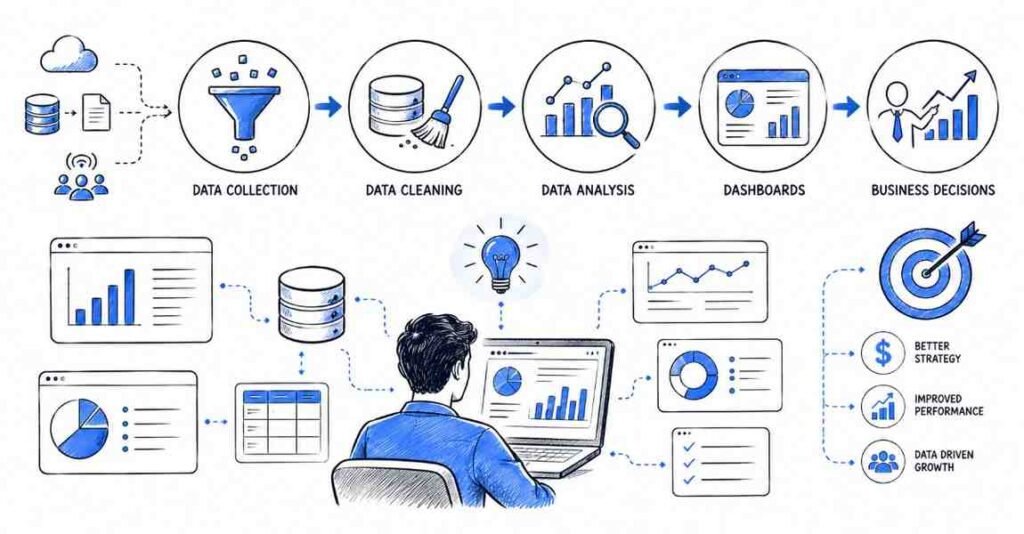
Data Analytics with Python and R involves using statistical programming languages to collect, clean, analyze, and visualize data to extract meaningful business insights. This discipline combines statistical analysis, data manipulation, visualization techniques, and domain expertise to solve business problems and support strategic decision-making across industries.

Core Components of Data Analytics:

Data Collection and Preparation:

  • Data Extraction – Web scraping, API integration, database connections, file processing
  • Data Cleaning – Missing value treatment, outlier detection, data validation, format standardization
  • Data Transformation – Feature engineering, aggregation, normalization, categorical encoding
  • Data Integration – Combining multiple data sources, joining datasets, handling schema differences
 

Exploratory Data Analysis (EDA):

  • Descriptive Statistics – Central tendency, variability, distribution analysis, correlation studies
  • Data Visualization – Charts, graphs, heatmaps, dashboards for pattern identification
  • Statistical Testing – Hypothesis testing, confidence intervals, significance analysis
  • Pattern Recognition – Trend analysis, seasonality detection, anomaly identification
 

Statistical Modeling and Machine Learning:

  • Regression Analysis – Linear regression, logistic regression, polynomial models, regularization
  • Classification and Clustering – Decision trees, random forests, k-means clustering, hierarchical clustering
  • Time Series Analysis – Forecasting, trend decomposition, ARIMA models, seasonal adjustments
  • Advanced Analytics – A/B testing, cohort analysis, customer segmentation, predictive modeling
 

Business Intelligence and Reporting:

  • Dashboard Development – Interactive visualizations, real-time monitoring, KPI tracking
  • Automated Reporting – Scheduled reports, alert systems, executive summaries
  • Insight Communication – Data storytelling, presentation skills, stakeholder engagement
  • Decision Support – Recommendation systems, optimization models, scenario analysis
 

Python vs R for Data Analytics

Python Advantages:

  • General-purpose programming language with extensive ecosystem
  • Excellent for data engineering, web scraping, and production deployment
  • Strong machine learning libraries (scikit-learn, TensorFlow, PyTorch)
  • Better integration with software development and DevOps practices
 

R Advantages:

  • Purpose-built for statistical analysis and data visualization
  • Comprehensive statistical packages and advanced modeling capabilities
  • Superior data visualization with ggplot2 and Shiny for interactive apps
  • Strong academic and research community with cutting-edge statistical methods

2. Why Choose Data Analytics in 2025?

Explosive Growth in Data-Driven Business Decisions

According to IDC’s Data Age 2025 Report, global data creation will grow from 33 zettabytes in 2018 to 175 zettabytes by 2025. In India specifically, data analytics adoption has accelerated across all industries:

Enterprise Analytics Transformation:

  • Banking and Finance – Risk modeling, fraud detection, algorithmic trading, customer analytics
  • Healthcare and Pharmaceuticals – Clinical trials analysis, drug discovery, patient outcomes, operational efficiency
  • E-commerce and Retail – Customer segmentation, recommendation engines, pricing optimization, demand forecasting
  • Manufacturing – Quality control, predictive maintenance, supply chain optimization, IoT analytics
 

Government and Public Sector Analytics:

  • Smart Cities – Traffic optimization, resource allocation, urban planning, environmental monitoring
  • Healthcare Policy – Epidemiological modeling, healthcare resource planning, outcome analysis
  • Financial Services Regulation – Risk assessment, compliance monitoring, market surveillance
  • Agricultural Analytics – Crop yield prediction, weather modeling, resource optimization
 

Competitive Salary Packages and Career Flexibility

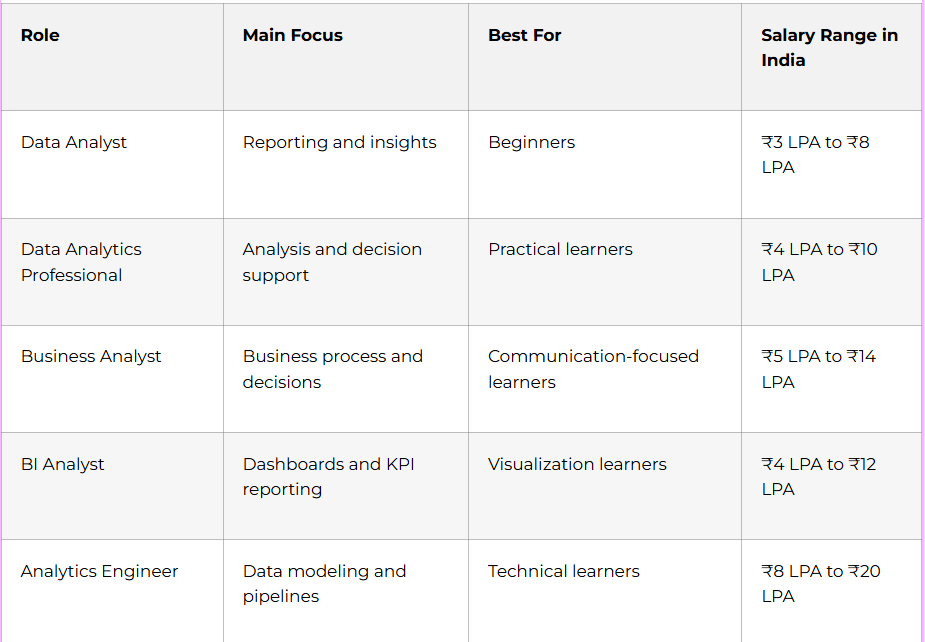
Data analytics professionals enjoy strong earning potential with diverse industry opportunities:

data analytics

Source: PayScale India 2025, Glassdoor Analytics Salaries

Strong Foundation for Advanced Career Paths

Data analytics provides excellent preparation for high-growth careers:

  • Data Science – Machine learning, AI development, predictive modeling
  • Business Intelligence – Dashboard development, data architecture, executive reporting
  • Product Analytics – User behavior analysis, A/B testing, growth metrics
  • Consulting – Analytics consulting, digital transformation, strategy development

Industry-Agnostic Skills with Global Opportunities

Data analytics skills transfer across industries and geographies:

  • Domain Flexibility – Analytics principles apply to finance, healthcare, technology, government
  • Remote Work Opportunities – Global remote positions with competitive compensation
  • Consulting Potential – Independent consulting and project-based work opportunities
  • Entrepreneurial Applications – Data-driven startup opportunities and business insights

3. Complete Learning Roadmap (4-6 Months)

data analytics roadmap

Phase 1: Programming Fundamentals and Statistical Foundation (Month 1-2)

Choose Primary Language (Python or R) (2-3 weeks)
Most professionals start with one language before adding the second:

Python Track:

  • Python Basics – Variables, data types, control structures, functions, object-oriented programming
  • Data Structures – Lists, dictionaries, sets, tuples, comprehensions, iterators
  • File Operations – Reading/writing files, JSON/CSV processing, exception handling
  • Package Management – pip, virtual environments, conda, Jupyter notebooks
 

R Track:

  • R Fundamentals – Vectors, factors, data frames, lists, functions, control structures
  • R Data Structures – Data manipulation with base R, indexing, filtering, subsetting
  • Package Ecosystem – CRAN packages, library management, workspace management
  • R Environment – RStudio, R Markdown, project organization, reproducible research
 

Statistics and Mathematics Foundation (2-3 weeks)

  • Descriptive Statistics – Mean, median, mode, variance, standard deviation, percentiles
  • Probability Theory – Probability distributions, Bayes’ theorem, conditional probability
  • Inferential Statistics – Sampling, hypothesis testing, confidence intervals, p-values
  • Linear Algebra – Matrices, vectors, eigenvalues, matrix operations for data analysis
 

Data Handling Basics (1-2 weeks)

  • Data Import/Export – CSV, Excel, JSON, database connections, web APIs
  • Data Types and Structures – Numerical, categorical, date-time data handling
  • Basic Cleaning – Missing values, duplicates, data validation, format conversion
  • Data Quality Assessment – Profiling, anomaly detection, consistency checks
 

Foundation Projects:

  1. Personal Finance Analytics – Analyze spending patterns, budget optimization, trend analysis
  2. Weather Data Analysis – Historical weather analysis, seasonal patterns, trend forecasting
  3. Sports Statistics Project – Player performance analysis, team comparisons, predictive modeling
 

Phase 2: Data Manipulation and Exploration (Month 2-3)

Advanced Data Manipulation (3-4 weeks)

Python with Pandas:

import pandas as pd
import numpy as np

# Advanced data manipulation techniques
def analyze_sales_data(df):
    # Data cleaning and preparation
    df[‘date’] = pd.to_datetime(df[‘date’])
    df[‘revenue’] = df[‘quantity’] * df[‘price’]
   
    # Advanced grouping and aggregation
    monthly_sales = df.groupby([df[‘date’].dt.to_period(‘M’), ‘category’]).agg({
        ‘revenue’: [‘sum’, ‘mean’, ‘count’],
        ‘quantity’: ‘sum’,
        ‘price’: ‘mean’
    }).round(2)
   
    # Window functions for trends
    df[‘revenue_ma’] = df.groupby(‘category’)[‘revenue’].transform(
        lambda x: x.rolling(window=7, min_periods=1).mean()
    )
   
    # Statistical measures
    df[‘revenue_zscore’] = df.groupby(‘category’)[‘revenue’].transform(
        lambda x: (x – x.mean()) / x.std()
    )
   
    return df, monthly_sales

# Time series analysis
def time_series_analysis(df, date_col, value_col):
    df[date_col] = pd.to_datetime(df[date_col])
    df.set_index(date_col, inplace=True)
   
    # Resampling and aggregation
    daily_values = df[value_col].resample(‘D’).sum().fillna(0)
    weekly_values = df[value_col].resample(‘W’).sum()
   
    # Trend analysis
    from scipy import stats
    x = np.arange(len(daily_values))
    slope, intercept, r_value, p_value, std_err = stats.linregress(x, daily_values.values)
   
    return daily_values, weekly_values, slope, r_value

R with dplyr and tidyr:

library(dplyr)
library(tidyr)
library(lubridate)

# Advanced data manipulation in R
analyze_sales_data <- function(df) {
  df <- df %>%
    mutate(
      date = as.Date(date),
      revenue = quantity * price,
      month = floor_date(date, “month”)
    ) %>%
    group_by(category) %>%
    mutate(
      revenue_ma = slider::slide_dbl(revenue, mean, .before = 6, .after = 0),
      revenue_zscore = (revenue – mean(revenue)) / sd(revenue)
    ) %>%
    ungroup()
 
  monthly_summary <- df %>%
    group_by(month, category) %>%
    summarise(
      total_revenue = sum(revenue),
      avg_revenue = mean(revenue),
      order_count = n(),
      avg_price = mean(price),
      .groups = “drop”
    )
 
  return(list(cleaned_data = df, monthly_summary = monthly_summary))
}

# Statistical analysis functions
perform_statistical_tests <- function(df, group_var, value_var) {
  # ANOVA test
  aov_result <- aov(get(value_var) ~ get(group_var), data = df)
 
  # Correlation analysis
  numeric_cols <- df %>% select_if(is.numeric)
  correlation_matrix <- cor(numeric_cols, use = “complete.obs”)
 
  # Regression analysis
  lm_model <- lm(get(value_var) ~ ., data = numeric_cols)
 
  return(list(
    anova = summary(aov_result),
    correlation = correlation_matrix,
    regression = summary(lm_model)
  ))
}

Exploratory Data Analysis (2-3 weeks)

  • Univariate Analysis – Distribution analysis, summary statistics, outlier detection
  • Bivariate Analysis – Correlation analysis, cross-tabulation, relationship identification
  • Multivariate Analysis – Dimensionality reduction, principal component analysis
  • Statistical Tests – t-tests, chi-square tests, ANOVA, non-parametric tests
 

Data Visualization Mastery (1-2 weeks)

  • Static Visualizations – Matplotlib/ggplot2, seaborn, advanced chart types
  • Interactive Visualizations – Plotly, bokeh, Shiny applications
  • Dashboard Development – Streamlit, Dash, R Shiny for business dashboards
  • Statistical Plots – Box plots, violin plots, heatmaps, distribution plots
 

Data Exploration Projects:

  1. Customer Behavior Analysis – E-commerce data exploration, purchase patterns, segmentation
  2. Financial Market Analysis – Stock price analysis, volatility modeling, correlation studies
  3. Healthcare Data Study – Patient outcomes analysis, treatment effectiveness, risk factors
 

Phase 3: Statistical Modeling and Machine Learning (Month 3-4)

Statistical Modeling Fundamentals (4-5 weeks)

  • Linear Regression – Simple and multiple regression, assumptions, diagnostics, interpretation
  • Logistic Regression – Binary and multinomial classification, odds ratios, model evaluation
  • Time Series Forecasting – ARIMA models, seasonal decomposition, exponential smoothing
  • Experimental Design – A/B testing, power analysis, sample size calculations
 

Machine Learning Implementation (3-4 weeks)

Python with Scikit-learn:

from sklearn.model_selection import train_test_split, cross_val_score, GridSearchCV
from sklearn.preprocessing import StandardScaler, LabelEncoder
from sklearn.ensemble import RandomForestClassifier, GradientBoostingRegressor
from sklearn.metrics import classification_report, confusion_matrix, roc_auc_score
import matplotlib.pyplot as plt
import seaborn as sns

class CustomerChurnAnalyzer:
    def __init__(self):
        self.scaler = StandardScaler()
        self.model = RandomForestClassifier(random_state=42)
        self.label_encoders = {}
   
    def preprocess_data(self, df, target_column):
        # Separate features and target
        X = df.drop(columns=[target_column])
        y = df[target_column]
       
        # Handle categorical variables
        categorical_columns = X.select_dtypes(include=[‘object’]).columns
       
        for col in categorical_columns:
            le = LabelEncoder()
            X[col] = le.fit_transform(X[col].astype(str))
            self.label_encoders[col] = le
       
        # Scale numerical features
        numerical_columns = X.select_dtypes(include=[‘int64’, ‘float64’]).columns
        X[numerical_columns] = self.scaler.fit_transform(X[numerical_columns])
       
        return X, y
   
    def train_model(self, X_train, y_train):
        # Hyperparameter tuning
        param_grid = {
            ‘n_estimators’: [100, 200, 300],
            ‘max_depth’: [10, 20, None],
            ‘min_samples_split’: [2, 5, 10]
        }
       
        grid_search = GridSearchCV(
            self.model, param_grid, cv=5, scoring=’roc_auc’, n_jobs=-1
        )
        grid_search.fit(X_train, y_train)
       
        self.model = grid_search.best_estimator_
        return grid_search.best_params_
   
    def evaluate_model(self, X_test, y_test):
        # Predictions
        y_pred = self.model.predict(X_test)
        y_pred_proba = self.model.predict_proba(X_test)[:, 1]
       
        # Metrics
        auc_score = roc_auc_score(y_test, y_pred_proba)
       
        # Feature importance
        feature_importance = pd.DataFrame({
            ‘feature’: X_test.columns,
            ‘importance’: self.model.feature_importances_
        }).sort_values(‘importance’, ascending=False)
       
        return {
            ‘auc_score’: auc_score,
            ‘classification_report’: classification_report(y_test, y_pred),
            ‘feature_importance’: feature_importance
        }

R with Caret and Tidymodels:

library(tidymodels)
library(ranger)
library(vip)

# Customer segmentation with R
perform_customer_segmentation <- function(df) {
  # Preprocessing
  customer_recipe <- recipe(~ ., data = df) %>%
    step_normalize(all_numeric()) %>%
    step_dummy(all_nominal()) %>%
    step_zv(all_predictors())
 
  # K-means clustering
  kmeans_spec <- k_means(num_clusters = tune()) %>%
    set_engine(“stats”)
 
  # Workflow
  kmeans_workflow <- workflow() %>%
    add_recipe(customer_recipe) %>%
    add_model(kmeans_spec)
 
  # Tune number of clusters
  cluster_grid <- grid_regular(num_clusters(range = c(2, 10)), levels = 9)
 
  # Cross-validation
  cv_folds <- vfold_cv(df, v = 5)
 
  # Tune hyperparameters
  cluster_results <- tune_grid(
    kmeans_workflow,
    resamples = cv_folds,
    grid = cluster_grid
  )
 
  # Select best model
  best_clusters <- select_best(cluster_results, metric = “tot_withinss”)
 
  # Final model
  final_model <- finalize_workflow(kmeans_workflow, best_clusters) %>%
    fit(df)
 
  return(final_model)
}

# Predictive modeling function
build_churn_model <- function(df, target_var) {
  # Data splitting
  data_split <- initial_split(df, prop = 0.8, strata = !!sym(target_var))
  train_data <- training(data_split)
  test_data <- testing(data_split)
 
  # Recipe
  churn_recipe <- recipe(as.formula(paste(target_var, “~ .”)), data = train_data) %>%
    step_normalize(all_numeric_predictors()) %>%
    step_dummy(all_nominal_predictors()) %>%
    step_zv(all_predictors())
 
  # Model specification
  rf_spec <- rand_forest(
    mtry = tune(),
    trees = tune(),
    min_n = tune()
  ) %>%
    set_engine(“ranger”, importance = “impurity”) %>%
    set_mode(“classification”)
 
  # Workflow
  rf_workflow <- workflow() %>%
    add_recipe(churn_recipe) %>%
    add_model(rf_spec)
 
  # Hyperparameter tuning
  rf_grid <- grid_random(
    mtry(range = c(1, 10)),
    trees(range = c(100, 1000)),
    min_n(range = c(2, 20)),
    size = 20
  )
 
  # Cross-validation
  cv_folds <- vfold_cv(train_data, v = 5, strata = !!sym(target_var))
 
  # Tune model
  rf_results <- tune_grid(
    rf_workflow,
    resamples = cv_folds,
    grid = rf_grid,
    metrics = metric_set(roc_auc, accuracy)
  )
 
  # Finalize model
  best_rf <- select_best(rf_results, “roc_auc”)
  final_workflow <- finalize_workflow(rf_workflow, best_rf)
  final_model <- fit(final_workflow, train_data)
 
  # Evaluate on test set
  test_predictions <- predict(final_model, test_data, type = “prob”) %>%
    bind_cols(test_data)
 
  auc_score <- roc_auc(test_predictions, !!sym(target_var), .pred_Yes)$.estimate
 
  return(list(
    model = final_model,
    auc_score = auc_score,
    predictions = test_predictions
  ))
}

Advanced Analytics Applications (2-3 weeks)

  • Customer Analytics – Segmentation, lifetime value, churn prediction
  • Market Research – Survey analysis, brand perception, competitive analysis
  • Operational Analytics – Process optimization, quality control, efficiency analysis
  • Financial Analytics – Risk modeling, portfolio optimization, fraud detection
 

Machine Learning Projects:

  1. Predictive Customer Analytics – Churn prediction, lifetime value modeling, recommendation systems
  2. Market Basket Analysis – Association rules, product recommendations, cross-selling optimization
  3. Financial Risk Modeling – Credit scoring, fraud detection, portfolio risk assessment
 

Phase 4: Advanced Analytics and Business Intelligence (Month 4-5)

Dashboard and Reporting Development (3-4 weeks)

  • Interactive Dashboards – Streamlit, Plotly Dash, R Shiny for business users
  • Automated Reporting – Scheduled reports, email automation, alert systems
  • Executive Summaries – KPI tracking, trend analysis, actionable insights presentation
  • Real-time Analytics – Live data connections, streaming analytics, monitoring dashboards
 

Advanced Statistical Techniques (2-3 weeks)

  • Multivariate Statistics – Factor analysis, cluster analysis, discriminant analysis
  • Bayesian Statistics – Bayesian inference, probabilistic modeling, uncertainty quantification
  • Survival Analysis – Time-to-event modeling, hazard ratios, Kaplan-Meier curves
  • Causal Inference – A/B testing, propensity score matching, difference-in-differences
 

Big Data and Cloud Integration (1-2 weeks)

  • Cloud Platforms – AWS, Google Cloud, Azure for analytics workloads
  • Big Data Tools – Spark with PySpark/SparkR, distributed computing concepts
  • Database Integration – SQL queries, NoSQL databases, data warehousing
  • MLOps Basics – Model deployment, versioning, monitoring, automation
 

Business Intelligence Projects:

  1. Executive Dashboard Suite – Real-time KPI monitoring, drill-down capabilities, automated alerts
  2. Market Intelligence Platform – Competitive analysis, trend monitoring, scenario planning
  3. Operational Analytics System – Performance tracking, optimization recommendations, predictive maintenance
 

Phase 5: Specialization and Portfolio Development (Month 5-6)

Choose Specialization Track:

Financial Analytics:

  • Risk management, algorithmic trading, portfolio optimization
  • Credit scoring, fraud detection, regulatory compliance
  • Financial forecasting, stress testing, market analysis
 

Healthcare Analytics:

  • Clinical trials analysis, epidemiological studies
  • Patient outcomes modeling, treatment effectiveness
  • Healthcare operations, cost analysis, quality metrics
 

Marketing Analytics:

  • Customer journey analysis, attribution modeling
  • Campaign optimization, marketing mix modeling
  • Social media analytics, brand sentiment analysis
 

Operations and Supply Chain:

  • Demand forecasting, inventory optimization
  • Process improvement, quality control analytics
  • Logistics optimization, supplier performance analysis

4. Essential Python and R Tools

data analytics expert

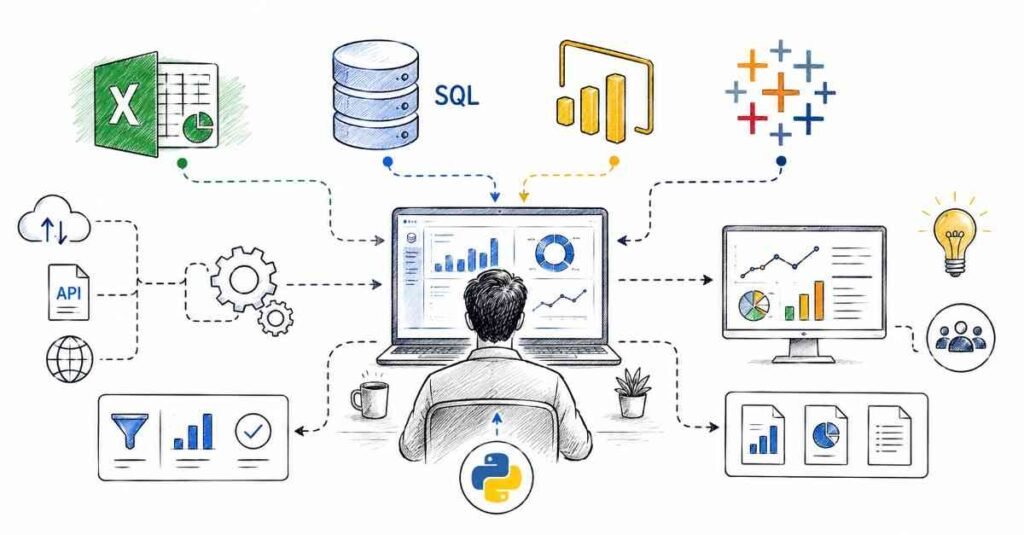
Python Data Analytics Ecosystem

Core Data Manipulation Libraries:

  • Pandas – Data structures and analysis tools for structured data manipulation
  • NumPy – Numerical computing with arrays, mathematical functions, linear algebra
  • Dask – Parallel computing and out-of-core processing for large datasets
  • Polars – High-performance DataFrame library with lazy evaluation
 

Statistical Analysis and Machine Learning:

  • Scikit-learn – Machine learning algorithms, model evaluation, preprocessing tools
  • Statsmodels – Statistical modeling, econometrics, time series analysis
  • SciPy – Scientific computing, optimization, signal processing, statistical functions
  • PyMC3/PyMC – Probabilistic programming, Bayesian statistics, MCMC sampling
 

Data Visualization:

  • Matplotlib – Comprehensive plotting library with publication-quality figures
  • Seaborn – Statistical data visualization built on matplotlib with attractive defaults
  • Plotly – Interactive visualizations, web-based dashboards, 3D plotting
  • Bokeh – Interactive visualization library for web applications
 

R Data Analytics Ecosystem

Core Data Manipulation Packages:

  • dplyr – Grammar of data manipulation with intuitive verbs
  • tidyr – Data tidying and reshaping for analysis-ready datasets
  • data.table – High-performance data manipulation with concise syntax
  • purrr – Functional programming tools for working with lists and vectors
 

Statistical Analysis and Modeling:

  • Caret – Classification and regression training with unified interface
  • Tidymodels – Modern modeling framework with tidy principles
  • Forecast – Time series forecasting methods and automatic model selection
  • Survival – Survival analysis and time-to-event modeling
 

Visualization and Reporting:

  • ggplot2 – Grammar of graphics for creating complex multi-layered plots
  • Shiny – Interactive web applications and dashboards
  • RMarkdown – Dynamic documents combining code, output, and narrative
  • Plotly for R – Interactive plots and dashboards with R integration
 

Cloud and Big Data Integration

Cloud Platforms:

  • Amazon Web Services – S3, EC2, SageMaker, Redshift for analytics workloads
  • Google Cloud Platform – BigQuery, Dataflow, AI Platform, Cloud Storage
  • Microsoft Azure – Azure ML, Synapse Analytics, Data Factory, Power BI integration
  • Databricks – Unified analytics platform with collaborative notebooks
 

Database and Data Warehousing:

  • SQL Databases – PostgreSQL, MySQL, SQL Server for structured data
  • NoSQL Databases – MongoDB, Cassandra, Redis for unstructured data
  • Data Warehouses – Snowflake, Redshift, BigQuery for analytics workloads
  • Data Lakes – S3, Azure Data Lake, Google Cloud Storage for raw data

5. Building Your Data Analytics Portfolio

data analytics portfolio

Portfolio Strategy and Structure

Data Analytics Portfolio Objectives:

  1. Demonstrate Technical Proficiency – Show mastery of Python/R, statistical analysis, and machine learning
  2. Highlight Business Impact – Quantify insights generated and decisions influenced
  3. Showcase Domain Knowledge – Display expertise in specific industries or functional areas
  4. Present Communication Skills – Professional documentation, visualization, and storytelling
 

Foundation Level Projects (Months 1-3)

  1. Comprehensive Sales Analytics Dashboard
  • Business Challenge: E-commerce company needs visibility into sales performance, customer behavior, and market trends
  • Data Sources: Transaction data, customer demographics, product catalog, marketing campaigns
  • Analysis Scope: Revenue analysis, customer segmentation, product performance, seasonal trends
  • Technical Implementation: Data cleaning, exploratory analysis, statistical modeling, interactive dashboard
  • Business Value: Identify top-performing products, customer segments, and optimal pricing strategies
 

Sales Analytics Implementation:

import pandas as pd
import numpy as np
import plotly.express as px
import plotly.graph_objects as go
from plotly.subplots import make_subplots
import streamlit as st
from sklearn.cluster import KMeans
from sklearn.preprocessing import StandardScaler

class SalesAnalyticsDashboard:
    def __init__(self, data_path):
        self.sales_data = pd.read_csv(data_path)
        self.prepare_data()
   
    def prepare_data(self):
        # Data cleaning and feature engineering
        self.sales_data[‘date’] = pd.to_datetime(self.sales_data[‘date’])
        self.sales_data[‘revenue’] = self.sales_data[‘quantity’] * self.sales_data[‘unit_price’]
        self.sales_data[‘month’] = self.sales_data[‘date’].dt.to_period(‘M’)
       
        # Customer metrics
        customer_metrics = self.sales_data.groupby(‘customer_id’).agg({
            ‘revenue’: [‘sum’, ‘mean’, ‘count’],
            ‘quantity’: ‘sum’,
            ‘date’: [‘min’, ‘max’]
        }).round(2)
       
        customer_metrics.columns = [‘total_revenue’, ‘avg_order_value’,
                                  ‘order_frequency’, ‘total_quantity’,
                                  ‘first_order’, ‘last_order’]
       
        # Calculate days since last order
        customer_metrics[‘days_since_last_order’] = (
            pd.Timestamp.now() – customer_metrics[‘last_order’]
        ).dt.days
       
        self.customer_metrics = customer_metrics
   
    def customer_segmentation(self):
        # RFM Analysis
        features = [‘total_revenue’, ‘order_frequency’, ‘days_since_last_order’]
        scaler = StandardScaler()
        scaled_features = scaler.fit_transform(self.customer_metrics[features])
       
        # K-means clustering
        kmeans = KMeans(n_clusters=4, random_state=42)
        self.customer_metrics[‘segment’] = kmeans.fit_predict(scaled_features)
       
        # Segment characteristics
        segment_summary = self.customer_metrics.groupby(‘segment’).agg({
            ‘total_revenue’: ‘mean’,
            ‘order_frequency’: ‘mean’,
            ‘days_since_last_order’: ‘mean’
        }).round(2)
       
        return segment_summary
   
    def create_dashboard(self):
        st.title(“Sales Analytics Dashboard”)
       
        # KPI metrics
        total_revenue = self.sales_data[‘revenue’].sum()
        total_orders = len(self.sales_data)
        avg_order_value = self.sales_data[‘revenue’].mean()
        unique_customers = self.sales_data[‘customer_id’].nunique()
       
        col1, col2, col3, col4 = st.columns(4)
        with col1:
            st.metric(“Total Revenue”, f”${total_revenue:,.2f}”)
        with col2:
            st.metric(“Total Orders”, f”{total_orders:,}”)
        with col3:
            st.metric(“Avg Order Value”, f”${avg_order_value:.2f}”)
        with col4:
            st.metric(“Unique Customers”, f”{unique_customers:,}”)
       
        # Monthly revenue trend
        monthly_revenue = self.sales_data.groupby(‘month’)[‘revenue’].sum()
        fig_trend = px.line(x=monthly_revenue.index.astype(str), y=monthly_revenue.values,
                          title=”Monthly Revenue Trend”)
        st.plotly_chart(fig_trend, use_container_width=True)
       
        # Customer segmentation visualization
        segment_data = self.customer_segmentation()
        fig_segments = px.scatter(self.customer_metrics,
                                x=’total_revenue’, y=’order_frequency’,
                                color=’segment’, title=”Customer Segmentation”)
        st.plotly_chart(fig_segments, use_container_width=True)
       
        # Product performance
        product_performance = self.sales_data.groupby(‘product_id’).agg({
            ‘revenue’: ‘sum’,
            ‘quantity’: ‘sum’
        }).sort_values(‘revenue’, ascending=False).head(10)
       
        fig_products = px.bar(product_performance, x=product_performance.index,
                            y=’revenue’, title=”Top 10 Products by Revenue”)
        st.plotly_chart(fig_products, use_container_width=True)

# Usage
if __name__ == “__main__”:
    dashboard = SalesAnalyticsDashboard(“sales_data.csv”)
    dashboard.create_dashboard()


Intermediate Level Projects (Months 3-5)

  1. Advanced Customer Behavior Analytics
  • Business Problem: Subscription-based company experiencing customer churn needs predictive insights
  • Analysis Framework: Cohort analysis, survival modeling, churn prediction, customer lifetime value
  • Machine Learning: Random forest for churn prediction, time series forecasting for revenue
  • Advanced Techniques: Feature engineering, hyperparameter tuning, model interpretation
  • Business Impact: Reduce churn by 25%, increase customer lifetime value by 15%
 

Customer Analytics Implementation:

library(tidyverse)
library(survival)
library(survminer)
library(randomForest)
library(ROCR)
library(plotly)

# Customer lifetime value and churn analysis
customer_analytics <- function(subscription_data) {
 
  # Data preparation
  customers <- subscription_data %>%
    mutate(
      signup_date = as.Date(signup_date),
      churn_date = as.Date(churn_date),
      is_churned = !is.na(churn_date),
      tenure_days = ifelse(is_churned,
                          as.numeric(churn_date – signup_date),
                          as.numeric(Sys.Date() – signup_date))
    ) %>%
    filter(tenure_days > 0)
 
  # Cohort analysis
  cohort_analysis <- customers %>%
    mutate(
      signup_month = floor_date(signup_date, “month”),
      period_number = case_when(
        is_churned ~ interval(signup_date, churn_date) %/% months(1),
        TRUE ~ interval(signup_date, Sys.Date()) %/% months(1)
      )
    ) %>%
    group_by(signup_month, period_number) %>%
    summarise(
      customers = n(),
      revenue = sum(monthly_revenue),
      .groups = “drop”
    ) %>%
    group_by(signup_month) %>%
    mutate(
      cohort_size = customers[period_number == 0],
      retention_rate = customers / cohort_size
    )
 
  # Survival analysis
  surv_data <- customers %>%
    select(tenure_days, is_churned, monthly_revenue, customer_segment,
          acquisition_channel, support_tickets)
 
  surv_object <- Surv(time = surv_data$tenure_days,
                      event = surv_data$is_churned)
 
  # Kaplan-Meier survival curve
  km_fit <- survfit(surv_object ~ customer_segment, data = surv_data)
 
  # Cox proportional hazards model
  cox_model <- coxph(surv_object ~ monthly_revenue + customer_segment +
                    acquisition_channel + support_tickets,
                    data = surv_data)
 
  # Churn prediction model
  churn_features <- customers %>%
    select(monthly_revenue, tenure_days, support_tickets,
          customer_segment, acquisition_channel, is_churned) %>%
    mutate(
      customer_segment = as.factor(customer_segment),
      acquisition_channel = as.factor(acquisition_channel)
    ) %>%
    na.omit()
 
  set.seed(42)
  train_idx <- sample(nrow(churn_features), 0.8 * nrow(churn_features))
  train_data <- churn_features[train_idx, ]
  test_data <- churn_features[-train_idx, ]
 
  # Random Forest model
  rf_model <- randomForest(
    is_churned ~ .,
    data = train_data,
    ntree = 500,
    importance = TRUE
  )
 
  # Model evaluation
  predictions <- predict(rf_model, test_data, type = “prob”)[, 2]
  pred_object <- prediction(predictions, test_data$is_churned)
  auc_score <- performance(pred_object, “auc”)@y.values[[1]]
 
  # Customer lifetime value calculation
  clv_data <- customers %>%
    filter(!is_churned) %>%
    mutate(
      predicted_lifetime = predict(km_fit, newdata = ., type = “median”),
      estimated_clv = monthly_revenue * predicted_lifetime / 30
    )
 
  return(list(
    cohort_analysis = cohort_analysis,
    survival_model = cox_model,
    churn_model = rf_model,
    auc_score = auc_score,
    clv_estimates = clv_data
  ))
}

# Visualization functions
create_cohort_heatmap <- function(cohort_data) {
  cohort_matrix <- cohort_data %>%
    select(signup_month, period_number, retention_rate) %>%
    pivot_wider(names_from = period_number,
                values_from = retention_rate) %>%
    column_to_rownames(“signup_month”) %>%
    as.matrix()
 
  plot_ly(
    z = ~cohort_matrix,
    type = “heatmap”,
    colorscale = “Viridis”,
    text = ~round(cohort_matrix, 2),
    texttemplate = “%{text}”,
    textfont = list(color = “white”)
  ) %>%
    layout(
      title = “Customer Retention Cohort Analysis”,
      xaxis = list(title = “Period Number”),
      yaxis = list(title = “Signup Month”)
    )
}


Advanced Level Projects (Months 5-6)

  1. Financial Risk Analytics and Fraud Detection
  • Business Challenge: Financial institution needs real-time fraud detection and credit risk assessment
  • Advanced Analytics: Anomaly detection, ensemble methods, real-time scoring, model interpretability
  • Technical Complexity: Imbalanced datasets, feature engineering, model deployment, monitoring
  • Regulatory Compliance: Model explainability, bias detection, audit trails
  • Business Impact: Reduce fraud losses by 40%, improve credit decision accuracy by 30%
  1. Advanced Marketing Mix Modeling
  • Business Problem: Consumer goods company needs to optimize marketing spend across channels
  • Methodology: Bayesian modeling, media saturation curves, adstock effects, incrementality measurement
  • Advanced Techniques: Hierarchical Bayesian models, Monte Carlo simulation, causal inference
  • Business Application: Marketing budget optimization, channel attribution, ROI measurement
  • Measurable Outcomes: Increase marketing efficiency by 35%, optimize budget allocation across channels
 

Portfolio Presentation Standards

Professional Documentation Framework:

Data Analytics Project Documentation:

Executive Summary:
– Business problem and analytical objectives
– Key findings and actionable recommendations
– Quantified business impact and ROI

Data and Methodology:
– Data sources, quality assessment, and limitations
– Statistical methods and modeling approaches
– Model validation and performance metrics
– Assumptions and confidence intervals

Technical Implementation:
– Data preprocessing and feature engineering
– Model development and hyperparameter tuning
– Code organization and reproducibility
– Performance optimization and scalability

Business Insights:
– Key findings and pattern identification
– Statistical significance and practical importance
– Recommendations and next steps
– Implementation roadmap and success metrics

Appendix:
– Detailed statistical output and model diagnostics
– Code samples and technical specifications
– Data dictionary and variable definitions
– Additional visualizations and supporting analysis


Interactive Portfolio Website:

  • Project Showcase – Interactive dashboards demonstrating analytical capabilities
  • Code Repository – Well-documented GitHub projects with clear README files
  • Technical Blog – Articles explaining analytical approaches and business insights
  • Professional Profile – LinkedIn optimization, analytics community participation

6. Job Search Strategy

data analytics job market

Resume Optimization for Data Analytics Roles

Technical Skills Section:

Data Analytics & Programming:
• Programming Languages: Python (pandas, numpy, scikit-learn), R (dplyr, ggplot2, caret)
• Statistical Analysis: Regression modeling, hypothesis testing, time series analysis, A/B testing
• Machine Learning: Classification, clustering, forecasting, model validation, feature engineering
• Data Visualization: Plotly, matplotlib, ggplot2, Tableau, Power BI, interactive dashboards
• Database & Big Data: SQL, PostgreSQL, MongoDB, Spark, AWS, Google Cloud Platform
• Business Intelligence: KPI development, executive reporting, automated dashboards

Certifications & Training:
• Google Data Analytics Certificate
• AWS Certified Data Analytics
• Microsoft Power BI Data Analyst
• R Programming Specialization (Johns Hopkins/Coursera)

Project Experience Examples:

Customer Analytics and Segmentation

  • Challenge: E-commerce platform with 2M+ customers needed better understanding of customer behavior and targeted marketing strategies
  • Solution: Developed comprehensive customer analytics framework using Python and machine learning for segmentation and lifetime value prediction
  • Technical Implementation: K-means clustering, RFM analysis, churn prediction models, cohort analysis with 85% accuracy
  • Business Impact: Increased marketing campaign effectiveness by 45%, reduced customer acquisition cost by 30%, improved retention by 25%
 

Financial Risk Modeling and Fraud Detection

  • Challenge: Financial services company experiencing $2M annual fraud losses needed real-time detection system
  • Solution: Built ensemble machine learning models for fraud detection using random forests and gradient boosting
  • Advanced Features: Anomaly detection, real-time scoring, model interpretability with SHAP values
  • Results: Reduced fraud losses by 60%, improved detection accuracy to 94%, decreased false positive rate by 40%
 

Data Analytics Job Market Analysis

High-Demand Role Categories:

  1. Data Analyst (Foundation Role)
  • Salary Range: ₹4-15 LPA
  • Open Positions: 12,500+ across India
  • Key Skills: SQL, Excel, Python/R, statistical analysis, data visualization
  • Growth Path: Analyst → Senior Analyst → Lead Analyst → Analytics Manager
 
  1. Business Intelligence Analyst (Reporting Focus)
  • Salary Range: ₹5-18 LPA
  • Open Positions: 8,200+ across India
  • Key Skills: Tableau, Power BI, SQL, dashboard development, stakeholder management
  • Growth Path: BI Analyst → Senior BI Analyst → BI Manager → Director of Analytics
 
  1. Quantitative Analyst (Finance Focus)
  • Salary Range: ₹8-25 LPA
  • Open Positions: 3,100+ across India
  • Key Skills: Statistical modeling, risk analysis, Python/R, financial markets knowledge
  • Growth Path: Quant Analyst → Senior Quant → Quant Manager → Head of Quantitative Research
 
  1. Marketing Analyst (Growth Focus)
  • Salary Range: ₹6-20 LPA
  • Open Positions: 5,800+ across India
  • Key Skills: Customer analytics, A/B testing, attribution modeling, campaign optimization
  • Growth Path: Marketing Analyst → Senior Analyst → Analytics Manager → VP Analytics
 

Top Hiring Companies and Opportunities

Technology and E-commerce:

  • Amazon India – Customer behavior analysis, supply chain optimization, pricing analytics
  • Flipkart – Product analytics, recommendation systems, customer lifetime value modeling
  • Google India – Ad optimization, user behavior analysis, product performance analytics
  • Microsoft India – Business intelligence, customer insights, market research analytics
 

Financial Services and Fintech:

  • HDFC Bank – Risk analytics, fraud detection, customer segmentation, regulatory reporting
  • Paytm – Transaction analytics, user behavior modeling, financial risk assessment
  • Razorpay – Payment analytics, merchant insights, fraud prevention, growth analytics
  • Zerodha – Trading analytics, risk management, customer behavior analysis
 

Consulting and Professional Services:

  • McKinsey & Company – Advanced analytics consulting, strategy support, market research
  • Deloitte – Business intelligence, risk analytics, digital transformation analytics
  • Accenture – Customer analytics, operations research, predictive modeling solutions
  • KPMG – Audit analytics, risk assessment, regulatory compliance, financial modeling
 

Healthcare and Pharmaceuticals:

  • Apollo Hospitals – Patient outcome analysis, operational efficiency, clinical analytics
  • Dr. Reddy’s – Drug discovery analytics, clinical trial analysis, market research
  • Fortis Healthcare – Healthcare operations, patient satisfaction, cost optimization
  • Cipla – Pharmaceutical analytics, market access, regulatory compliance
 

Interview Preparation Framework

Technical Competency Assessment:

Statistical and Analytical Thinking:

  1. “How would you approach analyzing customer churn for a subscription business?”
    • Define churn metrics and business objectives
    • Identify relevant features and data sources
    • Choose appropriate analytical methods (survival analysis, machine learning)
    • Design experiments and validate results
    • Present actionable recommendations
  2. “Explain A/B testing design and statistical significance”

import numpy as np
from scipy import stats

def ab_test_analysis(control_conversions, control_visitors,
                    test_conversions, test_visitors, alpha=0.05):
    # Calculate conversion rates
    control_rate = control_conversions / control_visitors
    test_rate = test_conversions / test_visitors
   
    # Calculate standard error
    pooled_rate = (control_conversions + test_conversions) / (control_visitors + test_visitors)
    se = np.sqrt(pooled_rate * (1 – pooled_rate) * (1/control_visitors + 1/test_visitors))
   
    # Calculate z-score and p-value
    z_score = (test_rate – control_rate) / se
    p_value = 2 * (1 – stats.norm.cdf(abs(z_score)))
   
    # Calculate confidence interval
    diff_se = np.sqrt((control_rate * (1 – control_rate) / control_visitors) +
                    (test_rate * (1 – test_rate) / test_visitors))
    margin_error = stats.norm.ppf(1 – alpha/2) * diff_se
    ci_lower = (test_rate – control_rate) – margin_error
    ci_upper = (test_rate – control_rate) + margin_error
   
    return {
        ‘control_rate’: control_rate,
        ‘test_rate’: test_rate,
        ‘lift’: (test_rate – control_rate) / control_rate,
        ‘p_value’: p_value,
        ‘is_significant’: p_value < alpha,
        ‘confidence_interval’: (ci_lower, ci_upper)
    }

Programming and Tools Proficiency:
3. “Write code to analyze sales data and identify seasonal patterns”

  • Demonstrate data manipulation skills
  • Show statistical analysis capabilities
  • Create meaningful visualizations
  • Interpret results and provide insights
 

Business Application:
4. “How would you measure the impact of a marketing campaign on revenue?”

  • Define success metrics and attribution models
  • Account for external factors and seasonality
  • Design measurement framework and control groups
  • Present findings with confidence intervals and recommendations
 

Data Ethics and Interpretation:
5. “How do you handle missing data and ensure model fairness?”

  • Discuss missing data mechanisms and treatment strategies
  • Address bias detection and mitigation techniques
  • Explain model interpretability and ethical considerations
  • Present validation approaches and limitations
 

Salary Negotiation and Career Advancement

Data Analytics Value Propositions:

  • Business Impact Quantification – Document revenue generated, costs saved, efficiency improvements
  • Cross-Functional Collaboration – Demonstrate ability to work with business stakeholders and technical teams
  • Technical Versatility – Show proficiency in both Python and R with diverse project applications
  • Domain Expertise – Develop deep knowledge in specific industries or functional areas
 

Negotiation Strategy:

Data Analytics Compensation Package:
Base Salary: ₹X LPA (Market research from multiple sources)
Performance Bonus: 10-20% of base (Project impact, accuracy of insights, stakeholder satisfaction)
Learning Budget: ₹25,000-50,000 annually (Certifications, conferences, online courses)
Flexible Benefits: Remote work, conference attendance, professional development time
Stock Options: Especially valuable in tech companies and startups
Consulting Opportunities: Additional income through freelance analytics projects

Career Advancement Factors:

  1. Technical Depth – Advanced statistical methods, machine learning expertise, programming proficiency
  2. Business Acumen – Industry knowledge, strategic thinking, ROI-focused analysis
  3. Communication Skills – Data storytelling, executive presentation, cross-functional collaboration
  4. Project Leadership – End-to-end analytics projects, team coordination, stakeholder management
  5. Continuous Learning – Stay current with new tools, methods, and industry trends

7. Salary Expectations and Career Growth

data analytics career

2025 Compensation Benchmarks by Role and Industry

Data Analyst Track:

  • Junior Data Analyst (0-2 years): ₹4-8 LPA
  • Data Analyst (2-4 years): ₹8-15 LPA
  • Senior Data Analyst (4-7 years): ₹15-25 LPA
  • Principal Data Analyst (7+ years): ₹25-40 LPA
 

Business Intelligence Track:

  • BI Analyst (1-3 years): ₹5-12 LPA
  • Senior BI Analyst (3-6 years): ₹12-22 LPA
  • BI Manager (6-10 years): ₹22-35 LPA
  • Director of Analytics (10+ years): ₹35-55 LPA
 

Quantitative Analyst Track:

  • Quantitative Analyst (2-4 years): ₹8-18 LPA
  • Senior Quant Analyst (4-8 years): ₹18-30 LPA
  • Principal Quant (8-12 years): ₹30-45 LPA
  • Head of Quantitative Research (12+ years): ₹45-70 LPA
 

Marketing Analytics Track:

  • Marketing Analyst (1-3 years): ₹6-14 LPA
  • Senior Marketing Analyst (3-6 years): ₹14-25 LPA
  • Analytics Manager (6-10 years): ₹25-40 LPA
  • VP Analytics (10+ years): ₹40-65 LPA
 

Industry and Geographic Salary Variations

High-Paying Industries:

  • Investment Banking and Financial Services – 30-40% premium for quantitative roles
  • Technology and Product Companies – 25-35% premium for growth and product analytics
  • Management Consulting – 20-30% premium for client-facing analytical consulting
  • Pharmaceuticals and Healthcare – 15-25% premium for clinical and regulatory analytics
 

Geographic Salary Distribution:

  • Bangalore – Technology hub with highest analytics demand, 18-25% above national average
  • Mumbai – Financial services center, 15-22% above national average
  • Delhi/NCR – Consulting and corporate headquarters, 12-18% above national average
  • Pune – Growing analytics center, 8-15% above national average
 

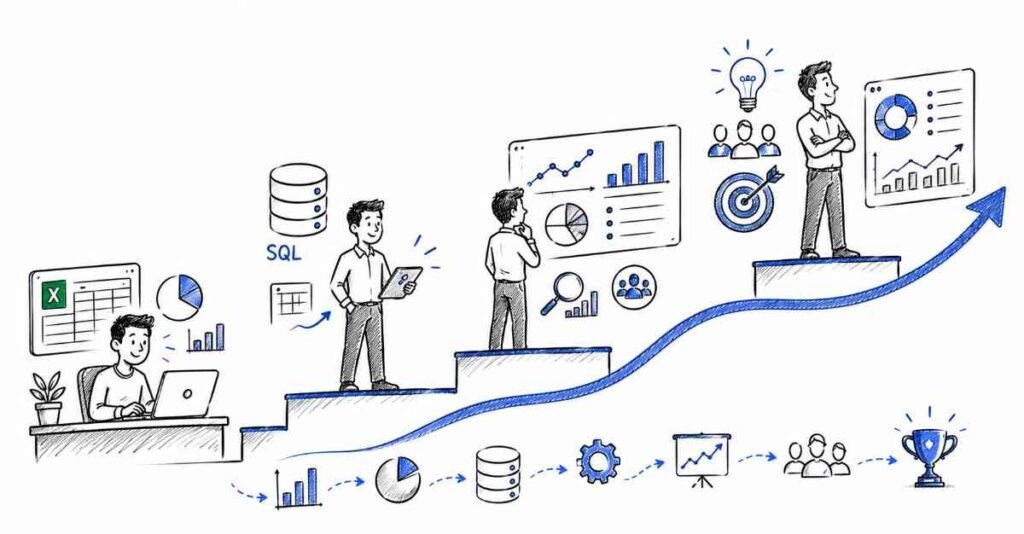
Career Progression Pathways

Individual Contributor Track:

Data Analyst (0-3 years)
    ↓
Senior Data Analyst (2-6 years)
    ↓
Principal Data Analyst (5-9 years)
    ↓
Staff Data Scientist (8-12 years)
    ↓
Distinguished Analyst (12+ years)

Management Track:

Senior Data Analyst (3-6 years)
    ↓
Analytics Manager (5-9 years)
    ↓
Senior Manager Analytics (8-12 years)
    ↓
Director of Analytics (10-15 years)
    ↓
VP Analytics/Chief Data Officer (15+ years)

Consulting and Entrepreneurial Track:

Senior Data Analyst (3-6 years)
    ↓
Analytics Consultant (5-8 years)
    ↓
Principal Consultant (8-12 years)
    ↓
Practice Lead (10-15 years)
    ↓
Analytics Firm Founder (12+ years)

Skills for Accelerated Career Growth

Technical Mastery (Years 1-3):

  • Programming Proficiency – Advanced Python/R skills with data manipulation and modeling libraries
  • Statistical Analysis – Hypothesis testing, regression analysis, experimental design, time series
  • Machine Learning – Supervised/unsupervised learning, model validation, feature engineering
  • Data Visualization – Advanced plotting, dashboard development, interactive visualizations
 

Business and Domain Expertise (Years 3-6):

  • Industry Knowledge – Deep understanding of specific verticals and their analytical challenges
  • Business Metrics – KPI development, ROI measurement, performance tracking, goal setting
  • Stakeholder Management – Requirements gathering, presentation skills, cross-functional collaboration
  • Project Management – End-to-end analytics projects, timeline management, resource allocation
 

Leadership and Strategy (Years 6+):

  • Team Leadership – Mentoring analysts, building analytics teams, fostering data culture
  • Strategic Planning – Analytics roadmap development, tool selection, capability building
  • Executive Communication – C-level presentation skills, business case development, influence
  • Innovation Leadership – New methodology adoption, best practice development, thought leadership
 

Emerging Opportunities and Future Trends

High-Growth Analytics Specializations:

  • Customer Data Platforms – First-party data strategy, identity resolution, personalization
  • Real-Time Analytics – Streaming data processing, event-driven architecture, instant insights
  • Automated Analytics – AutoML, automated insight generation, self-service analytics platforms
  • Privacy-Preserving Analytics – Differential privacy, federated learning, compliant data analysis
  • Causal Analytics – Causal inference, experimentation platforms, incrementality measurement
 

Market Trends Creating New Opportunities:

  • Analytics Engineering – Data pipeline development, transformation logic, analytics infrastructure
  • Product Analytics – User behavior analysis, product optimization, growth analytics
  • ESG Analytics – Sustainability metrics, environmental impact analysis, social governance
  • Voice and Conversational Analytics – Natural language processing, sentiment analysis, chatbot optimization
data analytics career growth

8. Success Stories from Our Students

Sneha Patel – From Excel Analyst to Senior Data Scientist

Background: 3 years as business analyst using primarily Excel and basic SQL for reporting
Challenge: Limited technical skills preventing career advancement to analytical roles with modeling capabilities
Transformation Strategy: Systematic progression from Python basics to advanced machine learning with portfolio focus
Timeline: 14 months from Python fundamentals to senior data scientist role
Current Position: Senior Data Scientist at Flipkart
Salary Progression: ₹7.2 LPA → ₹11.8 LPA → ₹18.5 LPA → ₹28.7 LPA (over 26 months)

Sneha’s Technical Evolution:

  • Programming Mastery – Advanced Python with pandas, scikit-learn, and deep learning frameworks
  • Statistical Expertise – Bayesian statistics, experimental design, causal inference techniques
  • Machine Learning Specialization – Recommendation systems, natural language processing, computer vision
  • Business Impact Focus – Customer lifetime value modeling, personalization algorithms, conversion optimization
 

Key Success Factors:

  • Project-Based Learning – “I learned by solving real business problems, not just completing tutorials. Every concept had to solve an actual analytical challenge.”
  • Mathematical Foundation – “I invested extra time in statistics and linear algebra because they’re fundamental to understanding why models work.”
  • Business Domain Knowledge – “Understanding e-commerce metrics and customer behavior was as important as technical skills for making meaningful contributions.”
 

Current Impact: Leading recommendation system serving 200M+ users, improving click-through rates by 35%, managing analytics team of 6 data scientists, contributing ₹50+ crores additional revenue through personalization initiatives.

Rahul Kumar – From Finance Professional to Quantitative Risk Analyst

Background: 5 years in traditional finance roles with strong Excel skills but limited programming experience
Challenge: Wanted to transition from manual analysis to quantitative modeling and risk analytics
Strategic Focus: Combined domain finance knowledge with Python/R statistical modeling capabilities
Timeline: 18 months from basic programming to principal quantitative analyst role
Career Trajectory: Finance Analyst → Junior Quant → Quantitative Analyst → Principal Quant
Current Role: Principal Quantitative Risk Analyst at Goldman Sachs India

Compensation and Expertise Growth:

  • Pre-transition: ₹8.5 LPA (Senior Finance Analyst)
  • Year 1: ₹14.2 LPA (Junior Quantitative Analyst)
  • Year 2: ₹22.8 LPA (Quantitative Analyst with derivatives focus)
  • Current: ₹38.5 LPA + bonuses (Principal Quant with team leadership)
 

Rahul’s Quantitative Finance Journey:

  • Mathematical Modeling – Stochastic calculus, Monte Carlo simulation, risk modeling frameworks
  • Programming Excellence – Advanced Python for financial modeling, R for statistical analysis
  • Risk Management – Value at Risk (VaR), stress testing, credit risk modeling, regulatory capital
  • Algorithmic Trading – Strategy development, backtesting, performance attribution, risk controls
 

Quantitative Achievements:

  • Risk Model Development – Built portfolio risk models managing $2B+ assets with 95% accuracy
  • Regulatory Compliance – Implemented Basel III capital calculations reducing compliance costs by 30%
  • Algorithmic Strategies – Developed trading algorithms generating 15% annual alpha with Sharpe ratio 2.1
  • Team Leadership – Leading team of 8 quantitative analysts across equity and fixed income desks
 

Success Philosophy: “Finance domain knowledge gave me credibility, but quantitative skills enabled me to solve problems that couldn’t be addressed with traditional methods. The combination created unique value in financial markets.”

Priya Sharma – From Marketing Executive to Analytics Entrepreneur

Background: 4 years in traditional marketing roles with limited exposure to data analysis
Challenge: Wanted to understand the analytical foundation of modern marketing and eventually start own practice
Entrepreneurial Vision: Building marketing analytics consultancy for small and medium businesses
Timeline: 20 months from analytics fundamentals to established consulting practice
Business Evolution: Marketing Executive → Marketing Analyst → Senior Analyst → Consultant → Founder

Revenue and Business Growth:

  • Months 1-8: ₹9.2 LPA (Marketing Analyst at e-commerce company)
  • Months 9-14: ₹15.8 LPA (Senior Marketing Analyst with analytics specialization)
  • Months 15-20: ₹1,35,000/month (Independent consultant with recurring clients)
  • Current: ₹2,85,000/month (Analytics consultancy with team of 5 specialists)
 

Priya’s Marketing Analytics Expertise:

  • Customer Analytics – Segmentation, lifetime value modeling, churn prediction, attribution analysis
  • Campaign Optimization – A/B testing, multivariate testing, budget allocation, channel optimization
  • Advanced Attribution – Marketing mix modeling, media saturation curves, incrementality measurement
  • Predictive Analytics – Demand forecasting, customer acquisition modeling, revenue predictions
 

Business Development and Client Success:

  • Niche Specialization – Focus on D2C brands and e-commerce companies needing sophisticated analytics
  • Measurable ROI – Average client sees 40% improvement in marketing efficiency within 6 months
  • Technology Platform – Built proprietary analytics platform for automated reporting and insights
  • Industry Recognition – Speaking at marketing conferences, published case studies, thought leadership
 

Client Impact and Growth:

  • Revenue Optimization – Helped 25+ clients increase marketing ROI by average of 65%
  • Strategic Insights – Customer segmentation projects identifying high-value segments worth ₹15+ crores
  • Predictive Models – Demand forecasting reducing inventory costs by 20% for retail clients
  • Platform Development – SaaS analytics platform serving 50+ small business clients
 

Entrepreneurial Insights: “Analytics gave me the ability to prove marketing impact with numbers instead of intuition. Clients pay premium for insights that directly translate to revenue growth and cost optimization.”

9. Common Challenges and How to Overcome Them

data analytics challenges

Challenge 1: Choosing Between Python and R for Data Analytics

Problem: Confusion about which programming language to learn first and their respective strengths
Impact: Decision paralysis, inefficient learning path, missing opportunities due to tool limitations
Solution: Strategic language selection based on career goals and systematic progression plan

Language Selection Framework:

Choose Python if:

  • Planning to work in technology companies or startups
  • Interest in machine learning engineering or production deployment
  • Need for web scraping, API integration, or software development integration
  • Preference for general-purpose programming with data analytics capabilities
 

Choose R if:

  • Focus on statistical analysis, research, or academic applications
  • Working in traditional industries (finance, pharmaceuticals, consulting)
  • Need for advanced statistical methods and specialized packages
  • Emphasis on data visualization and reporting
 

Optimal Learning Strategy:

# Python learning progression
Phase 1: Python fundamentals (4-6 weeks)
– Basic syntax, data structures, control flow
– Object-oriented programming concepts
– File operations and package management

Phase 2: Data analysis libraries (6-8 weeks)
– Pandas for data manipulation and analysis
– NumPy for numerical computing
– Matplotlib and Seaborn for visualization
– Jupyter notebooks for interactive analysis

Phase 3: Statistical analysis and ML (8-10 weeks)
– Statsmodels for statistical analysis
– Scikit-learn for machine learning
– Advanced pandas techniques
– Data preprocessing and feature engineering

Phase 4: Specialization (8-12 weeks)
– Domain-specific libraries (finance, NLP, computer vision)
– Advanced visualization (Plotly, Bokeh)
– Big data tools (PySpark)
– Model deployment and production

Dual Language Strategy (Advanced):

  • Start with one language and achieve proficiency (6 months)
  • Add second language focusing on complementary strengths (3 months)
  • Use Python for data engineering, ML engineering, production systems
  • Use R for statistical analysis, advanced modeling, research applications
 

Challenge 2: Building Statistical Intuition and Mathematical Foundation

Problem: Difficulty understanding statistical concepts and their practical applications in business
Challenge: Mathematical anxiety, abstract concepts, connecting theory to practice
Solution: Applied learning approach with business context and visual intuition

Statistical Learning Framework:

Visual Intuition Development:

# Building intuition for statistical concepts
library(ggplot2)
library(dplyr)

# Visualizing Central Limit Theorem
demonstrate_clt <- function(population_dist = “skewed”, sample_sizes = c(5, 30, 100)) {
  set.seed(42)
 
  # Create population distribution
  if (population_dist == “skewed”) {
    population <- rchisq(10000, df = 2)
  } else {
    population <- rnorm(10000, mean = 50, sd = 10)
  }
 
  # Simulate sampling distributions
  sampling_distributions <- map_dfr(sample_sizes, function(n) {
    sample_means <- replicate(1000, mean(sample(population, n)))
    data.frame(
      sample_size = paste(“n =”, n),
      sample_means = sample_means
    )
  })
 
  # Visualization
  ggplot(sampling_distributions, aes(x = sample_means)) +
    geom_histogram(bins = 50, alpha = 0.7, color = “white”) +
    facet_wrap(~sample_size, scales = “free”) +
    geom_vline(aes(xintercept = mean(population)), color = “red”, linetype = “dashed”) +
    labs(title = “Central Limit Theorem Demonstration”,
        subtitle = “Distribution of sample means approaches normal as sample size increases”,
        x = “Sample Means”, y = “Frequency”) +
    theme_minimal()
}

# Confidence interval intuition
confidence_interval_simulation <- function(true_mean = 100, true_sd = 15,
                                        sample_size = 30, num_samples = 100) {
  set.seed(123)
 
  # Generate samples and calculate confidence intervals
  ci_data <- map_dfr(1:num_samples, function(i) {
    sample_data <- rnorm(sample_size, mean = true_mean, sd = true_sd)
    sample_mean <- mean(sample_data)
    se <- sd(sample_data) / sqrt(sample_size)
   
    ci_lower <- sample_mean – 1.96 * se
    ci_upper <- sample_mean + 1.96 * se
    contains_true_mean <- (ci_lower <= true_mean) & (true_mean <= ci_upper)
   
    data.frame(
      sample_id = i,
      sample_mean = sample_mean,
      ci_lower = ci_lower,
      ci_upper = ci_upper,
      contains_true_mean = contains_true_mean
    )
  })
 
  # Calculate coverage rate
  coverage_rate <- mean(ci_data$contains_true_mean)
 
  # Visualization
  ci_data %>%
    slice_head(n = 20) %>%  # Show first 20 for clarity
    ggplot(aes(y = sample_id)) +
    geom_point(aes(x = sample_mean), size = 2) +
    geom_errorbar(aes(xmin = ci_lower, xmax = ci_upper,
                    color = contains_true_mean), width = 0.2) +
    geom_vline(xintercept = true_mean, color = “red”, linetype = “solid”, size = 1) +
    scale_color_manual(values = c(“FALSE” = “red”, “TRUE” = “blue”)) +
    labs(title = paste(“95% Confidence Intervals (Coverage Rate:”,
                      round(coverage_rate * 100, 1), “%)”),
        x = “Value”, y = “Sample ID”,
        color = “Contains True Mean”) +
    theme_minimal()
}

Business Context Integration:

  • A/B Testing – Use hypothesis testing to understand business experiment design
  • Customer Segmentation – Apply clustering to understand unsupervised learning concepts
  • Sales Forecasting – Use time series analysis to understand trend and seasonality
  • Risk Modeling – Apply probability distributions to understand uncertainty quantification
 

Challenge 3: Handling Messy Real-World Data

Problem: Academic tutorials use clean datasets, but real business data requires extensive preprocessing
Impact: Inability to work with actual business data, underestimating project complexity
Solution: Systematic data cleaning methodology with robust error handling

Data Cleaning and Quality Framework:

import pandas as pd
import numpy as np
from sklearn.impute import SimpleImputer, KNNImputer
from sklearn.preprocessing import StandardScaler
import matplotlib.pyplot as plt
import seaborn as sns

class DataQualityAnalyzer:
    def __init__(self, df):
        self.df = df.copy()
        self.quality_report = {}
   
    def assess_data_quality(self):
        “””Comprehensive data quality assessment”””
       
        # Basic information
        self.quality_report[‘shape’] = self.df.shape
        self.quality_report[‘memory_usage’] = self.df.memory_usage(deep=True).sum()
       
        # Missing values analysis
        missing_data = pd.DataFrame({
            ‘column’: self.df.columns,
            ‘missing_count’: self.df.isnull().sum(),
            ‘missing_percentage’: (self.df.isnull().sum() / len(self.df)) * 100
        }).sort_values(‘missing_percentage’, ascending=False)
       
        self.quality_report[‘missing_data’] = missing_data
       
        # Data type analysis
        dtype_analysis = pd.DataFrame({
            ‘column’: self.df.columns,
            ‘dtype’: self.df.dtypes,
            ‘unique_values’: [self.df[col].nunique() for col in self.df.columns],
            ‘unique_percentage’: [self.df[col].nunique() / len(self.df) * 100
                                for col in self.df.columns]
        })
       
        self.quality_report[‘dtype_analysis’] = dtype_analysis
       
        # Outlier detection for numeric columns
        numeric_columns = self.df.select_dtypes(include=[np.number]).columns
        outliers = {}
       
        for col in numeric_columns:
            Q1 = self.df[col].quantile(0.25)
            Q3 = self.df[col].quantile(0.75)
            IQR = Q3 – Q1
            lower_bound = Q1 – 1.5 * IQR
            upper_bound = Q3 + 1.5 * IQR
           
            outlier_mask = (self.df[col] < lower_bound) | (self.df[col] > upper_bound)
            outliers[col] = {
                ‘count’: outlier_mask.sum(),
                ‘percentage’: (outlier_mask.sum() / len(self.df)) * 100,
                ‘lower_bound’: lower_bound,
                ‘upper_bound’: upper_bound
            }
       
        self.quality_report[‘outliers’] = outliers
       
        return self.quality_report
   
    def clean_data(self, missing_strategy=’auto’, outlier_strategy=’cap’):
        “””Automated data cleaning with configurable strategies”””
       
        cleaned_df = self.df.copy()
        cleaning_log = []
       
        # Handle missing values
        for col in cleaned_df.columns:
            missing_pct = cleaned_df[col].isnull().sum() / len(cleaned_df) * 100
           
            if missing_pct > 0:
                if missing_strategy == ‘auto’:
                    if missing_pct > 50:
                        # Drop columns with >50% missing
                        cleaned_df.drop(columns=[col], inplace=True)
                        cleaning_log.append(f”Dropped {col}: {missing_pct:.1f}% missing”)
                    elif cleaned_df[col].dtype in [‘object’]:
                        # Fill categorical with mode
                        mode_val = cleaned_df[col].mode()[0] if len(cleaned_df[col].mode()) > 0 else ‘Unknown’
                        cleaned_df[col].fillna(mode_val, inplace=True)
                        cleaning_log.append(f”Filled {col} with mode: {mode_val}”)
                    else:
                        # Fill numeric with median
                        median_val = cleaned_df[col].median()
                        cleaned_df[col].fillna(median_val, inplace=True)
                        cleaning_log.append(f”Filled {col} with median: {median_val}”)
       
        # Handle outliers
        if outlier_strategy == ‘cap’:
            numeric_cols = cleaned_df.select_dtypes(include=[np.number]).columns
           
            for col in numeric_cols:
                Q1 = cleaned_df[col].quantile(0.25)
                Q3 = cleaned_df[col].quantile(0.75)
                IQR = Q3 – Q1
                lower_bound = Q1 – 1.5 * IQR
                upper_bound = Q3 + 1.5 * IQR
               
                # Cap outliers
                original_outliers = ((cleaned_df[col] < lower_bound) |
                                  (cleaned_df[col] > upper_bound)).sum()
               
                cleaned_df[col] = np.clip(cleaned_df[col], lower_bound, upper_bound)
               
                if original_outliers > 0:
                    cleaning_log.append(f”Capped {original_outliers} outliers in {col}”)
       
        return cleaned_df, cleaning_log
   
    def visualize_quality_issues(self):
        “””Create visualizations for data quality issues”””
       
        fig, axes = plt.subplots(2, 2, figsize=(15, 10))
       
        # Missing values heatmap
        sns.heatmap(self.df.isnull(), cbar=True, ax=axes[0,0], cmap=’viridis’)
        axes[0,0].set_title(‘Missing Values Pattern’)
       
        # Missing values bar chart
        missing_data = self.df.isnull().sum().sort_values(ascending=False)
        missing_data = missing_data[missing_data > 0]
       
        if len(missing_data) > 0:
            missing_data.plot(kind=’bar’, ax=axes[0,1])
            axes[0,1].set_title(‘Missing Values by Column’)
            axes[0,1].tick_params(axis=’x’, rotation=45)
       
        # Numeric columns distribution
        numeric_cols = self.df.select_dtypes(include=[np.number]).columns[:6]  # First 6 numeric columns
        if len(numeric_cols) > 0:
            self.df[numeric_cols].hist(bins=30, ax=axes[1,0], layout=(2, 3), figsize=(10, 6))
            axes[1,0].set_title(‘Numeric Columns Distribution’)
       
        # Correlation heatmap
        if len(numeric_cols) > 1:
            correlation_matrix = self.df[numeric_cols].corr()
            sns.heatmap(correlation_matrix, annot=True, cmap=’coolwarm’, center=0, ax=axes[1,1])
            axes[1,1].set_title(‘Correlation Matrix’)
       
        plt.tight_layout()
        plt.show()

# Usage example
def clean_business_data(file_path):
    # Load data
    df = pd.read_csv(file_path)
   
    # Initialize analyzer
    analyzer = DataQualityAnalyzer(df)
   
    # Assess quality
    quality_report = analyzer.assess_data_quality()
    print(“Data Quality Assessment:”)
    print(f”Dataset shape: {quality_report[‘shape’]}”)
    print(f”Memory usage: {quality_report[‘memory_usage’]:,} bytes”)
   
    # Clean data
    cleaned_df, cleaning_log = analyzer.clean_data()
   
    print(“\nCleaning Actions Taken:”)
    for action in cleaning_log:
        print(f”- {action}”)
   
    # Visualize quality issues
    analyzer.visualize_quality_issues()
   
    return cleaned_df, quality_report

Challenge 4: Translating Technical Analysis into Business Insights

Problem: Strong technical skills but difficulty communicating findings to business stakeholders
Challenge: Technical jargon, lack of business context, unclear recommendations
Solution: Structured approach to insight communication and storytelling with data

Business Communication Framework:

class BusinessInsightGenerator:
    def __init__(self, analysis_results, business_context):
        self.results = analysis_results
        self.context = business_context
   
    def generate_executive_summary(self, key_findings, business_impact):
        “””Generate executive summary with business focus”””
       
        summary = {
            ‘situation’: self.context[‘business_problem’],
            ‘analysis_approach’: self.context[‘methodology’],
            ‘key_findings’: key_findings,
            ‘business_impact’: business_impact,
            ‘recommendations’: self._generate_recommendations(key_findings),
            ‘next_steps’: self._define_next_steps()
        }
       
        return summary
   
    def create_business_narrative(self, statistical_results):
        “””Convert statistical results to business narrative”””
       
        narrative_elements = []
       
        # Convert statistical significance to business language
        if ‘p_value’ in statistical_results:
            p_val = statistical_results[‘p_value’]
            confidence = (1 – p_val) * 100
           
            if p_val < 0.01:
                confidence_level = “very high confidence”
            elif p_val < 0.05:
                confidence_level = “high confidence”
            else:
                confidence_level = “moderate confidence”
               
            narrative_elements.append(
                f”We can say with {confidence_level} that the observed difference is not due to random chance.”
            )
       
        # Convert effect size to business impact
        if ‘effect_size’ in statistical_results:
            effect = statistical_results[‘effect_size’]
           
            if abs(effect) > 0.8:
                magnitude = “large”
            elif abs(effect) > 0.5:
                magnitude = “medium”
            else:
                magnitude = “small”
               
            direction = “positive” if effect > 0 else “negative”
           
            narrative_elements.append(
                f”The {direction} impact is {magnitude} in magnitude, suggesting meaningful business implications.”
            )
       
        return narrative_elements
   
    def _generate_recommendations(self, findings):
        “””Generate actionable business recommendations”””
       
        recommendations = []
       
        for finding in findings:
            if finding[‘type’] == ‘opportunity’:
                recommendations.append({
                    ‘action’: f”Invest in {finding[‘area’]}”,
                    ‘rationale’: finding[‘business_justification’],
                    ‘expected_impact’: finding[‘projected_benefit’],
                    ‘implementation_complexity’: finding[‘effort_level’]
                })
            elif finding[‘type’] == ‘risk’:
                recommendations.append({
                    ‘action’: f”Mitigate risk in {finding[‘area’]}”,
                    ‘rationale’: finding[‘risk_description’],
                    ‘expected_impact’: finding[‘risk_mitigation_benefit’],
                    ‘implementation_complexity’: finding[‘effort_level’]
                })
       
        return recommendations

# Example usage for customer churn analysis
def present_churn_analysis_results():
    # Example results from churn model
    model_results = {
        ‘accuracy’: 0.87,
        ‘precision’: 0.82,
        ‘recall’: 0.79,
        ‘auc_score’: 0.91,
        ‘feature_importance’: {
            ‘days_since_last_purchase’: 0.34,
            ‘total_spent’: 0.28,
            ‘customer_service_contacts’: 0.22,
            ‘subscription_length’: 0.16
        }
    }
   
    # Business context
    business_context = {
        ‘business_problem’: ‘Customer churn costing $2M annually in lost revenue’,
        ‘methodology’: ‘Machine learning model trained on 18 months of customer data’,
        ‘current_churn_rate’: 0.15,
        ‘customer_acquisition_cost’: 150
    }
   
    # Convert to business insights
    key_findings = [
        {
            ‘type’: ‘opportunity’,
            ‘area’: ‘customer engagement’,
            ‘business_justification’: ‘Days since last purchase is strongest predictor of churn’,
            ‘projected_benefit’: ‘Proactive engagement could reduce churn by 25%’,
            ‘effort_level’: ‘Medium’
        },
        {
            ‘type’: ‘risk’,
            ‘area’: ‘customer service’,
            ‘risk_description’: ‘High customer service contact frequency predicts churn’,
            ‘risk_mitigation_benefit’: ‘Improving service quality could prevent 30% of at-risk customers from churning’,
            ‘effort_level’: ‘High’
        }
    ]
   
    business_impact = {
        ‘revenue_protection’: ‘$500,000 annually’,
        ‘cost_savings’: ‘$225,000 in reduced acquisition costs’,
        ‘efficiency_gains’: ‘40% reduction in reactive customer service’
    }
   
    # Generate executive summary
    insight_generator = BusinessInsightGenerator(model_results, business_context)
    executive_summary = insight_generator.generate_executive_summary(key_findings, business_impact)
   
    return executive_summary

10. Getting Started: Your Action Plan

data analytics next steps

Week 1: Environment Setup and Language Selection

Day 1-2: Development Environment Configuration

  1. Python Setup – Install Anaconda distribution with Jupyter notebooks, VS Code, essential libraries
  2. R Setup – Install R and RStudio with tidyverse, caret, and essential packages
  3. Database Tools – Install DB Browser for SQLite, configure database connections
  4. Cloud Accounts – Set up free tiers for AWS, Google Cloud, Kaggle for datasets and compute
 

Day 3-4: Language Choice and Initial Learning

  1. Career Goal Alignment – Choose primary language based on intended industry and role
  2. Basic Syntax Practice – Complete introductory tutorials for chosen language
  3. Data Structure Fundamentals – Practice with arrays, data frames, lists, dictionaries
  4. Package Management – Learn to install and import libraries, manage environments
 

Day 5-7: Learning Path Planning and Community Engagement

  1. Curriculum Design – Create 4-month learning schedule with weekly milestones
  2. Project Planning – Identify 3-4 portfolio projects aligned with career interests
  3. Resource Collection – Bookmark tutorials, datasets, documentation, and forums
  4. Professional Network – Join LinkedIn groups, Reddit communities, local meetups
 

Month 1: Programming Foundations and Data Manipulation

Week 1-2: Core Programming Skills

  • Python Track: Variables, functions, control flow, data structures, object-oriented concepts
  • R Track: Vectors, data frames, functions, control structures, R environment
  • Common Skills: File I/O, error handling, debugging techniques, code organization
  • Practice: Daily coding exercises, small data manipulation tasks
 

Week 3-4: Data Analysis Libraries

  • Python: Pandas fundamentals, NumPy basics, data import/export, basic visualization
  • R: dplyr, tidyr, readr for data manipulation, ggplot2 for visualization
  • Statistical Concepts: Descriptive statistics, data types, missing values, outliers
  • Practical Application: Work with real datasets from Kaggle or UCI repository
 

Month-End Project: “Personal Data Analysis”

  • Analyze personal data (fitness tracker, bank statements, social media)
  • Complete data cleaning, exploratory analysis, and basic visualization
  • Document findings and insights in reproducible format
  • Present results with clear narrative and recommendations
 

Month 2: Statistical Analysis and Exploratory Data Analysis

Week 1-2: Statistical Foundations

  • Descriptive Statistics – Central tendency, variability, distribution shapes, correlation
  • Probability Theory – Probability distributions, Bayes’ theorem, conditional probability
  • Inferential Statistics – Sampling distributions, confidence intervals, hypothesis testing
  • Practical Application – Calculate statistics on real datasets, interpret business implications
 

Week 3-4: Advanced Data Exploration

  • Visualization Mastery – Advanced plotting, dashboard creation, interactive charts
  • Pattern Recognition – Trend analysis, seasonality detection, anomaly identification
  • Multivariate Analysis – Correlation matrices, principal component analysis, clustering
  • Business Context – Connect statistical findings to business problems and opportunities
 

Advanced Learning Goals:

  • EDA Expertise – Master systematic exploratory data analysis methodology
  • Statistical Intuition – Develop understanding of when and how to apply statistical tests
  • Visualization Skills – Create publication-quality charts and business dashboards
  • Domain Knowledge – Begin developing expertise in chosen industry vertical
 

Month 3: Machine Learning and Predictive Modeling

Week 1-2: Supervised Learning

  • Regression Analysis – Linear regression, polynomial regression, regularization techniques
  • Classification – Logistic regression, decision trees, random forests, model evaluation
  • Model Validation – Cross-validation, hyperparameter tuning, performance metrics
  • Feature Engineering – Feature creation, selection, transformation, scaling
 

Week 3-4: Unsupervised Learning and Time Series

  • Clustering Analysis – K-means, hierarchical clustering, DBSCAN, cluster evaluation
  • Dimensionality Reduction – Principal component analysis, t-SNE for visualization
  • Time Series Analysis – Trend decomposition, forecasting, ARIMA models
  • Advanced Topics – Ensemble methods, model interpretation, automated ML
 

Practical Implementation Focus:

  • End-to-End Projects – Complete machine learning pipelines from data to deployment
  • Business Applications – Customer segmentation, churn prediction, demand forecasting
  • Model Evaluation – Comprehensive assessment of model performance and business impact
  • Documentation – Professional project documentation with clear methodology and results
 

Long-Term Milestones (6-12 Months)

Technical Expertise and Specialization:

  • Advanced Analytics – Bayesian statistics, causal inference, experimental design
  • Big Data Tools – Spark, cloud platforms, distributed computing, database integration
  • Domain Specialization – Deep expertise in chosen industry (finance, healthcare, marketing)
  • Programming Proficiency – Advanced Python/R skills with production-ready code
 

Professional Portfolio and Recognition:

  • Comprehensive Portfolio – 5-7 projects demonstrating increasing complexity and business impact
  • Technical Writing – Blog posts, tutorials, case studies showcasing analytical thinking
  • Open Source Contribution – Contribute to analytics packages or create useful tools
  • Professional Network – Active participation in analytics communities and conferences
 

Career Development and Transition:

  • Certification Achievement – Google Data Analytics, AWS, Microsoft, or vendor-specific certifications
  • Industry Knowledge – Deep understanding of business metrics and analytical challenges in chosen field
  • Job Market Preparation – Resume optimization, portfolio presentation, interview preparation
  • Advanced Opportunities – Senior analyst roles, data science positions, consulting opportunities

Conclusion

Data Analytics with Python and R represents one of the most accessible yet powerful entry points into the data-driven economy, combining statistical rigor with programming versatility to solve real business problems and drive strategic decision-making. As organizations across all industries recognize the competitive advantages of data-driven insights, skilled data analysts enjoy exceptional career opportunities, competitive compensation, and the satisfaction of turning complex data into actionable business intelligence.

The journey from programming beginner to proficient data analyst typically requires 4-6 months of dedicated learning and hands-on practice, but the investment delivers immediate value through improved decision-making capabilities and long-term career advancement opportunities. Unlike many technical fields that require extensive mathematical backgrounds, data analytics provides a practical learning path that builds statistical understanding through real-world application and business context.

Critical Success Factors for Data Analytics Excellence:

  • Programming Proficiency – Master Python or R with focus on data manipulation, analysis, and visualization libraries
  • Statistical Understanding – Develop intuitive grasp of statistical concepts through practical application to business problems
  • Business Context Integration – Connect analytical findings to measurable business outcomes and strategic recommendations
  • Communication Excellence – Translate technical results into compelling narratives that drive stakeholder action
  • Continuous Learning Commitment – Stay current with evolving analytical methods, tools, and industry best practices
 

The most successful data analysts combine technical competency with business acumen and communication skills. As data becomes increasingly central to competitive advantage, analysts who can bridge the gap between statistical analysis and strategic business insight will be most valued by organizations.

Whether you choose business intelligence focus, marketing analytics specialization, financial modeling expertise, or general analytical consulting, Python and R skills provide a versatile foundation for diverse career opportunities including data science, product analytics, consulting, and analytical leadership roles.

Ready to launch your data analytics career and drive business insights through statistical programming?

Explore our comprehensive Data Analytics with Python/R Program designed for professionals seeking analytical expertise:

  • ✅ 4-month intensive curriculum covering Python/R programming, statistical analysis, machine learning, and business applications
  • ✅ Hands-on project portfolio with real business datasets, predictive models, and interactive dashboards
  • ✅ Industry-standard tools including Jupyter, RStudio, Tableau, cloud platforms, and database integration
  • ✅ Business-focused learning with case studies from finance, healthcare, e-commerce, and consulting
  • ✅ Job placement assistance with resume optimization, portfolio presentation, and employer connections
  • ✅ Expert mentorship from senior data analysts and statisticians with 10+ years industry experience
  • ✅ Lifetime learning support including tool updates, new methodology training, and career advancement guidance
 

Unsure which analytics specialization or programming language aligns with your career goals? Schedule a free data analytics consultation with our experienced data scientists to receive personalized guidance and a customized learning roadmap.

Connect with our data analytics community: Join our Data Analytics Professionals WhatsApp Group with 320+ students, alumni, and working analysts for daily learning support, project collaboration, and job referrals.