90-Day Data Science with GenAI Roadmap: Your Complete Guide to Landing High-Paying Tech Jobs
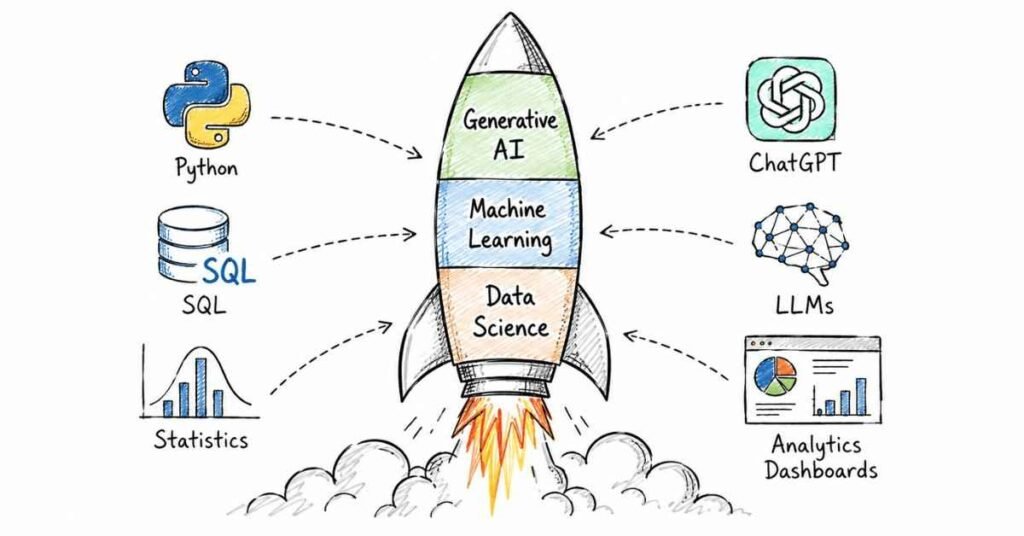
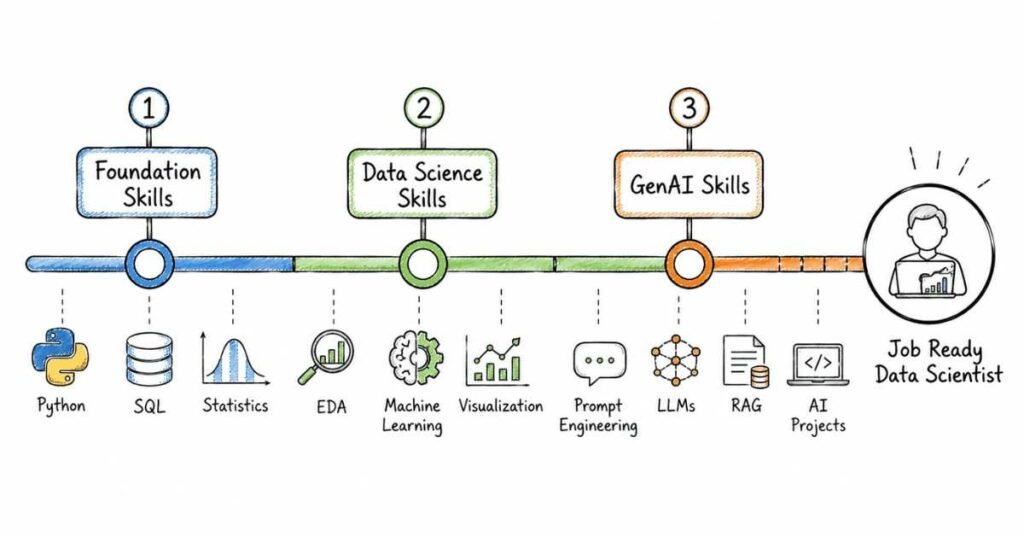
Breaking into data science can feel overwhelming when you’re staring at massive amounts of information scattered across the internet. Most students struggle to find a clear path that takes them from absolute beginner to interview-ready professional. That’s exactly why this roadmap exists—to give you a structured, day-by-day plan that transforms you into a confident data science professional in just three months.
This comprehensive guide is based on the proven curriculum from Frontlines Edutech’s Data Science with GenAI course, designed specifically for learners who want practical skills that employers actually need. Unlike theoretical courses that leave you confused about what to do next, this roadmap focuses on hands-on projects, real-world applications, and career preparation that gets you hired.
Why This 90-Day Roadmap Works
Start Your Data Science Journey Today
Master Python, Machine Learning, Deep Learning & Data Analytics with our
Data Science Course. Become industry-ready in just 90 days.
Traditional learning approaches fail because they teach concepts in isolation without showing you how everything connects in real projects. This roadmap solves that problem by breaking down complex topics into digestible daily lessons while building toward complete projects that demonstrate your skills to potential employers.
The job market for data science professionals has exploded, with cities like Bangalore, Hyderabad, Pune, Mumbai, Chennai, Gurgaon, and Noida offering thousands of opportunities in software technology, healthcare diagnostics, startup innovation, and enterprise AI solutions. Companies including Infosys, TCS, Accenture, Capgemini, Wipro, Cognizant, IBM, and KPMG are actively hiring skilled data scientists who can work with both traditional machine learning and cutting-edge generative AI technologies.
What makes this roadmap different is its focus on Employability from day one. You won’t just learn Python or machine learning—you’ll build a portfolio, optimize your LinkedIn profile, prepare for technical interviews, and understand exactly what recruiters look for when hiring data scientists.
Month 1: Building Your Foundation (Days 1-30)
The first month establishes your programming skills and mathematical understanding, which form the bedrock of everything you’ll build later. Many students skip this foundation and struggle with advanced concepts, so dedicate yourself fully to these fundamentals.
Week 1: Python Programming Fundamentals (Days 1-7)
Day 1: Understanding the Data Science Ecosystem
Start by understanding why Python dominates data science and who uses it in the industry. Install Python, PyCharm, and Anaconda on your laptop following step-by-step setup guides. Get comfortable with the IDLE interface and write your first simple programs to understand how Python interpreters work from both a programmer’s and system’s perspective.
Day 2: Numeric Data Types and Variables
Dive into all numeric types Python offers, including integers, floats, and complex numbers. Learn how Python handles variables, objects, and references differently from other languages. Practice shared references and understand garbage collection to write efficient code. Complete hands-on exercises that manipulate numbers and observe how Python manages memory.
Day 3: Strings, Lists, and Data Structures
Master Python’s built-in data types including strings, lists, dictionaries, tuples, sets, and file handling. These structures form the foundation for data manipulation you’ll do throughout your career. Practice creating, accessing, modifying, and iterating through each data type with real examples.
Day 4: Control Flow and Conditional Logic
Learn how to control program flow using if-else statements, if-elif-else chains, and ternary expressions. Write programs that make decisions based on data conditions. Practice assignments, expressions, and print statements that display meaningful information.
Day 5: Loops and Iterations
Master while and for loops that process data repeatedly. Learn about comprehensions versus regular loops for cleaner code. Practice parallel traversals using map and zip functions, along with important built-in functions like range, len, and enumerate.
Day 6: Functions and Code Organization
Understand how to write reusable functions using def statements and nested functions. Learn variable scoping with LEGB rules (Local, Enclosing, Global, Built-in) and when to use global and nonlocal keywords. Practice function arguments, passing techniques, and returning multiple results.
Day 7: Advanced Functions and Week Review
Explore recursive functions, function attributes, annotations, and lambda expressions. Learn about generators using yield statements and generator expressions for memory-efficient code. Review everything from Week 1 with a mini-project that combines all concepts.
💼 Career Tip: Start drafting your LinkedIn headline this week. Use keywords like “Aspiring Data Scientist | Python Programmer | Machine Learning Enthusiast” to appear in recruiter searches
Week 2: Modules, Packages, and Object-Oriented Programming (Days 8-14)
Day 8: Python Modules and Import Systems
Understand module definitions and why Python programs are organized into modules. Learn typical Python program architecture and practice import statements. Discover how imports work behind the scenes through finding, compiling, and running modules.
Day 9: Standard Library and Module Management
Explore Python’s standard library modules that provide pre-built functionality. Understand the pycache folder for byte code files and module search paths. Practice module creation, import statements, from statements, and from * statements.
Day 10: Module Namespaces and Packages
Learn about module namespaces and namespace dictionaries using dict. Understand module reloading and package import basics. Discover why packages are important and practice relative imports.
Day 11: Advanced Module Techniques
Master data hiding in modules and mixed usage modes using name and main. Practice the “as” extension for import and from statements. Complete exercises that organize code into professional package structures.
Day 12: Introduction to Classes and Object-Oriented Programming
Learn why classes are essential for organizing complex code. Understand constructors using init, method calls, and attribute inheritance search. Discover how OOP enables code reuse through subclassing and polymorphism.
Day 13: Class Attributes and Object Persistence
Practice distinguishing between class and instance attributes. Learn to store objects in databases using Pickles and Shelves for data persistence. Write code that creates, modifies, and saves object states.
Day 14: Advanced Classes and Week Review
Explore abstract superclasses, nested classes, and differences between classes and modules. Understand namespace dictionaries and how LEGB scopes apply to classes. Review Week 2 with a project that implements a complete class hierarchy.
Week 3: Operator Overloading and Exception Handling (Days 15-21)
Day 15: Constructor and Indexing Operators
Learn operator overloading starting with init constructors. Practice getitem and setitem for indexing and slicing your custom objects. Understand how Python uses special methods to make objects behave like built-in types.
Day 16: Attribute Access and String Representation
Master getattr and setattr for controlling attribute access. Learn repr and str for creating meaningful string representations of objects. Practice creating objects that print useful debugging information.
Day 17: Arithmetic and Comparison Operators
Implement right-side and in-place operations using radd and iadd. Learn call for making objects callable like functions. Practice comparison operators including lt, gt, and others.
Day 18: Special Class Features
Explore inheritance for “IS-A” relationships and composition for “HAS-A” relationships. Learn pseudo-private class attributes and bound versus unbound method objects. Understand class objects and “Mix-In” classes for flexible design.
Day 19: Advanced Class Models
Study “new style” class models and diamond inheritance changes. Learn Method Resolution Order (MRO), slots for attribute declarations, and properties for attribute accessors. Practice static methods, class methods, and the super built-in function.
Day 20: Exception Handling Fundamentals
Understand why exceptions are crucial for robust programs. Learn default exception handlers and how to catch and raise exceptions. Practice try/except/else statements, try/finally statements, raise statements, and assert statements.
Day 21: Advanced Exception Handling and Week Review
Master with/as context managers and nesting exception handlers. Learn class-based exceptions and why exception hierarchies matter. Create custom exceptions and review Week 3 with a project implementing error handling.
💼 Career Tip: Begin documenting your learning journey on LinkedIn with posts about what you’re learning. Use hashtags like #DataScience #PythonProgramming #100DaysOfCode to increase visibility.
Week 4: Data Manipulation and Regular Expressions (Days 22-30)
Day 22: Introduction to NumPy Arrays
Learn NumPy for numerical computing with array creation, indexing, and transposition. Practice universal array functions and array processing for efficient calculations. Understand why NumPy is essential for data science performance.
Day 23: Introduction to Pandas Series and DataFrames
Master Pandas, the most important library for data manipulation. Learn about Series (one-dimensional data) and DataFrames (two-dimensional tables). Practice creating DataFrames from different data sources.
Day 24: Data Reading and Cleaning
Learn to read data from CSV files, Excel spreadsheets, and databases using Pandas. Practice data cleaning techniques to handle missing values, duplicates, and inconsistent formats. Work with real-world messy datasets.
Day 25: Data Wrangling and Transformation
Master data wrangling to reshape, pivot, and transform datasets. Learn to merge, join, and concatenate multiple data sources. Practice aggregations, groupby operations, and applying custom functions.
Day 26: Data Selection and Extraction
Perfect data selection using loc, iloc, and boolean indexing. Learn to filter rows based on conditions and extract specific columns. Practice sorting, ranking, and sampling data.
Day 27: Regular Expressions for Pattern Matching
Understand what regular expressions are and why they’re powerful for text processing. Learn the regex module in Python with match and search functions. Practice meta characters and advanced patterns for extracting information from text.
Day 28: Advanced Regular Expressions
Master search and replace operations using regular expressions. Practice complex pattern matching for email validation, phone number extraction, and data cleaning. Complete exercises that combine regex with Pandas for data processing.
Day 29: Month 1 Project – Data Analysis Pipeline
Build a complete project that reads data from multiple sources, cleans it, transforms it, and extracts insights. Create a Jupyter notebook documenting your entire process with explanations. This project becomes the first item in your portfolio.
Day 30: Month 1 Review and LinkedIn Profile Setup
Review all Python concepts, data structures, and Pandas operations. Set up your professional LinkedIn profile with a clear headline, summary highlighting your learning journey, and skills section. Connect with 50+ data science professionals and join relevant groups.
💼 Career Action: Complete your LinkedIn profile optimization following this checklist—professional photo, data-driven banner, compelling headline with keywords (Python, Data Science, Machine Learning), detailed summary showcasing projects, skills section with endorsements, and featured section displaying your GitHub portfolio.
💡 Practice Python, Numpy & Pandas with Real Examples
Learn faster with hands-on mini-projects inside our
Data Science How-to Guides.
Month 2: Mathematics, Statistics, and Machine Learning (Days 31-60)
Month two transforms you from a programmer into a data scientist by adding mathematical rigor and machine learning expertise. This month is where theory meets practice through hands-on model building.
Week 5: Mathematics and Statistics for Data Science (Days 31-37)
Day 31: Linear Algebra Fundamentals
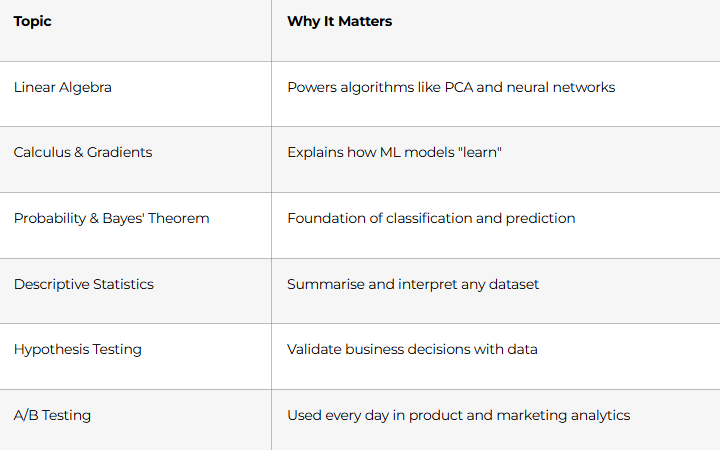
Learn vectors, matrices, and matrix operations essential for understanding algorithms. Practice matrix multiplication, transpose, and inverse calculations. Understand how linear algebra powers techniques like Principal Component Analysis.
Day 32: Calculus for Machine Learning
Master derivatives and gradients that explain how models learn. Understand the concept of optimization and how algorithms minimize errors. Practice calculating gradients for simple functions.
Day 33: Probability Theory
Learn probability distributions, conditional probability, and Bayes’ theorem. Understand how probability helps us work with uncertainty in data. Practice calculating probabilities for real-world scenarios.
Day 34: Descriptive Statistics
Master mean, median, mode, variance, and standard deviation for summarizing data. Learn to interpret these measures and understand what they reveal about datasets. Practice calculating statistics using Python and Pandas.
Day 35: Inferential Statistics
Understand sampling methods, confidence intervals, and the central limit theorem. Learn hypothesis testing with p-values, t-tests, and chi-square tests. Practice making statistical inferences from sample data.
Day 36: Regression Analysis Fundamentals
Learn correlation versus causation and simple linear regression concepts. Understand how to interpret regression coefficients and R-squared values. Practice fitting linear models to data.
Day 37: A/B Testing and Statistical Validation
Master hypothesis testing for validating assumptions in business contexts. Learn A/B testing methodology used by companies to make data-driven decisions. Practice designing experiments and interpreting results.
Week 6: Machine Learning Foundations (Days 38-44)
Day 38: Introduction to Machine Learning
Understand what machine learning is and why it matters in modern applications. Learn about supervised versus unsupervised learning, batch versus online learning, and instance-based versus model-based approaches. Explore real-world ML applications across industries.
Day 39: Machine Learning Challenges and Best Practices
Learn about overfitting versus underfitting and how to prevent them. Understand training, validation, and test set splitting. Practice all phases of end-to-end ML projects from problem definition to deployment.
Day 40: Binary Classification
Build your first classifier to predict yes/no outcomes. Learn about binary classification use cases like spam detection and fraud prevention. Practice implementing simple classification algorithms.
Day 41: Performance Measures for Classification
Master accuracy, confusion matrices, precision, and recall metrics. Understand when each metric is appropriate and how to interpret them. Practice calculating and visualizing performance measures.
Day 42: Multi-Class and Multi-Label Classification
Extend classification to predict multiple classes and multiple labels simultaneously. Learn techniques like one-vs-rest and one-vs-one. Practice building classifiers for complex scenarios.
Day 43: Linear Regression Deep Dive
Implement linear regression from scratch to understand the math behind it. Learn gradient descent, batch gradient descent, stochastic gradient descent, and mini-batch gradient descent. Practice optimizing models through iterative learning.
Day 44: Polynomial and Regularized Regression
Learn polynomial regression for capturing non-linear relationships. Master ridge regression, lasso regression, and early stopping for preventing overfitting. Practice regularization techniques on real datasets.
💼 Career Tip: Start building your GitHub portfolio this week. Create a repository for each major project with clear README files, documented code, and visualizations. Employers want to see your code and thinking process.
Week 7: Advanced Machine Learning Algorithms (Days 45-51)
Day 45: Logistic Regression for Classification
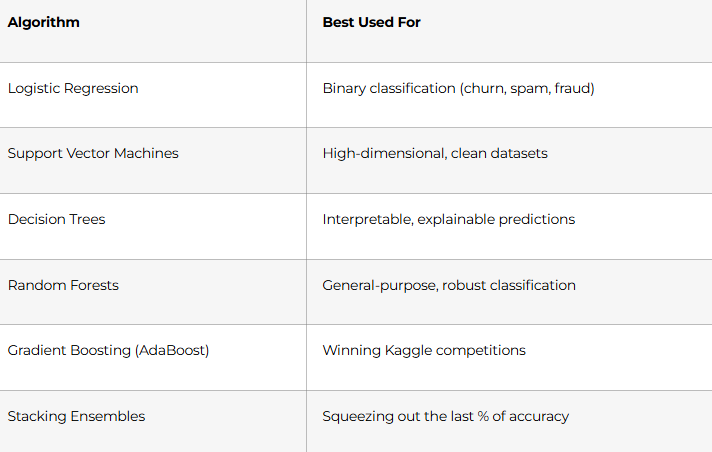
Learn logistic regression for binary and multi-class classification problems. Understand the sigmoid function and log-loss cost function. Practice building logistic regression models with scikit-learn.
Day 46: Support Vector Machines (SVM)
Master SVM for both classification and regression tasks. Understand soft margin versus hard margin classification and the kernel trick. Practice implementing SVMs for linearly and non-linearly separable data.
Day 47: Decision Trees
Learn how decision trees make predictions through recursive splitting. Understand the CART training algorithm, Gini impurity, and entropy. Visualize decision trees and practice regularization through hyperparameters.
Day 48: Ensemble Learning – Voting Classifiers
Discover how combining multiple models improves predictions. Learn about voting classifiers and why diversity among models matters. Practice building ensemble models that outperform individual classifiers.
Day 49: Bagging, Pasting, and Random Forests
Master bagging and pasting techniques using scikit-learn. Learn about out-of-bag evaluation, random patches, and random subspaces. Build random forest classifiers and understand feature importance.
Day 50: Boosting Algorithms
Learn AdaBoost and Gradient Boosting for sequential model improvement. Understand how boosting corrects previous model mistakes. Practice implementing boosting algorithms for challenging datasets.
Day 51: Stacking and Week Review
Master stacking, where models learn from other models’ predictions. Review all supervised learning algorithms and when to use each one. Complete a project comparing multiple algorithms on the same dataset.
Week 8: Unsupervised Learning and Month Review (Days 52-60)
Day 52: Introduction to Clustering
Learn K-Means clustering algorithm and its applications. Understand cluster initialization, centroid updates, and convergence. Practice clustering customer segments and identifying patterns in unlabeled data.
Day 53: Limits of K-Means and Alternatives
Discover K-Means limitations with non-spherical clusters and outliers. Learn about elbow method and silhouette scores for choosing K. Practice DBSCAN for density-based clustering that handles irregular shapes.
Day 54: Preprocessing and Semi-Supervised Learning with Clustering
Use clustering for preprocessing data before supervised learning. Learn semi-supervised learning techniques that combine labeled and unlabeled data. Practice these hybrid approaches on real datasets.
Day 55: Introduction to Neural Networks
Understand biological neurons and how they inspired artificial neural networks. Learn about perceptrons and multilayer perceptrons (MLPs). Study backpropagation, the algorithm that trains neural networks.
Day 56: Building Neural Networks with Keras
Implement regression MLPs and classification MLPs using Keras. Learn the Sequential API for building simple models and Functional API for complex architectures. Practice saving and restoring trained models.
Day 57: Fine-Tuning Neural Networks
Master hyperparameter tuning including number of hidden layers, neurons per layer, learning rate, and batch size. Learn systematic approaches to optimization. Practice grid search and random search for finding best configurations.
Day 58: Month 2 Capstone Project – Predictive Model
Build an end-to-end machine learning project solving a real business problem. Include data exploration, feature engineering, model selection, hyperparameter tuning, and performance evaluation. Document everything in a professional Jupyter notebook.
Day 59: Resume Building Workshop
Create a data science resume highlighting your projects, technical skills, and coursework. Learn how to quantify achievements and use action verbs. Get feedback on your resume from peers or mentors.
Day 60: Month 2 Review and Portfolio Website
Review all machine learning concepts, algorithms, and implementation techniques. Create a simple portfolio website or GitHub Pages showcasing your projects. Write project descriptions that explain business impact, technical approach, and results.
💼 Career Action: Update your LinkedIn featured section with your Month 2 capstone project. Write a detailed post explaining the problem you solved, your methodology.
🧠 Prepare for Data Science Interviews
Get 300+ real ML, statistics, SQL & case-study interview questions in our
Data Science Interview Preparation Guide.
Month 3: Deep Learning, GenAI, and Career Preparation (Days 61-90)
The final month transforms you into a cutting-edge professional who understands both traditional machine learning and the latest generative AI technologies that are revolutionizing industries. This month focuses heavily on practical implementation and career readiness.
Week 9: Deep Learning Mastery (Days 61-67)
Day 61: Training Deep Neural Networks
Tackle the vanishing and exploding gradients problems that plague deep networks. Learn Glorot and He initialization techniques along with Lecunn initialization for proper weight setup. Master batch normalization and gradient clipping to stabilize training.
Day 62: Advanced Optimization and Regularization
Explore transfer learning and unsupervised pretraining for leveraging existing models. Learn faster optimizers beyond standard gradient descent. Implement L1 and L2 regularization, dropout, and Monte Carlo dropout to prevent overfitting.
Day 63: TensorFlow Data Pipeline
Master loading and preprocessing data efficiently with TensorFlow. Learn the Data API for chaining transformations, shuffling data, and preprocessing features. Practice prefetching data to optimize training speed.
Day 64: Feature Engineering with Keras
Encode categorical features using one-hot vectors and embeddings. Learn Keras preprocessing layers for standardization, normalization, and feature transformation. Practice building complete pipelines from raw data to model-ready inputs.
Day 65: Computer Vision Fundamentals
Understand the architecture of the visual cortex and how it inspired CNNs. Learn convolutional layers, filters, and feature maps. Study pooling layers and CNN architectures like VGG, ResNet, and EfficientNet.
Day 66: Advanced Computer Vision
Master data augmentation techniques for improving model generalization. Practice building image classifiers for real-world applications. Learn transfer learning with pre-trained models like ImageNet weights.
Day 67: Natural Language Processing Basics
Learn recurrent neurons, layers, and memory cells for sequence processing. Understand input and output sequences for tasks like translation and sentiment analysis. Study training techniques for RNNs and stateful RNN architectures.
💼 Career Tip: Add your deep learning projects to GitHub with detailed README files explaining the architecture, dataset, training process, and results. Include visualizations of training curves and model predictions.
Week 10: Generative AI and LLMs (Days 68-74)
Day 68: Introduction to Large Language Models
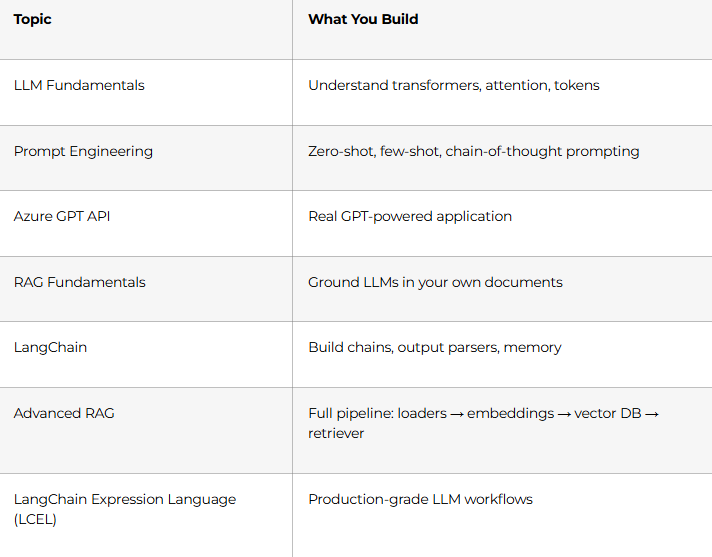
Understand foundation LLM models and their architecture. Learn about context windows, tokens, and how transformers process text. Study the attention mechanism and self-attention that powers modern NLP.
Day 69: Prompt Engineering Mastery
Master prompt engineering techniques for getting optimal responses from LLMs. Understand hallucinations and how to minimize them. Practice zero-shot, few-shot, and chain-of-thought prompting.
Day 70: Working with Azure GPT Models
Set up subscriptions for Microsoft Azure GPT models. Learn API authentication, rate limits, and best practices. Practice building applications that integrate GPT for real-world use cases.
Day 71: RAG (Retrieval-Augmented Generation) Fundamentals
Learn RAG technique basics and why it’s crucial for grounding LLMs in factual data. Understand RAG components including retrievers, embeddings, and vector databases. Study challenges in implementing RAG effectively.
Day 72: LangChain Orchestration Framework
Master LangChain for building LLM applications. Learn how to connect with OpenAI and free alternatives like Llama. Practice creating chains for sequences of instructions and output parsers for reformatting responses.
Day 73: Advanced RAG Implementation
Implement complete RAG workflows with data loaders, splitters, embeddings, and vector databases. Learn about retrievers and top K results selection. Practice building RAG systems that answer questions from your custom documents.
Day 74: LangChain Expression Language and Week Review
Master LCEL chains and runnables for complex workflows. Compare LangChain with Llama Index and OpenAI API frameworks. Build a complete conversational AI application combining everything from Week 10.
Week 11: Advanced GenAI and Multimodal Models (Days 75-81)
🎯 Master Data Cleaning, EDA & Professional Visualization Skills
Get structured mentorship and real datasets to practice with our
Data Science Course.
Day 75: Transformer Architecture Deep Dive
Study transformers in detail including attention mechanisms and positional encodings. Learn about pre-trained language models like BERT, RoBERTa, and T5. Understand word and sentence embeddings including Word2Vec and GloVe.
Day 76: Text Classification with BERT
Implement text classification using BERT for sentiment analysis and topic categorization. Practice fine-tuning pre-trained models on custom datasets. Learn evaluation metrics including BLEU, ROUGE, F1-Score, and Perplexity.
Day 77: Generative Adversarial Networks (GANs)
Understand GAN basics with generator and discriminator networks. Learn advanced models like StyleGAN and CycleGAN. Build a DCGAN for generating synthetic images.
Day 78: Diffusion Models
Study DDPM and Stable Diffusion architectures. Practice text-to-image generation with Stable Diffusion. Compare diffusion models with GANs for different use cases.
Day 79: Multimodal LLMs
Learn text-image and text-audio integration in multimodal models. Build a multimodal content generator combining different modalities. Understand applications in real-world scenarios.
Day 80: Real-Time Generative AI
Implement real-time inference for LLMs, GANs, and diffusion models. Build a real-time text-to-image generator. Learn evaluation metrics including FID, Inception Score, and perceptual quality.
Day 81: Agentic AI and Week Review
Explore autonomous agents and multi-agent systems. Learn tool-calling, reasoning capabilities, and ethical concerns. Build a customer support agent with tool-calling as your capstone project.
💼 Career Tip: Create a demo video of your GenAI projects and post them on LinkedIn. Videos showcasing working applications get significantly more engagement than static posts.
Week 12: Career Launch Preparation (Days 82-90)
Day 82: Portfolio Refinement Workshop
Review all 12 weeks of projects and select your top 5 showcase pieces. Write compelling project descriptions that explain business problems, technical approaches, and measurable results. Ensure all code is well-documented and follows best practices.
Day 83: Resume Optimization for ATS Systems
Optimize your resume with data science keywords that pass Applicant Tracking Systems. Quantify achievements using metrics and percentages. Format your resume cleanly with clear sections for technical skills, projects, education, and experience.
Day 84: LinkedIn Profile Deep Optimization
Create a compelling LinkedIn headline using high-impact keywords like “Data Scientist specializing in Machine Learning & GenAI | Python | TensorFlow | NLP” . Write a summary that tells your story, highlights unique skills, and includes specific accomplishments . Add all projects to your featured section with eye-catching thumbnails.
Day 85: Job Platform Mastery
Create profiles on Naukri, LinkedIn Jobs, Indeed, AngelList, and Instahire with optimized information. Set up job alerts for “Data Scientist,” “Machine Learning Engineer,” “AI Engineer,” and “Data Analyst” roles. Research target companies including Infosys, TCS, Accenture, Capgemini, Wipro, Cognizant, IBM, and startups in Bangalore, Hyderabad, Pune, and other tech hubs.
🔗 Want detailed strategies for each job platform? Check out Frontlines Edutech’s complete Job Search Strategy Guide for step-by-step application templates and networking approaches.
Day 86: Technical Interview Preparation – Python & Statistics
Practice 50+ Python coding questions covering data structures, algorithms, and Pandas operations. Review probability distributions, hypothesis testing, and A/B testing scenarios. Practice explaining your code solutions clearly and handling edge cases.
Day 87: Technical Interview Preparation – Machine Learning
Master explanations of supervised and unsupervised learning algorithms. Practice questions about overfitting, bias-variance tradeoff, and regularization techniques. Prepare to walk through your project implementations and defend design decisions.
Day 88: Technical Interview Preparation – Deep Learning & GenAI
Review neural network architectures, activation functions, and optimization algorithms. Practice explaining CNNs for computer vision and RNNs/Transformers for NLP. Prepare to discuss LLMs, prompt engineering, and RAG implementations.
🔗 Need comprehensive interview questions with answers? Download Frontlines Edutech’s Data Science Interview Preparation Guide with 200+ technical questions, behavioral scenarios, and communication strategies.
Day 89: Behavioral Interview and Communication Skills
Prepare STAR method responses for common questions about teamwork, problem-solving, and handling failure. Practice explaining complex technical concepts to non-technical audiences. Record yourself answering questions to improve delivery and confidence.
Day 90: Mock Interviews and Final Preparation
Conduct mock interviews with peers or mentors covering technical and behavioral questions. Receive feedback on your responses, communication style, and technical depth. Create a personalized job search action plan with daily application targets and networking activities.
Top Job Platforms for Data Science Roles
Navigating job platforms strategically multiplies your chances of landing interviews.
LinkedIn Jobs
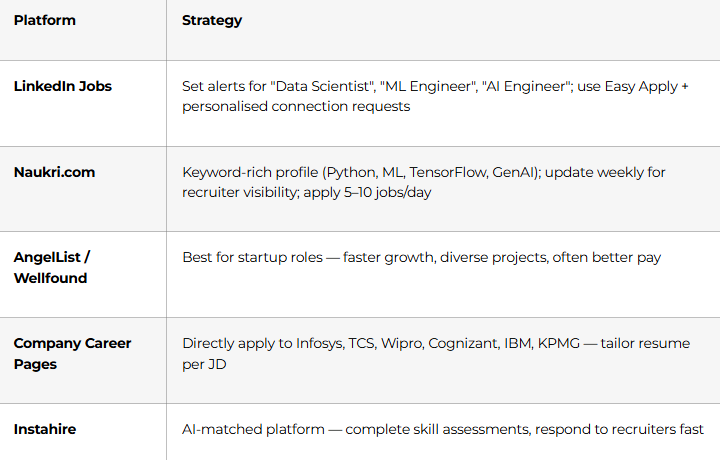
Set up alerts for “Data Scientist,” “Machine Learning Engineer,” “AI Engineer,” and “Data Analyst” with location filters for Bangalore, Hyderabad, Pune, Mumbai, Chennai, Gurgaon, and Noida. Use Easy Apply for quick applications but prioritize positions where you have connections. Research companies before applying and mention specific projects or values in your application.
Create a keyword-optimized profile emphasizing Python, Machine Learning, TensorFlow, GenAI, and domain expertise. Update your profile regularly to maintain high visibility in recruiter searches. Apply to 5-10 relevant positions daily and track application status systematically.
AngelList (Wellfound)
Target startup opportunities offering faster growth and diverse project exposure. Highlight your full-stack data science capabilities and willingness to wear multiple hats. Research startup funding rounds and technology stacks before applying.
Company Career Pages
Directly apply on career pages of target companies like Infosys, TCS, Accenture, Capgemini, Wipro, Cognizant, IBM, and KPMG. Tailor your resume and cover letter to specific job descriptions. Follow up with recruiters on LinkedIn after applying.
Instahire and Specialized Platforms
Use AI-driven matching platforms that connect candidates with companies based on skill alignment. Complete skill assessments to validate your capabilities and increase profile strength. Respond quickly to recruiter messages to demonstrate enthusiasm.
🔗 Get Frontlines Edutech’s Application Tracking Template with email templates, follow-up scripts, and negotiation strategies to maximize your job search efficiency.
Data Science Interview Preparation Blueprint
Technical interviews for data science roles test coding abilities, statistical knowledge, machine learning understanding, and problem-solving skills.
Python Coding Questions
Practice data structure implementations including lists, dictionaries, sets, and custom classes. Master Pandas operations for filtering, grouping, merging, and transforming DataFrames. Solve algorithm questions covering sorting, searching, recursion, and dynamic programming.
Statistics and Probability
Explain probability distributions including normal, binomial, and Poisson with real-world applications. Demonstrate hypothesis testing methodology including null hypothesis formulation, p-value interpretation, and Type I/II errors. Practice A/B testing scenarios common in product and marketing analytics.
Machine Learning Concepts
Explain supervised versus unsupervised learning with appropriate use cases. Discuss bias-variance tradeoff and techniques for addressing overfitting and underfitting. Compare algorithm trade-offs between decision trees, random forests, gradient boosting, and neural networks.
Deep Learning and Neural Networks
Describe neural network architectures including feedforward, CNN, and RNN/LSTM. Explain activation functions, loss functions, and optimization algorithms. Discuss regularization techniques including dropout, batch normalization, and early stopping.
Generative AI and LLMs
Explain transformer architecture and attention mechanisms. Discuss prompt engineering strategies and handling hallucinations. Describe RAG implementation for grounding LLMs in factual information.
Case Study and Project Questions
Walk through your end-to-end project workflow from problem definition to deployment. Explain feature engineering decisions and their impact on model performance. Discuss challenges faced, how you overcame them, and lessons learned.
Behavioral Interview Questions
Prepare STAR method responses for teamwork, conflict resolution, and leadership scenarios. Demonstrate growth mindset by discussing failures and what you learned. Show enthusiasm for continuous learning and staying updated with industry trends.
🔗 Access Frontlines Edutech’s complete Data Science Interview Preparation Guide with 200+ questions covering Python, Statistics, Machine Learning, Deep Learning, GenAI, SQL, and behavioral scenarios with model answers.
🛣️ Explore Your Data Science & AI Career Path
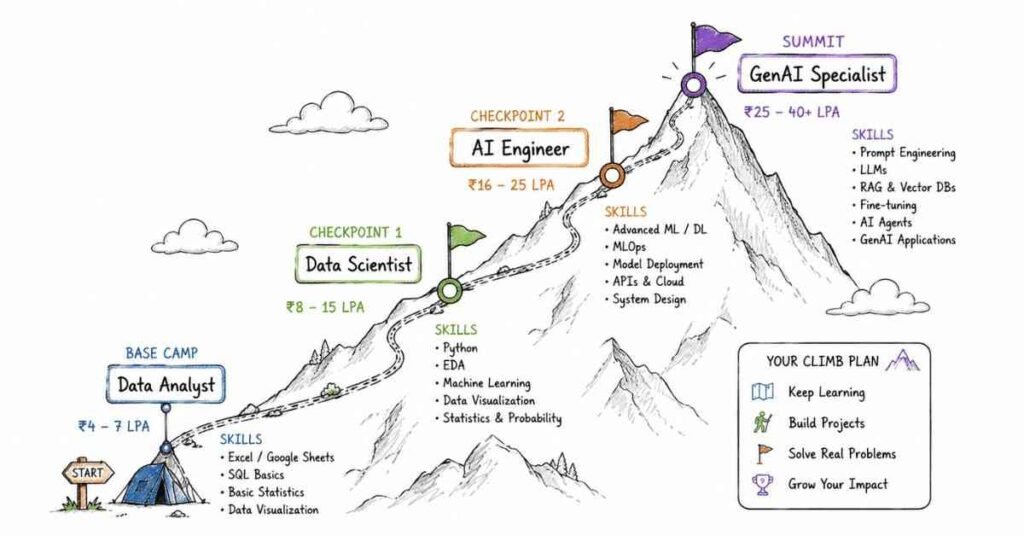
Go from Data Analyst → ML Engineer → Data Scientist → AI Engineer with our
Data Science Career Path
4. Why Choose Frontlines Edutech for Your Data Science Journey
Frontlines Edutech Private Limited bridges the gap between academic learning and industry requirements through practical, hands-on training that prepares you for real-world data science roles.
Industry-Standard Training
Learn from industry experts passionate about mentoring who bring real-world experience from top companies. The curriculum covers everything from Python fundamentals to cutting-edge generative AI, ensuring you’re equipped with both foundational and advanced skills. Unlike theoretical courses, every module includes hands-on projects that simulate actual workplace scenarios.
Comprehensive Career Support
Receive end-to-end career support including resume building, LinkedIn profile optimization, interview guidance, and placement updates. Access daily assignments that reinforce learning and build discipline. Get course completion certificates recognized by employers across industries.
Practical Learning Approach
Benefit from training designed specifically for non-IT students with beginner-friendly content that builds progressively. Watch on-demand videos that allow you to learn at your own pace while balancing other commitments. Participate in Q&A sessions that clarify doubts and deepen understanding.
Affordable and Transparent
Access high-quality training at affordable rates without hidden costs. Experience transparent communication about course content, timelines, and outcomes. Join thousands of learners who trust Frontlines Edutech for their career transformation.
Results-Driven Focus
Frontlines Edutech focuses on refining talent and turning learners into highly skilled professionals sought after by top companies including Infosys, TCS, Accenture, Capgemini, Wipro, Cognizant, IBM, and KPMG. The training emphasizes employability skills beyond just technical knowledge.
🔗 Ready to transform your career? Enroll in Frontlines Edutech’s Data Science with GenAI course and start your 90-day journey to becoming a job-ready data scientist. Contact +91-83330 77727 or email media.frontlines@gmail.com for enrollment details.
Your Next Steps to Data Science Success
This 90-day roadmap provides the structure, but your commitment determines the outcome. Success requires consistent daily effort, hands-on project building, and active career preparation from day one.
Week 1 Action Items:
Enroll in Frontlines Edutech’s Data Science with GenAI course to access structured learning materials, expert guidance, and career support. Set up your development environment with Python, Anaconda, and PyCharm. Create LinkedIn and GitHub accounts to document your learning journey.
Monthly Milestones:
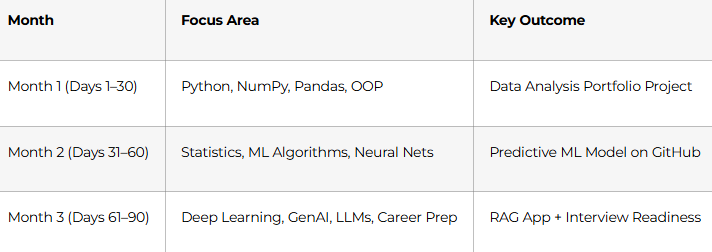
Complete Month 1 foundation with a data analysis portfolio project. Finish Month 2 with a machine learning prediction model demonstrating algorithm mastery. Conclude Month 3 with a GenAI application showcasing cutting-edge capabilities.
Post-Course Strategy:
Continue building projects that solve real problems in domains you’re passionate about. Network actively on LinkedIn and attend data science meetups in your city. Apply to 10+ positions weekly while refining your interview skills through mock practice.
The data science field offers extraordinary opportunities for those willing to invest the time and effort to master both foundational and advanced skills. With structured learning from Frontlines Edutech, consistent practice, and strategic career preparation, you’ll be ready to land high-paying data science roles within three months.
Your journey to becoming a professional data scientist starts today. Every expert was once a beginner who refused to give up. Follow this roadmap, leverage Frontlines Edutech’s comprehensive support, and transform your career trajectory in 90 days.
🎓 Enroll now at Frontlines Edutech and join thousands of successful data science professionals who started exactly where you are today. Visit www.frontlinesedutech.com or call +91-83330 77727 to begin your transformation.
🎯 Your Data Science Career Starts Now
Continue building your skills through structured learning and hands-on practice.