
.NET Microservices Interview Preparation Guide : 240 Q&As
Table of Contents
Part 1: Introduction & 30-Day Study Plan

What This Guide Covers
This guide prepares you for .NET Microservices interviews with practical topics such as:
- C# and .NET
- ASP.NET Core
- REST APIs
- EF Core and SQL
- Microservices
- RabbitMQ
- Security
- Docker
- Cloud basics
- Scenario questions
Who This Guide Is For
Useful for:
- Freshers
- .NET developers
- Backend developers
- Full Stack .NET developers
- Developers moving from monolith to microservices
What .NET Microservices Means
.NET is used to build backend applications and APIs.
Microservices split a large application into smaller services such as:
Order Service → Payment Service → Inventory Service → Notification Service
Each service handles a clear business responsibility.
What Does a .NET Microservices Developer Do?
A developer may work on:
- ASP.NET Core APIs
- Business logic
- Databases
- Service communication
- Messaging
- Security
- Docker
- Production troubleshooting
The role is not only coding. You should also understand how services communicate and what happens when one fails.
30-Day Study Plan
Week 1: C# & .NET
Focus on:
OOP, Collections, LINQ, Exceptions, Interfaces, Generics, Async/Await, Tasks, Garbage Collection
Week 2: ASP.NET Core & Database
Focus on:
Web API, Routing, Middleware, Dependency Injection, JWT, EF Core, SQL, Swagger
Week 3: Microservices
Focus on:
Monolith vs Microservices, REST, API Gateway, RabbitMQ, Saga, Eventual Consistency, Retry, Circuit Breaker
Week 4: Docker & Interview Practice
Focus on:
Docker, Kubernetes basics, Cloud, Logging, Monitoring, System Design, Projects, Mock Interviews
Reference PDF also follows a four-week preparation structure before moving deeper into interview questions.
Daily Study Routine
A simple routine:
- 30 min: Learn concept
- 30 min: Code practice
- 20 min: Interview questions
- 10 min: Revision
Even 60–90 focused minutes daily is enough if preparation is consistent.
Tools You Should Know
- Visual Studio
- Postman
- Swagger
- SQL Server
- Git
- EF Core
- Docker
- RabbitMQ
- Redis
- Azure basics
You do not need to master every tool.
Common Interview Focus Areas
Focus mainly on:
C# → ASP.NET Core → APIs → EF Core → SQL → Microservices → Messaging → Security → Docker → Resilience → System Design
What Strong Answers Look Like
Do not give only definitions.
Basic:
“Dependency Injection reduces coupling.”
Better:
“Dependency Injection lets a class receive its dependencies instead of creating them directly. This makes the code easier to test and maintain.”
Short, clear, and practical.
The reference guide also recommends learning concepts and explaining answers in your own words instead of memorizing them.
How To Think Like a .NET Microservices Developer
For every concept, ask:
What does it do?
Why do we use it?
Where does it fit?
What happens if it fails?
Part 2: C# & .NET Fundamentals
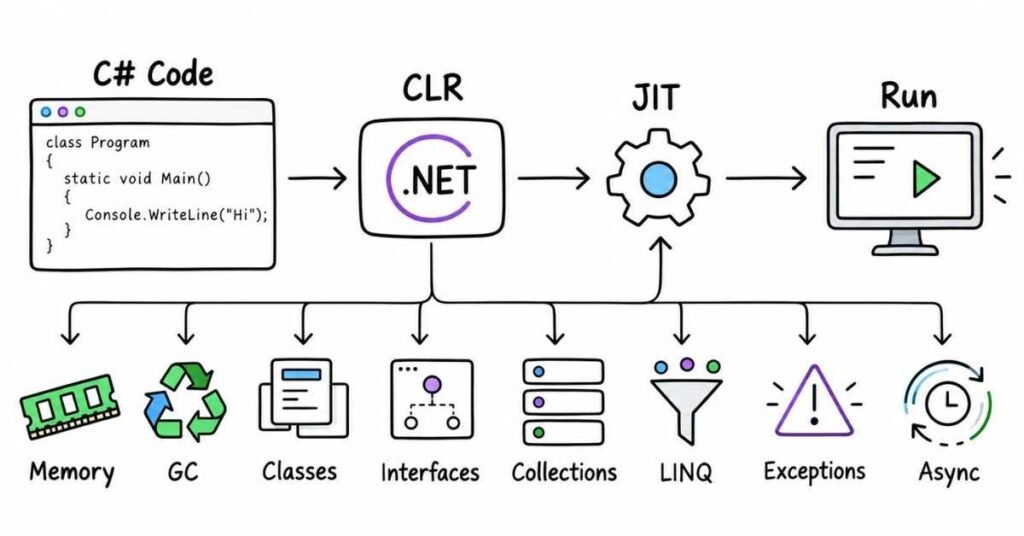
C# & .NET Basics — Questions 1–40
Q1. What is .NET?
.NET is a Microsoft development platform used to build web, desktop, cloud, API, and backend applications.
Q2. What is C#?
C# is a programming language mainly used with .NET to build applications, APIs, and services.
Q3. What is CLR?
CLR stands for Common Language Runtime.
It manages .NET code execution, memory, exceptions, and garbage collection.
Q4. What is managed code?
Managed code runs under the control of the CLR.
The CLR handles memory and runtime services for it.
Q5. What is unmanaged code?
Unmanaged code runs outside the CLR.
Developers usually have more direct responsibility for memory and system resources.
Q6. What is CTS?
CTS stands for Common Type System.
It defines how data types are represented and used across .NET languages.
Q7. What is CLS?
CLS stands for Common Language Specification.
It defines common rules that help different .NET languages work together.
Q8. What is JIT?
JIT stands for Just-In-Time compiler.
It converts intermediate .NET code into machine code during execution.
Q9. What is an assembly?
An assembly is a compiled .NET unit such as a .dll or .exe.
It contains code, metadata, and type information.
Q10. What is Garbage Collection?
Garbage Collection automatically removes objects that are no longer being used.
This helps manage memory.
C# Types & OOP
Q11. What is a value type?
A value type stores the actual value.
Examples:
int, bool, double, struct
Q12. What is a reference type?
A reference type stores a reference to an object.
Examples:
class, string, array
Q13. What is the difference between Stack and Heap?
Stack: commonly stores local variables and method-call information.
Heap: stores objects created at runtime.
Q14. What is boxing?
Boxing converts a value type into an object/reference type.
Example:
int n = 10;
object obj = n;
Q15. What is unboxing?
Unboxing converts the boxed object back to the original value type.
Q16. What is a class?
A class is a blueprint used to create objects.
It can contain fields, properties, methods, and constructors.
Q17. What is an object?
An object is an instance of a class.
Example:
Customer c = new Customer();
Q18. What is encapsulation?
Encapsulation keeps data and related methods together and controls access to internal details.
Q19. What is inheritance?
Inheritance allows one class to reuse or extend another class.
Q20. What is polymorphism?
Polymorphism allows the same operation to behave differently depending on the object or implementation.
Q21. What is abstraction?
Abstraction hides unnecessary implementation details and exposes only what is needed.
Q22. What is an interface?
An interface defines a contract.
Classes implementing it provide the actual behavior.
Q23. What is an abstract class?
An abstract class cannot normally be instantiated directly.
It can contain both implemented and abstract members.
Q24. Interface vs abstract class?
Use an interface mainly for a contract.
Use an abstract class when related classes need shared code or state.
Q25. What is method overloading?
Same method name with different parameter lists.
Q26. What is method overriding?
A derived class provides its own implementation of an inherited virtual or abstract method.
Collections, Generics & LINQ
Q27. What is a collection?
A collection stores multiple objects.
Examples:
List
Dictionary
HashSet
Queue
Q28. What is List<T>?
List<T> stores a dynamic collection of strongly typed items.
Q29. What is a Dictionary?
A Dictionary stores values using key-value pairs.
Example:
Dictionary<int, string>
Q30. What are generics?
Generics allow reusable code while keeping type safety.
Example:
List<int>
List<string>
Q31. What is LINQ?
LINQ stands for Language Integrated Query.
It is used to query collections and other data sources using C# syntax.
Example:
var result = users.Where(x => x.IsActive);
Q32. What is a lambda expression?
A lambda is a short way to write an anonymous function.
Example:
x => x.Price > 1000
Exceptions & Async Programming
Q33. What is exception handling?
Exception handling manages runtime errors using:
try, catch, finally, and throw.
Q34. What is finally?
The finally block runs whether an exception occurs or not.
It is useful for cleanup work.
Q35. What is throw?
throw is used to raise an exception.
It can also rethrow an existing exception.
Q36. What is async programming?
Async programming allows an application to continue useful work instead of blocking while waiting for long operations.
It is common in APIs and database calls.
Q37. What is async?
async marks a method that can use await.
Q38. What is await?
await waits for an asynchronous operation without blocking the thread in the normal way.
Q39. What is Task?
Task represents an asynchronous operation.
Example:
Task<User> GetUserAsync()
Q40. Why is async/await important in Web APIs?
APIs often wait for databases or external services.
Using async/await helps avoid blocking request threads unnecessarily and improves scalability.
Practice Strategy
For this part, practise explaining:
Interface vs Abstract Class
Value Type vs Reference Type
List vs Dictionary
Overloading vs Overriding
Task vs normal synchronous method
Also write one small C# program using:
Interface → Dependency → LINQ → Exception Handling → Async Method
Part 3: ASP.NET Core & Web API
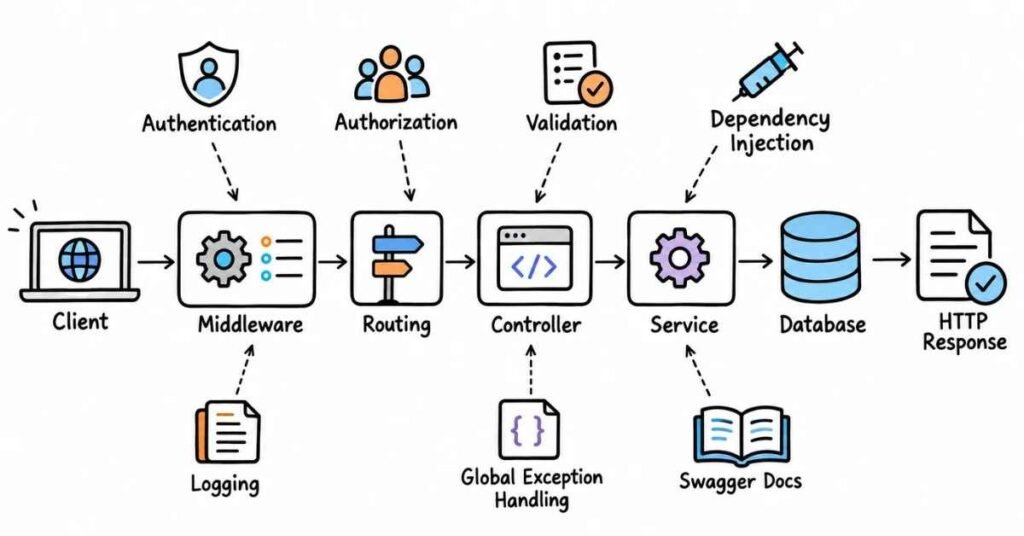
ASP.NET Core & Web API — Questions 41–75
Q41. What is ASP.NET Core?
ASP.NET Core is a cross-platform framework used to build web applications, REST APIs, and backend services with .NET.
Q42. Why is ASP.NET Core used for Microservices?
It is lightweight, fast, cross-platform, and works well with APIs, Dependency Injection, Docker, and cloud deployments.
Q43. What is a Web API?
A Web API allows applications to communicate over HTTP.
For example:
Frontend → Product API → Database
Q44. What is a Controller?
A Controller handles incoming HTTP requests and returns responses.
Example:
[ApiController]
[Route(“api/[controller]”)]
public class ProductController : ControllerBase
{
}
Q45. What is routing?
Routing decides which API endpoint should handle a request.
Example:
GET /api/products/10
Q46. What are common HTTP methods?
Common methods are:
GET
POST
PUT
PATCH
DELETE
Each is used for a different type of operation.
Q47. What is GET used for?
GET is mainly used to retrieve data.
Example:
GET /api/products
Q48. What is POST used for?
POST is used to create new data.
Example:
POST /api/products
Q49. What is PUT used for?
PUT is generally used to update an existing resource.
Q50. What is DELETE used for?
DELETE removes a resource.
Example:
DELETE /api/products/5
Q51. What are HTTP status codes?
Status codes tell the client what happened.
Examples:
200 — OK
201 — Created
400 — Bad Request
401 — Unauthorized
404 — Not Found
500 — Internal Server Error
Q52. What is model binding?
Model binding converts request data into C# objects automatically.
For example, JSON request data can be converted into a Product object.
Q53. What is model validation?
Model validation checks whether incoming data follows required rules.
Example:
[Required]
public string Name { get; set; }
Q54. What is Dependency Injection?
Dependency Injection provides required services to a class instead of creating them inside that class.
Example:
public ProductController(IProductService service)
{
_service = service;
}
Q55. Why is Dependency Injection useful?
It reduces tight coupling and makes code easier to test and maintain.
Q56. What are DI service lifetimes?
Common lifetimes are:
Transient — new instance each time.
Scoped — one instance per request.
Singleton — one instance for the application lifetime.
Q57. What is Middleware?
Middleware is code that runs during the HTTP request pipeline.
It can handle things like:
Logging
Authentication
Exception handling
CORS
Q58. Why does middleware order matter?
Middleware runs in the order it is added.
If the order is wrong, authentication, routing, or error handling may not work as expected.
Q59. What is configuration in ASP.NET Core?
Configuration stores settings such as:
Connection strings
API URLs
Feature settings
Values may come from files, environment variables, or secret stores.
Q60. What is appsettings.json?
appsettings.json is commonly used to store application configuration.
Sensitive production secrets should not be hardcoded there.
Q61. What are environment variables?
Environment variables allow configuration to change between environments without changing application code.
Example:
Development → Test → Production
Q62. What is Swagger?
Swagger provides interactive API documentation.
Developers can inspect endpoints and test API requests directly.
Q63. What is OpenAPI?
OpenAPI is a standard description format for HTTP APIs.
Swagger tools commonly use the OpenAPI specification.
Q64. What is CORS?
CORS stands for Cross-Origin Resource Sharing.
It controls which origins are allowed to call an API from a browser.
Q65. What is API versioning?
API versioning helps support different versions of an API.
Example:
/api/v1/products
/api/v2/products
This helps avoid breaking existing clients.
Q66. What is exception handling in Web APIs?
Exception handling catches errors and returns controlled responses instead of exposing internal details.
Global exception handling is usually better than repeating try-catch in every controller.
Q67. What is a global exception handler?
It handles unhandled exceptions from one central place.
This keeps API error responses more consistent.
Q68. What is logging?
Logging records useful application information.
Examples:
Request failures
Exceptions
Service calls
Important business events
Logs help during production troubleshooting.
Q69. What is authentication?
Authentication checks who the user is.
For example, validating a JWT token.
Q70. What is authorization?
Authorization checks what the authenticated user is allowed to do.
For example:
Only an Admin can delete a product.
Q71. What is JWT?
JWT stands for JSON Web Token.
It is commonly used to carry authenticated user information between the client and API.
Q72. What is an API filter?
Filters run around specific stages of MVC or controller execution.
They can be used for validation, authorization, logging, or action-related behavior.
Q73. Middleware vs Filters?
Middleware works at the overall HTTP pipeline level.
Filters work more closely with MVC controllers and actions.
Q74. What is asynchronous API programming?
Async APIs avoid blocking threads while waiting for I/O such as database or external API calls.
Example:
var product = await _service.GetByIdAsync(id);
Q75. What makes a good REST API?
A good API should have:
Clear URLs
Correct HTTP methods
Useful status codes
Validation
Security
Consistent error responses
Logging
Good documentation
Practice Strategy
Build one small Product API with:
GET → POST → PUT → DELETE
Then add:
Dependency Injection → Validation → EF Core → JWT → Swagger → Global Exception Handling
After building it, practise explaining:
Client Request → Middleware → Controller → Service → Database → Response
Part 4: Entity Framework Core, SQL & Data Access
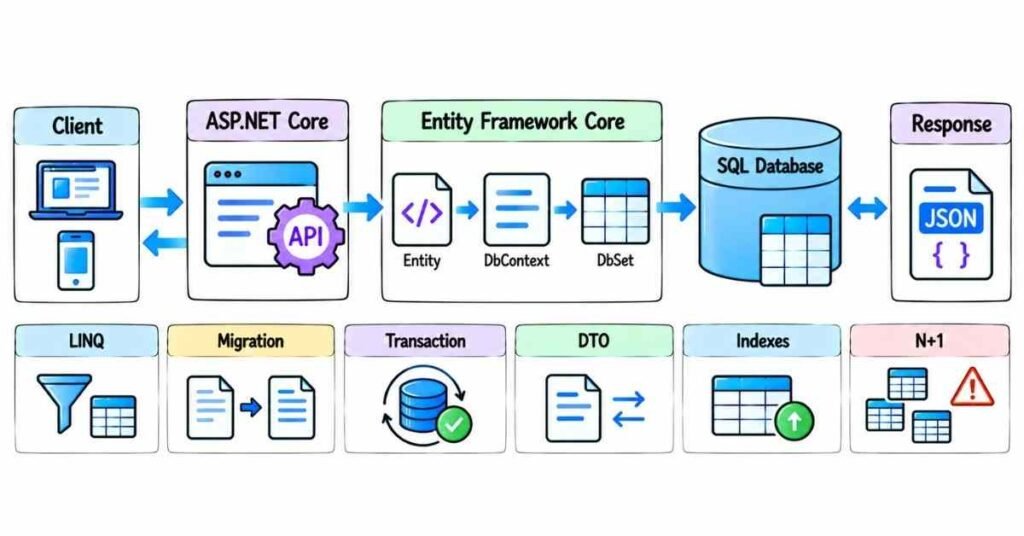
EF Core & SQL — Questions 76–110
Q76. What is Entity Framework Core?
EF Core is an ORM for .NET.
It lets developers work with databases using C# objects instead of writing SQL for every operation.
Q77. What is an ORM?
ORM stands for Object-Relational Mapper.
It maps C# classes to database tables.
Q78. What is DbContext?
DbContext manages the connection and interaction between the application and database.
It is used for querying, inserting, updating, and deleting data.
Q79. What is DbSet?
DbSet<T> represents a database table or collection of entities.
Example:
public DbSet<Product> Products { get; set; }
Q80. What is Code First?
In Code First, we create C# entity classes first.
EF Core then uses those classes to create or update the database structure.
Q81. What is Database First?
In Database First, the database already exists.
Entity classes are generated based on the existing schema.
Q82. What is a migration?
A migration tracks database schema changes.
For example, adding a new property to an entity can result in a new database column.
Q83. Why are migrations useful?
They help developers manage database changes in a controlled and repeatable way.
Q84. What is change tracking in EF Core?
Change tracking helps EF Core detect which entities were added, updated, or deleted.
Those changes can later be saved to the database.
Q85. What is AsNoTracking()?
AsNoTracking() tells EF Core not to track returned entities.
It is useful for read-only queries and can reduce unnecessary overhead.
Q86. When would you use tracking?
Use tracking when the entity may be modified and saved later.
Q87. What is eager loading?
Eager loading fetches related data along with the main entity.
Example:
context.Orders.Include(x => x.Customer)
Q88. What is lazy loading?
Lazy loading retrieves related data only when it is accessed.
It is convenient, but careless use can create many unexpected database queries.
Q89. What is explicit loading?
Explicit loading means related data is loaded manually when required.
It gives the developer more control.
Q90. What is the N+1 query problem?
It happens when one query loads the main data and many additional queries load related records one by one.
This can make the API slow.
Q91. What is LINQ in EF Core?
LINQ lets us query database data using C# syntax.
Example:
var users = await context.Users
.Where(x => x.IsActive)
.ToListAsync();
Q92. What is SaveChanges()?
SaveChanges() writes tracked changes to the database.
SaveChangesAsync() is the asynchronous version.
Q93. Why use SaveChangesAsync()?
Database work involves I/O.
Using the async version avoids blocking the request thread while waiting.
Q94. What is a transaction?
A transaction treats multiple database operations as one unit.
Either all required operations succeed or they can be rolled back.
Q95. When are transactions useful?
Suppose an order requires:
Create Order → Update Stock → Save Payment Record
If one critical database operation fails, we may not want the database left in a partially updated state.
Q96. What is the Repository Pattern?
A repository separates data-access logic from business logic.
For example:
IProductRepository
can contain methods used to read or save Product data.
Q97. Why use a repository?
It can improve separation of concerns and make data access easier to test or replace.
It should still solve a real design need rather than adding unnecessary layers.
Q98. What is Unit of Work?
Unit of Work coordinates multiple data operations as part of one logical transaction.
EF Core’s DbContext already provides some Unit of Work behavior.
Q99. What is a primary key?
A primary key uniquely identifies a row.
Example:
ProductId
Q100. What is a foreign key?
A foreign key creates a relationship between tables.
Example:
Order.CustomerId → Customer.CustomerId
Q101. What is an INNER JOIN?
An INNER JOIN returns only matching rows from both tables.
Q102. What is a LEFT JOIN?
A LEFT JOIN keeps all rows from the left table even when there is no matching row on the right.
Q103. What is an index?
An index helps the database find records faster.
However, too many indexes can make insert and update operations more expensive.
Q104. When should you create an index?
Indexes are useful on columns frequently used for:
Searching
Joining
Filtering
Sorting
They should be based on actual query patterns.
Q105. What is a stored procedure?
A stored procedure is reusable SQL logic stored inside the database.
It can contain queries, conditions, and data-modification operations.
Q106. EF Core vs Stored Procedures?
EF Core is convenient for normal application data access.
Stored procedures may still be useful for existing database logic, complex operations, or specific performance requirements.
Q107. How do you improve a slow EF Core query?
I would first check:
Generated SQL
Missing indexes
Too much data being selected
Unnecessary Include
N+1 queries
Tracking when it is not needed
I would find the bottleneck before changing the whole design.
Q108. Why should APIs avoid returning database entities directly?
Database entities may expose fields the API should not return.
Using DTOs gives better control over the response structure.
Q109. What is a DTO?
DTO stands for Data Transfer Object.
It contains only the data needed for a request or response.
Q110. What makes a good data-access layer?
A good data-access layer should be:
Clear
Efficient
Easy to test
Careful with transactions
Free from unnecessary queries
Separate from business rules where appropriate
Practical Scenario
“An API that returns orders became very slow after adding customer and product details. What would you check?”
A practical answer:
“I would inspect the generated SQL and check whether related data is causing too many queries. I would look for N+1 problems, unnecessary Includes, large result sets, and missing indexes. I would also return only the fields the API actually needs.”
Practice Strategy
Build a small database with:
Customers → Orders → Products
Practise:
EF Core relationships → LINQ → Include → AsNoTracking → Transactions → DTOs → SQL joins
Then explain what you would check if the API becomes slow.
Part 5: Microservices Architecture & Service Communication
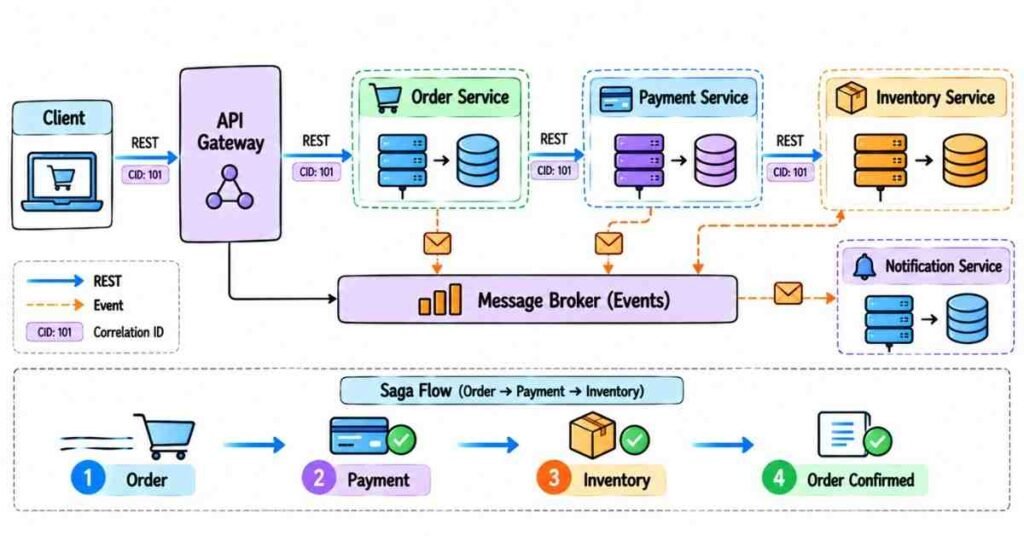
Microservices Architecture — Questions 111–145
Q111. What are Microservices?
Microservices split a large application into smaller services.
Each service handles a specific business responsibility and can be developed or deployed independently.
Q112. What is a monolithic application?
A monolith keeps most application features inside one application and usually deploys them together.
Q113. Monolith vs Microservices?
Monolith: Simple deployment, tightly connected modules.
Microservices: Separate services, independent deployment, more operational complexity.
Q114. Why use Microservices?
Microservices can help with:
Independent deployment
Independent scaling
Team ownership
Fault isolation
Faster releases
They should be used only when the project really needs them.
Q115. What is a service boundary?
A service boundary defines what business responsibility a service owns.
Example:
Order Service should handle order-related logic, not payment or notification logic.
Q116. What is bounded context?
A bounded context defines a clear business area with its own rules and model.
For example:
Ordering, Payments, and Inventory can be separate contexts.
Q117. Should two Microservices share the same database?
Usually, each service should own its own data.
Sharing one database creates tight coupling between services.
Q118. What is database per service?
Each Microservice owns its database or schema and controls its data.
Other services should access that data through APIs or messages.
Q119. How do Microservices communicate?
Common approaches are:
REST APIs
gRPC
Message brokers
Events
Q120. What is synchronous communication?
In synchronous communication, one service calls another and waits for a response.
Example:
Order Service → Inventory Service
Q121. What is asynchronous communication?
One service sends a message or event and continues without waiting for immediate processing.
Example:
Order Created → Notification Service
Q122. Synchronous vs asynchronous communication?
Synchronous: Immediate response is required.
Asynchronous: Processing can happen later.
The choice depends on the business requirement.
Q123. What is REST communication?
REST uses HTTP endpoints for service-to-service communication.
Example:
GET /api/products/10
Q124. What is gRPC?
gRPC is a high-performance communication framework often used between backend services.
It uses strongly defined contracts and is useful when low-latency communication matters.
Q125. REST vs gRPC?
REST is simple and widely used for external APIs.
gRPC can be useful for fast internal service-to-service communication.
Q126. What is an API Gateway?
An API Gateway acts as a single entry point for client requests.
It can route requests to different Microservices.
Q127. Why use an API Gateway?
It can handle:
Routing
Authentication
Rate limiting
Logging
Request aggregation
It also hides internal service details from clients.
Q128. What is service discovery?
Service discovery helps services find the current network location of other services.
This is useful when instances are created or removed dynamically.
Q129. What is load balancing?
Load balancing distributes requests across multiple instances of a service.
It helps improve availability and scalability.
Q130. What is an event-driven architecture?
Services communicate by publishing and consuming events.
Example:
OrderPlaced → Payment Processing → Notification
Q131. What is an event?
An event represents something that already happened.
Examples:
OrderCreated
PaymentCompleted
ProductUpdated
Q132. What is eventual consistency?
In distributed systems, all services may not update at exactly the same moment.
The data becomes consistent after related events are processed.
Q133. Why is eventual consistency common in Microservices?
Because services usually own separate databases.
Updating every service inside one database transaction is often not practical.
Q134. What is a distributed transaction?
A distributed transaction involves operations across multiple services or databases.
It is harder to manage than a normal local database transaction.
Q135. Why are distributed transactions difficult?
Because one service may succeed while another fails.
This can leave the overall business process incomplete.
Q136. What is the Saga Pattern?
Saga manages a business process across multiple services using a series of local transactions.
If something fails, compensating actions may be used.
Q137. Give a simple Saga example.
Suppose:
Order Created → Payment Completed → Inventory Reserved
If inventory fails after payment, the system may need to refund or cancel the payment.
Q138. What is orchestration in Saga?
A central coordinator tells services what step to perform next.
It controls the overall process flow.
Q139. What is choreography in Saga?
Services react to events without one central coordinator controlling every step.
Example:
OrderCreated event → Payment reacts → PaymentCompleted event → Inventory reacts
Q140. What is idempotency?
Idempotency means processing the same request or message multiple times should not create an incorrect duplicate result.
Q141. Why is idempotency important in Microservices?
Retries and duplicate messages can happen.
For example, the same payment request should not charge the customer twice.
Q142. What is a correlation ID?
A correlation ID is a unique identifier used to track one request across multiple services.
It helps with distributed troubleshooting.
Q143. What is fault isolation?
Fault isolation means one failing service should not automatically bring down the whole system.
For example, Notification Service failure should not always block Order creation.
Q144. What is service independence?
A service should be able to change or deploy without forcing every other service to change at the same time.
Q145. What makes a good Microservices design?
A good design should have:
Clear service boundaries
Independent ownership
Controlled communication
Fault handling
Monitoring
Secure APIs
Minimal coupling
Practical Scenario
“Payment Service is down. Should Order Service also fail?”
A practical answer:
“It depends on the business flow. If payment must succeed before creating the order, I would return a controlled failure or pending status. If the process can continue asynchronously, I may store the order and retry payment later. The decision should follow the business requirement.”
Another Scenario
“The same message is delivered twice. What would you do?”
A strong answer:
“I would make the consumer idempotent. Before applying the operation, I would check whether that message or business transaction was already processed.”
Practice Strategy
Take one e-commerce system:
Order → Payment → Inventory → Notification
Practise explaining:
- Which calls should be synchronous?
- Which can be asynchronous?
- What happens if Payment fails?
- What happens if Inventory fails?
- What if the same event comes twice?
- How would you trace one request across services?
Part 6: Messaging, Security & Resilience

Messaging, Security & Resilience — Questions 146–180
Q146. What is messaging in Microservices?
Messaging allows services to communicate through messages instead of direct API calls.
It is useful for asynchronous processing.
Q147. What is RabbitMQ?
RabbitMQ is a message broker.
It receives messages from producers and delivers them to consumers.
Q148. What is a producer?
A producer sends messages to the message broker.
Example:
Order Service → OrderCreated event
Q149. What is a consumer?
A consumer receives and processes messages.
Example:
Notification Service consumes OrderCreated
Q150. What is a queue?
A queue stores messages until a consumer processes them.
Q151. What is an exchange in RabbitMQ?
An exchange receives messages from producers and routes them to queues.
Q152. Why use asynchronous messaging?
It reduces direct dependency between services.
One service does not always need to wait for another service to finish.
Q153. What is message acknowledgement?
Acknowledgement tells the broker that a message was processed successfully.
Then the broker can remove it from the queue.
Q154. What happens if a consumer fails?
The message may be retried or returned to the queue depending on the configuration.
Q155. What is a dead-letter queue?
A dead-letter queue stores messages that could not be processed successfully after defined handling or retries.
Q156. What is message retry?
Retry means processing a failed message again.
Retries should be controlled so the system does not retry forever.
Q157. What is a poison message?
A poison message repeatedly fails because the data or processing logic is invalid.
It should usually be isolated instead of blocking other messages.
Q158. What is idempotent message processing?
It means processing the same message more than once should not create duplicate business results.
Q159. What is authentication?
Authentication checks who the user is.
Example:
Validating login credentials or a token.
Q160. What is authorization?
Authorization checks what the user is allowed to do.
Example:
Only Admin users can delete products.
Q161. What is JWT?
JWT stands for JSON Web Token.
It is commonly used to carry authenticated user information between clients and APIs.
Q162. What does a JWT contain?
A JWT usually contains:
Header
Payload
Signature
The payload can contain claims about the user.
Q163. What is a claim?
A claim is information about the authenticated identity.
Examples:
User ID
Role
Email
Q164. What is OAuth?
OAuth is an authorization framework used to give applications controlled access to resources.
Q165. Authentication vs OAuth?
Authentication identifies the user.
OAuth mainly deals with delegated access to protected resources.
Q166. What is CORS?
CORS controls which browser origins are allowed to call an API.
Q167. What is rate limiting?
Rate limiting controls how many requests a client can send within a period.
It helps protect APIs from overload or abuse.
Q168. What is resilience in Microservices?
Resilience means the system can handle failures without completely breaking.
Q169. What is a Retry Pattern?
Retry Pattern tries a failed operation again when the failure may be temporary.
Example:
Temporary network issue while calling another service.
Q170. When should you avoid too many retries?
Too many retries can increase load on an already failing service.
Retries should have limits and delays.
Q171. What is a Circuit Breaker?
Circuit Breaker temporarily stops calls to a failing service.
This prevents repeated unnecessary requests.
Q172. How does a Circuit Breaker work?
Common states are:
Closed → Open → Half-Open
It opens after repeated failures and later checks whether the service has recovered.
Q173. What is a timeout?
A timeout limits how long one service waits for another service.
Without a timeout, requests may wait too long.
Q174. Why combine Timeout, Retry, and Circuit Breaker?
They solve different failure problems.
Timeout: stops waiting too long.
Retry: handles temporary failures.
Circuit Breaker: stops repeated calls to an unhealthy service.
Q175. What is a Health Check?
A Health Check shows whether an application or dependency is healthy.
It can check services such as databases or message brokers.
Q176. What is graceful degradation?
Graceful degradation means the system still provides limited functionality when one component fails.
Example:
Recommendation Service fails, but product checkout still works.
Q177. What is fallback?
Fallback provides an alternative response when the main operation fails.
Example:
Return cached data if an external service is unavailable.
Q178. How do you secure communication between Microservices?
Common approaches include:
HTTPS
Tokens
Service identities
Authorization
Secure secret storage
Q179. Why should secrets not be hardcoded?
Hardcoded passwords or API keys can leak through code repositories or configuration files.
Secrets should be stored securely.
Q180. What makes a resilient Microservices system?
A resilient system should have:
Timeouts
Controlled retries
Circuit Breakers
Health Checks
Logging
Monitoring
Idempotency
Proper error handling
Practical Scenario
“Order Service publishes a message, but Notification Service is down. What happens?”
A practical answer:
“The message can remain in the queue until the Notification Service becomes available. This allows Order Service to continue without waiting for the notification process.”
Another Scenario
“Payment Service is failing repeatedly. Should Order Service keep calling it?”
A better approach is:
Timeout → Limited Retry → Circuit Breaker
This prevents repeated calls to an unhealthy service.
Practice Strategy
Practise explaining:
Producer → Exchange → Queue → Consumer
Then think through:
- What if the consumer fails?
- What if the same message arrives twice?
- What if Payment Service is down?
- When should retry stop?
- When should the circuit breaker open?
Part 7: Docker, Kubernetes, Cloud & System Design
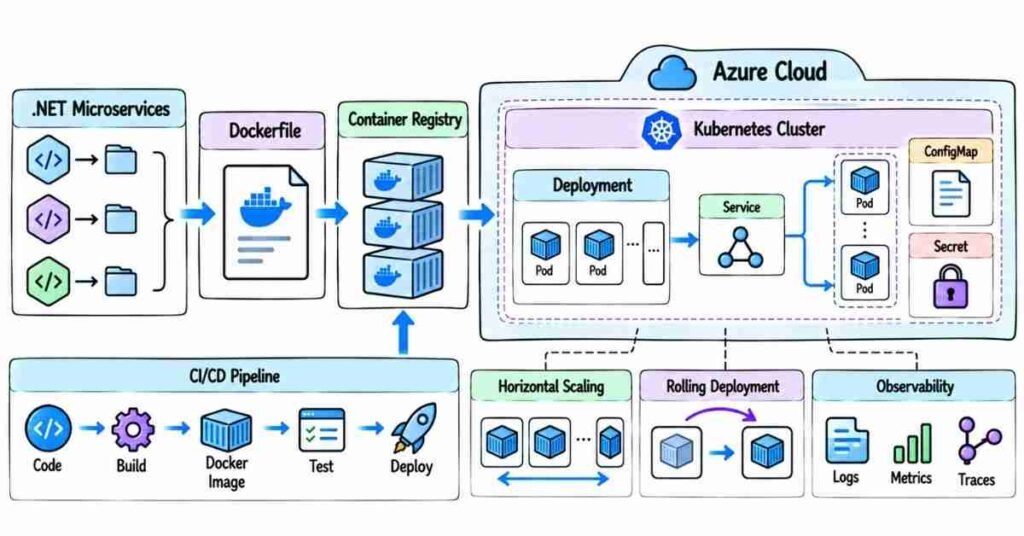
Docker, Kubernetes & Cloud — Questions 181–210
Q181. What is Docker?
Docker packages an application with its dependencies into a container.
This helps the application run consistently across environments.
Q182. What is a Docker image?
A Docker image is a packaged template used to create containers.
It contains the application and required dependencies.
Q183. What is a Docker container?
A container is a running instance of a Docker image.
Q184. What is a Dockerfile?
A Dockerfile contains instructions to build a Docker image.
Example steps:
Restore → Build → Publish → Run
Q185. Why use Docker for Microservices?
Each Microservice can run in its own container.
This makes deployment and scaling easier.
Q186. What is Docker Compose?
Docker Compose helps run multiple containers together.
Example:
Order API + SQL Server + RabbitMQ
Q187. Image vs Container?
Image: Template.
Container: Running instance of that image.
Q188. What is containerization?
Containerization packages an application and its dependencies into an isolated runtime environment.
Q189. What is a Docker volume?
A volume stores data outside the container.
It is useful when data must survive container restarts.
Q190. What is a Docker network?
Docker networks allow containers to communicate with each other.
For example:
Order Service → RabbitMQ
Kubernetes
Q191. What is Kubernetes?
Kubernetes is a platform used to deploy, manage, and scale containers.
Q192. What is a Pod?
A Pod is the smallest deployable unit in Kubernetes.
It normally runs one application container or closely related containers.
Q193. What is a Deployment?
A Deployment manages application Pods.
It helps with scaling and rolling updates.
Q194. What is a Kubernetes Service?
A Service provides stable network access to a group of Pods.
Q195. What is scaling?
Scaling means increasing or decreasing application instances based on workload.
Q196. What is horizontal scaling?
Horizontal scaling adds more instances.
Example:
2 Order Service instances → 5 instances
Q197. What is vertical scaling?
Vertical scaling increases resources such as CPU or memory for an existing instance.
Q198. What is a ConfigMap?
A ConfigMap stores non-sensitive configuration values.
Q199. What is a Secret in Kubernetes?
A Secret is used to store sensitive configuration such as passwords or tokens.
Sensitive values should still be handled carefully.
Q200. What is a rolling deployment?
A rolling deployment replaces old application instances gradually.
This helps reduce downtime during releases.
Cloud & Monitoring
Q201. Why deploy Microservices to the cloud?
Cloud platforms make it easier to:
Scale services
Automate deployment
Monitor applications
Use managed databases
Handle changing workloads
Q202. What Azure services can host .NET applications?
Common options include:
Azure App Service
Azure Container Apps
Azure Kubernetes Service
Azure Functions
The right choice depends on the application.
Q203. What is CI/CD?
CI/CD automates building, testing, and deploying code.
A common flow is:
Code Commit → Build → Test → Deploy
Q204. What is centralized logging?
Centralized logging collects logs from multiple Microservices in one place.
This makes troubleshooting easier.
Q205. What is distributed tracing?
Distributed tracing follows one request across multiple services.
A trace ID helps identify where a request became slow or failed.
Q206. Why is observability important?
Observability helps understand what is happening inside a distributed system.
It commonly includes:
Logs + Metrics + Traces
Q207. What are metrics?
Metrics are measurable values such as:
Request count
Error rate
CPU usage
Response time
Q208. What is system design in Microservices?
System design means deciding how services, databases, APIs, messaging, security, and scaling work together.
Q209. How would you design an e-commerce Microservices system?
A simple design could be:
API Gateway
↓
Order Service
Payment Service
Inventory Service
Notification Service
Each service can own its data and communicate through APIs or events.
Q210. What should you think about when designing Microservices?
Consider:
Service boundaries
Data ownership
Communication
Security
Failure handling
Scaling
Logging
Monitoring
Deployment
Practical Scenario
“Your Order Service works locally but fails inside Docker. What would you check?”
A practical answer:
“I would check container logs, environment variables, ports, connection strings, network configuration, and whether dependent services are reachable from inside the container.”
Another Scenario
“One Microservice receives much more traffic than others. What would you do?”
A good approach:
Scale that service independently instead of scaling the entire application.
This is one major benefit of Microservices.
Practice Strategy
Practise this architecture:
Client → API Gateway → Order Service → Payment Service → Database
Add:
RabbitMQ → Notification Service
Then containerize the services and think through:
- How will services communicate?
- Where will configuration come from?
- What if a container crashes?
- How will you scale one service?
- How will you trace one failed request?
Part 8: Advanced .NET Microservices & Modern Architecture Practices

Advanced Microservices — Questions 211–240
Q211. What is Clean Architecture?
Clean Architecture separates business logic from infrastructure and frameworks.
Common layers are:
Domain → Application → Infrastructure → API
Q212. Why use Clean Architecture?
It keeps business logic independent from databases, APIs, and external tools.
This makes the application easier to test and maintain.
Q213. What is Domain-Driven Design?
DDD designs software around business domains and business rules.
It helps define clear service boundaries.
Q214. What is an Entity in DDD?
An Entity has a unique identity that remains important even when its properties change.
Example:
Order with OrderId
Q215. What is a Value Object?
A Value Object is identified by its values rather than an ID.
Example:
Address, Money
Q216. What is an Aggregate?
An Aggregate is a group of related domain objects treated as one consistency boundary.
Q217. What is CQRS?
CQRS stands for Command Query Responsibility Segregation.
It separates:
Commands → Change data
Queries → Read data
Q218. Why use CQRS?
It can make complex systems easier to organize and allows read and write models to evolve separately.
It is not necessary for every project.
Q219. What is MediatR?
MediatR is a .NET library commonly used to send commands, queries, and notifications without directly coupling components.
Q220. What is the Repository Pattern in Clean Architecture?
The application depends on an abstraction such as:
IOrderRepository
The infrastructure layer provides the actual database implementation.
Q221. What is caching?
Caching stores frequently used data temporarily so it can be returned faster.
Q222. What is Redis?
Redis is an in-memory data store commonly used for:
Distributed caching
Session data
Temporary values
Q223. What is distributed caching?
Distributed caching allows multiple application instances to use the same cache.
This is useful when Microservices are scaled across several instances.
Q224. When should you avoid caching?
Avoid caching data when stale information could create serious business problems.
Caching should have a clear expiration and invalidation strategy.
Q225. What is cache invalidation?
Cache invalidation removes or refreshes cached data when the original data changes.
Q226. What is the Outbox Pattern?
The Outbox Pattern helps keep database updates and event publishing reliable.
The application first stores the business change and outgoing event together, then publishes the event separately.
Q227. Why is the Outbox Pattern useful?
It helps avoid situations where:
Database update succeeds but message publishing fails.
Q228. What is the Inbox Pattern?
The Inbox Pattern records consumed messages so duplicate messages can be detected and handled safely.
Q229. What is contract testing?
Contract testing checks whether communication between services follows the agreed API or message contract.
Q230. Why is API versioning important in Microservices?
One service may change while other clients still depend on the old API.
Versioning helps avoid suddenly breaking those clients.
Q231. What is backward compatibility?
Backward compatibility means a newer service version still supports existing clients where required.
Q232. What is a Backend for Frontend pattern?
BFF provides a backend designed for a specific client.
For example:
Mobile BFF
Web BFF
Each can return data suited to that client.
Q233. What is API composition?
API composition combines data from multiple Microservices into one response.
For example:
Order + Customer + Payment Status
Q234. What is OpenTelemetry?
OpenTelemetry is used to collect telemetry such as:
Traces
Metrics
Logs
It helps monitor distributed applications.
Q235. Why is distributed tracing important?
A single request may travel through several Microservices.
Tracing helps identify which service caused a delay or failure.
Q236. What is a feature flag?
A feature flag enables or disables functionality without requiring a full code rollback.
It can help with controlled releases.
Q237. What is Blue-Green Deployment?
Blue-Green Deployment keeps two environments.
Traffic moves from the old version to the new version after validation.
Q238. What is Canary Deployment?
Canary deployment sends a small percentage of traffic to the new version first.
If it works correctly, traffic is increased gradually.
Q239. How do you prevent duplicate business operations?
Common approaches include:
Idempotency keys
Unique business keys
Processed-message records
Database constraints
This is especially important for payments and orders.
Q240. What makes a mature Microservices architecture?
A mature system should have:
Clear service boundaries
Independent deployment
Reliable messaging
Security
Resilience
Observability
Automated testing
CI/CD
Safe data handling
Good operational support
Practical Scenario
“Order data is saved successfully, but the OrderCreated event fails to publish. What would you do?”
A practical answer:
“I would use a reliable pattern such as the Outbox Pattern. The order and outgoing event can be stored in the same local transaction, and a background process can publish the event later.”
Another Scenario
“A new API version may break existing mobile users. What would you do?”
A good approach:
Keep backward compatibility where possible, introduce a new API version, test existing clients, and remove the old version only through a controlled migration.
Practice Strategy
Practise explaining:
Clean Architecture → DDD → CQRS → Caching → Outbox → Observability → Deployment
Then think through:
- What if event publishing fails?
- What if the same event arrives twice?
- What if cache contains stale data?
- How will you trace a request across services?
- How will you release a new version safely?
Part 9: Behavioral, Communication & Career Strategy

The STAR Method
Use STAR for behavioral questions:
- S — Situation: What happened?
- T — Task: What was your responsibility?
- A — Action: What did you personally do?
- R — Result: What was the outcome?
Keep each answer around 1–2 minutes and focus more on your own contribution. The reference PDF uses the same STAR structure for behavioral preparation.
20 Behavioral Interview Questions
Q1. Tell me about yourself.
Mention:
Background → .NET skills → Project experience → Role you are targeting
Keep it short and relevant.
Q2. Explain a .NET project you worked on.
Cover:
Project purpose → Architecture → Your role → Technologies → Result
Q3. Tell me about a production issue you handled.
Explain the error, how you investigated it, the fix, and how you prevented it from happening again.
Q4. Describe a time an API failed.
Mention:
Error → Logs → Root cause → Fix → Validation
Q5. Tell me about a performance issue you solved.
Example:
Slow API caused by an inefficient EF Core query or missing database index.
Q6. Describe a time you worked with QA or DevOps.
Explain how you communicated, fixed issues, and completed the release successfully.
Q7. Tell me about a code review disagreement.
Focus on technical discussion, evidence, and choosing the best solution rather than proving someone wrong.
Q8. Describe a Microservices failure you handled.
Example:
Payment Service became unavailable and the calling service needed proper timeout and retry handling.
Q9. Tell me about a database problem you solved.
You can discuss:
Slow query → Execution review → Index or query improvement → Better response time
Q10. Tell me about a mistake you made.
Choose a genuine mistake.
Explain what you corrected and what process you changed afterward.
Q11. How do you handle feedback?
Listen, understand the reason, make the required improvement, and avoid taking technical feedback personally.
Q12. How would you explain Microservices to a non-technical person?
Example:
“Instead of building one huge application, we divide it into smaller applications responsible for specific business functions.”
Q13. Tell me about learning a new technology quickly.
Mention how you used documentation, small experiments, and practical tasks.
Q14. How do you handle multiple deadlines?
Prioritize based on:
Business impact → Dependencies → Urgency
Communicate risks early.
Q15. Tell me about working under production pressure.
Show that you stayed focused on logs, evidence, impact, and safe recovery.
Q16. Why do you want to work at this company?
Connect your answer to:
Role → Technology → Projects → Career growth
Avoid generic praise.
Q17. What is your greatest strength?
Choose one relevant strength:
Debugging
Backend development
API design
Problem-solving
Learning ability
Support it with an example.
Q18. What is your weakness?
Mention a real but manageable weakness and explain how you are improving it.
Q19. Where do you see yourself in three years?
A practical answer:
“I want to become a stronger backend and Microservices developer who can handle design, development, and production issues independently.”
Q20. Do you have any questions for us?
Ask questions such as:
What type of .NET architecture does the team use?
How are Microservices deployed?
Which messaging system is used?
How much production support is involved?
What will success look like in the first few months?
The reference guide similarly finishes its behavioral section with thoughtful questions for the interviewer.
50 AI Self-Preparation Prompts
The reference PDF includes a dedicated 50-prompt practice section after behavioral questions.
Technical Practice Prompts — 1–20
- Ask me 10 C# interview questions one by one.
- Quiz me on OOP with examples.
- Test me on interface vs abstract class.
- Ask me LINQ interview questions.
- Quiz me on async/await and Task.
- Ask me ASP.NET Core questions.
- Test me on Dependency Injection.
- Ask me Middleware questions.
- Give me HTTP status-code scenarios.
- Quiz me on REST API design.
- Ask me EF Core questions.
- Test me on SQL joins and indexes.
- Ask me Microservices architecture questions.
- Give me API Gateway scenarios.
- Quiz me on RabbitMQ.
- Ask me Saga Pattern questions.
- Give me Retry and Circuit Breaker scenarios.
- Quiz me on Docker.
- Ask me Kubernetes basics.
- Conduct a .NET Microservices mock interview.
Behavioral Practice Prompts — 21–35
- Improve my “Tell me about yourself.”
- Help me explain my .NET project.
- Turn my project into a STAR answer.
- Ask me about a production failure.
- Ask me about an API performance problem.
- Review my teamwork answer.
- Ask me about a mistake I made.
- Help me explain code review feedback.
- Ask me about handling deadlines.
- Simulate a production-pressure question.
- Help me explain a difficult bug.
- Ask me about learning a new tool.
- Conduct a behavioral interview.
- Give me questions to ask an interviewer.
- Review whether my answers show enough ownership.
Career Strategy Prompts — 36–50
- Improve my .NET resume summary.
- Write a .NET developer LinkedIn headline.
- Improve my project resume bullets.
- Suggest ATS keywords for .NET roles.
- Review my skills section.
- Improve my GitHub project description.
- Suggest .NET portfolio projects.
- Help me explain a career switch into .NET.
- Write an interview thank-you email.
- Improve my Microservices project description.
- Review my resume for backend roles.
- Help me prepare salary negotiation.
- Suggest LinkedIn Featured section content.
- Create a 7-day final revision plan.
- Run a full .NET Microservices interview.
Resume Optimization for .NET Microservices Developers
The reference guide structures resume preparation around six key sections and recommends action-based project bullets.
1. Headline
.NET Developer | C# | ASP.NET Core | Microservices | Web API | SQL
2. Professional Summary
Keep it to 3–4 lines.
Mention:
Experience → Main skills → Projects → Target role
3. Skills
Group clearly:
Languages: C#
Backend: ASP.NET Core, Web API
Database: SQL Server, EF Core
Architecture: Microservices, REST
Messaging: RabbitMQ
DevOps: Docker, Git
Cloud: Azure basics
4. Experience / Projects
Avoid:
“Worked on Microservices.”
Better:
“Developed ASP.NET Core REST APIs for Order and Payment services and integrated asynchronous communication using RabbitMQ.”
5. Education
Include:
Degree → College → Graduation
Add relevant certifications only if actually completed.
6. Projects / Portfolio
Useful projects:
- E-commerce Microservices
- Order Management API
- Payment Service
- Inventory Service
- RabbitMQ-based Notification System
LinkedIn Profile Optimization
The reference PDF separately optimizes headline, About, Featured, Experience, and Skills.
Headline
.NET Developer | ASP.NET Core | Microservices | C# | SQL | Docker
About Section
Use three short parts:
- Your background
- Your main .NET skills
- The role you are looking for
Featured Section
Add:
- GitHub projects
- API demos
- Architecture diagrams
- Certifications
- Technical articles
Experience Section
Use action-based bullets instead of only responsibilities.
Skills Section
Add relevant skills such as:
C#, .NET, ASP.NET Core, REST API, EF Core, SQL Server, Microservices, RabbitMQ, Docker, Git
Portfolio Strategy
A good .NET portfolio should show working code and architecture thinking.
Strong project idea:
E-Commerce Microservices
Services:
- Order → Payment → Inventory → Notification
Include:
- ASP.NET Core APIs
- EF Core
- SQL
- RabbitMQ
- JWT
- Docker
- Logging
- Retry / Circuit Breaker
For every project, explain:
- Problem → Architecture → Your work → Challenge → Solution
Salary Guidance
Salary depends on experience, company, city, cloud skills, and Microservices depth.
Role | Experience | Approximate India Range |
Junior .NET Developer | 0–1 year | ₹3–6 LPA |
.NET Developer | 1–3 years | ₹5–10 LPA |
Microservices Developer | 2–5 years | ₹8–18 LPA |
Senior .NET Developer | 5+ years | ₹15 LPA+ |
Treat these only as broad planning ranges.
The reference guide also includes salary guidance and negotiation preparation near the end.
Post-Interview Follow-Up Templates
- Thank-You Email
Subject: Thank You — .NET Developer Interview
Hi [Interviewer Name],
Thank you for speaking with me about the .NET Developer role. I enjoyed our discussion, especially around ASP.NET Core and Microservices.
I remain very interested in the opportunity.
Best regards,
[Your Name]
- Follow-Up Email
Subject: Following Up — .NET Developer Interview
Hi [Name],
I wanted to follow up regarding my interview for the .NET Developer role. I remain interested in the opportunity and would appreciate any update regarding the next steps.
Best regards,
[Your Name]
The reference PDF follows the same thank-you and follow-up email format.
Final 30-Day Checklist
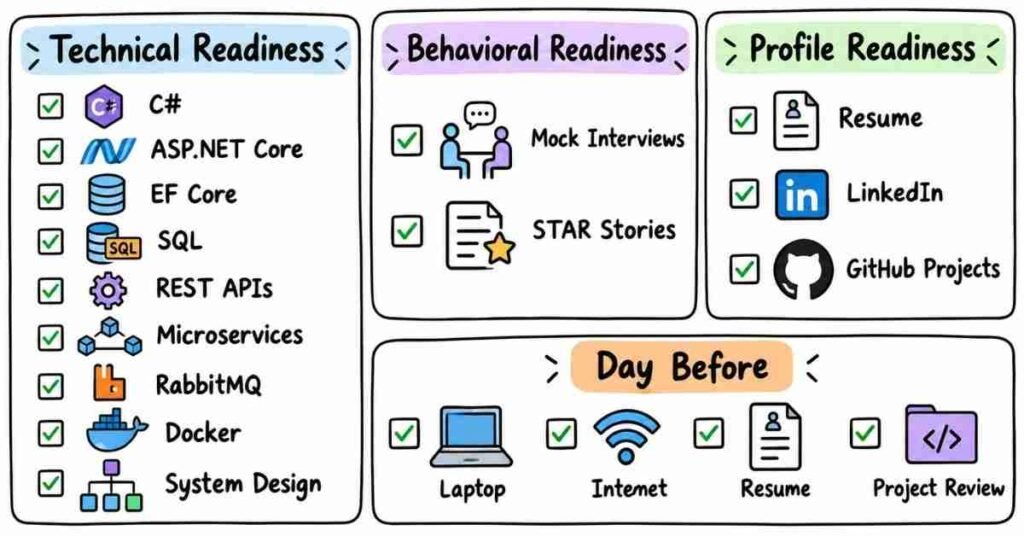
Technical Readiness
Completed all 9 parts
Revised C# and .NET
Practised ASP.NET Core
Revised EF Core and SQL
Practised Microservices
Revised RabbitMQ
Practised Docker
Reviewed system-design scenarios
Completed mock interviews
Behavioral Readiness
Prepared Tell Me About Yourself
Prepared project explanation
Prepared 5–8 STAR stories
Prepared failure scenarios
Prepared strengths and weakness
Prepared interviewer questions
Profile Readiness
Updated resume
Updated LinkedIn
Added GitHub projects
Reviewed project descriptions
Checked contact information
Day Before Interview
Review resume
Review project architecture
Revise key concepts
Check laptop and internet
Avoid last-minute heavy preparation