
90-Day Python with DSA Roadmap: From Zero to Software Engineer
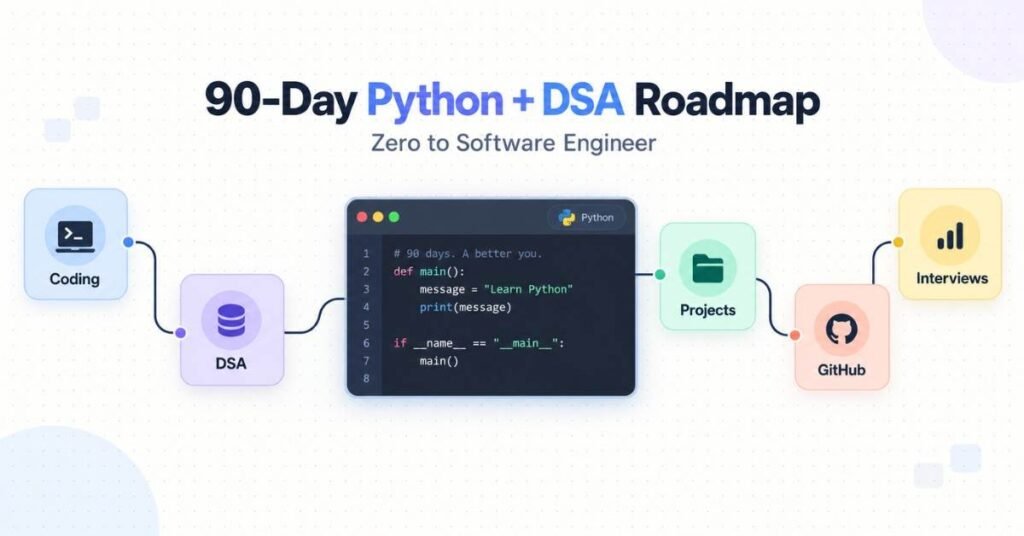
Table of Contents
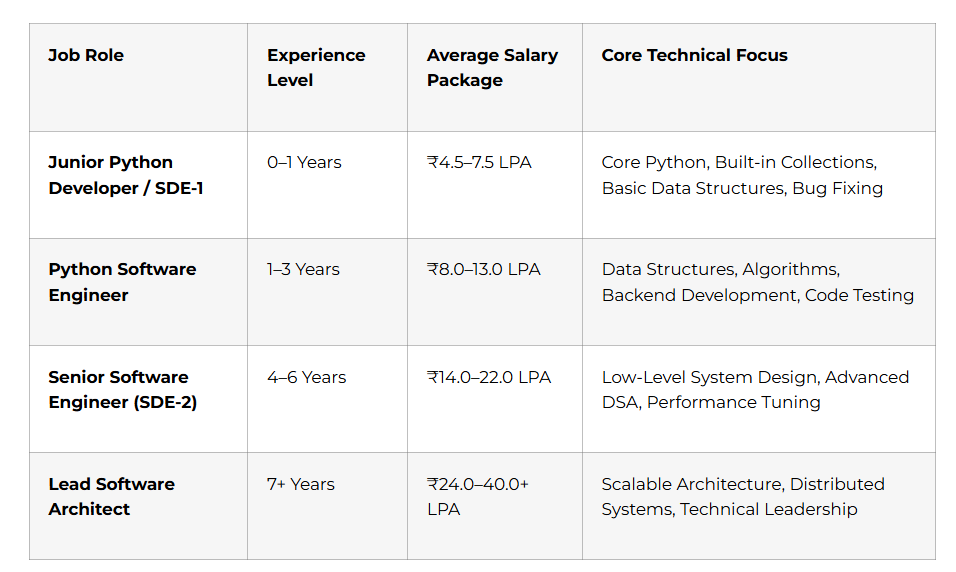
Mastering Python along with Data Structures and Algorithms (DSA) provides a direct path to securing a role as a Software Engineer. Python’s clear syntax allows learners to focus on algorithmic logic rather than complex setup rules. This 90-day plan breaks down your preparation into manageable daily steps covering fundamental syntax, object-oriented design, dynamic data handling, recursion, tree structures, graph logic, and coding interview techniques. Entry-level Python developers in India earn starting packages ranging from ₹4.5 to ₹7.5 LPA, while mid-level engineers reach ₹8 to ₹15 LPA in key tech hubs like Hyderabad and Bangalore.
Why Choose Python with DSA?
- Expressive & Clear Syntax: Focus on core algorithm design without getting tangled in boilerplate syntax.
- Wide Industry Demand: Enterprise backends, cloud automations, and data engines rely heavily on Python.
- Strong Logic Building: Learning DSA builds problem-solving habits that apply across any tech stack.
- High Growth Trajectory: Entry-level developers cracking technical interviews start at solid salary bands with rapid career growth potential.
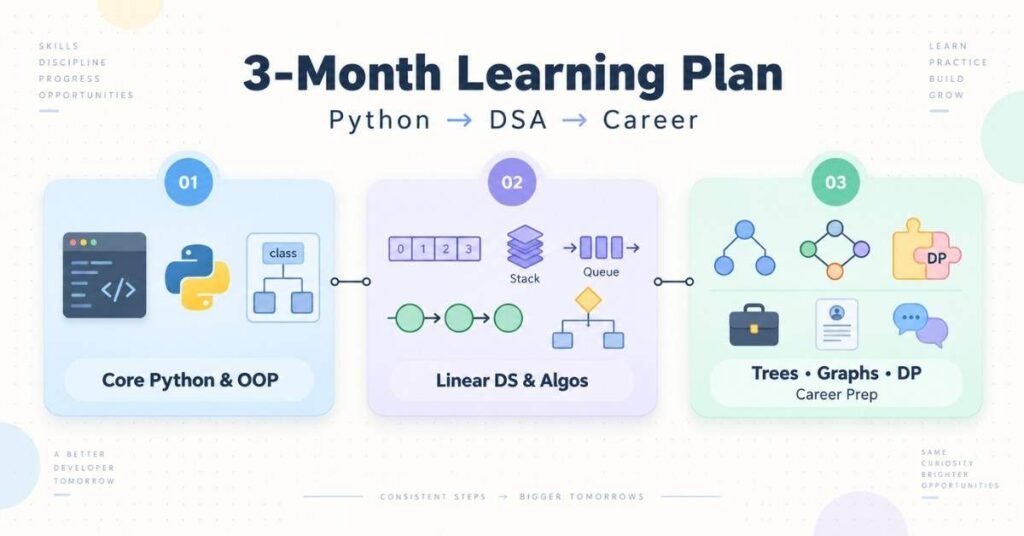
3-Month Learning Structure
Strengthen Coding and Problem-Solving Skills – Discover the Python with DSA Course
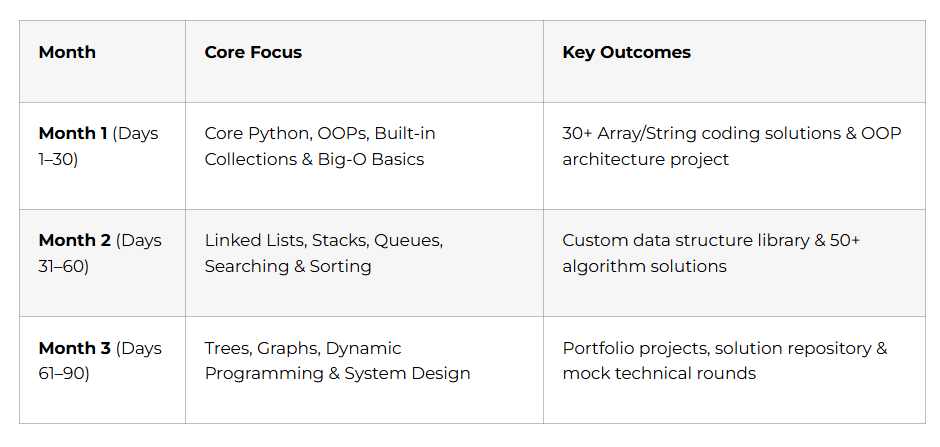
Month 1: Core Python, OOPs & Complexity Analysis (Days 1–30)
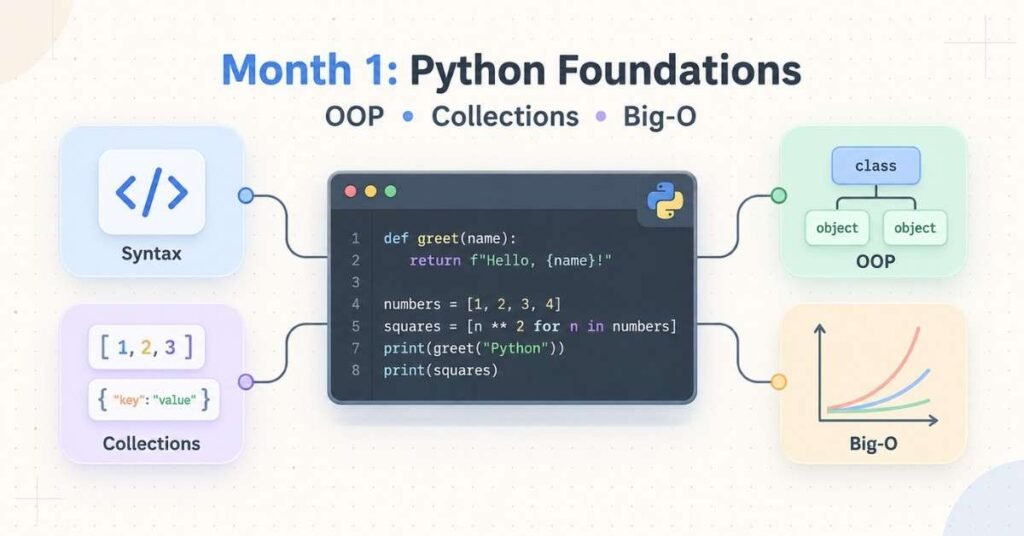
The first month sets up programming logic, object-oriented design, built-in dynamic collections, and algorithm efficiency analysis.
Week 1: Environment Setup & Execution Control (Days 1–7)
- Days 1–2: Setup & Syntax Fundamentals
- Configure Python 3.12+ and set up VS Code or PyCharm environments.
- Understand how code moves from source file (.py) to bytecode (.pyc) to execution inside the Python Virtual Machine.
- Practice working with dynamic types, type casting, variables, and math operators.
- Days 3–4: Decision Making & Loops
- Direct program flow using if, elif, and else blocks.
- Practice loop controls (for, while, range()) alongside break and continue keywords.
- Days 5–6: Modular Functions & Variable Scope
- Define reusable functions using parameters, return values, positional args, keyword args, and *args/**kwargs.
- Learn how scopes work under LEGB rules (Local, Enclosing, Global, Built-in).
- Day 7: Hands-on Project
- Console Banking Tool Build an interactive terminal application to manage user deposits, account balances, and user inputs cleanly.
Week 2: Object-Oriented Programming (OOPs) (Days 8–14)
- Days 8–9: Encapsulation & Classes
- Construct custom classes, instantiate objects, and use the __init__ constructor.
- Protect private attributes using single (_) and double (__) underscore conventions.
- Days 10–11: Inheritance & Dynamic Behavior
- Apply single, multiple, and multilevel inheritance patterns with super() calls.
- Use method overriding and special dunder methods like __str__ and __len__.
- Days 12–13: Error Handling & File Operations
- Manage runtime errors using try, except, else, and finally blocks.
- Read and write files securely using context managers (with open()).
- Day 14: Hands-on Project
- Library Management Engine Build an object-oriented tracking program utilizing class inheritance, encapsulation rules, and custom exceptions.
Week 3: Built-in Collections & Time Complexity (Days 15–21)
- Days 15–16: Lists, Tuples & Sets
- Work with dynamic list operations, slicing tricks, dynamic resizing, and list comprehensions.
- Store immutable data in tuples and manage unique collections using sets.
- Days 17–18: Dictionaries & Collections Module
- Map key-value pairs using dict, dictionary comprehensions, and tools like defaultdict and Counter from the collections module.
- Write custom generators with the yield statement.
- Days 19–20: Big-O Complexity Analysis
- Calculate time complexity metrics: $O(1)$, $O(\log N)$, $O(N)$, $O(N \log N)$, and $O(N^2)$.
- Track space complexity demands across auxiliary allocations.
- Day 21: Performance Mini-Project
- Collections Benchmark Utility — Build a measuring script to evaluate lookup speeds across lists, sets, and dictionaries over 100,000 data elements.
Week 4: Arrays & String Manipulation Patterns (Days 22–30)
- Days 22–25: Two Pointers & Sliding Window
- Solve problems using Two-Pointer strategies (reversing arrays, tracking target sums, checking palindromes).
- Implement Fixed and Variable Sliding Window patterns for subarray problems.
- Days 26–27: Bit Manipulation & Core Math
- Use bitwise operators (&, |, ^, <<, >>) for quick checks.
- Practice prime number evaluations (Sieve of Eratosthenes) and GCD/LCM algorithms.
- Days 28–30: Month 1 Capstone
- Array & String Solving Suite Resolve 30 curated array and string coding problems. Document your solutions step by step on GitHub.
Month 2: Linear Data Structures, Searching, Sorting & Recursion (Days 31–60)
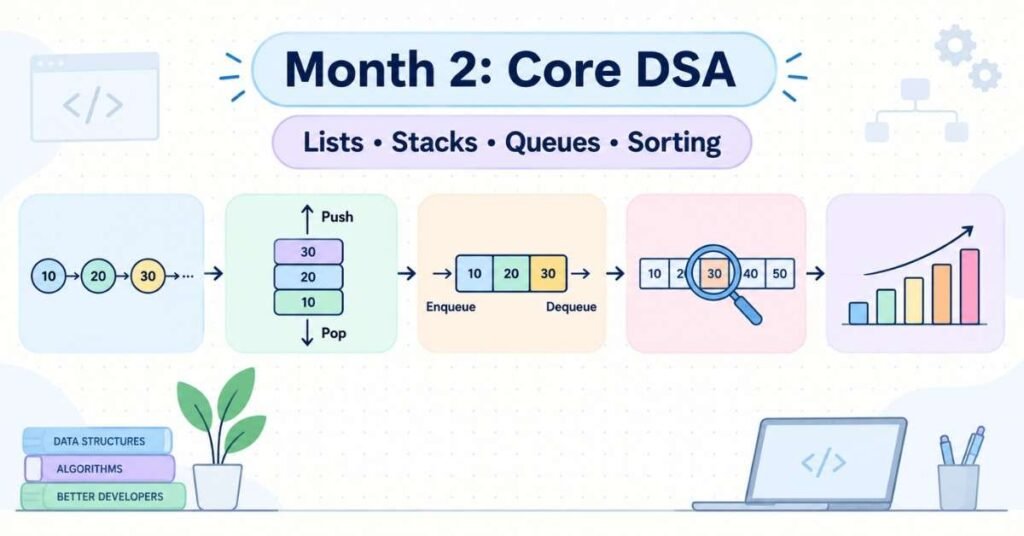
The second month covers manual data structure builds, pointer movements, sorting efficiency, and recursive strategies.
Build a Strong Programming Career Path – Unlock the Python with DSA Career Guide
Week 5: Linked Lists & Recursive Logic (Days 31–37)
- Days 31–33: Singly & Doubly Linked Lists
- Build custom Node structures for Singly and Doubly Linked Lists from scratch.
- Write manual algorithms for insertion, node deletion, linear searches, and list reversals.
- Practice classic challenges: reverse a linked list, detect loops (Floyd’s algorithm), and locate middle nodes.
- Days 34–36: Recursion & Backtracking Rules
- Identify base cases, trace stack frames, and draw recursive call trees.
- Solve classic recursive problems: Subsets, Permutations, and N-Queens layout logic.
- Day 37: Hands-on Assignment
- Custom Linked List Tool Create a zero-dependency Linked List class featuring cycle detection and list-merging methods.
Week 6: Stacks, Queues & Hash Patterns (Days 38–44)
- Days 38–39: Stack Data Structure
- Build Stack logic using lists and custom node configurations.
- Solve target problems: Balanced Parentheses verification, Next Greater Element, and Min-Stack design.
- Days 40–41: Queues & Deques
- Implement Linear Queues, Circular Queues, and Double-Ended Queues using collections.deque.
- Solve queue tasks: implementing stacks using queues and tracking sliding window maximums.
- Days 42–43: Advanced Hashing Techniques
- Track element frequencies, prefix sums, and index positions using hashing.
- Solve problems like Subarray Sum Equals K and Longest Consecutive Sequence.
- Day 44: Hands-on Assignment
- Math Expression Calculator Build an Infix-to-Postfix conversion tool using custom stack logic.
Week 7: Searching & Sorting Algorithms (Days 45–54)
- Days 45–47: Binary Search Patterns
- Compare Linear Search logic against Binary Search ($O(\log N)$) performance.
- Practice Binary Search variations: rotated array searches, boundary checks, and search-on-answer space.
- Days 48–50: Sorting Algorithms
- Write standard sorting algorithms: Bubble Sort, Selection Sort, and Insertion Sort.
- Master Divide & Conquer sorting logic: Merge Sort and Quick Sort.
- Days 51–54: Heaps & Priority Queues
- Understand Min-Heap and Max-Heap tree properties.
- Use Python’s built-in heapq module to solve Top-K Frequent Elements and List Merging tasks.
Week 8: Greedy Approaches & Month 2 Capstone (Days 55–60)
- Days 55–56: Greedy Algorithms
- Apply greedy selection choices to solve Activity Selection, Fractional Knapsack, and Gas Station problems.
- Days 57–60: Month 2 Capstone
- Linear Structures & Sorting Suite Implement custom versions of Stack, Queue, Priority Queue, and MergeSort algorithms with modular code coverage. Save as Portfolio Project #2.
Month 3: Non-Linear Structures, Dynamic Programming & Career Launch (Days 61–90)
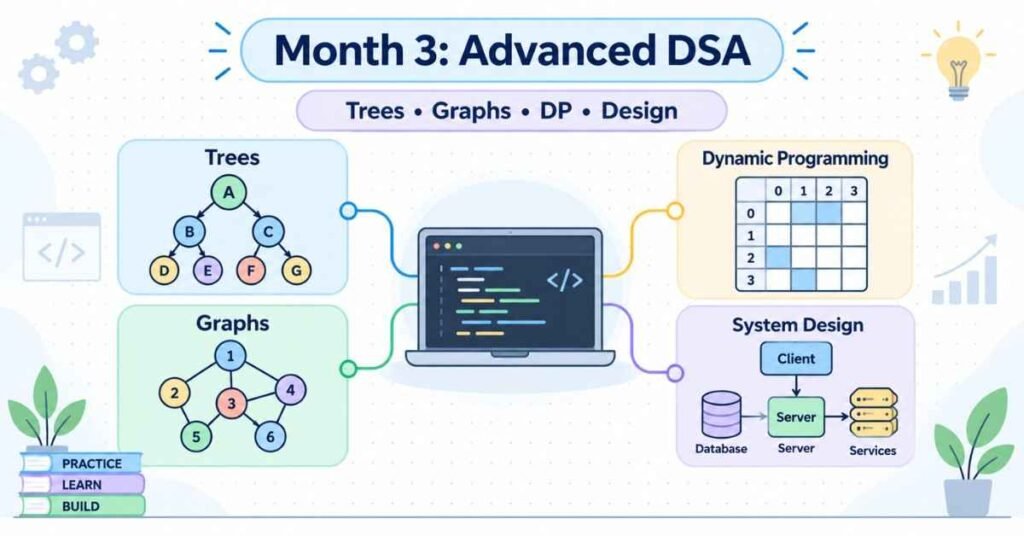
The final month expands into complex tree structures, network graphs, algorithm optimization, system design fundamentals, and technical interview readiness.
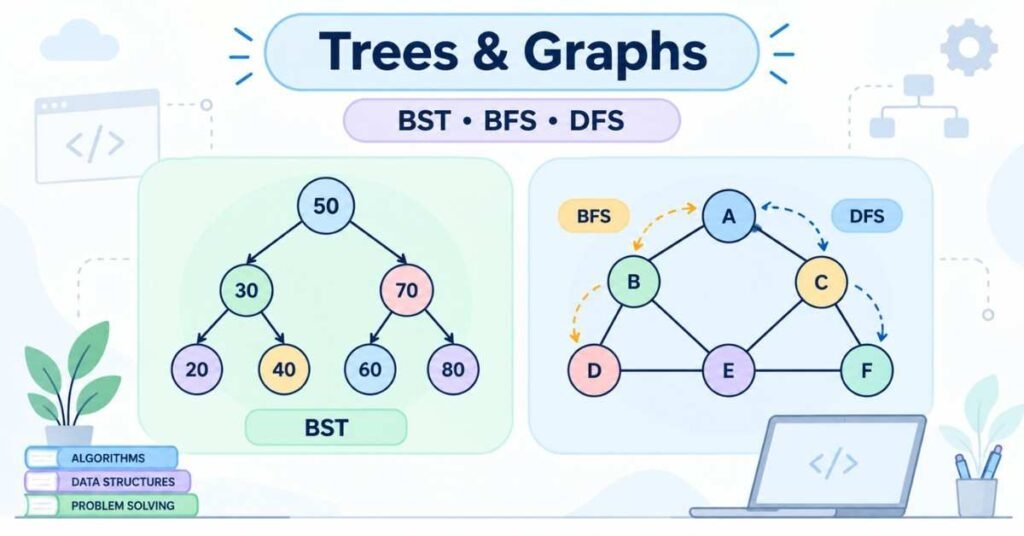
Week 9: Trees & Graphs (Days 61–67)
- Days 61–63: Binary Trees & BSTs
- Construct Binary Tree nodes and implement traversals (Inorder, Preorder, Postorder, Level-Order BFS).
- Work on Binary Search Trees (BST): insertion, deletion, searching, and validation rules.
- Solve tree tasks: Maximum Depth, Lowest Common Ancestor (LCA), and Tree Diameter.
- Days 64–66: Graph Data Structures & Traversals
- Model Graph structures using Adjacency Lists and Adjacency Matrices.
- Implement Breadth-First Search (BFS) and Depth-First Search (DFS) traversals.
- Solve core graph challenges: Topological Sorting (Kahn’s Algorithm), Number of Islands, and Cycle Detection.
- Day 67: Graph Mini-Project
- Routing & Path Visualizer Build a Python script that models graph traversals and calculates shortest path routes.
Week 10: Dynamic Programming & System Design Basics (Days 68–79)
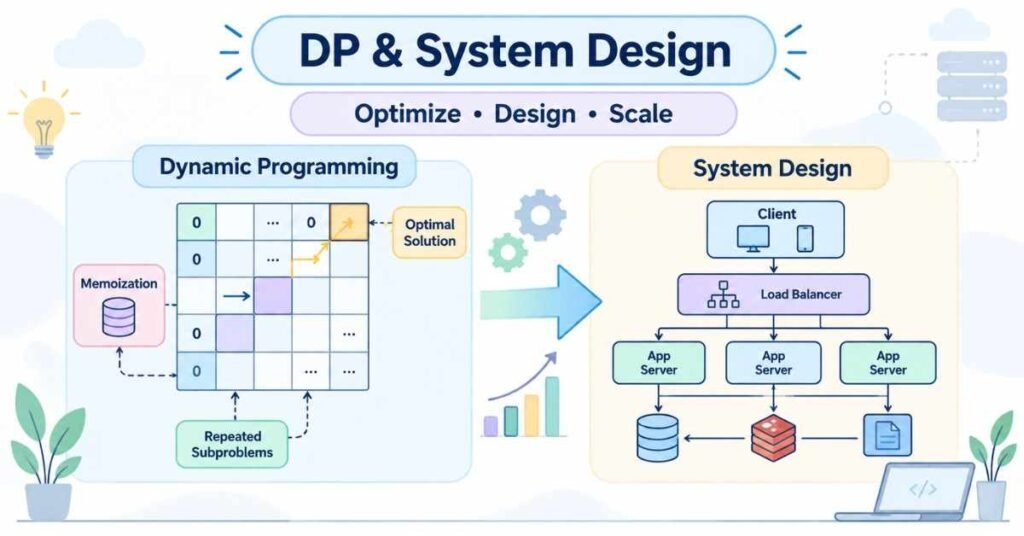
- Days 68–72: Dynamic Programming (DP) Strategies
- Identify Overlapping Subproblems and Optimal Substructure conditions.
- Compare Top-Down Memoization (using @functools.lru_cache) against Bottom-Up Tabulation.
- Master classic DP problems:
- 1D DP: Climbing Stairs, House Robber, Coin Change.
- 2D DP: 0/1 Knapsack, Longest Common Subsequence (LCS), Longest Increasing Subsequence (LIS).
- Days 73–76: System Design Basics
- Learn SOLID design principles and apply them to modular code.
- Explore Low-Level Design (LLD) fundamentals: Singleton, Factory, and Observer design patterns.
- Days 77–79: Month 3 Greenfield Capstone
- Enterprise Algorithmic Engine Construct a complete Python application that combines custom graph searches, thread-safe dynamic storage, and solid OOP patterns. Document it fully as Portfolio Project #3.
Week 11–12: Career Launch & Interview Readiness (Days 80–90)
- Days 80–82: Portfolio & GitHub Setup
- Clean up your centralized GitHub repository containing 150+ solved algorithm challenges.
- Include clear documentation with Time ($O(T)$) and Space ($O(S)$) complexity notes for every problem.
- Days 83–84: ATS Resume & LinkedIn Branding
- LinkedIn Headline: “Python Software Developer | Data Structures & Algorithms | Core Python, OOPs, System Design | Open to Opportunities in Hyderabad”
- Resume Layout: Profile Summary $\rightarrow$ Technical Skills (Python, OOPs, DSA, Git) $\rightarrow$ Projects $\rightarrow$ Coding Metrics $\rightarrow$ Education.
- Days 85–86: Job Search Execution
Platform | Recommended Strategy |
Naukri.com | Set alerts for “Python Developer Fresher”, “Software Development Engineer (SDE-1)”, and “Python Trainee”. |
LinkedIn Jobs | Target technical recruiters, engineering managers, and leads directly with project links. |
HackerEarth / Unstop | Take part in online coding contests to earn direct interview callbacks. |
Company Portals | Apply directly to IT service providers and tech startups in Hyderabad and Bangalore. |
- Days 87–88: Final Technical Revision
- Core focus areas for technical interviews:
Topic Area | Important Revision Focus |
Core Python | Memory management, reference counting, decorators, generators, and GIL behavior. |
Data Structures | Manual Linked List reversal, BST validation rules, and BFS vs DFS decisions. |
Algorithms | Partitioning logic in QuickSort, Binary Search edge cases, and DP Memoization setups. |
System Design | SOLID design principles, Singleton implementations, and Object-Oriented patterns. |
- Days 89–90: Mock Coding Interviews & Program Completion
- Complete two 60-minute live mock technical coding sessions (1 Easy + 1 Medium problem under time limits). Receive your Frontlines Edutech course completion certificate.
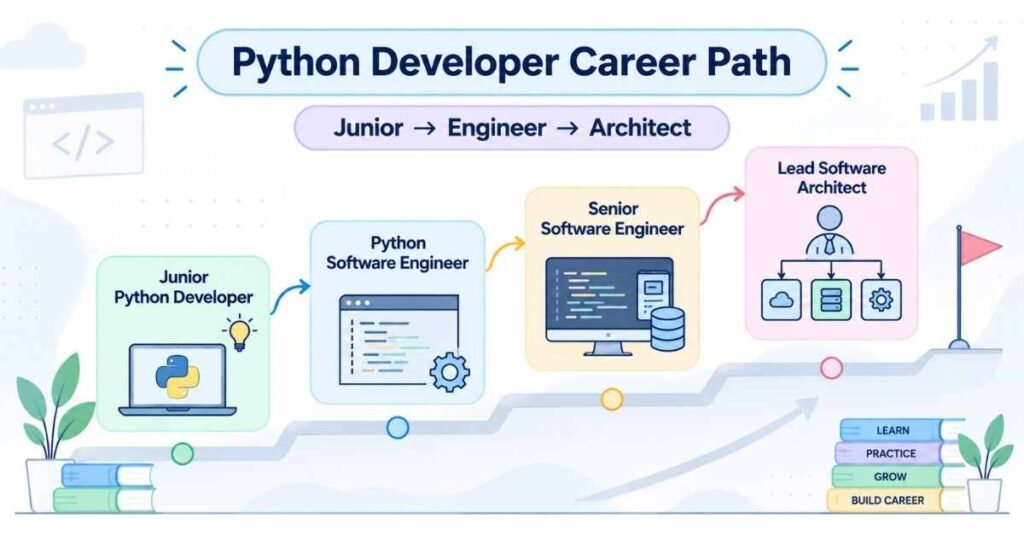
Python Developer Career & Salary Structure (India 2026)
Regional Salary Trends for Freshers
- Hyderabad: ₹5.5–7.0 LPA
- Bangalore: ₹6.0–8.5 LPA
- Pune: ₹5.2–6.8 LPA
- Chennai: ₹5.0–6.5 LPA
- Delhi NCR: ₹5.5–7.2 LPA
Prepare for Coding and DSA Rounds – Access the Python with DSA Interview Guide
Why Choose Frontlines Edutech for Python DSA Training?
Frontlines Edutech, located in Somajiguda, Hyderabad, helps students and job seekers across the Telugu states launch software careers.
- Complete Curriculum: Core Python, OOPs, Collections, Data Structures, Algorithms, and System Design basics.
- 3 Portfolio Projects: Real code implementations published directly on your GitHub profile.
- Telugu-Friendly Support: Complex dynamic memory models and pointer logic explained clearly.
- Interview-Targeted Training: Problem sets modeled on real technical rounds used by service and product IT firms.
- Career Assistance: Resume optimization, LinkedIn branding, mock coding rounds, and placement assistance.
Call: +91-83330 77727 | Email: support@frontlinesedutech.com | Website: courses.frontlinesedutech.com
Frequently Asked Questions (FAQs)
Q1: Do I need prior coding experience to learn Python with DSA?
No. The roadmap starts with fundamental concepts variables, dynamic types, and simple loops. It is built for complete beginners, non-IT graduates, and career switchers.
Q2: What starting package can a Python DSA fresher expect in India?
Starting packages for freshers with strong Python DSA skills range between ₹4.5 LPA and ₹7.5 LPA, while product-based SDE-1 roles offer ₹10–16+ LPA in tech hubs like Hyderabad.
Q3: Why choose Python over Java or C++ for Data Structures and Algorithms?
Python’s simple syntax lets you spend more time understanding algorithm mechanics without fighting strict syntax rules. It also transfers easily into backend engineering, data science, and automation roles.
Q4: How many LeetCode problems should I solve to prepare for technical rounds?
Focusing on core algorithmic patterns is key. Solving 120–150 well-selected problems across main patterns (Two Pointers, Sliding Window, BFS/DFS, Top-Down DP) builds the skills needed to tackle unseen interview problems effectively.
Q5: Will I build practical projects during this Python DSA course?
Yes. You will build 3 portfolio projects: a console-based dynamic engine, a custom data structures library, and a graph path visualizer saved directly to your code repository.
Q6: Are Object-Oriented Programming (OOPs) concepts tested in technical interviews?
Yes. Interviewers test Encapsulation, Inheritance, Polymorphism, Abstraction, and Python class structures alongside problem-solving questions.
Q7: Is Python suitable for non-IT graduates switching to tech?
Yes. Python’s clean structure makes building logic straightforward. Combining Python syntax with consistent DSA practice helps non-IT candidates secure software development roles.
Q8: Does Frontlines Edutech offer placement and job guidance?
Yes. Support includes resume refinement, LinkedIn branding, mock technical rounds, and job referral assistance.