
Python with DSA Interview Questions : 245 Q&A Guide
Table of Contents
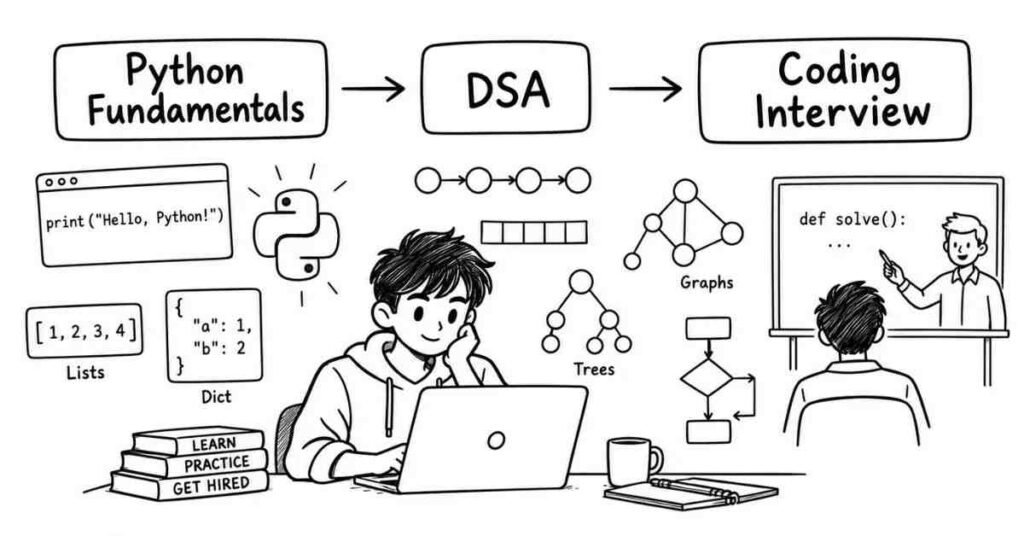
Part 1: Introduction and 30-Day Study Plan
What This Guide Covers
Python interviews usually test two things: how well you understand Python and how well you solve problems using data structures and algorithms.
This guide is designed to help you prepare both areas together. It covers Python fundamentals, arrays, strings, linked lists, stacks, queues, trees, graphs, sorting, searching, recursion, dynamic programming, coding problems, and interview strategy.
The aim is simple: understand the concept, solve problems, and explain your approach clearly during an interview.
Who This Guide Is For
This guide is useful if you are:
- A fresher preparing for Python developer roles
- A student preparing for campus placements
- A beginner learning DSA with Python
- A developer preparing for coding rounds
- A career switcher moving into software development
The reference guide follows the same idea of starting from basics and gradually moving toward advanced and interview-focused topics.
Why Python with DSA Matters
Knowing Python syntax alone is not enough for most technical interviews.
Interviewers often want to see whether you can:
- Understand a problem
- Choose the right data structure
- Write clean Python code
- Handle edge cases
- Explain time and space complexity
- Improve a basic solution when needed
A candidate who explains the logic clearly often performs better than someone who only memorizes code.
30-Day Python with DSA Study Plan
Week 1: Python Fundamentals
Focus on:
- Variables and data types
- Lists, tuples, sets, dictionaries
- Functions
- OOP concepts
- Exception handling
- Iterators and generators
- Basic time complexity
Practice small Python programs every day.
Week 2: Arrays, Strings & Linear Data Structures
Study:
- Arrays and strings
- Hashing
- Two pointers
- Sliding window
- Linked lists
- Stacks
- Queues
Try to solve problems without checking the solution immediately.
Week 3: Trees, Searching & Sorting
Focus on:
- Binary trees
- Binary Search Trees
- Tree traversals
- Binary search
- Sorting algorithms
- Recursion
- Backtracking
- Heaps
Always understand why a particular approach works.
Week 4: Graphs, DP & Mock Interviews
Cover:
- BFS and DFS
- Graph basics
- Greedy problems
- Dynamic programming
- Mixed coding problems
- Complexity analysis
- Mock interviews
Spend the final few days revising weak areas instead of learning too many new topics.
Daily Study Routine
A simple routine is enough:
- 30 minutes: Learn one concept
- 45 minutes: Solve 2–3 coding problems
- 15 minutes: Review mistakes
- 15 minutes: Explain one solution aloud
The original guide also recommends learning the concept, practicing interview questions, rewriting answers in your own words, and revising weak areas instead of memorizing answers.
Common Interview Focus Areas
For Python with DSA interviews, prepare well in:
- Python fundamentals
- OOP
- Lists and dictionaries
- Arrays and strings
- Linked lists
- Stack and queue
- Trees and BST
- Searching and sorting
- Recursion
- Graphs
- Dynamic programming
- Time and space complexity
- Problem-solving approach
What Strong Interview Answers Look Like
A good answer should be short and practical.
Instead of saying:
“I know binary search.”
A better answer is:
“Binary search works on sorted data. I compare the target with the middle element and eliminate half of the search space in every step, so the time complexity is O(log n).”
We’ll use this style throughout this guide: clear, natural, and interview-ready.
How to Use This Guide
Do not memorize every solution.
For each problem:
- Understand the question.
- Think of a basic approach.
- Improve it if possible.
- Write clean Python code.
- Check edge cases.
- Explain the complexity.
This habit will help you more in interviews than solving hundreds of questions without understanding them.
Part 2: Python Fundamentals
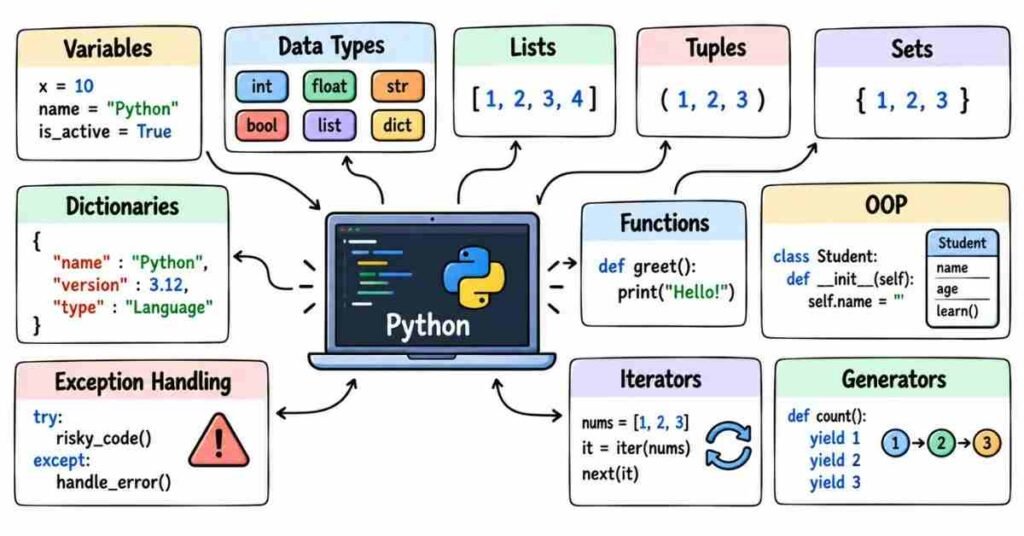
Python Basics — Questions 1–40
Q1. What is Python?
Python is a high-level programming language known for its simple and readable syntax. It is widely used in web development, automation, data science, AI, scripting, and backend development.
Q2. Why is Python popular?
Python is easy to learn, has a large standard library, and supports many third-party packages. It also allows developers to build applications with less code compared to many other languages.
Q3. Is Python compiled or interpreted?
Python is commonly described as an interpreted language. Python source code is first converted into bytecode, which is then executed by the Python Virtual Machine.
Q4. What are the main features of Python?
Important features include:
- Simple syntax
- Dynamic typing
- Object-oriented programming
- Large standard library
- Cross-platform support
- Automatic memory management
Q5. What is dynamic typing in Python?
Dynamic typing means you do not need to declare a variable’s type explicitly.
x = 10
x = “Python”
The same variable can refer to different types of objects during execution.
Q6. What are Python variables?
A variable is a name that refers to an object in memory.
age = 22
name = “Ravi”
Python creates the object and binds the variable name to it.
Q7. What are the common data types in Python?
Common Python data types include:
- int
- float
- str
- bool
- list
- tuple
- set
- dict
Q8. What is the difference between mutable and immutable objects?
Mutable objects can be changed after creation.
Examples: lists, sets, dictionaries.
Immutable objects cannot be changed after creation.
Examples: strings, tuples, integers.
Q9. What is the difference between a list and a tuple?
A list is mutable, while a tuple is immutable.
a = [1, 2, 3]
b = (1, 2, 3)
Lists are better when values need to change. Tuples are useful for fixed collections.
Q10. What is a set in Python?
A set stores unique values and does not maintain duplicate elements.
nums = {1, 2, 2, 3}
print(nums)
Output:
{1, 2, 3}
Sets are useful for membership checking and removing duplicates.
Strings and Collections
Q11. What is a dictionary in Python?
A dictionary stores data as key-value pairs.
student = {
“name”: “Asha”,
“age”: 21
}
Keys must be unique.
Q12. What is slicing in Python?
Slicing is used to extract part of a sequence.
text = “Python”
print(text[0:3])
Output:
Pyt
The general syntax is:
sequence[start:stop:step]
Q13. What is negative indexing?
Negative indexing accesses elements from the end of a sequence.
a = [10, 20, 30]
print(a[-1])
Output:
30
Q14. How do you reverse a string in Python?
A simple way is slicing:
text = “python”
print(text[::-1])
Q15. What is list comprehension?
List comprehension is a short way to create a list.
squares = [x * x for x in range(5)]
It is useful when the logic is simple and readable.
Q16. What is the difference between append() and extend()?
append() adds one object to a list.
a.append([3, 4])
extend() adds each element from another iterable.
a.extend([3, 4])
Q17. What is the difference between remove(), pop(), and del?
remove() deletes a value.
pop() removes an element by index and returns it.
del can delete an element, slice, or variable.
Q18. How can you remove duplicates from a list?
One simple approach is:
nums = [1, 2, 2, 3]
unique = list(set(nums))
If order must be preserved, another approach should be used.
Q19. What is membership testing in Python?
The in and not in operators check whether a value exists in a collection.
3 in [1, 2, 3]
This returns True.
Q20. What is unpacking in Python?
Unpacking assigns multiple values at once.
a, b, c = 10, 20, 30
It is also commonly used with tuples and function returns.
Functions
Q21. What is a function in Python?
A function is a reusable block of code that performs a specific task.
def add(a, b):
return a + b
Functions improve readability and reduce repeated code.
Q22. What is the difference between parameters and arguments?
Parameters are variables defined in the function.
Arguments are actual values passed when calling the function.
def greet(name):
print(name)
greet(“Ravi”)
Here, name is a parameter and “Ravi” is an argument.
Q23. What are default arguments?
Default arguments have predefined values.
def greet(name=”User”):
print(name)
If no argument is passed, the default value is used.
Q24. What are *args and **kwargs?
*args collects extra positional arguments.
**kwargs collects extra keyword arguments.
def demo(*args, **kwargs):
print(args)
print(kwargs)
They are useful when the number of arguments is flexible.
Q25. What is a lambda function?
A lambda is a small anonymous function.
square = lambda x: x * x
It is mainly useful for short operations.
Q26. What is recursion?
Recursion happens when a function calls itself.
def factorial(n):
if n == 1:
return 1
return n * factorial(n – 1)
A recursive solution must have a base condition.
Q27. What is variable scope in Python?
Scope defines where a variable can be accessed.
Common scopes include:
- Local
- Enclosing
- Global
- Built-in
This is often remembered as the LEGB rule.
Q28. What is the difference between return and print?
print() displays a value.
return sends a value back to the caller.
For reusable functions, returning values is usually more useful.
Object-Oriented Programming
Q29. What is a class in Python?
A class is a blueprint used to create objects.
class Student:
pass
It defines attributes and behavior that objects can have.
Q30. What is an object?
An object is an instance of a class.
s1 = Student()
Different objects can have different data while following the same class structure.
Q31. What is self in Python?
self refers to the current object.
class Student:
def __init__(self, name):
self.name = name
It is used to access instance variables and methods.
Q32. What is __init__()?
__init__() is a special method that runs when an object is created.
It is commonly used to initialize instance variables.
Q33. What is inheritance?
Inheritance allows one class to reuse properties and methods from another class.
class Animal:
pass
class Dog(Animal):
pass
It supports code reuse.
Q34. What is polymorphism?
Polymorphism means the same method or operation can behave differently for different objects.
For example, different classes can provide their own version of the same method.
Q35. What is encapsulation?
Encapsulation means keeping data and related behavior together inside a class and controlling how that data is accessed.
It helps make code easier to maintain.
Q36. What is method overriding?
Method overriding happens when a child class provides its own version of a method already defined in the parent class.
Exceptions, Iterators and Generators
Q37. What is exception handling in Python?
Exception handling prevents a program from crashing unexpectedly when an error occurs.
try:
x = 10 / 0
except ZeroDivisionError:
print(“Cannot divide by zero”)
Common keywords are try, except, else, and finally.
Q38. What is an iterator?
An iterator is an object that returns values one at a time.
It uses methods such as:
__iter__()
__next__()
A for loop internally works with iterators.
Q39. What is a generator?
A generator is a simple way to create an iterator using yield.
def numbers():
yield 1
yield 2
yield 3
Generators produce values when needed instead of storing everything in memory.
Q40. What is the difference between == and is?
== checks whether two values are equal.
is checks whether two references point to the same object.
a = [1, 2]
b = [1, 2]
print(a == b) # True
print(a is b) # False
This is a common Python interview question.
Practice Strategy
For Python interviews, do not stop with definitions.
Take one small program and practice explaining:
- What data type you selected.
- Why you selected it.
- How the function works.
- What happens for edge cases.
- What the time and space complexity is.
Part 3: Arrays, Strings & Hashing
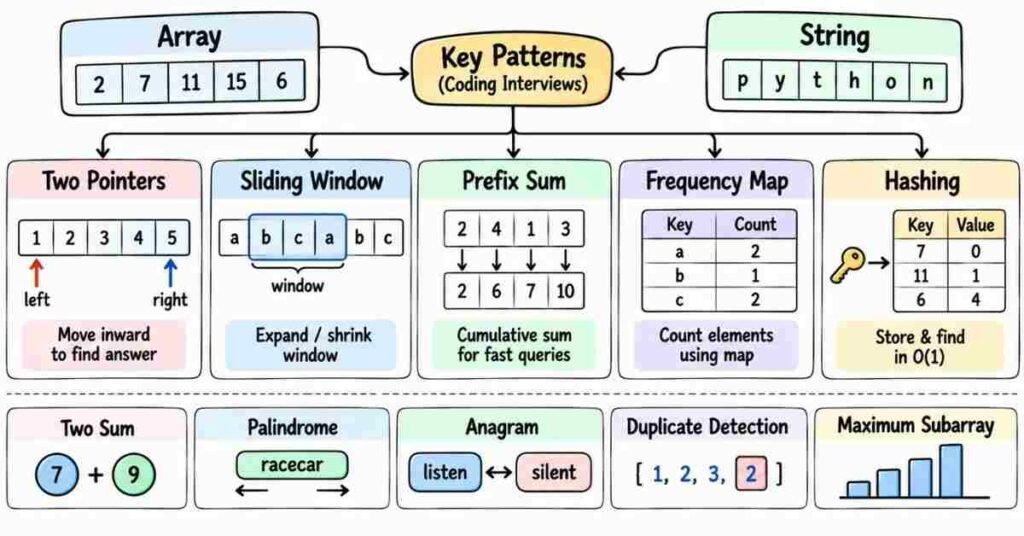
Arrays, Strings & Hashing — Questions 41–75
Q41. What is an array in Python?
Python does not have a built-in array type used exactly like Java or C. In most coding interviews, lists are used to work with array-style problems.
nums = [10, 20, 30, 40]
Lists support indexing, iteration, insertion, deletion, and slicing.
Q42. How do you access an element in a list?
Use its index.
nums = [10, 20, 30]
print(nums[1])
Output:
20
Index access in a Python list is generally O(1).
Q43. What is the time complexity of searching in a list?
A normal linear search takes O(n) because, in the worst case, every element may need to be checked.
Q44. What is the time complexity of inserting at the end of a list?
Using append() is typically O(1) amortized.
nums.append(50)
Inserting at the beginning is usually O(n) because existing elements need to shift.
Q45. How do you find the largest element in a list?
nums = [4, 8, 2, 10]
print(max(nums))
For interview problems, you should also know how to find it manually using one traversal.
Q46. How do you find the second-largest element?
Track the largest and second-largest values while scanning the array.
This can be done in O(n) time without sorting the whole list.
Q47. How do you reverse an array?
A simple Python approach is:
nums = [1, 2, 3, 4]
nums.reverse()
Or:
nums = nums[::-1]
In interviews, you may also be asked to reverse it using two pointers.
Q48. What is the two-pointer technique?
Two pointers use two indexes that move through the array based on a condition.
It is useful for:
- Reversing arrays
- Pair-sum problems
- Removing duplicates
- Palindrome checks
- Sorted-array problems
Q49. How do you check whether two numbers add up to a target?
A common approach is to use a set.
def two_sum(nums, target):
seen = set()
for num in nums:
if target – num in seen:
return True
seen.add(num)
return False
Time complexity is O(n) on average.
Q50. What is a prefix sum?
A prefix sum stores the cumulative sum up to each position.
For:
[2, 4, 6]
Prefix sums are:
[2, 6, 12]
It is useful when many range-sum queries need to be answered efficiently.
Strings
Q51. What is a string in Python?
A string is an immutable sequence of characters.
name = “Python”
Because strings are immutable, their existing characters cannot be changed directly.
Q52. How do you check if a string is a palindrome?
def is_palindrome(text):
return text == text[::-1]
A two-pointer solution is also common in interviews.
Q53. What is the two-pointer approach for a palindrome?
Place one pointer at the start and another at the end.
Compare both characters and move inward.
If any pair does not match, the string is not a palindrome.
Q54. How do you count characters in a string?
A dictionary is a simple approach.
text = “banana”
freq = {}
for ch in text:
freq[ch] = freq.get(ch, 0) + 1
Result:
{‘b’: 1, ‘a’: 3, ‘n’: 2}
Q55. How do you find first non-repeating character?
First count the frequency of every character.
Then traverse the string again and return the first character whose count is 1.
This takes O(n) time.
Q56. What are anagrams?
Two strings are anagrams when they contain the same characters with the same frequencies but possibly in a different order.
Example:
listen
Q57. How do you check whether two strings are anagrams?
One approach is:
def is_anagram(a, b):
return sorted(a) == sorted(b)
This is simple, but hashing can provide an O(n) solution.
Q58. How can hashing be used to check anagrams?
Count characters in both strings and compare their frequency maps.
from collections import Counter
Counter(“listen”) == Counter(“silent”)
Q59. What is string concatenation?
String concatenation joins strings together.
first = “Data”
second = “Structures”
result = first + ” ” + second
For repeatedly joining many strings, join() is often more efficient.
Q60. What does join() do?
join() combines multiple strings using a separator.
words = [“Python”, “with”, “DSA”]
result = ” “.join(words)
Output:
Python with DSA
Hashing
Q61. What is hashing?
Hashing maps a key to a location using a hash function.
In Python, dictionaries and sets use hashing internally.
It helps achieve fast average-time lookup.
Q62. What is a hash table?
A hash table stores key-value data using hashes to locate entries quickly.
Python’s dict is a hash-table-based structure.
Q63. Why are dictionaries useful in DSA problems?
Dictionaries are useful for:
- Frequency counting
- Fast lookups
- Mapping values to indexes
- Caching results
- Detecting duplicates
Average lookup and insertion are typically O(1).
Q64. What is the difference between a dictionary and a set?
A dictionary stores key-value pairs.
student = {“name”: “Ravi”}
A set stores only unique values.
nums = {1, 2, 3}
Q65. How do you detect duplicates in an array?
Use a set.
def has_duplicate(nums):
seen = set()
for num in nums:
if num in seen:
return True
seen.add(num)
return False
Q66. Why is a set faster than a list for membership testing?
Checking:
x in my_set
is typically O(1) on average.
Checking:
x in my_list
can take O(n).
Q67. What is frequency counting?
Frequency counting means recording how many times each value appears.
Example:
nums = [1, 1, 2, 3, 3, 3]
Frequency map:
1 -> 2
2 -> 1
3 -> 3
This pattern appears often in interview problems.
Q68. What is Counter in Python?
Counter is available in the collections module and automatically counts frequencies.
from collections import Counter
nums = [1, 1, 2, 3, 3]
print(Counter(nums))
Q69. What is the sliding window technique?
Sliding window is used to process a continuous part of an array or string without recalculating everything.
It is useful for:
- Maximum sum subarrays
- Longest substring problems
- Fixed-size windows
- Variable-size windows
Q70. When should you use sliding window?
Use it when the problem involves a contiguous subarray or substring and asks for things like maximum, minimum, longest, shortest, or count.
Q71. How do you find the maximum sum of a subarray of size k?
Use a fixed sliding window.
def max_sum(nums, k):
window_sum = sum(nums[:k])
best = window_sum
for i in range(k, len(nums)):
window_sum += nums[i]
window_sum -= nums[i – k]
best = max(best, window_sum)
return best
Time complexity is O(n).
Q72. What is the difference between a subarray and a subsequence?
A subarray contains continuous elements.
Example:
[2, 3, 4]
A subsequence keeps the original order but elements do not need to be continuous.
Example:
[2, 4]
This difference is very important in DSA interviews.
Q73. What is Kadane’s Algorithm?
Kadane’s Algorithm finds the maximum sum of a contiguous subarray.
It keeps track of:
- Best sum ending at the current position
- Best overall sum
Its time complexity is O(n).
Q74. How do you rotate an array?
For a right rotation by k positions:
nums = [1, 2, 3, 4, 5]
k = 2
k %= len(nums)
nums = nums[-k:] + nums[:-k]
Result:
[4, 5, 1, 2, 3]
Interviewers may also ask you to perform the rotation in-place.
Q75. How do you approach an array or string problem in an interview?
Start by identifying:
- Is the input sorted?
- Is the problem about a contiguous section?
- Do I need fast lookup?
- Are duplicates important?
- Can two pointers help?
- Can hashing reduce repeated searching?
- What are the time and space complexities?
Choosing the right pattern is often more important than immediately writing code.
Important Patterns to Practice
For this section, focus mainly on:
- Two Pointers
- Sliding Window
- Hashing
- Frequency Maps
- Prefix Sum
- Kadane’s Algorithm
- Sorting + Searching
- String Manipulation
Do not memorize twenty different solutions. Learn to recognize which pattern fits the problem.
Practice Strategy
Start with problems such as:
- Two Sum
- Contains Duplicate
- Valid Anagram
- Valid Palindrome
- Best Time to Buy and Sell Stock
- Maximum Subarray
- Move Zeroes
- Rotate Array
- Longest Substring Without Repeating Characters
- First Unique Character
For each problem, first explain the brute-force approach, then improve it using hashing, two pointers, or sliding window.
Part 4: Linked Lists, Stacks & Queues
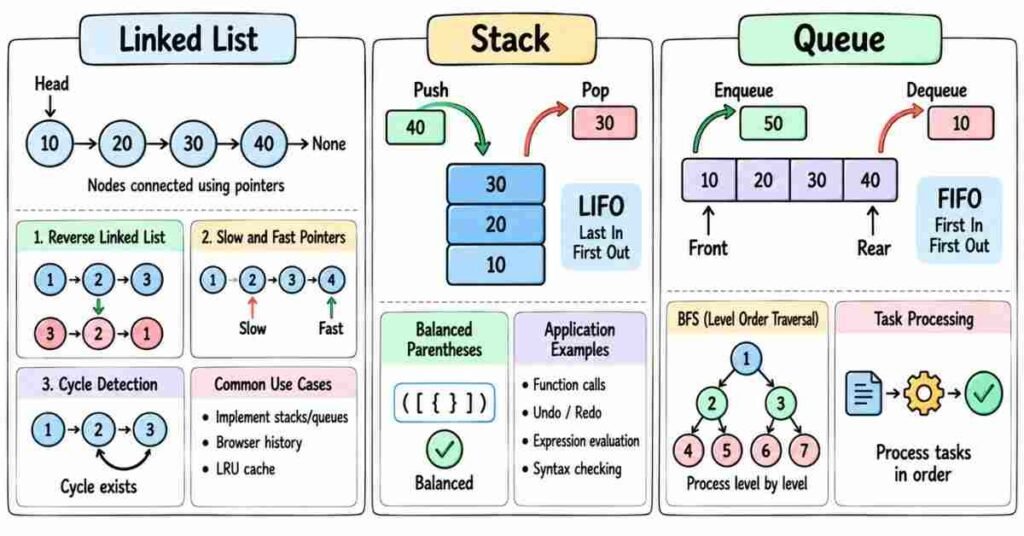
Linked Lists, Stacks & Queues — Questions 76–105
Q76. What is a linked list?
A linked list is a linear data structure where each node stores a value and a reference to the next node.
Unlike a Python list, linked-list elements are not stored next to each other in memory.
Q77. What does a linked-list node contain?
A basic node contains:
- Data
- Reference to the next node
class Node:
def __init__(self, data):
self.data = data
self.next = None
Q78. What are the main types of linked lists?
Common types are:
- Singly Linked List
- Doubly Linked List
- Circular Linked List
Q79. What is a singly linked list?
In a singly linked list, each node points only to the next node.
10 → 20 → 30 → None
Traversal happens in one direction.
Q80. What is a doubly linked list?
A doubly linked list stores references to both the previous and next nodes.
None ← 10 ⇄ 20 ⇄ 30 → None
It allows traversal in both directions.
Q81. What is a circular linked list?
In a circular linked list, the last node points back to the first node instead of None.
It can be useful in cyclic processes such as round-robin scheduling.
Q82. What is the time complexity of accessing an element in a linked list?
Accessing a specific position takes O(n) because nodes must be traversed one by one.
Q83. What is the advantage of a linked list over an array?
Insertion or deletion can be efficient when the required node is already known.
A linked list also does not require elements to be stored in contiguous memory.
Q84. How do you traverse a linked list?
Start from the head and continue until the current node becomes None.
current = head
while current:
print(current.data)
current = current.next
Q85. How do you insert a node at the beginning?
new_node.next = head
head = new_node
This operation takes O(1) time.
Q86. How do you reverse a linked list?
Use three references:
- prev
- current
- next_node
prev = None
current = head
while current:
next_node = current.next
current.next = prev
prev = current
current = next_node
head = prev
Time complexity is O(n).
Q87. How do you find the middle of a linked list?
Use a slow pointer and a fast pointer.
Slow moves one step while fast moves two steps.
When fast reaches the end, slow will be near the middle.
Q88. How do you detect a cycle in a linked list?
Use Floyd’s Cycle Detection algorithm.
A slow pointer moves one step and a fast pointer moves two steps. If they eventually meet, a cycle exists.
Time complexity is O(n) and extra space is O(1).
Q89. How can you remove duplicates from a linked list?
For an unsorted linked list, a set can store values already seen.
If the list is sorted, duplicates can often be removed by comparing adjacent nodes.
Q90. What is a common linked-list interview pattern?
Common patterns include:
- Fast and slow pointers
- Reversing links
- Dummy nodes
- Merging lists
- Cycle detection
Understanding these patterns is more useful than memorizing individual solutions.
Stacks
Q91. What is a stack?
A stack follows LIFO — Last In, First Out.
The most recently added item is removed first.
A stack is similar to a pile of plates.
Q92. How do you implement a stack in Python?
A list can be used.
stack = []
stack.append(10)
stack.append(20)
print(stack.pop())
Output:
20
Q93. What are the main stack operations?
Common operations are:
- push
- pop
- peek
- isEmpty
With a Python list, append() works like push and pop() removes the top element.
Q94. What is the time complexity of stack operations?
Adding and removing from the end of a Python list are typically O(1) amortized.
Q95. Where are stacks used?
Stacks are commonly used for:
- Function calls
- Undo operations
- Expression evaluation
- Parentheses matching
- DFS
- Backtracking
Q96. How do you check for balanced parentheses?
Push opening brackets onto a stack.
When a closing bracket appears, compare it with the most recent opening bracket.
def is_valid(s):
stack = []
pairs = {‘)’: ‘(‘, ‘]’: ‘[‘, ‘}’: ‘{‘}
for ch in s:
if ch in pairs:
if not stack or stack.pop() != pairs[ch]:
return False
else:
stack.append(ch)
return not stack
Time complexity is O(n).
Q97. What is a monotonic stack?
A monotonic stack keeps elements in increasing or decreasing order.
It is useful for problems such as:
- Next Greater Element
- Daily Temperatures
- Stock Span
- Largest Rectangle in Histogram
Queues
Q98. What is a queue?
A queue follows FIFO — First In, First Out.
The first element added is the first one removed.
A real-world example is a line of people waiting at a counter.
Q99. What are the main queue operations?
Common operations are:
- Enqueue
- Dequeue
- Front
- isEmpty
Q100. How should you implement a queue in Python?
collections.deque is usually preferred.
from collections import deque
queue = deque()
queue.append(10)
queue.append(20)
print(queue.popleft())
Output:
10
Q101. Why is deque better than a list for queues?
Removing the first element of a list using:
list.pop(0)
takes O(n) because other elements need to shift.
deque.popleft() is typically O(1).
Q102. What is a circular queue?
A circular queue connects the end of the queue back to the beginning.
It allows fixed-size storage to be reused efficiently instead of wasting empty positions.
Q103. What is a priority queue?
A priority queue removes elements based on priority rather than insertion order.
Python commonly implements it using heapq.
import heapq
pq = []
heapq.heappush(pq, 30)
heapq.heappush(pq, 10)
heapq.heappush(pq, 20)
print(heapq.heappop(pq))
Output:
10
Q104. What is the difference between a stack and a queue?
Stack | Queue |
LIFO | FIFO |
Last element removed first | First element removed first |
append() + pop() | append() + popleft() |
Used in DFS | Used in BFS |
Q105. How do you decide between a stack, queue, and linked list?
Look at the way data needs to be processed.
Use a stack when the most recent item should be handled first.
Use a queue when items should be processed in arrival order.
Use a linked list when the problem involves node connections, frequent insertions or deletions, or pointer manipulation.
Important Patterns to Practice
Focus on:
- Fast and Slow Pointers
- Linked List Reversal
- Dummy Nodes
- Cycle Detection
- Stack-Based Parsing
- Monotonic Stack
- Queue Processing
- deque
- Priority Queues
Practice Strategy
Start with problems such as:
- Reverse Linked List
- Middle of the Linked List
- Linked List Cycle
- Merge Two Sorted Lists
- Remove Nth Node From End
- Valid Parentheses
- Min Stack
- Next Greater Element
- Daily Temperatures
- Implement Queue Using Stacks
For every problem, first understand why the data structure fits the problem. Then discuss the brute-force solution, optimized approach, and complexity.
Part 5: Trees, BST & Heaps
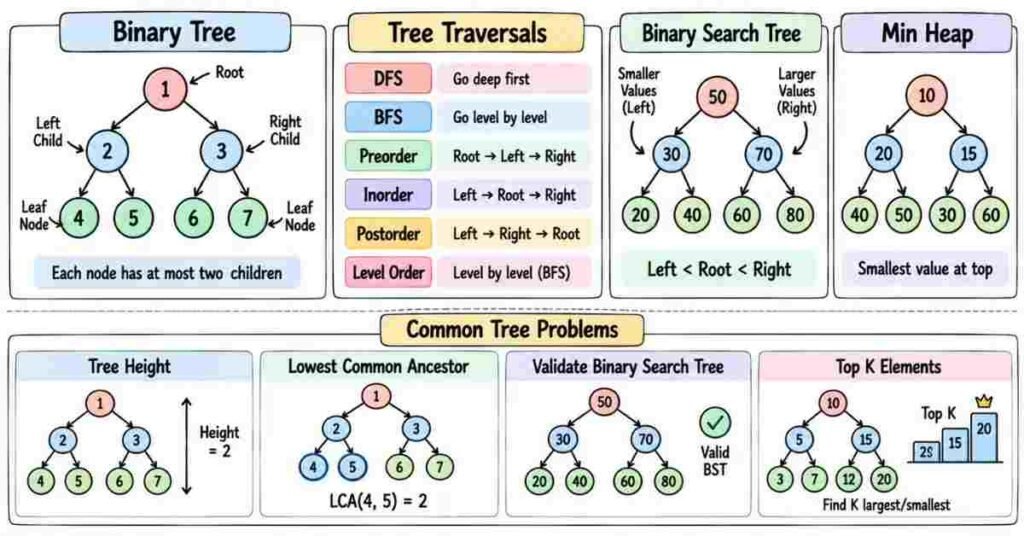
Trees, BST & Heaps — Questions 106–135
Q106. What is a tree in DSA?
A tree is a non-linear data structure used to store data in a hierarchy.
Think of a company structure or folder system. One item starts at the top and connects to other items below it.
Q107. What is a binary tree?
A binary tree is a tree where each node can have at most two children.
They are called the left child and right child.
10
/ \
5 20
Q108. What is the root node?
The root is the first node of a tree.
Every other node is connected directly or indirectly to the root.
Q109. What is a leaf node?
A leaf node is a node that has no children.
In the tree below, 5 and 20 are leaf nodes.
10
/ \
5 20
Q110. What is the height of a tree?
Height tells us how far the tree extends from a node to its deepest leaf.
It is useful when checking whether a tree is balanced.
Q111. What is the depth of a node?
Depth tells us how far a node is from the root.
The root normally starts at depth 0.
Q112. What are the main tree traversals?
The common traversal methods are:
- Preorder
- Inorder
- Postorder
- Level Order
Each one visits the nodes in a different order.
Q113. What is preorder traversal?
Preorder follows:
Root → Left → Right
def preorder(root):
if root is None:
return
print(root.val)
preorder(root.left)
preorder(root.right)
It processes the root before its children.
Q114. What is inorder traversal?
Inorder follows:
Left → Root → Right
def inorder(root):
if root is None:
return
inorder(root.left)
print(root.val)
inorder(root.right)
For a BST, inorder traversal gives values in sorted order.
Q115. What is postorder traversal?
Postorder follows:
Left → Right → Root
Here, child nodes are processed before the parent.
Q116. What is level-order traversal?
Level-order traversal visits nodes one level at a time.
It normally uses a queue.
10
/ \
5 20
Output:
10, 5, 20
Q117. What is the difference between DFS and BFS?
DFS goes deep into one branch before moving to another.
BFS visits nodes level by level.
In interviews:
- DFS usually uses recursion or a stack.
- BFS usually uses a queue.
Q118. How do you find the maximum depth of a binary tree?
Use recursion.
def max_depth(root):
if root is None:
return 0
return 1 + max(
max_depth(root.left),
max_depth(root.right)
)
Time complexity is O(n) because every node is visited once.
Q119. What is a balanced binary tree?
A tree is balanced when the left and right subtrees do not differ too much in height.
A balanced tree usually performs better than a heavily skewed tree.
Q120. What is the diameter of a binary tree?
The diameter is the longest path between any two nodes in the tree.
That path does not have to pass through the root.
Q121. What is the Lowest Common Ancestor?
The Lowest Common Ancestor, or LCA, is the lowest node that has both given nodes under it.
Example:
10
/ \
5 20
/ \
2 7
The LCA of 2 and 7 is 5.
Binary Search Trees
Q122. What is a Binary Search Tree?
A Binary Search Tree follows a simple rule:
- Smaller values go left.
- Larger values go right.
10
/ \
5 20
This ordering makes searching easier.
Q123. What is the search complexity in a BST?
For a balanced BST:
O(log n)
For a badly skewed BST:
O(n)
So the shape of the tree matters.
Q124. How do you search for a value in a BST?
Compare the target with the current node.
- Smaller target → go left
- Larger target → go right
def search(root, target):
if root is None or root.val == target:
return root
if target < root.val:
return search(root.left, target)
return search(root.right, target)
Q125. How do you insert a value into a BST?
Start from the root.
Move left if the value is smaller and right if it is larger.
Insert the value when you find an empty position.
Q126. Why does inorder traversal give sorted output in a BST?
Because a BST stores:
Smaller values → Root → Larger values
And inorder traversal follows the same order:
Left → Root → Right
Q127. How do you find the minimum value in a BST?
Keep moving to the left child.
The leftmost node contains the minimum value.
Q128. How do you find the maximum value in a BST?
Keep moving to the right child.
The rightmost node contains the maximum value.
Q129. What are the cases in BST deletion?
There are three cases:
- Node has no child.
- Node has one child.
- Node has two children.
The third case usually needs the inorder successor or predecessor.
Q130. How do you check whether a tree is a valid BST?
Every node should stay within a valid minimum and maximum range.
Checking only the immediate children is not enough.
Q131. What is a skewed tree?
A skewed tree grows mostly on one side.
10
\
20
\
30
It starts behaving more like a linked list.
Heaps
Q132. What is a heap?
A heap is a tree-based structure mainly used when we repeatedly need the smallest or largest value.
The common types are:
- Min Heap
- Max Heap
Q133. What is a min heap?
In a min heap, the smallest value stays at the top.
2
/ \
5 8
Python’s heapq works as a min heap by default.
Q134. What is the time complexity of common heap operations?
Typical complexities are:
- Get minimum: O(1)
- Insert: O(log n)
- Remove minimum: O(log n)
- Build heap: O(n)
Q135. When should you think of using a heap?
A heap is a strong choice when a problem asks for:
- Kth largest element
- Kth smallest element
- Top K elements
- Highest or lowest priority
- Repeated minimum or maximum values
Words like Top K, smallest K, largest K, priority are good hints.
Important Patterns to Practice
For this section, focus on:
- DFS
- BFS
- Tree Recursion
- Level Order Traversal
- Tree Height
- Tree Diameter
- Lowest Common Ancestor
- BST Search
- BST Validation
- Min Heap
- Top-K Problems
Practice Strategy
Start with these problems:
- Maximum Depth of Binary Tree
- Invert Binary Tree
- Same Tree
- Balanced Binary Tree
- Diameter of Binary Tree
- Level Order Traversal
- Lowest Common Ancestor
- Validate Binary Search Tree
- Kth Smallest in BST
- Kth Largest Element
- Top K Frequent Elements
When you see a tree problem, first think:
“Can I solve the left subtree and right subtree separately?”
That one question makes many tree problems easier.
Part 6: Searching, Sorting & Recursion
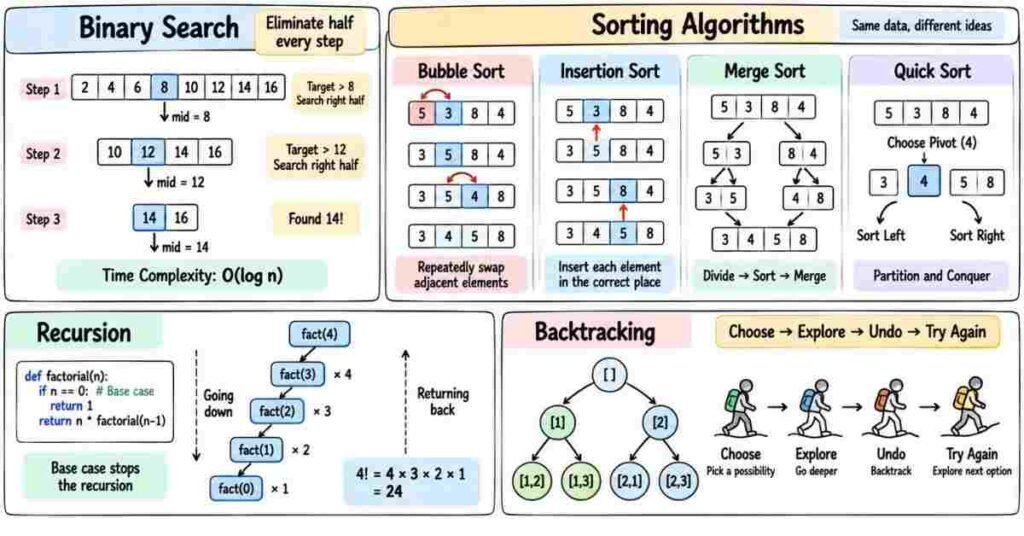
Searching, Sorting & Recursion — Questions 136–165
Searching
Q136. What is searching in DSA?
Searching means finding whether a particular value exists in a collection.
For example, if you have student IDs in a list, searching helps you find a specific ID.
Q137. What is linear search?
Linear search checks elements one by one until the target is found.
def linear_search(nums, target):
for i in range(len(nums)):
if nums[i] == target:
return i
return -1
Its time complexity is O(n).
Q138. When should you use linear search?
Linear search is useful when:
- The data is small
- The list is unsorted
- You only need to search once
For large sorted data, binary search is usually better.
Q139. What is binary search?
Binary search repeatedly divides the search space into half.
It works when the data is sorted.
def binary_search(nums, target):
left, right = 0, len(nums) – 1
while left <= right:
mid = (left + right) // 2
if nums[mid] == target:
return mid
elif nums[mid] < target:
left = mid + 1
else:
right = mid – 1
return -1
Time complexity is O(log n).
Q140. Why is binary search faster than linear search?
Linear search may check every element.
Binary search removes half of the remaining elements after every comparison.
That is why binary search becomes very useful for large sorted datasets.
Q141. What is the main condition for binary search?
The data should normally be sorted.
If the data is not sorted, a normal binary search cannot reliably decide which half to remove.
Q142. How do you calculate mid in binary search?
A common Python approach is:
mid = (left + right) // 2
The middle element is then compared with the target.
Q143. What are common binary search mistakes?
Common mistakes include:
- Wrong left or right updates
- Using the wrong loop condition
- Forgetting the sorted-data requirement
- Off-by-one errors
Most binary search bugs come from boundary handling.
Q144. Can binary search be used for more than finding a number?
Yes.
Binary search is also used for:
- First occurrence
- Last occurrence
- Search insert position
- Finding boundaries
- Searching the answer space
So it is more of a problem-solving pattern than just one algorithm.
Sorting
Q145. What is sorting?
Sorting means arranging values in a particular order.
Example:
Before: [5, 2, 8, 1]
After: [1, 2, 5, 8]
Sorting often makes later searching or comparison easier.
Q146. What is Bubble Sort?
Bubble Sort repeatedly compares neighboring elements and swaps them when they are in the wrong order.
Its worst-case time complexity is O(n²).
It is easy to understand, but not usually preferred for large inputs.
Q147. How does Bubble Sort work?
Example:
[5, 2, 4]
5 and 2 → swap
[2, 5, 4]
5 and 4 → swap
[2, 4, 5]
With every pass, a larger value moves toward the end.
Q148. What is Selection Sort?
Selection Sort finds the smallest element and places it in the correct position.
It repeats this process for the remaining elements.
Time complexity is O(n²).
Q149. What is Insertion Sort?
Insertion Sort builds the sorted portion one element at a time.
Think of arranging playing cards in your hand. You pick a card and place it where it belongs.
Its worst-case complexity is O(n²).
Q150. When can Insertion Sort work well?
Insertion Sort can work well for:
- Small datasets
- Nearly sorted data
It is simple and does not require much extra memory.
Q151. What is Merge Sort?
Merge Sort follows the divide-and-conquer approach.
It:
- Divides the array into smaller parts
- Sorts those parts
- Merges them back together
Time complexity is O(n log n).
Q152. Why does Merge Sort need extra space?
During merging, temporary storage is usually needed to combine the sorted halves.
So the common array implementation uses O(n) extra space.
Q153. What is Quick Sort?
Quick Sort chooses a pivot and divides elements around it.
Smaller values move to one side and larger values to the other.
Its average time complexity is O(n log n).
Q154. What is a pivot in Quick Sort?
A pivot is the element used to divide the array.
For example:
[7, 2, 9, 4, 5]
If 5 is the pivot:
- Smaller values go to one side
- Larger values go to the other
Good pivot selection can improve performance.
Q155. What is the worst-case complexity of Quick Sort?
The worst case is O(n²).
This can happen when partitions become very unbalanced repeatedly.
Q156. What is the difference between Merge Sort and Quick Sort?
Merge Sort
- Guaranteed O(n log n)
- Uses extra memory
- Works by merging
Quick Sort
- Average O(n log n)
- Can often work with less additional array storage
- Depends heavily on partitioning
The better choice depends on the situation.
Q157. Which sorting algorithm should you explain first in an interview?
Do not immediately name an algorithm.
First look at:
- Input size
- Whether data is nearly sorted
- Memory restrictions
- Stability requirements
- Expected time complexity
Then explain why your choice fits.
Q158. What does Python’s sorted() do?
sorted() returns a new sorted collection.
nums = [4, 1, 3, 2]
result = sorted(nums)
nums remains unchanged.
Q159. What is the difference between sort() and sorted()?
list.sort() modifies the original list.
nums.sort()
sorted() creates and returns a new sorted result.
new_nums = sorted(nums)
This is a common Python interview question.
Searching
Q160. What is recursion?
Recursion happens when a function calls itself to solve a smaller version of the same problem.
A recursive solution normally needs:
- A base case
- A recursive case
Q161. What is a base case?
The base case tells recursion when to stop.
Without it, the function may continue calling itself until Python raises a recursion error.
Q162. How do you find factorial using recursion?
def factorial(n):
if n <= 1:
return 1
return n * factorial(n – 1)
For 5, the result is:
120
Q163. What happens internally during recursion?
Each function call is stored on the call stack until it finishes.
For:
factorial(3)
The calls look roughly like:
factorial(3)
factorial(2)
factorial(1)
Then the results return back in reverse order.
Q164. What is backtracking?
Backtracking means:
Choose → Explore → Undo → Try another choice
It is useful when a problem has many possible combinations.
Common examples include:
- Permutations
- Subsets
- Sudoku
- N-Queens
- Maze problems
Q165. How do you identify a recursion or backtracking problem?
Look for questions involving:
- Repeated smaller subproblems
- Trees
- All combinations
- All permutations
- Multiple possible paths
- Choose-and-undo decisions
A useful question to ask yourself is:
“Can I solve this problem by solving a smaller version of the same problem?”
If yes, recursion may fit naturally.
Important Patterns to Practice
Focus on:
- Linear Search
- Binary Search
- Binary Search on Answer
- Bubble Sort
- Selection Sort
- Insertion Sort
- Merge Sort
- Quick Sort
- Divide and Conquer
- Recursion
- Backtracking
Practice Strategy
Start with problems such as:
- Binary Search
- Search Insert Position
- First and Last Position in Sorted Array
- Search in Rotated Sorted Array
- Merge Sorted Array
- Sort Colors
- Merge Sort Implementation
- Quick Sort Implementation
- Generate Parentheses
- Subsets
- Permutations
- Combination Sum
While solving, do not rush into code.
First explain:
What is the input? → What pattern fits? → What is the simple solution? → Can I make it faster?
Part 7: Graphs, Greedy & Dynamic Programming
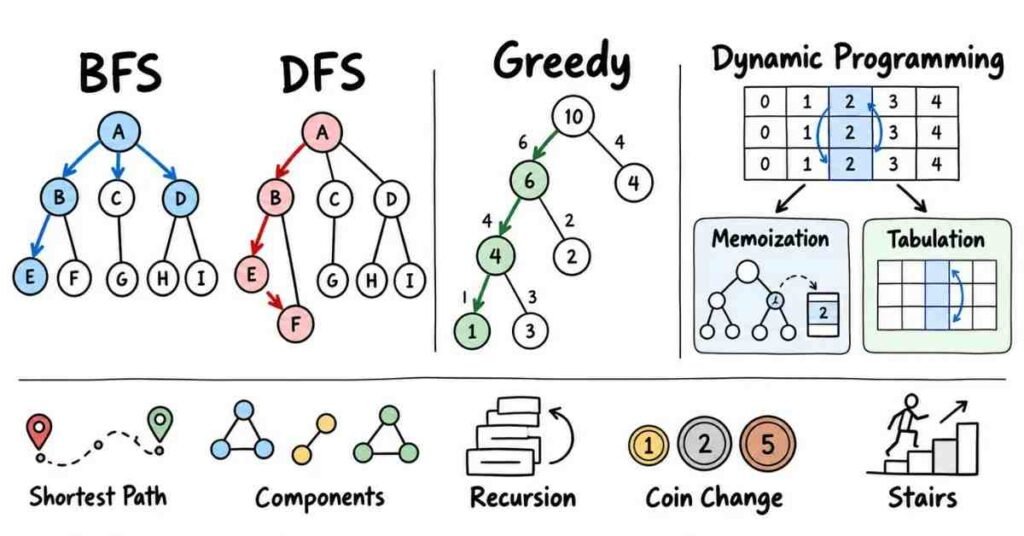
Graphs, Greedy & Dynamic Programming Questions
166–200
Graphs
Q166. What is a graph in DSA?
A graph is a collection of nodes connected by edges.
Real examples include:
- Social networks
- Road maps
- Computer networks
- Flight routes
Q167. What are vertices and edges?
A vertex is a node.
An edge is a connection between two nodes.
A —— B
| |
C —— D
Here, A, B, C, and D are vertices.
Q168. What is a directed graph?
In a directed graph, edges have a direction.
A → B
This means you can move from A to B, but not automatically from B to A.
Q169. What is an undirected graph?
In an undirected graph, the connection works both ways.
A —— B
If A is connected to B, then B is also connected to A.
Q170. What is a weighted graph?
A weighted graph gives each edge a value.
That value may represent:
- Distance
- Cost
- Time
- Weight
For example, Google Maps can treat road distance as an edge weight.
Q171. How can we represent a graph in Python?
A common method is an adjacency list.
graph = {
“A”: [“B”, “C”],
“B”: [“A”, “D”],
“C”: [“A”],
“D”: [“B”]
}
It stores the neighbors of each node.
Q172. What is BFS?
BFS stands for Breadth-First Search.
It visits nodes level by level and normally uses a queue.
Q173. When is BFS useful?
BFS is useful for:
- Level-by-level traversal
- Finding shortest paths in unweighted graphs
- Finding nearby nodes
- Connected-component problems
Q174. What is DFS?
DFS stands for Depth-First Search.
It explores one path deeply before returning and trying another path.
It can use recursion or a stack.
Q175. What is the difference between BFS and DFS?
BFS
- Uses a queue
- Explores level by level
DFS
- Uses recursion or a stack
- Goes deep into a path first
Neither is always better. It depends on the problem.
Q176. Why do we need a visited set in graph problems?
Graphs may contain cycles.
Without tracking visited nodes, we may keep visiting the same nodes again and again.
visited = set()
This prevents unnecessary work and infinite loops.
Q177. What is a connected component?
A connected component is a group of nodes that can reach one another.
A graph may contain several separate groups.
Finding the number of such groups is a common interview problem.
Q178. What is a cycle in a graph?
A cycle exists when you can start from a node and return to the same node by following edges.
Example:
A → B → C → A
Cycle detection is common in graph interviews.
Q179. What is topological sorting?
Topological sorting gives an order for tasks that depend on one another.
For example:
Learn Python → Learn DSA → Attend Interview
It is mainly used with a Directed Acyclic Graph (DAG).
Q180. What is Dijkstra’s Algorithm?
Dijkstra’s Algorithm finds the shortest path from one source node in a graph with non-negative edge weights.
It is commonly implemented using a priority queue or heap.
Greedy Algorithms
Q181. What is a greedy algorithm?
A greedy algorithm makes the best choice available at the current step.
It does not usually go back and change earlier decisions.
Q182. Does a greedy approach always give the correct answer?
No.
A greedy approach works only when making the best local choice also leads to the best overall result.
So you should not use greedy just because it looks simple.
Q183. How do you identify a greedy problem?
Look for situations where you repeatedly choose:
- Smallest value
- Largest value
- Earliest finishing task
- Cheapest option
- Best available option
Then check whether that choice remains safe for the final answer.
Q184. What is the Activity Selection problem?
You are given activities with start and finish times.
The goal is to select the maximum number of non-overlapping activities.
A common greedy idea is to choose the activity that finishes earliest.
Q185. What is the difference between greedy and dynamic programming?
Greedy makes one best-looking decision and moves forward.
Dynamic Programming considers repeated subproblems and saves their results.
Greedy is often simpler, but DP handles more complex decision problems.
Dynamic Programming
Q186. What is Dynamic Programming?
Dynamic Programming, or DP, is used when the same smaller problems appear repeatedly.
Instead of solving them again and again, we store the answers and reuse them.
Q187. What are overlapping subproblems?
Overlapping subproblems happen when the same calculation is needed multiple times.
For example, a recursive Fibonacci solution calculates the same Fibonacci values repeatedly.
DP avoids that repeated work.
Q188. What is optimal substructure?
Optimal substructure means the solution to a bigger problem can be built using solutions to smaller problems.
This is one of the signs that DP may work.
Q189. What is memoization?
Memoization is a top-down DP approach.
We use recursion and store previously calculated results.
memo = {}
def fib(n):
if n <= 1:
return n
if n in memo:
return memo[n]
memo[n] = fib(n – 1) + fib(n – 2)
return memo[n]
Q190. What is tabulation?
Tabulation is a bottom-up approach.
Instead of recursion, we start with smaller answers and build toward the final answer.
def fib(n):
if n <= 1:
return n
dp = [0] * (n + 1)
dp[1] = 1
for i in range(2, n + 1):
dp[i] = dp[i – 1] + dp[i – 2]
return dp[n]
Q191. What is the difference between memoization and tabulation?
Memoization
- Top-down
- Uses recursion
- Calculates values when needed
Tabulation
- Bottom-up
- Usually uses loops
- Builds answers step by step
Both avoid repeated work.
Q192. How do you identify a DP problem?
Ask yourself:
- Can the problem be divided into smaller problems?
- Are the same smaller problems repeating?
- Can I store previous answers?
- Am I trying to find a maximum, minimum, count, or best result?
If several answers are yes, DP may be useful.
Q193. What is the Fibonacci DP problem?
Fibonacci follows:
F(n) = F(n-1) + F(n-2)
A normal recursive solution repeats many calculations.
DP stores those values and improves the time complexity.
Q194. What is the Climbing Stairs problem?
Suppose you can climb either 1 or 2 steps at a time.
The number of ways to reach a step depends on:
ways(n) = ways(n-1) + ways(n-2)
This makes it similar to Fibonacci.
Q195. What is the 0/1 Knapsack problem?
You have items with:
- Weight
- Value
You must choose items without exceeding the bag’s capacity.
Each item can either be:
- Taken once
- Not taken
It is a classic DP problem.
Q196. What is the Longest Common Subsequence?
LCS finds the longest sequence that appears in two sequences in the same order.
For example:
ABCDEF
ACE
The LCS is:
ACE
Q197. What is the difference between a substring and subsequence?
A substring must be continuous.
Example:
“yth” from “python”
A subsequence does not need to be continuous, but order must remain the same.
Q198. What is a DP state?
A DP state tells us what one stored value represents.
For example:
dp[i] = minimum cost to reach position i
Defining the state clearly often makes the rest of the solution easier.
Q199. What is a DP transition?
A transition explains how the current answer is built from previous answers.
Example:
dp[i] = dp[i-1] + dp[i-2]
Think of it as the relationship between one state and earlier states.
Q200. What is the best way to solve a DP problem in an interview?
Do not start by writing a large DP table.
First explain:
- What smaller problem are we solving?
- What is repeating?
- What does dp[i] represent?
- What is the recurrence?
- What is the base case?
- Can the memory be reduced?
A clear explanation matters as much as the final code.
Important Patterns to Practice
Focus on:
- BFS
- DFS
- Connected Components
- Cycle Detection
- Topological Sort
- Shortest Path
- Greedy Selection
- Memoization
- Tabulation
- 1D DP
- 2D DP
Practice Strategy
Start with problems such as:
- Number of Islands
- Clone Graph
- Flood Fill
- Course Schedule
- Rotting Oranges
- Network Delay Time
- Jump Game
- Climbing Stairs
- House Robber
- Coin Change
- Longest Common Subsequence
- 0/1 Knapsack
When you see a graph problem, first ask:
“Should I explore level by level or go deep into one path?”
That usually helps you choose between BFS and DFS.
Part 8: Coding Interview Strategy & Advanced Problems
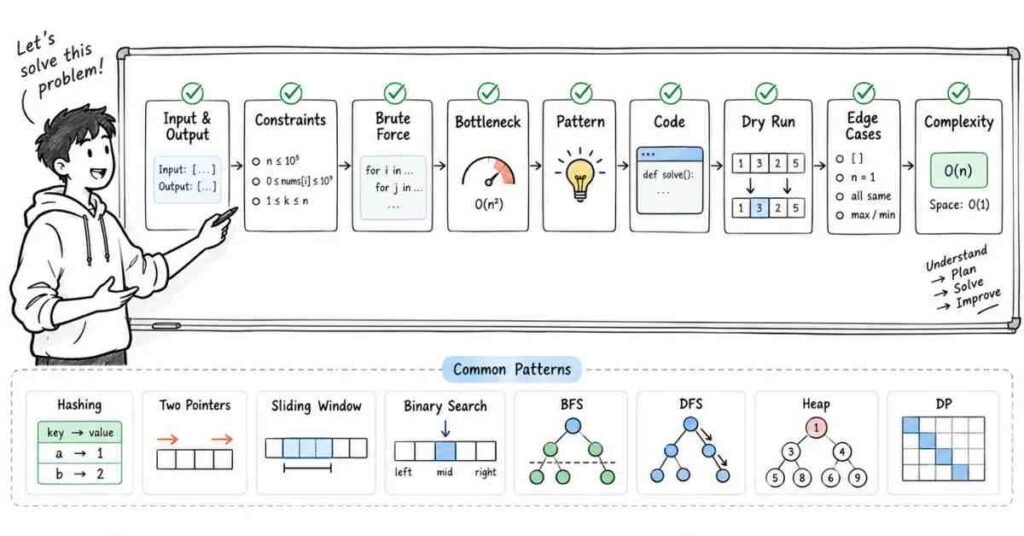
Coding Interview Strategy — Questions 201–230
Complexity & Optimization
Q201. What is time complexity?
Time complexity tells us how the running time grows when the input becomes larger.
For example:
- O(1) – constant time
- O(log n) – binary search
- O(n) – one full traversal
- O(n log n) – efficient sorting
- O(n²) – nested loops
In interviews, always explain the complexity of your final solution.
Q202. What is space complexity?
Space complexity tells us how much extra memory an algorithm needs.
For example, using a hash set of n elements usually requires O(n) extra space.
Q203. Is O(n) always better than O(n log n)?
Usually, yes for large inputs. But complexity is not the only factor.
You should also consider:
- Memory usage
- Input size
- Code simplicity
- Whether the input is already sorted
Q204. What is brute force?
Brute force is the most direct solution to a problem.
It may not be the fastest, but it is often a good starting point because it proves that you understand the problem.
Q205. Should you explain brute force in an interview?
Yes.
A good approach is:
Brute Force → Identify the bottleneck → Optimize
This shows the interviewer how your thinking improves step by step.
Q206. How do you optimize a slow solution?
Look for repeated work.
For example:
- Repeated search → Hashing
- Repeated range calculation → Prefix Sum
- Nested scanning → Two Pointers
- Repeated subproblems → DP
- Sorted input → Binary Search
Optimization usually starts by finding what your code is doing again and again.
Problem-Solving Approach
Q207. What should you do first when given a coding problem?
Do not start coding immediately.
First understand:
- Input
- Expected output
- Constraints
- Edge cases
- Examples
A wrong understanding leads to wrong code, no matter how good the syntax is.
Q208. Why are constraints important?
Constraints often tell you what type of solution is practical.
For example, if n = 100000, an O(n²) solution is usually too slow.
Q209. Should you ask questions before coding?
Yes, when something is unclear.
Useful questions include:
- Can the input be empty?
- Are duplicates allowed?
- Is the array sorted?
- Can values be negative?
- What should I return if no answer exists?
Good clarification shows careful thinking.
Q210. What is an edge case?
An edge case is an unusual input that may break a normal solution.
Examples:
- Empty list
- One element
- Duplicate values
- Negative numbers
- Very large input
- Already sorted data
Q211. What does dry run mean?
A dry run means manually tracing your algorithm with a sample input.
For example:
Input: [2, 7, 11, 15]
Target: 9
Walk through the variables step by step before trusting the code.
Q212. Why should you explain your thinking aloud?
Interviewers are not only checking the final answer.
They also want to know how you reached it.
A simple explanation such as “I need fast lookup, so I’ll use a set” makes your reasoning clear.
Common Interview Patterns
Q213. When should you think about hashing?
Think about hashing when you need:
- Fast lookup
- Frequency counting
- Duplicate detection
- Value-to-index mapping
Common structures are dict and set.
Q214. When should you use two pointers?
Two pointers are useful when working with:
- Sorted arrays
- Palindromes
- Pair sums
- Array reversal
- Removing duplicates
Q215. When should you think about sliding window?
Look for a contiguous subarray or substring.
Words like:
- Longest
- Shortest
- Maximum window
- Minimum window
often suggest sliding window.
Q216. When should you think about binary search?
Use binary search when:
- Data is sorted
- The search space is ordered
- You can remove half of the possibilities each step
Q217. When should you think about a stack?
Stacks are useful for:
- Parentheses
- Undo operations
- Next greater element
- Expression problems
- DFS
Q218. When should you think about BFS?
BFS is useful when the problem asks for:
- Level order
- Minimum steps
- Shortest path in an unweighted graph
- Nearest node
Q219. When should you think about DFS?
DFS works well for:
- Exploring connected regions
- Tree traversal
- Graph traversal
- Backtracking
- Finding components
Q220. When should you think about dynamic programming?
Think about DP when:
- Smaller problems repeat
- You need a minimum, maximum, count, or best result
- A recursive solution is recalculating the same values
Python in Coding Interviews
Q221. Why are dictionaries useful in Python interviews?
Python dictionaries provide fast average lookup.
They are especially useful in questions like:
- Two Sum
- Frequency Count
- Group Anagrams
- Duplicate Detection
Q222. Why is deque useful?
deque is useful when you need fast operations from both ends.
from collections import deque
It is commonly used for BFS and queue problems.
Q223. When should you use heapq?
Use heapq when you repeatedly need the smallest value or are working with Top-K problems.
Common examples:
- Kth Largest
- Merge K Sorted Lists
- Top K Frequent Elements
Q224. Is using Python built-in functions allowed in interviews?
Usually yes, unless the interviewer specifically asks you to implement the logic manually.
But you should understand what the built-in function does and its complexity.
Q225. Should you write Pythonic code in interviews?
Yes, but readability comes first.
This is good:
seen = set()
Avoid making code so short that the interviewer struggles to understand it.
Handling Coding Rounds
Q226. What should you do if you get stuck?
Do not stay silent.
Explain:
- What you already know
- Where the problem is getting difficult
- What alternative you are considering
Interviewers may give a hint if they can follow your thinking.
Q227. What should you do after writing the solution?
Test it manually.
Check:
- Normal input
- Empty input
- Single value
- Duplicates
- Boundary cases
Then state the time and space complexity.
Q228. What if your first solution is not optimal?
That is fine.
Start with the working solution and then say:
“This works, but we can improve it by…”
That shows problem-solving ability instead of memorization.
Q229. What matters more: solving fast or explaining clearly?
Both matter, but a correct solution with clear reasoning is usually stronger than rushed code with no explanation.
An interview is a conversation, not just an online coding test.
Q230. What is a good structure for answering a coding question?
Use this flow:
- Understand the problem.
- Clarify doubts.
- Explain brute force.
- Identify the bottleneck.
- Choose a better pattern.
- Write clean code.
- Dry run the solution.
- Explain complexity.
- Test edge cases.
Following a repeatable process helps you stay calm even when the question is unfamiliar.
Important Problem-Solving Patterns
Revise these before interviews:
- Hashing
- Two Pointers
- Sliding Window
- Prefix Sum
- Fast & Slow Pointers
- Binary Search
- Stack & Queue
- DFS & BFS
- Heap
- Backtracking
- Greedy
- Dynamic Programming
Do not try to memorize every problem. Learn why a pattern works and when to use it.
Practice Strategy
Take one coding problem and practice saying your thoughts aloud.
For example:
“The brute-force solution needs two loops, so it takes O(n²). I need faster lookup, so I can store previous values in a dictionary and reduce it to O(n).”
That kind of explanation sounds natural and shows the interviewer that you understand your solution.
A good practice set for this part:
- Two Sum
- Longest Substring Without Repeating Characters
- Merge Intervals
- Search in Rotated Sorted Array
- Linked List Cycle
- Binary Tree Level Order Traversal
- Number of Islands
- Kth Largest Element
- Coin Change
- House Robber
Part 9: Behavioral, Resume & Career Strategy
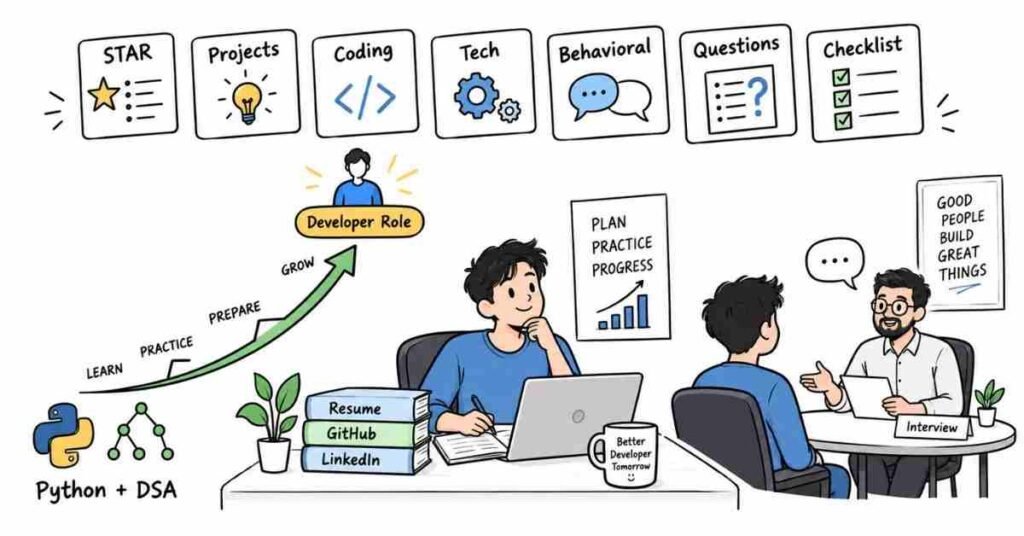
Behavioral & Career Preparation — Questions 231–245
The reference guide finishes with behavioral questions, STAR answers, resume and LinkedIn preparation, portfolio strategy, follow-up messages, and a final interview checklist.
Q231. What is the STAR method?
STAR helps you answer behavioral questions clearly.
- S – Situation: What happened?
- T – Task: What was your responsibility?
- A – Action: What did you do?
- R – Result: What was the outcome?
Keep the answer short and focus mainly on your own contribution.
Q232. Tell me about yourself.
Keep it simple:
Background → Python/DSA skills → Projects → Role you are targeting
Avoid giving your full life story.
Q233. How should you explain a coding project?
Cover four points:
- What problem you solved
- Technologies used
- Your contribution
- What you learned
If possible, mention one technical challenge you solved.
Q234. How do you answer “What is your strength?”
Choose a genuine strength such as:
- Problem solving
- Debugging
- Consistency
- Fast learning
- Clean coding
Support it with a small example.
Q235. How do you answer “What is your weakness?”
Choose a real but manageable weakness.
Then explain what you are doing to improve it.
The answer should show self-awareness, not negativity.
Q236. How do you explain a coding mistake?
Do not hide it.
Explain:
What went wrong → How you fixed it → What you changed afterward
Interviewers usually value accountability.
Q237. What should you say if you do not know an answer?
Do not guess blindly.
You can say:
“I’m not completely sure, but this is how I would approach it.”
Then explain your reasoning.
Q238. How do you answer “Why should we hire you?”
Connect your skills with the role.
Mention your Python knowledge, DSA practice, projects, learning ability, and willingness to contribute.
Keep it specific.
Q239. Where do you see yourself in three years?
Give a realistic answer.
For example, you may want to grow into a strong Python/backend developer with better problem-solving and system design skills.
Q240. What questions can you ask the interviewer?
Good questions include:
- What does the first 90 days look like?
- What technologies does the team use?
- How is performance measured?
- What kind of projects will I work on?
The reference guide also recommends ending interviews with thoughtful questions rather than saying you have none.
Resume Preparation
Q241. What should a Python with DSA resume contain?
Keep these sections clear:
- Professional Summary
- Python Skills
- DSA Skills
- Projects
- Education
- Certifications
- Coding Profiles
Freshers should give extra importance to projects.
Q242. What skills should be mentioned?
Useful skills may include:
Python, OOP, DSA, Arrays, Strings, Linked Lists, Trees, Graphs, SQL, Git, APIs, Problem Solving
Only add skills you can explain in an interview.
Q243. How should projects be written?
Avoid writing only:
“Created a Python project.”
Write what you actually built and solved.
Example:
“Built a Python application that stored and processed user data using OOP and SQL.”
The source guide similarly recommends action-based, result-focused project and experience bullets.
LinkedIn & Coding Profile
Q244. What should your LinkedIn headline look like?
Keep it role-focused.
Example:
Python Developer | DSA | SQL | Problem Solving | Backend Development
Also add projects and certifications to your Featured section where possible.
Q245. Which coding profiles can help?
Maintain profiles such as:
- LeetCode
- HackerRank
- CodeChef
- GitHub
Do not chase problem counts alone. Your ability to explain the solution matters more.
Final Interview Checklist
Before the interview, do a quick check in four areas: technical preparation, behavioral answers, profile readiness, and interview setup.
Technical Readiness
Make sure you have:
- Revised Python fundamentals
- Practiced important DSA patterns
- Solved a few mixed coding problems
- Reviewed time and space complexity
- Practiced explaining your approach before writing code
- Revised common patterns like hashing, two pointers, sliding window, BFS, DFS, heaps, and DP
You do not need to solve hundreds of problems at the last minute. Focus more on concepts you have already practiced.
Behavioral Readiness
Prepare 3–5 STAR stories from your projects, college work, internships, or previous experience.
Be ready for questions like:
- Tell me about yourself.
- What is your biggest strength?
- Tell me about a challenge you faced.
- Describe a mistake and how you handled it.
- Why should we hire you?
Keep your answers simple and genuine rather than memorizing long scripts.
Resume & Profile Readiness
Before the interview:
- Read your resume once completely
- Review every project mentioned in it
- Be ready to explain your Python and DSA skills
- Update your LinkedIn profile
- Keep GitHub or coding profiles ready if relevant
- Prepare 2–3 questions to ask the interviewer
Never mention a skill on your resume that you cannot explain confidently.
On the Day of the Interview
For an online interview:
- Check your laptop
- Test internet connection
- Check camera and microphone
- Keep your resume ready
- Join a few minutes early
- Keep a notebook and pen nearby
For an offline interview, confirm the location, reporting time, required documents, and travel plan in advance.
Final Reminder
The day before the interview is for revision, not panic learning.
Review your strongest topics, practice a few familiar coding problems, go through your projects, and get proper rest. During the interview, focus on explaining your thinking clearly even if you do not reach the perfect solution immediately.