
How to Become a Python Developer with DSA in 2026: Complete Career Guide
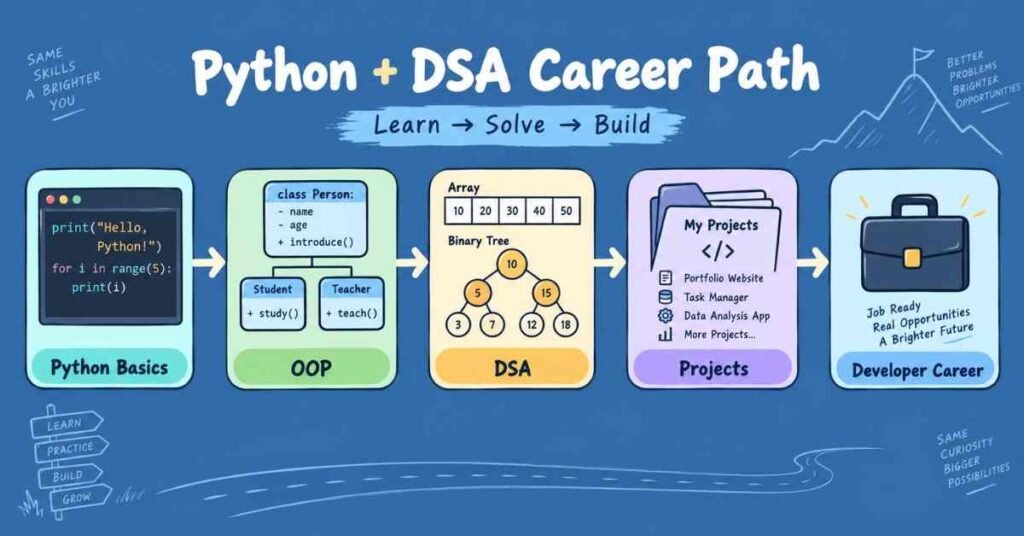
Table of Contents
Python is one of the programming languages many beginners choose when starting a software development journey. Its syntax is relatively easy to understand, but becoming a Python Developer requires more than learning commands and writing basic programs.
A developer needs to understand how to approach a problem, work with information, build application logic, and create solutions that can handle real-world requirements. Data Structures and Algorithms (DSA) can help develop this problem-solving ability.
If you are beginning your career in 2026, you can learn Python and DSA step by step instead of trying to cover every topic at once. Start with programming fundamentals, strengthen your logic, practise DSA, build projects, and gradually prepare for technical interviews.
This guide covers the major steps involved in becoming a Python Developer with DSA skills.
What Does a Python Developer with DSA Skills Do?
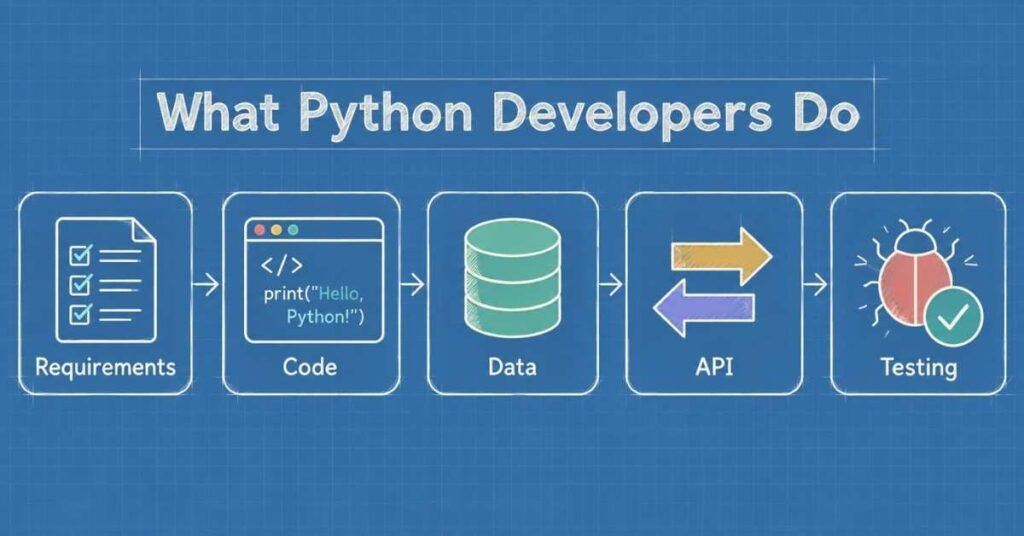
A Python Developer works with Python to develop software applications, scripts, services, and other technology solutions.
The actual responsibilities depend on the organisation and job role. Some developers work mainly on backend applications, while others may work on automation, APIs, data processing, or business applications.
A Python Developer may be responsible for:
Main Responsibilities
- Developing Python-based applications
- Creating and improving application functionality
- Translating requirements into programming logic
- Handling and processing data
- Working with databases
- Connecting applications through APIs
- Identifying and fixing programming errors
- Testing application features
- Maintaining existing code
- Collaborating with other technical teams
Consider an application that stores a large number of customer records. The developer may need to retrieve a particular record, identify repeated information, update data, or process requests efficiently.
Understanding DSA can help the developer select an appropriate approach for such problems.
In simple terms, a Python Developer uses programming to turn requirements into practical software solutions.
Why Python with DSA Is a Good Career Choice
Learning Python can help beginners enter programming because the language has comparatively readable syntax. However, knowing the syntax alone does not automatically make someone a strong programmer.
When solving a new problem, you need to decide how the information should be organised and how the solution should work.
This is where DSA becomes useful.
It introduces concepts related to:
- Organising different types of data
- Finding information efficiently
- Reducing unnecessary operations
- Comparing different approaches
- Understanding how input size affects performance
Python combined with DSA can provide a foundation for several technical career paths, including software development, backend development, automation, and data-related development.
Why Students Choose This Career
Some reasons learners consider Python include:
- Beginner-friendly programming syntax
- Wide application across technology fields
- Large collection of libraries and frameworks
- Availability of learning resources
- Ability to create small projects quickly
- Opportunity to practise programming through coding exercises
- Useful foundation for learning other technologies
Students from different educational backgrounds can start learning Python. The important part is to build the fundamentals gradually and practise regularly.
Ready to Start Your Python Career? Explore Python with DSA & IT Courses →
Python Career Roles Compared
Python is used in multiple types of technical roles. The responsibilities and additional skills can vary from one position to another.
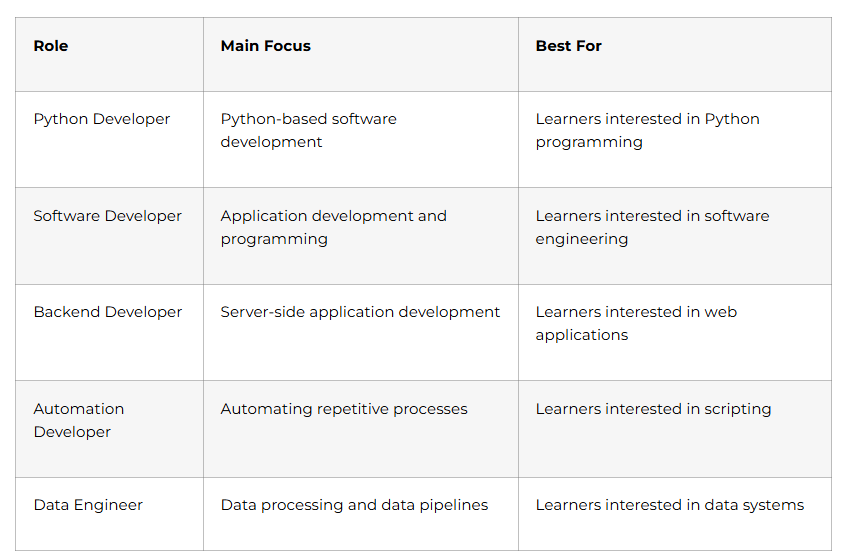
For entry-level candidates, the exact skills required depend on the job description. Projects, programming fundamentals, DSA knowledge, and supporting technologies can all contribute to job preparation.
How to Become a Python Developer with DSA
Step 1: Build Strong Python Basics
Start by becoming comfortable with the fundamentals of Python.
The initial learning stage should cover:
- Variables
- Data types
- Operators
- Conditional statements
- Loops
- Functions
- Strings
- Lists
- Tuples
- Sets
- Dictionaries
Instead of trying to remember every concept theoretically, use each one while writing programs.
For example, you could build a simple marks calculator that accepts student marks and produces the total, average, highest mark, and result status.
Small exercises help you understand how individual Python concepts work together.
The objective at this stage is to reach a point where you can write simple programs independently.
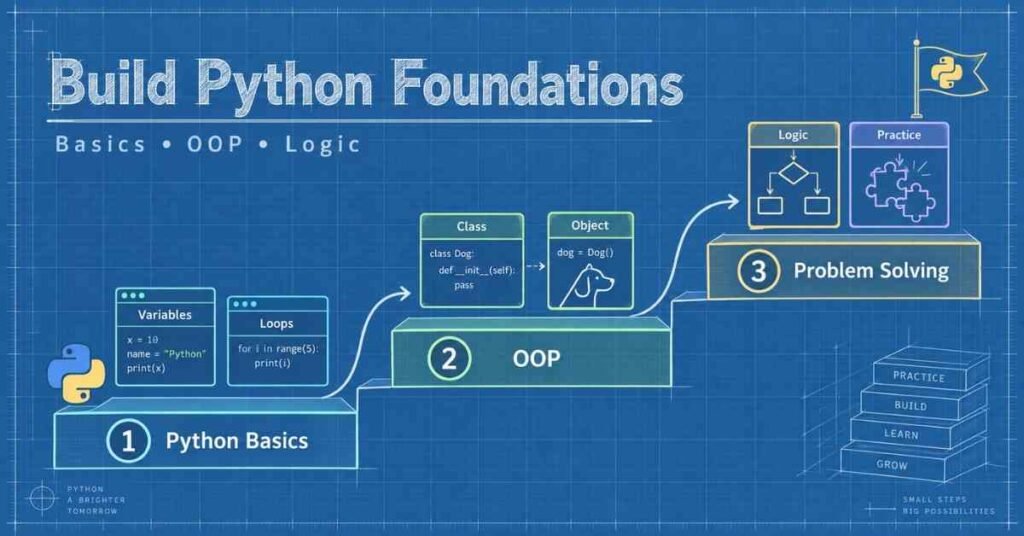
Step 2: Learn Object-Oriented Programming
After gaining confidence with Python basics, move towards Object-Oriented Programming.
Important OOP concepts include:
- Classes
- Objects
- Constructors
- Methods
- Inheritance
- Encapsulation
- Polymorphism
- Abstraction
Try to connect these concepts with applications rather than studying them only as definitions.
For example, a Student class could contain information such as a student’s name, course, roll number, and marks. Methods could then be created to display or update that information.
Practical examples make OOP easier to understand and apply when building larger applications.
Step 3: Improve Your Problem-Solving Skills
Before moving into advanced DSA, strengthen your basic programming logic.
Start with beginner-level problems such as:
- Reversing a string
- Checking a palindrome
- Finding the largest number
- Counting repeated characters
- Calculating factorial
- Producing Fibonacci numbers
- Finding duplicate values
When you receive a coding problem, do not immediately start typing.
First understand what the input contains, what output is expected, and what steps are required to reach that output.
A useful approach is:
Understand → Break Down → Plan → Code → Test
With regular practice, this process can make unfamiliar coding questions easier to approach.
Step 4: Learn Core Data Structures
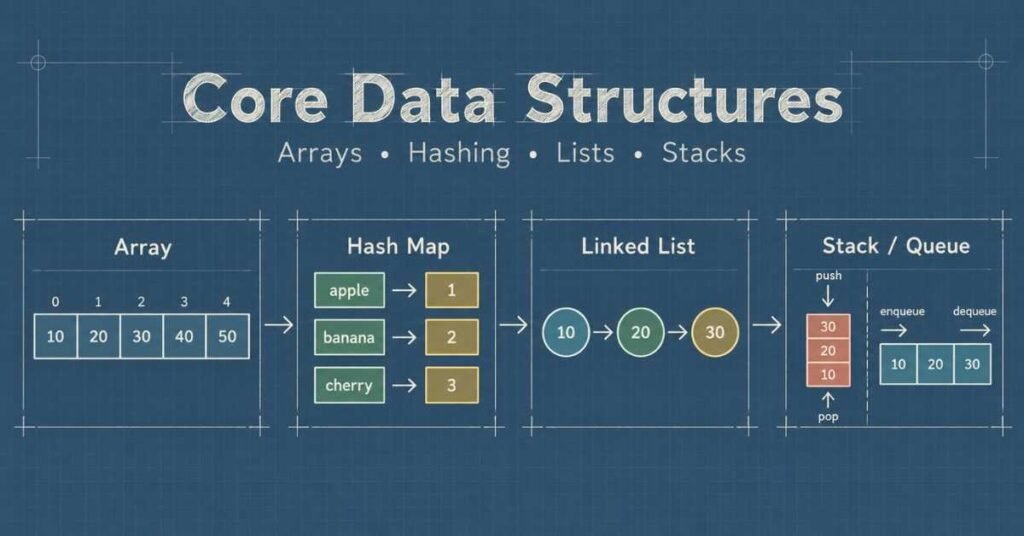
Once your Python fundamentals are clear, begin learning the data structures commonly used in programming problems.
Arrays and Strings
Arrays and strings are good starting points for DSA practice.
Work on problems involving:
- Searching for elements
- Reversing values
- Counting occurrences
- Detecting duplicates
- Finding minimum and maximum values
- Checking palindromes
- Solving anagram problems
Try to understand the reasoning behind each solution rather than remembering the final code.
Hashing
Python dictionaries and sets are useful when a problem requires fast lookup, counting, or uniqueness checks.
You can practise problems involving:
- Duplicate values
- Character counts
- Frequency tables
- Pair-sum problems
- Unique elements
Learning when to use a dictionary or set can make many coding problems easier to solve.
Linked Lists
Linked Lists introduce the concept of connecting individual nodes to form a sequence.
Learn how to perform:
- Traversal
- Insertion
- Deletion
- Searching
- Reversal
Understanding how nodes and references work is more important than simply memorising implementation steps.
Stacks and Queues
A stack generally works according to the Last In, First Out principle.
A queue generally follows the First In, First Out principle.
Learn the basic operations and then solve practical coding questions based on them. These structures are frequently used when explaining different programming and algorithmic problems.
Build Python and DSA Skills Step by Step – Python Developer with DSA Roadmap Guide
Step 5: Learn Important Algorithms
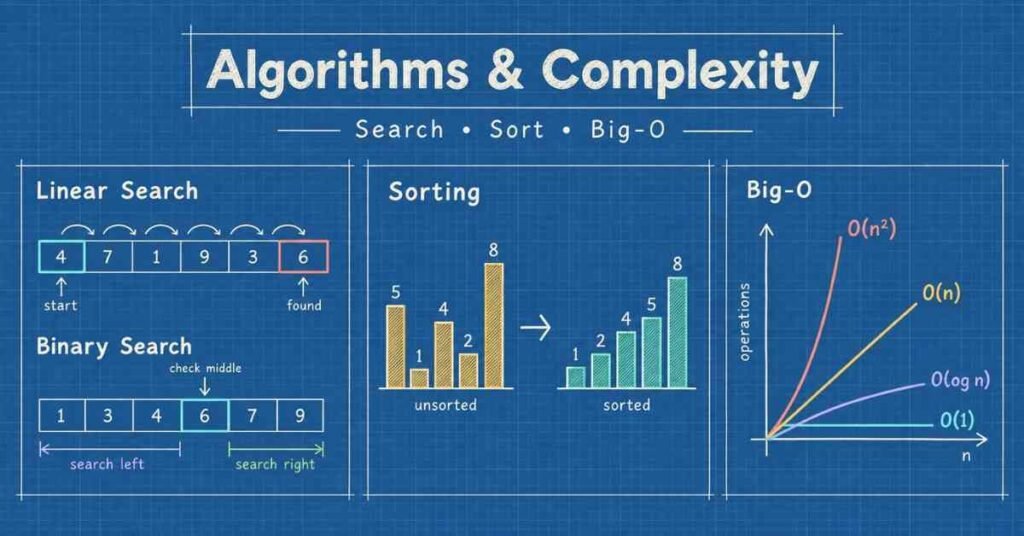
After gaining confidence with basic data structures, start studying algorithms.
Begin with fundamental techniques such as:
- Linear Search
- Binary Search
- Bubble Sort
- Selection Sort
- Insertion Sort
- Merge Sort
- Quick Sort
For each algorithm, focus on three things:
How does it work? When should it be used? How efficiently does it process the input?
Once searching and sorting concepts are comfortable, continue with:
- Recursion
- Binary Trees
- Binary Search Trees
- Tree Traversals
- Graph Basics
- BFS
- DFS
Dynamic Programming can be introduced later, after you become comfortable with recursion and structured problem-solving.
Step 6: Understand Time and Space Complexity
Two programs can produce the same output while requiring very different amounts of time or memory.
Complexity analysis helps you understand this difference.
Start by becoming familiar with:
- O(1)
- O(n)
- O(log n)
- O(n²)
You do not need advanced mathematics to understand the basic idea.
Think about a simple question:
If the amount of input becomes much larger, how will my program behave?
For example, a solution that works quickly with 10 records may become slow if it performs unnecessary operations on one million records.
Learning complexity helps you recognise such situations and look for more efficient approaches.
Essential Skills for a Python Developer
Python programming is the foundation, but a developer may need several supporting skills as well.
Python Skills
Develop a strong understanding of:
- Python fundamentals
- Functions
- OOP
- Collections
- Exception handling
- File handling
DSA Skills
Important areas include:
- Arrays
- Strings
- Hashing
- Linked Lists
- Stacks
- Queues
- Searching
- Sorting
- Recursion
- Trees
- Graph basics
Supporting Skills
You can gradually add:
- SQL
- Git
- GitHub
- API basics
- Debugging
- Database concepts
There is no need to study every technology simultaneously. Build your programming foundation first and introduce supporting tools as you progress towards real application development.
Real Projects to Build
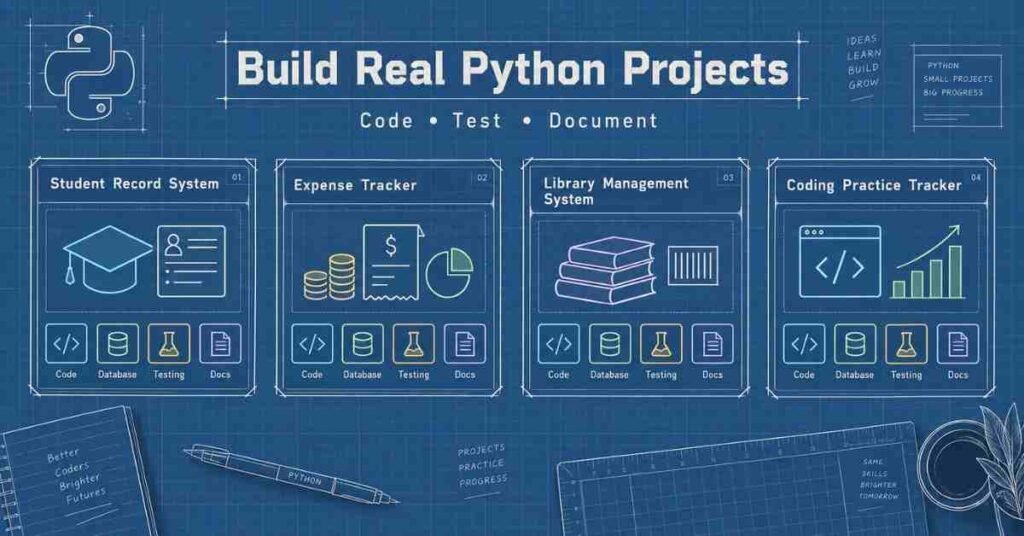
Projects give you an opportunity to apply concepts outside individual coding exercises.
Student Record System
Create a simple application that allows users to:
- Add student information
- Find student records
- Modify marks
- Remove records
- Display student results
You can begin with Python data structures and later extend the application with file storage or a database.
Expense Tracker
An expense tracker can be designed to let users:
- Record expenses
- Select expense categories
- View previous transactions
- Calculate spending totals
As you learn additional technologies, you can add database storage and a user interface.
Library Management System
Build a basic library application with options to:
- Add books
- Search the collection
- Issue books
- Accept returned books
- Display available books
This type of project can help you practise application logic and data management.
Coding Practice Tracker
Create a small application for recording your DSA preparation.
You can store:
- Problem name
- Topic
- Difficulty
- Attempt count
- Completion status
Later, you can add filters, reports, and database functionality.
Do not choose a project simply because it looks large.
A smaller application that you created yourself and can explain clearly can demonstrate your skills effectively.
Salary Expectations in India
Python Developer compensation can vary depending on several factors, including experience, location, organisation, job responsibilities, technical skills, and interview performance.
Salary information should therefore be treated as a general reference rather than a fixed expectation.
Instead of focusing only on a package figure, beginners should concentrate on developing skills that employers commonly request, building practical projects, and improving interview performance.
With experience, the role, responsibilities, technology stack, and organisation can all influence compensation.
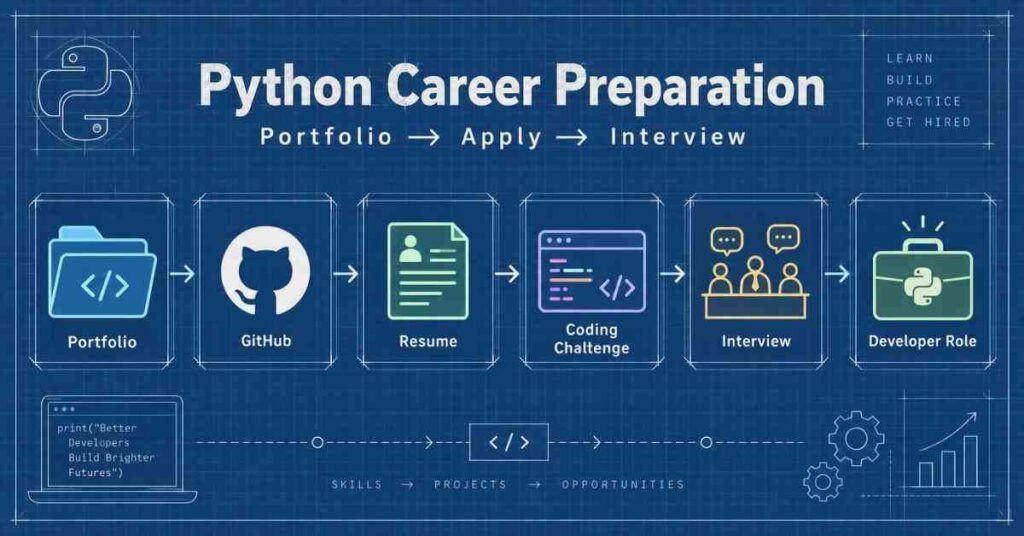
Portfolio That Gets Interviews
Your portfolio should provide evidence of your practical skills.
Consider including:
- Two or three Python projects
- GitHub repositories
- Project documentation
- DSA practice
- SQL knowledge
- README files
For every project, explain:
Problem → Approach → Technologies → Challenge → Solution → Result
This gives recruiters or interviewers a quick understanding of what you actually worked on.
You do not need a huge number of repositories. Focus on projects that you understand completely and can discuss confidently.
Now Prepare for Python with DSA Interviews, Python Interview Preparation Guide →
Job Search Strategy
Once you have a working knowledge of Python, DSA, SQL, Git, and project development, start exploring suitable opportunities.
Resume Keywords
Depending on your actual skills, your resume may include:
- Python
- Data Structures
- Algorithms
- OOP
- SQL
- Git
- GitHub
- REST API
- Problem-Solving
- Debugging
Avoid adding technologies only because they appear in a job description.
Every skill listed on your resume should be something you can explain during an interview.
Roles to Search
Potential job titles include:
- Python Developer
- Junior Python Developer
- Software Developer
- Backend Developer
- Python Intern
- Graduate Engineer Trainee
Always read the individual job description because two positions with the same title can have different technical requirements.
Interview Preparation
Python interviews can cover programming fundamentals, DSA, and project knowledge.
Python Fundamentals
Revise:
- Data types
- Lists and tuples
- Sets and dictionaries
- Functions
- OOP
- Exceptions
DSA
Practise questions involving:
- Arrays
- Strings
- Hashing
- Linked Lists
- Stacks
- Queues
- Searching
- Sorting
- Recursion
- Trees
- Graph basics
Projects
Be prepared to discuss:
- Why you selected the project
- What problem it addresses
- How the application works
- Which technologies you used
- What difficulties you encountered
- How you resolved those issues
- What improvements you would make
For coding questions, use a structured process:
Understand → Plan → Code → Test → Explain
This helps you communicate your reasoning instead of jumping directly into implementation.
30-Day Starter Plan
The first 30 days should be used to establish your programming foundation.
Week 1
Focus on:
- Python basics
- Conditions
- Loops
- Functions
- Small programming exercises
Week 2
Move into:
- Lists
- Sets
- Dictionaries
- OOP
- Basic logical problems
- Introduction to complexity
Week 3
Begin DSA with:
- Arrays
- Strings
- Hashing
- Linked Lists
- Stacks
- Queues
Week 4
Continue with:
- Searching
- Sorting
- Recursion
- Basic trees
- One small Python project
After completing the first month, continue working on DSA, projects, trees, graphs, and interview questions.
The purpose of these 30 days is to create a strong learning routine. Mastery will require continued practice beyond the first month.
Why Learn Python with DSA at Frontlines Edutech
Programming becomes easier to understand when learners can connect theoretical concepts with practical coding exercises.
A practical Python with DSA learning path can cover areas such as:
- Python fundamentals
- OOP
- Coding exercises
- Data Structures
- Algorithms
- Complexity basics
- Practical projects
- Interview preparation
- Resume guidance
- Career support
For Telugu-speaking learners, explaining difficult programming concepts in a familiar language can make the initial learning process easier.
At the same time, learners should become comfortable with English technical terminology because programming documentation, coding platforms, interviews, and software-development environments commonly use English terms.
Frequently Asked Questions (FAQs)
Q1: Is Python good for beginners?
Yes. Python’s relatively readable syntax makes it a practical option for people who are starting to learn programming.
Q2: Do I need DSA to become a Python Developer?
The amount of DSA required depends on the position. Some Python jobs may focus more on application development, while software-development roles and coding interviews may include DSA-based questions.
Q3: Should I learn Python before DSA?
You should first become comfortable with basic Python concepts such as loops, functions, lists, dictionaries, sets, and simple programming logic. After that, beginning DSA becomes easier.
Q4: Which DSA topics should I learn first?
Start with arrays and strings, followed by hashing, linked lists, stacks, queues, searching, sorting, recursion, trees, and graphs.
Q5: Can a non-CSE student become a Python Developer?
Yes. Students from different academic backgrounds can learn Python. Building programming fundamentals, solving problems regularly, and creating practical projects are important parts of the process.
Q6: Is advanced mathematics required?
Advanced mathematics is not necessary to begin learning Python and fundamental DSA. Basic mathematical understanding and logical reasoning are enough for getting started.
Q7: What projects should beginners build?
Beginners can start with applications such as:
- Student Record System
- Expense Tracker
- Library Management System
- Coding Practice Tracker
- Task Management Application
Choose a project that matches your current skill level and make sure you understand the code you write.
Q8: How many coding problems should I solve?
There is no universal number that determines whether you are ready. Focus on understanding the problem, identifying the appropriate approach, and solving similar questions independently.
Q9: When should I start applying for Python jobs?
You can start exploring entry-level positions after developing your Python fundamentals, core DSA knowledge, basic SQL and Git skills, and a few projects that you can explain confidently.
Q10: How do I prepare for Python interviews?
Revise Python fundamentals, practise DSA problems, understand basic complexity, prepare your project explanations, and practise communicating your approach while solving coding questions.