
How to Become a Python Full Stack Developer in 2026: Complete Career Guide
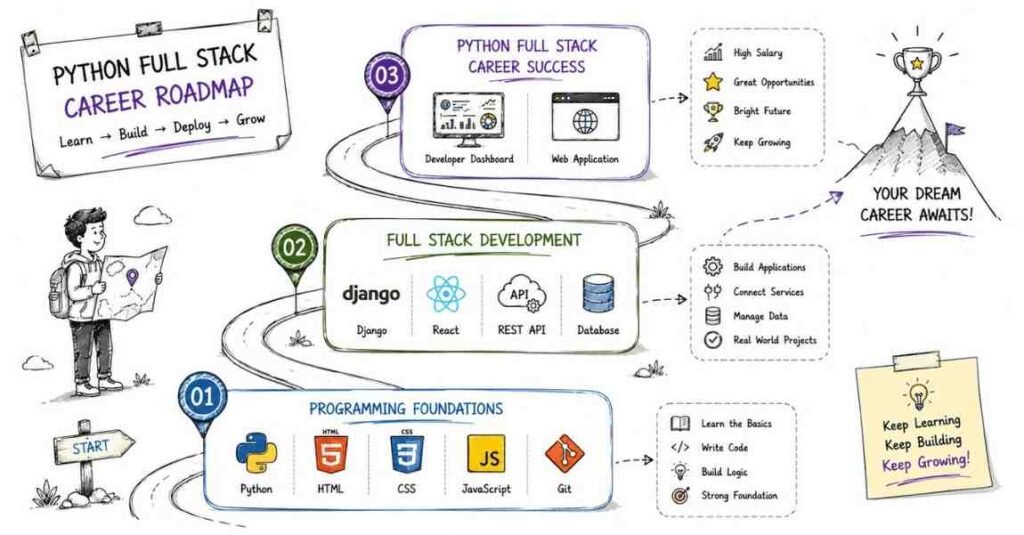
Table of Contents
Python Full Stack Developers are among the most versatile and in-demand professionals in tech because they can build both the front end and the back end of an application. If you can work with Python, Django or FastAPI, React, APIs, databases, and cloud deployment, you can build a strong career in India with solid salary growth and remote opportunities. This guide gives you a complete roadmap to become job-ready in 2026, whether you are a fresher, a developer switching stacks, or a working professional who wants to move into full-stack development.
Unlock Python Full Stack All Learning Resources →
What a Python Full Stack Developer Does
A Python full stack developer builds complete web applications from user interface to server logic and database integration. The role combines front-end development, back-end development, API integration, testing, and deployment.
This is a practical career because companies want developers who can work across the full product flow. That means one person can create the UI, write business logic, connect the database, and deploy the application.
Main responsibilities
- Build responsive web interfaces.
- Develop back-end logic with Python.
- Create and consume REST APIs.
- Design and manage databases.
- Handle authentication and authorization.
- Test application features.
- Deploy applications to cloud or server environments.
- Collaborate with designers, testers, and product teams.
Why Python Full Stack Is a Smart Career
Python full stack development is a smart career because Python is simple to learn, widely used, and backed by a massive ecosystem. On the front end, React gives you the flexibility to build modern user interfaces. Together, these skills make you useful in startups, product companies, service firms, and freelance projects.
The field also offers strong upward mobility. If you start with basic full-stack skills and keep improving, you can move into senior developer, tech lead, solution architect, or product engineering roles.
Why students choose it
- Python is beginner-friendly.
- Full-stack skills are highly practical.
- You can build complete projects yourself.
- Good demand across startups and established companies.
- Easy to move into backend, frontend, or product development later.
Python Full Stack Roles Compared
Python full stack development includes several related career paths. Understanding them helps you choose the right learning focus.
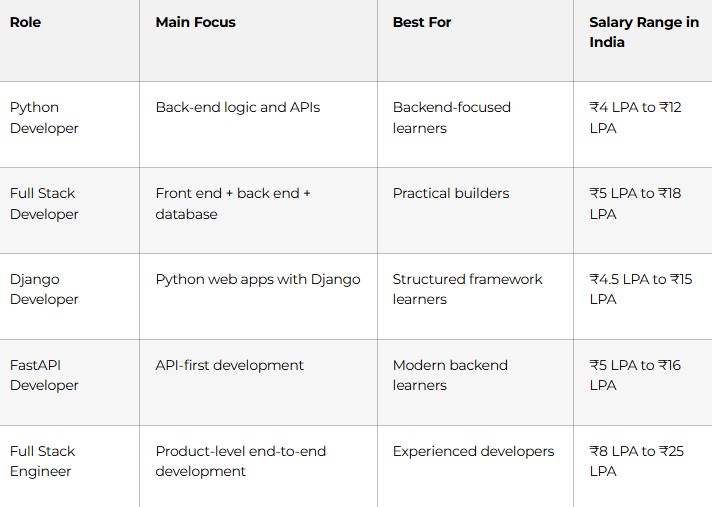
If you are starting from scratch, the Python full stack path is one of the most balanced ways to enter software development.
Pick Your Python Full Stack Path →
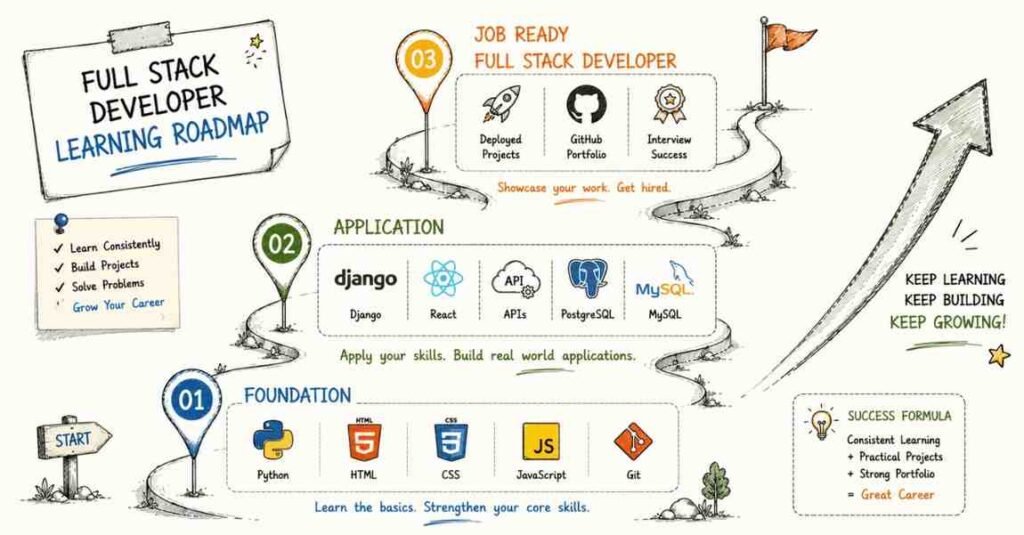
Complete Learning Roadmap
Phase 1: Programming Foundations
Before jumping into frameworks, learn the basics of programming and web development. This gives you the confidence to build and debug applications.
Focus on:
- Python syntax and core concepts.
- Data types, loops, functions, and classes.
- Object-oriented programming.
- HTML, CSS, and JavaScript basics.
- Git and GitHub fundamentals.
- Command-line basics.
Phase 2: Python for Back-End Development
Once the basics are clear, move into Python back-end development. This is where you start building server-side features and business logic.
Learn:
- Python modules and packages.
- File handling and exception handling.
- OOP in practical use.
- Virtual environments.
- Package management with pip.
- Database connectivity.
- REST API fundamentals.
Phase 3: Django or FastAPI
Most Python full stack learners choose Django because it is powerful, structured, and widely used in web applications. FastAPI is also a great option if you want to focus on APIs and modern back-end development.
Learn:
- URL routing.
- Views and templates.
- Models and migrations.
- Forms and validation.
- Authentication and sessions.
- Django REST Framework.
- FastAPI request handling and schemas.
Phase 4: Front-End Development
A full stack developer must be able to build usable front-end interfaces. React is the most valuable front-end skill for this path.
Learn:
- HTML structure and semantic tags.
- CSS layout and responsive design.
- JavaScript ES6+.
- React components and props.
- State management.
- Hooks.
- Form handling.
- API integration from React.
Phase 5: Databases and APIs
Web applications need data storage and communication between front end and back end. This is where database and API knowledge becomes essential.
Learn:
- SQL basics.
- PostgreSQL or MySQL.
- Table design and relationships.
- CRUD operations.
- REST API design.
- JSON handling.
- Authentication tokens.
- Error handling in APIs.
Phase 6: Deployment and Dev Tools
A real developer should know how to deploy and maintain applications. This is often where freshers lack confidence, so it becomes a strong advantage in interviews.
Learn:
- Git workflows.
- Environment variables.
- Docker basics.
- Deployment on cloud or hosting platforms.
- Static file handling.
- Logging and monitoring.
- Basic CI/CD awareness.
Access Python Full Stack Roadmaps →
Python, Django, React, and APIs
These are the most important pillars of the Python full stack path.
Python skills to master
- Data structures.
- Functions and modules.
- Object-oriented programming.
- Error handling.
- File operations.
- Database interaction.
Django skills to master
- Project structure.
- Models, views, and templates.
- Admin panel.
- Forms and authentication.
- REST APIs with Django REST Framework.
- Pagination, filtering, and permissions.
React skills to master
- Components.
- Props and state.
- Hooks.
- Event handling.
- Conditional rendering.
- API calls.
- Form validation.
API skills to master
- REST principles.
- GET, POST, PUT, DELETE.
- Request and response formats.
- Status codes.
- Authentication.
- Token-based access.
- Error handling.
Salary Expectations in India
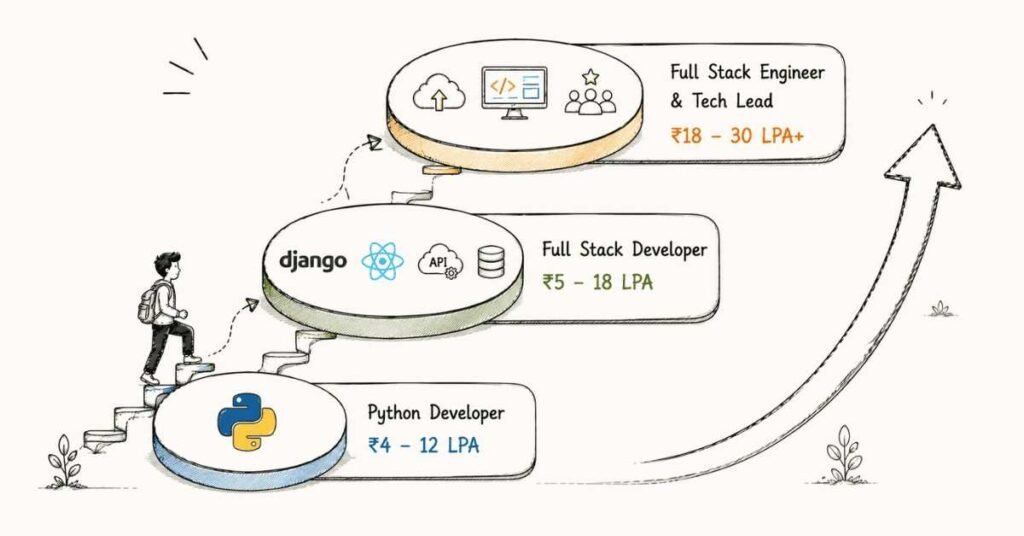
Salary depends on your project quality, communication skill, tool knowledge, and interview performance. Python full stack developers are usually paid well because they can contribute across the product stack.
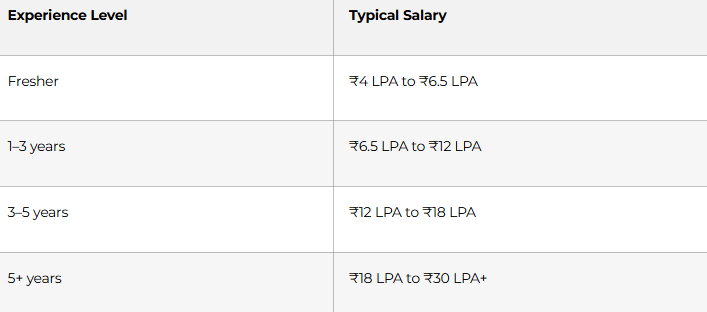
Developers with Django, React, API, and deployment experience usually grow faster than those who know only one layer of the stack.
Your Python Full Stack Interview Skills →
Portfolio That Gets Interviews
Your portfolio is one of the most important parts of your job search. Recruiters want to see real applications, not just certificates.
What to include
- A login-based web app.
- A CRUD dashboard.
- A REST API project.
- A full-stack e-commerce demo.
- A blog or CMS project.
- Deployment link and GitHub repository.
- Clear README files with screenshots.
Portfolio checklist
- Show both front end and back end.
- Use clean code and folder structure.
- Mention the technologies used.
- Include problem statements and outcomes.
- Deploy at least one project publicly.
- Add version control history on GitHub.
Job Search Strategy
A Python full stack resume should show both coding and product-building ability. Hiring teams want developers who can understand the user experience and the server logic.
Resume keywords
- Python
- Django
- FastAPI
- React
- REST API
- PostgreSQL
- MySQL
- HTML
- CSS
- JavaScript
- Git
- Docker
- Deployment
Where to apply
- LinkedIn Jobs
- Naukri
- Indeed
- startup career pages
- software product companies
- internship portals
Interview preparation
Be ready to answer questions like:
- What is the difference between Django and FastAPI?
- How do you connect React with a Python backend?
- How do you design a REST API?
- What is the difference between SQL and NoSQL?
- How do you handle authentication?
- How do you deploy a full-stack app?
30-Day Starter Plan
If you want to begin now, follow this simple plan.
Week 1
- Learn Python basics.
- Practice data types and functions.
- Set up GitHub.
- Create your first small script.
Week 2
- Learn HTML, CSS, and JavaScript basics.
- Build a simple responsive page.
- Practice Git commits.
- Explore Python modules.
Week 3
- Start Django or FastAPI.
- Create one basic backend project.
- Learn database connectivity.
- Build a simple CRUD flow.
Week 4
Learn React basics.
Connect the front end to the backend.
Deploy one small project.
Update your resume and LinkedIn.
Why Learn Python Full Stack at Frontlines Edutech
Frontlines Edutech is a practical choice for students and working professionals who want regional support, structured learning, and career-focused training. The best programs combine Python, Django, React, databases, deployment, and project work in a way that makes job readiness realistic.
What to look for in training
- Strong Python foundation.
- Django or FastAPI practice.
- React and API integration.
- Database and deployment training.
- Real project assignments.
- Resume and interview support.
- Regional-language explanation if needed.
Frequently Asked Questions
Q1.How long does it take to become a Python full stack developer?
A.It usually takes 4 to 8 months of consistent learning to become job-ready, depending on your background and how much project practice you do.
Q2.Is Python full stack development a good career in India?
A.Yes, it is a strong career because companies need developers who can build complete applications. Python is easy to learn, and the full-stack path gives you broad job opportunities.
Q3.Which skill should I learn first?
A.Start with Python basics, HTML, CSS, JavaScript, and Git. After that, move into Django or FastAPI, React, and databases.
Q4.Do I need advanced coding to become a full stack developer?
A.You need solid programming fundamentals, but you do not need to be an advanced computer science expert to begin. Consistent practice and project building matter most.
Q5.What is the best specialization for beginners?
A.Python full stack development is a great beginner-friendly path because it combines back-end and front-end work. If you prefer only APIs, FastAPI can be a good secondary focus.
Q6.Can I get a job without experience?
A.Yes, if you have a few real projects, a clean GitHub profile, and a basic understanding of deployment and APIs. Internships and freelance projects help a lot.
Q7.Which tools should I learn first?
A.Start with Python, Django or FastAPI, React, PostgreSQL or MySQL, Git, and Postman. These cover the core workflow of a full stack developer.
Q8.Is Python full stack remote-friendly?
A.Yes, many companies hire full stack developers for remote and hybrid roles because the work can be done using standard dev tools and online collaboration.
Q9.What kind of projects should I show in interviews?
A.Show login systems, dashboards, CRUD apps, API projects, and deployed full-stack applications. Employers want to see that you can build something complete from start to finish.