
How to Become an Azure Data Engineer in 2026: Complete Career Guide
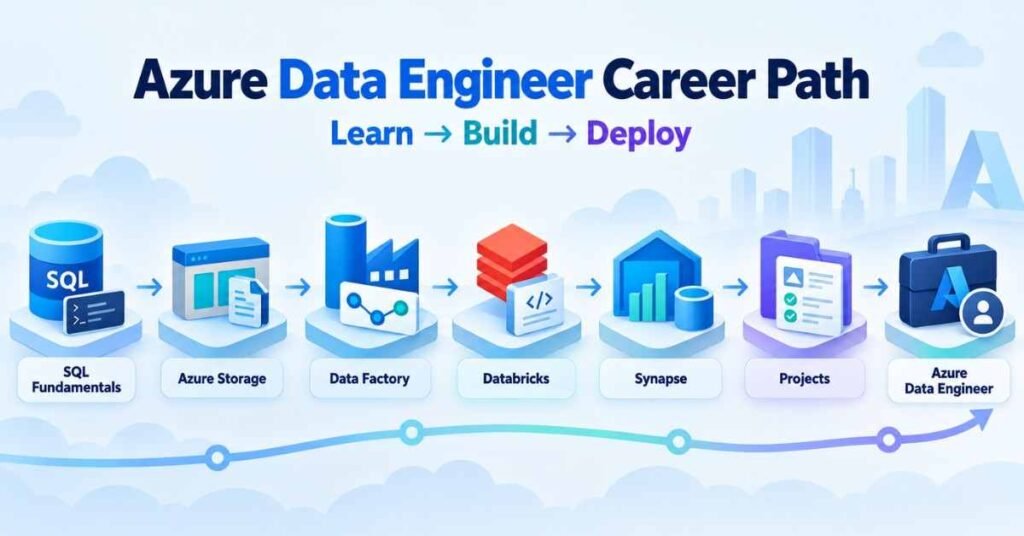
Table of Contents
An Azure Data Engineer helps organisations move, prepare, store, and organise data so that it can be used for reporting, analytics, and business decisions. The role is not only about learning Azure services. A good Data Engineer also understands how data flows from one system to another, how to clean it, how to store it efficiently, and how to build reliable pipelines. If you are starting from zero, the right path is to first understand SQL and data concepts, then learn Azure storage and data-processing services, practise building pipelines, and create projects that show how you handle real data. This guide explains that journey in a clear, practical way.
What Does an Azure Data Engineer Do?
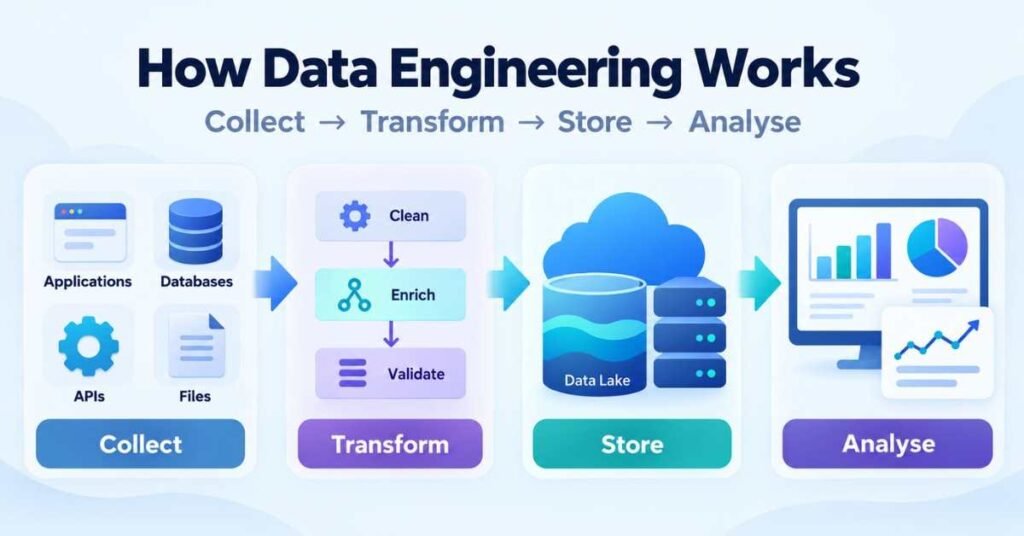
An Azure Data Engineer works with data that may come from many different places.
A company can receive information from websites, mobile apps, CRM tools, databases, finance systems, or third-party platforms.
That data is not always ready for analysis.
The Data Engineer helps collect it, clean it, transform it, and move it into systems where analysts and business teams can use it.
For example, imagine an e-commerce company.
Customer orders may be stored in one database, website activity in another system, and marketing data in a third platform.
A Data Engineer can build a pipeline that brings this information together and stores it in a structured environment for reporting.
Main Responsibilities
- Collect data from different sources
- Build data pipelines
- Move data between systems
- Transform raw data
- Work with structured and semi-structured data
- Store data in cloud platforms
- Monitor pipeline failures
- Improve data quality
- Work with analysts and developers
- Maintain reliable data workflows
In simple terms, an Azure Data Engineer makes sure that the right data reaches the right place in a usable form.
Why Azure Data Engineering Is a Strong Career Path
Companies generate large amounts of data, but raw information is useful only when it can be organised and accessed correctly.
This is where Data Engineers become important.
Azure gives organisations cloud-based services for storage, integration, processing, analytics, and governance.
For learners, this creates a career path that combines technical skills with real business use cases.
Why Students Choose Azure Data Engineering
- It combines cloud and data skills.
- SQL remains highly useful.
- The role is connected with analytics and reporting.
- Azure provides multiple services for real data workflows.
- Data Engineering supports many industries.
- Learners can build practical projects using cloud pipelines.
- The role can lead to broader cloud and data careers.
The best approach is not to memorise every Azure service.
Understand the data journey first.
Build Practical Cloud Data Skills – Explore the Azure Data Engineer Course →
Azure Data Engineering Roles Compared
How to Become an Azure Data Engineer
Azure skills can support several related roles.
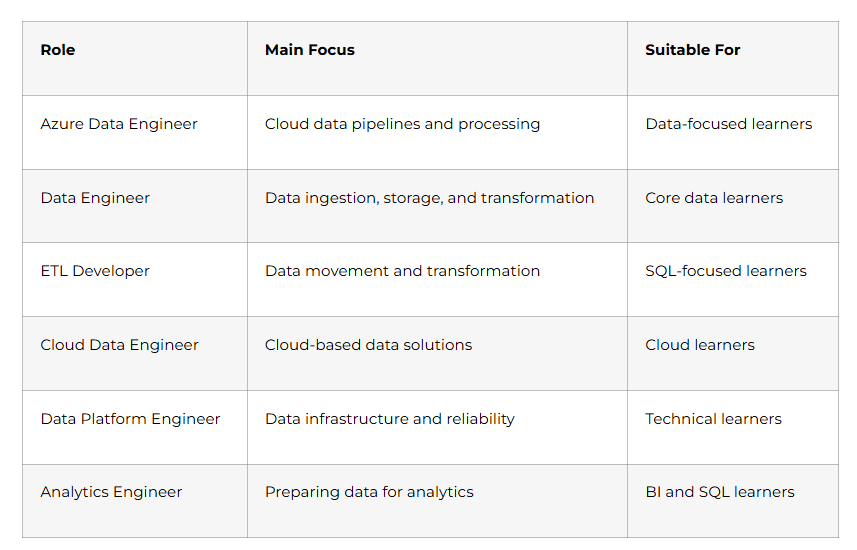
For beginners, Azure Data Engineer and ETL-related roles can be good targets when supported by SQL, cloud basics, and practical projects.
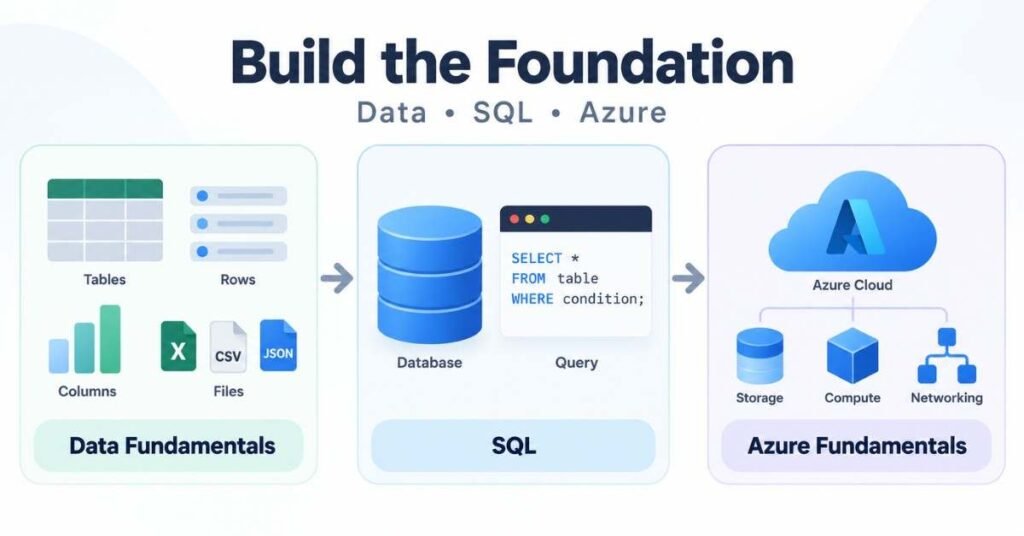
Step 1: Understand Data Fundamentals
Before learning Azure tools, understand how data behaves.
Begin with:
- Structured data
- Semi-structured data
- Unstructured data
- Databases
- Tables
- Rows and columns
- Data types
- Primary keys
- Relationships
- Data quality
You should also understand where business data comes from.
Examples include:
- Sales systems
- Customer applications
- HR systems
- Web applications
- APIs
- CSV files
- Excel files
- Log files
This gives you a clear picture of what a Data Engineer actually works with.
Step 2: Build Strong SQL Skills
SQL is one of the most important skills for Data Engineering.
You should become comfortable writing queries without depending on examples every time.
Start with:
- SELECT
- WHERE
- ORDER BY
- GROUP BY
- HAVING
- JOINs
- Subqueries
- Aggregate functions
Then move to:
- CTEs
- Window functions
- Views
- Stored procedures
- Query optimisation basics
Use practical questions.
For example:
“Find total monthly sales by region.”
“Show customers who placed more than five orders.”
“Find the second-highest salary in each department.”
Questions like these build problem-solving ability with real data.
Step 3: Learn Azure Cloud Basics
Before moving into data services, understand the Azure environment.
Become familiar with:
- Azure subscriptions
- Resource groups
- Regions
- Storage concepts
- Identity basics
- Permissions
- Azure Portal
You do not need to become a full cloud administrator.
The goal is to understand where Azure resources live and how they connect.
Step 4: Learn Azure Storage
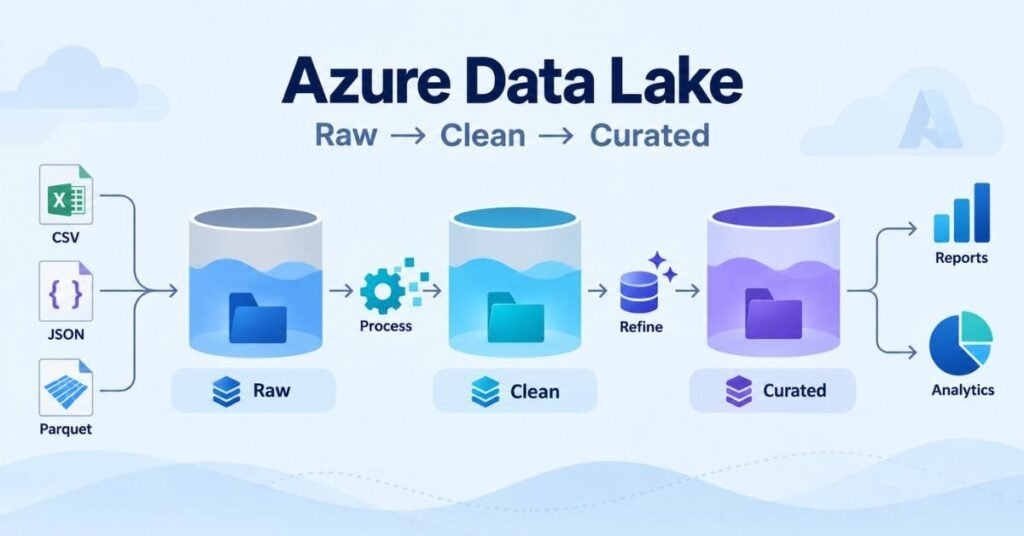
Data Engineering requires a place to store raw and processed data.
Azure Storage is therefore an important area.
Understand concepts such as:
- Azure Blob Storage
- Azure Data Lake Storage
- Containers
- Files
- Folders
- Access control
- Data formats
Common file formats may include:
- CSV
- JSON
- Parquet
A useful exercise is to imagine a company receiving daily sales files.
Raw files can be stored first, processed later, and then moved into a cleaner structure.
Thinking in stages helps you understand Data Lake design more clearly.
Step 5: Learn Azure Data Factory
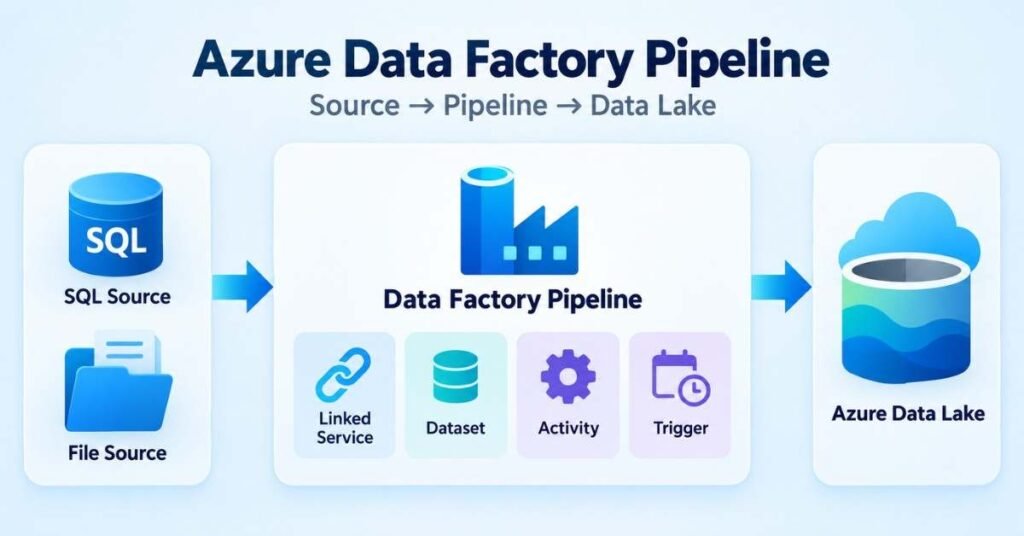
Azure Data Factory is commonly used for data movement and orchestration.
Start with the basic concepts:
- Pipelines
- Activities
- Datasets
- Linked Services
- Triggers
- Parameters
Think of Data Factory as a way to organise the movement of data.
For example:
SQL Database → Data Factory Pipeline → Azure Data Lake
The pipeline may run every night and copy new sales information into storage.
Later, the same pipeline can include transformations or multiple sources.
Focus first on understanding how the pieces connect.
Step 6: Learn Data Transformation
Moving data is only one part of Data Engineering.
Raw data often needs cleaning and transformation.
Common tasks include:
- Removing duplicates
- Handling missing values
- Changing data types
- Combining datasets
- Filtering unwanted records
- Creating derived columns
- Standardising values
For example, customer names may use different formats across systems.
One source may store:
“Hyderabad”
Another may store:
“HYD”
A transformation step can standardise both values before analysis.
That is the kind of real-world issue Data Engineers regularly handle.
Step 7: Understand Azure Databricks and Spark Basics
Azure Databricks is useful for large-scale data processing.
Before going deep, understand the basics of:
- Apache Spark
- Notebooks
- DataFrames
- Transformations
- Actions
- PySpark
Do not try to memorise every Spark command.
Learn how distributed processing helps when data becomes too large for simple tools.
A beginner should first become comfortable loading data, transforming it, and writing the result back to storage.
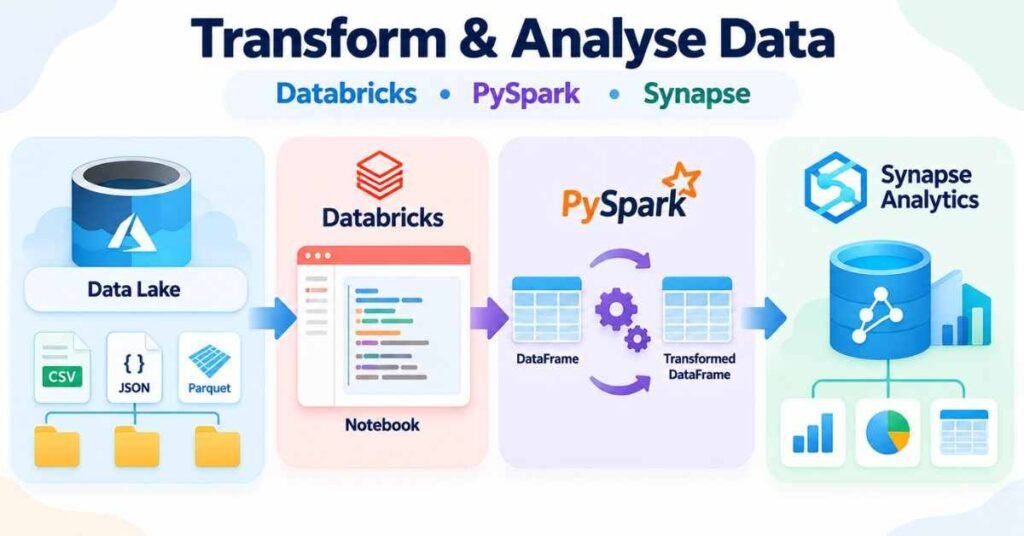
Step 8: Learn Azure Synapse Concepts
Azure Synapse can be used in analytics and data warehousing scenarios.
Understand:
- Data warehouse concepts
- Tables
- SQL pools
- Data integration
- Analytics workflows
You should also understand the difference between storing raw data and preparing structured data for analytics.
That distinction helps you understand why companies use multiple data services.
Build Your Azure Data Skills Step by Step – Azure Data Engineer Roadmap Guide
Essential Skills for an Azure Data Engineer
A strong beginner profile should include both cloud and data skills.
Data Skills
- SQL
- Data modelling basics
- ETL concepts
- Data quality
- Data transformation
- File formats
Azure Skills
- Azure Data Lake Storage
- Azure Data Factory
- Azure Databricks
- Azure Synapse concepts
- Azure SQL
- Azure Storage
Programming Skills
- Basic Python
- PySpark fundamentals
- File handling
- Data processing logic
Professional Skills
- Problem-solving
- Debugging
- Requirement understanding
- Documentation
- Communication
- Data validation
The goal is not to become an expert in every service immediately.
Build a connected understanding of how data moves through Azure.
Real Projects to Build
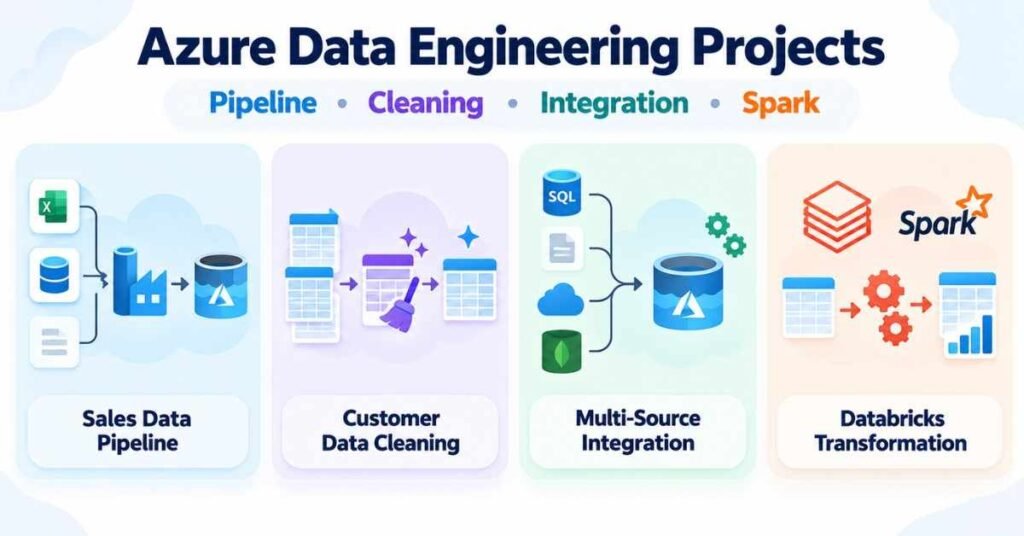
Projects can help you explain Azure Data Engineering during interviews.
Project 1: Sales Data Pipeline
Build a pipeline that moves sales data from a source into Azure Data Lake.
Include:
- Source connection
- Data Factory pipeline
- Storage
- Basic transformation
- Scheduled trigger
Explain how new data arrives and where it is stored.
Project 2: Customer Data Cleaning
Take customer data containing missing values, duplicates, and inconsistent fields.
Use a transformation process to clean and standardise the data.
Show:
- Raw data
- Cleaning steps
- Final output
This demonstrates data-quality understanding.
Project 3: Multi-Source Data Integration
Use two or more sources.
For example:
- Customer data from SQL
- Order data from CSV
- Product data from another file
Combine the information into a single analytics-ready dataset.
Project 4: Databricks Transformation
Load data into a Databricks notebook.
Perform:
- Filtering
- Column transformation
- Aggregation
- Data cleaning
Then write the processed output back to Azure storage.
Projects like these are more useful than simply listing Azure tools on a resume.
Salary Expectations in India
Azure Data Engineer salaries depend on experience, cloud knowledge, SQL skills, project exposure, company, and location.
Experience Level | Broad Salary Range |
Fresher | ₹4 LPA to ₹7 LPA |
1–3 Years | ₹6 LPA to ₹12 LPA |
3–5 Years | ₹10 LPA to ₹18 LPA |
5+ Years | ₹16 LPA to ₹28 LPA+ |
These figures are broad estimates rather than fixed packages.
Actual compensation can vary significantly based on the role and organisation.
Freshers should focus on building strong fundamentals and practical project experience.
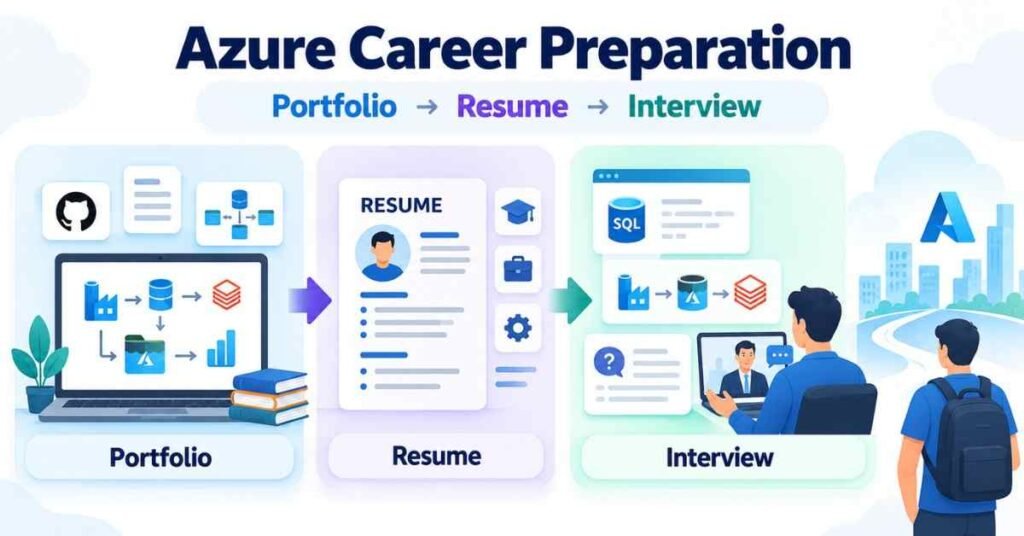
Portfolio That Gets Interviews
A Data Engineering portfolio should show data flow clearly.
For each project, explain:
Source → Pipeline → Transformation → Storage → Output
Include:
- Project objective
- Architecture diagram
- Azure services used
- Data flow
- Transformation logic
- Screenshots where useful
- GitHub files if applicable
- Challenges faced
A recruiter should be able to understand what you built without reading hundreds of lines of code.
Portfolio Checklist
- Keep projects practical.
- Explain every Azure service you use.
- Avoid copied architectures you cannot explain.
- Mention how failures would be handled.
- Show the final data output.
- Keep documentation simple.
Your ability to explain the pipeline is just as important as building it.
Job Search Strategy
Once you are comfortable with SQL, Azure storage, Data Factory, basic Databricks, and projects, begin exploring job descriptions.
Search for roles such as:
- Azure Data Engineer
- Junior Data Engineer
- Cloud Data Engineer
- ETL Developer
- Data Engineering Intern
- Azure Data Analyst
- Data Platform Associate
Resume Keywords
Use relevant skills such as:
- Azure Data Factory
- Azure Data Lake
- Azure Databricks
- Azure Synapse
- SQL
- Python
- PySpark
- ETL
- Data Pipelines
- Data Transformation
Use only the skills you can explain confidently.
Do not list every Azure service just to make the resume look larger.
Prepare for Azure Data Roles with Confidence – Azure Data Engineer Interview Guides
Interview Preparation
Azure Data Engineering interviews may test both concepts and scenarios.
Prepare topics such as:
- SQL
- ETL
- Data pipelines
- Data Lake
- Data Warehouse
- Data Factory
- Databricks
- Spark basics
- Azure storage
- Data transformation
- Data quality
Scenario questions are especially useful.
For example:
“A company receives a CSV file every day. How would you move and process it in Azure?”
A structured answer could be:
- Identify where the source file arrives.
- Use Data Factory to detect or copy it.
- Store raw data in Data Lake.
- Transform the data if required.
- Write cleaned data to another layer.
- Make the final data available for analytics.
This shows that you understand the workflow rather than just tool names.
SQL Interview Preparation
Practise:
- JOINs
- GROUP BY
- Window functions
- CTEs
- Subqueries
- Duplicate handling
- Ranking problems
- Aggregation questions
SQL remains one of the areas where regular hands-on practice gives a clear advantage.
30-Day Starter Plan
The first month should help you understand the Azure Data Engineering ecosystem.
Week 1
Focus on:
- Data fundamentals
- SQL basics
- Joins
- Aggregations
- Database concepts
Week 2
Learn:
- Azure fundamentals
- Storage
- Data Lake
- Resource groups
- Basic security concepts
Week 3
Practise:
- Azure Data Factory
- Pipelines
- Linked Services
- Datasets
- Triggers
- Data movement
Week 4
Explore:
- Databricks basics
- PySpark
- Transformations
- Azure Synapse concepts
- One small end-to-end project
Thirty days can give you direction.
Becoming job-ready requires continued SQL practice, more complex projects, and repeated work with Azure services.
Why Learn Azure Data Engineering at Frontlines Edutech?
For beginners, Azure Data Engineering can feel complicated when SQL, cloud, ETL, Data Factory, Databricks, and storage are learned as separate topics.
A practical learning path should connect these concepts through real data flows.
Useful training should cover:
- Data fundamentals
- SQL
- Azure basics
- Azure Data Lake
- Azure Data Factory
- Azure Databricks
- PySpark
- Azure Synapse concepts
- ETL pipelines
- Real projects
- Interview preparation
- Resume guidance
For Telugu-speaking learners, regional-language explanations can make cloud and data concepts easier to understand during the initial learning stage.
At the same time, learners should become comfortable with standard English technical terminology because Azure documentation, interviews, and workplace communication use it regularly.
Frequently Asked Questions (FAQs)
Q1: What does an Azure Data Engineer do?
An Azure Data Engineer builds and maintains data pipelines using Azure services. The role includes collecting, transforming, storing, and preparing data for analytics or other business use.
Q2: Is SQL required for Azure Data Engineering?
Yes. SQL is one of the most useful skills for Data Engineering because engineers regularly work with databases, transformations, and analytical queries.
Q3: Is Python required for an Azure Data Engineer?
Basic Python is useful, especially when working with data processing and Databricks. Advanced Python may not be required for every beginner role, but programming knowledge improves flexibility.
Q4: Which Azure service should I learn first?
After Azure fundamentals and storage, Azure Data Factory is a useful service to learn because it helps you understand pipelines and data movement.
Q5: What is Azure Data Lake used for?
Azure Data Lake can store large amounts of data in different formats. It is commonly used to keep raw and processed data for Data Engineering and analytics workloads.
Q6: What is Azure Data Factory?
Azure Data Factory is a cloud-based data integration service used to create and schedule pipelines that move and process data between different systems.
Q7: Is Azure Databricks difficult for beginners?
Beginners can start with basic notebooks, DataFrames, and transformations. Spark becomes easier when you already understand SQL and data-processing concepts.
Q8: Can a fresher become an Azure Data Engineer?
Yes. Freshers can begin with SQL, cloud fundamentals, Azure data services, and practical projects. Entry requirements vary by employer.
Q9: What projects should I build for Azure Data Engineering?
Build projects involving Data Factory pipelines, Data Lake storage, SQL, data transformation, Databricks, or multi-source integration.
Q10: How should I prepare for Azure Data Engineer interviews?
Prepare SQL, ETL concepts, Data Factory, Data Lake, Databricks, Spark basics, Azure storage, data modelling, and practical pipeline scenarios.