
Business Analyst Interview Preparation Guide : 240 Q&As
Table of Contents
Part 1: Introduction & 30-Day Study Plan

What This Guide Covers
This guide covers:
- Business Analysis basics
- Requirement Gathering
- BRD and FRD
- User Stories
- Acceptance Criteria
- Agile and Scrum
- Process Mapping
- SQL basics
- UAT
- Stakeholder Management
- Practical interview scenarios
Who This Guide Is For
Useful for:
- Freshers
- MBA graduates
- Non-IT professionals
- Data or Operations Analysts
- Career switchers
- Junior Business Analysts
The reference guide also starts with basics and gradually moves toward advanced interview preparation.
What Business Analysis Means
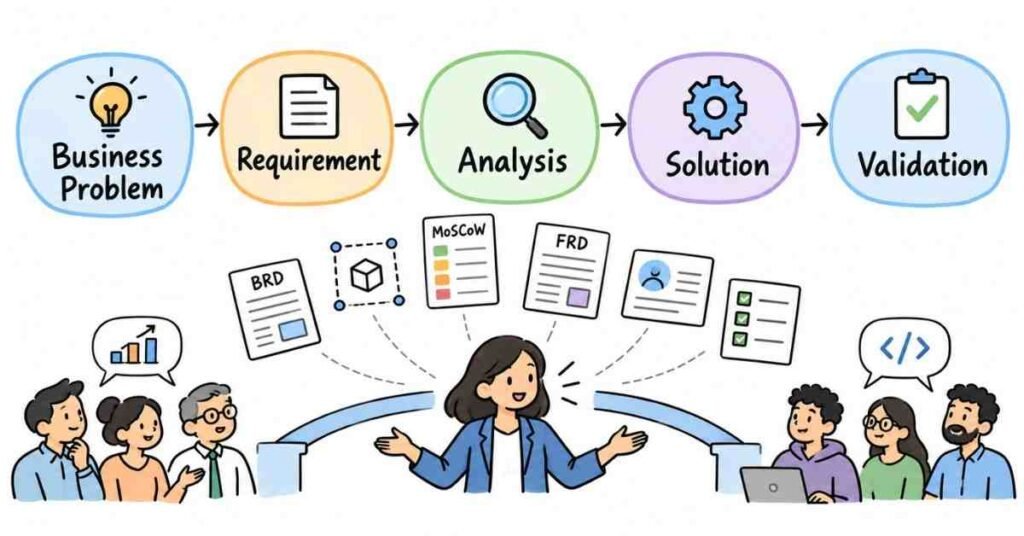
Business Analysis is about understanding a business problem and turning it into clear requirements.
A simple flow is:
Business Problem → Requirement → Analysis → Solution → Validation
What Does a Business Analyst Do?
A Business Analyst may:
- Talk to stakeholders
- Gather requirements
- Document processes
- Write user stories
- Clarify requirements for developers
- Support testing
- Handle UAT
- Track requirement changes
The role connects business teams and technical teams.
Why Business Analysts Matter
A good BA helps prevent:
- Unclear requirements
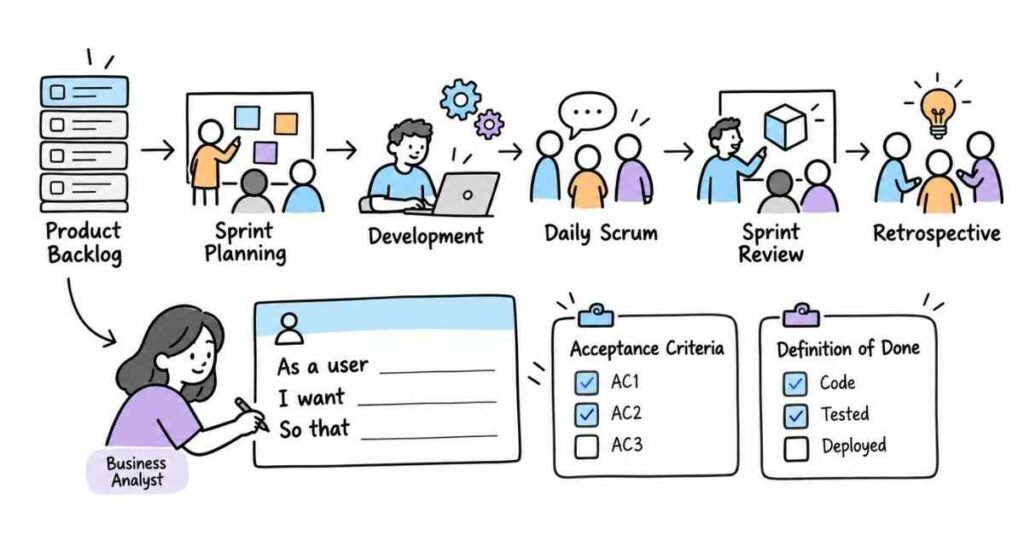
- Rework
- Wrong features
- Communication gaps
- Project delays
The goal is to make sure the team solves the right problem.
Career Path
A common path can be:
Junior Business Analyst → Business Analyst → Senior BA → Product Owner / Lead BA → Business Analysis Manager
Career growth depends on domain knowledge, communication, analysis, and project experience.
How To Use This Guide
Use this method:
- Learn the concept.
- Practise the question.
- Explain it in your own words.
- Add a small project example.
- Review weak areas.
The reference PDF also recommends understanding and practising answers instead of memorizing them.
30-Day Study Plan
Week 1: BA Fundamentals
Focus on:
BA Role → SDLC → Stakeholders → Requirements → BRD → FRD → Gap Analysis
Week 2: Agile & Documentation
Focus on:
Agile → Scrum → User Stories → Acceptance Criteria → Backlog → Jira
Week 3: Process, SQL & UAT
Focus on:
Process Mapping → Flowcharts → SQL Basics → Data Validation → UAT
Week 4: Scenarios & Mock Interviews
Focus on:
Requirement Changes → Stakeholder Conflicts → Project Examples → Behavioral Questions → Mock Interviews
The reference PDF also uses a four-week preparation plan before technical sections.
Daily Study Routine
- 30 min: Learn concept
- 20 min: Documentation practice
- 20 min: Interview questions
- 10 min: Revision
Tools You Should Know
Know the purpose of:
- Jira
- Confluence
- Excel
- SQL
- Power BI basics
- Visio / Draw.io
- Balsamiq basics
- Teams / Slack
You do not need to master every tool.
Common Interview Focus Areas
Most BA interviews cover:
Requirements → Stakeholders → BRD/FRD → Agile → User Stories → Process Mapping → SQL → UAT → Scenarios
Typical questions:
“How do you gather requirements?”
“What if two stakeholders want different things?”
“How do you handle changing requirements?”
“What is the difference between BRD and FRD?”
Salary Expectations
Salary depends on:
- Experience
- Industry
- Domain knowledge
- Communication
- SQL and reporting skills
- Company and location
Strong domain knowledge and practical project understanding usually improve opportunities.
What Strong Answers Look Like
Weak Answer
“I gather requirements from stakeholders.”
Better Answer
“I first understand the business problem, identify key stakeholders, ask focused questions, document the requirement, and confirm it with stakeholders before development starts.”
Good answers should show:
Situation → Approach → Result
The reference guide also emphasizes practical answers instead of vague skill statements.
How To Think Like a Business Analyst
For every requirement, ask:
What is the actual business problem?
Who is affected?
What does the user need?
What is the current process?
What should change?
How will we know the solution works?
A good BA does not simply write what stakeholders say.
A good BA first understands why they need it.
Part 2: Business Analysis Fundamentals & Requirement Gathering
Business Analysis Basics — Questions 1–40
Q1. What is Business Analysis?
Business Analysis is the process of understanding a business problem and defining the right solution.
Q2. Who is a Business Analyst?
A Business Analyst connects business needs with the technical team and helps convert requirements into workable solutions.
Q3. What are the main responsibilities of a BA?
A BA usually handles:
Requirement gathering
Analysis
Documentation
Stakeholder communication
UAT support
Change management
Q4. What is a business requirement?
A business requirement explains what the organization wants to achieve.
Example: Reduce customer onboarding time.
Q5. What is a functional requirement?
It explains what the system should do.
Example: The user should be able to reset a password.
Q6. What is a non-functional requirement?
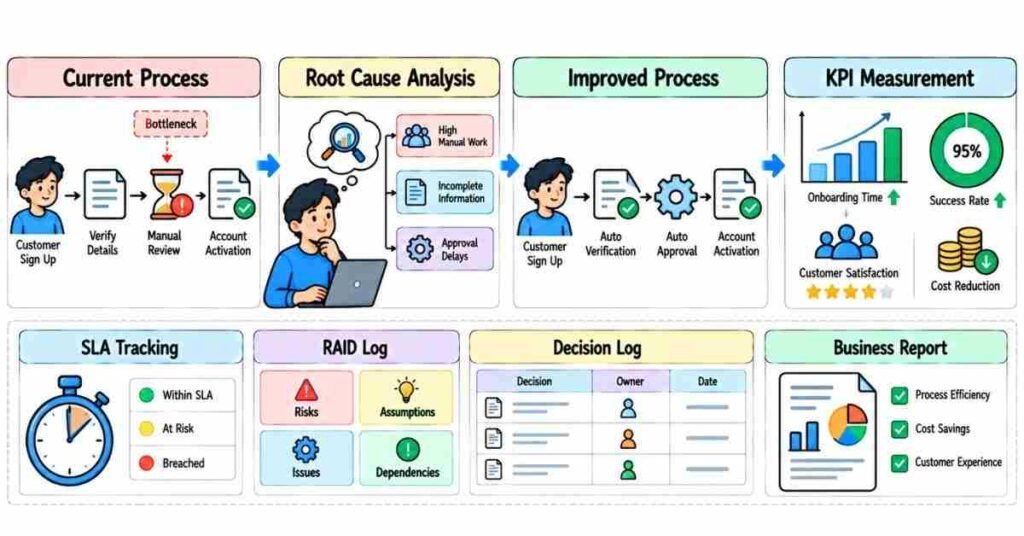
It explains how well the system should perform.
Examples:
Security, speed, availability, usability
Q7. Business requirement vs Functional requirement?
Business requirement: Why the solution is needed.
Functional requirement: What the system should do.
Q8. What is requirement gathering?
Requirement gathering is collecting information from stakeholders about their needs, problems, and expectations.
Q9. What is requirement elicitation?
Requirement elicitation means discovering requirements through discussions, workshops, observation, and other techniques.
Q10. What are common requirement elicitation techniques?
Common methods include:
Interviews
Workshops
Surveys
Observation
Document analysis
Brainstorming
Q11. What is a stakeholder?
A stakeholder is anyone affected by or involved in the project.
Examples:
Customer, manager, developer, tester, end user
Q12. How do you identify stakeholders?
Start by checking who:
Uses the system
Makes decisions
Provides requirements
Builds the solution
Is affected by the change
Q13. What is stakeholder analysis?
Stakeholder analysis identifies each stakeholder’s influence, interest, and involvement in the project.
Q14. What is a stakeholder matrix?
It groups stakeholders based on factors such as:
High/Low Power + High/Low Interest
This helps plan communication.
Q15. How do you handle conflicting stakeholder requirements?
Understand both needs, compare business impact, discuss constraints, and agree on priority with the right decision-makers.
Q16. What is requirement prioritization?
Requirement prioritization decides which requirements should be completed first.
Q17. What is MoSCoW prioritization?
MoSCoW means:
Must Have
Should Have
Could Have
Won’t Have for now
Q18. What is scope?
Scope defines what is included and excluded from the project.
Q19. What is scope creep?
Scope creep happens when new work keeps getting added without proper review or approval.
Q20. How do you control scope creep?
Document the original scope, review change requests, check impact, and get approval before adding new work.
Requirement Documentation
Q21. What is BRD?
BRD stands for Business Requirements Document.
It explains business goals, needs, and high-level requirements.
Q22. What is FRD?
FRD stands for Functional Requirements Document.
It explains how the system should behave to meet the business requirement.
Q23. BRD vs FRD?
BRD: Business needs.
FRD: System functionality.
Q24. What is an SRS?
SRS stands for Software Requirements Specification.
It contains detailed functional and non-functional requirements.
Q25. What is a use case?
A use case explains how a user interacts with the system to complete a goal.
Q26. What is a user story?
A user story describes a requirement from the user’s point of view.
Example:
As a customer, I want to track my order so that I know its delivery status.
Q27. What is Acceptance Criteria?
Acceptance Criteria defines the conditions that must be met for a requirement or user story to be accepted.
Q28. Why is Acceptance Criteria important?
It gives developers and testers a clear understanding of when the requirement is complete.
Q29. What is a requirement traceability matrix?
RTM connects requirements with design, development, and test cases.
It helps ensure nothing is missed.
Q30. What is requirement validation?
Requirement validation checks whether requirements are correct, clear, complete, and aligned with the business need.
Analysis Techniques
Q31. What is Gap Analysis?
Gap Analysis compares the current state with the desired future state.
Current Process → Gap → Future Process
Q32. What is AS-IS analysis?
AS-IS analysis documents how the current process works.
Q33. What is TO-BE analysis?
TO-BE analysis describes how the process should work after improvement.
Q34. What is process mapping?
Process mapping visually shows the steps in a business process.
It helps identify delays, gaps, and unnecessary steps.
Q35. What is a flowchart?
A flowchart uses symbols and arrows to show how a process moves from one step to another.
Q36. What is a business rule?
A business rule defines a condition or policy the system must follow.
Example:
A refund is allowed only within 30 days.
Q37. What is a requirement walkthrough?
A walkthrough is a review session where the BA explains requirements to stakeholders, developers, and testers.
Q38. What makes a good requirement?
A good requirement should be:
Clear
Specific
Testable
Necessary
Easy to understand
Q39. What should a BA do when a requirement is unclear?
Ask follow-up questions, understand the business reason, document the clarification, and confirm it with the stakeholder.
Q40. What makes a good Business Analyst?
A good BA combines:
Listening + Analysis + Communication + Documentation + Business Understanding
Practical Scenario
“Two stakeholders give different requirements for the same feature. What would you do?”
A natural answer:
“I would understand why each stakeholder needs the feature in a different way, check the business impact and priority, then arrange a discussion to reach an agreed requirement before development starts.”
Practice Strategy
Take one simple process such as:
Online Course Registration
Practise creating:
Business Requirement → Functional Requirement → User Story → Acceptance Criteria → Process Flow
Also practise explaining:
- BRD vs FRD
- Functional vs Non-functional requirements
- AS-IS vs TO-BE
- Scope vs Scope Creep
- Requirement Gathering vs Requirement Validation
Part 3: Agile, Scrum, User Stories & Requirement Documentation
Agile & Scrum — Questions 41–75
Q41. What is Agile?
Agile is a way of developing products in small, frequent releases instead of waiting for one large final delivery.
Q42. Why is Agile useful?
It allows teams to get feedback early, handle changes, and deliver working features faster.
Q43. What is Scrum?
Scrum is an Agile framework where work is completed in short cycles called Sprints.
Q44. What is a Sprint?
A Sprint is a fixed period in which the team completes selected work.
A Sprint commonly lasts 1–4 weeks.
Q45. Who is a Product Owner?
The Product Owner manages priorities and decides what should be built based on business value.
Q46. Who is a Scrum Master?
The Scrum Master helps the team follow Scrum and removes obstacles affecting progress.
Q47. What is the BA’s role in Agile?
A BA helps clarify requirements, write user stories, define acceptance criteria, and connect stakeholders with the delivery team.
Q48. What is a Product Backlog?
The Product Backlog is the ordered list of features, fixes, and improvements planned for the product.
Q49. What is a Sprint Backlog?
It contains the work selected by the team for the current Sprint.
Q50. What is Backlog Refinement?
It is the process of reviewing future stories, clarifying requirements, and preparing them for development.
Q51. What is Sprint Planning?
The team decides which backlog items can be completed during the upcoming Sprint.
Q52. What is a Daily Scrum?
A short daily meeting used to discuss progress, next steps, and blockers.
Q53. What is Sprint Review?
The team demonstrates completed work and collects feedback from stakeholders.
Q54. What is Sprint Retrospective?
The team discusses what worked well, what did not, and what can improve in the next Sprint.
Q55. Agile vs Waterfall?
Agile: Work is delivered in smaller cycles and changes are easier to handle.
Waterfall: Work usually follows a more sequential phase-by-phase approach.
User Stories
Q56. What is a User Story?
A User Story describes a requirement from the user’s point of view.
Example:
As a customer, I want to reset my password so that I can access my account again.
Q57. What is the common User Story format?
As a [user], I want [goal], so that [benefit].
Q58. What makes a good User Story?
A good story should be:
Clear
Small enough
Valuable
Testable
Q59. What is INVEST?
INVEST is a guideline for good User Stories:
Independent, Negotiable, Valuable, Estimable, Small, Testable
Q60. What is Acceptance Criteria?
Acceptance Criteria defines the conditions that must be met before a User Story is accepted.
Q61. Give an Acceptance Criteria example.
For password reset:
User enters registered email
Reset link is sent
Link expires after a defined period
New password must meet security rules
Q62. User Story vs Acceptance Criteria?
User Story: What the user needs.
Acceptance Criteria: How we know the requirement works correctly.
Q63. What is an Epic?
An Epic is a large requirement that can be divided into smaller User Stories.
Q64. What is a Task?
A Task is a specific piece of work required to complete a User Story.
Q65. What is a Story Point?
Story Points estimate the relative effort or complexity of a User Story.
Q66. What is Velocity?
Velocity shows how much work a team typically completes during a Sprint.
Q67. What is Definition of Done?
Definition of Done explains the conditions required before work is considered complete.
Example:
Developed → Tested → Reviewed → Accepted
Q68. What is Definition of Ready?
Definition of Ready means a story has enough information for the team to start working on it.
Requirement Handling in Agile
Q69. How does a BA handle changing requirements?
Understand the change, check its impact, update the story or backlog, and confirm the new priority with stakeholders.
Q70. What if a requirement changes during a Sprint?
First understand how urgent it is.
Normally, major changes are discussed with the Product Owner and planned properly instead of disrupting current work without review.
Q71. How does a BA prioritize User Stories?
Consider:
Business value
Customer need
Risk
Dependencies
Urgency
Q72. What is a dependency?
A dependency means one story or activity relies on another being completed first.
Q73. What is Jira?
Jira is commonly used to manage:
User Stories
Tasks
Bugs
Sprints
Backlogs
Q74. What is Confluence?
Confluence is used to store and share project documentation, requirements, meeting notes, and process information.
Q75. What should a BA do before giving a story to developers?
Confirm:
Requirement is clear
Acceptance Criteria exists
Dependencies are known
Business rules are explained
Stakeholder questions are resolved
Practical Scenario
“A developer says the User Story is not clear. What would you do?”
A natural answer:
“I would discuss the unclear part with the developer, check the original business need, clarify it with the stakeholder if required, and update the story and Acceptance Criteria before development continues.”
Practice Strategy
Take one feature:
Online Course Payment
Write:
Epic → User Story → Acceptance Criteria → Tasks
Then practise explaining:
- Product Backlog vs Sprint Backlog
- Epic vs User Story
- User Story vs Acceptance Criteria
- Sprint Review vs Retrospective
- BA role in Scrum
Part 4: Process Mapping, SQL & Data Analysis

Process Mapping & Data Analysis — Questions 76–110
Q76. What is Process Mapping?
Process Mapping visually shows how work moves from one step to another.
It helps identify delays, gaps, and unnecessary steps.
Q77. What is an AS-IS Process?
AS-IS shows how the process works today.
Q78. What is a TO-BE Process?
TO-BE shows how the process should work after improvement.
Q79. AS-IS vs TO-BE?
AS-IS: Current process.
TO-BE: Improved future process.
Q80. What is Gap Analysis?
Gap Analysis compares the current state with the desired state.
Current → Gap → Future
Q81. What is a Flowchart?
A Flowchart uses symbols and arrows to show process steps and decisions.
Q82. What is BPMN?
BPMN stands for Business Process Model and Notation.
It is used to represent business processes in a standard visual format.
Q83. What is a Swimlane Diagram?
A Swimlane Diagram shows process steps along with who is responsible for each step.
Q84. Why is process mapping useful for a BA?
It helps the BA understand:
Current workflow
Bottlenecks
Ownership
Missing steps
Improvement areas
Q85. What is a bottleneck?
A bottleneck is a step that slows down the overall process.
Q86. How do you improve a business process?
First understand the current flow, find delays or duplicate work, then suggest a simpler future process.
Q87. What is Root Cause Analysis?
Root Cause Analysis identifies the real reason behind a problem instead of only fixing the symptom.
Q88. What is the 5 Whys technique?
Ask “Why?” repeatedly until the main cause of the problem becomes clear.
Q89. What is a Fishbone Diagram?
A Fishbone Diagram helps identify possible causes of a problem.
It is also called an Ishikawa Diagram.
Q90. What is SWOT Analysis?
SWOT stands for:
Strengths, Weaknesses, Opportunities, Threats
It helps understand a business situation.
SQL for Business Analysts
Q91. Why should a Business Analyst know SQL?
SQL helps a BA check data, validate requirements, and answer business questions directly from databases.
Q92. What is SELECT?
SELECT is used to retrieve data from a table.
Q93. What is WHERE?
WHERE filters rows based on a condition.
Q94. What is ORDER BY?
ORDER BY sorts query results.
Q95. What is GROUP BY?
GROUP BY groups similar rows for summary calculations.
Q96. What is COUNT?
COUNT returns the number of records.
Q97. What is SUM?
SUM adds numerical values.
Q98. What is AVG?
AVG calculates the average value.
Q99. What is an INNER JOIN?
It returns matching records from both tables.
Q100. What is a LEFT JOIN?
It returns all rows from the left table and matching rows from the right table.
Q101. Why are joins useful for a BA?
Business data is often stored in different tables.
Joins help combine it for analysis.
Q102. What is NULL?
NULL means the value is missing or unknown.
Q103. How do you check duplicate data?
Use grouping or duplicate checks based on the correct business key.
Q104. What is data validation?
Data validation checks whether data is correct, complete, and follows expected rules.
Q105. What is data mapping?
Data mapping connects fields from one system to matching fields in another.
Example:
Customer_ID → CustomerId
Q106. What is source-to-target mapping?
It documents how data moves from a source system to a target system.
Q107. What is data profiling?
Data profiling checks the structure and quality of data.
It may include:
Missing values
Duplicates
Data types
Value ranges
Q108. What is data reconciliation?
Data reconciliation compares source and target data to confirm that information moved correctly.
Q109. How can Excel help a Business Analyst?
Excel is useful for:
Filtering
Pivot Tables
Lookups
Data cleaning
Quick analysis
Q110. How can Power BI help a Business Analyst?
Power BI helps convert data into dashboards and reports that make business trends easier to understand.
Practical Scenario
“Customer complaints increased after a new process was introduced. What would you do?”
A natural answer:
“I would compare the old and new process, identify where complaints increased, check the data, speak with stakeholders, and find the actual root cause before suggesting changes.”
Practice Strategy
Take one process:
Lead Received → Sales Call → Demo → Payment
Create:
AS-IS → Bottleneck → Gap Analysis → TO-BE
Then practise simple SQL:
SELECT → WHERE → GROUP BY → JOIN → COUNT
Part 5: UAT, Testing, Change Management & Stakeholder Handling

UAT, Testing & Stakeholders — Questions 111–145
Q111. What is UAT?
UAT stands for User Acceptance Testing.
It checks whether the solution works for actual business needs.
Q112. Who performs UAT?
Usually business users, SMEs, or key stakeholders perform UAT with support from the BA and testing team.
Q113. What is the BA’s role in UAT?
A BA may:
Prepare scenarios
Explain requirements
Support users
Track defects
Confirm fixes
Q114. What is a UAT scenario?
A UAT scenario describes a real business situation that needs to be tested.
Example:
Customer completes an online payment successfully.
Q115. What is a UAT test case?
A test case contains:
Steps → Input → Expected Result → Actual Result
Q116. What is the difference between UAT and System Testing?
System Testing: Checks whether the system works technically.
UAT: Checks whether it meets business needs.
Q117. What is a defect?
A defect is a problem where the system does not behave as expected.
Q118. What is defect severity?
Severity shows how serious the defect is.
Example:
Critical, High, Medium, Low
Q119. What is defect priority?
Priority shows how quickly the defect should be fixed.
Q120. Severity vs Priority?
Severity: How serious the issue is.
Priority: How urgently it should be fixed.
Q121. What is regression testing?
Regression testing checks whether a new change has broken existing functionality.
Q122. What is smoke testing?
Smoke testing checks whether the main features are working before deeper testing starts.
Q123. What is test data?
Test data is the sample data used to check whether the system works correctly.
Q124. What is a traceability matrix in testing?
It links requirements with test cases so all requirements are covered.
Q125. What happens after a defect is fixed?
The defect is retested.
If needed, related areas are also checked through regression testing.
Change Management
Q126. What is a change request?
A change request is a formal request to modify an approved requirement, scope, or solution.
Q127. Why is impact analysis important?
Impact analysis checks how a change affects:
Scope
Cost
Timeline
System
Other requirements
Q128. How should a BA handle a change request?
Understand the change, check impact, discuss priority, get approval, and update documents.
Q129. What is change control?
Change control is the process used to review, approve, and track project changes.
Q130. What is baseline requirement?
A baseline is an approved version of requirements used as the reference point for future changes.
Q131. What if a stakeholder asks for a major change late in the project?
Do not accept it immediately.
First check impact, effort, risk, and timeline, then take the right approval.
Q132. How do you document requirement changes?
Update the relevant story or document and maintain clear change history.
Q133. What is version control in documentation?
Version control tracks different document versions and what changed between them.
Stakeholder Handling
Q134. How do you communicate with stakeholders?
Keep communication clear, short, and based on the stakeholder’s level of understanding.
Q135. How do you handle a difficult stakeholder?
Listen carefully, understand the actual concern, use facts, and keep the discussion focused on the project goal.
Q136. What if a stakeholder is unavailable?
Document pending questions, identify alternatives such as SMEs, and escalate only when necessary.
Q137. How do you handle conflicting priorities?
Compare business value, urgency, risk, and dependencies before agreeing on priority.
Q138. What is stakeholder expectation management?
It means making sure stakeholders understand scope, timelines, risks, and what the solution will actually deliver.
Q139. Why are meeting notes important?
Meeting notes capture:
Decisions
Actions
Owners
Deadlines
Open questions
They reduce later confusion.
Q140. What is an action item?
An action item is a specific task assigned to someone after a discussion or meeting.
Q141. How do you handle unclear feedback?
Ask specific follow-up questions and confirm the final expectation before making changes.
Q142. What if business and technical teams disagree?
Understand both sides, identify constraints, and help both teams reach a workable solution.
Q143. How do you present a complex requirement?
Break it into:
Problem → Current Flow → Requirement → Expected Result
Use diagrams if needed.
Q144. Why is communication important for a BA?
A BA works between multiple teams.
Poor communication can lead to wrong requirements and rework.
Q145. What makes stakeholder management successful?
Good stakeholder management needs:
Listening + Clear Updates + Early Risk Communication + Agreement on Decisions
Practical Scenario
“UAT users reject a feature that matches the written requirement. What would you do?”
A natural answer:
“I would first understand why users rejected it and compare their expectation with the approved requirement. If the original requirement missed the real business need, I would document the gap and follow the change process instead of treating it only as a defect.”
Practice Strategy
Take one feature:
Online Course Refund
Prepare:
Requirement → UAT Scenario → Test Case → Defect → Change Request
Then practise:
- UAT vs System Testing
- Severity vs Priority
- Defect vs Change Request
- Regression vs Smoke Testing
- Change Request handling
- Stakeholder conflict handling
Part 6: Business Process Improvement, KPIs, Reporting & Documentation
Process Improvement & Reporting — Questions 146–180
Searching
Q146. What is Business Process Improvement?
It means finding problems in an existing process and making it faster, simpler, or more effective.
Q147. How does a BA improve a process?
A BA usually studies the current flow, finds gaps, checks data, and proposes a better future process.
Q148. What is process optimization?
Process optimization improves existing steps without changing the entire process.
Q149. What is process automation?
Process automation uses technology to reduce repetitive manual work.
Example:
Manual approval email → Automated workflow
Q150. How do you identify automation opportunities?
Look for work that is:
Repetitive
Rule-based
Time-consuming
High in manual errors
Q151. What is Root Cause Analysis?
Root Cause Analysis finds the actual reason behind a problem instead of treating only the symptom.
Q152. What is the 5 Whys method?
Ask “Why?” repeatedly until the real cause becomes clear.
Q153. What is Pareto Analysis?
Pareto Analysis helps identify the few causes responsible for most problems.
It is often linked to the 80/20 principle.
Q154. What is Cost-Benefit Analysis?
It compares the expected benefit of a solution with its cost.
Q155. What is Feasibility Analysis?
Feasibility Analysis checks whether a proposed solution is practical.
It may consider cost, technology, time, and resources.
Q156. What is a Business Case?
A Business Case explains why a project or change is worth doing.
It may include:
Problem → Options → Cost → Benefit → Risk
Q157. What is ROI?
ROI stands for Return on Investment.
It compares the benefit gained with the money spent.
Q158. What is a KPI?
KPI stands for Key Performance Indicator.
It measures progress toward an important business goal.
Q159. Give an example of a KPI.
For customer support:
Average Resolution Time
For sales:
Conversion Rate
Q160. KPI vs Metric?
A metric measures an activity.
A KPI measures something directly linked to an important business goal.
Q161. What is a leading indicator?
A leading indicator gives an early signal of future performance.
Example:
Number of qualified leads
Q162. What is a lagging indicator?
A lagging indicator shows the final result.
Example:
Monthly revenue
Q163. What makes a good KPI?
A good KPI should be:
Relevant
Measurable
Clear
Linked to a goal
Q164. What is a dashboard?
A dashboard shows important business data in one visual place.
Q165. What is a Business Report?
A Business Report summarizes data, findings, and important actions for decision-makers.
Q166. Dashboard vs Report?
Dashboard: Quick visual monitoring.
Report: More detailed explanation and analysis.
Q167. What should a good dashboard show?
Only information needed for decisions.
Avoid adding charts that do not support a business question.
Q168. How does a BA use Excel?
Excel can help with:
Data cleaning
Pivot Tables
Lookups
Comparisons
Quick reports
Q169. How does a BA use Power BI?
Power BI helps create dashboards and show trends, KPIs, and business performance visually.
Q170. What is trend analysis?
Trend analysis studies how a value changes over time.
Example:
Monthly sales increasing or decreasing
Q171. What is variance analysis?
Variance analysis compares actual performance with expected or planned performance.
Q172. What is a benchmark?
A benchmark is a reference point used to compare performance.
Q173. What is an SLA?
SLA stands for Service Level Agreement.
It defines expected service standards such as response or resolution time.
Q174. What is a risk?
A risk is a possible future event that may affect the project.
Q175. What is an issue?
An issue is a problem that has already happened.
Q176. Risk vs Issue?
Risk: May happen.
Issue: Has already happened.
Q177. What is a RAID Log?
RAID tracks:
Risks, Assumptions, Issues, Dependencies
It helps teams monitor important project concerns.
Q178. What is a Decision Log?
A Decision Log records important project decisions and why they were made.
Q179. Why is documentation important for a BA?
Good documentation keeps requirements, decisions, changes, and responsibilities clear.
It also reduces misunderstandings later.
Q180. What makes a good BA report?
A good report should clearly show:
What happened → Why it matters → What action is needed
It should help people make a decision, not just show numbers.
Practical Scenario
“A customer onboarding process takes five days, but the business wants it completed within two days. What would you do?”
A natural answer:
“I would map the current process, measure where most time is spent, identify manual approvals or repeated work, and then propose changes such as automation or removing unnecessary steps. I would also define a KPI to check whether onboarding time actually improves.”
Practice Strategy
Take one process:
Customer Registration → Verification → Approval → Activation
Practise identifying:
Current Time → Bottleneck → Root Cause → Improvement → KPI
Also revise:
- KPI vs Metric
- Risk vs Issue
- Dashboard vs Report
- Cost-Benefit Analysis
- Business Case
- RAID Log
Part 7: Product Analysis, Prototyping, APIs & Technical BA Concepts

Product & Technical BA — Questions 181–210
Q181. What is Product Analysis?
Product Analysis means understanding how a product works, who uses it, and what can be improved.
Q182. What is a Product Requirement?
A Product Requirement explains what a feature or product should achieve for users or the business.
Q183. What is a Product Roadmap?
A Product Roadmap shows the planned direction of a product over time.
It may include:
Features
Priorities
Releases
Business goals
Q184. What is an MVP?
MVP stands for Minimum Viable Product.
It is the smallest useful version of a product that can be tested with real users.
Q185. Why is an MVP useful?
It helps test an idea early without building every feature first.
Q186. What is a Prototype?
A Prototype is an early visual version of a product or feature.
It helps stakeholders understand the proposed solution.
Q187. What is a Wireframe?
A Wireframe is a simple screen layout showing where major elements will appear.
Q188. Wireframe vs Prototype?
Wireframe: Basic structure.
Prototype: More realistic interaction or flow.
Q189. Why should a BA know prototyping?
A visual screen can make requirements easier to understand than long text.
Q190. What tools can be used for wireframes?
Common tools include:
Figma
Balsamiq
Draw.io
The BA only needs enough knowledge to explain the requirement clearly.
API Basics
Q191. What is an API?
API stands for Application Programming Interface.
It allows two applications to exchange information.
Q192. Give a simple API example.
An e-commerce app may call a payment service API to process a payment.
Q193. What is a REST API?
A REST API is a common way for applications to communicate over HTTP.
Q194. What is an API request?
An API request is information sent from one system to another asking for data or an action.
Q195. What is an API response?
An API response is the result returned after the request is processed.
Q196. What is an endpoint?
An endpoint is the address used to access a specific API function or resource.
Q197. What is GET?
GET is generally used to retrieve data.
Q198. What is POST?
POST is generally used to create or submit new data.
Q199. What is PUT?
PUT is commonly used to replace or update a resource.
Q200. What is DELETE?
DELETE is used to remove a resource.
Q201. What is JSON?
JSON is a common format used to exchange data between systems.
Example:
{
“customerId”: 101,
“status”: “Active”
}
Q202. What is an HTTP Status Code?
It tells whether an API request succeeded or failed.
Examples:
200 — Success
400 — Bad Request
404 — Not Found
500 — Server Error
Q203. Why should a Business Analyst understand APIs?
A BA may need to understand how systems exchange data and what information is required between them.
Q204. What should a BA document for an integration?
A BA may capture:
Source system
Target system
Data fields
Business rules
Trigger
Expected response
Error cases
Q205. What is system integration?
System integration connects two or more applications so they can share data or work together.
Q206. What is an interface requirement?
An interface requirement explains how one system should interact with another system or user interface.
Q207. What is authentication?
Authentication checks whether a user or system is who it claims to be.
Q208. What is authorization?
Authorization decides what an authenticated user is allowed to access or do.
Q209. Authentication vs Authorization?
Authentication: Who are you?
Authorization: What are you allowed to do?
Q210. What should a Technical BA understand?
A Technical BA should understand enough about:
APIs → Databases → Integrations → Data Flow → System Behavior → Error Handling
The goal is not to become a developer, but to communicate technical requirements clearly.
Practical Scenario
“A payment system needs to connect with an external payment provider. What would you clarify?”
A natural answer:
“I would confirm what data needs to be sent, what response is expected, when the API should be called, how failures are handled, and what should happen after a successful payment.”
Practice Strategy
Take one feature:
Course Payment Integration
Create this flow:
User → Website → Payment API → Payment Provider → Response → Confirmation
Then practise:
- MVP vs Full Product
- Wireframe vs Prototype
- API Request vs Response
- GET vs POST
- Authentication vs Authorization
- Source System vs Target System
Part 8: Advanced Business Analysis, Real-World Scenarios & Case-Based Questions
Advanced BA Questions — 211–240
Q211. What is a business problem statement?
A problem statement clearly explains the issue, who is affected, and why it needs attention.
Q212. How do you define a business problem?
Understand:
Current Situation → Pain Point → Impact → Expected Improvement
Q213. Problem vs Requirement?
Problem: What is going wrong.
Requirement: What is needed to solve it.
Q214. What is Solution Assessment?
Solution Assessment checks whether the implemented solution actually meets the business need.
Q215. How do you measure solution success?
Compare expected results with actual results using:
KPIs
User feedback
Business outcomes
Error rates
Q216. What is impact analysis?
Impact analysis checks how a proposed change affects systems, users, cost, scope, and timeline.
Q217. What is dependency analysis?
It identifies work that depends on another feature, team, system, or decision.
Q218. What is assumption analysis?
It checks whether project assumptions are still valid.
Example:
“All users will have internet access.”
Q219. What is a constraint?
A constraint is a limitation affecting the solution.
Examples:
Budget, time, technology, regulation
Q220. Assumption vs Constraint?
Assumption: Something believed to be true.
Constraint: A known limitation.
Q221. What is business value?
Business value is the benefit a requirement or solution provides to the organization or user.
Q222. How do you prioritize when everything is marked urgent?
Compare:
Business value → Risk → Deadline → Dependency → Customer impact
Then involve the right decision-maker.
Q223. What is a requirement conflict?
It happens when two requirements cannot both be satisfied as written.
Q224. How do you resolve requirement conflicts?
Understand both needs, identify the business priority, discuss alternatives, and document the final decision.
Q225. What if stakeholders keep changing requirements?
Track changes formally and show their impact on scope, effort, and timeline.
Q226. What if a stakeholder says, “Build it like the old system”?
Do not copy it immediately.
Understand which old-system features are actually useful and what problem they solve.
Q227. What if users reject a new process?
Find out whether the issue is with the requirement, usability, training, or change adoption.
Q228. What if developers say a requirement is not feasible?
Understand the technical constraint and work with business stakeholders on an acceptable alternative.
Q229. What if QA finds a gap in the requirement?
Review the original requirement, clarify the expected behavior, and update the documentation if needed.
Q230. What if a critical requirement was missed?
Assess the impact, inform stakeholders early, and follow the agreed change process.
Case-Based Questions
Q231. Sales are falling. How would you approach the problem?
Start with:
Data → Customer Segment → Product → Region → Time Period → Root Cause
Avoid jumping directly to a solution.
Q232. Customer complaints suddenly increase. What would you check?
Check:
Complaint category
Recent changes
Customer journey
Support data
Process failures
Q233. A process takes too long. What would you do?
Map the current process and identify:
Waiting Time → Rework → Manual Steps → Approvals → Bottlenecks
Q234. A company wants a new mobile app. What should the BA ask first?
Ask:
Who will use it?
What problem does it solve?
What are the main features?
What is the expected outcome?
Q235. A client wants 20 features in the first release. What would you do?
Prioritize the features and identify the smallest useful first release.
An MVP may be appropriate.
Q236. Two departments want different workflows. How would you handle it?
Understand both processes, identify common steps, document differences, and agree on the required business rules.
Q237. A dashboard shows wrong numbers. What would you check?
Check:
Source Data → Filters → Business Logic → Mapping → Calculations
Q238. An integration is failing. What should a BA verify?
Check:
Expected data
Field mapping
Trigger
API response
Error scenario
Business impact
Q239. Users say the system is difficult to use. What would you do?
Observe how they use it, collect examples, identify unnecessary steps, and discuss possible usability improvements.
Q240. How do you answer an unknown scenario in an interview?
Do not guess immediately.
Use a clear flow:
Understand → Ask Questions → Analyze → Identify Options → Recommend → Validate
Practical Scenario
“A company wants to reduce customer onboarding time from five days to one day. How would you approach it?”
A natural answer:
“I would first map the current onboarding process, measure where time is being spent, identify manual work and approval delays, then discuss possible improvements with stakeholders. After implementation, I would track onboarding time as a KPI.”
Case Interview Approach
For most BA scenarios, use:
Problem → Stakeholders → Current Process → Data → Root Cause → Options → Recommendation → Measure Result
Do not rush to give a solution before understanding the problem.
Practice Strategy
Practise these five situations:
- Conflicting requirements
- Changing requirements
- Process delay
- Wrong dashboard data
- Failed system integration
For each one, explain:
What would you check first?
Who would you speak with?
What would you document?
How would you measure success?
Part 9: Behavioral, Communication, Resume & Career Strategy
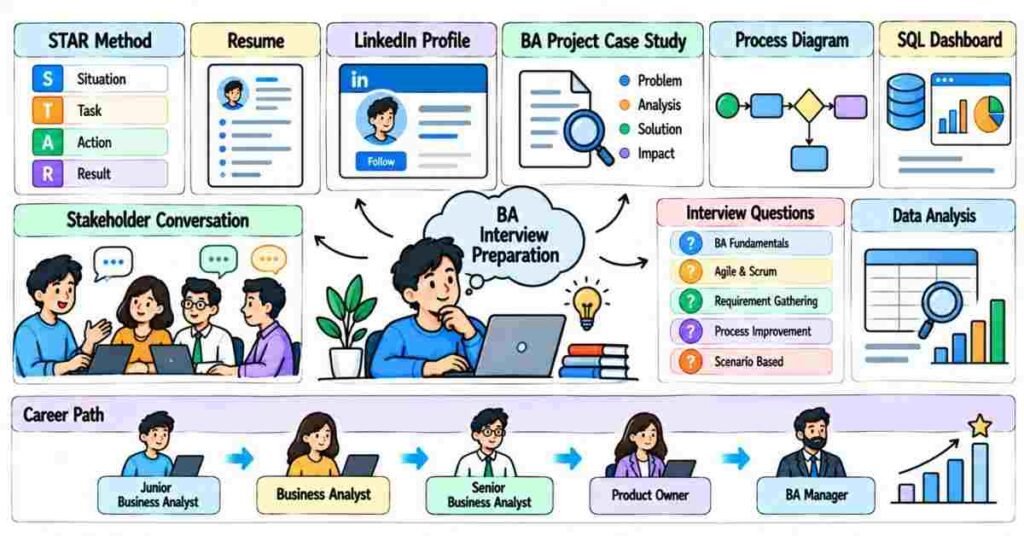
STAR Method
Use STAR for experience-based questions:
Situation → Task → Action → Result
Keep the answer focused on what you personally did and what changed because of it. The reference PDF also uses STAR for behavioral interview preparation.
20 Behavioral Interview Questions
Q1. Tell me about yourself.
Keep it simple:
Background → BA Skills → Project Experience → Career Goal
Q2. Why do you want to become a Business Analyst?
Talk about your interest in understanding business problems, working with stakeholders, and improving processes.
Q3. Explain one Business Analyst project.
Use:
Problem → Requirements → Analysis → Solution → Result
Q4. Tell me about a difficult requirement.
Explain why it was difficult and how you clarified it with stakeholders.
Q5. How did you handle conflicting requirements?
Understand both sides, compare business impact, and help stakeholders agree on a priority.
Q6. Tell me about a requirement you missed.
Explain the mistake, impact, correction, and what you changed afterward.
Q7. How do you handle a difficult stakeholder?
Listen first, understand the concern, use facts, and keep discussions focused on the business goal.
Q8. Tell me about a process you improved.
Explain:
Old Process → Problem → Change → Improvement
Q9. How do you handle tight deadlines?
Prioritize important requirements, communicate risks early, and avoid unnecessary work.
Q10. How do you manage multiple stakeholders?
Understand each stakeholder’s role, expectations, and level of influence.
Q11. Tell me about a disagreement with a developer.
Clarify the business need, understand the technical limitation, and work toward a practical alternative.
Q12. How do you handle incomplete requirements?
Ask focused questions, identify missing information, and confirm the final requirement before development.
Q13. Tell me about a change request you handled.
Explain how you checked scope, effort, risk, and approvals before updating the requirement.
Q14. How do you explain technical information to business users?
Use simple language, process examples, and diagrams instead of technical jargon.
Q15. How do you handle negative feedback?
Understand the reason, make useful corrections, and apply the learning to future work.
Q16. What is your biggest strength?
Choose something you can support with an example:
Communication, Requirement Analysis, SQL, Documentation, or Problem-solving
Q17. What is your weakness?
Choose a genuine weakness and explain how you are improving it.
Q18. Why should we hire you as a Business Analyst?
Connect your answer to:
Analysis + Communication + Requirements + Stakeholder Handling
Q19. Where do you see yourself in three years?
Example:
“I want to become a strong Business Analyst who can independently handle requirements, stakeholders, process improvement, and end-to-end project support.”
Q20. Do you have any questions for us?
Ask questions such as:
What type of projects will I work on?
How are requirements managed here?
Which BA tools does the team use?
How much stakeholder interaction will I have?
What does success look like in this role?
The reference guide also includes questions candidates can ask interviewers.
50 Self-Preparation Prompts
The reference PDF includes a separate 50-prompt practice section after behavioral preparation.
Technical Practice — 1–20
- Ask me Business Analyst fundamentals.
- Test me on requirement gathering.
- Quiz me on BRD and FRD.
- Ask me functional requirement questions.
- Test me on non-functional requirements.
- Ask me stakeholder questions.
- Quiz me on Agile.
- Test me on Scrum.
- Ask me User Story questions.
- Test me on Acceptance Criteria.
- Ask me process mapping questions.
- Test me on AS-IS and TO-BE.
- Ask me Gap Analysis questions.
- Quiz me on SQL basics.
- Test me on UAT.
- Ask me change-management questions.
- Quiz me on KPIs.
- Ask me API basics.
- Give me a BA case study.
- Conduct a Business Analyst mock interview.
Behavioral Practice — 21–35
- Improve my self-introduction.
- Help me explain my BA project.
- Turn my experience into a STAR answer.
- Ask me about stakeholder conflict.
- Ask me about changing requirements.
- Test me on difficult stakeholders.
- Ask me about a project mistake.
- Review my communication answer.
- Ask me about deadlines.
- Give me a UAT scenario.
- Ask me about process improvement.
- Test my problem-solving approach.
- Conduct a behavioral interview.
- Give me questions for the interviewer.
- Review whether my answers show ownership.
Career Practice — 36–50
- Improve my BA resume summary.
- Create a Business Analyst LinkedIn headline.
- Improve my project bullets.
- Suggest BA resume keywords.
- Review my skills section.
- Improve my project description.
- Suggest Business Analyst portfolio projects.
- Help me explain a career switch.
- Write an interview thank-you email.
- Improve my Agile project explanation.
- Review my resume for BA roles.
- Help me prepare for salary discussion.
- Suggest LinkedIn Featured content.
- Create a 7-day revision plan.
- Conduct a complete BA interview.
Resume Optimization
The reference guide recommends clear resume sections with action-based bullet points.
Headline
Business Analyst | Requirements | Agile | SQL | UAT | Process Improvement
Professional Summary
Keep it to 3–4 lines.
Mention:
Experience → Core BA Skills → Domain/Projects → Target Role
Skills
Business Analysis: Requirement Gathering, Gap Analysis, Process Mapping
Agile: Scrum, User Stories, Acceptance Criteria
Data: SQL, Excel, Power BI
Tools: Jira, Confluence, Draw.io
Testing: UAT, Requirement Validation
Experience / Project Bullets
Avoid:
“Responsible for gathering requirements.”
Better:
“Gathered and documented business requirements through stakeholder discussions and converted them into clear user stories and acceptance criteria.”
LinkedIn Profile
The reference PDF also treats LinkedIn optimization as a separate career-preparation step.
Headline
Business Analyst | Agile | Requirement Gathering | SQL | UAT
About Section
Keep three short parts:
Who you are → What you know → What role you want
Featured Section
Add:
- BA case studies
- Process diagrams
- Sample dashboards
- Certifications
- Portfolio projects
Portfolio Strategy
Create 2–3 simple BA projects.
Good examples:
- E-Commerce Requirement Analysis
- Customer Onboarding Process Improvement
- Course Registration System
- Banking Loan Application Flow
For each project, show:
Problem → Stakeholders → Requirements → Process Flow → User Stories → UAT → Result
Salary Discussion
Salary depends on experience, domain, location, company size, and practical BA skills.
During negotiation:
- Understand the role first
- Research the market range
- Highlight relevant experience
- Discuss the complete offer
- Keep the conversation professional
Post-Interview Follow-Up
Thank-You Email
Subject: Thank You — Business Analyst Interview
Hi [Interviewer Name],
Thank you for taking the time to speak with me today. I enjoyed learning more about the Business Analyst role and the type of projects handled by the team.
I remain interested in the opportunity.
Best regards,
[Your Name]
Follow-Up Email
Subject: Follow-Up — Business Analyst Interview
Hi [Name],
I wanted to follow up regarding my interview for the Business Analyst position. I remain interested in the role and would appreciate any update on the next steps.
Best regards,
[Your Name]
The reference PDF also includes thank-you and follow-up templates near the end of the guide.
Final Interview Checklist
Technical
BA fundamentals revised
BRD and FRD understood
Agile and Scrum revised
User Stories practised
Process mapping revised
SQL basics practised
UAT understood
API basics reviewed
Case studies practised
Behavioral
Self-introduction ready
5–8 STAR stories ready
Stakeholder conflict example ready
Requirement-change example ready
Strength and weakness prepared
Interviewer questions ready
Profile
Resume updated
LinkedIn updated
BA keywords added
Portfolio checked
Projects reviewed
Day Before Interview
Review your resume
Revise one strong project
Review BA terminology
Keep documents ready
Avoid learning new topics at the last minute