
Machine Learning Interview Preparation Guide 2026
Table of Contents
Part 1: Introduction & 30-Day Study Plan
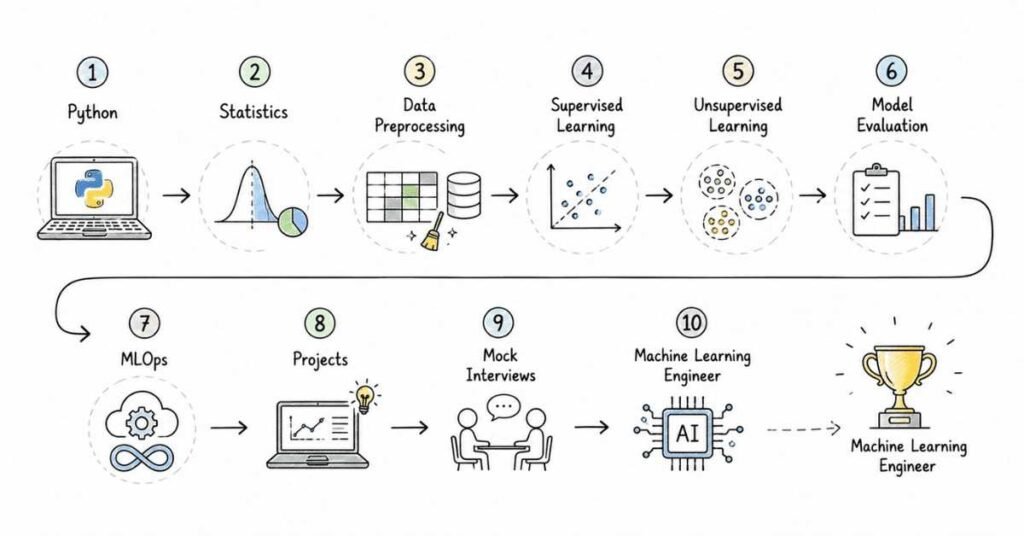
This first part sets up the roadmap for machine learning interview preparation, including role clarity, core skills, interview stages, project expectations, and a practical 30-day study plan. Current India salary sources place average machine learning engineer pay around ₹10.1 lakh per year on PayScale and average AI/ML engineer pay around ₹7.14 lakh on Indeed, with clear upside based on city, specialization, and experience.
What this guide covers
This guide is designed to prepare you for machine learning interviews in a structured way, starting from fundamentals and moving toward applied interview readiness. It will cover ML basics, Python and data handling, statistics and math, supervised learning, unsupervised learning, NLP awareness, model evaluation, tuning, deployment, MLOps awareness, case studies, projects, behavioral questions, resume positioning, and career strategy.
The goal is not only to help you define algorithms, but also to explain when to use them, how to evaluate them, and how to discuss ML work in practical business or product terms.
Who this guide is for
This guide is useful if you are:
- A fresher preparing for your first machine learning or AI interview.
- A data analyst or software engineer moving into ML roles.
- A data science learner who knows some theory but struggles to explain it clearly.
- A working professional targeting ML engineer, data scientist, or AI engineer roles.
- A candidate who is comfortable with notebooks but not yet confident in interviews.
The structure is meant to help both beginners and transitioning professionals build a clean progression from concepts to interview execution.
What machine learning is
Machine learning is a branch of artificial intelligence where systems learn patterns from data and use those patterns to make predictions, classifications, recommendations, or decisions. In interviews, a strong answer should go beyond “teaching machines to learn” and connect ML to solving real problems such as spam detection, fraud detection, recommendation systems, forecasting, or customer segmentation.
A good beginner explanation is: machine learning helps computers improve task performance using data instead of relying only on manually written rules.
Where machine learning fits in real work
In real companies, machine learning sits between data, software systems, and business outcomes. ML work often includes:
- Framing the problem correctly.
- Collecting and cleaning training data.
- Engineering useful features.
- Selecting and training models.
- Evaluating performance with the right metrics.
- Deploying models into production or workflows.
- Monitoring drift and retraining when needed.
This is why ML interviews often test much more than algorithms. Many companies now assess coding, data handling, experimentation, model evaluation, and production awareness in addition to theory.
Common machine learning roles
Machine learning interviews vary because role names can mean different things. Common role types include:
- Machine Learning Engineer: model building plus engineering and deployment.
- Data Scientist: experimentation, modeling, insight generation, and business problem-solving.
- AI Engineer: broader AI application development, often including GenAI or LLM tooling.
- Applied Scientist: deeper research orientation with strong modeling depth.
- MLOps Engineer: deployment, monitoring, pipelines, reproducibility, and infrastructure.
- NLP or Computer Vision Engineer: specialization in text or image domains.
One of the smartest things you can do before preparing is decide which role you are targeting, because interview depth and emphasis differ across these paths.
Common interview process
A typical machine learning interview process often includes:
- Recruiter or HR screening.
- Coding or Python round.
- ML theory round.
- Statistics or math round.
- Case study or applied problem-solving round.
- ML system design or production-awareness round.
- Behavioral or hiring manager round.
Recent ML interview-prep resources emphasize that modern ML interviews no longer focus only on textbook algorithms; they also test coding, production thinking, and applied reasoning. That is especially true for ML engineer roles, where deployment and pipeline awareness increasingly matter.
Core skill areas interviewers usually check
Most ML interviews evaluate some combination of:
- Python programming.
- Data structures and problem-solving.
- pandas and NumPy.
- Statistics and probability.
- Linear algebra and basic calculus awareness.
- ML algorithms and their trade-offs.
- Feature engineering and preprocessing.
- Model evaluation and validation.
- Overfitting, regularization, and tuning.
- Deployment or MLOps awareness.
- Communication and project storytelling.
Current ML interview guides consistently highlight supervised versus unsupervised learning, bias-variance, overfitting, evaluation metrics, feature engineering, regularization, and production-oriented thinking as high-frequency topics.
Why coding matters so much
Even for theory-heavy ML roles, coding matters because companies want candidates who can work with real data rather than only explain concepts. Python, pandas, NumPy, preprocessing logic, and debugging are common expectations, especially for take-home rounds or notebook-style interviews.
A candidate who understands gradient boosting but cannot clean a dataset or write basic preprocessing code will often struggle in practical rounds. That is why this guide gives coding and data handling their own dedicated section.
Why math and statistics matter
Machine learning depends heavily on statistics and optimization logic, even if not every role asks formal proofs. Interviewers often use math and statistics questions to test whether you truly understand how models behave rather than only memorizing model names.
You should be comfortable with concepts like probability, distributions, bias-variance, regularization, train-test splits, cross-validation, gradient-based optimization, and evaluation metrics. The goal is not always deep theoretical derivation, but strong intuitive understanding.
Why project storytelling matters
Many candidates can recite definitions of random forests, SVMs, or regularization, but struggle when asked: “Tell me about a machine learning project you built.” That is where strong candidates stand out.
A good ML project explanation should cover:
- The problem statement.
- The data source.
- Data cleaning and preprocessing.
- Feature engineering.
- Model choice and why.
- Evaluation metric and result.
- Limitations and next steps.
This guide will keep coming back to project communication because interviews reward explanation quality almost as much as technical knowledge.
Salary expectations in India
PayScale reports an average machine learning engineer salary in India of ₹1,011,763 in 2026, with entry-level compensation around ₹596,082 and early-career compensation around ₹836,204. Indeed reports average AI/ML engineer pay in India at ₹7,13,708 per year, with higher-paying cities including Bengaluru at ₹11,65,299, Pune at ₹10,98,517, Hyderabad at ₹8,99,572, and Mumbai at ₹8,50,000. Broader 2026 market guides place fresher ML salaries roughly around ₹5–9 LPA and mid-level roles around ₹10–20 LPA, though specialty skills like MLOps, LLMs, and strong engineering experience can push pay much higher.
For preparation purposes, a practical range is:
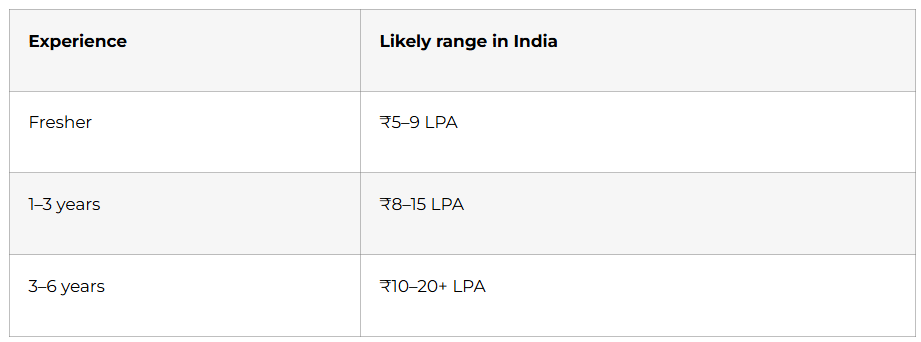
Use salary numbers as directional context, not as guaranteed outcomes. In ML hiring, pay varies sharply based on engineering depth, specialization, and whether the role is more analytics, research, software, or production-focused.
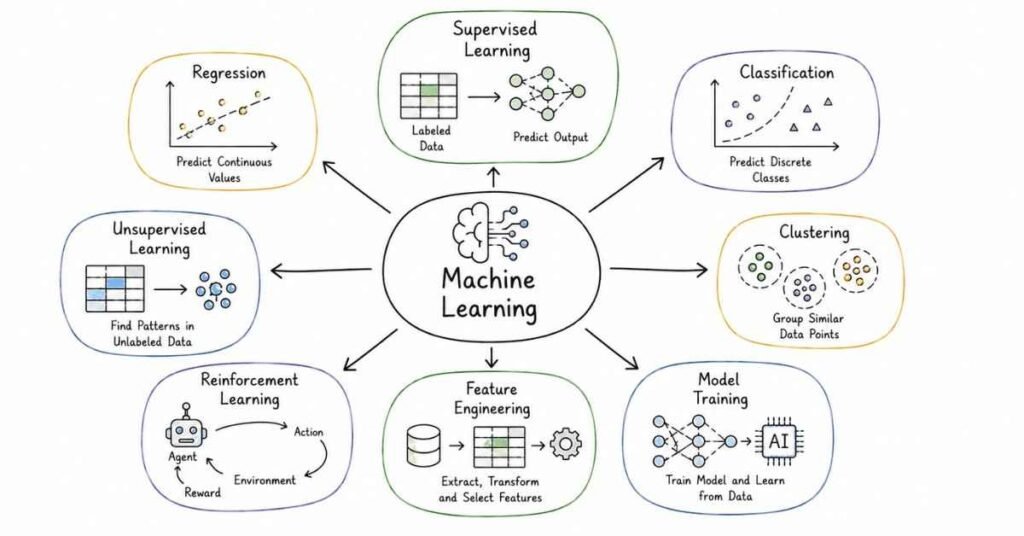
30-day study plan
Week 1: Fundamentals and role clarity
Focus on what machine learning is, the main role types, supervised versus unsupervised learning, regression versus classification, train-validation-test splits, and common interview structure. Begin revising Python basics and make sure you can explain at least one ML project clearly.
Week 2: Python, data handling, and math foundations
Study Python, NumPy, pandas, data cleaning, feature preprocessing, and dataset handling. Alongside that, revise core statistics, probability, distributions, linear algebra basics, and optimization intuition.
Week 3: Algorithms and evaluation
Revise supervised learning algorithms such as linear regression, logistic regression, decision trees, random forests, k-NN, SVM, and naive Bayes. Then focus on model evaluation, cross-validation, regularization, overfitting, underfitting, and hyperparameter tuning.
Week 4: Unsupervised learning, deployment, projects, and mock interviews
Revise clustering, PCA, basic NLP awareness, deployment concepts, MLOps fundamentals, model monitoring, and production thinking. Then practice case studies, project storytelling, behavioral questions, and full mock interview flow.
Follow the Complete Machine Learning Roadmap
Daily study routine
A practical daily routine looks like this:
- 45 minutes of concept revision.
- 60 minutes of coding or model practice.
- 30 minutes of spoken explanation or mock interview practice.
- 15 minutes of notes, flashcards, or project refinement.
If you are a fresher, do not skip spoken explanation practice. Many candidates understand ML topics privately but cannot explain them clearly under pressure.
How to think in ML interviews
A strong machine learning answer often follows this structure:
- Clarify the problem type.
- Understand the data and target variable.
- Clean and preprocess the data.
- Choose an appropriate baseline model.
- Evaluate using the right metric.
- Improve with feature engineering or tuning.
- Discuss deployment, limitations, and monitoring if relevant.
For example, if asked how you would build a churn model, do not jump straight to XGBoost. First clarify the target, imbalance level, business cost of false negatives, available features, baseline approach, metric choice, and deployment context. That structured thinking is often more impressive than naming a sophisticated model too early.
What to do before Part 2
Before moving to Part 2, make sure you can comfortably explain:
- What machine learning is.
- The difference between ML role types.
- Why Python, math, and evaluation matter.
- What type of ML role you are targeting.
- Which 1–2 ML projects you can discuss confidently.
Part 2: ML Fundamentals & Problem Framing Questions 1–40
This part builds the conceptual base for the rest of the machine learning guide. Introductory ML resources consistently divide machine learning into supervised, unsupervised, semi-supervised, and reinforcement learning, while model-generalization references explain that underfitting is associated with high bias, overfitting with high variance, and good ML practice depends on balancing that trade-off while avoiding leakage between train, validation, and test data.
Questions 1–40
1) What is machine learning?
Machine learning is the process of training systems to learn patterns from data so they can make predictions, classifications, recommendations, or decisions without being explicitly programmed for every rule. In interviews, a strong answer usually connects ML to generalization on unseen data rather than memorizing the training set.
2) Why do companies use machine learning?
Companies use machine learning when patterns are too complex, too dynamic, or too large-scale for manual rule-writing. Typical business uses include prediction, ranking, recommendation, anomaly detection, automation, and personalization.
3) What is the difference between traditional programming and machine learning?
In traditional programming, rules are written first and applied to data to get outputs, while in machine learning the system learns useful patterns from data and outputs so it can make future predictions. A good interview answer highlights that ML is especially useful when rules are hard to specify manually.
4) What are the main types of machine learning?
The main types commonly discussed are supervised learning, unsupervised learning, semi-supervised learning, and reinforcement learning. This is one of the most basic and most frequently asked foundational ML questions.
5) What is supervised learning?
Supervised learning means training a model on labeled data, where each input has a known target or answer. Common use cases include predicting house prices, spam detection, and customer churn.
6) What is unsupervised learning?
Unsupervised learning means training on unlabeled data to discover hidden structure, patterns, or groups. Clustering and dimensionality reduction are common examples.
7) What is semi-supervised learning?
Semi-supervised learning uses a small amount of labeled data together with a larger amount of unlabeled data. It is useful when labeling data is expensive but unlabeled data is abundant.
8) What is reinforcement learning?
Reinforcement learning is a learning framework in which an agent interacts with an environment, takes actions, receives rewards or penalties, and learns a strategy to maximize long-term reward. It is conceptually different from standard labeled-data prediction tasks.
9) What is the difference between supervised and unsupervised learning?
Supervised learning uses labeled data and aims to predict a known target, while unsupervised learning uses unlabeled data to find structure such as clusters or latent patterns. This distinction is one of the most important beginner-level ML interview concepts.
10) What is the difference between supervised and reinforcement learning?
Supervised learning learns from labeled examples with known answers, while reinforcement learning learns by trial and error using rewards from an environment. A strong answer also mentions that reinforcement learning focuses on sequential decision-making rather than one-shot prediction.
Problem types
11) What is regression in machine learning?
Regression is a supervised learning task where the target variable is continuous, such as price, demand, revenue, or time. The goal is to predict a numerical value.
12) What is classification in machine learning?
Classification is a supervised learning task where the target variable belongs to one or more classes, such as spam versus not spam or churn versus no churn. The goal is to predict the correct class label or class probability.
13) What is the difference between regression and classification?
Regression predicts continuous values, while classification predicts categories or class labels. This is one of the first distinctions interviewers expect candidates to explain clearly.
14) What is binary classification?
Binary classification means the target has two possible classes, such as yes or no, fraud or not fraud, or default or non-default. It is one of the most common ML problem types in interviews.
15) What is multiclass classification?
Multiclass classification means the target can belong to more than two classes, such as predicting species, product category, or document type. A model must choose among multiple labels instead of only two.
16) What is multilabel classification?
Multilabel classification means one example can belong to multiple classes at the same time, such as tagging an article as politics, economy, and international. It is different from multiclass classification, where only one class is chosen.
17) What is clustering?
Clustering is an unsupervised learning task that groups similar data points together without predefined labels. A common interview answer is that clustering helps discover hidden segments in the data.
18) What is anomaly detection?
Anomaly detection identifies unusual or rare observations that differ significantly from normal patterns. Typical use cases include fraud detection, manufacturing faults, and network intrusion alerts.
19) What is recommendation as an ML problem?
Recommendation involves predicting what a user is likely to prefer, click, watch, or buy next based on past behavior, item properties, or similar users. It is often treated as a ranking or personalization problem.
20) What is forecasting?
Forecasting means predicting future values over time, such as sales next month, traffic next week, or demand next quarter. It is often related to time series methods and regression-style prediction.
Data splitting and leakage
21) Why do we split data in machine learning?
We split data so the model can be trained on one portion and evaluated on unseen data to estimate how well it will generalize. Without proper splitting, it is hard to know whether performance is real or just memorization.
22) What is a training set?
The training set is the portion of data used to fit the model’s parameters. This is the data the model learns from directly.
23) What is a validation set?
The validation set is used to tune hyperparameters, compare models, and make development decisions without touching the final test set. It helps reduce the risk of over-optimizing to the test data.
24) What is a test set?
The test set is held back until the end and used for final unbiased evaluation of the chosen model. A strong interview answer makes it clear that the test set should not guide repeated model tweaking.
25) Why is the train-validation-test split important?
It separates model learning, model selection, and final evaluation into different stages so performance estimates stay more honest. This is a foundational best practice in machine learning.
26) What is data leakage?
Data leakage happens when information from outside the training process improperly enters model development and gives overly optimistic results. Leakage can come from target-related features, preprocessing done on the full dataset, or accidental contamination between train and test data.
27) Why is data leakage dangerous?
It makes the model appear better than it really is, which leads to disappointing performance on real unseen data. In interviews, a strong answer is that leakage damages trust because it creates false confidence during evaluation.
28) Can preprocessing cause leakage?
Yes, preprocessing can cause leakage if steps like scaling, imputation, encoding, or feature selection are fit on the full dataset before splitting. The correct approach is to fit those transformations only on training data and apply them to validation or test data afterward.
29) What is target leakage?
Target leakage happens when a feature contains information that would not actually be available at prediction time but is closely tied to the label. This often creates unrealistically high performance and is a common interview trap.
30) What is a simple example of leakage?
If you are predicting customer churn and include a feature generated after the customer already churned, that feature leaks future information into the model. In interviews, concrete examples like this show practical awareness.
Generalization, bias, variance, and model fit
31) What is underfitting?
Underfitting happens when a model is too simple to capture the real patterns in the data and therefore performs poorly even on the training data. It is commonly associated with high bias.
32) What is overfitting?
Overfitting happens when a model learns noise or overly specific patterns from the training data and performs much worse on new unseen data. It is commonly associated with high variance.
33) How can you recognize underfitting?
A common sign is poor performance on both training and validation data, which suggests the model is not learning enough structure from the dataset. A strong interview answer also mentions that adding complexity or better features may help.
34) How can you recognize overfitting?
A common sign is very good training performance but much worse validation performance, creating a large gap between train and validation results. This means the model is not generalizing well.
35) What is bias in machine learning?
Bias is the error caused by overly simplistic assumptions that make the model miss important structure in the data. High bias is usually linked to underfitting.
36) What is variance in machine learning?
Variance is the amount a model’s predictions would change if trained on different samples of data, reflecting sensitivity to fluctuations in the training set. High variance is usually linked to overfitting.
37) What is the bias-variance tradeoff?
The bias-variance tradeoff is the idea that making a model more complex often reduces bias but increases variance, while simplifying a model often reduces variance but increases bias. Good ML practice aims to find a balance that generalizes well.
38) Why is the bias-variance tradeoff important?
It explains why neither the simplest nor the most complex model is automatically best. Interviewers ask this because it shows whether you understand model behavior beyond just memorizing algorithms.
39) What does it mean for a model to generalize well?
A model generalizes well when it performs strongly not just on the training data but also on new unseen data from the same problem setting. This is one of the most important goals in machine learning.
40) What is feature engineering?
Feature engineering is the process of creating, transforming, selecting, or encoding input variables so models can learn more effectively from the data. Interviewers care about this because better features can improve performance more than simply switching algorithms.
Revision focus
For this part, revise the four types of machine learning, regression versus classification, clustering, train-validation-test splits, data leakage, feature engineering, underfitting, overfitting, bias, variance, and generalization. These topics matter because they form the language of almost every ML interview and strongly shape how you answer later questions on algorithms, evaluation, and deployment.
Part 3: Python, Coding & Data Handling Questions 41–80
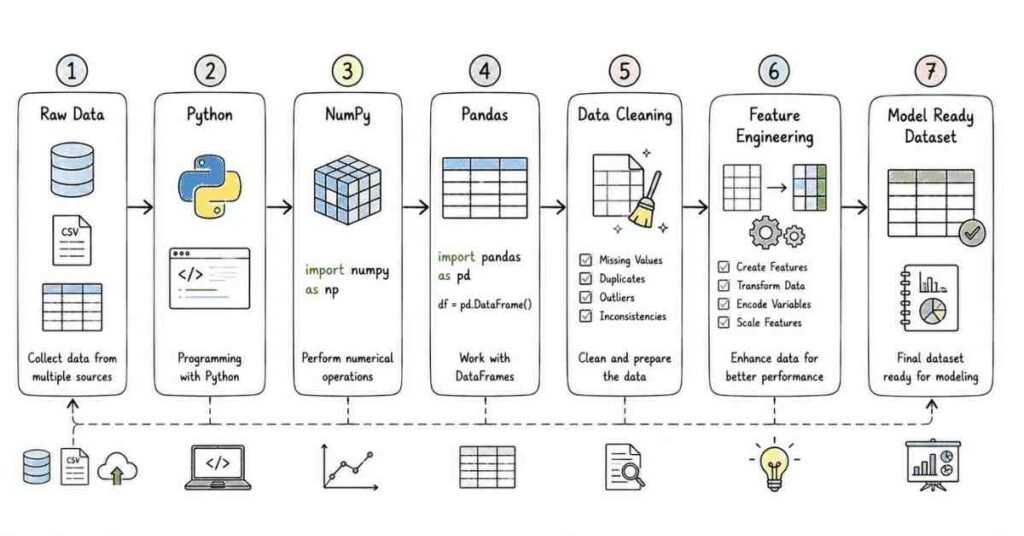
This part covers the Python and data manipulation skills that machine learning interviews often use to test practical readiness. Current preprocessing resources describe data preprocessing as the first step in ML pipelines, while pandas-focused guides consistently emphasize cleaning, transforming, grouping, merging, and handling missing values as core operations for model-ready data.
Questions 41–80
41) Why is Python important in machine learning interviews?
Python is important because it is the most common language used for data handling, prototyping, model training, preprocessing, and ML experimentation. Even if the role emphasizes theory, interviewers usually expect you to work comfortably with Python-based workflows.
42) What kinds of Python skills are usually tested in ML interviews?
Interviewers commonly test core syntax, functions, loops, conditionals, lists, dictionaries, NumPy, pandas, preprocessing, and basic debugging. In practical rounds, they often care more about clean reasoning and correct data handling than about writing highly complex code.
43) Why do ML interviews test coding at all?
Because real ML work involves cleaning data, transforming features, testing assumptions, and building repeatable pipelines rather than only choosing algorithms. Coding rounds help verify that you can move from raw data to model-ready input.
44) What Python data structures should you know well?
You should know lists, tuples, sets, and dictionaries well, along with when to use each. These are basic but important because they appear constantly in preprocessing and coding problems.
45) What is a list in Python?
A list is an ordered, mutable collection of items. It is commonly used to store sequences of values such as feature names, predictions, or records.
46) What is a tuple in Python?
A tuple is an ordered but immutable collection. It is useful when you want grouped values that should not be modified after creation.
47) What is a dictionary in Python?
A dictionary stores key-value pairs and is very useful for mappings, counters, configuration settings, and structured feature metadata. It is one of the most commonly used Python data structures in ML-related coding.
48) What is a set in Python?
A set is an unordered collection of unique elements. It is useful for removing duplicates and checking membership efficiently.
49) What is the difference between mutable and immutable objects?
Mutable objects can be changed after creation, while immutable objects cannot. A strong beginner answer includes examples such as lists being mutable and tuples or strings being immutable.
50) Why are functions important in ML coding?
Functions help organize logic into reusable, testable blocks and make code easier to debug and maintain. Interviewers often like candidates who break tasks into clean functions instead of writing one long script.
Core Python coding habits
51) Why are loops important in Python?
Loops help you process repeated operations such as iterating over rows, files, features, or model outputs. Even though vectorized tools are often preferred, basic loop understanding is still essential.
52) What is the difference between a for loop and a while loop?
A for loop is typically used when iterating over a sequence or known range, while a while loop continues until a condition becomes false. In most data work, for loops appear more often.
53) What are list comprehensions?
List comprehensions are a compact way to create lists by applying an expression over an iterable. They are often used for simple transformations and filtering.
54) Why should you avoid unnecessary loops in data work?
Because vectorized libraries like NumPy and pandas are usually faster, cleaner, and more efficient for working with arrays and tables. A good interview answer shows that you know loops are useful, but not always the best tool for tabular operations.
55) What is debugging in Python?
Debugging is the process of identifying and fixing errors, logical mistakes, or unexpected behavior in code. In ML work, debugging often involves checking shapes, missing values, dtypes, merges, and unexpected outputs.
56) What are common types of Python errors?
Common types include syntax errors, type errors, key errors, index errors, value errors, and attribute errors. Interviewers may not ask for all of these directly, but practical coding tasks often expose them.
57) Why is reading error messages important?
Because Python error messages often tell you where the issue happened and what type of problem occurred. Strong candidates use them to debug systematically instead of guessing randomly.
58) What is a strong debugging approach in ML tasks?
A strong approach is to inspect shapes, column names, data types, missing values, intermediate outputs, and assumptions step by step. This is often more valuable in interviews than writing fancy code quickly.
NumPy basics
59) What is NumPy?
NumPy is a Python library for numerical computing built around fast multidimensional arrays and vectorized operations. It is foundational for ML because many data and model operations rely on array-based computation.
60) Why is NumPy important in machine learning?
NumPy helps handle arrays efficiently, supports mathematical operations, and underlies many other ML and data science libraries. A lot of model inputs, parameters, and transformations are easiest to reason about as arrays.
61) What is a NumPy array?
A NumPy array is a fast, homogeneous, n-dimensional array object used for storing and operating on numerical data. It is more efficient than standard Python lists for many numerical tasks.
62) What is vectorization in NumPy?
Vectorization means applying operations to entire arrays at once instead of using explicit Python loops. This makes code faster and often easier to read for numerical operations.
63) What is broadcasting in NumPy?
Broadcasting is the ability to perform operations on arrays of different shapes when NumPy can align them under defined rules. It is useful, but candidates should also be careful because unexpected shape behavior can create bugs.
64) Why should you check array shape in ML code?
Because models, matrix operations, and preprocessing steps often expect inputs in specific dimensions. Shape mismatches are one of the most common practical errors in ML coding.
pandas basics
65) What is pandas?
Pandas is a Python library for working with structured or tabular data, especially through Series and DataFrames. It is one of the most important tools for data cleaning and preprocessing in ML pipelines.
66) What is a DataFrame?
A DataFrame is a two-dimensional tabular structure with rows and columns, similar to a spreadsheet or SQL table. It is the main pandas object used in data preparation and exploratory analysis.
67) Why is pandas so important for ML interviews?
Because most real-world ML problems begin with messy tabular data that needs cleaning, merging, encoding, filtering, and validation before modeling. Interviewers use pandas questions to test practical data readiness, not just library familiarity.
68) How do you load data into pandas?
A common method is pd.read_csv() for CSV files, though pandas also supports Excel, JSON, SQL, and other sources. Loading data is often the first step in a notebook-style interview task.
69) What are the first things to inspect in a DataFrame?
A strong answer includes checking .head(), .shape, .columns, .dtypes, .info(), and missing values before doing transformations. This shows disciplined data handling rather than jumping straight into modeling.
70) How do you select columns in pandas?
You typically select one column with bracket notation and multiple columns with a list of names. Column selection is one of the most basic but most frequent pandas operations.
71) How do you filter rows in pandas?
You filter rows using boolean conditions, which works conceptually like WHERE clauses in SQL. This is essential for subsetting training data, segments, or cleaned records.
72) What does groupby() do in pandas?
groupby() splits data into groups and lets you aggregate or transform each group independently. It is widely used for summary statistics, feature generation, and grouped analysis.
73) What does merge() do in pandas?
merge() combines DataFrames based on common keys, similar to joins in SQL. This is especially important when training data is spread across multiple tables or files.
74) Why should you be careful after a merge?
Because wrong keys, duplicate keys, or missing matches can change row counts and introduce data quality issues. A strong answer mentions checking row counts and missing values after the merge.
75) What does concat() do in pandas?
concat() combines DataFrames along rows or columns, depending on the axis used. It is useful when stacking similar datasets from multiple sources or periods.
Missing values and preprocessing
76) Why is missing-value handling important in ML?
Because missing values can break model training, distort feature calculations, and bias results if handled carelessly. Preprocessing guides consistently describe cleaning and organizing data as a necessary first step before modeling.
77) How do you detect missing values in pandas?
You typically use methods like .isna() or check summary statistics and null counts. Identifying missingness early is an important part of preprocessing.
78) What are common ways to handle missing values?
Common methods include dropping rows or columns, filling with constants, or imputing with values like mean, median, or mode. A good answer also mentions that the choice depends on the feature, missingness pattern, and business meaning.
79) Why is preprocessing important before model training?
Because raw data is often noisy, inconsistent, incomplete, or poorly formatted, and models depend on clean, structured inputs. Preprocessing typically includes cleaning, transforming, and organizing the data into a model-ready form.
80) What are common preprocessing tasks in machine learning?
Common preprocessing tasks include handling missing values, encoding categorical variables, scaling or normalization, feature creation, removing duplicates, fixing data types, and splitting data correctly. In interviews, this answer is strong because it frames preprocessing as a pipeline rather than one isolated step.
Revision focus
For this part, revise Python data structures, functions, loops, debugging, NumPy arrays, vectorization, pandas DataFrames, loading data, filtering, grouping, merging, missing values, and preprocessing basics. These topics matter because ML coding rounds often test whether you can move from raw data to clean, structured, model-ready input using clear and reliable Python code rather than just explain algorithms in theory.
Part 4: Statistics, Probability & Math for ML Questions 81–120
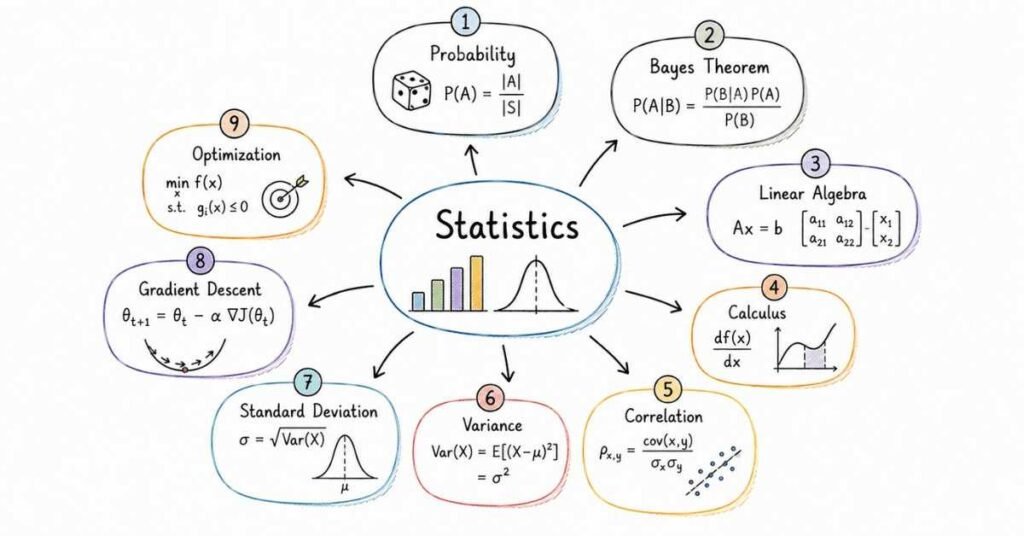
This part covers the mathematical foundations interviewers use to test whether you understand how machine learning works beneath the library layer. Introductory ML math resources consistently describe linear algebra, probability and statistics, and calculus as the core foundations for representing data, modeling uncertainty, and optimizing loss functions, while standard CLT references explain that sample means tend toward a normal distribution as sample size grows, even when the original population is not normal.
Questions 81–120
81) Why is math important in machine learning?
Math is important because it explains how models represent data, measure error, estimate uncertainty, and update parameters during training. A strong interview answer is that math helps you understand not just how to run models, but why they behave the way they do.
82) What areas of math matter most for machine learning?
The three main areas are linear algebra, probability and statistics, and calculus. These support data representation, uncertainty reasoning, and optimization respectively.
83) Why do interviewers ask math questions in ML interviews?
They ask math questions to check whether you understand the logic behind models, not just how to use libraries. Even if the role is practical, a solid intuitive grasp of math usually signals stronger ML depth.
84) What is a variable in statistics?
A variable is any measurable quantity or attribute that can take different values, such as age, salary, class label, or probability score. Features and target variables in ML are both examples of variables.
85) What is a random variable?
A random variable is a variable whose value depends on the outcome of a random process. In ML and statistics, random variables are often used to model uncertain outcomes.
86) What is expected value?
Expected value is the long-run average value of a random variable over repeated trials. In interviews, a simple answer is that it represents the average outcome you would expect over time.
87) What is variance?
Variance measures how far values tend to spread around the mean. A larger variance means greater dispersion in the data.
88) What is standard deviation?
Standard deviation is the square root of variance and represents spread in the same units as the data. It is often easier to interpret than variance directly.
89) What is a probability distribution?
A probability distribution describes how likely different values or outcomes are. It is a core idea in machine learning because many models depend on assumptions about how data or errors are distributed.
90) Why do probability distributions matter in ML?
They matter because they help model uncertainty, define likelihood, and support inference and prediction. Many algorithms assume or exploit distributions in some form, even when that assumption is only approximate.
Probability basics
91) What is probability?
Probability is a measure of how likely an event is to occur, typically ranging from 0 to 1. It forms the basis for uncertainty modeling in statistics and machine learning.
92) What is conditional probability?
Conditional probability is the probability of one event occurring given that another event has already occurred. It is important in ML for updating beliefs and reasoning about dependent events.
93) What is joint probability?
Joint probability is the probability that two events happen together. It is often used when reasoning about combined feature relationships or multiple outcomes.
94) What is independence in probability?
Two events are independent if the occurrence of one does not change the probability of the other. This idea matters because many statistical simplifications rely on independence assumptions.
95) What is Bayes’ theorem?
Bayes’ theorem is a rule that updates the probability of a hypothesis using new evidence. In simple interview language, it helps revise prior belief after observing data.
96) Why is Bayes’ theorem important in ML?
It is important because it provides a principled way to update probabilities based on evidence, and it underlies methods such as Naive Bayes. More broadly, it helps candidates think clearly about prior belief, observed evidence, and posterior probability.
97) What is prior probability?
Prior probability is your belief about an event or hypothesis before observing the new evidence. In Bayes-style reasoning, it is the starting point before the update.
98) What is posterior probability?
Posterior probability is the updated probability after new evidence has been taken into account. It is the output of Bayes-style updating.
99) What is likelihood?
Likelihood describes how probable the observed data is under a particular model or parameter setting. In interviews, a safe answer is that models often choose parameters that make the observed data more likely.
100) What is the difference between probability and likelihood?
Probability usually treats parameters as fixed and asks how likely data is, while likelihood treats observed data as fixed and compares parameter values. This distinction matters in model fitting and statistical inference.
Sampling and Central Limit Theorem
101) What is a population?
A population is the full set of items, observations, or outcomes you want to understand. In ML, available data is usually only a sample from a broader real-world population.
102) What is a sample?
A sample is a subset drawn from the population for analysis or model training. Since models learn from samples, sample quality strongly affects model quality.
103) Why is sampling important in ML?
Sampling matters because models trained on one sample must generalize to unseen data from the broader population. Poor or biased samples can create weak, misleading, or unfair models.
104) What is sampling bias?
Sampling bias happens when the sample is not representative of the population. This can cause models to learn distorted patterns that do not generalize well.
105) What is a sampling distribution?
A sampling distribution is the distribution of a statistic, such as the sample mean, over many repeated samples. This concept helps explain estimation uncertainty and inferential methods.
106) What is the Central Limit Theorem?
The Central Limit Theorem says that for sufficiently large independent and identically distributed samples with finite variance, the distribution of sample means approaches a normal distribution even if the original population is not normal. This is one of the most important ideas in practical statistics.
107) Why is the Central Limit Theorem important in ML?
It matters because it supports statistical inference, uncertainty estimation, and repeated-evaluation reasoning in model validation and experimentation. Standard ML-oriented explanations also note that it helps justify normal approximations for sample-based statistics.
108) What happens to the sampling distribution as sample size increases?
As sample size increases, the sampling distribution of the mean becomes more normal and its spread shrinks around the population mean. This makes estimates more stable and precise.
109) What is standard error?
Standard error measures the variability of a sample statistic, especially the sample mean, across repeated samples. It gets smaller as sample size increases.
110) Why is standard error useful?
It helps quantify uncertainty around estimates and is used in confidence intervals, hypothesis testing, and model evaluation comparisons. In interviews, a concise answer is that it tells you how much a sample-based estimate is expected to vary.
Correlation, causation, and distributions
111) What is correlation?
Correlation measures the strength and direction of association between two variables. It tells you whether variables tend to move together, but not why.
112) What is causation?
Causation means one factor directly affects another. In interviews, a strong answer is that correlation may suggest a relationship, but it does not prove causation.
113) Why is correlation not the same as causation?
Because two variables can move together due to coincidence, a hidden confounder, reverse causality, or shared trends. This is a classic interview concept because ML often identifies associations, not causal mechanisms.
114) Why does correlation still matter in ML?
It matters because correlated features can reveal useful predictive relationships even when they are not causal. Machine learning often cares more about predictive signal than causal explanation, depending on the problem.
115) What is a normal distribution?
A normal distribution is a symmetric bell-shaped distribution in which values cluster around the mean with fewer observations far from the center. It is widely used because many natural and sample-based phenomena approximate it.
116) What is a skewed distribution?
A skewed distribution is asymmetrical, with a longer tail on one side than the other. Many real-world business variables like income, time-on-site, and transaction size are skewed rather than normal.
117) What is a uniform distribution?
A uniform distribution gives equal probability to all outcomes within a defined range. It is simple conceptually and often used in simulation or initialization examples.
Linear algebra and calculus intuition
118) Why is linear algebra important in ML?
Linear algebra is important because data, features, weights, and transformations are often represented as vectors and matrices. Many ML computations such as dot products, matrix multiplication, projections, and dimensionality reduction rely on linear algebra concepts.
119) Why is calculus important in ML?
Calculus is important because training many models involves minimizing a loss function using gradients and derivatives. Introductory ML math references specifically describe calculus as the basis for optimization and parameter updates during learning.
120) What is gradient descent in simple terms?
Gradient descent is an optimization method that updates model parameters step by step in the direction that reduces the loss function most efficiently. A strong beginner answer is that it uses gradients to move downhill toward better parameter values.
Revision focus
For this part, revise probability basics, conditional probability, Bayes’ theorem, sampling, the Central Limit Theorem, standard error, distributions, correlation versus causation, and the intuition behind linear algebra and calculus in ML. These topics matter because they explain uncertainty, model fitting, and optimization, which are the mathematical ideas that appear repeatedly across algorithms, evaluation, and training discussions.
Part 5: Supervised Learning Algorithms — Questions 121–160
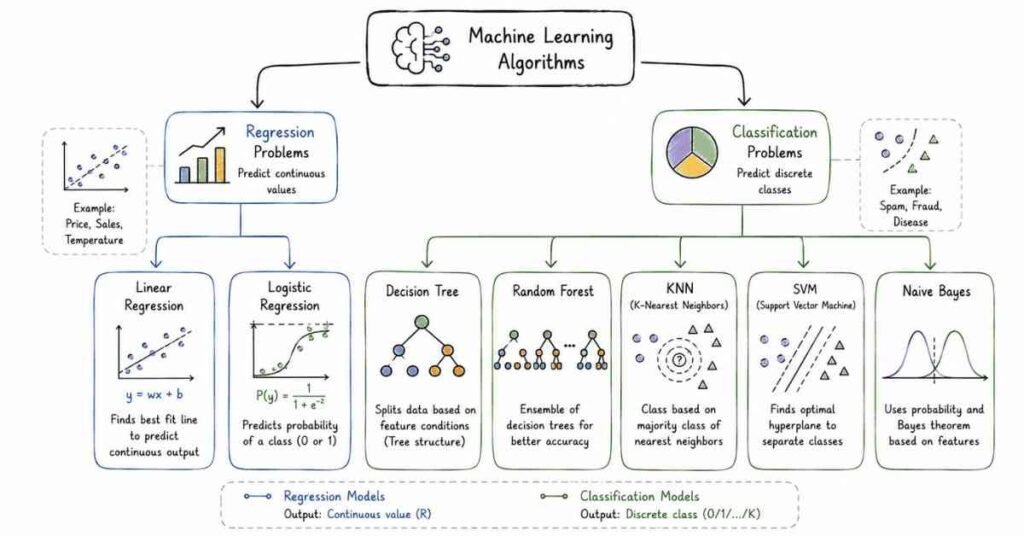
This part covers the mathematical foundations interviewers use to test whether you understand how machine learning works beneath the library layer. Introductory ML math resources consistently describe linear algebra, probability and statistics, and calculus as the core foundations for representing data, modeling uncertainty, and optimizing loss functions, while standard CLT references explain that sample means tend toward a normal distribution as sample size grows, even when the original population is not normal.
Questions 121–160
121) What is supervised learning again in practical terms?
Supervised learning means learning a mapping from input features to a known target using labeled examples. In interview terms, it is the family of methods used for prediction tasks such as classification and regression.
122) What are the most common supervised learning algorithms asked in interviews?
The most commonly discussed ones are linear regression, logistic regression, decision trees, random forests, k-nearest neighbors, support vector machines, and Naive Bayes. These appear repeatedly in beginner and intermediate ML interview preparation content.
123) How should you answer “how do you choose an algorithm” in interviews?
A strong answer is that you choose based on problem type, data size, interpretability needs, feature types, nonlinearity, training speed, and evaluation metric rather than by assuming one model is always best. Interviewers usually want to hear structured reasoning, not just a favorite model name.
124) What is a baseline model?
A baseline model is a simple starting model used as a reference point for later improvements. In interviews, saying you start with a baseline shows disciplined modeling rather than immediately jumping to complex algorithms.
125) Why are simple models still important?
Simple models are often easier to interpret, quicker to train, and useful for checking whether more complex models actually add value. A strong answer is that complexity should be earned, not assumed.
Linear regression
126) What is linear regression?
Linear regression is a supervised learning algorithm used for predicting a continuous target by modeling a linear relationship between features and the output. It is one of the most foundational algorithms in machine learning interviews.
127) When do you use linear regression?
You use linear regression when the target variable is continuous, such as price, demand, cost, or revenue. It works best when a roughly linear relationship is a reasonable approximation.
128) Why is linear regression important in interviews?
It is important because it teaches core concepts like coefficients, residuals, assumptions, loss minimization, and interpretability. Interviewers also use it to test whether you understand regression as more than just fitting a line.
129) What is the intuition behind linear regression?
The intuition is that the model finds the best-fitting linear relationship between input features and the target by minimizing prediction error. A concise answer is that it learns weights showing how features contribute to the predicted value.
130) What are common assumptions of linear regression?
Common assumptions include linearity, independence of errors, constant variance of errors, and limited multicollinearity among features. In interviews, it is usually enough to mention these at a high level unless asked to go deeper.
Logistic regression
131) What is logistic regression?
Logistic regression is a supervised learning algorithm mainly used for classification, especially binary classification. It models class probability rather than predicting a continuous value.
132) Why is logistic regression called regression if it is used for classification?
It is called regression because it models a function of the input features mathematically in a regression-like way, but the output is transformed into a probability for classification. This naming confusion is a very common interview question.
133) What does logistic regression output?
It outputs a probability, usually for one class such as the probability of fraud, churn, or spam. That probability is then converted into a class label using a threshold.
134) What is the sigmoid function in logistic regression?
The sigmoid function maps any real-valued score into a value between 0 and 1, making it suitable for probability-like outputs. Interviewers often ask this to see whether you understand why logistic regression works for classification.
135) When should you use logistic regression?
You use logistic regression when you need a simple, interpretable classification model and the relationship between features and log-odds is reasonably learnable. It is often a strong baseline classifier.
Decision trees and random forests
136) What is a decision tree?
A decision tree is a supervised learning algorithm that makes predictions by repeatedly splitting the data into subsets based on feature values, forming a tree-like structure of decisions. It can be used for both classification and regression.
137) Why are decision trees popular?
Decision trees are popular because they are easy to visualize, relatively interpretable, and can capture nonlinear relationships without requiring much feature scaling. They also handle both numerical and categorical-style decision logic well conceptually.
138) What is the main weakness of decision trees?
A single decision tree can overfit easily if allowed to grow too deep or become too specific. This is one reason ensemble tree methods are often preferred in practice.
139) What is a random forest?
A random forest is an ensemble of multiple decision trees whose combined predictions usually improve robustness and reduce overfitting compared with one tree alone. It is one of the most common interview algorithms for discussing ensemble learning.
140) Why is random forest often better than a single decision tree?
Because averaging across many trees reduces variance and makes the model more stable than relying on one tree’s exact splits. A strong answer is that it usually improves generalization while keeping much of the tree-based flexibility.
141) What are the trade-offs of random forest?
Random forests are usually stronger than single trees but less interpretable and more computationally expensive. They also may not be ideal when you need the simplest possible explanation of individual predictions.
KNN, SVM, and Naive Bayes
142) What is k-nearest neighbors or KNN?
KNN is a supervised algorithm that predicts a label or value based on the nearest data points in the feature space. It is often described as an instance-based or lazy learning method.
143) Why is KNN called a lazy learner?
Because it does not build a strong explicit model during training and instead stores the data, doing most of the work at prediction time. This is a useful interview detail because it explains KNN’s training and inference trade-off.
144) What are the strengths of KNN?
KNN is simple, intuitive, and can work well for smaller datasets with a reasonable distance measure. It is often useful as a baseline or teaching algorithm.
145) What are the weaknesses of KNN?
KNN can become slow on large datasets, sensitive to feature scaling, and affected by irrelevant features. A good answer also mentions that choosing kkk well matters a lot.
146) What is a support vector machine or SVM?
SVM is a supervised learning algorithm that tries to find a decision boundary, often described as a hyperplane, that best separates classes. It can handle both linear and nonlinear classification through kernels.
147) Why are SVMs powerful?
SVMs are powerful because they focus on maximizing the margin between classes, which can improve generalization. They can also model nonlinear class boundaries using kernel methods.
148) What is a kernel in SVM?
A kernel is a method that allows SVM to work in transformed feature spaces without explicitly computing all coordinates there. In interviews, a simple answer is that kernels help SVM handle nonlinear patterns.
149) What is Naive Bayes?
Naive Bayes is a probabilistic classifier based on Bayes’ theorem that assumes features are conditionally independent given the class. It is commonly used in text classification and other fast classification tasks.
150) Why is it called “naive” Bayes?
It is called “naive” because it makes the strong simplifying assumption that features are conditionally independent given the class label. Interviewers ask this often because the assumption is central to understanding the method.
151) When does Naive Bayes work surprisingly well?
It often works well when the independence assumption is not perfectly true but still good enough for useful classification, especially in high-dimensional text problems. This is a strong practical point to mention in interviews.
Model behavior and algorithm trade-offs
152) Which algorithm is most interpretable among these?
Linear regression, logistic regression, and shallow decision trees are generally among the most interpretable. A strong answer adds that interpretability depends on both the algorithm and the complexity of the final fitted model.
153) Which of these algorithms can capture nonlinear patterns?
Decision trees, random forests, KNN, and kernel SVMs can capture nonlinear relationships more naturally than plain linear or logistic regression. This is one of the most common model-comparison questions in interviews.
154) Which algorithms are sensitive to feature scaling?
KNN and SVM are especially sensitive to feature scaling because they depend heavily on distances or geometry in feature space. Logistic regression can also benefit from scaling in some optimization settings.
155) Which algorithm is a good starting point for classification?
Logistic regression is often a strong baseline because it is simple, fast, and interpretable. Decision trees and random forests are also common starting points depending on the data and business needs.
156) Which algorithm is a good starting point for regression?
Linear regression is a natural baseline for regression because it is simple and interpretable. Tree-based methods are often added later if the relationship appears more nonlinear.
157) Why do interviewers ask for algorithm comparisons instead of only definitions?
Because real ML work is about choosing and evaluating models under constraints, not just memorizing them. Good candidates explain trade-offs like interpretability, nonlinearity, speed, scaling sensitivity, and robustness.
158) What is regularization in simple terms?
Regularization is a way to discourage overly complex models by penalizing large parameter values or excessive flexibility. Interviewers often connect this concept to controlling overfitting.
159) What is the difference between Ridge and Lasso regularization?
Ridge, or L2 regularization, shrinks coefficients toward zero, while Lasso, or L1 regularization, can shrink some coefficients all the way to zero. A concise answer is that Ridge mostly reduces magnitude, while Lasso can also perform feature selection.
160) What is a strong closing answer if asked how you pick a supervised model?
A strong answer is: “I start with the problem type and a simple baseline, check data size and feature characteristics, choose metrics that match the business goal, compare a few suitable models, validate carefully, and then balance performance with interpretability and deployment constraints”. That kind of answer shows practical ML thinking rather than just theory.
Revision focus
For this part, revise linear regression, logistic regression, decision trees, random forests, KNN, SVM, Naive Bayes, and the high-level logic of regularization and model selection. These topics matter because they are the core supervised algorithms interviewers expect you to explain, compare, and choose between in realistic scenarios rather than just define from memory.
Part 6: Unsupervised Learning, NLP & Clustering — Questions 161–200
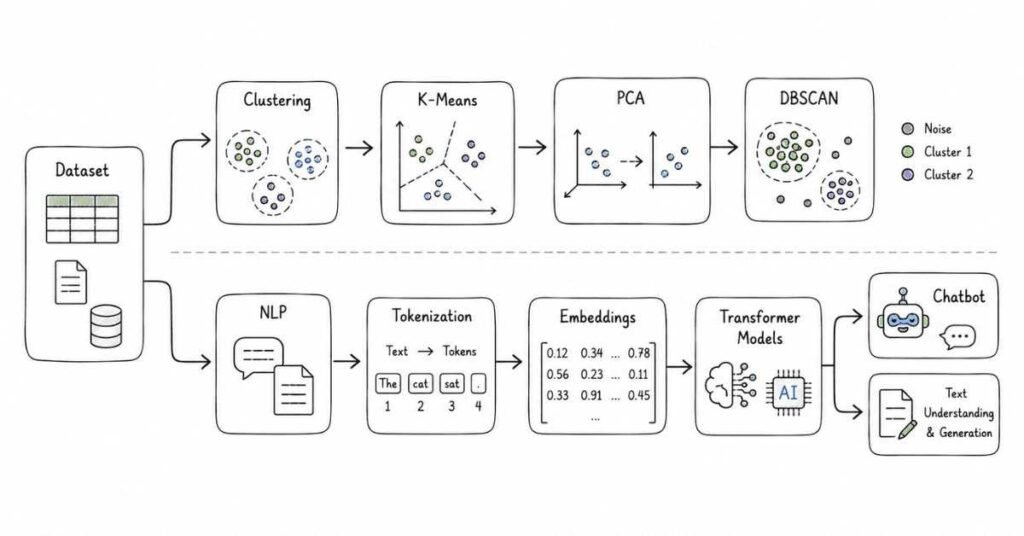
This part covers unsupervised learning concepts, common clustering methods, dimensionality reduction, anomaly detection, and the NLP basics that frequently appear in ML interviews. Current unsupervised-learning resources consistently describe clustering as finding structure in unlabeled data, with k-means, hierarchical clustering, DBSCAN, and PCA appearing as standard interview topics, while NLP references highlight text preprocessing and transformer awareness as essential modern foundations.
Questions 161–200
161) What is unsupervised learning in practical terms?
Unsupervised learning means working with unlabeled data to discover hidden structure, groups, patterns, or compressed representations. Instead of predicting a known target, the goal is usually exploration, segmentation, pattern discovery, or representation learning.
162) Why is unsupervised learning useful?
It is useful when labeled data is unavailable, expensive to collect, or when you want to explore the structure of the data before defining a supervised target. Common use cases include customer segmentation, anomaly detection, topic discovery, and feature compression.
163) What are the most common unsupervised learning tasks?
The most common tasks are clustering, dimensionality reduction, anomaly detection, and association or structure discovery. In interviews, clustering and PCA are especially common.
164) What is clustering?
Clustering is the process of grouping similar data points together without predefined labels. It is one of the most common unsupervised learning tasks in ML interviews.
165) What is a good real-world use case for clustering?
A classic example is customer segmentation, where users are grouped by behavior or attributes so a business can target them differently. Other common uses include document grouping, image grouping, and anomaly exploration.
166) What is the main challenge in clustering?
The main challenge is that there is no single “correct” clustering in all cases, so results depend heavily on distance choice, scaling, feature design, and business interpretation. A strong interview answer shows that clustering is exploratory, not magic.
K-means clustering
167) What is k-means clustering?
K-means is a clustering algorithm that partitions data into kkk clusters by assigning each point to the nearest centroid and iteratively updating those centroids. It is one of the most standard clustering algorithms asked in interviews.
168) Why is it called k-means?
It is called k-means because you choose kkk, the number of clusters, and each cluster is represented by the mean of the points assigned to it, which becomes the centroid.
169) What are the main steps in k-means?
The usual steps are: initialize kkk centroids, assign each point to the nearest centroid, recompute centroids as cluster means, and repeat until assignments stabilize. This iterative refinement is a common interview explanation.
170) What are the strengths of k-means?
K-means is simple, relatively fast, and works well when clusters are roughly compact and spherical. It is often a strong baseline clustering method.
171) What are the weaknesses of k-means?
K-means requires choosing the number of clusters in advance and can perform poorly when clusters are non-spherical, have different densities, or contain many outliers. It is also sensitive to initialization and feature scaling.
172) Why is scaling important before k-means?
Because k-means relies on distance, and features on larger numeric scales can dominate the clustering result if data is not standardized. This is a very common practical interview point.
Hierarchical clustering and DBSCAN
173) What is hierarchical clustering?
Hierarchical clustering is a family of clustering methods that builds nested clusters by successively merging or splitting groups. It produces a hierarchy rather than forcing a flat partition from the start.
174) What is a dendrogram?
A dendrogram is a tree-like diagram that visualizes how clusters are merged or split in hierarchical clustering. It helps decide where to cut the hierarchy to form final clusters.
175) What is the advantage of hierarchical clustering?
It can reveal cluster structure at multiple levels and does not always require fixing the final number of clusters upfront in the same way as k-means. It is often useful for exploratory analysis.
176) What is DBSCAN?
DBSCAN is a density-based clustering algorithm that groups together points in dense regions and marks isolated points as noise or outliers. It is especially useful when clusters are irregularly shaped.
177) Why is DBSCAN useful?
DBSCAN is useful because it can discover arbitrarily shaped clusters and naturally identify outliers. Unlike k-means, it does not require choosing the number of clusters directly in advance.
178) What are the main limitations of DBSCAN?
DBSCAN can struggle when cluster densities vary significantly, and choosing its parameters well can be difficult. A strong answer also mentions that performance may degrade in high-dimensional settings.
Dimensionality reduction and PCA
179) What is dimensionality reduction?
Dimensionality reduction means reducing the number of features while trying to preserve useful information in the data. It is commonly used for visualization, noise reduction, and improving modeling efficiency.
180) Why is dimensionality reduction useful?
It can reduce noise, improve computational efficiency, help visualization, and sometimes improve downstream model performance when redundant features exist. It is especially useful when many features are correlated.
181) What is PCA?
PCA, or Principal Component Analysis, is a dimensionality reduction technique that creates new orthogonal directions called principal components that capture as much variance as possible. It is one of the most common dimensionality-reduction topics in ML interviews.
182) What is the intuition behind PCA?
The intuition is that PCA rotates the data into a new coordinate system so the first few directions capture most of the variation in the data. This allows you to keep fewer dimensions while retaining much of the structure.
183) Why is variance important in PCA?
Because PCA chooses principal components based on how much variance they explain. The components with higher explained variance preserve more of the dataset’s information content in the PCA sense.
184) What is explained variance in PCA?
Explained variance tells you how much of the total data variation is captured by each principal component. Interviewers often ask about it because it helps determine how many components to keep.
185) What are common uses of PCA?
Common uses include visualization in 2D or 3D, noise reduction, compressing features, and simplifying high-dimensional inputs before other analysis. It can also help reduce redundancy among correlated variables.
186) What is a limitation of PCA?
PCA is a linear method, so it may not capture complex nonlinear structure well. It can also reduce interpretability because principal components are combinations of original features.
Anomaly detection and unsupervised reasoning
187) What is anomaly detection?
Anomaly detection is the process of identifying data points that differ strongly from the normal pattern. Common use cases include fraud detection, equipment failure, and suspicious activity monitoring.
188) How is anomaly detection related to clustering?
Some clustering-style methods treat points far from dense clusters as anomalies, and DBSCAN explicitly labels low-density isolated points as noise. This makes clustering ideas useful for anomaly exploration.
189) When should you use unsupervised methods instead of supervised methods?
You use unsupervised methods when labels are unavailable, the goal is exploration, or you want to learn structure before defining a prediction task. A strong answer also mentions that unsupervised learning can support feature engineering or pre-model understanding.
NLP basics
190) What is NLP?
NLP, or Natural Language Processing, is the field focused on enabling computers to process, analyze, and work with human language. In ML interviews, basic NLP awareness is increasingly important because text data is common.
191) What are common NLP tasks?
Common NLP tasks include text classification, sentiment analysis, topic modeling, named entity recognition, translation, summarization, and text generation. In interviews, text classification is especially common as a beginner example.
192) What is text preprocessing in NLP?
Text preprocessing means cleaning and converting raw text into a form suitable for modeling, often through steps like tokenization, normalization, stop-word handling, stemming, or lemmatization. It is one of the first stages in many NLP pipelines.
193) What is tokenization?
Tokenization is the process of splitting text into smaller units such as words, subwords, or sentences. It is a basic preprocessing step in almost every NLP workflow.
194) What is stemming?
Stemming reduces words to a root-like form by chopping off endings, often in a rough heuristic way. It is simple but can produce less natural roots than lemmatization.
195) What is lemmatization?
Lemmatization reduces words to their meaningful base or dictionary form, usually in a more linguistically informed way than stemming. In interviews, a concise distinction is that lemmatization is generally cleaner but more informed.
196) What is a bag-of-words representation?
Bag-of-words represents a document by counting word occurrences without preserving full word order. It is simple and historically important, though modern methods often use richer representations.
197) What is an embedding?
An embedding is a dense numerical representation of text units such as words, sentences, or documents that captures semantic relationships better than sparse count-based features. In interviews, a good answer is that embeddings map language into vectors that preserve meaning-related structure.
198) Why are embeddings important in modern NLP?
They are important because they capture semantic similarity and support more powerful models than simple count-based features. This is one reason embeddings became central to modern NLP workflows.
199) What is a transformer at a high level?
A transformer is a neural architecture designed for sequence modeling that became central to modern NLP and large language models. In interview terms, it is enough to say transformers process context efficiently and power many current text models.
200) What level of NLP depth is usually enough for general ML interviews?
For general ML interviews, basic text preprocessing, bag-of-words or embedding awareness, common NLP tasks, and high-level transformer awareness are usually enough unless the role is NLP-specific. Specialized NLP roles, of course, require much deeper understanding.
Revision focus
For this part, revise clustering, k-means, hierarchical clustering, DBSCAN, dimensionality reduction, PCA, anomaly detection, text preprocessing, embeddings, and high-level transformer awareness. These topics matter because they test whether you can work with unlabeled data and text data, which are both common in modern ML interview scenarios beyond standard supervised prediction.
Part 7: Model Evaluation, Validation & Tuning — Questions 201–240
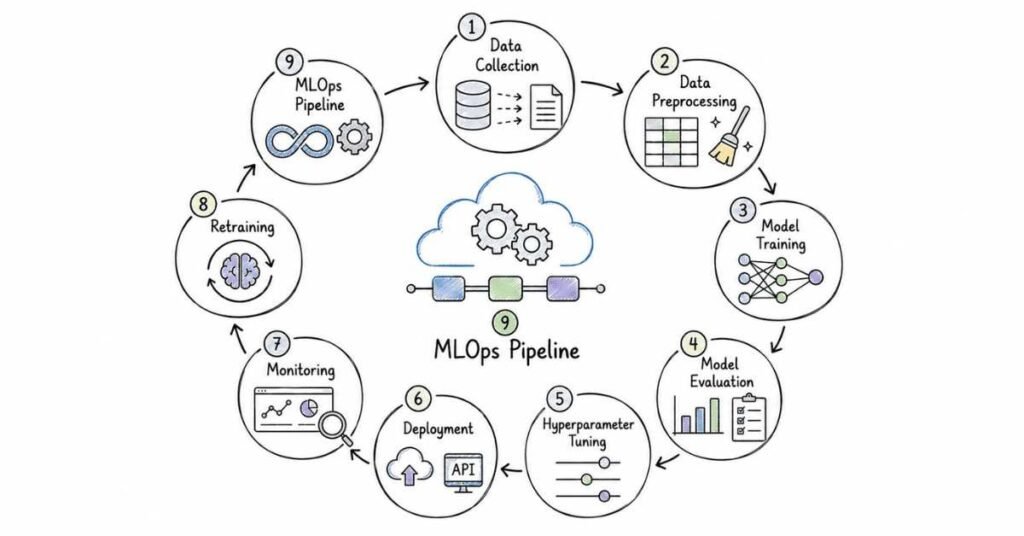
This part covers how to measure model performance correctly, validate models honestly, and improve them without fooling yourself. Current evaluation guides consistently emphasize confusion matrix metrics, precision, recall, F1 score, ROC-AUC, regression metrics, cross-validation, threshold tuning, and imbalanced-data handling as core interview topics because model quality depends as much on evaluation choices as on the algorithm itself.
Questions 201–240
201) Why is model evaluation so important in machine learning?
Model evaluation is important because a model is only useful if it performs well on unseen data and according to the right business objective. Interviewers ask these questions to see whether you understand that choosing a model and evaluating it are not the same thing.
202) Why is accuracy not always enough?
Accuracy can be misleading, especially when classes are imbalanced, because a model can look good by mostly predicting the majority class. Current evaluation guides explicitly warn that high accuracy can hide terrible performance on rare but important positive cases.
203) What is a confusion matrix?
A confusion matrix is a table that summarizes predicted versus actual classifications using counts such as true positives, true negatives, false positives, and false negatives. It is the foundation for many classification metrics.
204) What is a true positive?
A true positive is a case where the model correctly predicts the positive class. For example, the model flags fraud and the transaction really is fraud.
205) What is a true negative?
A true negative is a case where the model correctly predicts the negative class. For example, a normal transaction is correctly classified as non-fraud.
206) What is a false positive?
A false positive is a case where the model predicts positive but the true class is negative. In business terms, this is a false alarm.
207) What is a false negative?
A false negative is a case where the model predicts negative but the true class is positive. In many sensitive use cases, this can be more costly than a false positive.
208) What is precision?
Google’s ML Crash Course defines precision as the proportion of predicted positives that are actually positive. It tells you how reliable your positive predictions are.
209) What is recall?
Google’s ML Crash Course defines recall as the proportion of actual positives that the model correctly identifies. It tells you how completely the model captures the positive class.
210) What is the difference between precision and recall?
Precision focuses on how correct positive predictions are, while recall focuses on how many true positives you successfully capture. Evaluation guides consistently present this as a core trade-off in classification.
Classification metrics
211) When should you prioritize precision?
You should prioritize precision when false positives are expensive, such as flagging innocent users as fraudsters or sending too many wrong alerts. In these cases, you want positive predictions to be trustworthy.
212) When should you prioritize recall?
You should prioritize recall when missing true positives is very costly, such as disease screening, fraud detection, or safety-critical alerts. In these cases, it is better to catch more positives even if false alarms increase.
213) What is F1 score?
F1 score is the harmonic mean of precision and recall, balancing the two into a single metric. It is useful when you care about both false positives and false negatives.
214) Why is F1 score useful?
It is useful when classes are imbalanced and you need one summary number that reflects both precision and recall rather than accuracy alone. It is especially common in classification interview discussions.
215) What is specificity?
Specificity is the proportion of actual negatives correctly identified as negative. It is useful when you care about avoiding false positives and correctly recognizing the negative class.
216) What is ROC curve?
A ROC curve plots true positive rate against false positive rate across different classification thresholds. It helps evaluate how a classifier behaves as the decision threshold changes.
217) What is AUC in ROC-AUC?
AUC means Area Under the ROC Curve. It summarizes the model’s ability to separate classes across thresholds, where higher values usually indicate better ranking performance.
218) When is ROC-AUC useful?
ROC-AUC is useful when you want to compare ranking quality across thresholds rather than evaluate one fixed threshold. However, current evaluation guidance also notes that it can be less informative in heavily imbalanced settings.
219) Why can ROC-AUC be misleading on imbalanced data?
Because a model can appear strong on ROC-AUC while still performing poorly on the minority class that matters most. Modern imbalanced-classification guidance often recommends looking carefully at precision-recall behavior as well.
220) What is a classification threshold?
A classification threshold is the probability cutoff used to convert predicted probabilities into class labels. Changing the threshold changes the precision-recall trade-off.
Cross-validation and generalization
221) What is cross-validation?
Cross-validation is a validation method that repeatedly splits data into training and validation portions to estimate model performance more reliably. It helps reduce dependence on one lucky or unlucky split.
222) What is k-fold cross-validation?
In k-fold cross-validation, the data is split into kkk folds, and the model is trained kkk times, each time using a different fold as validation and the remaining folds for training. The results are then averaged for a more stable performance estimate.
223) Why is cross-validation useful?
Cross-validation gives a more reliable estimate of generalization than a single validation split, especially when data is limited. It is also helpful for comparing models and tuning hyperparameters.
224) What is stratified cross-validation?
Stratified cross-validation preserves class proportions across folds, which is especially helpful in classification tasks with class imbalance. Many modern evaluation guides recommend stratification for more realistic validation under imbalance.
225) What is the difference between validation set and cross-validation?
A validation set is one fixed subset used for model selection, while cross-validation rotates the validation role across multiple folds. Cross-validation usually gives a more stable estimate but can be more computationally expensive.
Regression metrics
226) What are common regression metrics?
Common regression metrics include MAE, MSE, RMSE, and R2R^2R2. These appear frequently in ML interview prep because they capture different notions of prediction quality.
227) What is MAE?
MAE, or Mean Absolute Error, measures the average absolute difference between predicted and actual values. It is easy to interpret because it stays in the original unit of the target.
228) What is MSE?
MSE, or Mean Squared Error, measures the average squared difference between predicted and actual values. Because errors are squared, it penalizes large errors more heavily.
229) What is RMSE?
RMSE, or Root Mean Squared Error, is the square root of MSE and expresses error in the original unit of the target. It is commonly used when large errors should matter more than small ones.
230) What is R2R^2R2?
R2R^2R2, or coefficient of determination, measures how much variation in the target is explained by the model relative to a baseline mean prediction. It is common in regression discussions but should not be used alone to judge model quality.
Regularization, tuning, and imbalanced data
231) What is regularization in evaluation and tuning terms?
Regularization is a way to control model complexity so it generalizes better rather than fitting noise. In interviews, a good answer is that it helps reduce overfitting.
232) What is hyperparameter tuning?
Hyperparameter tuning is the process of choosing the best configuration values, such as tree depth, number of neighbors, or regularization strength, based on validation performance. Unlike learned parameters, hyperparameters are set before training.
233) Why is hyperparameter tuning important?
Because the same algorithm can perform very differently depending on its configuration. Good tuning can improve performance, while poor tuning can cause underfitting or overfitting.
234) What is the danger of too much tuning?
Too much tuning can overfit the validation process itself, especially if you repeatedly optimize against the same split. A strong interview answer mentions that honest evaluation requires discipline.
235) What is imbalanced data?
Imbalanced data means one class appears much more often than another, such as fraud being rare compared with non-fraud. This is common in real-world classification problems.
236) Why is imbalanced data difficult?
Because standard metrics like accuracy can look strong even when the model performs poorly on the minority class that may matter most. Evaluation and threshold choices become especially important under imbalance.
237) What are common strategies for imbalanced data?
Common strategies include choosing better metrics, adjusting class weights, resampling, and tuning the classification threshold. Recent guidance also emphasizes that threshold tuning is often underused in practice.
238) Why is threshold tuning important?
Because the default threshold is not always optimal for the business goal, and changing it can improve precision, recall, or cost trade-offs significantly. This is a strong practical point in interviews.
239) What is a strong answer if asked how you evaluate a classification model?
A strong answer is: “I start with the business cost of errors, inspect the confusion matrix, choose metrics like precision, recall, F1, or ROC-AUC based on the problem, validate using cross-validation if appropriate, and tune thresholds rather than relying on accuracy alone”. That shows both statistical and practical thinking.
240) What is a strong answer if asked how you evaluate a regression model?
A strong answer is: “I compare MAE, RMSE, and R2R^2R2, inspect residual behavior, validate on unseen data, and choose the metric that best reflects business cost and tolerance for large errors”. That signals mature evaluation thinking beyond one default metric.
Revision focus
For this part, revise confusion matrix terms, precision, recall, F1 score, ROC-AUC, thresholds, cross-validation, MAE, MSE, RMSE, R2R^2R2, regularization, hyperparameter tuning, and imbalanced-data handling. These topics matter because evaluation mistakes can make a weak model look strong, and interviewers want candidates who can measure success honestly and align metrics with real business objectives.
Part 8: Deployment, MLOps, Case Studies & Projects — Questions 241–280
This part covers what happens after model training: how models are deployed, monitored, maintained, and explained in interviews. Current MLOps and deployment interview resources consistently emphasize model serving, CI/CD awareness, monitoring, data drift, retraining, feature stores, and production troubleshooting as core topics, especially for ML engineer and applied ML roles.
Questions 241–280
241) Why do ML interviews ask about deployment and MLOps?
Because a model is only valuable if it works reliably in production, not just in a notebook. Modern ML interview prep materials increasingly emphasize deployment, monitoring, and pipeline thinking alongside theory and algorithms.
242) What is deployment in machine learning?
Deployment means making a trained model available for real-world use, such as batch prediction, API inference, recommendation serving, or integration into an application. In simple terms, it is the step where model predictions become part of a product or workflow.
243) What is MLOps?
MLOps is the practice of managing the ML lifecycle in a structured way, including training, deployment, monitoring, versioning, and maintenance. It is often described as bringing engineering discipline to machine learning systems.
244) Why is MLOps important?
MLOps is important because ML systems can fail due to changing data, broken pipelines, stale features, reproducibility issues, and poor monitoring. Strong MLOps practices help models stay reliable, traceable, and maintainable in production.
245) What is an ML pipeline?
An ML pipeline is the sequence of steps used to move from raw data to deployed predictions, often including data ingestion, cleaning, feature engineering, training, validation, deployment, and monitoring. Interviewers like this question because it reveals whether you think in end-to-end systems rather than isolated models.
Production workflows
246) What is batch inference?
Batch inference means generating predictions in bulk at scheduled times rather than one request at a time. It is useful for cases like nightly scoring, reporting, or periodic recommendations.
247) What is real-time inference?
Real-time inference means generating predictions on demand when an application or user request arrives. This is common in fraud detection, ranking, personalization, and real-time recommendations.
248) What is model serving?
Model serving is the process of exposing a trained model so other systems can send inputs and receive predictions, often through an API or service endpoint. In interviews, a strong answer usually mentions latency, reliability, and scalability concerns.
249) What is the difference between training and inference?
Training is the process of learning model parameters from historical data, while inference is the process of using the trained model to make predictions on new data. This distinction is simple but very important in production discussions.
250) Why can a model that works in a notebook fail in production?
Because production adds issues like data drift, missing features, latency constraints, scaling limits, dependency mismatches, and unreliable upstream data. That is why strong candidates discuss systems and monitoring, not just model score.
Monitoring, drift, and retraining
251) Why do deployed models need monitoring?
Deployed models need monitoring because data and user behavior change over time, which can reduce model quality after launch. Monitoring helps detect whether prediction quality, feature quality, or input distributions are degrading.
252) What is data drift?
Data drift means the distribution of input data in production changes relative to the data used during training. This can make a previously good model perform poorly.
253) What is concept drift?
Concept drift means the relationship between inputs and the target changes over time, even if the input distribution itself may not change much. A strong interview answer distinguishes this from simple data drift.
254) Why is drift dangerous?
Drift is dangerous because the model may keep producing predictions confidently even when the original training assumptions no longer hold. Without monitoring, this can create silent business failures.
255) What should you monitor in production?
Useful things to monitor include input distribution changes, feature freshness, missing values, latency, error rates, prediction distributions, and eventually real outcome-based model performance when labels arrive. Current MLOps guidance also stresses watching for stale or inconsistent features.
256) What is retraining?
Retraining means updating the model using newer data so it can adapt to changing patterns and remain useful in production. In interviews, it is good to mention that retraining should be triggered thoughtfully, not automatically by habit.
257) When should a model be retrained?
A model may need retraining when drift is detected, performance drops, new data changes the environment, or business rules shift. Strong answers mention that retraining decisions should be based on monitored evidence rather than guesswork.
Feature stores and reproducibility
258) What is a feature store?
A feature store is a centralized system for managing ML features so they can be reused consistently across training and inference. Current feature-store explanations emphasize consistency, reusability, versioning, and support for both offline and online serving.
259) Why is a feature store useful?
A feature store helps ensure that the same feature definitions are used in both training and production, reducing training-serving mismatch. It also improves governance, reuse, and tracking of feature versions and lineage.
260) What is training-serving skew?
Training-serving skew happens when the features or transformations used during training differ from those used during real-time inference. This is a practical production issue because even a good model can fail if the feature logic is inconsistent.
261) Why does versioning matter in ML systems?
Versioning matters because models, datasets, features, and code can all change over time, and teams need reproducibility and rollback capability. A strong answer mentions traceability as well as debugging and governance.
262) What is reproducibility in ML?
Reproducibility means being able to recreate a model result using the same code, data, parameters, and environment. In production teams, this matters for trust, debugging, and controlled deployment.
MLOps engineering awareness
263) What is CI/CD in the ML context?
In the ML context, CI/CD refers to automating testing, validation, and deployment workflows for code, data pipelines, and sometimes models themselves. A strong beginner answer is that ML systems need engineering automation just like software systems do.
264) What is the role of testing in ML pipelines?
Testing helps catch broken transformations, schema changes, missing features, bad assumptions, and model regressions before production impact occurs. This is important because ML failures are often caused by pipeline issues rather than algorithm math alone.
265) What should you do if a production model suddenly underperforms?
Current MLOps interview guidance recommends first checking monitoring data for drift, feature problems, pipeline breaks, latency issues, and recent system changes before retraining blindly. This kind of answer shows calm production reasoning instead of panic.
Case studies and project storytelling
266) Why are ML case studies common in interviews?
They help interviewers see how you frame problems, choose metrics, reason about trade-offs, and connect technical decisions to business goals. Case studies test practical judgment more than memorization.
267) What is a strong framework for ML case studies?
A strong framework is: define the business objective, identify the ML problem type, inspect and prepare data, choose a baseline, select evaluation metrics, consider deployment constraints, and discuss monitoring plus limitations. This is the kind of end-to-end reasoning interviewers expect from practical ML candidates.
268) What should you clarify first in an ML case study?
Clarify the business objective, the prediction target, how success will be measured, and what decisions the model will influence. Weak case-study answers often start with algorithms too early.
269) How do you explain model choice in a case study?
Explain model choice in terms of problem type, data size, interpretability, speed, feature characteristics, and business cost of errors rather than saying one model is universally best. This is one of the clearest signals of mature ML thinking.
270) How do you discuss metrics in a case study?
Tie metrics to the business goal, error costs, and class balance. For example, fraud detection may care more about recall and precision trade-offs than raw accuracy.
271) What should you say about deployment in a case study?
You should mention whether the use case needs batch or real-time predictions, what latency constraints exist, and how the model would integrate into the product or workflow. Adding monitoring and retraining considerations makes the answer much stronger.
272) What should you say about data quality in an ML case study?
You should discuss missing values, leakage risk, feature availability at inference time, schema consistency, and whether labels are trustworthy. Production-quality ML starts with production-quality data assumptions.
273) What makes an ML project explanation strong in interviews?
A strong project explanation clearly covers the problem, dataset, preprocessing, feature engineering, model selection, evaluation, and what you learned or would improve. Interviewers usually prefer clear reasoning over excessive technical jargon.
274) What is a good structure for explaining an ML project?
Use this order:
- Problem statement.
- Data source.
- Preprocessing and features.
- Model choice.
- Evaluation and results.
- Deployment or production considerations.
- Limitations and next steps.
This structure works well because it mirrors the actual ML workflow and keeps the explanation organized.
275) What are common mistakes when describing ML projects?
Common mistakes include only naming algorithms, skipping preprocessing, not explaining metric choice, hiding limitations, and pretending notebook results automatically mean production readiness. Interviewers usually notice when a project story lacks practical depth.
276) How should freshers talk about projects if they have no production experience?
They should be honest and say something like: “This project was not deployed in production, but if I were taking it further, I would think about inference mode, feature consistency, monitoring, and retraining triggers.” That shows maturity without exaggeration.
Production-minded interview answers
277) What is a strong answer if asked what happens after model training?
A strong answer is: “After training, I validate performance on unseen data, package the model for inference, decide whether batch or real-time serving is needed, monitor inputs and outputs in production, check for drift, and retrain when the evidence supports it”. That answer reflects modern ML lifecycle thinking.
278) What is a strong answer if asked why ML systems are hard to maintain?
A strong answer is that ML systems depend on changing data, feature logic, model behavior, and business environments, so they can fail even when the code technically still runs. This is exactly why monitoring, reproducibility, and disciplined MLOps practices matter.
279) What is a strong answer if asked about feature stores?
A strong answer is: “A feature store helps manage reusable features consistently across training and inference, reducing skew and improving versioning, governance, and reuse”. That is concise and production-aware.
280) What is the best way to stand out in Part 8 topics?
The best way is to connect modeling with real system behavior: how data arrives, how predictions are served, how failures are detected, and how projects would be maintained over time. Modern ML interview prep increasingly rewards this production-aware mindset rather than pure notebook-only thinking.
Revision focus
For this part, revise ML pipelines, batch versus real-time inference, model serving, monitoring, data drift, concept drift, retraining, feature stores, reproducibility, CI/CD awareness, case-study framing, and project storytelling. These topics matter because modern ML interviews increasingly test whether you understand the full lifecycle of a model in the real world rather than only algorithm selection in isolation.
Part 9: Behavioral, Resume, LinkedIn & Career Strategy
This final part focuses on how to present yourself effectively for machine learning roles, not just how to answer theory questions. Current salary and resume sources for 2026 show that machine learning roles in India continue to command strong compensation, with Indeed reporting an average machine learning engineer salary of ₹11,61,367 per year and modern ATS guidance emphasizing keywords such as Python, TensorFlow, PyTorch, MLOps, model deployment, and measurable model outcomes rather than generic “worked on ML” statements.
STAR method
The STAR method means answering behavioral questions using Situation, Task, Action, and Result. It works especially well for machine learning interviews because hiring managers often want to hear how you handled unclear requirements, noisy data, weak labels, failed experiments, model trade-offs, or stakeholder expectations.
Use this ML-friendly STAR structure:
- Situation: Brief context, such as a classification problem, poor model performance, pipeline issue, or product objective.
- Task: What you were responsible for.
- Action: What data work, modeling, evaluation, debugging, or deployment steps you took.
- Result: What improved, what was learned, or what outcome was achieved.
Example:
- Situation: A churn model prototype performed well offline but stakeholders were unsure whether it was ready to use.
- Task: I had to validate whether the model was useful enough for the business case.
- Action: I checked data leakage risk, reviewed class imbalance, compared precision and recall at different thresholds, and proposed a simpler baseline for comparison.
- Result: We found the original result was inflated by leakage, corrected the pipeline, and ended with a more realistic model that the team could trust.
20 behavioral questions
Below are 20 common behavioral questions with answer direction.
- Tell me about yourself.
Framework: Background → ML skills → role target. - Why do you want to work in machine learning?
Framework: Interest in modeling and problem-solving → data-driven systems → long-term fit. - Tell me about a difficult technical problem you solved.
Framework: Problem → approach → outcome. - Describe a time you worked with messy or incomplete data.
Framework: Data issue → preprocessing → result. - Tell me about a model that did not perform well.
Framework: Problem → diagnosis → improvement or lesson. - Describe a time you had unclear requirements.
Framework: Ambiguity → clarification → outcome. - Tell me about a project you are proud of.
Framework: Problem → model pipeline → impact. - Describe a time you had to explain ML results to a non-technical person.
Framework: Complex model → simplified explanation → stakeholder decision. - Tell me about a mistake you made in a project.
Framework: Mistake → ownership → correction → learning. - Describe a disagreement with a teammate or stakeholder.
Framework: Disagreement → evidence → resolution. - Tell me about a time you improved model performance.
Framework: Baseline → changes → metric improvement. - Describe a time you had to learn a new framework quickly.
Framework: Skill gap → learning → application. - Tell me about a time you balanced speed and quality.
Framework: Deadline → prioritization → trade-off. - Describe a time your analysis or model was challenged.
Framework: Challenge → validation → response. - Tell me about a repetitive task you automated.
Framework: Manual work → automation → time or quality gain. - Describe a time you had limited data.
Framework: Constraint → workaround → outcome. - Tell me about a time you handled failure in an experiment.
Framework: Failure → diagnosis → lesson. - Describe a time you worked across teams.
Framework: Collaboration → communication → result. - Why should we hire you for this ML role?
Framework: technical fit + applied thinking + communication + reliability. - Where do you see yourself in 3 years?
Framework: deeper ML ownership + stronger production depth + business impact.
Keep most answers concise and structured. For freshers, project-based examples are completely acceptable if they are honest and specific.
50 AI self-preparation prompts
Use these prompts with an AI assistant or for structured self-practice.
- Ask me machine learning behavioral questions one by one.
- Evaluate my “Tell me about yourself” answer for an ML engineer role.
- Rewrite my introduction for a machine learning engineer role.
- Rewrite my introduction for a data scientist role.
- Conduct a mock HR interview for a machine learning role.
- Conduct a mock hiring-manager interview for an ML role.
- Ask me supervised learning interview questions one by one.
- Ask me unsupervised learning interview questions one by one.
- Ask me model evaluation interview questions one by one.
- Ask me MLOps and deployment interview questions.
- Turn my ML project into a STAR answer.
- Improve my machine learning resume bullet points.
- Convert my software or analytics experience into ML-friendly wording.
- Create a 30-second ML elevator pitch.
- Create a 60-second ML elevator pitch.
- Ask follow-up questions after every ML answer I give.
- Score my answers for clarity and confidence.
- Identify weak areas in my ML interview preparation.
- Simulate an ML system design round.
- Simulate a salary negotiation for an ML engineer role in India.
- Help me explain a churn prediction project in an interview.
- Help me explain an NLP project in an interview.
- Help me explain a computer vision project in an interview.
- Help me explain a recommendation system project in an interview.
- Create recruiter-friendly ML resume keywords.
- Improve my LinkedIn headline for ML roles.
- Improve my LinkedIn About section for ML roles.
- Ask me why I want to move into machine learning.
- Ask me why I am changing jobs.
- Ask me questions about model evaluation and metrics.
- Ask me questions about overfitting and regularization.
- Ask me questions about production ML and monitoring.
- Ask me questions about deployment and drift.
- Ask me questions based on my TensorFlow or PyTorch projects.
- Give feedback on whether my project sounds realistic.
- Make my ML interview answers sound more natural.
- Shorten my long answers into interview-ready responses.
- Help me answer “What is your weakness?” for an ML role.
- Help me answer “Why this company?” for an AI or ML role.
- Create 20 likely HR questions for applied scientist roles.
- Create 20 likely HR questions for ML engineer roles.
- Ask me questions as if my resume is being cross-examined.
- Check whether my claimed metrics sound believable.
- Turn my academic project into an industry-style ML project summary.
- Build a 7-day mock interview plan based on my resume.
- Create a follow-up email after an ML interview.
- Create a recruiter outreach message for ML roles.
- Create a no-response follow-up after 5 days.
- Create a final revision checklist from my weak areas.
- Simulate a full ML interview from coding to behavioral round.
Resume optimization
Current ATS-focused resume guidance for 2026 emphasizes that machine learning resumes should include not only “machine learning” itself but also specific subdomains, frameworks, evaluation metrics, and deployment or MLOps tools when relevant. Resume sources also stress that quantified model performance and business impact are much stronger than generic skill lists.
Use this structure:
- Name and contact details.
- Resume headline.
- 3–4 line summary.
- Technical skills.
- Experience or projects.
- Education.
- Certifications.
- GitHub, portfolio, Kaggle, or publications if relevant.
Useful keywords to include naturally:
- Python, scikit-learn, TensorFlow, PyTorch, machine learning, deep learning, NLP, computer vision, feature engineering, model evaluation, hyperparameter tuning, MLOps, model deployment, experiment tracking, Airflow, MLflow, Kubernetes, SageMaker, Vertex AI, AWS, Azure, data pipelines, statistics, A/B testing, XGBoost, recommendation systems.
Current ATS guidance specifically recommends listing algorithm families, frameworks, and ML subdomains separately because systems often parse them as distinct keywords rather than synonyms. Modern keyword lists also increasingly include MLOps, deployment tools, and LLM-related terms for many roles, though you should include only what you can honestly defend in an interview.
Better bullet style:
- Built and evaluated a churn prediction model using Python and scikit-learn, improving F1 score over the baseline through feature engineering and threshold tuning.
- Developed an NLP classification pipeline using PyTorch or TensorFlow and reported model performance using precision, recall, and F1 score.
- Designed preprocessing and training workflows for tabular data, including missing-value handling, encoding, and cross-validation.
- Compared baseline and ensemble models using ROC-AUC, confusion matrix analysis, and business-relevant trade-offs.
- Created reusable data pipelines and tracked experiments to improve reproducibility and model iteration speed.
- Proposed deployment and monitoring considerations such as drift checks, inference mode, and retraining triggers.
Avoid these common mistakes:
- Writing only “worked on machine learning models.”
- Listing many frameworks without evidence.
- Claiming production experience when you only trained notebook models.
- Skipping metrics like F1, AUC, RMSE, or business outcomes.
- Using one generic resume for ML engineer, data scientist, NLP, CV, and MLOps roles.
Resume summary example
For fresher:
“Entry-level machine learning candidate with strong foundations in Python, statistics, supervised and unsupervised learning, model evaluation, and preprocessing. Hands-on project experience in building, validating, and explaining ML models using scikit-learn and related tools. Seeking an opportunity to contribute to applied machine learning work while growing in deployment, MLOps, and production-ready model development.”
For experienced candidate:
“Machine learning professional with experience in Python-based modeling, feature engineering, evaluation, and pipeline development across structured and unstructured data problems. Comfortable with end-to-end workflows including preprocessing, model comparison, hyperparameter tuning, and communicating results to stakeholders. Interested in roles that combine applied ML depth with reliable deployment and business impact.”
LinkedIn profile optimization
For ML roles, your LinkedIn profile should quickly signal your role target, technical stack, and project depth. Recruiters usually scan your headline, About section, recent experience, technical skills, and whether your profile reflects ML engineering, data science, NLP, CV, or MLOps orientation.
Use these upgrades:
- Headline: include role target plus 3–5 relevant tools or domains.
- About: write 3 short paragraphs covering background, skills, and role focus.
- Experience: use quantified, project-style bullets.
- Featured: add GitHub, Kaggle, portfolio writeups, demos, or papers.
- Skills: include both tools and subdomains.
- Certifications: add only relevant ones.
- URL: customize your LinkedIn URL.
- Open to Work: enable it for recruiters.
Headline examples
General ML:
- Machine Learning Engineer | Python, scikit-learn, TensorFlow, PyTorch | Model Evaluation & Deployment
Data science to ML transition:
- Aspiring Machine Learning Engineer | Python, Statistics, ML, NLP, Model Evaluation, MLOps
MLOps-focused:
- Machine Learning Engineer | Python, MLflow, Airflow, Docker, AWS | Deployment, Monitoring, MLOps
About section template
“I work on machine learning problems with a focus on turning data into useful predictive systems. My core toolkit includes Python, statistics, model evaluation, and ML frameworks such as scikit-learn, TensorFlow, or PyTorch, along with growing interest in deployment and MLOps.
My experience and projects include preprocessing, feature engineering, supervised and unsupervised learning, model comparison, and communicating technical results clearly. I am especially interested in roles where machine learning can be applied to real business or product problems with measurable impact.
I am currently targeting machine learning opportunities where I can contribute across the model lifecycle, from data preparation and experimentation to evaluation, deployment awareness, and ongoing improvement.”
Project and portfolio strategy
Projects matter a lot in ML interviews because they give interviewers a concrete way to test your depth. A strong project does not need to be the most advanced model; it needs to show problem framing, preprocessing, evaluation discipline, and practical thinking.
Strong project categories:
- Churn prediction.
- Fraud detection.
- Customer segmentation.
- Recommendation system.
- Demand forecasting.
- Sentiment analysis or text classification.
- Resume screening or ticket routing NLP project.
- Image classification or defect detection.
- ML pipeline or deployment demo.
- Drift monitoring or MLOps-oriented project.
For each project, prepare these six points:
- Problem statement.
- Data source.
- Preprocessing and features.
- Model choice.
- Evaluation metric.
- Result and next step.
Example explanation:
“I built a customer churn prediction project using Python and scikit-learn. I cleaned the dataset, handled missing values, encoded categorical variables, and compared logistic regression with tree-based models. Since the classes were imbalanced, I evaluated using precision, recall, F1 score, and ROC-AUC instead of accuracy alone, and I found that threshold tuning improved recall meaningfully without making precision unusable.”
Salary guidance in India
Indeed reports an average machine learning engineer salary in India of ₹11,61,367 per year as of June 2026, with some cited city averages including Noida at ₹24,06,646, Hyderabad at ₹15,78,552, Chennai at ₹15,76,889, Mumbai at ₹11,41,861, and Bengaluru at ₹10,58,109. Broader 2026 salary sources and earlier guide references show meaningful variation by specialization, role seniority, and stack depth, especially for candidates with strong MLOps, deployment, LLM, or research-aligned skills.
A practical planning range is:
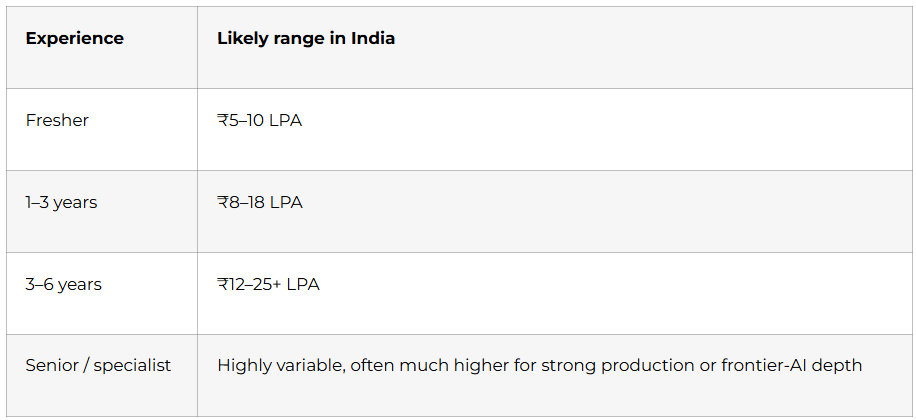
Use salary discussions carefully. ML pay varies more than many software roles because job titles cover very different depths, from entry-level applied modeling to high-end production ML and advanced AI engineering.
Sample line:
“Based on my machine learning skills, project depth, and the current market range for similar roles in India, I am looking for a fair opportunity in the range of X to Y LPA, while also considering the scope of the role and long-term growth.”
Thank-you email template
Subject: Thank you — Machine Learning Engineer interview
Hello [Interviewer Name],
Thank you for taking the time to speak with me today regarding the Machine Learning Engineer role. I enjoyed our discussion, especially the conversation around [model evaluation / deployment / NLP / MLOps / ML system design].
The role aligns strongly with my background in [Python / machine learning / evaluation / deployment awareness / model development], and I would be excited about the opportunity to contribute.
Thank you again for your time and consideration.
Best regards,
[Your Name]
[Phone Number]
[Email]
Follow-up email after 4–7 days
Subject: Follow-up on Machine Learning Engineer interview
Hello [Interviewer Name],
I hope you are doing well. I wanted to follow up on the interview process for the Machine Learning Engineer position. I remain very interested in the role and wanted to check whether there are any updates regarding the next steps.
Thank you for your time and consideration.
Best regards,
[Your Name]
Professional follow-up templates like these remain standard best practice in current interview communication guides.
Final 30-day checklist
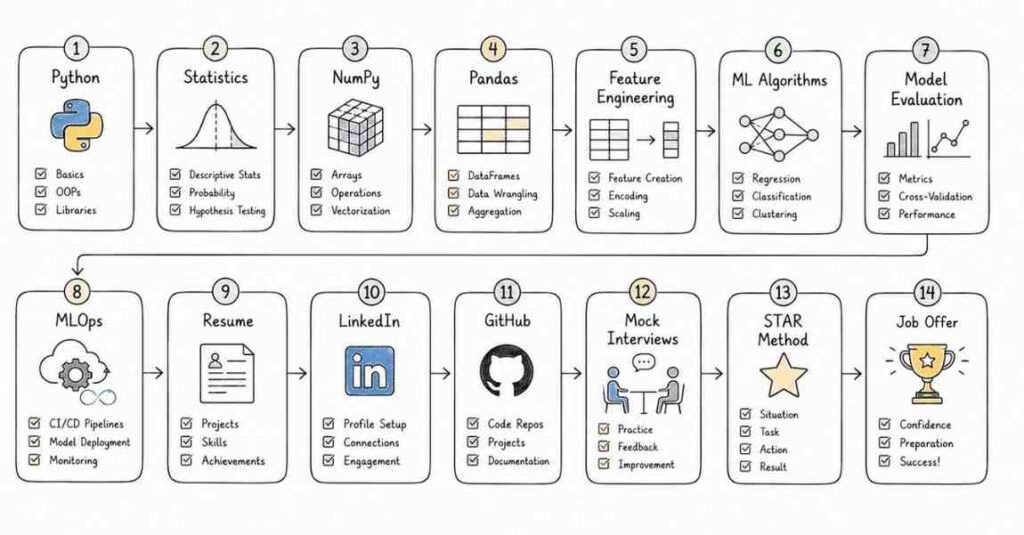
Week 1
- Revise ML fundamentals, problem framing, data splits, leakage, bias, variance, and feature engineering.
- Practice explaining supervised versus unsupervised learning aloud.
- Finalize 2 project stories.
- Update resume summary and technical skills.
Week 2
- Revise Python, NumPy, pandas, preprocessing, debugging, and statistics.
- Practice coding small ML-related tasks daily.
- Strengthen one structured-data project.
- Update LinkedIn headline and About section.
Week 3
- Revise supervised learning, unsupervised learning, evaluation metrics, cross-validation, and tuning.
- Practice model comparison answers.
- Prepare metric-based explanations for one classification and one regression project.
- Practice speaking through threshold and imbalance trade-offs.
Week 4
- Revise deployment, MLOps, monitoring, drift, retraining, and case-study frameworks.
- Practice project storytelling and behavioral answers using STAR.
- Do full mock interviews: HR, ML theory, coding, evaluation, and project round.
- Apply consistently and track applications.
Final 3 days
- Review only your notes and project summaries.
- Practice concise spoken answers.
- Keep resume, GitHub, project links, and documents ready.
- Sleep well and stay sharp for communication.