
90-Day SAP FICO Consultant Roadmap: Zero to Job-Ready Guide
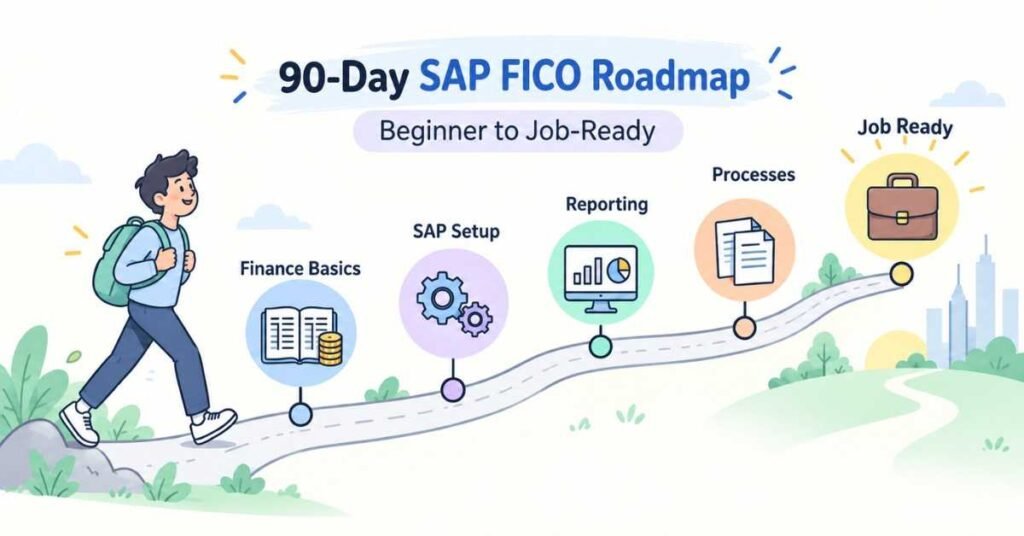
Table of Contents
This is a structured day-by-day blueprint designed to transform complete beginners into job-ready SAP Financial Accounting and Controlling (FICO) functional consultants. It covers everything from foundation setup to cross-module logic, SAP S/4HANA migration concepts, and career implementation.
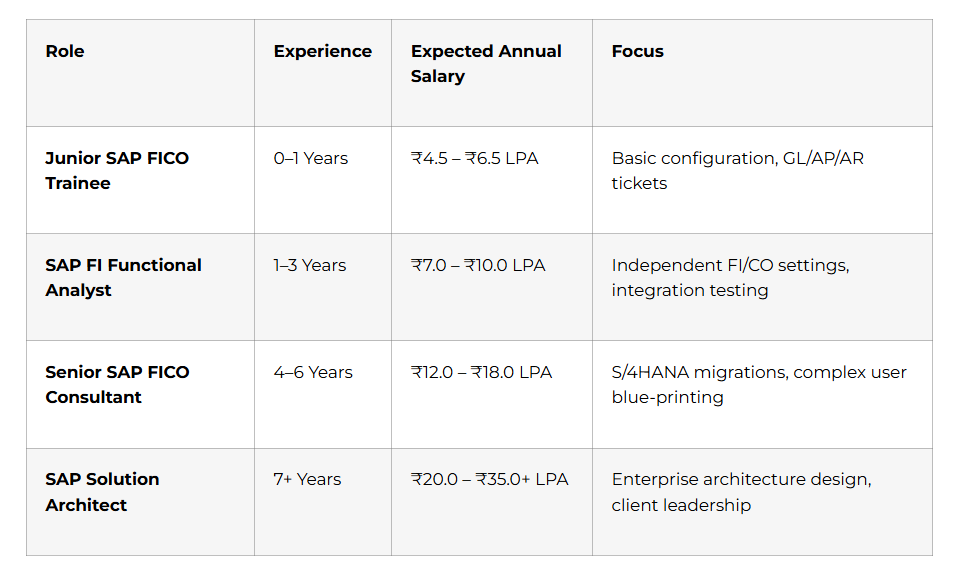
This guide fits commerce graduates, accountants, non-IT background students, and career switchers across India looking to secure functional consultant roles in 2026. Entry-level SAP FICO consultants in India earn ₹4.5–6.5 LPA, while experienced consultants command packages between ₹12–28 LPA in enterprise hiring hubs like Hyderabad and Bangalore.
Why Pick SAP FICO as a Career Pathway?
Global enterprises depend on SAP systems to manage financial data, regulatory compliance, and core operational reporting.
- Core Enterprise Need: Finance forms the backbone of every enterprise. SAP functional consultants are continuously recruited across business cycles.
- Dual Functional Advantage: You master both external reporting (FI) and internal management accounting (CO).
- High Growth Opportunities: Starting salaries for freshers average ₹5.5 LPA in hubs like Hyderabad.
- S/4HANA Upgrade Demand: Enterprises are transitioning legacy ECC setups to SAP S/4HANA Finance, opening thousands of functional configuration roles.
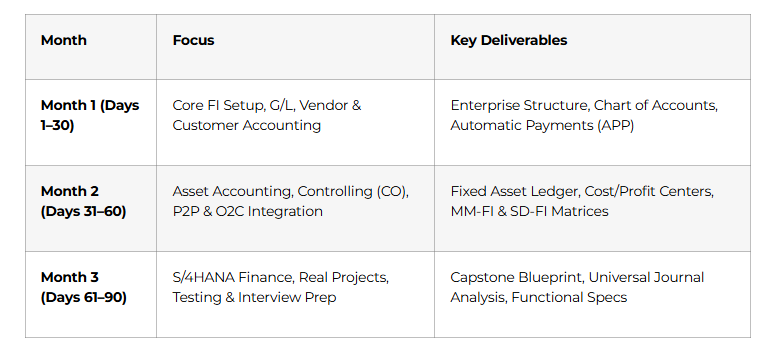
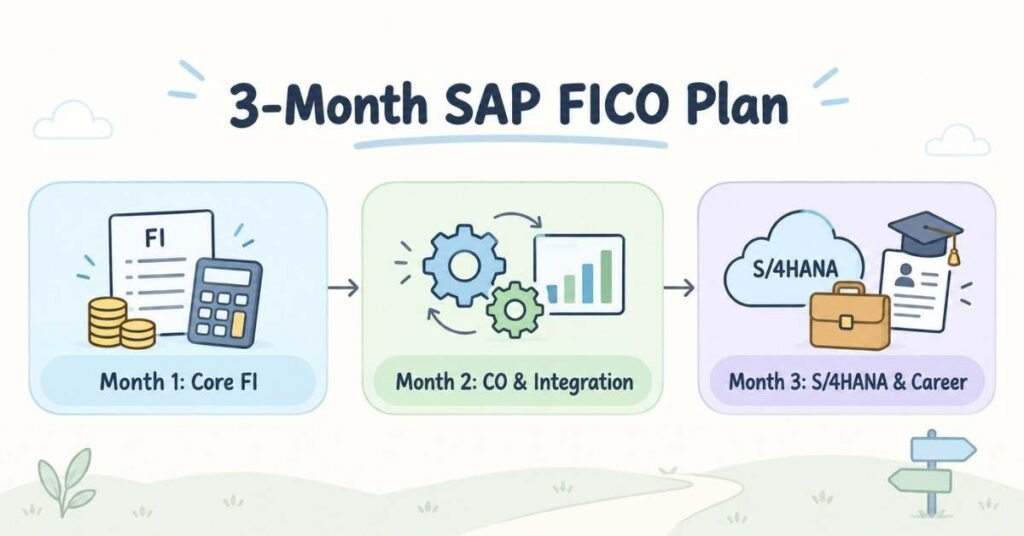
3-Month Roadmap at a Glance
Master Finance and Controlling Skills – Discover the SAP FICO Course
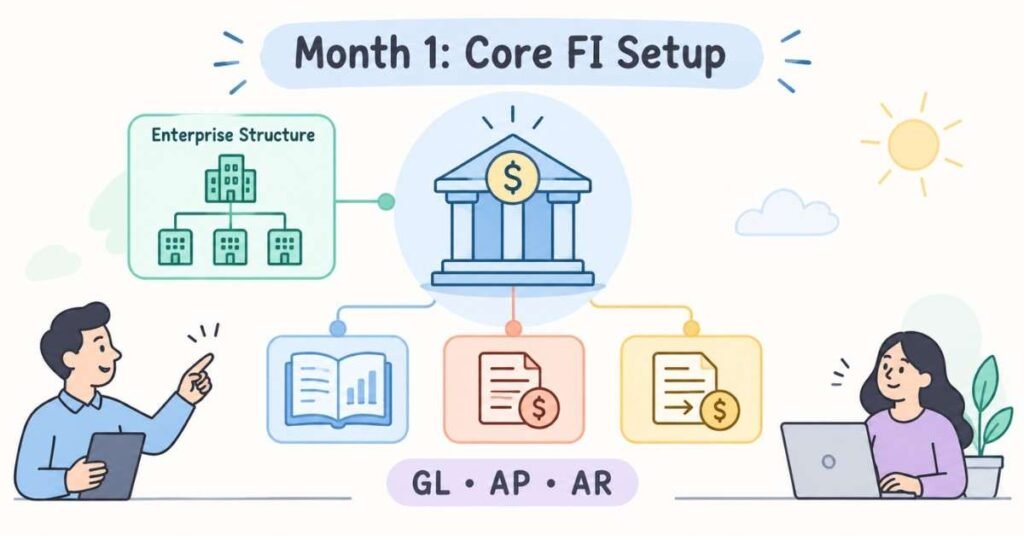
Month 1: Core Financial Accounting & System Setup (Days 1–30)
Month 1 focuses on understanding user workflows, T-codes, basic settings, and operational financial sub-modules.
Week 1: SAP GUI Basics & Enterprise Structure (Days 1–7)
- Days 1–2: Introduction to SAP ERP Environment
- Learn SAP GUI interface navigation, T-codes, user commands, and multi-session handling.
- Understand Client, Company Code, Business Area, and Chart of Accounts concepts.
- Days 3–4: Enterprise Definition
- Configure Company (OX15), Company Code (OX02), Credit Control Area (OB45), and Business Area (OX03).
- Days 5–6: Enterprise Assignment
- Connect Company Code to Company (OX16) and Credit Control Area (OB38).
- Day 7: Practical Assignment
- Map a multi-division manufacturing enterprise structure inside the SAP system.
Week 2: General Ledger (FI-GL) Operations (Days 8–14)
- Days 8–9: Global Financial Controls
- Define Fiscal Year Variant (OB29), Posting Period Variant (OBBP), and Field Status Variant (OBC4).
- Map Document Types (OBA7) and Document Number Ranges (FBN1).
- Days 10–11: Chart of Accounts Architecture
- Define Chart of Accounts (OB13), Account Groups (OBD4), and Retained Earnings Account (OB53).
- Days 12–13: Master Data & Journal Entries
- Set up G/L Master Records (FS00).
- Execute standard G/L postings (FB50/F-02), line-item reviews (FAGLB03), document parking, and reversals (FB08).
- Day 14: Practical Assignment
- Build a operational Chart of Accounts with 20+ G/L accounts and post ledger entries.
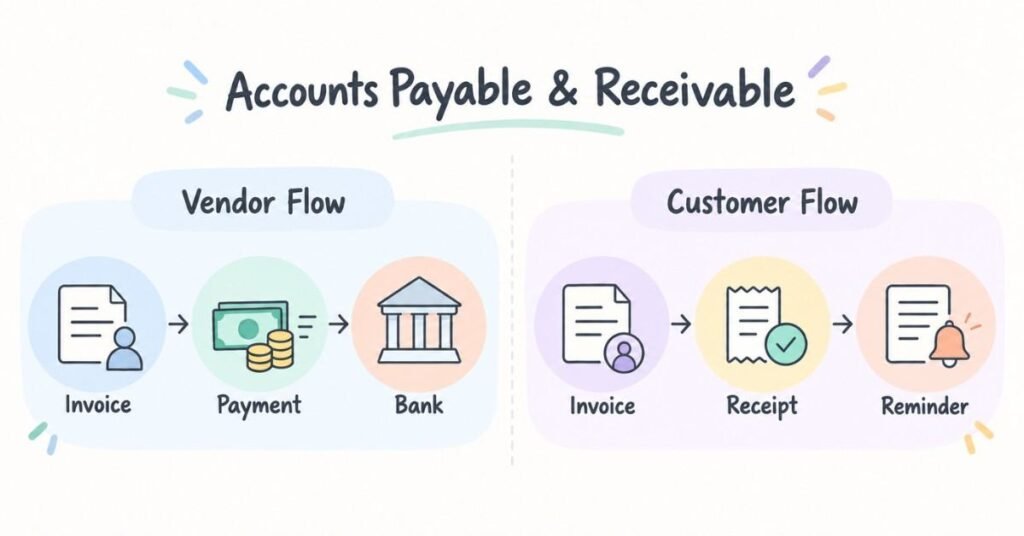
Week 3: Accounts Payable (FI-AP) Setup (Days 15–21)
- Days 15–16: Vendor Management
- Build Vendor Account Groups (OBD3), Number Ranges (OBAS), and Tolerance Groups (OBA3).
- Days 17–18: Vendor Invoicing & Down Payments
- Handle Vendor Invoices (FB60), Outgoing Payments (F-53), Down Payment Requests (F-47), and Clearing (F-54).
- Days 19–20: Automatic Payment Program (APP)
- Configure APP settings using T-code FBZP (Paying Company Codes, Payment Methods, House Banks).
- Run payment proposals and automated executions (F110).
- Day 21: Practical Assignment
- Configure a full vendor lifecycle with automated batch clearing runs.
Week 4: Accounts Receivable (FI-AR) & Month 1 Capstone (Days 22–30)
- Days 22–25: Customer Invoicing & Receipts
- Create Customer Account Groups (OBD2), master records (FD01/BP), and post Customer Invoices (FB70).
- Days 26–27: Customer Dunning Engine
- Set up Dunning Procedures (FBMP) and generate automatic payment reminder letters (F150).
- Days 28–30: Month 1 Project Build
- Execute end-to-end G/L, AP, and AR operations. Run trial balances and export system documentation for your portfolio.
Build a Strong ERP Career Path – Unlock the SAP FICO Career Guide
Month 2: Asset Accounting, Controlling & Module Integration (Days 31–60)
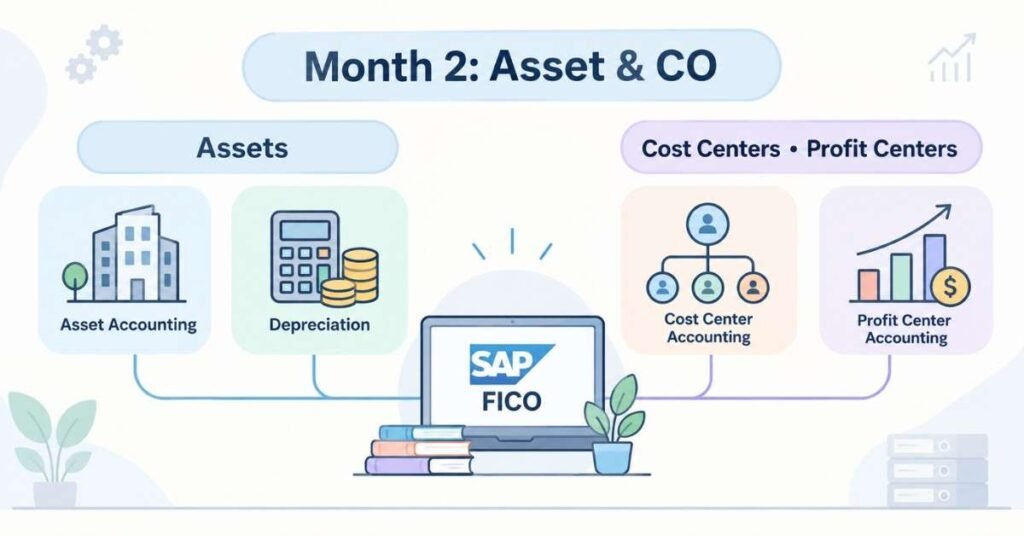
Month 2 moves into fixed asset management, internal cost allocations, and enterprise module linkages.
Prepare for SAP Finance Roles – Access the SAP FICO Interview Guide
Week 5: Asset Accounting (FI-AA) (Days 31–37)
- Days 31–34: Asset Master Setup & Depreciation Keys
- Copy Chart of Depreciation (EC08), set up Asset Classes (OAOA), and define Depreciation Keys (AFAMA).
- Create Asset Master Records (AS01).
- Days 35–37: Asset Postings & Execution
- Execute Asset Acquisition (F-90), Asset Transfers (ABT1N), Asset Retirement (ABAVN), and Monthly Depreciation Runs (AFAB).
Week 6: Controlling (CO) Fundamentals (Days 38–44)
- Days 38–39: Controlling Area & Cost Elements (CO-CEL)
- Maintain Controlling Area (OKKP) and set up Primary and Secondary Cost Elements.
- Days 40–41: Cost Center Accounting (CO-CCA)
- Build Cost Center Hierarchies (OKENN), create Cost Centers (KS01), and run assessment/distribution cycles (KSU5/KSV5).
- Days 42–44: Profit Center Accounting (CO-PCA)
- Build Profit Center Hierarchies (KCH1), assign Profit Centers (KE51), and generate profit center performance reports.
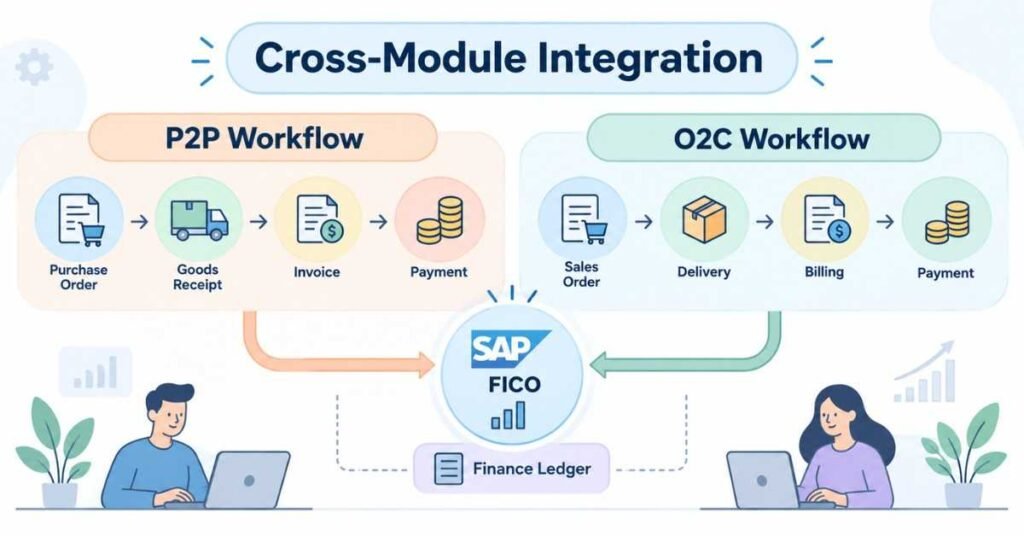
Week 7: Cross-Module Integration (MM-FI & SD-FI) (Days 45–54)
- Days 45–47: Procure-to-Pay (P2P) Integration
- Understand Purchase Order $\rightarrow$ Goods Receipt $\rightarrow$ Invoice Verification $\rightarrow$ Payment workflows.
- Map Automatic Account Determination using T-code OBYC (BSX, WRX, GBB).
- Execute complete P2P testing via ME21N, MIGO, and MIRO.
- Days 48–50: Order-to-Cash (O2C) Integration
- Master Sales Order $\rightarrow$ Delivery $\rightarrow$ Goods Issue $\rightarrow$ Billing $\rightarrow$ Payment workflows.
- Configure Revenue Account Determination (VKOA).
- Test transaction flows using VA01, VL01N, and VF01.
- Days 51–54: Testing & Tax Integration
- Configure tax handling (FTXP) and verify system postings.
Week 8: Bank Accounting & Closing Workflows (Days 55–60)
- Days 55–56: Bank Accounting & EBS
- Configure House Banks (FI12), Electronic Bank Statement rules (FF67), and automated clearing (FEBAN).
- Days 57–60: Month-End Procedures & Month 2 Capstone
- Execute Foreign Currency Revaluation (FAGL_FCV) and balance carry-forwards (FAGLGVTR).
- Document your complete integrated P2P/O2C and controlling project as Portfolio Project #2.
Month 3: S/4HANA Finance, Documentation & Career Preparation (Days 61–90)
Month 3 prepares you for technical interviews, blueprint documentation, and real enterprise deployments.
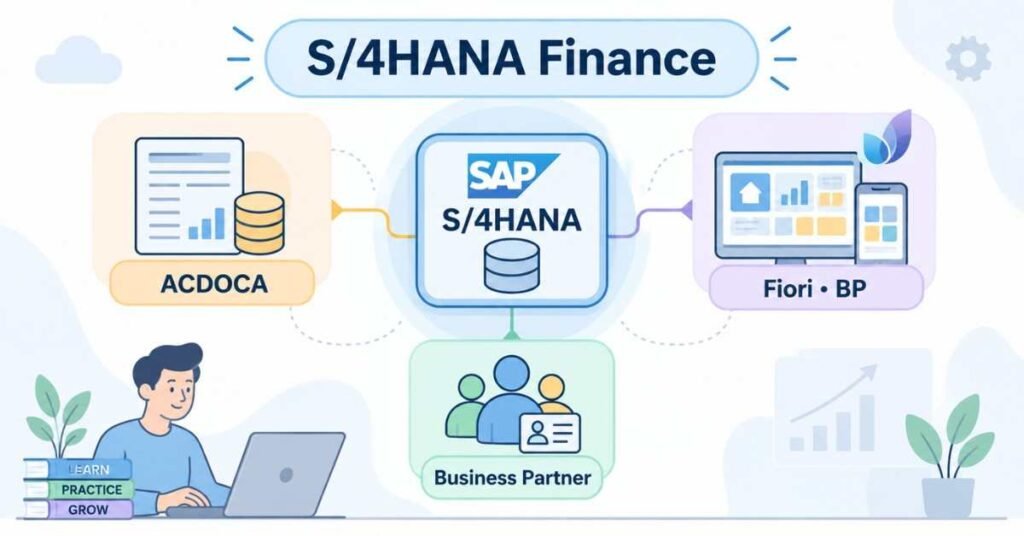
Week 9: S/4HANA Finance Core Concepts (Days 61–67)
- Days 61–63: Universal Journal Architecture
- Key architectural shifts between SAP ECC and SAP S/4HANA.
- Master the Universal Journal (ACDOCA) table structures and centralized Business Partner (BP) concept.
- Days 64–67: Extension Ledgers & Fiori Interface
- Configure Standard and Extension Ledgers. Navigate SAP Fiori Launchpad apps and analytical views.
Week 10: Implementation & Capstone Project (Days 68–79)
- Days 68–73: Project Methodologies & Testing
- Master SAP Activate phases: Explore, Realize, Deploy.
- Write Functional Specification Documents (FSDs), gap analysis notes, and User Acceptance Testing (UAT) scripts.
- Days 74–79: Greenfield Capstone Project
- Build an enterprise model covering FI baseline parameters, CO hierarchies, OBYC/VKOA integration, and S/4HANA Business Partners.
Weeks 11–12: Job Search & Interview Sprint (Days 80–90)
- Days 80–84: Portfolio & Profile Preparation
- Organize 3 functional blueprint documents with T-code steps, configuration notes, and screenshots.
- Update ATS-friendly resume and LinkedIn profile targeting “SAP FICO Consultant” and “SAP Functional Analyst” roles.
- Days 85–88: Applications & Interview Drills
- Apply across major job boards and target IT service firms and enterprise hiring hubs.
- Practice top interview topics: FBZP parameters, OBYC/VKOA account keys, Asset Accounting depreciation, and S/4HANA ACDOCA table logic.
- Days 89–90: Mock Technical Rounds & Final Review
- Complete full mock interviews, review technical edge cases, and finalize certification materials.
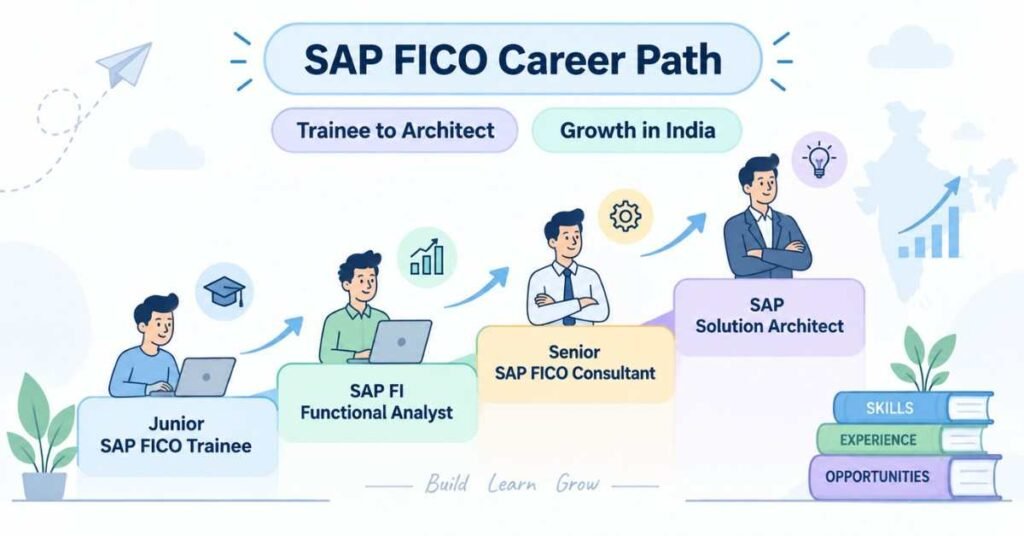
Career Snapshot: Roles & Salary Matrix (India)
Why Choose Frontlines Edutech for Your SAP FICO Course?
Frontlines Edutech is headquartered in Somajiguda, Hyderabad and has helped thousands of students across the Telugu states launch technology careers including freshers, B.Com/M.Com/MBA graduates, accountants, IT professionals switching stacks, and non-technical candidates pivoting to ERP consulting.
- Complete Full-Stack ERP Coverage: FI + CO + MM-FI Integration + SD-FI Integration + S/4HANA Finance, all in one structured program.
- 3 Deployed Portfolio Projects: Real enterprise configuration blueprints, not just slide theory.
- Telugu-Friendly Teaching: OBYC integration keys, FBZP payment rules, and Universal Journal logic explained in the language you think in.
- Industry-Aligned Curriculum: Built from what TCS Digital, Accenture, Deloitte, and Hyderabad consulting firms actually interview for.
- Career Support Until Placed: Resume, LinkedIn, mock interviews, and placement referrals from 200+ hiring partners.
Call: +91-83330 77727 | Email: support@frontlinesedutech.com | Website: frontlinesedutech.com/sap-fico-course
Frequently Asked Questions (FAQs)
Q1: Can someone without a programming background learn SAP FICO?
Yes. SAP FICO is a functional module that focuses on business process configuration, financial rules, and ledger logic rather than writing software code. Commerce, finance, accounting, and general non-technical graduates can master it.
Q2: What is the typical starting package for an SAP FICO fresher in India?
Freshers typically secure packages between ₹4.5 LPA and ₹6.5 LPA depending on location, background, and practical configuration project strength.
Q3: Why is understanding S/4HANA Finance important in 2026?
Enterprises are migrating from legacy SAP ECC systems to S/4HANA Finance. Understanding S/4HANA features like the Universal Journal (ACDOCA) ensures your skills align with ongoing corporate migration projects.
Q4: What is the main difference between SAP FI and SAP CO?
SAP FI (Financial Accounting) targets external financial reporting such as Balance Sheets and Profit & Loss statements for auditors and legal compliance. SAP CO (Controlling) handles internal cost tracking, departmental budgets, cost center allocations, and profitability analysis for management decision-making.
Q5: How do MM-FI (OBYC) and SD-FI (VKOA) integrations work?
Cross-module integrations connect financial ledgers directly to logistical events. OBYC maps inventory movement types and material valuation classes to appropriate G/L accounts during purchasing (P2P). VKOA routes billing items and sales condition types to revenue accounts during customer sales (O2C).
Q6: What documents should I include in my project portfolio?
Your portfolio should include 3 detailed functional blueprints showing enterprise configuration tables, step-by-step T-code setups, test logs, UAT scripts, and clear system screenshots.