
How to Become an SAP FICO Consultant in 2026: Complete Career Guide
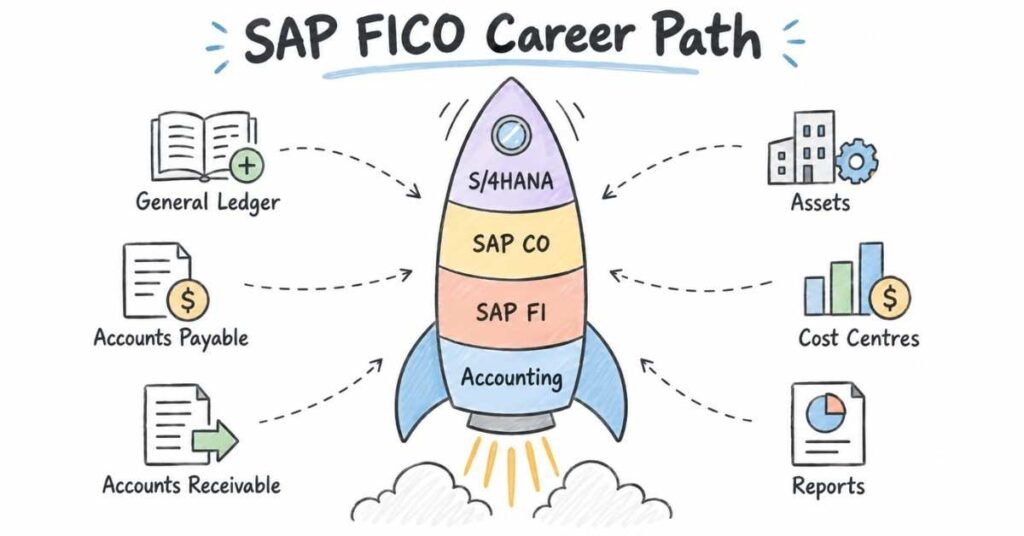
Table of Contents
SAP FICO Consultants help companies manage financial accounting, payments, customer balances, supplier dues, assets, costs, and internal reporting through SAP. If you want to become an SAP FICO Consultant, start with accounting basics, learn SAP FI and SAP CO, understand SAP S/4HANA Finance, and practise real business scenarios. You do not need strong coding knowledge, but you do need a clear understanding of finance and business processes. This guide gives freshers, finance graduates, working professionals, and career switchers a practical roadmap to build SAP FICO skills and prepare for entry-level jobs.
What an SAP FICO Consultant Does
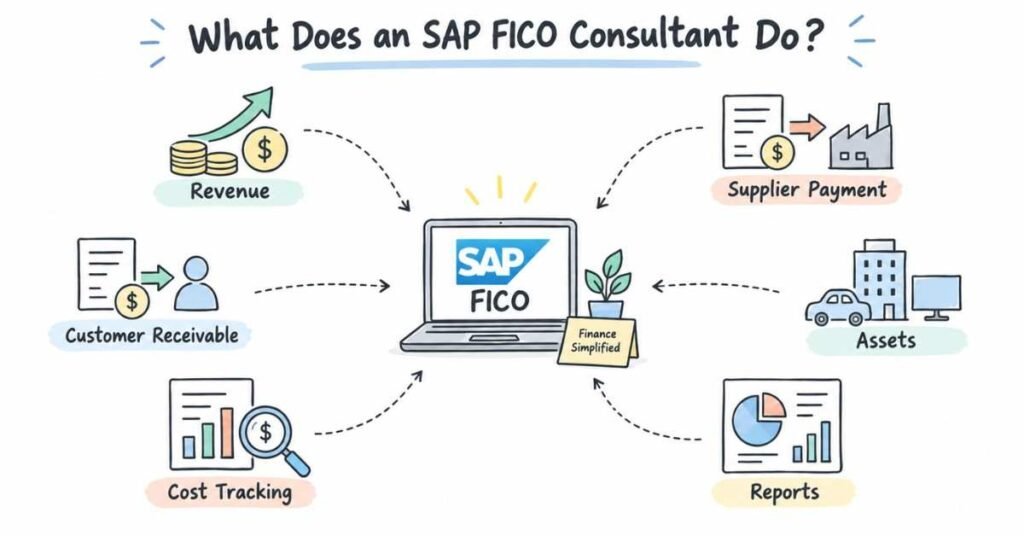
An SAP FICO Consultant helps companies manage their finance processes inside SAP.
The role mainly connects business finance requirements with SAP configuration.
For example, a company may need to manage hundreds of suppliers, customers, bank transactions, assets, and department expenses every month.
The SAP FICO Consultant helps the company organise these processes properly.
In simple terms, the role involves understanding:
- How money enters the business
- How money goes out of the business
- What customers need to pay
- What the company needs to pay suppliers
- How assets are recorded
- How costs are tracked
- How financial reports are prepared
Main Responsibilities
- Understand financial and accounting requirements
- Configure SAP FI and SAP CO
- Work with General Ledger Accounting
- Manage Accounts Payable processes
- Manage Accounts Receivable processes
- Support Asset Accounting
- Work with bank and payment processes
- Configure cost centres and profit centres
- Test financial transactions
- Prepare functional documents
- Support business users
- Work with other SAP teams
The role is both functional and analytical because the consultant needs to understand business problems and convert them into SAP processes.
Why SAP FICO Is a Smart Career Choice
Finance is one of the most important departments in any organisation.
Every company needs to manage:
- Revenue
- Expenses
- Supplier payments
- Customer payments
- Assets
- Bank transactions
- Financial statements
- Internal costs
Large organisations use ERP systems such as SAP to manage these activities more efficiently.
This creates career opportunities for professionals who understand both finance and SAP.
Why Students Choose SAP FICO
- Coding is not the main requirement
- Commerce and finance students can use their existing knowledge
- Skills are useful across multiple industries
- Opportunities are available in support and implementation
- SAP S/4HANA Finance offers long-term career growth
- Experienced consultants can move into senior and lead roles
- Finance professionals can transition into technology-based careers
SAP FICO is especially suitable for learners from:
- B.Com
- M.Com
- MBA Finance
- BBA Finance
- Accounting
- Banking
- Accounts Payable
- Accounts Receivable
- Finance operations
Non-commerce learners can also enter the field, but they should first become comfortable with basic accounting.
Build Practical SAP Finance Skills – Explore the SAP FICO Consultant Course
SAP FICO Roles Compared
SAP FICO is not one single role. Different career paths are available based on your skills and experience.
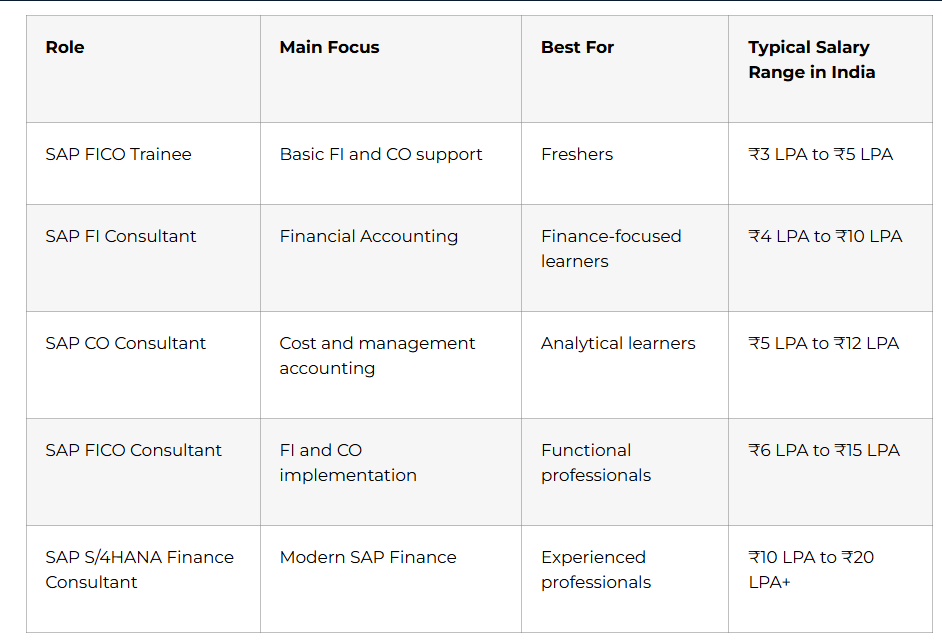
If you are a fresher, start with SAP FI and basic SAP CO. Once your foundation is strong, move into integration and S/4HANA Finance.
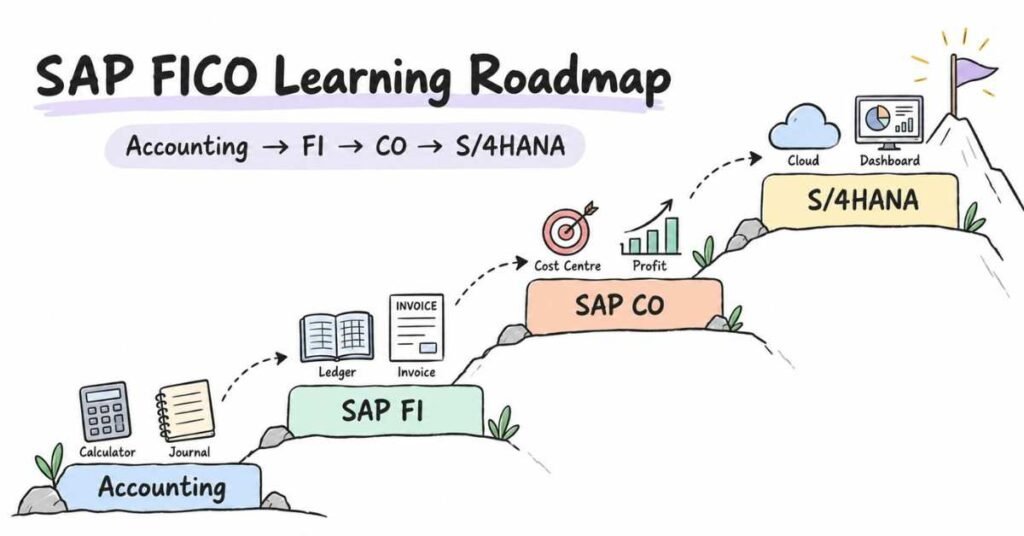
Complete Learning Roadmap
Phase 1: Accounting Foundations
Before learning SAP screens or transaction codes, understand basic accounting.
SAP FI is built around accounting concepts.
Focus on:
- Debit and credit
- Journal entries
- General Ledger
- Trial balance
- Assets
- Liabilities
- Revenue
- Expenses
- Balance Sheet
- Profit and Loss Statement
- Accounts Payable
- Accounts Receivable
- Depreciation
Simple Example
Suppose a company receives an office rent bill of ₹25,000.
Before using SAP, understand the business transaction.
The company has an expense.
It also has an amount that needs to be paid.
When the payment is completed, the liability is cleared.
If you understand this logic, SAP FI becomes much easier.
Phase 2: Core SAP FI Skills
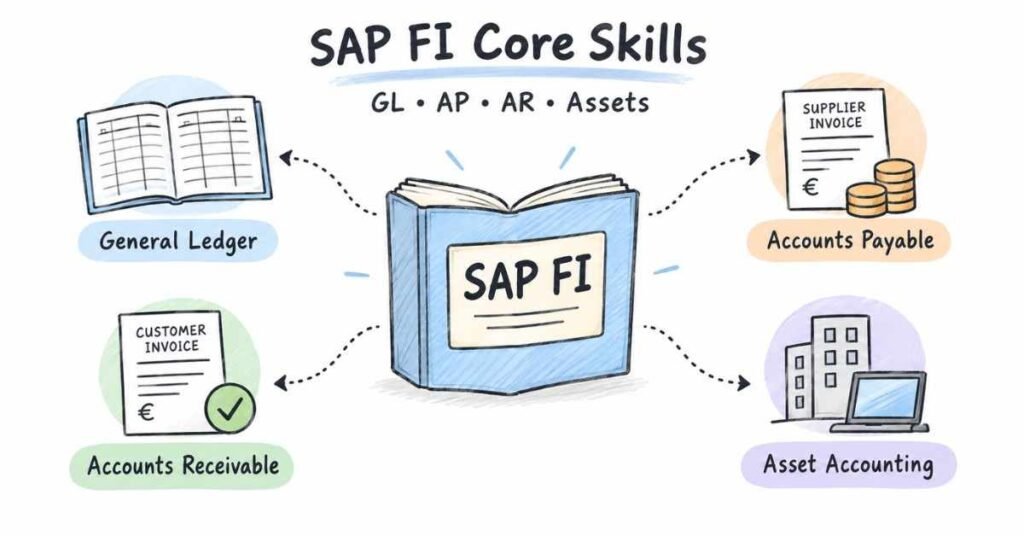
Once accounting basics are clear, start learning SAP FI.
Enterprise Structure
Understand:
- Client
- Company
- Company Code
- Fiscal Year
- Posting Period
- Chart of Accounts
Company Code is one of the most important concepts because financial transactions are maintained within this organisational structure.
General Ledger
Learn:
- G/L accounts
- Account groups
- Posting keys
- Document types
- Number ranges
- Financial documents
- Posting periods
Create simple G/L accounts such as:
- Cash
- Bank
- Rent Expense
- Electricity Expense
- Sales Revenue
- Office Equipment
Practise financial postings and understand which accounts are affected.
Accounts Payable
Accounts Payable deals with money the organisation owes to suppliers.Learn:
- Supplier master concepts
- Supplier invoices
- Credit memos
- Payment terms
- Outgoing payments
- Open items
- Clearing
- Automatic payment basics
Simple flow:Supplier → Invoice → Amount Due → Payment → Clearing
Accounts Receivable
Accounts Receivable deals with money customers owe the company.Learn:
- Customer master concepts
- Customer invoices
- Incoming payments
- Payment terms
- Open items
- Clearing
- Dunning basics
Simple flow:Customer → Invoice → Amount Due → Payment → Clearing
Asset Accounting
Companies need to manage assets such as:
- Laptops
- Vehicles
- Machinery
- Furniture
- Buildings
Learn:
- Asset classes
- Asset creation
- Asset acquisition
- Depreciation
- Asset transfer
- Asset retirement
Phase 3: SAP CO Skills
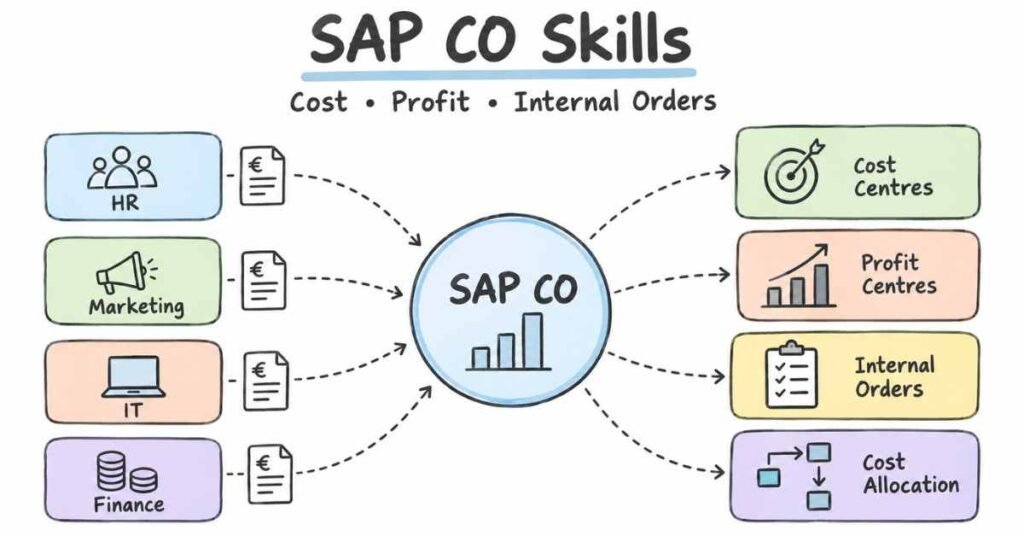
After building a strong SAP FI foundation, move into SAP CO.
SAP CO helps companies understand internal costs and business performance.
Cost Centre Accounting
Cost centres help track expenses by department.
Examples:
- HR
- Marketing
- IT
- Finance
- Operations
Learn:
- Cost centre concepts
- Cost centre hierarchy
- Actual postings
- Planning basics
- Distribution
- Assessment
Profit Centre Accounting
Profit centres help companies analyse the performance of different business units.
For example:
- Software Services
- Training
- Consulting
Management can use profit centre information to understand which area is performing better.
Internal Orders
Internal orders are useful for temporary cost tracking.
For example, a company may organise an annual event.
The company may need to track:
- Venue costs
- Travel costs
- Food expenses
- Branding expenses
An internal order helps collect these costs separately.
Phase 4: S/4HANA and Real Projects
Modern SAP FICO learners should also understand SAP S/4HANA Finance.
Focus on:
- SAP S/4HANA Finance
- Universal Journal
- Business Partner
- SAP Fiori
- Modern financial reporting
- Integrated finance processes
You do not need to learn every technical detail at the beginning.
The goal is to understand the modern SAP Finance environment.
Real Projects
Do not depend only on certificates.
Build practical scenarios that you can explain during interviews.
Examples:
Create a basic company finance structure.
Configure General Ledger accounts.
Build a supplier invoice-to-payment process.
Build a customer invoice-to-payment process.
Create an Asset Accounting scenario.
Track department expenses using cost centres.
Explain an FI-CO integration scenario.
Explain one MM-FI or SD-FI business flow.
Build Your SAP FICO Skills Step by Step – Explore the SAP FICO Consultant Roadmap Guide
SAP FI, SAP CO, and Integration
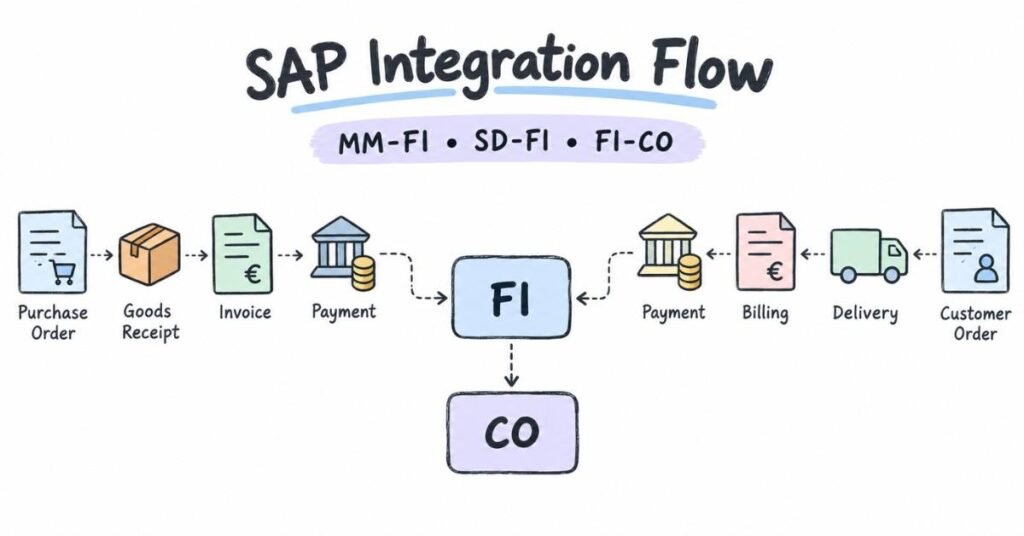
A good SAP FICO learner should understand how different areas connect.
SAP FI Skills
- General Ledger
- Accounts Payable
- Accounts Receivable
- Asset Accounting
- Financial postings
- Payment processes
- Posting periods
SAP CO Skills
- Cost Centres
- Profit Centres
- Internal Orders
- Cost allocation basics
- FI-CO integration
Integration Skills
SAP Finance also connects with other modules.
MM-FI Integration
A simple procurement process can look like:
Purchase Order → Goods Receipt → Invoice → Payment
You should understand how purchasing creates financial impact.
SD-FI Integration
A simple sales process can look like:
Customer Order → Delivery → Billing → Receivable → Payment
You do not need deep MM or SD knowledge as a beginner, but you should understand how Finance connects with them.
Salary Expectations in India
Salary depends on your skills, SAP experience, finance knowledge, company, location, and S/4HANA exposure.
Experience Level | Typical Salary |
Fresher | ₹3 LPA to ₹5 LPA |
1–3 Years | ₹5 LPA to ₹9 LPA |
3–5 Years | ₹8 LPA to ₹15 LPA |
5+ Years | ₹14 LPA to ₹25 LPA+ |
These are broad salary ranges and may vary from company to company.
Professionals with strong S/4HANA knowledge, implementation exposure, and integration skills may have better career growth.
Portfolio That Gets Interviews
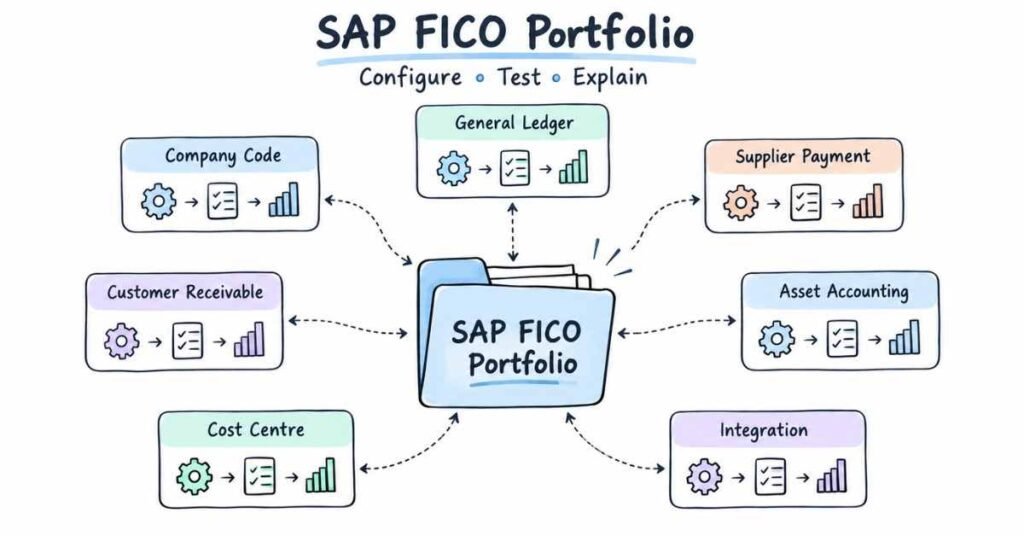
Hiring managers want to see practical understanding.
Your portfolio should show what you learned and how you applied it.
What to Include
- Company Code setup
- General Ledger scenario
- Supplier invoice and payment
- Customer invoice and payment
- Asset Accounting example
- Cost Centre project
- FI-CO integration example
- MM-FI or SD-FI process
Portfolio Checklist
For every project, mention:
- Business problem
- SAP process
- Configuration
- Transaction flow
- Accounting impact
- Testing
- Result
Keep each project simple and easy to explain.
Job Search Strategy
Once your SAP FICO basics and projects are ready, start applying for relevant roles.
Resume Keywords
Use keywords such as:
- SAP FICO
- SAP FI
- SAP CO
- SAP S/4HANA Finance
- General Ledger
- Accounts Payable
- Accounts Receivable
- Asset Accounting
- Cost Centre Accounting
- Profit Centre Accounting
- Internal Orders
- FI-CO Integration
- MM-FI Integration
- SD-FI Integration
- Functional Testing
Only add skills that you can explain confidently.
Where to Apply
- LinkedIn Jobs
- Naukri
- Indeed
- Company career pages
- SAP consulting companies
- ERP implementation firms
Roles to Search
SAP FICO Trainee
Junior SAP FICO Consultant
SAP Finance Associate
SAP Support Consultant
SAP Functional Trainee
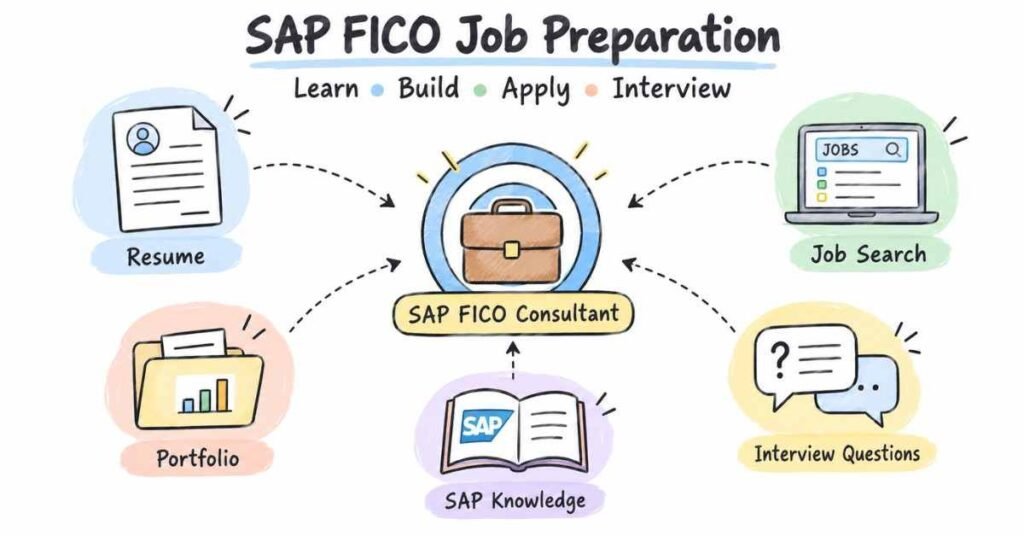
Interview Preparation
Be ready to answer questions from four areas.
Accounting
Prepare:
- Debit and credit
- Journal entries
- Assets and liabilities
- Revenue and expenses
- AP and AR
- Depreciation
SAP FI
Prepare:
- Company Code
- Chart of Accounts
- G/L account
- Posting Key
- Document Type
- Fiscal Year
- Accounts Payable
- Accounts Receivable
- Asset Accounting
SAP CO
Prepare:
- Controlling Area
- Cost Centre
- Profit Centre
- Internal Order
- FI-CO integration
SAP S/4HANA and Integration
Prepare:
- Universal Journal
- Business Partner
- SAP Fiori
- MM-FI
- SD-FI
For scenario questions, follow this simple format:
Requirement → Process → Configuration → Financial Impact → Result
30-Day Starter Plan
Prepare for SAP FICO Roles with Confidence – SAP FICO Consultant Interview Guides
If you want to start immediately, follow this simple four-week plan.
Week 1
- Learn accounting basics
- Practise debit and credit
- Understand journal entries
- Learn AP and AR
- Understand financial statements
Week 2
- Learn SAP basics
- Understand SAP S/4HANA
- Learn Company Code
- Study Chart of Accounts
- Practise G/L concepts
Week 3
- Learn Accounts Payable
- Learn Accounts Receivable
- Study Asset Accounting
- Practise supplier and customer scenarios
- Learn payment basics
Week 4
- Learn Cost Centres
- Learn Profit Centres
- Understand Internal Orders
- Learn FI-CO integration
- Understand MM-FI and SD-FI
- Build one project
- Start interview preparation
Why Learn SAP FICO at Frontlines Edutech
Frontlines Edutech can be a practical learning option for students and working professionals who want structured SAP FICO training with regional-language support and career-focused guidance.
A useful SAP FICO learning program should include:
- Accounting fundamentals
- SAP FI
- SAP CO
- SAP S/4HANA Finance
- Hands-on configuration
- Real business scenarios
- Integration basics
- Project practice
- Resume preparation
- Interview preparation
- Career guidance
For Telugu-speaking learners, regional-language explanation can make difficult finance and SAP concepts easier to understand during the learning stage.
At the same time, students should also practise SAP terminology in English because interviews and workplace communication commonly require it.
Frequently Asked Questions (FAQs)
Q1: How long does it take to become an SAP FICO Consultant?
The time depends on your accounting background and how consistently you practise. Learners with finance knowledge may understand concepts faster, while beginners may need more time to build the basics.
Q2: Is SAP FICO a good career in India?
Yes. SAP FICO can be a good career for people interested in finance, business processes, and enterprise technology.
Q3: Can freshers learn SAP FICO?
Yes. Freshers can learn SAP FICO and apply for trainee, support, and junior functional roles after building practical skills.
Q4:Does SAP FICO require coding?
No. Coding is not the main requirement. SAP FICO is mainly a functional career path focused on finance, configuration, and business processes.
Q5: What should I learn first?
Start with accounting basics. Then move to SAP FI, SAP CO, S/4HANA, integration, and projects.
Q6: What is the difference between SAP FI and SAP CO?
SAP FI focuses on financial accounting. SAP CO focuses on internal cost management and performance analysis.
Q7: Can non-commerce students learn SAP FICO?
Yes. Non-commerce students can learn SAP FICO, but they should first spend time understanding accounting fundamentals.
Q8: Is SAP S/4HANA important?
Yes. S/4HANA Finance is important for modern SAP careers. Beginners should understand Universal Journal, Business Partner, and SAP Fiori.
Q9: What projects should beginners build?
Yes. S/4HANA Finance is important for modern SAP careers. Beginners should understand Universal Journal, Business Partner, and SAP Fiori.
Q10: How do I prepare for an SAP FICO interview?
Prepare accounting, SAP FI, SAP CO, S/4HANA, and integration topics. Practise explaining business scenarios clearly instead of memorising answers.