
Digital Marketing Interview Preparation Guide
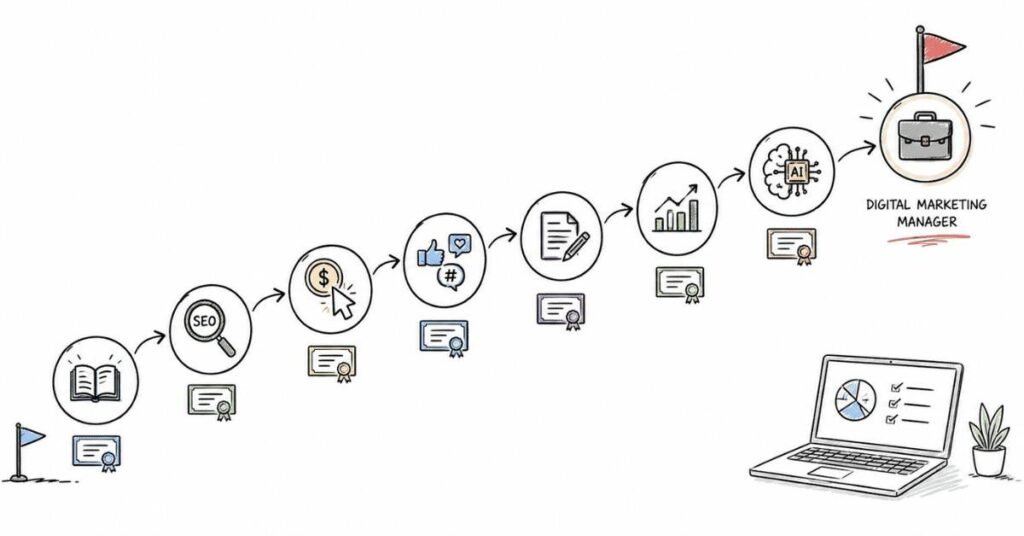
Table of Contents
Part 1: Introduction & 30-Day Study Plan
What This Guide Covers
This guide is designed to help you prepare for digital marketing interviews in a structured, practical way. It covers SEO, SEM, PPC, social media marketing, content marketing, email marketing, analytics, strategy, AI tools, and behavioral interviews.
It is written for freshers, career switchers, and early-career marketers who want a clear path from basics to interview-ready confidence.
Who This Guide Is For
This guide is useful if you are:
- A fresher preparing for your first digital marketing role.
- A marketing graduate or MBA student.
- A content writer moving into marketing.
- A sales or support professional switching to digital marketing.
- A beginner who wants to understand the full interview landscape before applying.
The guide starts with fundamentals and moves toward advanced and career-focused topics. That makes it easier to build knowledge step by step.
What Digital Marketing Means
Digital marketing is the use of online channels to promote products, services, or brands. These channels include search engines, social media, websites, email, paid ads, and mobile platforms.
A digital marketer does more than run ads. The role can involve strategy, content creation, SEO, campaign analysis, lead generation, conversion optimization, and reporting. In simple terms, digital marketing is about reaching the right audience with the right message at the right time.
Why Digital Marketing Matters In 2026
Businesses depend heavily on online visibility, customer acquisition, and measurable growth. That means digital marketing roles continue to stay relevant across startups, agencies, e-commerce companies, SaaS businesses, and local brands.
In 2026, employers often expect candidates to understand both creative and data-driven marketing. That includes content, ads, analytics, AI tools, and platform-specific strategy. The best candidates can connect marketing execution with business results.
Career Path In Digital Marketing
A digital marketing career often grows in stages:
- Digital Marketing Executive: Works on campaigns, content support, reporting, and coordination.
- SEO Specialist / PPC Specialist / Social Media Executive: Focuses on one channel in depth.
- Performance Marketer / Growth Marketer: Works on paid campaigns, funnels, and measurable ROI.
- Digital Marketing Manager: Leads strategy, team coordination, and cross-channel planning.
- Growth Head / Marketing Lead / CMO: Owns broader brand and acquisition strategy.
Many interviewers want to know whether you understand one channel deeply or the whole marketing ecosystem. Both matter, depending on the role.
How To Use The Guide
Read the guide in order if you are new to the field. If you already know one area, such as social media or SEO, you can move faster through that section and spend more time on analytics, strategy, and behavioral questions.
A good preparation method is:
- Learn the concept.
- Practice interview questions.
- Rewrite answers in your own words.
- Build small examples or case studies.
- Review weak areas before the interview.
This is much more effective than memorizing answers without understanding them.
30-Day Study Plan
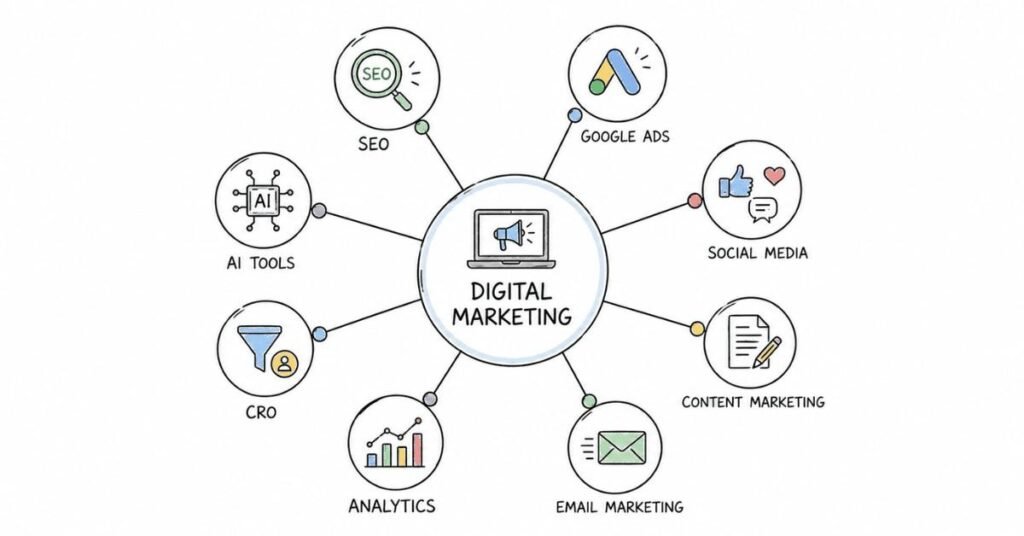
Week 1: SEO And Basics
Focus on search engines, keyword research, on-page SEO, technical SEO, and content basics. Practice explaining how websites rank and how organic traffic is improved.
Week 2: Paid Marketing And Social Media
Learn SEM, PPC, Google Ads, Meta Ads, social media strategy, audiences, creatives, and campaign structure. Try to understand how paid and organic marketing work together.
Week 3: Content, Email, And Analytics
Study content marketing, email marketing, Google Analytics, Search Console, KPIs, funnels, and reporting. This is where you learn how marketers prove results.
Week 4: Strategy, AI Tools, And Mocks
Cover CRO, landing pages, budget planning, AI in marketing, and interview practice. Finish the week with mock interviews and STAR story preparation.
Daily Study Routine
A simple daily routine can help you stay consistent:
- 45 minutes of concept learning.
- 45 minutes of note making or interview practice.
- 30 minutes of revision or case examples.
If you have limited time, even 60 to 90 focused minutes daily can still help. Consistency matters more than long but irregular study sessions.
Tools You Should Know
You do not need to master every tool, but you should recognize the major ones:
- Google Ads.
- Meta Ads Manager.
- Google Analytics 4.
- Google Search Console.
- SEMrush.
- Ahrefs.
- HubSpot.
- Mailchimp.
- Canva.
- Looker Studio.
- Hotjar.
- ChatGPT and other AI writing tools.
If possible, practice at least one campaign workflow and one analytics dashboard so your answers sound practical, not theoretical.
Common Interview Focus Areas
Most digital marketing interviews check whether you understand both strategy and execution. Common topics include:
- SEO and keyword research.
- Paid advertising and bidding.
- Social media content strategy.
- Content planning and brand communication.
- Email marketing and automation.
- Analytics and reporting.
- Campaign optimization.
- Conversion rate improvement.
- AI tools and current trends.
- Behavioral questions about teamwork and deadlines.
Interviewers also want to see whether you can explain campaign results in clear business language.
Salary Expectations In 2026
Salary varies by company size, city, specialization, and skill depth. Here is a simple India-focused view for planning:
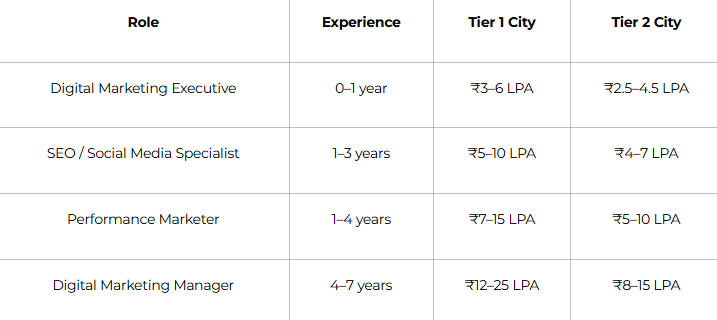
Candidates with strong analytics, paid ads, SEO, and AI tool experience can often command higher offers. Results matter more than titles in this field.
What Strong Answers Look Like
Good digital marketing interview answers are:
- Clear and practical.
- Based on real campaigns or realistic examples.
- Focused on outcomes like traffic, leads, CTR, conversions, or ROI.
- Easy to understand for both marketers and managers.
- Balanced between creativity and measurement.
For example, instead of saying “I know SEO,” a stronger answer is: “I improved a blog’s organic traffic by targeting search intent, updating headings, improving internal links, and tracking CTR and rankings over time.”
How To Think Like A Digital Marketer
A digital marketer should always think about audience, channel, message, and measurement. Every campaign should answer these questions:
- Who is the audience?
- What problem are we solving?
- Which channel fits best?
- What content or ad will we use?
- How will we measure success?
This mindset helps you answer interviews more confidently and makes your responses sound more strategic.
Part 2: SEO — Search Engine Optimization
SEO Basics (Questions 1–40)
Q1. What is SEO?
SEO stands for Search Engine Optimization. It is the process of improving a website so it appears higher in organic search results. In simple terms, SEO helps people find your website when they search for something relevant.
Q2. Why is SEO important?
SEO is important because it brings organic traffic without paying for every click. It helps brands get visibility, credibility, and long-term traffic growth. For many businesses, SEO is one of the most cost-effective channels.
Q3. What is organic traffic?
Organic traffic refers to visitors who come to your website from unpaid search results. These visitors usually arrive because your content matches their search intent. It is different from paid traffic, which comes from ads.
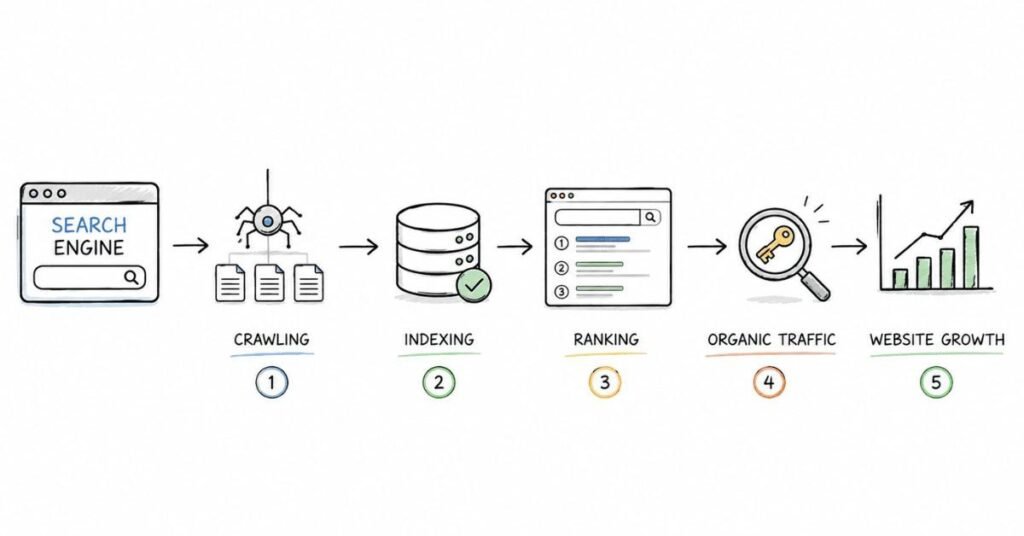
Q4. How do search engines work?
Search engines crawl the web, index pages, and rank them based on relevance and quality. First they discover pages, then store them in an index, and finally decide which results to show for a query. The better your content and site structure, the easier it is for search engines to understand your pages.
Q5. What is crawling?
Crawling is the process where search engine bots visit web pages and follow links. They collect information about pages so the search engine can store and understand them. If a page is blocked or hidden, it may not get crawled properly.
Q6. What is indexing?
Indexing is the process of storing crawled pages in a search engine’s database. Once a page is indexed, it can appear in search results. If a page is not indexed, it usually cannot rank.
Q7. What is ranking?
Ranking is the position a page appears in search results for a particular query. Search engines rank pages based on many factors such as relevance, quality, backlinks, speed, and user experience. Higher rankings usually bring more clicks.
Q8. What is keyword research?
Keyword research is the process of finding the words and phrases people use when searching online. It helps you understand what your audience wants and what content you should create. Strong keyword research connects user intent with business goals.
Q9. What is search intent?
Search intent is the reason behind a search query. A person may want to learn, compare, buy, or find a specific website. Good SEO content matches the intent behind the keyword, not just the keyword itself.
Q10. What are the main types of search intent?
The main types are informational, navigational, commercial, and transactional. Informational intent means the user wants to learn something. Transactional intent means the user is ready to act, like buying or signing up.
On-Page SEO
Q11. What is on-page SEO?
On-page SEO refers to improvements made directly on the website pages to help them rank better. This includes content quality, titles, headings, internal links, URL structure, and keyword placement. It is like organizing your shop so both customers and search engines can understand it easily.
Q12. What is a title tag?
A title tag is the main title of a web page that appears in search results and browser tabs. It helps search engines and users understand what the page is about. A strong title tag is clear, relevant, and includes the main keyword naturally.
Q13. What is a meta description?
A meta description is a short summary of a page that often appears below the title in search results. It does not directly guarantee rankings, but it can improve click-through rate. A good meta description gives people a reason to click.
Q14. What are header tags?
Header tags are HTML tags such as H1, H2, and H3 used to structure content. They make the page easier to read and help search engines understand the topic hierarchy. Think of them like chapter headings in a book.
Q15. What is keyword stuffing?
Keyword stuffing means repeating a keyword too many times in a page in an unnatural way. It makes content hard to read and can hurt rankings. Good SEO uses keywords naturally, not excessively.
Q16. Why are internal links important?
Internal links connect one page on your site to another. They help users navigate, spread link value, and guide search engines through your website. A strong internal linking structure can improve crawlability and page relevance.
Q17. What is URL optimization?
URL optimization means creating short, clear, descriptive URLs. A good URL is easy to read and usually contains the topic of the page. Clean URLs can improve user trust and make sharing easier.
Q18. What makes content SEO-friendly?
SEO-friendly content is useful, well-structured, original, and aligned with search intent. It should answer the user’s question clearly and be easy to scan. Good content also includes headings, examples, and naturally placed keywords.
Q19. Why is content freshness important?
Fresh content can help keep pages relevant, especially for topics that change often. Search engines may favor updated content when users expect current information. Refreshing old posts can improve performance if the content is still valuable.
Q20. What is duplicate content?
Duplicate content is when the same or very similar content appears on multiple pages. This can confuse search engines and dilute ranking signals. It is better to keep pages distinct or use the right technical handling.
Off-Page SEO
Q21. What is off-page SEO?
Off-page SEO refers to actions taken outside your website to improve its authority and rankings. The biggest example is backlink building. It also includes brand mentions, social signals, and online reputation.
Q22. What is a backlink?
A backlink is a link from one website to another website. Backlinks can help search engines see your site as trustworthy and relevant. High-quality links from respected sites are usually more valuable than many weak links.
Q23. Why are backlinks important?
Backlinks act like votes of confidence from other websites. They can improve authority, visibility, and ranking potential. However, quality matters more than quantity.
Q24. What is the difference between dofollow and nofollow links?
Dofollow links generally pass ranking value from one site to another. Nofollow links tell search engines not to pass the same ranking value in the same way. Both can still be useful for traffic and visibility.
Q25. What is link building?
Link building is the process of earning or creating backlinks to your website. Good link building focuses on relevance, quality, and natural acquisition. Bad link building often relies on spammy tactics that can hurt SEO.
Q26. What is domain authority?
Domain authority is a score used by SEO tools to estimate how strong a website is compared to others. It is not a direct Google ranking factor, but it is often used as a comparative metric. Higher authority often correlates with stronger backlink profiles.
Q27. What is guest posting?
Guest posting means writing content for another website in exchange for exposure and often a backlink. It can be a useful off-page strategy when done on relevant, reputable sites. The content should provide value, not just exist for a link.
Q28. What is brand mention in SEO?
A brand mention is when your brand is referenced online, with or without a direct link. Search engines may use brand visibility as one signal of authority and trust. Strong brands often earn more mentions naturally over time.
Technical SEO
Q29. What is technical SEO?
Technical SEO focuses on the behind-the-scenes parts of a website that affect crawling, indexing, and performance. This includes site speed, mobile usability, structure, sitemaps, canonical tags, and crawl access. It helps search engines access your content efficiently.
Q30. What is site speed and why does it matter?
Site speed is how quickly a webpage loads and becomes usable. Faster pages generally provide a better user experience and can support stronger SEO performance. Slow pages may frustrate visitors and hurt engagement.
Q31. What are Core Web Vitals?
Core Web Vitals are user experience metrics related to loading, interactivity, and visual stability. They help measure whether a page feels fast and smooth to users. In interviews, it is enough to know they are important performance signals for modern SEO.
Q32. What is mobile-friendly design?
Mobile-friendly design means a website works well on smartphones and tablets. Since many users browse on mobile devices, search engines care a lot about this. A page should be readable, responsive, and easy to use on smaller screens.
Q33. What is robots.txt?
robots.txt is a file that tells search engine bots which parts of a site they can or cannot crawl. It helps control crawler access to certain sections. However, it does not guarantee privacy, so it should not be used for sensitive information.
Q34. What is an XML sitemap?
An XML sitemap is a file that lists important pages on a website for search engines. It helps crawlers discover content more easily. It is especially useful for large websites or new sites with limited internal links.
Q35. What is canonicalization?
Canonicalization helps search engines understand the preferred version of a page when similar or duplicate versions exist. A canonical tag points to the main version of the content. This reduces confusion and helps consolidate SEO value.
Q36. What are broken links?
Broken links are links that lead to pages that no longer exist or cannot be found. They create poor user experience and may waste crawl budget. Fixing broken links is a simple but useful SEO maintenance task.
Q37. What is crawl budget?
Crawl budget is the amount of crawling time and resources search engines allocate to a website. Large sites care more about this because search engines may not crawl every page equally. Good site structure and technical health help make crawling more efficient.
Keyword And Metrics
Q38. What are long-tail keywords?
Long-tail keywords are longer, more specific search phrases. They often have lower search volume but stronger intent and less competition. They are useful for targeting users closer to taking action.
Q39. What are the most important SEO metrics?
Important SEO metrics include organic traffic, rankings, impressions, clicks, CTR, bounce rate, and conversions. These numbers help you understand whether your SEO work is driving real value. Rankings alone are not enough to measure success.
Q40. What is CTR in SEO?
CTR stands for Click-Through Rate. It shows the percentage of users who click your result after seeing it in search results. A higher CTR often means your title and description are more attractive or relevant.
Practice Strategy
For SEO interviews, you should be able to explain the full chain from keyword research to ranking and traffic growth. Practice by picking one blog post or landing page and reviewing its title tag, headings, internal links, keyword intent, and technical health.
A strong exercise is to explain how you would improve a page that ranks on page two but gets low clicks. That kind of scenario often comes up in real interviews.
Part 3: SEM & PPC — Paid Advertising
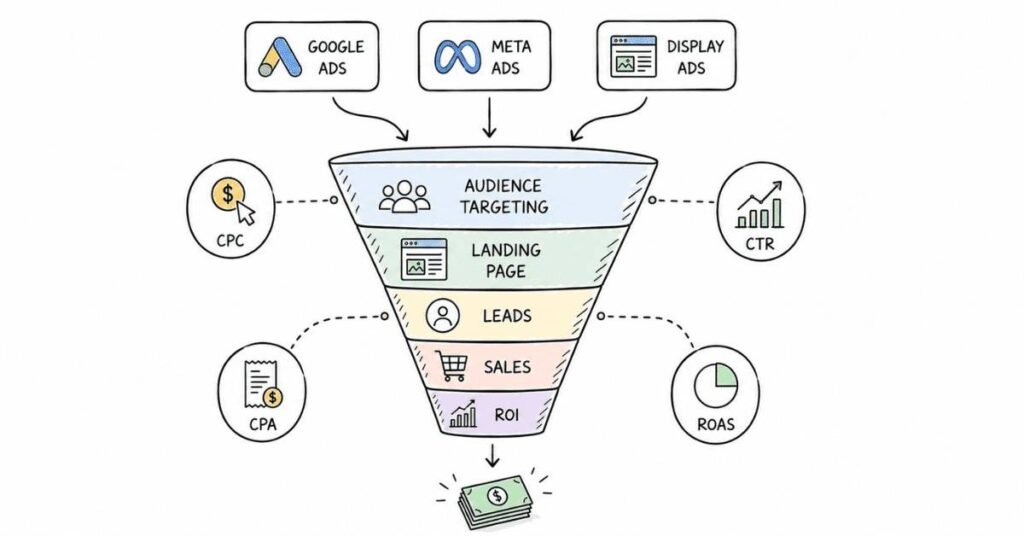
SEM & PPC Fundamentals (Questions 41–75)
Q41. What is SEM?
SEM stands for Search Engine Marketing. It usually refers to paid visibility on search engines through ads. While SEO earns unpaid traffic over time, SEM helps you appear faster by paying for clicks or impressions.
Q42. What is PPC?
PPC stands for Pay-Per-Click. It is an advertising model where you pay when someone clicks your ad. In simple terms, you are buying visits instead of waiting for them organically.
Q43. What is the difference between SEO and SEM?
SEO focuses on improving organic rankings without paying for each click. SEM focuses on paid search visibility through ad platforms like Google Ads. SEO is usually slower but long-term, while SEM is faster but budget-dependent.
Q44. What is Google Ads?
Google Ads is Google’s online advertising platform. It allows businesses to run ads across search results, websites, YouTube, apps, and shopping placements. It is one of the most important tools in performance marketing.
Q45. What is the structure of a Google Ads account?
A Google Ads account is usually organized into campaigns, ad groups, keywords, and ads. Campaigns control broader settings like budget and location, while ad groups hold more specific keyword and ad combinations. This structure helps keep targeting and reporting organized.
Q46. What is a campaign in Google Ads?
A campaign is the top-level container that controls settings such as budget, location, bidding strategy, and network type. It is usually based on a major goal or product category. For example, a brand may create separate campaigns for lead generation and e-commerce sales.
Q47. What is an ad group?
An ad group is a smaller section inside a campaign that contains related keywords and ads. It helps keep ad messaging tightly matched to search intent. Think of a campaign as a store and ad groups as different shelves for specific product themes.
Keywords And Match Types
Q48. What are keywords in PPC?
Keywords are the search terms advertisers target in search campaigns. When a user searches something related to those keywords, the ad may become eligible to appear. Good keyword choice improves relevance and reduces wasted spend.
Q49. What is broad match?
Broad match gives your ad the widest reach by allowing it to show for related searches, not just exact phrases. It can bring more traffic, but sometimes less precise traffic too. It is useful when paired with strong monitoring and negative keywords.
Q50. What is phrase match?
Phrase match gives more control than broad match. It allows your ad to show for searches that include the meaning of your target phrase more closely. It helps balance reach and relevance.
Q51. What is exact match?
Exact match is the most precise keyword targeting option. It shows ads for searches that closely match the exact meaning or intent of the keyword. This often improves relevance, though it may reduce volume compared to broader options.
Q52. What are negative keywords?
Negative keywords prevent your ads from showing for irrelevant searches. For example, if you sell premium services, you may add “free” as a negative keyword. They help protect budget and improve lead quality.
Q53. Why are negative keywords important?
Negative keywords reduce wasted spend by filtering out poor-fit traffic. They also improve campaign efficiency by focusing impressions and clicks on more relevant searches. A strong PPC manager reviews search terms regularly to keep adding negatives.
Ads, Relevance, And Quality
Q54. What is ad copy in PPC?
Ad copy is the text users see in your search or display ads. It usually includes headlines, descriptions, and sometimes extensions. Strong ad copy should match user intent and clearly communicate value.
Q55. What is a responsive search ad?
A responsive search ad lets advertisers provide multiple headlines and descriptions, and Google automatically tests combinations. This helps the system find high-performing variations. It makes ad creation more flexible and data-driven.
Q56. What is Quality Score?
Quality Score is Google’s estimate of the quality and relevance of your keywords, ads, and landing pages. A higher Quality Score can help improve ad position and reduce cost per click. It rewards advertisers for creating useful, relevant experiences.
Q57. What factors affect Quality Score?
The main factors are expected click-through rate, ad relevance, and landing page experience. If your keyword, ad, and landing page all align well, your Quality Score usually improves. It is like being rewarded for showing the right message to the right person.
Q58. What is Ad Rank?
Ad Rank determines the position of your ad in the auction. It is influenced by factors such as bid amount, Quality Score, and ad experience signals. This means the highest bidder does not always win the top position.
Q59. Why is landing page relevance important in PPC?
A relevant landing page improves user experience and supports better conversion rates. It also helps Quality Score because Google wants users to land on useful pages. If the ad promises one thing and the page shows another, performance usually suffers.
Bidding And Budgeting
Q60. What is CPC?
CPC stands for Cost Per Click. It is the amount you pay when someone clicks your ad. Lower CPC is not always better if the clicks do not convert.
Q61. What is CPM?
CPM stands for Cost Per Mille, or cost per 1,000 impressions. It is often used in brand awareness campaigns where visibility matters more than clicks. It is common in display and video advertising.
Q62. What is CPA?
CPA stands for Cost Per Acquisition or Cost Per Action. It measures how much you spend to generate one conversion, such as a lead or sale. This is one of the most important performance metrics because it connects spend to outcomes.
Q63. What is ROAS?
ROAS stands for Return on Ad Spend. It shows how much revenue you generate for every unit of money spent on advertising. For example, a ROAS of 4 means you generated 4 rupees for every 1 rupee spent.
Q64. What is manual CPC bidding?
Manual CPC bidding means the advertiser controls bids directly. This gives more hands-on control but requires closer monitoring and optimization. It can be useful when you want tight control over keyword-level spending.
Q65. What is automated bidding?
Automated bidding uses platform algorithms to adjust bids based on goals such as clicks, conversions, CPA, or ROAS. It saves time and can work well when there is enough conversion data. However, it still needs strategy and supervision.
Q66. What is target CPA bidding?
Target CPA is an automated bidding strategy where the platform tries to generate conversions at a chosen average cost per acquisition. It is useful when lead cost matters more than raw traffic. Good tracking is essential for it to work well.
Q67. What is target ROAS bidding?
Target ROAS is an automated bidding strategy that focuses on maximizing revenue relative to spend. It is especially useful in e-commerce campaigns where purchase values differ. The platform needs enough conversion value data to optimize effectively.
Q68. How should budget be allocated in PPC campaigns?
Budget should be allocated based on goals, audience value, campaign stage, and performance data. High-intent campaigns often deserve more budget than awareness-only campaigns. A smart marketer treats budget like fuel and gives more to engines that perform well.
Campaign Types And Networks
Q69. What is the difference between Search Ads and Display Ads?
Search ads appear when users actively search for something, so they often capture high intent. Display ads appear visually across websites and apps, usually helping with awareness and retargeting. Search often captures demand, while display often creates or reminds demand.
Q70. What are Shopping Ads?
Shopping Ads are product-based ads that show image, price, store name, and other product details. They are commonly used in e-commerce. These ads are strong because they show buying information before the click.
Q71. What are video ads in digital marketing?
Video ads are promotional ads shown on platforms like YouTube and other video placements. They can be used for awareness, consideration, or action depending on the format and targeting. Video is powerful because it combines sight, sound, and story.
Q72. What is retargeting?
Retargeting means showing ads to users who have already visited your website or interacted with your brand. It helps re-engage warm audiences who did not convert the first time. Since these users already know the brand, retargeting often performs better than cold targeting.
Q73. What is audience targeting in paid ads?
Audience targeting is the process of choosing who should see your ads based on factors like interests, behavior, location, age, device, or previous interactions. Better targeting improves efficiency and lead quality. It helps ensure your message reaches people who are more likely to care.
Q74. What are Meta Ads?
Meta Ads are paid ads run on platforms like Facebook and Instagram through Meta Ads Manager. They are commonly used for awareness, lead generation, engagement, app installs, and e-commerce sales. Meta is especially strong for visual storytelling and audience targeting.
Q75. What is A/B testing in PPC?
A/B testing means comparing two versions of an ad, landing page, audience, or creative to see which performs better. Only one major change should be tested at a time for clearer learning. It helps marketers improve campaigns with data instead of guesswork.
Practice Strategy
For this part, practice speaking in terms of business outcomes, not just definitions. You should be able to explain how keyword targeting, ad relevance, bidding, and landing page quality all connect to conversions and spend efficiency.
A strong mock exercise is this: explain what you would do if a campaign has high impressions, decent clicks, but very few conversions. That kind of troubleshooting answer often reveals whether you understand real PPC thinking.
Part 4: Social Media Marketing
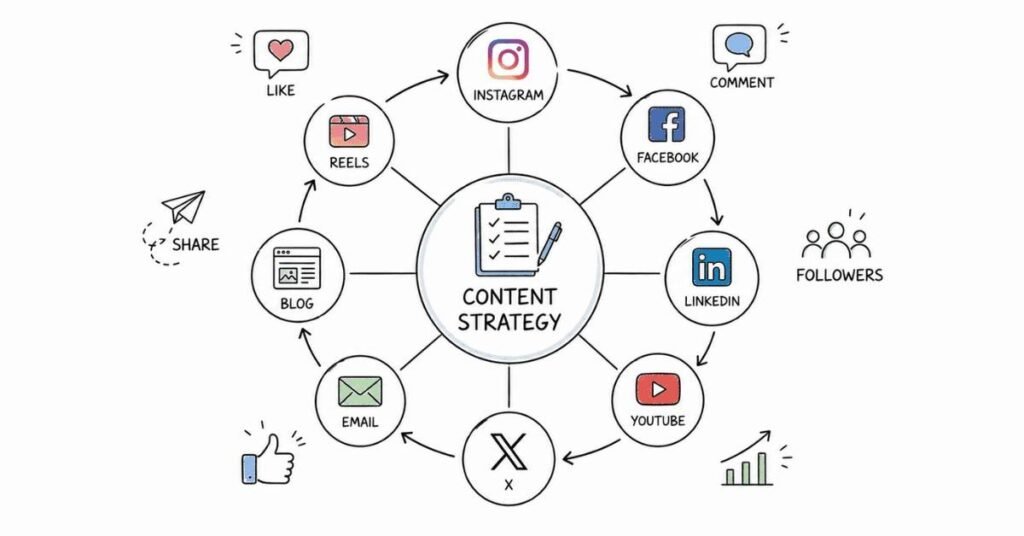
Social Media Marketing (Questions 76–110)
Q76. What is social media marketing?
Social media marketing is the use of platforms like Instagram, Facebook, LinkedIn, YouTube, and X to promote a brand, build relationships, and drive business goals. These goals may include awareness, engagement, leads, traffic, or sales. In simple terms, it is where brands meet people where they already spend time online.
Q77. Why is social media marketing important?
Social media helps brands stay visible, talk directly to their audience, and distribute content quickly. It also supports both organic growth and paid promotion. For many businesses, it is one of the fastest ways to test messaging and gather audience feedback.
Q78. What is the difference between organic and paid social media?
Organic social media refers to unpaid posts and interactions shared naturally through a brand’s account. Paid social media involves spending money to boost posts or run targeted ads. Organic builds long-term community, while paid helps scale reach faster.
Q79. Which platforms are most important in social media marketing?
The most important platforms usually include Instagram, Facebook, LinkedIn, YouTube, X, Pinterest, and sometimes TikTok depending on the market. The right platform depends on the audience and business type. A B2B brand may prefer LinkedIn, while a fashion brand may focus more on Instagram and YouTube.
Q80. How do you choose the right social platform for a brand?
You choose the platform based on target audience, content format, business goals, and user behavior. If the audience prefers short videos, Reels or Shorts may matter more than text-heavy platforms. Good platform choice is like choosing the right shop location before opening a store.
Platform Strategy
Q81. What makes Instagram useful for marketing?
Instagram is strong for visual storytelling, short-form video, product discovery, and influencer collaboration. It works well for lifestyle, beauty, fashion, food, fitness, and personal brands. Features like Reels, Stories, and DMs also support both reach and engagement.
Q82. What makes LinkedIn useful for marketing?
LinkedIn is strong for B2B marketing, employer branding, thought leadership, and professional networking. It works well for service businesses, SaaS, consulting, training, and hiring-focused communication. Content that performs well there is often educational, industry-specific, or credibility-driven.
Q83. What makes YouTube useful for marketing?
YouTube is powerful for long-form video, search-based discovery, tutorials, reviews, and trust-building. It supports both brand awareness and high-intent content. Good YouTube content can keep bringing traffic long after it is published.
Q84. What makes Facebook still relevant for marketers?
Facebook remains useful for community building, local business promotion, lead generation, retargeting, and Meta Ads. Its groups, events, and ad targeting still make it valuable in many markets. It may not be the trendiest platform, but it still has practical marketing value.
Q85. What is platform-specific content?
Platform-specific content means adapting your message to suit the style and behavior of each platform. A LinkedIn post should not look exactly like an Instagram Reel or a YouTube video. Strong marketers do not just repost the same content everywhere without context.
Content And Engagement
Q86. What is a social media content strategy?
A social media content strategy is a plan for what to post, why to post it, where to post it, and how success will be measured. It usually includes content themes, audience segments, posting frequency, and goals. A good strategy prevents random posting.
Q87. What are common content pillars in social media?
Content pillars are the main recurring themes a brand posts about. Common pillars include education, entertainment, community, promotions, behind-the-scenes content, and user stories. They help keep content varied but still consistent.
Q88. What is a content calendar?
A content calendar is a schedule that organizes what content will be posted, on which platform, and when. It helps teams plan campaigns, maintain consistency, and avoid last-minute confusion. Think of it as a publishing roadmap for the month.
Q89. Why is consistency important on social media?
Consistency helps audiences remember your brand and understand what to expect from you. It also improves platform signals because active, reliable accounts often perform better over time. Consistency does not mean posting every hour, it means posting with purpose and rhythm.
Q90. What is engagement in social media?
Engagement refers to how users interact with content through likes, comments, shares, saves, clicks, replies, and direct messages. It shows whether the audience cares enough to respond. High engagement usually means the content is relevant or interesting.
Q91. Why are comments and saves often more meaningful than likes?
Likes are easy and quick, so they are sometimes a weaker signal of intent. Comments and saves usually show deeper interest because the user took more effort or wants to revisit the content later. In many cases, saves suggest the content delivered real value.
Q92. What is community management?
Community management is the process of replying to comments, handling messages, engaging with followers, and maintaining brand presence in conversations. It helps make the brand feel human and responsive. Social media is not only posting, it is also listening and interacting.
Q93. How can a brand improve engagement organically?
A brand can improve engagement by posting relevant content, asking better questions, using strong hooks, replying quickly, experimenting with formats, and understanding audience behavior. Interactive formats like polls, carousels, and Q&A posts often help. Good engagement is earned through value, not forced through noise.
Algorithms And Reach
Q94. What is a social media algorithm?
A social media algorithm is the system a platform uses to decide which content users see and in what order. It looks at signals like relevance, engagement, watch time, relationships, and user behavior. In simple words, it is the platform’s way of ranking content.
Q95. Why do algorithms matter in marketing?
Algorithms affect how much organic reach your content gets. If you understand what the platform favors, you can create content that performs better. Ignoring algorithms is like trying to win a game without learning the rules.
Q96. What is reach?
Reach is the number of unique people who see your content. It tells you how many individuals were exposed to your message. Reach is useful for awareness-focused campaigns.
Q97. What are impressions?
Impressions are the total number of times content is displayed, even if the same person sees it more than once. This means impressions can be higher than reach. Reach counts people, impressions count views.
Q98. What is engagement rate?
Engagement rate measures how much interaction your content gets relative to its reach, impressions, or followers, depending on the formula used. It helps compare performance more fairly than raw likes alone. A smaller account with strong engagement can sometimes be healthier than a larger inactive one.
Influencer Marketing
Q99. What is influencer marketing?
Influencer marketing is when brands collaborate with creators who already have the attention and trust of a specific audience. These influencers help promote products, services, or messages in a more relatable way. It is like borrowing trust instead of building all of it from scratch.
Q100. What are the main types of influencers?
Influencers are often grouped as nano, micro, macro, and celebrity influencers based on audience size. Smaller influencers may have lower reach but stronger trust and engagement in niche communities. Bigger influencers offer scale, but usually at higher cost.
Q101. How do you choose the right influencer for a campaign?
You should look at audience relevance, engagement quality, brand fit, content style, and credibility. Follower count alone is not enough. The right influencer is someone whose audience overlaps with your target audience and actually pays attention.
Q102. How do you measure influencer campaign success?
Success can be measured using reach, impressions, engagement, clicks, leads, conversions, promo code use, traffic, and branded search lift. The best metric depends on the campaign goal. For awareness, reach may matter more, while for sales, conversions matter most.
Q103. What are common risks in influencer marketing?
Common risks include fake followers, low-quality engagement, poor brand fit, unclear expectations, and content that feels forced. Another risk is choosing influencers based only on popularity. Good influencer marketing needs research and a clear brief.
Social Media Metrics And Tools
Q104. What social media metrics matter most?
Important metrics include reach, impressions, engagement rate, follower growth, video views, watch time, clicks, CTR, leads, and conversions. The most important ones depend on the campaign objective. Metrics should connect to business goals, not just vanity.
Q105. What is follower growth and why does it matter?
Follower growth shows whether the brand is attracting more people over time. It is useful as a long-term signal of audience building. However, follower count alone is not enough if those followers do not engage or convert.
Q106. What is CTR in social media?
CTR stands for Click-Through Rate. It measures the percentage of users who click a link after seeing the content or ad. It helps show whether the creative and message are strong enough to drive action.
Q107. What is social listening?
Social listening means tracking online conversations, mentions, trends, and audience sentiment around a brand, topic, or competitor. It helps marketers understand what people are saying and what opportunities or risks exist. It is like market research happening in public.
Q108. What tools are commonly used in social media marketing?
Common tools include Meta Business Suite, Hootsuite, Buffer, Later, Sprout Social, Canva, and analytics tools built into each platform. Scheduling, reporting, and creative tools help teams stay efficient. The tool matters less than knowing what problem it solves.
Q109. What is a social media crisis?
A social media crisis is a situation where a post, comment, campaign, or public reaction creates negative attention that can damage the brand. It may involve backlash, complaints, misinformation, or sensitive mistakes. Fast, calm, and clear communication becomes very important in such moments.
Q110. How should a brand handle a social media crisis?
A brand should respond quickly, verify the facts, avoid emotional replies, and communicate with clarity. The response should match the seriousness of the issue and protect both trust and accountability. In many cases, silence or careless replies make the crisis worse.
Practice Strategy
For this part, practice by picking one brand and building a simple social media plan for it. Decide the platforms, content pillars, posting style, metrics, and one campaign idea.
A strong interview exercise is to explain how you would grow engagement for a small brand with limited budget. That shows whether you can think strategically, not just define terms.
Part 5: Content Marketing & Email Marketing
Content Marketing & Email Marketing (Questions 111–145)
Q111. What is content marketing?
Content marketing is the creation and distribution of useful, relevant content to attract and retain an audience. Instead of pushing a product directly, it builds trust and interest over time. In simple terms, it is marketing by helping before selling.
Q112. Why is content marketing important?
Content marketing supports SEO, social media, lead generation, brand awareness, and customer education. Good content can keep working for a business long after it is published. It is one of the strongest long-term assets in digital marketing.
Q113. What is the goal of content marketing?
The goal is to attract the right audience, provide value, build credibility, and move people closer to action. That action may be subscribing, sharing, booking a demo, or making a purchase. Content is not just about traffic, it is about influence and conversion too.
Q114. What are common types of content in digital marketing?
Common content types include blogs, videos, case studies, email newsletters, social posts, infographics, e-books, webinars, and landing page copy. Different formats serve different stages of the funnel. A strong marketer chooses the format based on audience need, not personal preference.
Q115. What is a buyer persona?
A buyer persona is a semi-fictional profile of an ideal customer based on research and behavior. It includes details like goals, problems, interests, and decision triggers. Personas help marketers create content that feels relevant instead of generic.
Content Strategy
Q116. What is a content strategy?
A content strategy is a plan for what content to create, who it is for, where it will be published, and what result it should drive. It connects content to business goals. Without strategy, content often becomes random and inconsistent.
Q117. What is a content calendar?
A content calendar is a schedule of planned content across channels and dates. It helps teams stay organized and maintain publishing consistency. It also makes campaign planning easier because everyone can see what is coming.
Q118. What are content pillars?
Content pillars are the main themes a brand repeatedly creates content around. For example, a digital marketing brand may post about SEO, paid ads, analytics, and career tips. Pillars help keep content focused without becoming repetitive.
Q119. How does content support SEO?
Content helps SEO by giving search engines relevant pages to rank for keywords and user intent. Strong content also attracts backlinks, increases engagement, and supports internal linking. In many cases, SEO and content marketing work like two gears in the same machine.
Q120. What makes a blog post effective?
An effective blog post solves a real problem, has a clear structure, uses strong headings, and is easy to read. It should match search intent and lead the reader toward the next step. Good blog content is useful first and optimized second.
Q121. Why is readability important in content?
Readability affects whether people stay, scroll, and understand your message. If content feels too dense or confusing, users may leave quickly. Clear writing is like good road signage — it helps people move forward without friction.
Q122. What is a CTA in content marketing?
CTA stands for Call To Action. It is the next step you want the reader to take, such as downloading a guide, signing up, contacting sales, or reading another article. Good content should not only inform, it should also guide.
Q123. What is evergreen content?
Evergreen content stays useful for a long time instead of becoming outdated quickly. Examples include beginner guides, how-to articles, and foundational concepts. It is valuable because it can keep driving traffic over months or years.
Q124. What is content repurposing?
Content repurposing means turning one piece of content into multiple formats. For example, a blog can become a LinkedIn post, Instagram carousel, email newsletter, and short video. This helps extend reach without starting from zero every time.
Q125. What is the difference between owned, earned, and paid content distribution?
Owned distribution happens on channels the brand controls, like its website, email list, or social pages. Earned distribution comes from others sharing or mentioning the content naturally. Paid distribution means promoting content through ads or sponsored placements.
Content Performance
Q126. How do you measure content marketing success?
Success can be measured using traffic, time on page, scroll depth, shares, backlinks, leads, conversions, and assisted revenue. The right metric depends on the goal of the content. Awareness content and lead-generation content should not be judged the same way.
Q127. What is engagement in content marketing?
Engagement refers to how users interact with content through actions like reading, sharing, commenting, saving, or clicking. It shows whether the content captured attention and provided value. High traffic with low engagement often means the content did not meet expectations.
Q128. What is content ROI?
Content ROI measures the business return generated from content relative to the cost of creating and distributing it. This may include leads, sales, pipeline value, or customer retention benefits. It helps prove that content is not just creative output, but business work.
Q129. Why is search intent important in content creation?
Search intent helps ensure the content matches what the user actually wants. If someone wants a comparison and you give them a broad definition article, the content may not perform well. Intent is often more important than keyword volume.
Q130. How can content underperformance be improved?
Underperforming content can be improved by updating the headline, improving structure, refreshing data, targeting better keywords, adding stronger CTAs, or improving distribution. Sometimes the problem is not the content quality but the wrong audience or weak promotion. Good marketers diagnose before rewriting everything.
Email Marketing Basics
Q131. What is email marketing?
Email marketing is the use of email to communicate with an audience for goals like nurturing leads, promoting offers, sharing updates, or driving repeat engagement. It is one of the most direct digital marketing channels. Unlike rented attention on social platforms, email gives brands access to their own subscriber list.
Q132. Why is email marketing still effective?
Email remains effective because it is direct, measurable, personalizable, and cost-efficient. It works across many stages of the customer journey, from welcome sequences to retention campaigns. A good email strategy can generate strong ROI even without huge budgets.
Q133. What are common types of marketing emails?
Common types include welcome emails, newsletters, promotional campaigns, product updates, abandoned cart emails, drip sequences, re-engagement emails, and event emails. Each type serves a different purpose. The best email mix depends on the audience and funnel stage.
Q134. What is a drip campaign?
A drip campaign is an automated series of emails sent over time based on a schedule or user behavior. It is often used for onboarding, education, lead nurturing, or re-engagement. Think of it as gradually building a conversation instead of sending one loud message.
Q135. What is email segmentation?
Email segmentation means dividing your subscriber list into smaller groups based on factors like behavior, interests, purchase history, location, or lifecycle stage. This makes email more relevant. Relevance usually improves open rates, clicks, and conversions.
Q136. Why is personalization important in email marketing?
Personalization makes emails feel more relevant to the subscriber. This can include using a first name, product recommendations, location, or behavior-based messaging. People respond better when the message feels meant for them, not for everyone.
Q137. What is email automation?
Email automation means sending emails automatically based on triggers, timing, or user behavior. For example, someone who downloads a guide may automatically enter a follow-up sequence. Automation saves time and makes communication more timely.
Deliverability And Email Health
Q138. What is email deliverability?
Email deliverability is the ability of your emails to reach the inbox instead of bouncing or landing in spam. It is affected by sender reputation, list quality, authentication, and content practices. A great email is useless if nobody receives it properly.
Q139. What is the difference between a hard bounce and a soft bounce?
A hard bounce happens when an email cannot be delivered permanently, often because the address is invalid. A soft bounce happens because of a temporary issue, such as a full inbox or server problem. Hard bounces should usually be removed quickly to protect list health.
Q140. What is open rate?
Open rate is the percentage of delivered emails that were opened. It is often used as a signal of subject line strength, timing, and audience interest. However, open rate alone does not tell the full performance story.
Q141. What is click-through rate in email marketing?
Click-through rate measures the percentage of recipients who clicked a link in the email. It shows whether the message and CTA were strong enough to drive action. A high open rate with a low click rate may mean the subject line worked better than the email content.
Q142. What is unsubscribe rate?
Unsubscribe rate shows the percentage of recipients who chose to leave the email list after receiving a campaign. A rising unsubscribe rate may signal poor targeting, over-emailing, or irrelevant content. It is a useful warning sign for list quality and messaging fit.
Q143. What is list hygiene?
List hygiene means keeping the email list healthy by removing invalid, inactive, or unengaged subscribers and maintaining clean data. This improves deliverability and reporting accuracy. A smaller healthy list is often better than a large weak one.
Email Optimization
Q144. How can you improve email performance?
Email performance can be improved through better subject lines, clearer copy, stronger CTAs, mobile-friendly design, segmentation, personalization, and A/B testing. Send timing and frequency also matter. Good email marketing is part writing, part psychology, and part testing.
Q145. What tools are commonly used for email marketing?
Common tools include Mailchimp, HubSpot, Klaviyo, ActiveCampaign, ConvertKit, and Brevo. These tools help with automation, templates, segmentation, testing, and analytics. The important thing in interviews is not just naming tools, but understanding what they help you do.
Practice Strategy
For this part, practice by building one simple content plan and one email flow. For example, create a 1-month blog calendar for a brand and then outline a welcome email sequence for new subscribers.
A strong mock question is: “How would you use content and email together to generate leads?” That tests whether you understand channel integration, not just isolated definitions.
Part 6: Analytics, Data & Campaign Measurement
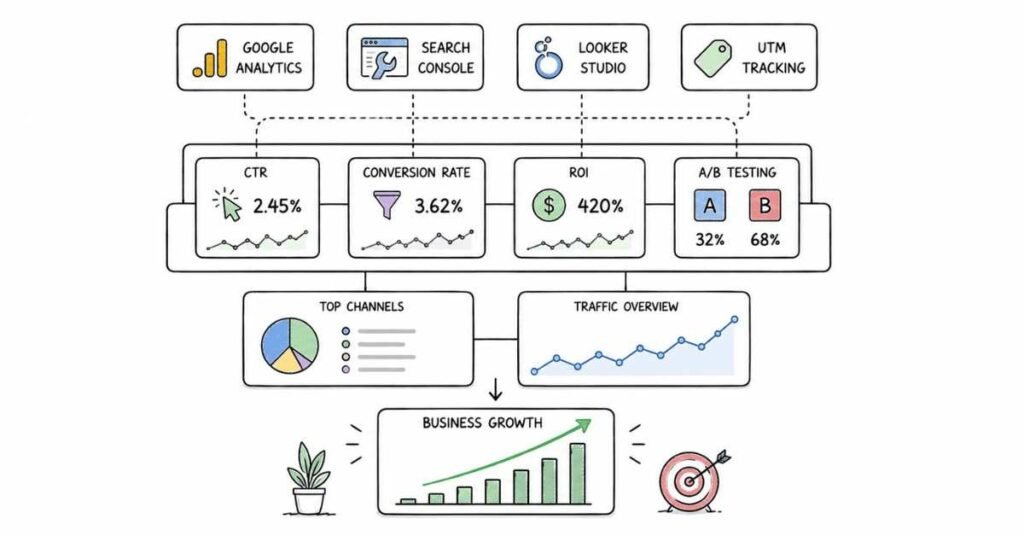
Analytics, Data & Campaign Measurement (Questions 146–180)
Q146. Why is analytics important in digital marketing?
Analytics helps marketers understand what is working, what is failing, and where to improve. Without analytics, marketing becomes guesswork. In simple terms, analytics is the scoreboard that tells you whether your efforts are actually producing results.
Q147. What is campaign measurement?
Campaign measurement is the process of tracking and evaluating the performance of marketing activities. It helps determine whether a campaign achieved its goals, such as traffic, leads, conversions, or revenue. Good measurement connects activity to business impact.
Q148. What is Google Analytics 4?
Google Analytics 4, or GA4, is Google’s analytics platform for tracking user behavior across websites and apps. It is event-based, which means it focuses on actions users take rather than only pageviews and sessions. It helps marketers understand the full customer journey more clearly.
Q149. What is an event in GA4?
An event is any tracked user action, such as page_view, scroll, click, video_start, or form_submit. GA4 uses events as the basic unit of measurement. This gives marketers more flexibility in tracking what matters.
Q150. What is a conversion in GA4?
A conversion in GA4 is an event marked as especially important to business goals. Examples include purchases, lead form submissions, sign-ups, or demo bookings. Not every event is a conversion, only the ones you choose to treat as key outcomes.
Q151. What is the difference between users and sessions?
Users are individual people who visit a site or app, while sessions are visits or interactions during a specific time period. One user can have multiple sessions. A simple way to remember it is that users are people and sessions are visits.
Q152. What is bounce rate in analytics?
Bounce rate generally refers to the percentage of visits where users leave without meaningful engagement, though the exact definition can vary by platform and setup. A high bounce rate may suggest poor relevance, weak UX, or mismatched traffic. However, bounce rate should always be interpreted with context.
Core Marketing Metrics
Q153. What is CTR?
CTR stands for Click-Through Rate. It shows the percentage of people who clicked after seeing an ad, email, or search result. CTR helps measure how appealing and relevant your message is.
Q154. What is CPC?
CPC stands for Cost Per Click. It tells you how much you pay for each click in a paid campaign. It is useful for understanding traffic cost, but it should always be judged alongside conversion quality.
Q155. What is CPM?
CPM stands for Cost Per Mille, which means cost per 1,000 impressions. It is commonly used in awareness campaigns where visibility matters more than clicks. It helps evaluate how expensive it is to get exposure.
Q156. What is CPA?
CPA stands for Cost Per Acquisition or Cost Per Action. It measures how much it costs to get one desired result, such as a sale or lead. This metric is important because it connects spend to actual outcomes.
Q157. What is CAC?
CAC stands for Customer Acquisition Cost. It measures how much a business spends on average to acquire one customer. This usually includes marketing and sometimes sales costs depending on the company’s method.
Q158. What is LTV?
LTV stands for Lifetime Value. It estimates how much revenue or value a customer brings over their relationship with the business. CAC tells you what it costs to get a customer, while LTV tells you what that customer is worth over time.
Q159. What is ROI in digital marketing?
ROI stands for Return on Investment. It measures whether marketing generated more value than it cost. A positive ROI means the return was greater than the investment.
Q160. What is ROAS?
ROAS stands for Return on Ad Spend. It shows how much revenue was generated for every unit of money spent on advertising. ROAS is especially useful in performance marketing and e-commerce.
Tracking And Attribution
Q161. What are UTM parameters?
UTM parameters are tags added to URLs to track where traffic comes from. They help marketers identify the source, medium, campaign, and other details in analytics tools. Without UTMs, traffic reporting can become messy and unclear.
Q162. Why are UTM parameters important?
UTM parameters help you understand which campaigns, channels, or creatives are driving results. They create cleaner reporting across email, paid ads, social media, and partnerships. Think of UTMs like labels on delivery boxes so you know where each visitor came from.
Q163. What is conversion tracking?
Conversion tracking is the setup used to record when users complete important actions like purchases, lead submissions, or sign-ups. It is essential for optimization and reporting. If tracking is wrong, even a good campaign can look bad.
Q164. What is cross-domain tracking?
Cross-domain tracking is used when users move between multiple related domains during their journey, such as from a website to a separate checkout domain. It helps keep the user journey connected in analytics. Without it, one user journey may look like two separate visits.
Q165. What is attribution in marketing?
Attribution is the process of assigning credit to marketing touchpoints that influenced a conversion. It tries to answer which channel or action helped create the result. Attribution matters because modern customer journeys are rarely just one click long.
Q166. What is last-click attribution?
Last-click attribution gives all the credit to the final touchpoint before the conversion. It is simple and common, but it can undervalue earlier awareness or nurturing channels. It often favors bottom-funnel activity.
Q167. What is first-click attribution?
First-click attribution gives all the credit to the first touchpoint that introduced the user to the brand. It is useful for understanding top-of-funnel discovery. However, it ignores the influence of later steps in the journey.
Q168. What is linear attribution?
Linear attribution spreads credit evenly across all major touchpoints in the journey. It gives a more balanced view than last-click or first-click. However, it assumes every touchpoint mattered equally, which may not always be true.
Q169. What is data-driven attribution?
Data-driven attribution uses platform data and algorithms to estimate how much each touchpoint contributed to a conversion. It aims to be more realistic than simple rule-based models. In interviews, it is enough to understand that it tries to assign credit using actual observed patterns.
Reporting Tools
Q170. What is Google Search Console?
Google Search Console is a free Google tool that shows how a website performs in search. It provides data on clicks, impressions, indexing, coverage, queries, and technical issues. It is especially useful for SEO monitoring and troubleshooting.
Q171. What is Looker Studio?
Looker Studio is a reporting and dashboard tool that helps marketers visualize data from sources like GA4, Google Ads, Search Console, and spreadsheets. It is useful for building client or team reports. Good dashboards help turn raw numbers into understandable stories.
Q172. What makes a good marketing report?
A good marketing report is clear, relevant, and tied to goals. It should show what happened, why it matters, and what action should be taken next. Too many numbers without interpretation make reports harder, not better.
Q173. What is a dashboard in marketing analytics?
A dashboard is a visual summary of key metrics and trends. It helps teams track performance without digging through raw data every time. A good dashboard should help decision-making, not just look impressive.
Q174. Why are trends more important than one-time numbers?
One-time numbers show a snapshot, but trends show direction over time. A single good day or bad day can be misleading. Trends help marketers understand whether performance is improving, declining, or staying stable.
Experimentation And Optimization
Q175. What is A/B testing in marketing?
A/B testing means comparing two versions of something, such as an ad, email subject line, landing page, or CTA, to see which performs better. Usually only one major variable is changed at a time. It helps marketers improve results using evidence instead of assumptions.
Q176. Why is A/B testing useful?
A/B testing helps reduce guesswork and improve performance over time. It shows what actually works with a real audience. In simple terms, it lets the market vote instead of the team arguing.
Q177. What should be tested in A/B testing?
Common things to test include headlines, creatives, CTAs, form length, button color, landing page layout, ad copy, email subject lines, and audience targeting. The test should focus on a clear hypothesis. Random testing without purpose wastes time.
Q178. What is a hypothesis in experimentation?
A hypothesis is a clear statement about what you expect to happen and why. For example, “A shorter form will increase lead submissions because it reduces friction.” A good hypothesis gives the test direction and makes learning easier.
Q179. What is statistical significance in simple terms?
Statistical significance means the result of a test is likely not due to random chance alone. It helps give confidence that one variation really performed differently. In interviews, you do not need deep math, but you should know that test results need enough data before being trusted.
Q180. What is conversion rate optimization?
Conversion Rate Optimization, or CRO, is the process of improving pages, flows, or campaigns so a higher percentage of users take the desired action. It focuses on turning more existing traffic into results. CRO is like fixing leaks in a bucket before pouring in more water.
Practice Strategy
For this part, practice by building one simple content plan and one email flow. For example, create a 1-month blog calendar for a brand and then outline a welcome email sequence for new subscribers.
A strong mock question is: “How would you use content and email together to generate leads?” That tests whether you understand channel integration, not just isolated definitions.
Part 7: Marketing Strategy, CRO & Funnels
Marketing Strategy, CRO & Funnels (Questions 181–210)
Q181. What is a marketing funnel?
A marketing funnel is a model that shows how people move from first discovering a brand to finally taking action. The number of people usually becomes smaller at each stage, which is why it looks like a funnel. It helps marketers understand where users drop off and where to optimize.
Q182. What are the main stages of a marketing funnel?
The stages are often described as awareness, consideration, and conversion, though some models include retention and advocacy too. Awareness brings people in, consideration builds trust, and conversion drives action. Different businesses may use slightly different names, but the journey idea stays the same.
Q183. What do TOFU, MOFU, and BOFU mean?
TOFU stands for Top of Funnel, MOFU stands for Middle of Funnel, and BOFU stands for Bottom of Funnel. TOFU content attracts attention, MOFU content educates and builds trust, and BOFU content encourages decisions. It is like moving someone from “Who are you?” to “Why should I choose you?” to “I’m ready.”
Q184. What is the customer journey?
The customer journey is the full path a person takes from first interacting with a brand to becoming a customer and sometimes a repeat buyer. It includes touchpoints across search, social, ads, email, website, and sales interactions. Understanding the journey helps marketers create better content and campaigns at each stage.
Q185. Why is customer journey mapping important?
Customer journey mapping helps identify what users need, think, and feel at different stages. It reveals friction points, missed opportunities, and places where messaging can improve. Good marketing strategy starts with understanding the journey, not just the channel.
CRO Basics
Q186. What is CRO?
CRO stands for Conversion Rate Optimization. It is the process of improving a website, landing page, or campaign so a higher percentage of users take the desired action. Instead of only buying more traffic, CRO helps you get more value from the traffic you already have.
Q187. Why is CRO important?
CRO improves efficiency because it helps turn more visitors into leads, customers, or subscribers without always increasing ad spend. It also improves user experience by reducing friction. In simple terms, it helps fix leaks before you pour more water into the bucket.
Q188. What is a conversion?
A conversion is any action that matches a business goal, such as a purchase, sign-up, form submission, call booking, or app install. The exact definition depends on the campaign objective. Not every click is a conversion, and not every conversion has the same value.
Q189. What is conversion rate?
Conversion rate is the percentage of visitors who complete the desired action. It is usually calculated by dividing conversions by total visitors or clicks, then multiplying by 100. This metric helps show how efficiently a page or campaign turns attention into action.
Q190. What is friction in conversion optimization?
Friction is anything that makes it harder for users to complete the next step. This can include slow load speed, confusing messaging, too many form fields, weak design, or poor mobile experience. Less friction usually means smoother conversions.
Landing Pages
Q191. What is a landing page?
A landing page is a page designed for a specific campaign goal, such as collecting leads or driving purchases. It is more focused than a homepage and usually built around one clear CTA. A strong landing page removes distractions and guides users toward one decision.
Q192. What makes a good landing page headline?
A good headline is clear, relevant, and benefit-focused. It should quickly tell the visitor what the offer is and why it matters. If the headline is confusing, many users leave before reading the rest.
Q193. Why is a strong CTA important on a landing page?
A CTA gives visitors a clear next step. Without a strong CTA, even interested users may hesitate or leave. The CTA should feel obvious, relevant, and easy to act on.
Q194. What is social proof and why does it matter?
Social proof includes testimonials, reviews, ratings, case studies, client logos, and user counts that show others trust the brand. It reduces uncertainty and builds confidence. People often feel safer taking action when they see that others already did.
Q195. Why does page speed matter for conversions?
A slow page increases drop-offs because users lose patience quickly. Even strong campaigns can underperform if the landing page feels slow or unstable. Speed matters because attention online is fragile.
Q196. Why should landing pages match ad messaging?
When the ad promise and landing page message match, users feel they arrived in the right place. This improves trust, relevance, and conversion rate. A mismatch creates confusion and often wastes paid traffic.
Lead Generation And Strategy
Q197. What is lead generation?
Lead generation is the process of attracting people and collecting their contact or intent information so they can be nurtured toward a sale. Leads may come through forms, downloads, demos, webinars, or contact requests. It is about turning anonymous traffic into identifiable opportunities.
Q198. What is the difference between inbound and outbound lead generation?
Inbound lead generation attracts users through content, SEO, social media, and organic interest. Outbound lead generation reaches out directly through ads, email outreach, cold campaigns, or prospecting. Inbound pulls people in, while outbound pushes the message outward.
Q199. What is a lead magnet?
A lead magnet is something valuable offered in exchange for user information. Common examples include e-books, checklists, templates, webinars, trials, or audits. A good lead magnet solves a real problem, not just fills space.
Q200. What is lead nurturing?
Lead nurturing is the process of building trust with leads over time until they are ready to take the next step. This often happens through email sequences, retargeting, educational content, and follow-ups. Not every lead is ready immediately, so nurturing helps move them forward.
Q201. What is the AIDA model?
AIDA stands for Attention, Interest, Desire, and Action. It is a classic marketing model that explains how people move from noticing something to acting on it. It is still useful because many digital campaigns follow this basic psychological path.
Integrated Strategy
Q202. What is an integrated digital marketing strategy?
An integrated digital marketing strategy connects multiple channels like SEO, paid ads, content, social media, and email so they work together. Instead of treating each channel separately, it aligns them around one audience and goal. This usually creates stronger results than isolated efforts.
Q203. Why is channel integration important?
Users rarely convert after seeing only one touchpoint. They may discover a brand through search, follow it on social, click an email later, and convert after a retargeting ad. Integration matters because real customer journeys are connected, not single-channel.
Q204. What is brand positioning in digital marketing?
Brand positioning is how a brand wants to be perceived in the mind of its audience compared to competitors. It shapes messaging, tone, offers, and creative strategy. Strong positioning helps people remember why you are different.
Q205. What is a value proposition?
A value proposition is a clear statement of why someone should choose your product or service. It explains the main benefit and the problem it solves. A good value proposition is simple, specific, and easy to understand quickly.
Q206. How should digital marketing budgets be allocated?
Budget allocation should depend on business goals, audience behavior, funnel stage, historical performance, and testing needs. High-intent channels may deserve more budget, but awareness channels are also important for future growth. Good allocation balances short-term wins and long-term demand building.
Q207. Why should marketers leave room for testing in the budget?
If every rupee is locked into existing tactics, growth can become limited. Testing helps discover new audiences, creatives, offers, and channels that may outperform current assumptions. A good marketer protects some budget for learning, not just repeating.
Campaign Planning
Q208. How do you plan a digital marketing campaign from scratch?
Start with the goal, then define the audience, message, offer, channels, budget, timeline, and KPIs. After that, create assets, tracking, and reporting before launch. A strong campaign plan is not just creative, it is structured.
Q209. What KPIs should be chosen for a campaign?
KPIs should match the campaign objective. Awareness campaigns may focus on reach, impressions, and engagement, while lead campaigns may focus on CPL, conversion rate, and lead quality. The best KPI is the one closest to the actual business goal.
Q210. What is the biggest mistake in campaign strategy?
One common mistake is focusing on tactics before clarifying the goal and audience. Another is judging all campaigns by the same metric, even when the objectives are different. Strategy fails when teams jump into posting or spending before deciding what success actually means.
Practice Strategy
For this part, practice by taking one business and building a simple funnel for it. Define TOFU, MOFU, BOFU content, one landing page, one lead magnet, and the KPIs you would track.
A strong mock interview exercise is: “Your campaign gets traffic but low leads — how do you diagnose the funnel?” That reveals whether you understand messaging, audience fit, landing page friction, and conversion strategy.
Part 8: AI in Digital Marketing & Emerging Trends
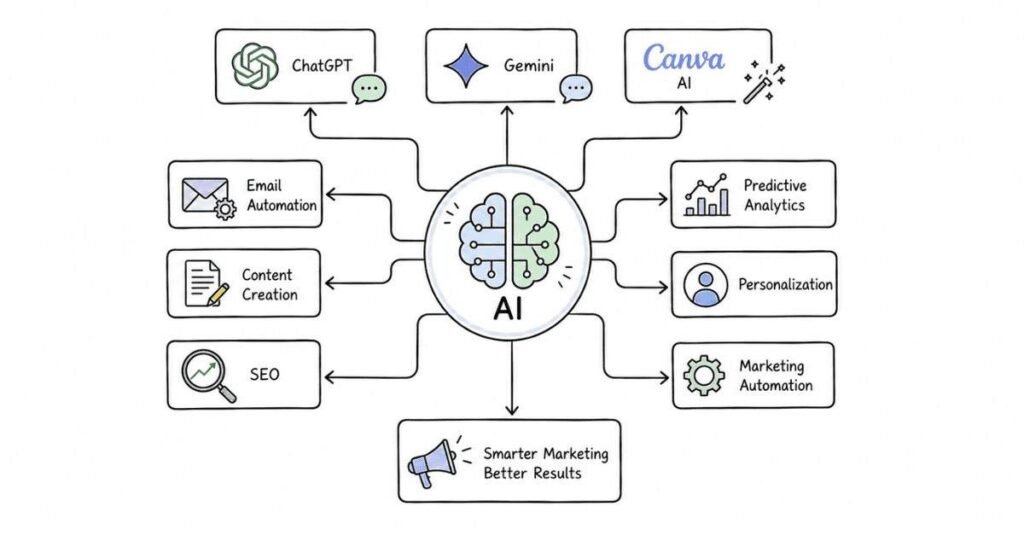
AI in Digital Marketing & Emerging Trends (Questions 211–240)
Q211. How is AI changing digital marketing?
AI is helping marketers create content faster, personalize campaigns, analyze data, automate workflows, and test ideas at scale. It does not replace marketing strategy, but it speeds up execution and decision support. In simple terms, AI is becoming a powerful assistant, not a full substitute for judgment.
Q212. Why is AI important for marketers in 2026?
AI matters because competition is high, customer attention is limited, and campaigns need to move faster than before. Marketers are expected to do more with less time, and AI helps with that. In 2026, knowing how to use AI well is becoming a practical skill, not just a bonus.
Q213. What are the biggest AI use cases in digital marketing?
The biggest use cases include content drafting, ad copy generation, audience segmentation, predictive recommendations, customer support automation, reporting assistance, and personalization. AI is especially useful in repetitive or data-heavy tasks. The human marketer still decides strategy, brand voice, and final direction.
AI Tools And Content Creation
Q214. What are common AI tools used in digital marketing?
Common tools include ChatGPT, Gemini, Jasper, Copy.ai, Canva AI, HubSpot AI features, and AI features inside ad platforms. These tools help with writing, ideation, design support, summaries, and workflow automation. The most important thing is not memorizing tool names, but knowing what business problem each tool solves.
Q215. How can AI help with content creation?
AI can help generate first drafts, headlines, outlines, ad copy, email variations, content ideas, and repurposed versions of existing content. It can speed up production, but the output still needs human editing. AI is good at acceleration, but not always at originality or nuance.
Q216. What are the risks of relying too much on AI-generated content?
Overusing AI can make content sound generic, repetitive, inaccurate, or off-brand. It may also reduce originality if teams publish unedited outputs. Strong marketers use AI as a starting point, not as the entire creative process.
Q217. What is prompt engineering in marketing?
Prompt engineering means writing clear, specific instructions so AI tools produce better outputs. A weak prompt gives vague output, while a strong prompt gives useful direction. It is like briefing a junior assistant — the clearer you are, the better the result.
Q218. What makes a good AI prompt for marketers?
A good prompt includes context, audience, goal, format, tone, and constraints. For example, it may specify that the output should be for a B2B SaaS audience, in a professional tone, and optimized for LinkedIn. Better input usually produces better output.
AI And SEO
Q219. How is AI affecting SEO?
AI is changing how content is created, researched, optimized, and discovered. It also affects search behavior because AI-generated search answers may reduce some clicks for simple queries. This means SEO content now needs to be more useful, original, and better structured.
Q220. What does AI mean for content quality in SEO?
AI makes low-effort content easier to produce, which raises the competition and noise level. As a result, search engines and users reward content that has stronger expertise, better structure, and genuine value. The easy content bar is lower, so the quality bar is actually higher.
Q221. What is search generative behavior in simple terms?
Search generative behavior refers to users getting direct, summarized answers generated by AI systems inside or around search experiences. This changes how people click, compare, and discover information. Marketers need content that is useful enough to be cited, visited, or trusted beyond a one-line answer.
Q222. How should marketers adapt SEO for AI-driven search?
Marketers should focus on structured content, clear headings, strong topic depth, original insights, FAQs, and trust-building signals. Pages should answer real questions clearly and quickly. In other words, content should be easy for both humans and machines to understand.
Personalization And Predictive Marketing
Q223. What is personalization in digital marketing?
Personalization means tailoring messages, content, offers, or experiences based on user behavior, preferences, or segments. Instead of showing the same message to everyone, brands adjust what people see. Better personalization usually improves relevance and engagement.
Q224. How does AI improve personalization?
AI can analyze behavior patterns faster than manual teams and help predict what users may want next. It can support personalized emails, product recommendations, ad creative variations, and audience targeting. This helps scale relevance across larger audiences.
Q225. What is predictive analytics in marketing?
Predictive analytics uses past data to estimate likely future outcomes, such as who might convert, churn, click, or buy again. It helps marketers act earlier and more strategically. It is like using patterns from yesterday to make smarter choices today.
Q226. What are examples of predictive marketing use cases?
Examples include predicting high-value leads, identifying likely churn, recommending products, estimating customer lifetime value, and forecasting campaign performance. These insights help prioritize budget and attention. Prediction is not magic, but it improves decision-making when used carefully.
Programmatic, Privacy, And Data Shifts
Q227. What is programmatic advertising?
Programmatic advertising is the automated buying and placement of digital ads using software and data. Instead of manually negotiating every placement, systems decide where and when ads should appear. It helps advertisers scale targeting and optimization more efficiently.
Q228. Why is programmatic advertising important?
Programmatic matters because it allows real-time targeting, broader reach, and data-driven media buying. It is widely used in display, video, and retargeting campaigns. For marketers, it represents how automation and media buying increasingly work together.
Q229. What is privacy-first marketing?
Privacy-first marketing means respecting user consent, protecting data, and building strategies that do not depend too heavily on invasive tracking. It reflects a shift toward more responsible data use. In practical terms, marketers must balance personalization with trust.
Q230. Why is first-party data becoming more important?
First-party data comes directly from your own audience, such as website behavior, email subscribers, purchase history, or CRM data. It is more reliable and future-friendly than depending too much on third-party tracking. As privacy rules tighten, owned data becomes more valuable.
Q231. What is cookie deprecation in simple terms?
Cookie deprecation refers to the reduced use or support of third-party cookies for tracking users across the web. This affects targeting, attribution, and retargeting. Marketers need stronger first-party data, better measurement models, and more creative audience strategies.
Emerging Channels And Formats
Q232. Why is short-form video so important in 2026?
Short-form video captures attention quickly and fits how people consume content on mobile platforms. It works well for awareness, education, entertainment, and product discovery. Platforms reward it because it keeps users engaged for longer periods.
Q233. What makes short-form video effective?
Effective short-form video usually has a strong opening hook, clear pacing, visual movement, captions, and one focused message. It must earn attention in the first few seconds. A good short video feels like a strong opening sentence, not a slow introduction.
Q234. What is the role of YouTube Shorts, Instagram Reels, and similar formats?
These formats help brands reach users in quick, scrollable environments where discovery happens fast. They can support both organic growth and paid promotion. They are especially useful for increasing reach and testing content themes quickly.
Q235. What is conversational marketing?
Conversational marketing uses real-time or near-real-time communication, such as chat, messaging apps, and automated responses, to guide users toward action. It makes marketing feel more interactive and personal. Instead of only broadcasting, the brand starts a conversation.
Q236. Why is WhatsApp marketing important in India?
WhatsApp is widely used, highly personal, and effective for business communication, updates, offers, and customer support. It helps brands engage users where they already spend time daily. In India especially, it has become a practical channel for both nurture and conversion.
Q237. What are examples of WhatsApp marketing use cases?
Common use cases include lead follow-up, order updates, reminders, event confirmations, customer service, product catalogs, and promotional broadcasts. It works best when messages are timely and relevant. Overuse can quickly feel intrusive because the channel is personal.
Future Skills For Marketers
Q238. What skills do digital marketers need most in 2026?
The most important skills include strategic thinking, analytics, content creation, ad platform understanding, AI tool usage, testing mindset, audience understanding, and communication. Technical skill matters, but so does the ability to connect activities to outcomes. The strongest marketers are both creative and measurable.
Q239. Why is adaptability important in digital marketing?
Platforms, algorithms, tools, and user behavior change constantly. A marketer who depends only on old tactics can become outdated quickly. Adaptability matters because the field rewards people who keep learning and adjusting.
Q240. What is the biggest trend shaping digital marketing right now?
The biggest trend is the combination of AI, personalization, and platform-native content formats like short-form video. At the same time, privacy changes are forcing marketers to be smarter with data and trust. The future is not just more automation, but more thoughtful and adaptive marketing.
Practice Strategy
For this part, practice explaining AI as a tool for better execution rather than as a magic solution. You should be able to discuss where AI helps, where human judgment still matters, and how trends like video, privacy, and first-party data are changing strategy.
A strong mock interview exercise is this: “How would you use AI to improve a digital marketing workflow without making the content feel robotic?” That kind of answer reveals maturity and practical thinking.
Part 9: Behavioral, Communication & Career Strategy
The STAR Method: Your Framework for Behavioral Questions
The STAR method is the simplest and strongest way to answer behavioral interview questions clearly. It helps you avoid vague answers and makes your examples easier for interviewers to follow.
- S — Situation: Explain the background. What campaign, brand, team, or challenge were you working on?
- T — Task: Describe the responsibility or goal you had.
- A — Action: Explain what you personally did, not just what the team did.
- R — Result: Share the outcome with metrics where possible, such as traffic growth, CTR, leads, ROAS, open rate, or conversion improvement.
A good STAR answer usually takes 1 to 2 minutes when spoken. That is enough to sound detailed without becoming confusing.
20 Behavioral Questions with STAR Frameworks
Q1. Tell me about yourself.
This is usually the first question, and it should sound structured, not random. A good answer includes your background, your main digital marketing skills, one area of strength, and the kind of role you are targeting. Keep it concise and relevant to marketing.
Q2. Tell me about a campaign you worked on from start to finish.
STAR Framework:
S: Explain the campaign type, brand, goal, and timeline.
T: Describe your role in planning, execution, or reporting.
A: Talk about the channels used, content or ads created, targeting, and tracking setup.
R: Share the outcome using numbers like traffic, leads, conversions, engagement, or ROAS.
Q3. Describe a time when a campaign underperformed.
STAR Framework:
S: Mention the campaign and what was expected versus what happened.
T: Your job was to identify the issue and improve results.
A: Explain how you reviewed data, checked targeting, improved creative, updated landing pages, or adjusted budget.
R: Share what improved and what you learned.
Q4. Tell me about a time you used data to make a marketing decision.
STAR Framework:
S: A campaign or content strategy needed a decision.
T: You had to choose based on performance, not assumption.
A: Mention analytics, audience behavior, campaign metrics, or A/B test results.
R: Show how the data-led decision improved outcomes.
Q5. Describe a time you handled multiple deadlines at once.
STAR Framework:
S: You had campaign launches, reporting, content deadlines, or ad approvals happening together.
T: You had to deliver without missing important work.
A: Explain how you prioritized tasks, used tools, coordinated with others, and managed timelines.
R: Show that deadlines were met and quality stayed stable.
Q6. Tell me about a time you worked with a designer, writer, or sales team.
STAR Framework:
S: A campaign needed collaboration across functions.
T: You had to align goals and assets with other stakeholders.
A: Explain how you briefed, communicated feedback, clarified expectations, and resolved confusion.
R: Show the outcome and how teamwork improved execution.
Q7. Describe a time you improved social media or content engagement.
STAR Framework:
S: A brand had weak reach, low engagement, or inconsistent content performance.
T: You were expected to improve audience response.
A: Mention content changes, hooks, platform adjustments, posting frequency, or community engagement.
R: Share measurable improvement.
Q8. Tell me about a time you improved SEO performance.
STAR Framework:
S: A page, blog, or website was not ranking well or had traffic decline.
T: You needed to improve organic visibility.
A: Explain keyword research, content updates, internal linking, on-page improvements, or technical fixes.
R: Mention traffic, rankings, clicks, impressions, or leads gained.
Q9. Describe a time you managed a paid advertising campaign.
STAR Framework:
S: A Google Ads or Meta Ads campaign had a defined goal.
T: You were responsible for setup, optimization, or reporting.
A: Mention targeting, ad copy, creatives, bidding, testing, and tracking.
R: Share metrics like CTR, CPC, CPA, conversions, or ROAS.
Q10. Tell me about a time you made a mistake in a campaign.
STAR Framework:
S: A campaign issue happened, such as wrong targeting, tracking errors, or a scheduling mistake.
T: You had to fix it quickly and reduce impact.
A: Explain how you identified the mistake, corrected it, informed stakeholders, and prevented repetition.
R: Focus on accountability and improvement, not excuses.
Q11. Describe a time you handled feedback on your work.
STAR Framework:
S: A manager or client gave critical feedback on strategy, content, or reporting.
T: You had to respond professionally and improve the output.
A: Explain how you listened, clarified the issue, updated the work, and stayed solution-focused.
R: Show that the final outcome improved and the relationship stayed strong.
Q12. Tell me about a time you explained marketing results to a non-marketing stakeholder.
STAR Framework:
S: A founder, client, or senior manager needed performance updates.
T: You had to explain numbers in business language.
A: Show how you simplified the metrics, focused on outcomes, and avoided jargon.
R: The stakeholder understood the results and next steps more clearly.
Q13. Describe a time you had to learn a new tool quickly.
STAR Framework:
S: You needed to use a new platform like GA4, Meta Ads Manager, HubSpot, or Looker Studio.
T: You had to become productive fast.
A: Explain how you learned through documentation, tutorials, experimentation, or guided tasks.
R: Show how you applied the tool successfully.
Q14. Tell me about a time you faced low conversions despite good traffic.
STAR Framework:
S: A campaign brought traffic but results stayed weak.
T: You needed to find the gap in the funnel.
A: Mention landing page review, message match, CTA testing, audience quality, and conversion tracking checks.
R: Share what changed and how performance improved.
Q15. Describe a time you worked under pressure during a live campaign.
STAR Framework:
S: A launch, promotion, event, or sale was happening live.
T: You had to monitor closely and react quickly.
A: Explain how you tracked performance, handled issues, adjusted budget or content, and communicated updates.
R: Show the campaign result and how you stayed calm.
Q16. Why do you want to work at this company?
A strong answer should connect the company’s brand, product, audience, growth stage, or marketing style to your interests and strengths. Avoid generic praise. Show that you understand why this company is a meaningful fit for your digital marketing career.
Q17. What is your greatest strength as a digital marketer?
Choose one genuine strength and support it with a practical example. Good strengths include analytical thinking, content clarity, paid campaign optimization, adaptability, or audience understanding. The strongest answers prove the skill with a result.
Q18. What is your greatest weakness?
Pick a real weakness that does not destroy your fit for the role, and explain how you are improving it. For example, you may say you once focused too much on polishing content before testing it, and now you validate ideas faster. The goal is to sound honest, self-aware, and coachable.
Q19. Where do you see yourself in 3 years?
A strong answer should be realistic and aligned with the role. You might want to become a specialist in SEO, performance marketing, growth, or a broader digital marketing manager. Show ambition, but keep it believable and connected to learning and impact.
Q20. Do you have any questions for us?
Always ask thoughtful questions. Good examples include:
What are the biggest marketing challenges the team is trying to solve right now?
Which channels drive the most business impact today?
How is success measured in the first 90 days for this role?
What tools and reporting systems does the team use most?
How much ownership does this role have over campaign strategy and execution?
50 AI Self-Preparation Prompts
Use these prompts with ChatGPT, Claude, Gemini, or similar tools to practice smarter.
Technical Practice Prompts (1–20)
- Ask me 10 SEO interview questions one at a time and grade my answers.
- Quiz me on keyword research, search intent, and on-page SEO.
- Give me 5 Google Ads interview questions with scenario-based follow-ups.
- Ask me to explain CPC, CPA, CTR, CAC, ROAS, and ROI in simple terms.
- Give me a weak paid campaign scenario and ask how I would optimize it.
- Ask me 10 social media interview questions for a fresher role.
- Create a mock interview focused on Instagram, LinkedIn, and YouTube strategy.
- Ask me content marketing interview questions with practical examples.
- Quiz me on email marketing, segmentation, and deliverability.
- Give me a lead generation funnel case study and ask how I would improve it.
- Ask me 10 GA4 and analytics interview questions.
- Help me explain attribution models in a simple way.
- Give me an A/B testing scenario and ask what I would test first.
- Ask me to compare SEO, SEM, SMM, and email marketing.
- Create a digital marketing manager mock interview.
- Ask me AI-in-marketing interview questions relevant to 2026.
- Give me a WhatsApp marketing use case and ask how I would use it.
- Ask me to build a 30-day digital marketing campaign for a small brand.
- Quiz me on CRO, landing pages, and conversion funnels.
- Ask me to explain short-form video strategy for a new brand.
Behavioral Practice Prompts (21–35)
21. Ask me a behavioral digital marketing interview question using STAR format and critique my answer.
22. Improve my “Tell me about yourself” answer for a digital marketing role.
23. Help me turn my real campaign experience into a strong STAR story.
24. Ask me a question about handling campaign failure and review my answer.
25. Role-play a hiring manager asking me why a campaign did not perform well.
26. Help me answer “What is your greatest strength as a digital marketer?”
27. Help me prepare an honest answer for “What is your biggest weakness?”
28. Ask me 5 behavioral questions about teamwork in marketing roles.
29. Review my answer to “Why do you want to work here?” for a digital marketing company.
30. Role-play a pressure situation during a product launch campaign.
31. Help me explain a marketing mistake in a professional way.
32. Ask me how I handled feedback from a manager or client.
33. Simulate a 20-minute behavioral interview for a digital marketing executive role.
34. Give me 5 thoughtful questions I can ask a marketing hiring manager.
35. Review whether my STAR answers show enough ownership using “I” instead of only “we.”
Career Strategy Prompts (36–50)
36. Rewrite this digital marketing resume bullet to sound more measurable: [paste bullet].
37. Write a LinkedIn headline for a fresher targeting digital marketing roles.
38. Write a 3-line professional summary for my digital marketing resume.
39. What keywords should I include in a digital marketing resume for ATS in 2026?
40. Help me write a cold outreach message to a marketing manager on LinkedIn.
41. Write a thank-you email after a digital marketing interview.
42. What are the biggest mistakes candidates make on digital marketing resumes?
43. Turn my internship work into stronger digital marketing resume bullets.
44. Suggest 5 portfolio ideas for a fresher in digital marketing.
45. Help me write a case study for a campaign project.
46. Compare two digital marketing job offers beyond salary.
47. Give me a salary negotiation script for a digital marketing role.
48. What should I include in the featured section of my LinkedIn profile?
49. Help me explain a career transition into digital marketing.
50.Build a 2-week final revision plan before my digital marketing interview.
Resume Optimization for Digital Marketers in 2026
The 6 Resume Sections That Matter
Headline / Title
Use a clear role-focused title such as:
Digital Marketing Executive | SEO | Google Ads | Social Media | Analytics
Professional Summary
- Keep it short and targeted:
- Who you are.
- What marketing areas you know.
- What kind of role you want.
Example:
“Digital marketing professional with hands-on exposure to SEO, social media, content marketing, and Google Ads. Skilled in campaign planning, analytics, and lead generation basics. Seeking a role where I can contribute to growth through data-driven marketing.”
Skills Section
Group skills clearly:
- Marketing Channels: SEO, SEM, PPC, social media, email marketing, content marketing
- Analytics: GA4, Search Console, Looker Studio, UTM tracking
- Paid Tools: Google Ads, Meta Ads Manager
- SEO Tools: Ahrefs, SEMrush, Screaming Frog
- Email Tools: Mailchimp, HubSpot, Klaviyo
- Creative / Productivity: Canva, Notion, Excel, ChatGPT
Experience / Projects
Use action-based bullets:
- Improved Instagram engagement by 32% by restructuring content pillars and posting formats.
- Supported Google Ads optimization by reviewing search terms and adding negative keywords, reducing wasted clicks.
- Wrote SEO-optimized blog content that increased impressions and improved ranking visibility for target keywords.
Education
Include degree, institution, year, and strong certifications such as Google Ads, GA4, HubSpot, Meta Blueprint, or SEO certifications where relevant.
Projects / Portfolio
Especially important for freshers:
- SEO audit for a sample website.
- Paid campaign simulation with strategy and KPIs.
- Content calendar for a brand.
- Email sequence project.
- Analytics dashboard or reporting case study.
LinkedIn Profile Optimization
Headline:
Do not keep it too vague. A stronger headline is:
Digital Marketing Executive | SEO | Paid Ads | Social Media | GA4 | Content Marketing
About Section:
Use 3 short paragraphs:
- Your background and interest in marketing.
- Your strongest channels, tools, or projects.
- The kind of opportunities you are targeting.
Featured Section:
Add project case studies, certifications, blog writing samples, campaign mockups, dashboards, content calendars, or your portfolio link. This helps recruiters see proof of work.
Experience Section:
Use result-focused bullets instead of only role descriptions. Even internship work can sound stronger when tied to campaign actions and outcomes.
Skills Section:
Add at least 10 to 15 relevant skills such as SEO, Google Ads, Meta Ads, Social Media Marketing, Content Marketing, Email Marketing, Google Analytics, Search Console, Lead Generation, Copywriting, and CRO.
Portfolio Strategy
A digital marketing portfolio should show thinking, execution, and measurement. It does not need to be huge, but it should feel real and practical.
Good portfolio ideas
- SEO audit of a real or sample website.
- Google Ads or Meta Ads strategy deck.
- Social media content calendar with rationale.
- Blog content samples optimized for SEO.
- Email sequence with segmentation logic.
- Marketing dashboard or reporting case study.
- Landing page analysis with CRO suggestions.
What every portfolio piece should include
- The objective.
- The target audience.
- The strategy or setup.
- The channel or tool used.
- The KPIs or expected outcomes.
- The lesson learned.
A portfolio is most impressive when it shows how you think, not just what you designed.
Salary Guidance in 2026
Salary depends on city, skills, specialization, and business type. Paid ads, analytics, SEO, and growth roles often pay more than generalist entry roles when performance impact is clear.
Approximate salary ranges in India (2026)
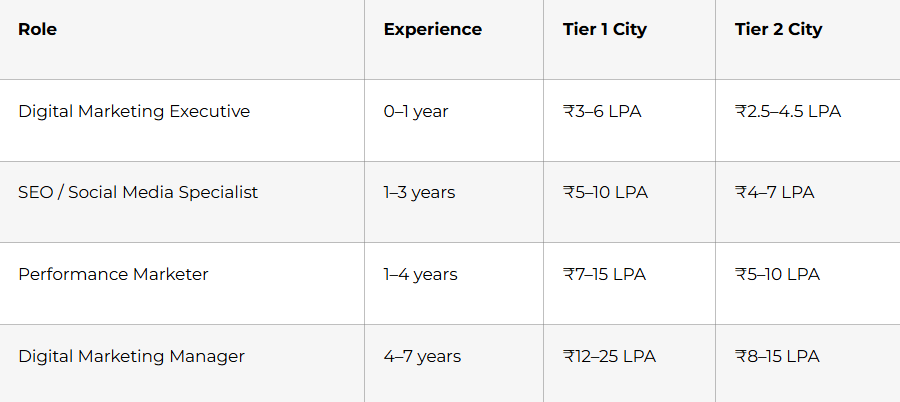
Negotiation script
“Thank you for the offer. I’m excited about the role and the kind of work the team is doing. Based on my skills in [mention channels/tools/results], and the market range for similar roles, I was expecting something closer to [target number]. Is there flexibility there?”
Then pause and let them respond.
What else you can negotiate
- Joining bonus
- Performance bonus structure
- Training or certification budget
- Hybrid or remote flexibility
- Early salary review timeline
- Role scope and ownership
Post-Interview Follow-Up Templates
Thank-you email
Subject: Thank You — Digital Marketing Interview [Your Name]
Hi [Interviewer Name],
Thank you for taking the time to speak with me today about the Digital Marketing role at [Company]. I enjoyed our discussion, especially around [mention specific topic such as SEO strategy, paid campaigns, content planning, or analytics].
The conversation increased my interest in the role, particularly because of [mention one specific reason]. I believe my experience in [relevant skill] would allow me to contribute meaningfully to the team.
Thank you again for your time and consideration.
Best regards,
[Your Name]
Follow-up email after 5–7 business days
Subject: Following Up — Digital Marketing Interview [Your Name]
Hi [Recruiter or Interviewer Name],
I hope you are doing well. I wanted to follow up regarding my interview for the Digital Marketing role on [date]. I remain very interested in the opportunity and would appreciate any update you can share on the next steps or timeline.
Thank you for your time and consideration.
Best regards,
[Your Name]
Final 30-Day Checklist Before Interview Day
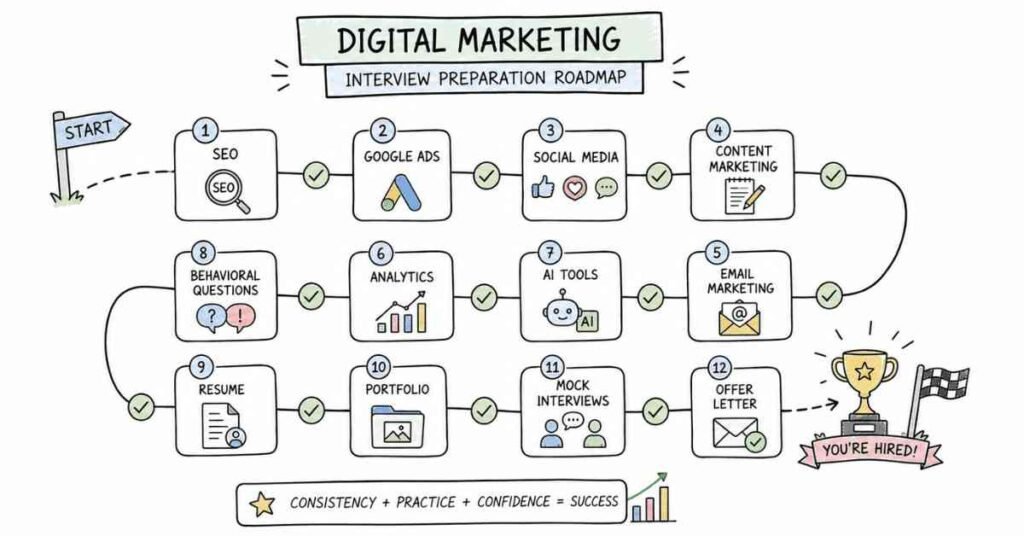
Technical readiness
- ☐ Completed all 9 parts of this guide
- ☐ Practiced SEO, paid ads, social, content, and analytics questions
- ☐ Reviewed GA4, KPIs, funnels, and campaign strategy
- ☐ Practiced explaining AI in marketing with practical examples
- ☐ Completed at least 2 mock interviews
Behavioral readiness
- ☐ Prepared 8 to 10 STAR stories
- ☐ Practiced “Tell me about yourself”
- ☐ Prepared answers for weakness, strength, teamwork, mistakes, and campaign challenges
- ☐ Prepared 3 strong questions for the interviewer
Profile readiness
- ☐ Updated resume for the exact role
- ☐ Updated LinkedIn headline, about, and featured section
- ☐ Organized portfolio or case studies
- ☐ Finalized salary range and target number
Day before interview
- ☐ Confirmed time, format, and interviewer details
- ☐ Reviewed resume, projects, and campaign examples
- ☐ Checked laptop, internet, camera, and audio
- ☐ Slept properly instead of doing last-minute panic revision