
How to Become a Workday HCM Consultant in 2026: Complete Career Guide
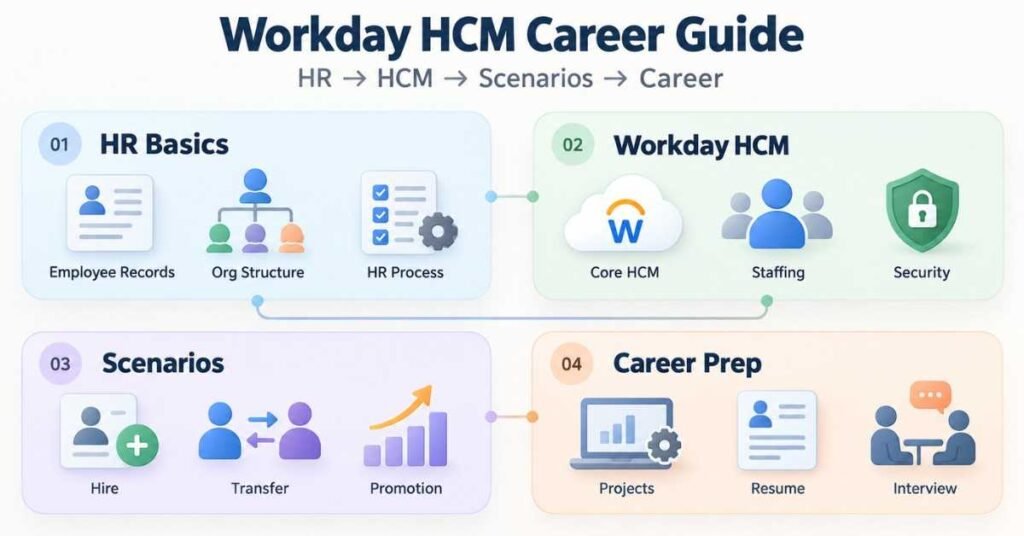
Table of Contents
A career in Workday HCM begins with understanding people processes, not simply learning where different options appear on a software screen. Companies use HCM systems to manage employee information, organisational structures, hiring, compensation, absence, and other workforce activities. A Workday HCM Consultant helps connect these business requirements with the way Workday is configured and used. If you are starting from zero, you need to understand HR fundamentals, become familiar with Workday terminology, learn how common HCM processes move through the system, and practise explaining business scenarios clearly. This guide takes you through that career journey from beginner preparation to job search.
What Does a Workday HCM Consultant Do?
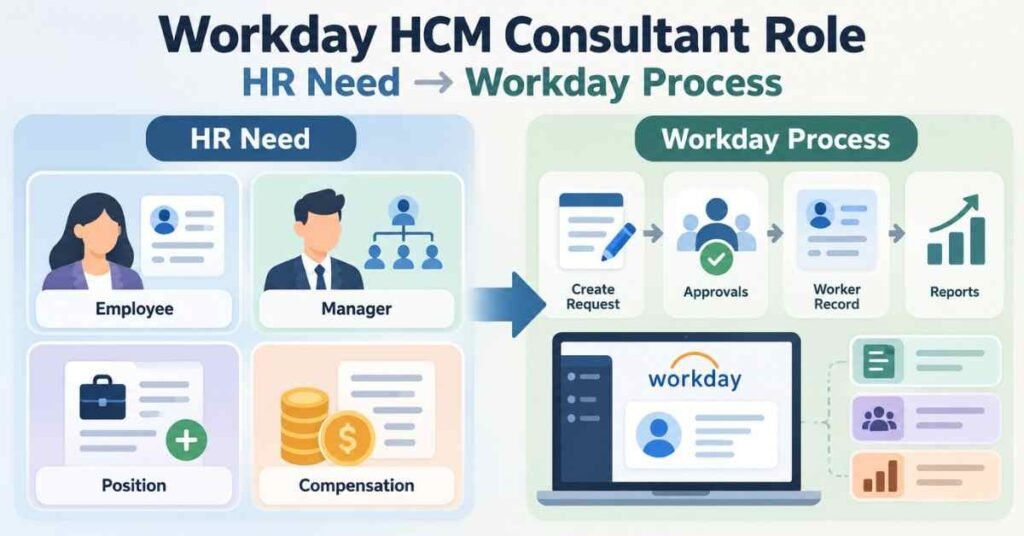
A Workday HCM Consultant works between HR requirements and the Workday platform.
Imagine a company hires a new employee.
The process involves more than entering a person’s name. The employee may need a position, manager, department, location, compensation details, and other information. Different approvals may also be required before the process is complete.
A Workday HCM Consultant needs to understand how such a business requirement should work inside the system.
Depending on the project, daily responsibilities may include:
- Understanding HR requirements
- Working with worker and organisational data
- Supporting HCM business processes
- Reviewing configuration requirements
- Testing business scenarios
- Preparing reports
- Investigating functional issues
- Supporting data-related activities
- Documenting processes
- Coordinating with HR, technical, and project teams
The role therefore needs both HR process understanding and Workday functional knowledge.
Why Workday HCM Can Be a Good Career
Workday HCM is different from a general HR role.
You are working with the processes and technology used to manage workforce information.
That makes the career suitable for people who enjoy understanding a business process, finding where something is going wrong, and translating requirements into system behaviour.
A person entering this field may come from HR, operations, ERP support, business analysis, or another technology background.
Why Learners Consider Workday HCM
- It combines HR processes with enterprise technology.
- Functional roles do not revolve around heavy programming.
- Existing HR knowledge can be useful.
- The career includes both implementation and support work.
- Consultants can later specialise in different Workday areas.
- Business-process knowledge remains important as experience grows.
A beginner should not approach Workday as a collection of screens to memorise. Understanding why a process exists makes the system much easier to learn.
Build Practical HR Tech Skills – Explore the Workday HCM Consultant Course
Workday Career Roles Compared
Workday offers several career directions.
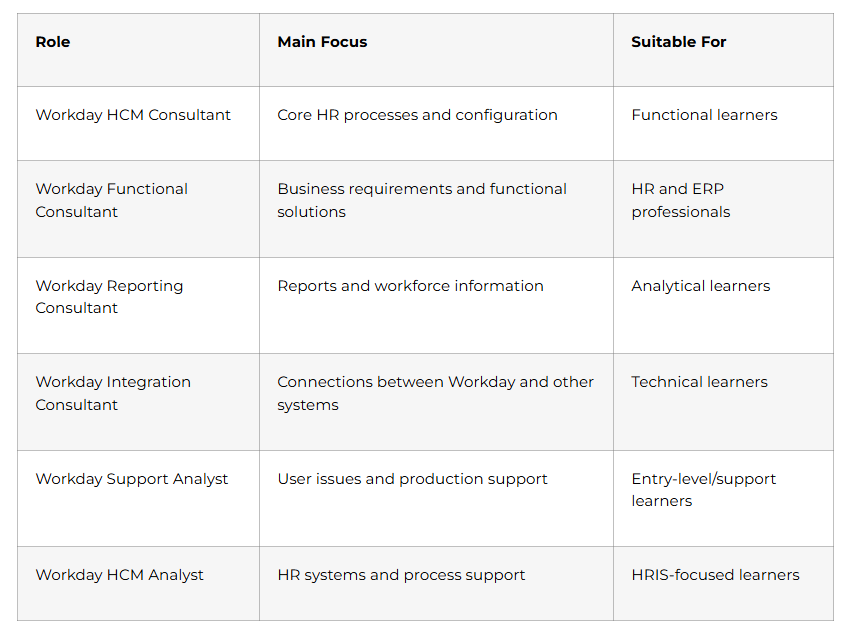
You do not have to decide your final specialisation on day one. Core HCM knowledge gives you the context needed before choosing a deeper path.
How to Become a Workday HCM Consultant
Step 1: Understand HR and HCM Fundamentals
Before concentrating on Workday terminology, understand what an HR department actually manages.
Become familiar with areas such as:
- Employee information
- Hiring
- Job changes
- Promotions
- Transfers
- Organisational structures
- Compensation
- Leave and absence
- Termination
- Employee lifecycle
Think of an employee’s journey through a company.
A person joins, becomes part of a team, may change roles or locations, receives compensation changes, takes leave, and eventually may leave the organisation.
HCM systems help companies manage these events in an organised way.
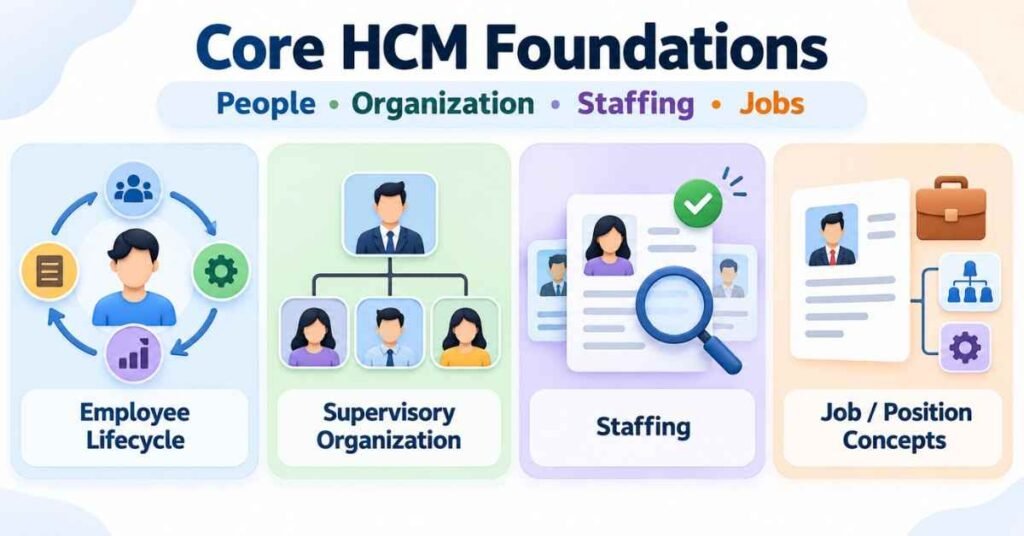
If you understand this employee lifecycle first, Workday concepts become less abstract.
Step 2: Become Comfortable with Workday Terminology
Workday uses terminology that may initially feel unfamiliar.
Build a clear understanding of concepts such as:
- Worker
- Employee
- Contingent Worker
- Position
- Job
- Organization
- Supervisory Organization
- Staffing Model
- Business Process
- Security
- Tenant
Do not memorise these as isolated definitions.
Connect them.
For example, a worker belongs within an organisational structure, reports through a management hierarchy, and participates in different business processes during employment.
Once these relationships become clear, later topics are easier to understand.
Step 3: Understand Organizational Structures
Organisations are an important part of HCM.
A business may need to group workers by management hierarchy, company, location, cost centre, or another business requirement.
A Workday learner should understand the purpose of structures such as:
- Supervisory Organizations
- Companies
- Cost Centers
- Locations
- Custom Organizations
Pay particular attention to the Supervisory Organization because management structures influence many HCM activities.
Use a simple company example while practising.
Imagine:
CEO → Department Head → Team Manager → Employees
Then think about how workers, positions, and managers would fit into that structure.
Learning with an example is easier than memorising a diagram.
Step 4: Learn Staffing Concepts
Staffing determines how workers are connected with jobs and positions.
Understand the difference between common staffing concepts and why an organisation may choose one approach over another.
Important areas include:
- Jobs
- Positions
- Job Profiles
- Job Families
- Job Levels
- Worker Types
- Employee Types
Consider a company that needs five customer-support employees.
The organisation first needs to define what kind of work those employees perform and how those workers should fit into the company’s staffing structure.
Thinking from the business requirement towards the configuration is a useful consultant habit.
Step 5: Understand Business Processes
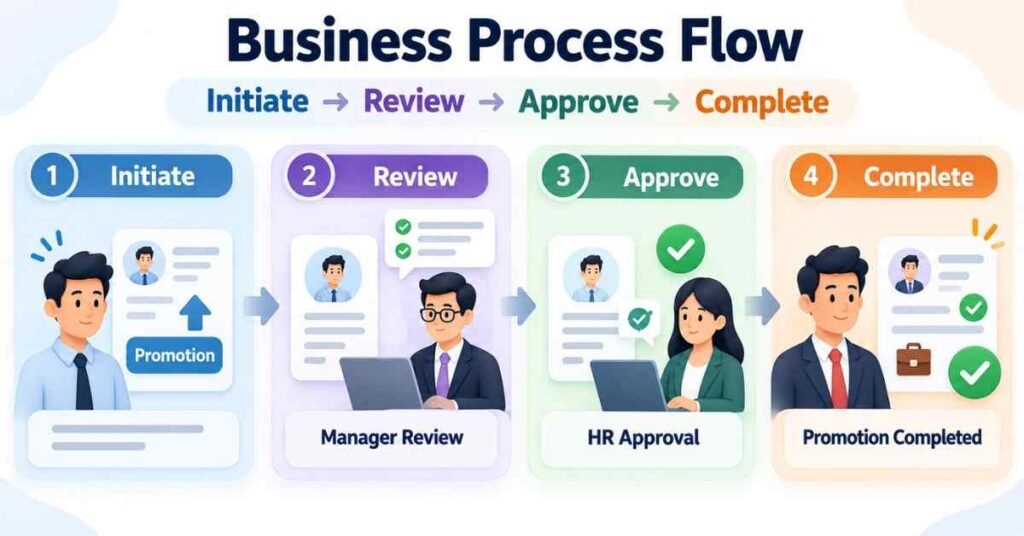
Business Processes are one of the most important areas for a Workday HCM learner.
A process describes how a business activity moves from initiation to completion.
Consider a promotion.
The change may be initiated by a manager, reviewed by another person, require approval, update compensation, and then become effective on a particular date.
That is not simply one action. It is a flow.
Common processes you should understand include:
- Hire
- Change Job
- Transfer
- Promote
- Terminate
- Request Compensation Change
- Create Position
While learning a process, ask:
Who starts it?
What information is required?
Who reviews it?
Who approves it?
What changes after completion?
This approach builds functional understanding instead of screen-level memory.
Step 6: Learn Compensation Fundamentals
Compensation is another useful area for an HCM Consultant.
Begin with the business meaning of:
- Salary
- Hourly pay
- Allowances
- Bonuses
- Compensation packages
- Compensation grades
- Compensation plans
You should understand how compensation information connects with workers and job changes.
For example, a promotion may involve both a new job profile and a compensation adjustment.
Seeing the relationship between HCM areas is more important than learning each topic separately.
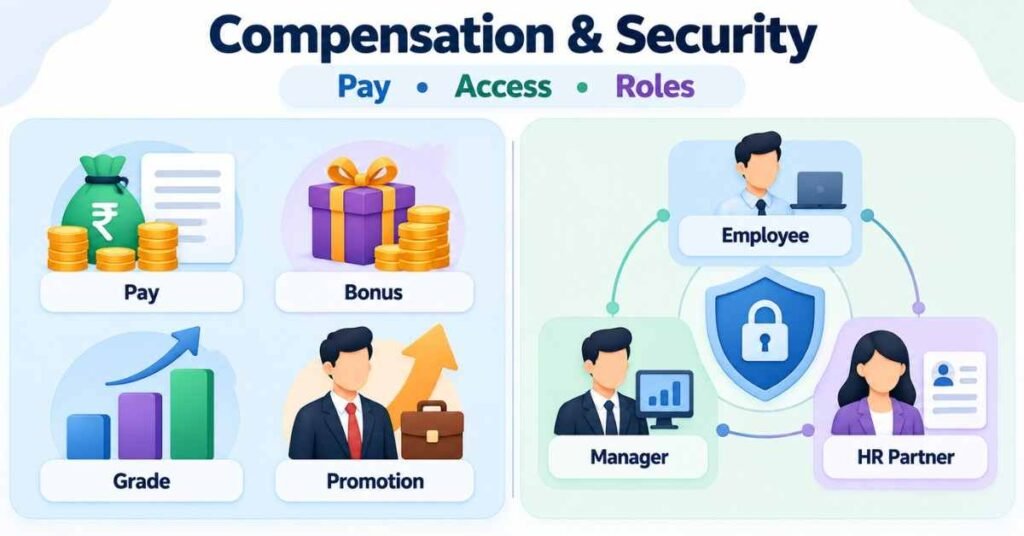
Step 7: Understand Security at a Functional Level
Workforce data contains sensitive information.
Not every employee should be able to see or change every piece of data.
That is why security matters.
At a beginner level, understand:
- Why access control is required
- Role-based access
- User-based access concepts
- Security groups
- Domain-related security concepts
- Business-process security concepts
A useful question to ask is:
Who should be allowed to view or perform this action?
For example, an employee, manager, and HR administrator may have different access to the same worker’s information.
You do not need to master every security configuration immediately, but you should understand why security exists and how it affects HCM processes.
Step 8: Learn Workday Reporting Basics
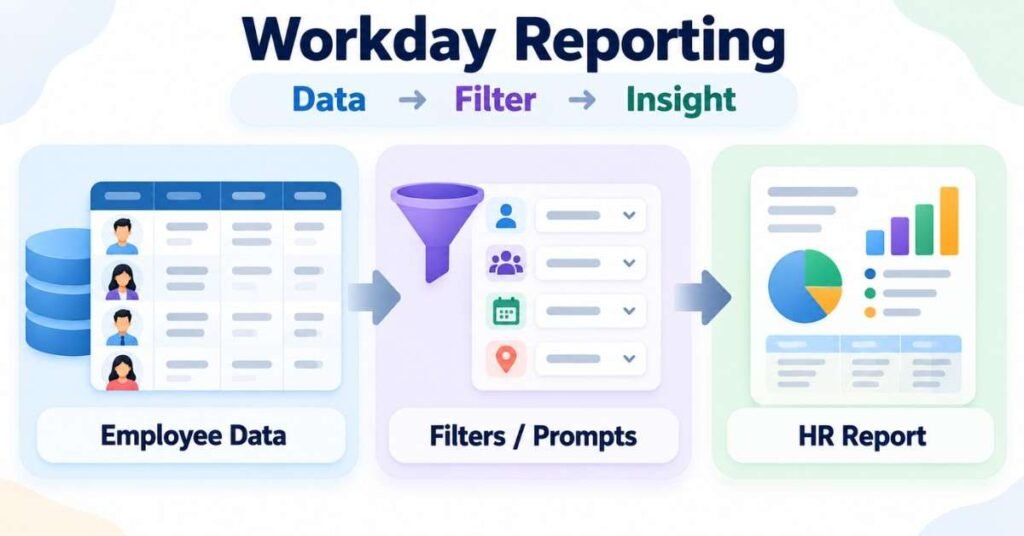
HR teams need information from the system to make decisions and complete daily work.
That makes reporting a useful skill for functional consultants.
Become familiar with concepts such as:
- Data sources
- Fields
- Filters
- Prompts
- Sorting
- Calculated-field concepts
- Custom report concepts
Think in terms of a requirement.
Suppose HR asks:
“Show all active employees working in Hyderabad under a particular department.”
A consultant should be able to understand what information is needed and how the report should be structured.
That type of thinking is more useful than memorising report terminology alone.
Build Your Workday Skills Step by Step – Workday HCM Consultant Roadmap Guide
Core Skills for a Workday HCM Consultant
A strong beginner profile combines platform knowledge with business skills.
HCM Knowledge
- Employee lifecycle
- Organizations
- Staffing concepts
- Worker data
- Job changes
- Compensation basics
- Business Processes
Workday Functional Skills
- Core HCM terminology
- Supervisory Organizations
- Business Process concepts
- Security fundamentals
- Reporting basics
- Functional testing
Professional Skills
- Requirement understanding
- Problem-solving
- Documentation
- Communication
- Scenario analysis
- Stakeholder coordination
Technical terminology matters, but consultants also need to explain a process clearly to people who may not know the system.
Practical Scenarios to Work On
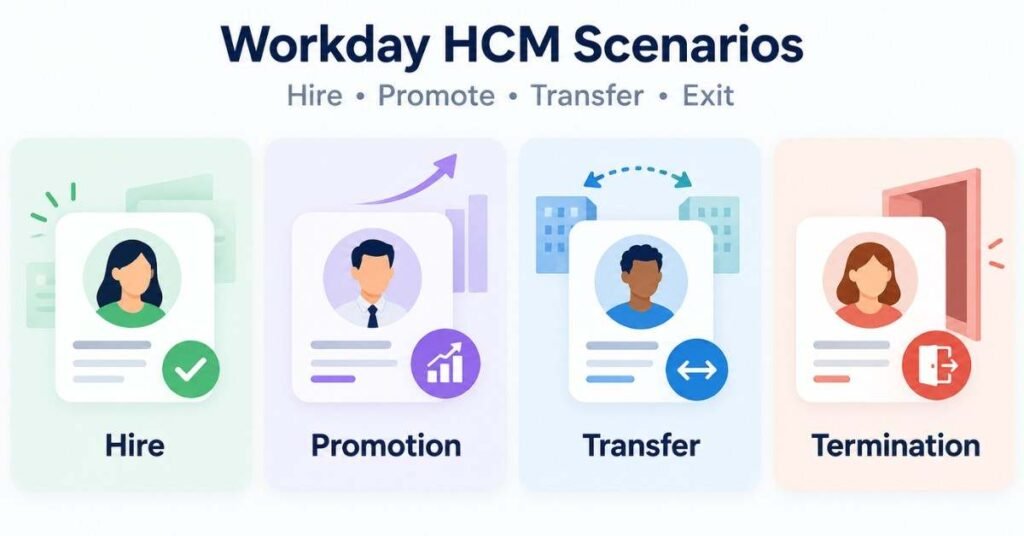
A Workday HCM portfolio is different from a traditional software-development portfolio.
Instead of building large applications, you can document business scenarios and explain how you would approach them.
Scenario 1: New Employee Hire
Create a case where a company needs to hire an employee.
Document:
- Employee details required
- Position
- Manager
- Location
- Department
- Compensation information
- Approval flow
Then explain how the process moves from initiation to completion.
Scenario 2: Employee Promotion
Take an employee moving from one role to another.
Explain:
- Current position
- New role
- Effective date
- Manager impact
- Compensation impact
- Required approvals
Scenario 3: Employee Transfer
Create a scenario where an employee moves to another team or location.
Think about which worker details may need to change and who should approve the request.
Scenario 4: Employee Termination
Document the steps involved when a worker leaves the company.
Include the effective date, reason, approvals, and worker-status impact.
These exercises help you think like a functional consultant rather than someone who has only memorised terminology.
Salary Expectations in India
Workday HCM compensation can differ considerably based on previous experience, consulting exposure, Workday specialisation, employer, location, and project responsibilities.
For that reason, there is no single salary that applies to every Workday HCM professional.
Freshers and people entering through support roles may begin differently from experienced HRIS or ERP professionals moving into Workday. Consultants with stronger project experience and specialised functional knowledge can progress into higher-responsibility roles.
When planning your career, evaluate opportunities based on:
- Actual role responsibilities
- Workday exposure
- Implementation or support experience
- Functional depth
- Learning opportunities
- Long-term specialisation
The first useful project experience can sometimes matter more to career growth than comparing only the initial package.
Build a Portfolio for Workday HCM Roles
For a functional role, your portfolio should show how you understand business situations.
You can prepare a simple portfolio containing:
- Employee lifecycle explanation
- Organization structure example
- Hire scenario
- Promotion scenario
- Transfer scenario
- Termination scenario
- Business Process flow
- Sample reporting requirement
- Functional test cases
For each case, explain:
Business Need → Process → People Involved → Expected Result
Keep the explanation simple enough that another person can understand the scenario without needing you beside them.
Do not include confidential information from an employer or training environment.
Job Search Strategy
Once your HCM fundamentals and Workday concepts are comfortable, begin studying real job descriptions.
Look for positions such as:
- Workday HCM Analyst
- Workday Support Analyst
- Junior Workday Consultant
- HRIS Analyst
- Workday Functional Analyst
- Workday HCM Consultant
Requirements will vary between companies.
Some positions may ask for prior HR or ERP experience, while others may be support-oriented.
Resume Skills
Use skills that genuinely match your knowledge, such as:
- Workday HCM
- Core HCM
- Business Processes
- Supervisory Organizations
- Staffing
- Compensation
- Reporting
- Functional Testing
- HR Processes
- Requirement Analysis
Avoid filling your resume with Workday areas that you cannot explain during an interview.
Prepare for Workday HCM Roles with Confidence – Workday HCM Interview Guides
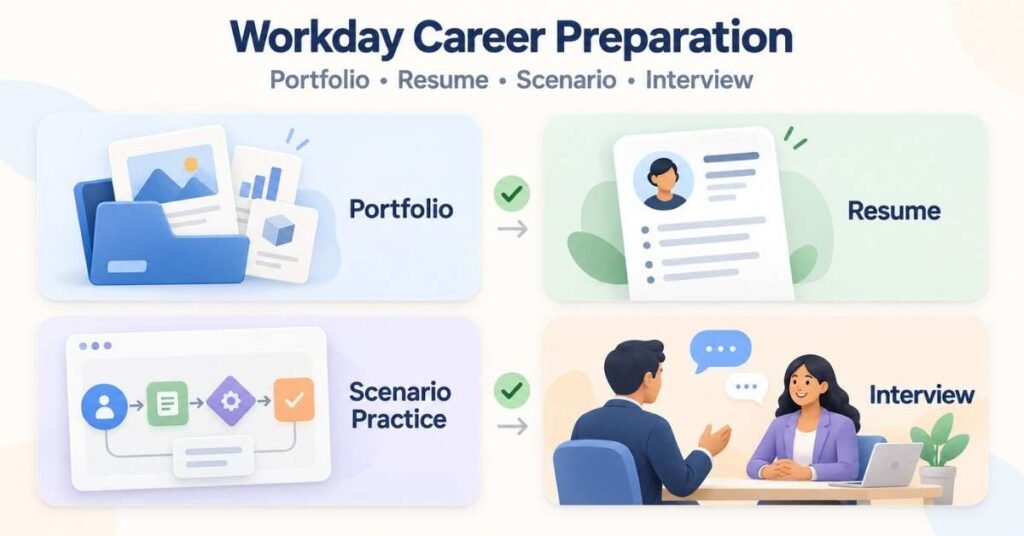
Workday HCM Interview Preparation
Workday interviews can include both concept questions and business scenarios.
You should be comfortable discussing:
- What HCM means
- Employee lifecycle
- Supervisory Organizations
- Staffing concepts
- Business Processes
- Worker types
- Job and position concepts
- Compensation basics
- Security fundamentals
- Reporting concepts
Scenario questions deserve special attention.
For example:
“An employee is moving from one department to another. How would you understand this requirement?”
Instead of immediately naming configuration options, first clarify:
- What exactly is changing?
- Is the manager changing?
- Is the location changing?
- Is the position changing?
- Does compensation change?
- What is the effective date?
- Who needs to approve the change?
That is consultant-style thinking.
Interviewers may value this structured approach because it shows that you understand the business event behind the system action.
30-Day Starter Plan
The first month should help you understand the Workday HCM landscape rather than rush through every functional area.
Week 1
Understand:
- HR fundamentals
- Employee lifecycle
- HCM terminology
- Worker concepts
- Basic Workday vocabulary
Week 2
Work on:
- Organizations
- Supervisory Organizations
- Staffing concepts
- Jobs and positions
- Worker movements
Week 3
Study:
- Business Processes
- Hire
- Change Job
- Transfer
- Promotion
- Termination
- Compensation basics
Week 4
Explore:
- Security fundamentals
- Reporting basics
- Functional testing
- Business scenarios
- Resume preparation
- Interview questions
At the end of 30 days, you should have a clearer picture of how different HCM concepts connect.
Becoming confident still requires continued scenario practice and exposure to real business requirements.
Why Learn Workday HCM at Frontlines Edutech?
For a beginner, Workday can feel difficult when every concept is taught separately.
The learning becomes clearer when HR processes and Workday concepts are connected through practical situations.
A useful Workday HCM learning program should help learners understand:
- HR and HCM fundamentals
- Workday terminology
- Organizations
- Staffing
- Business Processes
- Compensation basics
- Security fundamentals
- Reporting concepts
- Functional scenarios
- Interview preparation
- Resume guidance
For Telugu-speaking students and working professionals, regional-language explanations can make unfamiliar functional concepts easier to understand during the early learning stage.
At the same time, learners should become comfortable with standard Workday and HR terminology in English because professional projects, documentation, and interviews commonly use it.
Frequently Asked Questions (FAQs)
Q1: What is Workday HCM?
Workday HCM is a cloud-based Human Capital Management solution used to support workforce and HR-related processes such as worker information, organisational structures, staffing, compensation, and other employee activities.
Q2: What does a Workday HCM Consultant do?
A Workday HCM Consultant understands HR requirements and helps translate them into functional processes within Workday. The work can involve configuration, testing, reporting, issue analysis, documentation, and business-process support.
Q3: Is coding required for Workday HCM?
Core functional HCM roles generally focus more on HR processes and functional configuration than programming. Technical Workday areas such as integrations require a different skill set.
Q4: Can an HR professional move into Workday HCM?
An HR background can be useful because understanding employee processes, organisational structures, compensation, and HR operations provides relevant business context.
Q5: Can a fresher learn Workday HCM?
A fresher can begin learning HCM concepts and Workday terminology. Entry requirements for actual Workday jobs vary by employer, so practical understanding and realistic job targeting are important.
Q6: Which Workday HCM topics should I understand first?
Begin with HR fundamentals, worker concepts, organizations, staffing, and Business Processes. Compensation, security, reporting, and other functional areas can follow.
Q7: What is a Supervisory Organization?
A Supervisory Organization represents a management hierarchy that groups workers based on who manages them. Understanding this concept is important because many HCM activities connect with organisational structure.
Q8: Why are Business Processes important in Workday?
Business Processes define how activities move through steps such as initiation, review, approval, and completion. They help organisations control how HR events are carried out.
Q9: What should I prepare for a Workday HCM interview?
Prepare core HCM terminology, worker and organisation concepts, staffing, Business Processes, compensation basics, security fundamentals, reporting concepts, and practical HR scenarios.
How can I become job-ready for Workday HCM?
Build strong HR fundamentals, understand core Workday HCM concepts, practise realistic employee scenarios, prepare functional documentation and test cases, and become confident explaining business processes during interviews.