
Data Engineer Interview Preparation Guide 2026
Table of Contents
Part 1: Introduction & 30-Day Study Plan
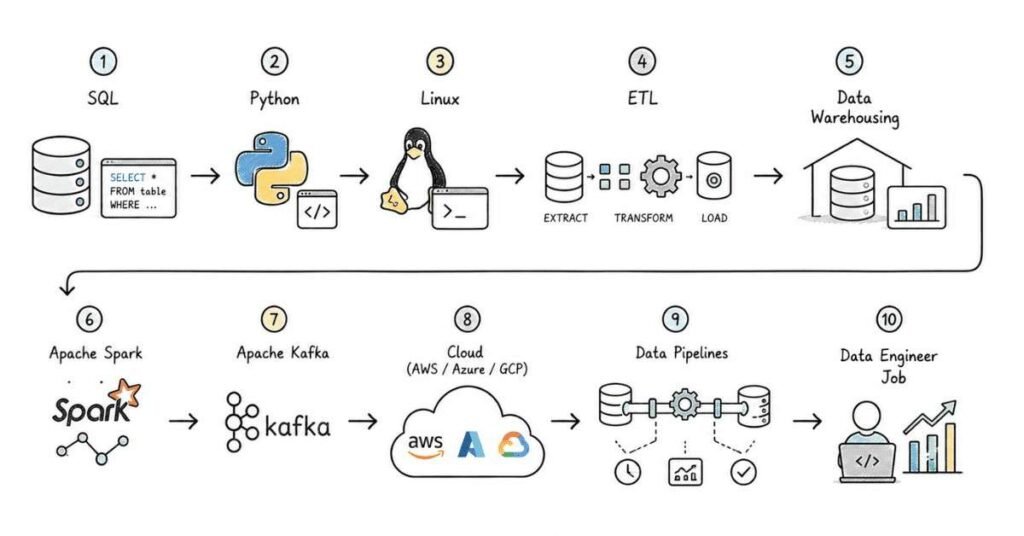
This part sets the foundation for Data Engineering interview preparation in a practical, structured way. It explains what Data Engineering is, why it matters, what interviews usually test, and how to build a focused 30-day study plan that improves both conceptual clarity and interview performance.
What this guide covers
This guide is designed to prepare you for Data Engineering interviews in a step-by-step format. It starts with the data engineering lifecycle and the role of pipelines, then moves into SQL, Python, data warehousing, ETL and ELT, big data tools, cloud platforms, orchestration, and data quality.
The goal is not only to help you memorize tools. The real goal is to help you explain why a tool is used, how data workflows fit together, and how you would solve real data problems in analytics, platform, or big data interviews.
In Data Engineering interviews, recruiters and hiring managers often care about your clarity of thinking as much as your technical answer. They want to know whether you understand data ingestion, transformation, storage, modeling, orchestration, quality, governance, and scalability.
Who this guide is for
This guide is useful if you are:
- A fresher preparing for your first Data Engineering interview.
- A software developer moving into data engineering.
- A data analyst transitioning into pipeline and platform work.
- A candidate who knows SQL or Python but is not yet confident in system design or pipeline design rounds.
- An early-career professional who wants structured revision across Data Engineering concepts.
The guide is structured to help both beginners and job-ready candidates build confidence step by step. It gives you a clear path from core concepts to interview execution while staying practical and easy to revise.
What Data Engineering is and why it matters
Data Engineering is the discipline of designing, building, and maintaining systems that collect, store, transform, and deliver data reliably for analytics and machine learning. It matters because raw data is rarely usable as-is; engineers build pipelines that clean, structure, and scale data so business and data science teams can trust it.
A simple way to think about Data Engineering is this: it turns data delivery from a mostly manual process into a mostly automated, measurable, and reliable process. Strong Data Engineers are valuable because they reduce delays, improve trust in data, and make analytics and decision-making more dependable.
Where Data Engineering fits in real work
In real companies, Data Engineering is used for:
- Collecting data from applications, APIs, databases, and event streams.
- Building ETL or ELT pipelines.
- Storing data in warehouses, lakes, or lakehouses.
- Transforming data for analytics and reporting.
- Processing batch and streaming workloads.
- Orchestrating jobs with schedulers and workflow tools.
- Monitoring data freshness, quality, and pipeline health.
- Supporting BI, analytics, and ML teams with reliable datasets.
This is why Data Engineering interviews are rarely only about definitions. Interviewers usually want to see whether you understand how systems work together, how data flows end to end, and how you would troubleshoot issues in production.
Common role types
Data Engineering interviews vary depending on role scope. Common role types include:
- Data Engineer: pipelines, ETL/ELT, SQL, Python, and warehousing.
- Big Data Engineer: distributed processing, Spark, Kafka, and large-scale systems.
- Analytics Engineer: modeling data for BI and analytics.
- Cloud Data Engineer: cloud-native storage, compute, orchestration, and reliability.
- Data Platform Engineer: internal tooling, pipeline infrastructure, and platform support.
- Streaming Data Engineer: real-time ingestion, event processing, and low-latency pipelines.
Understanding the target role early helps you prepare better. A Data Engineer role may emphasize SQL, Python, and ETL design, while a Big Data Engineer role may emphasize Spark, Kafka, and distributed systems. A Cloud Data Engineer role may focus more on orchestration, storage-compute separation, and scalable architecture.
Common interview process
A typical Data Engineering interview process often includes:
- Recruiter or HR screening.
- Fundamentals round on SQL, Python, and data concepts.
- Tool-specific or coding round.
- Pipeline design or system design round.
- Scenario-based troubleshooting round.
- Hiring manager or architecture discussion.
- Behavioral or communication round.
In many Data Engineering interviews, the most important part is how clearly you explain a workflow or troubleshooting scenario. You may be asked how data moves from source to destination, how you would design a pipeline, how you would handle duplicates, or how you would monitor a failed job.
Core skill areas interviewers usually check
Most Data Engineering interviews evaluate some combination of these areas:
- Data engineering fundamentals and lifecycle.
- SQL and database design.
- Python scripting and data manipulation.
- ETL and ELT design.
- Data modeling and warehousing.
- Big data tools such as Spark and Kafka.
- Cloud data platforms and orchestration.
- Data quality, lineage, and governance.
- Performance tuning and troubleshooting.
- Behavioral communication and collaboration.
These areas appear repeatedly because they reflect how Data Engineering is used in actual work. A strong candidate is not just someone who knows tool names, but someone who understands why a design choice is made and how it supports reliability and scale.
Why data mindset matters so much
Three Data Engineering ideas come up repeatedly across roles: reliability, scalability, and data trust. Reliability matters because pipelines must run consistently. Scalability matters because data volumes and workloads grow quickly. Data trust matters because poor-quality data can break reporting, models, and business decisions.
This is also where many candidates struggle in interviews. It is not enough to say you know SQL or Spark. Interviewers often want to hear when you would use a workflow, what problem it solves, and how you would protect correctness, performance, and maintainability.
How to think in Data Engineering interviews
A strong Data Engineering answer usually follows this structure:
- Define the concept clearly.
- Explain where it is used.
- Mention the technical or business reason for choosing it.
- Give a short example or scenario.
- Mention a trade-off, best practice, or caution if relevant.
For example, if asked about ETL versus ELT, do not only define both. A stronger answer explains that ETL transforms data before loading, while ELT loads raw data first and transforms it in the warehouse, which can improve flexibility and use cloud compute efficiently.
30-day study plan
A practical 30-day Data Engineering interview preparation plan can look like this:
Week 1: Fundamentals and SQL
Focus on data engineering basics, data lifecycle, batch vs streaming, and SQL fundamentals such as joins, aggregations, subqueries, and window functions. Start speaking out loud about how data moves from a source system to a usable table or dashboard.
Study areas for Week 1:
- What Data Engineering is.
- Data engineering lifecycle.
- Batch vs streaming.
- Data lakes, warehouses, and lakehouses.
- SQL basics.
- Joins and aggregations.
- Window functions.
- Subqueries and CTEs.
Week 2: Python and data modeling
Move into Python for data engineering, file handling, APIs, pandas basics, and error handling. Then study ETL versus ELT, dimensional modeling, star and snowflake schemas, and slowly changing dimensions.
Study areas for Week 2:
- Python basics for data work.
- pandas and DataFrames.
- File processing and APIs.
- Exception handling.
- ETL vs ELT.
- Dimensional modeling.
- Fact and dimension tables.
- Slowly changing dimensions.
Week 3: Big data and distributed processing
Study Hadoop, Spark, and Kafka. Focus on how distributed storage and processing work, why Spark is faster than older batch approaches for many use cases, and how Kafka supports event-driven and streaming systems.
Study areas for Week 3:
- Hadoop and HDFS.
- Spark architecture and transformations.
- Spark DataFrames and lazy evaluation.
- Kafka topics, partitions, producers, and consumers.
- Data skew and shuffling.
- Fault tolerance in distributed systems.
Week 4: Cloud, orchestration, governance, and scenarios
Revise cloud data warehouses, data lakes, Airflow, orchestration, data quality, governance, security, and troubleshooting. This week should be focused on scenario-based answers, architecture thinking, and interview presentation.
Study areas for Week 4:
- Cloud data warehouses.
- Storage and compute separation.
- Data orchestration and DAGs.
- Data quality checks.
- Lineage and governance.
- PII, masking, and access control.
- Query optimization.
- Troubleshooting scenarios.
- Behavioral answers using STAR.
Daily practice plan
A good daily routine can keep preparation steady:
- 30 minutes of theory.
- 30 minutes of hands-on practice.
- 20 minutes of interview questions.
- 20 minutes of speaking answers out loud.
- 10 minutes of revision notes.
If time is limited, focus on consistency instead of long study sessions. Even one focused hour per day is enough to build strong interview readiness over a month.
How to study effectively
The best way to study Data Engineering is to combine theory with practice. Read the concept, try a small example, and then explain it in interview language. This helps you move from memorization to real understanding.
Practice by taking a simple workflow such as ingesting CSV data into a warehouse, then ask yourself:
- How would I automate this?
- Which tool would I use?
- What would fail?
- How would I monitor it?
- How would I secure it?
This habit helps you answer both direct and scenario-based interview questions more naturally.
What interviewers usually expect
Interviewers usually expect you to:
- Explain Data Engineering clearly in simple language.
- Understand SQL and database basics.
- Know Python for scripting and data handling.
- Understand ETL, ELT, and data modeling.
- Describe distributed processing concepts.
- Explain orchestration and pipeline reliability.
- Talk about data quality, governance, and security.
- Show practical troubleshooting thinking.
- Communicate your experience confidently.
They do not expect perfection in every tool. They do expect you to be able to reason through real data problems and explain your approach clearly.
How to use this guide
Use this guide in layers:
- Read one part at a time.
- Answer the questions aloud.
- Take notes on weak areas.
- Revisit the revision focus section.
- Build one small project or lab for practice.
- Practice scenario answers before mock interviews.
If you follow the structure steadily, you will develop both technical understanding and interview confidence. That combination matters more than just memorizing question answers.
Final preparation mindset
A strong Data Engineering candidate is someone who thinks in data flow, reliability, scale, and trust. Interviewers want to see whether you can connect tools, explain trade-offs, and respond clearly under pressure.
If you can clearly explain Data Engineering basics, SQL, Python, ETL/ELT, modeling, Spark, Kafka, cloud warehousing, orchestration, and data quality, you will already be ahead of many candidates. The rest comes from practice, repetition, and speaking confidently about your projects.
Part 2: Data Engineering Fundamentals and Lifecycle
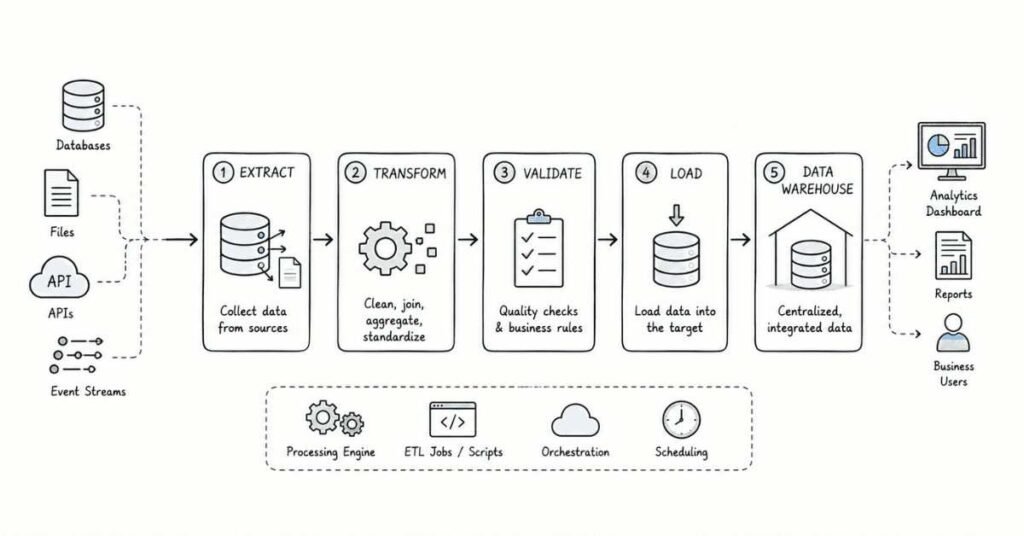
This part builds the base for the rest of the Data Engineering guide. It covers the core ideas, principles, and terminology that interviewers usually expect you to understand before moving into SQL, Python, ETL and ELT, warehousing, Spark, Kafka, orchestration, and data quality.
Questions 1–40
What is Data Engineering?
Data Engineering is the discipline of designing, building, and maintaining systems that collect, store, transform, and deliver data reliably for analytics and machine learning use cases.Why is Data Engineering important?
Data Engineering is important because raw data is rarely ready for direct use. It helps organizations turn scattered, messy, or high-volume data into reliable datasets that support reporting, analytics, and decision-making.What are the main goals of Data Engineering?
The main goals are reliable data movement, scalability, consistency, data quality, automation, and timely delivery of usable data to downstream systems and users.What problem does Data Engineering solve?
Data Engineering solves the challenge of moving data from multiple source systems into forms that are clean, structured, accessible, and trustworthy for business and technical use.What is the relationship between Data Engineering and analytics?
Data Engineering builds and maintains the data foundation, while analytics uses that prepared data to generate reports, dashboards, and insights.What is the relationship between Data Engineering and data science?
Data Engineering prepares and serves reliable datasets and features, while data science uses that data for experimentation, modeling, and prediction.What is a data pipeline?
A data pipeline is an automated workflow that collects, processes, and moves data from one or more sources to one or more destinations.Why are data pipelines important?
Data pipelines are important because they make data movement repeatable, scalable, and less dependent on manual work. They help ensure that downstream consumers receive fresh and consistent data.What is data ingestion?
Data ingestion is the process of collecting data from source systems such as applications, APIs, logs, databases, or event streams into a storage or processing layer.What is the difference between batch and streaming data processing?
Batch processing handles data in groups at scheduled intervals, while streaming processes data continuously or near real time as it arrives.When should you use batch processing?
Batch processing is useful when low latency is not required and the workload can run at fixed intervals, such as nightly reports or periodic reconciliation jobs.When should you use stream processing?
Stream processing is useful when data must be processed quickly after it is generated, such as fraud detection, monitoring, or live event analytics.What is structured data?
Structured data follows a fixed schema and is usually stored in rows and columns, such as relational database tables.What is semi-structured data?
Semi-structured data does not fit a strict tabular schema but still contains some organization, such as JSON, XML, or log events.What is unstructured data?
Unstructured data has no predefined schema, such as documents, images, videos, or free-form text.What is a data source?
A data source is any system or location from which data is collected, such as transactional databases, SaaS tools, flat files, APIs, sensors, or message queues.What is a data sink or destination?
A data sink or destination is the target system where processed or stored data is delivered, such as a warehouse, lake, dashboard layer, or machine learning feature store.What is a data lake?
A data lake is a centralized repository that stores large volumes of raw structured, semi-structured, and unstructured data, usually in its native form.What is a data warehouse?
A data warehouse is a structured storage system optimized for analytical queries, reporting, and business intelligence over cleaned and modeled data.What is the difference between a data lake and a data warehouse?
A data lake stores raw and flexible data at scale, while a data warehouse stores curated and structured data optimized for analytics and query performance.What is a data lakehouse?
A data lakehouse is an architecture that combines the low-cost, flexible storage of a data lake with some of the management and analytics capabilities of a data warehouse.What is data transformation?
Data transformation is the process of cleaning, reshaping, enriching, aggregating, or standardizing raw data into a more useful format.Why is data transformation necessary?
Transformation is necessary because raw data often contains errors, duplicates, missing fields, inconsistent formats, or structures that are not suitable for analytics.What is data validation?
Data validation is the process of checking whether data meets expected rules, formats, types, or business constraints before or after processing.What is data quality?
Data quality refers to how accurate, complete, consistent, timely, and reliable data is for its intended use.Why is data quality important in Data Engineering?
Data quality is important because poor-quality data can break dashboards, confuse decision-making, damage trust, and cause downstream systems to fail or behave incorrectly.What is data lineage?
Data lineage is the record of where data came from, how it moved, and what transformations it went through across systems and pipelines.Why is data lineage useful?
Data lineage is useful for debugging, governance, impact analysis, and understanding how a metric or dataset was produced.What is metadata?
Metadata is data about data, such as schema definitions, column descriptions, ownership, timestamps, and usage information.What is schema?
A schema defines the structure of data, including fields, data types, and relationships between elements.What is schema evolution?
Schema evolution is the process of handling changes in data structure over time without breaking downstream systems unnecessarily.What is data partitioning?
Data partitioning is the practice of splitting large datasets into smaller segments, often by date, region, or category, to improve performance and manageability.Why is partitioning important?
Partitioning improves query performance, reduces the amount of data scanned, and can lower storage or compute cost in large-scale systems.What is scalability in Data Engineering?
Scalability is the ability of a data system or pipeline to handle increasing volumes, velocity, or complexity of data without major loss of performance or reliability.What is fault tolerance in data systems?
Fault tolerance is the ability of a system to continue operating or recover gracefully when components fail.What is idempotency in data pipelines?
Idempotency means that running the same pipeline or job multiple times produces the same correct result without creating duplicates or inconsistent side effects.Why is idempotency important?
Idempotency is important because pipelines often need retries, backfills, or reruns, and these should not corrupt data or produce repeated records.What is orchestration in Data Engineering?
Orchestration is the coordination of pipeline tasks, dependencies, retries, schedules, and execution order across workflows.What is the difference between processing and orchestration?
Processing refers to the actual transformation or movement of data, while orchestration manages when and how those processing steps run together in a workflow.How should you answer Data Engineering fundamentals questions in interviews?
Answer clearly, define the concept first, explain where it fits in the data lifecycle, and add a short practical example if possible. Strong answers focus on real usage and trade-offs instead of memorized definitions.
Revision focus
Revise Data Engineering basics, pipelines, ingestion, batch vs streaming, structured vs semi-structured vs unstructured data, lakes and warehouses, transformation, validation, quality, lineage, metadata, schema evolution, partitioning, scalability, fault tolerance, idempotency, and orchestration before moving to SQL and database fundamentals.
Part 3: SQL, Databases, and Data Modeling
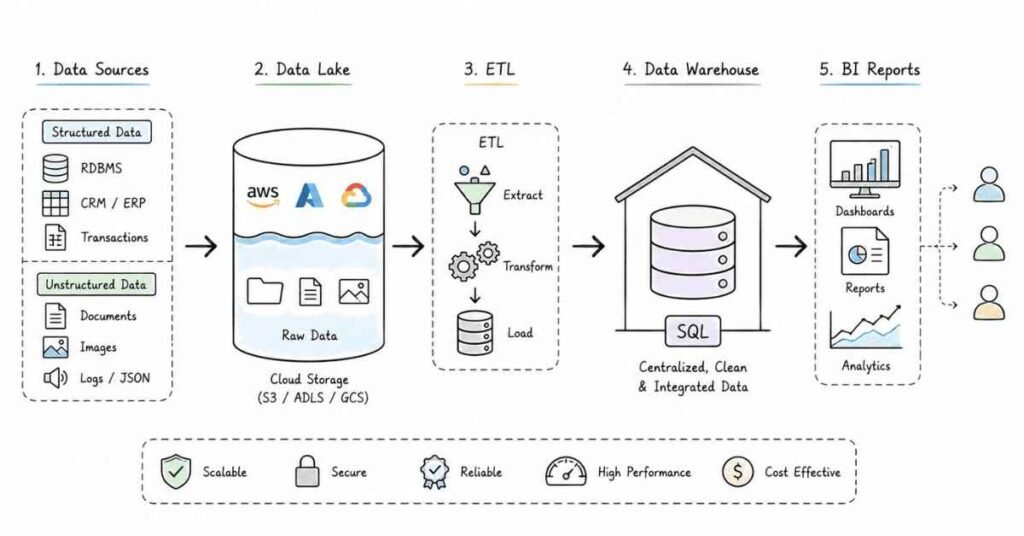
This part covers the data foundation that almost every Data Engineering interview expects. It focuses on SQL, relational database concepts, query design, performance basics, and data modeling, because these are the building blocks behind transformation, warehousing, analytics, and pipeline design.
Questions 41–80
41. Why is SQL important in Data Engineering?
SQL is important because data engineers use it to query, transform, validate, and model data across warehouses, databases, and pipeline stages.
42. What is a relational database?
A relational database stores data in tables made of rows and columns, with relationships defined between tables.
43. What is a table in a database?
A table is a structured collection of data organized into rows and columns, usually representing one type of entity such as customers, orders, or products.
44. What is a row and what is a column?
A row represents one record in a table, while a column represents one attribute or field of that record.
45. What is a primary key?
A primary key is a column or combination of columns that uniquely identifies each row in a table.
46. What is a foreign key?
A foreign key is a column that references a primary key in another table to create a relationship between the two tables.
47. Why are keys important in databases?
Keys are important because they help maintain uniqueness, enforce relationships, and support clean joins across related tables.
48. What is normalization?
Normalization is the process of organizing data into related tables to reduce redundancy and improve consistency.
49. Why is normalization useful?
Normalization is useful because it improves data integrity and reduces duplication, especially in transactional systems.
50. What is denormalization?
Denormalization is the process of combining or duplicating data to reduce joins and improve read performance, often in analytics systems.
51. When is denormalization useful?
Denormalization is useful in reporting and warehousing when faster query performance matters more than strict normalization.
52. What is a SELECT statement?
A SELECT statement is used to retrieve data from one or more tables in a database.
53. What is a WHERE clause?
A WHERE clause filters rows based on conditions before the results are returned.
54. What is the difference between WHERE and HAVING?
WHERE filters individual rows before aggregation, while HAVING filters grouped results after aggregation.
55. What is GROUP BY?
GROUP BY is used to group rows that share common values so aggregate functions like COUNT, SUM, or AVG can be applied.
56. What is ORDER BY?
ORDER BY sorts query results based on one or more columns in ascending or descending order.
57. What is a JOIN in SQL?
A JOIN combines rows from two or more tables based on a related column.
58. What is an INNER JOIN?
An INNER JOIN returns only the rows that have matching values in both joined tables.
59. What is a LEFT JOIN?
A LEFT JOIN returns all rows from the left table and the matching rows from the right table, with nulls where no match exists.
60. What is the difference between INNER JOIN and LEFT JOIN?
INNER JOIN keeps only matching records, while LEFT JOIN keeps all left-side records even if no matching right-side row exists.
61. What is a RIGHT JOIN?
A RIGHT JOIN returns all rows from the right table and matching rows from the left table.
62. What is a FULL OUTER JOIN?
A FULL OUTER JOIN returns all matching and non-matching rows from both tables, filling missing sides with null values.
63. What is a subquery?
A subquery is a query written inside another query to provide intermediate results or filtering logic.
64. What is a Common Table Expression (CTE)?
A CTE is a named temporary result set defined with a WITH clause to make complex queries easier to read and manage.
65. Why are CTEs useful?
CTEs are useful because they improve readability, help break large queries into logical steps, and can support recursive logic in some databases.
66. What is an aggregate function?
An aggregate function performs a calculation across multiple rows, such as COUNT, SUM, AVG, MIN, or MAX.
67. What is a window function?
A window function performs calculations across a related set of rows without collapsing them into one grouped result.
68. Why are window functions important in Data Engineering?
Window functions are important because they are frequently used for rankings, running totals, deduplication, and change tracking in transformations.
69. What is the difference between aggregate and window functions?
Aggregate functions usually reduce multiple rows into fewer grouped results, while window functions preserve row-level detail while still performing grouped calculations.
70. What is DISTINCT?
DISTINCT removes duplicate rows from a query result based on the selected columns.
71. What is indexing?
Indexing is a technique used to speed up data retrieval by creating a structure that allows faster lookups on specific columns.
72. Why are indexes important?
Indexes are important because they can improve query performance significantly, especially on filtered, joined, or sorted columns.
73. What is a transaction?
A transaction is a sequence of database operations treated as one unit of work that either fully succeeds or fully fails.
74. What does ACID stand for?
ACID stands for Atomicity, Consistency, Isolation, and Durability, which are properties that make transactions reliable.
75. What is the difference between OLTP and OLAP?
OLTP systems are optimized for frequent transactional operations, while OLAP systems are optimized for analytical queries over large datasets.
76. What is a fact table?
A fact table stores measurable business events or metrics, such as sales amount, click count, or order quantity.
77. What is a dimension table?
A dimension table stores descriptive attributes such as customer name, product category, or region that provide context to facts.
78. What is a star schema?
A star schema is a warehouse design where a central fact table connects directly to multiple dimension tables.
79. What is a snowflake schema?
A snowflake schema is a variation of a star schema where dimension tables are further normalized into related sub-dimensions.
80. How should you answer SQL and data modeling questions in interviews?
Give a clear definition, explain where the concept is used, and mention a practical example or trade-off such as performance, readability, or maintainability.
Revision focus
Revise relational database basics, keys, normalization and denormalization, SELECT, WHERE, HAVING, GROUP BY, joins, subqueries, CTEs, aggregate functions, window functions, DISTINCT, indexes, transactions, ACID, OLTP vs OLAP, fact tables, dimension tables, and star and snowflake schemas before moving to Python and ETL development.
Part 4: Python, ETL, and Data Processing
This part covers the development layer that Data Engineering interviews test heavily after fundamentals and SQL are clear. It focuses on Python basics, data manipulation, file handling, ETL workflows, error handling, and practical processing patterns that show whether you can build and maintain real data pipelines.
Questions 81–120
81. Why is Python important in Data Engineering?
Python is important because it is widely used for data ingestion, transformation, automation, API integration, orchestration logic, and pipeline scripting.
82. What makes Python useful for data pipelines?
Python is useful because it is easy to read, has strong library support, and integrates well with databases, files, APIs, and cloud services.
83. What is a variable in Python?
A variable is a name that stores a value so it can be reused and referenced in code.
84. What is the difference between a list and a tuple?
A list is mutable and can be changed, while a tuple is immutable and cannot be modified after creation.
85. What is a dictionary in Python?
A dictionary is a key-value data structure used for fast lookups and flexible representation of structured data.
86. What is a function in Python?
A function is a reusable block of code that performs a specific task and can be called whenever needed.
87. Why are functions useful in data engineering scripts?
Functions improve readability, reduce duplication, and make pipeline logic easier to test and maintain.
88. What is a module in Python?
A module is a file containing reusable Python code such as functions, classes, or variables that can be imported into other scripts.
89. What is a package in Python?
A package is a collection of related Python modules organized in directories.
90. What is pandas?
pandas is a Python library used for working with structured and tabular data through high-level data manipulation functions.
91. What is a DataFrame?
A DataFrame is the main pandas data structure that stores data in rows and columns similar to a table.
92. Why are DataFrames useful in ETL work?
DataFrames are useful because they make it easier to clean, filter, join, aggregate, and reshape tabular data during transformation steps.
93. How do you handle missing values in data processing?
You can handle missing values by dropping them, filling them with defaults, imputing them, or flagging them depending on the business need.
94. What is data cleaning in Python?
Data cleaning is the process of correcting, standardizing, or removing incomplete, duplicate, or invalid data before further use.
95. What is the difference between merge and concat in pandas?
Merge combines datasets based on common keys like a SQL join, while concat stacks datasets together across rows or columns.
96. What is filtering in data processing?
Filtering means selecting only the records that meet specific conditions.
97. What is aggregation in data processing?
Aggregation means combining multiple records into summary values such as counts, totals, averages, or grouped metrics.
98. What is file handling in Python?
File handling is the process of reading from and writing to files such as CSV, JSON, Parquet, or text files.
99. Why is file handling important in Data Engineering?
File handling is important because many pipelines ingest raw files, generate intermediate outputs, or deliver processed datasets to storage systems.
100. What is the difference between CSV and JSON?
CSV is a simple row-column text format suited for tabular data, while JSON is a flexible hierarchical format often used in APIs and semi-structured data exchange.
101. What is Parquet?
Parquet is a columnar file format optimized for analytics, compression, and efficient reading of selected columns.
102. Why is Parquet popular in modern data systems?
Parquet is popular because it reduces storage size and improves query performance, especially in data lakes and distributed processing systems.
103. What is exception handling in Python?
Exception handling is the use of constructs like try and except to catch and manage runtime errors safely.
104. Why is exception handling important in pipelines?
Exception handling is important because pipelines need controlled failure behavior, logging, retries, and safer recovery instead of silent crashes.
105. What is logging in Python scripts?
Logging is the practice of recording events, warnings, errors, and execution details so that pipeline behavior can be monitored and troubleshot.
106. Why is logging important in ETL jobs?
Logging is important because it helps engineers understand what ran, what failed, where it failed, and what data was affected.
107. What is an API in Data Engineering?
An API is an interface that allows systems to exchange data or functionality programmatically, often used to ingest data from external services.
108. What is API pagination?
API pagination is the process of retrieving large result sets in smaller pages rather than in one response.
109. Why is pagination important when ingesting API data?
Pagination is important because many APIs limit response size, and proper pagination helps retrieve complete datasets reliably.
110. What is batching in data processing?
Batching means processing data in chunks instead of one record at a time or all at once.
111. Why is batching useful?
Batching improves efficiency, reduces memory pressure, and can make database writes or API calls more manageable.
112. What is a generator in Python?
A generator is an object that yields values one at a time instead of storing the full result in memory at once.
113. Why are generators useful in large data workflows?
Generators are useful because they allow memory-efficient processing of large files, streams, or record sets.
114. What is idempotency in ETL jobs?
Idempotency means rerunning the same ETL job produces the same correct result without creating duplicates or inconsistent state.
115. Why are retries important in ETL pipelines?
Retries are important because failures can happen due to temporary issues such as network timeouts, API rate limits, or short-lived infrastructure problems.
116. What is a schema validation check?
A schema validation check confirms that incoming data matches the expected structure, field names, and data types.
117. What is a duplicate check in ETL?
A duplicate check identifies repeated records that should not be loaded more than once.
118. What is a transformation step in ETL?
A transformation step is the stage where raw data is cleaned, mapped, enriched, validated, or reshaped into the required output format.
119. What is the difference between ETL and ELT in implementation?
In ETL, transformation usually happens before loading into the destination, while in ELT the raw data is loaded first and transformed inside the target platform.
120. How should you answer Python and ETL questions in interviews?
Start with a clear definition, explain how the concept fits into a pipeline, and mention a practical example such as reading files, handling missing data, logging failures, or making ETL jobs idempotent.
Revision focus
Revise Python basics, lists, tuples, dictionaries, functions, modules, pandas, DataFrames, cleaning, missing values, merge and concat, file handling, CSV, JSON, Parquet, exception handling, logging, APIs, pagination, batching, generators, schema validation, duplicate checks, and ETL vs ELT before moving to warehousing, Spark, and large-scale pipeline systems.
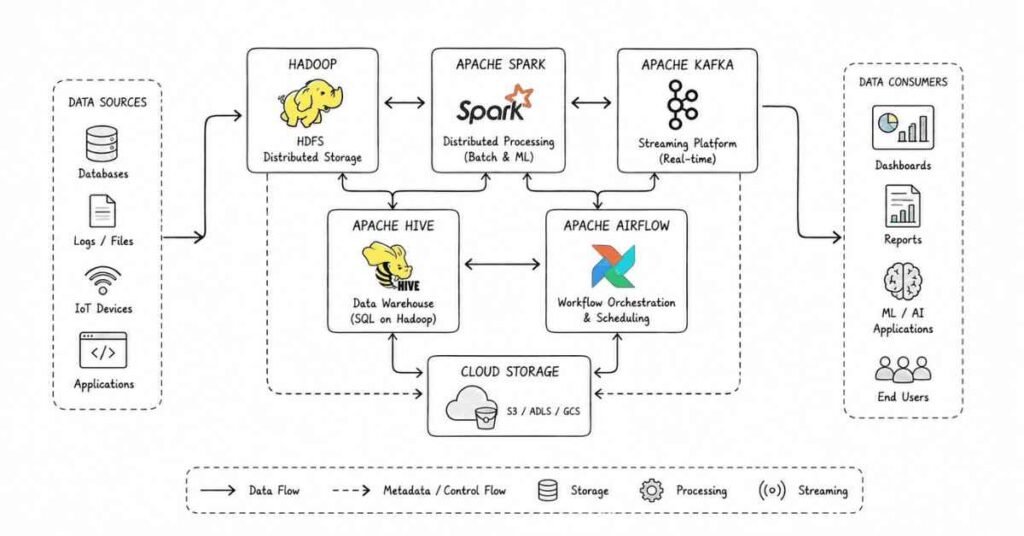
Part 5: Data Warehousing, ETL/ELT, and Pipeline Design
This part covers the storage and transformation layer that Data Engineering interviews test heavily after SQL and Python. It focuses on warehousing concepts, ETL and ELT workflows, dimensional modeling, loading strategies, and practical pipeline design questions that show whether you can build reliable analytics-ready data systems.
Questions 121–160
121. What is a data warehouse?
A data warehouse is a system designed to store structured, integrated, and query-optimized data for analytics and reporting.
122. Why is a data warehouse important in Data Engineering?
A data warehouse is important because it provides a centralized place for cleaned, modeled, and analytics-ready data that business users and analysts can trust.
123. What is the difference between a database and a data warehouse?
A database is often used for transactional applications, while a data warehouse is optimized for analytical workloads and large-scale reporting.
124. What is OLTP?
OLTP stands for Online Transaction Processing and refers to systems designed for frequent, small, real-time transactions such as inserts, updates, and deletes.
125. What is OLAP?
OLAP stands for Online Analytical Processing and refers to systems designed for complex analytical queries over large datasets.
126. Why are OLTP and OLAP separated in most architectures?
They are separated because transactional systems need fast write performance and consistency, while analytical systems need large scans, aggregations, and query optimization.
127. What is ETL?
ETL stands for Extract, Transform, Load, where data is extracted from sources, transformed into the required format, and then loaded into the target system.
128. What is ELT?
ELT stands for Extract, Load, Transform, where raw data is loaded first into the target platform and then transformed there.
129. What is the difference between ETL and ELT?
ETL transforms data before loading, while ELT loads raw data first and performs transformations inside the destination system.
130. Why has ELT become more common in modern data platforms?
ELT has become more common because cloud warehouses provide scalable compute, making it practical to transform data directly inside the target system.
131. What is a staging area in a pipeline?
A staging area is a temporary landing zone where raw or partially processed data is stored before further validation and transformation.
132. Why is a staging layer useful?
A staging layer helps isolate raw ingestion from transformation logic, making debugging, reprocessing, and auditability easier.
133. What is data transformation in warehousing?
Data transformation in warehousing means cleaning, reshaping, standardizing, enriching, and aggregating data so it can support analysis.
134. What is dimensional modeling?
Dimensional modeling is a way of structuring warehouse data around facts and dimensions to support fast and understandable analytics.
135. What is a fact table?
A fact table stores measurable events or metrics such as sales, clicks, revenue, or orders.
136. What is a dimension table?
A dimension table stores descriptive context such as customer, product, time, or location attributes.
137. What is a star schema?
A star schema is a dimensional model where a central fact table connects directly to multiple dimension tables.
138. Why is a star schema popular?
A star schema is popular because it is simple to understand and supports efficient analytical querying with fewer joins than more normalized designs.
139. What is a snowflake schema?
A snowflake schema is a dimensional model where dimension tables are further normalized into related sub-dimension tables.
140. What is the difference between star and snowflake schema?
A star schema is simpler and usually faster for analytics, while a snowflake schema reduces redundancy but adds more joins and complexity.
141. What is a surrogate key?
A surrogate key is a system-generated identifier used in dimension tables instead of relying only on business or natural keys.
142. Why are surrogate keys useful?
Surrogate keys are useful because they provide stable identifiers and help manage historical changes in dimensions more cleanly.
143. What is a natural key?
A natural key is a real-world business identifier such as email, employee ID, or product code.
144. What is a slowly changing dimension (SCD)?
A slowly changing dimension is a method for handling changes to dimension attributes over time.
145. What is SCD Type 1?
SCD Type 1 overwrites old values with new values and does not preserve history.
146. What is SCD Type 2?
SCD Type 2 preserves history by creating a new row for each change, often with effective dates or versioning fields.
147. When would you use SCD Type 2?
You would use SCD Type 2 when historical tracking matters, such as changes in customer address, plan type, or employee department.
148. What is a full load?
A full load refreshes the entire dataset in the target system every time the pipeline runs.
149. What is an incremental load?
An incremental load processes only new or changed records since the last successful run.
150. Why are incremental loads important?
Incremental loads improve efficiency, reduce compute cost, and make large-scale pipelines faster and more practical.
151. What is partitioning in a data warehouse?
Partitioning is the practice of splitting large tables into smaller logical segments, often by date or another high-value filter column.
152. Why is partitioning useful?
Partitioning improves query performance and reduces the amount of data scanned during transformations and reporting.
153. What is clustering or sorting in warehouse design?
Clustering or sorting organizes data physically or logically to improve query performance on frequently filtered or joined columns.
154. What is data deduplication?
Data deduplication is the process of identifying and removing duplicate records so downstream datasets remain accurate.
155. What is schema evolution in warehousing?
Schema evolution is the process of handling structural changes in incoming data, such as added, removed, or modified columns, without breaking the pipeline unnecessarily.
156. What is data lineage in a warehouse environment?
Data lineage tracks where warehouse data came from, what transformations were applied, and how datasets depend on one another.
157. What is dbt?
dbt is a transformation tool that allows data teams to build modular, version-controlled SQL transformations inside the warehouse.
158. Why is dbt popular in modern data teams?
dbt is popular because it supports testing, documentation, modular modeling, and collaboration while fitting naturally into ELT workflows.
159. What is a good warehouse pipeline design answer in interviews?
A good answer explains the source, ingestion method, staging layer, transformation steps, data model, quality checks, orchestration, and how failures or reruns are handled.
160. How should you answer data warehousing and ETL/ELT questions in interviews?
Start with a clear definition, explain where the concept fits in the pipeline, and mention a trade-off such as performance, simplicity, history tracking, or cost.
Revision focus
Revise data warehouses, OLTP vs OLAP, ETL vs ELT, staging layers, dimensional modeling, fact and dimension tables, star and snowflake schemas, surrogate and natural keys, SCDs, full and incremental loads, partitioning, deduplication, schema evolution, lineage, dbt, and end-to-end pipeline design before moving to big data and distributed processing.
Part 6: Big Data Processing, Spark, and Streaming Systems
This part covers the large-scale processing layer that Data Engineering interviews test once SQL, Python, and warehousing basics are clear. It focuses on distributed storage, Spark, streaming systems, messaging concepts, and practical scaling questions that show whether you understand how modern data platforms process high-volume workloads reliably.
Questions 161–200
161. What is big data in Data Engineering?
Big data refers to datasets that are too large, fast, or complex to handle efficiently with traditional single-machine systems.
162. Why is big data important in Data Engineering?
Big data is important because many organizations generate large volumes of events, logs, transactions, and behavioral data that need scalable processing and storage.
163. What are the common characteristics of big data?
The common characteristics are usually volume, velocity, and variety, which describe how much data exists, how fast it arrives, and how many forms it takes.
164. What is distributed computing?
Distributed computing is the use of multiple machines working together to process or store data as a single system.
165. Why is distributed computing used in data systems?
It is used because one machine may not be enough for storage, compute, fault tolerance, or performance when data grows very large.
166. What is Hadoop?
Hadoop is an open-source framework for distributed storage and large-scale data processing across clusters of machines.
167. What is HDFS?
HDFS, or Hadoop Distributed File System, is Hadoop’s storage layer that stores large files across multiple nodes in a cluster.
168. Why is HDFS useful?
HDFS is useful because it supports high-throughput access to large files and provides fault tolerance through replication.
169. What is block storage in HDFS?
Block storage in HDFS means files are split into fixed-size blocks and distributed across cluster nodes.
170. Why does HDFS replicate data blocks?
It replicates blocks so data remains available even if a machine or disk fails.
171. What is MapReduce?
MapReduce is a distributed programming model that processes large datasets by mapping records into intermediate key-value pairs and then reducing them into final results.
172. What are the map and reduce stages?
The map stage processes and transforms input records, while the reduce stage aggregates or combines results by key.
173. Why did MapReduce become less popular for many workloads?
It became less popular because newer engines like Spark can process data faster, especially for iterative and memory-intensive workloads.
174. What is Apache Spark?
Apache Spark is a distributed data processing engine used for large-scale batch processing, streaming, SQL, and machine learning workloads.
175. Why is Spark popular in Data Engineering?
Spark is popular because it is fast, supports multiple APIs, works well with large datasets, and can process data in memory across clusters.
176. What is an RDD in Spark?
An RDD, or Resilient Distributed Dataset, is Spark’s low-level distributed collection that can be processed across cluster nodes.
177. What is a Spark DataFrame?
A Spark DataFrame is a distributed table-like data structure with named columns that supports optimized processing.
178. What is the difference between RDD and DataFrame?
RDDs offer lower-level control, while DataFrames are higher-level, easier to use, and generally more optimized for structured data workloads.
179. What is lazy evaluation in Spark?
Lazy evaluation means Spark records transformations first and executes them only when an action is triggered.
180. Why is lazy evaluation useful?
It allows Spark to optimize execution plans and reduce unnecessary computation before running the job.
181. What is the difference between a transformation and an action in Spark?
A transformation defines a processing step such as filter or map, while an action triggers execution and returns a result or writes output.
182. What is partitioning in Spark?
Partitioning is the way Spark divides data into chunks so it can be processed in parallel across executors.
183. Why is partitioning important in Spark?
Partitioning affects parallelism, performance, and resource utilization, so poor partitioning can slow down jobs significantly.
184. What is a shuffle in Spark?
A shuffle is the movement of data across partitions and nodes during operations like groupBy, reduceByKey, or joins.
185. Why is shuffling expensive?
Shuffling is expensive because it involves network transfer, disk I/O, and sorting, which can become bottlenecks in large jobs.
186. What is data skew in distributed processing?
Data skew happens when some partitions contain much more data than others, causing uneven processing times.
187. Why is data skew a problem?
It is a problem because a few slow tasks can delay the whole job even if the rest of the cluster finishes earlier.
188. What is caching in Spark?
Caching stores intermediate data in memory or disk so it can be reused more quickly in later operations.
189. When should you use caching in Spark?
You should use caching when the same dataset will be reused multiple times and recomputing it would be expensive.
190. What is Spark SQL?
Spark SQL is the module in Spark that lets you process structured data using SQL queries and DataFrame operations.
191. What is a streaming system in Data Engineering?
A streaming system processes data continuously or in near real time as events arrive.
192. What is Apache Kafka?
Apache Kafka is a distributed event streaming platform used to collect, store, and deliver streams of records between systems.
193. What is a Kafka topic?
A Kafka topic is a named stream or category where messages are written and read.
194. What is a Kafka producer?
A Kafka producer is a client or application that writes messages to a Kafka topic.
195. What is a Kafka consumer?
A Kafka consumer is a client or application that reads messages from a Kafka topic and processes them.
196. What is a Kafka partition?
A partition is a subdivision of a Kafka topic that allows parallel reading and writing while preserving order within that partition.
197. Why are partitions important in Kafka?
Partitions are important because they improve scalability, throughput, and parallelism in streaming pipelines.
198. What is the difference between batch and streaming in architecture terms?
Batch pipelines process accumulated data on a schedule, while streaming architectures process events continuously with lower latency expectations.
199. What is a good big data design answer in interviews?
A good answer explains the data source, storage layer, processing engine, scaling approach, fault tolerance strategy, and how latency requirements affect tool choices.
200. How should you answer Spark and streaming questions in interviews?
Start with the basic concept, explain how distributed processing or streaming works, and mention practical concerns such as partitioning, shuffling, latency, throughput, or fault tolerance.
Revision focus
Revise big data basics, distributed computing, Hadoop, HDFS, block replication, MapReduce, Spark, RDDs, DataFrames, lazy evaluation, transformations, actions, partitioning, shuffling, data skew, caching, Spark SQL, Kafka, topics, producers, consumers, partitions, and batch vs streaming architecture before moving to cloud platforms and orchestration.
Part 7: Cloud Data Engineering, Orchestration, and Platform Services
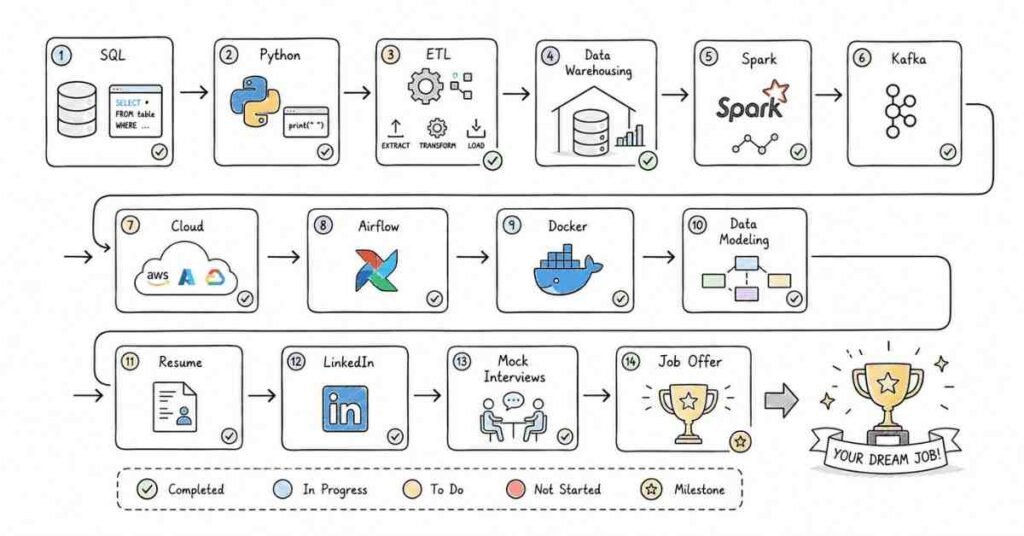
This part covers the cloud and workflow automation layer that Data Engineering interviews test heavily once SQL, Python, warehousing, and big data basics are clear. It focuses on cloud storage and compute, managed data platforms, orchestration tools, scheduling, platform trade-offs, and the practical questions that show whether you can design reliable data systems in modern cloud environments.
Questions 201–240
201. What is cloud data engineering?
Cloud data engineering is the practice of building, running, and maintaining data pipelines and platforms using cloud-based storage, compute, and managed services.
202. Why is cloud data engineering important?
It is important because many companies want scalable, flexible, and lower-maintenance data systems without managing all infrastructure themselves.
203. What is a managed service in cloud platforms?
A managed service is a cloud offering where the provider handles much of the infrastructure setup, scaling, patching, and maintenance.
204. Why do teams use managed data services?
Teams use them to reduce operational overhead, speed up implementation, and focus more on data logic than infrastructure management.
205. What is a cloud data warehouse?
A cloud data warehouse is a managed analytical database designed for large-scale SQL queries, reporting, and data modeling.
206. What are common cloud data warehouses?
Common examples include Snowflake, Google BigQuery, and Amazon Redshift.
207. What is separation of storage and compute?
It means storage and processing resources can scale independently rather than being tightly tied together.
208. Why is storage-compute separation useful?
It is useful because teams can scale query performance without unnecessarily increasing storage costs, or scale storage without overpaying for compute.
209. What is a data lake in cloud architecture?
A cloud data lake is a low-cost storage layer used to keep raw and processed data in formats such as CSV, JSON, or Parquet.
210. What is object storage?
Object storage is a cloud storage model that stores data as objects rather than traditional filesystems or database rows, and it is commonly used for data lakes.
211. Why is object storage widely used in data engineering?
It is widely used because it is scalable, durable, cost-effective, and well suited for large raw datasets.
212. What is a lakehouse architecture?
A lakehouse architecture combines data lake storage flexibility with data warehouse-style management and analytics capabilities.
213. Why do lakehouses matter?
They matter because teams want one platform that can support raw storage, structured analytics, and sometimes machine learning workflows together.
214. What is data orchestration?
Data orchestration is the coordination of pipeline tasks, dependencies, schedules, retries, and execution order.
215. Why is orchestration important in data pipelines?
It is important because real pipelines involve many dependent tasks, and manual execution becomes unreliable and hard to manage.
216. What is Apache Airflow?
Apache Airflow is a workflow orchestration tool used to define, schedule, and monitor data pipelines.
217. Why is Airflow popular in Data Engineering?
Airflow is popular because it supports complex workflow dependencies, scheduling, retries, and code-based pipeline definitions.
218. What is a DAG in Airflow?
A DAG, or Directed Acyclic Graph, is a workflow definition made up of tasks and dependencies with no circular loops.
219. Why are DAGs useful?
DAGs are useful because they make task relationships explicit and help orchestrators run tasks in the correct order.
220. What is a task in Airflow?
A task is a single unit of work inside a DAG, such as running a script, querying a database, or loading a file.
221. What is an operator in Airflow?
An operator defines the type of work a task performs, such as a Python operation, SQL query, or file transfer.
222. What is scheduling in data orchestration?
Scheduling is the process of automatically triggering workflows at defined times or intervals.
223. What is a dependency in a workflow?
A dependency is a relationship where one task must complete before another task can start.
224. What is retry logic in orchestration?
Retry logic is the rule that allows a failed task to run again automatically after a delay or under defined conditions.
225. Why are retries important in pipelines?
Retries are important because some failures are temporary, such as network issues, service throttling, or short-lived infrastructure problems.
226. What is backfilling in data pipelines?
Backfilling is the process of running pipelines for past time periods to recover missing data or reprocess historical records.
227. Why is backfilling important?
It is important because pipelines can fail, source data can arrive late, and historical consistency often matters for analytics.
228. What is event-driven orchestration?
Event-driven orchestration triggers workflows based on events such as file arrival, message publication, or API notifications instead of only fixed schedules.
229. What is a metadata-driven pipeline?
A metadata-driven pipeline uses configuration or metadata rules to control pipeline behavior instead of hardcoding all logic.
230. Why are metadata-driven approaches useful?
They are useful because they improve reuse, reduce duplication, and make pipeline management easier across many similar datasets.
231. What is serverless data processing?
Serverless data processing means running data workloads without managing servers directly, while the cloud provider handles scaling and runtime infrastructure.
232. Why is serverless attractive in data engineering?
It is attractive because it reduces operational work and can be cost-efficient for variable or intermittent workloads.
233. What is a data catalog?
A data catalog is a system that stores metadata about datasets, such as schema, ownership, lineage, and usage information.
234. Why is a data catalog important?
It is important because it helps teams discover, understand, and govern data assets more effectively.
235. What is data lineage in cloud platforms?
Data lineage in cloud platforms tracks how data moves across storage, transformations, and downstream tables or reports.
236. What is data freshness?
Data freshness refers to how up to date a dataset is compared with the expected delivery time.
237. Why is freshness monitoring important?
It is important because stale data can break dashboards, delay decisions, and reduce trust in the platform.
238. What is a good cloud pipeline design answer in interviews?
A good answer explains the source, ingestion method, cloud storage layer, processing engine, orchestration method, quality checks, and how failures or late-arriving data are handled.
239. What is a common mistake in cloud data engineering interviews?
A common mistake is naming cloud tools without explaining why they are chosen, how they interact, or what trade-offs they solve.
240. How should you answer cloud and orchestration questions in interviews?
Start with a clear definition, explain the tool or concept’s role in the pipeline, and connect it to reliability, scalability, cost, or maintainability.
Revision focus
Revise cloud data engineering basics, managed services, cloud warehouses, storage-compute separation, object storage, data lakes, lakehouses, orchestration, Airflow, DAGs, tasks, operators, scheduling, dependencies, retries, backfilling, event-driven workflows, metadata-driven pipelines, serverless processing, data catalogs, lineage, and freshness monitoring before moving to data quality, governance, and security.
Part 8: Data Quality, Governance, Security, and Reliability
This part covers the trust and protection layer that Data Engineering interviews often test after core pipeline, warehousing, and cloud concepts are clear. It focuses on data quality, validation, governance, access control, security, observability, and operational reliability questions that show whether you can keep data platforms accurate, compliant, and dependable in production.
Questions 241–280
241. What is data quality in Data Engineering?
Data quality is the measure of how accurate, complete, consistent, timely, and reliable data is for its intended use.
242. Why is data quality important?
Data quality is important because poor data leads to wrong reports, weak decisions, broken dashboards, and reduced trust in the platform.
243. What are common dimensions of data quality?
Common dimensions include accuracy, completeness, consistency, validity, uniqueness, and timeliness.
244. What is data validation?
Data validation is the process of checking whether incoming or transformed data matches expected rules, formats, and business conditions.
245. What is schema validation?
Schema validation checks whether a dataset has the expected columns, data types, structure, and sometimes nullability rules.
246. Why is schema validation useful?
It is useful because source systems change over time, and schema checks help prevent broken pipelines and incorrect downstream loads.
247. What is a null check in data pipelines?
A null check verifies whether required fields contain missing values where data is expected to be present.
248. What is a uniqueness check?
A uniqueness check confirms that values such as primary keys or business identifiers are not duplicated when they should be unique.
249. What is a referential integrity check?
A referential integrity check confirms that relationships between datasets remain valid, such as every fact table key matching an existing dimension row.
250. What is a range check?
A range check verifies that numeric or date values fall within expected minimum and maximum limits.
251. What is a freshness check?
A freshness check confirms that data arrived or was updated within the expected time window.
252. Why are freshness checks important?
Freshness checks are important because stale data can silently break dashboards, machine learning features, and operational decisions.
253. What is data profiling?
Data profiling is the analysis of a dataset’s structure, distributions, null patterns, uniqueness, and anomalies before or during pipeline design.
254. Why is data profiling useful?
It is useful because it helps engineers understand real source data behavior instead of making assumptions from documentation alone.
255. What is data lineage?
Data lineage tracks where data came from, what transformations were applied, and where the resulting datasets are used downstream.
256. Why is lineage important?
Lineage is important because it helps with debugging, impact analysis, audits, and trust in analytical outputs.
257. What is data governance?
Data governance is the set of processes, policies, roles, and standards used to manage data quality, access, ownership, and compliance.
258. Why is data governance important?
It is important because data platforms grow across many teams, and governance helps maintain consistency, accountability, and responsible usage.
259. What is data ownership?
Data ownership means a defined person or team is responsible for the quality, meaning, and lifecycle of a dataset.
260. What is a data steward?
A data steward is a person responsible for maintaining data definitions, quality standards, and governance practices for specific datasets or domains.
261. What is metadata in data platforms?
Metadata is information about data, such as schema, column descriptions, lineage, ownership, update frequency, and access rules.
262. Why is metadata important?
Metadata is important because it helps users discover, understand, trust, and safely use datasets.
263. What is data cataloging?
Data cataloging is the process of organizing and publishing dataset metadata so teams can find and interpret available data assets.
264. What is access control in data engineering?
Access control is the practice of limiting who can view, modify, or manage data systems and datasets.
265. Why is access control important?
It is important because sensitive or critical data should only be available to approved users and services.
266. What is role-based access control (RBAC)?
RBAC is a security model where permissions are assigned to roles, and users or services receive access by being assigned those roles.
267. What is the principle of least privilege?
The principle of least privilege means giving users and systems only the access they need and no more.
268. Why is least privilege important in data systems?
It is important because excessive permissions increase the risk of data leaks, accidental changes, and security incidents.
269. What is encryption at rest?
Encryption at rest protects stored data by keeping it encrypted while saved in databases, filesystems, or object storage.
270. What is encryption in transit?
Encryption in transit protects data while it moves between systems, services, or users across networks.
271. What is sensitive data in Data Engineering?
Sensitive data includes information such as personal details, financial records, credentials, health data, or any data that requires controlled handling.
272. What is masking in data pipelines?
Masking is the process of hiding or transforming sensitive values so they are not exposed to unauthorized users.
273. What is tokenization?
Tokenization replaces sensitive values with non-sensitive tokens that can be mapped back through a secure system when needed.
274. What is auditing in data platforms?
Auditing is the recording of access, changes, and actions performed on data systems for security, compliance, and investigation purposes.
275. What is observability in data engineering?
Observability in data engineering means being able to understand pipeline health and behavior through logs, metrics, alerts, lineage, and run history.
276. What is a pipeline SLA?
A pipeline SLA is a defined service-level expectation for data delivery, availability, or processing performance.
277. What is incident response in a data platform?
Incident response is the process of detecting, investigating, communicating, and resolving data or platform failures.
278. Why is root cause analysis important?
Root cause analysis is important because fixing only the surface issue can allow the same problem to happen again.
279. What is a good answer for data quality and governance questions?
A good answer explains the rule or concept, where it is enforced in the pipeline, and how it improves trust, compliance, or reliability.
280. How should you answer security and reliability questions in interviews?
Start with the basic principle, explain how it is implemented in a data platform, and mention a practical control such as validation checks, RBAC, encryption, masking, monitoring, or auditing.
Revision focus
Revise data quality dimensions, validation, schema checks, null checks, uniqueness, referential integrity, freshness, profiling, lineage, governance, ownership, metadata, cataloging, access control, RBAC, least privilege, encryption, masking, auditing, observability, pipeline SLAs, incident response, and root cause analysis before moving to scenario-based design and behavioral interview preparation.
Part 9: Behavioral, Resume, LinkedIn, and Career Strategy
This final part turns technical preparation into interview performance. It focuses on how to answer behavioral questions, present your projects, strengthen your resume and LinkedIn profile, and handle the job search process with more confidence.
STAR method
STAR means Situation, Task, Action, and Result. It is one of the best ways to answer behavioral questions because it keeps your answer structured and practical.
- Situation: Explain the context.
- Task: Explain your responsibility.
- Action: Describe what you did.
- Result: Share the outcome or learning.
A strong STAR answer should be clear, specific, and focused on ownership. Interviewers usually respond well when you explain what changed because of your work.
20 behavioral questions
Here are 20 behavioral questions to practice:
- Tell me about a time you solved a production issue.
- Tell me about a time you automated a manual process.
- Describe a time you worked with a difficult stakeholder.
- Tell me about a time you improved a deployment pipeline.
- Describe a time you made a mistake and fixed it.
- Tell me about a time you explained a technical issue to a non-technical person.
- Describe a time you worked under pressure.
- Tell me about a time you had multiple tasks and had to prioritize.
- Describe a time you handled an urgent incident.
- Tell me about a time you improved monitoring or alerting.
- Describe a time you secured a deployment or secret.
- Tell me about a time you worked with development and operations teams.
- Describe a time requirements were unclear.
- Tell me about a time you received feedback and improved.
- Describe a time you managed a change request.
- Tell me about a time you influenced a decision without authority.
- Describe a time you resolved a user issue quickly.
- Tell me about a time you learned a new DevOps tool quickly.
- Describe a time you balanced speed and reliability.
- Tell me about a time you improved a system through automation.
Use these to practice spoken answers, not just written notes. The goal is to sound structured and confident under pressure.
Project storytelling
A strong project explanation should include the business problem, tools used, your contribution, the workflow, challenges, and outcome. That structure helps interviewers quickly understand both your technical depth and your ownership.
A good flow is:
- What was the problem?
- Which DevOps tools were used?
- What did you personally do?
- What challenges came up?
- What was the result?
Even if your project is a lab, internship task, or self-built setup, present it like real production work. Focus on automation, reliability, monitoring, and security rather than only listing tools.
Resume focus
A strong DevOps resume should show impact, not just tool names. Good keywords include Linux, Shell Scripting, Git, Jenkins, CI/CD, Docker, Kubernetes, Terraform, Ansible, Infrastructure as Code, Monitoring, Logging, Alerting, Observability, Secrets Management, DevSecOps, Rollback, Release Automation, Cloud Deployment, and Incident Response.
Useful bullet style:
- Built and maintained CI/CD pipelines to automate build, test, and deployment workflows.
- Automated infrastructure provisioning using Terraform to improve consistency across environments.
- Managed containerized deployments using Docker and Kubernetes.
- Improved monitoring and alerting to reduce time to detect production issues.
- Secured pipeline secrets and deployment access using approved controls.
- Supported rollback, deployment, and incident response processes for production systems.
A resume summary should stay short and role-focused. One effective format is to state your main tools, your strength in automation, and the kind of DevOps work you want to do.
LinkedIn setup
Your LinkedIn profile should match your resume and the role you want. A clear headline, a concise About section, and aligned project highlights make it easier for recruiters to understand your profile fast.
Example headline:
- DevOps Engineer | CI/CD, Docker, Kubernetes, Terraform
- DevOps and Automation Engineer | Linux, Git, Jenkins, IaC
- Cloud DevOps Engineer | Automation, Containers, Monitoring
- SRE | Reliability, Observability, Automation, Kubernetes
Example About section:
- DevOps professional focused on automation, CI/CD, Linux, containers, infrastructure as code, and operational reliability. I enjoy solving delivery and deployment problems, improving release consistency, and building secure and repeatable workflows. My strengths include structured troubleshooting, clear communication, and continuous learning through hands-on practice and project work.
Keep your headline, summary, and project descriptions aligned with the same target role. That consistency helps both recruiters and ATS systems.
Job search flow
Your final preparation should include project revision, behavioral practice, mock interviews, and simple follow-up communication. A practical checklist is to finalize 1 to 3 projects, prepare a 60-second self-introduction, practice at least 20 behavioral answers, and revise core DevOps tools and scenarios.
A thank-you email after interviews should be short and respectful. A follow-up email should be polite and direct. If you are rejected, asking for feedback is still worthwhile because it helps you improve for the next round.
One useful habit is to practice answers out loud every day. That often improves interview performance more than passive reading because DevOps interviews reward clear explanation under pressure.
Would you like me to compile Parts 1–9 into one clean final document?