
How to Become a Machine Learning Engineer in 2026: Complete Career Guide
Table of Contents
Machine Learning Engineer
Machine Learning Engineers are the people who turn data and algorithms into real products that make predictions, automate decisions, and improve business performance. If you can learn Python, statistics, machine learning, model deployment, and problem solving, you can build a strong career in India with excellent growth and salary potential. This guide shows you the exact roadmap to become job-ready in 2026, whether you are a fresher, an analyst, or a working professional moving into AI and ML.
What a Machine Learning Engineer Does
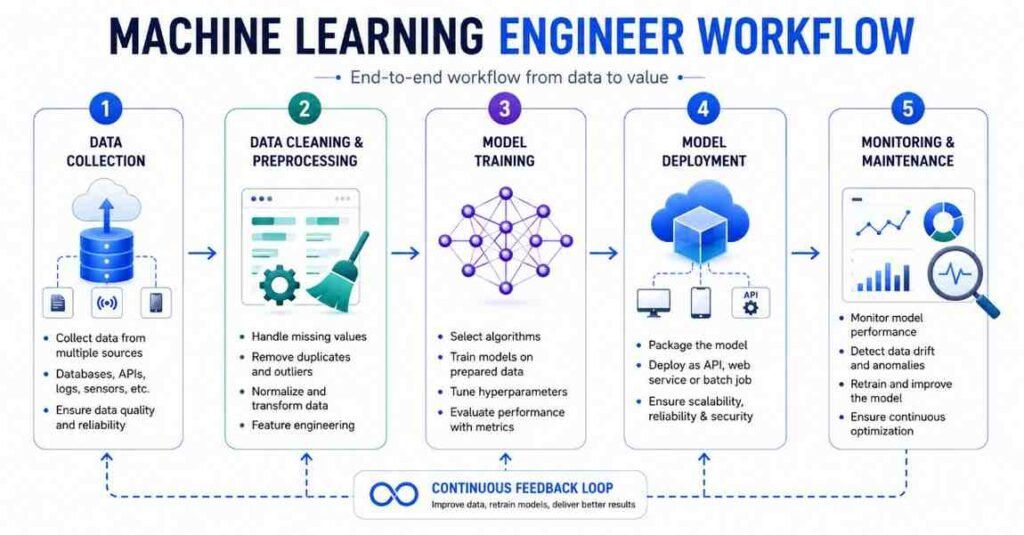
A machine learning engineer builds systems that learn from data and make predictions or decisions with minimal manual intervention. The role sits between data science and software engineering, so you need both analytical thinking and coding ability.
This is not just about training models. It is about preparing data, building features, selecting algorithms, evaluating results, and deploying the model into a real application.
Main responsibilities
- Collect and prepare data for modeling.
- Build and train machine learning models.
- Perform feature engineering.
- Evaluate model performance.
- Deploy models into production systems.
- Monitor model drift and retraining needs.
- Work with data scientists, backend teams, and product teams.
Why Machine Learning Engineering Is a Smart Career
Machine learning engineering is a smart career because companies are using AI in search, recommendations, automation, fraud detection, and customer experience. Businesses need engineers who can make models work in the real world, not just in notebooks.
The field also gives strong long-term growth. If you keep learning deployment, cloud, and MLOps, you can move into senior engineering, applied AI, or solution architecture roles.
Why students choose it
- Strong demand across startups and enterprises.
- High salary potential compared to many entry-level tech roles.
- Useful for AI, analytics, and software careers.
- Project-based learning works well for interviews.
- Good future scope with automation and AI adoption.
Machine Learning Roles Compared
Machine learning has several related roles, and each one focuses on a different part of the AI stack.
If you want a balanced mix of coding, mathematics, and practical product work, machine learning engineering is a strong path.
Complete Learning Roadmap
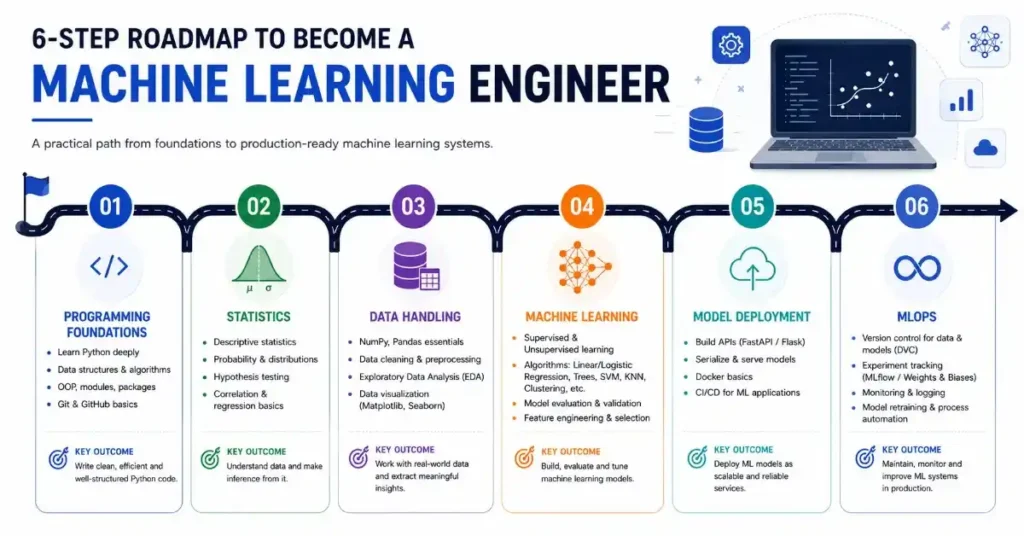
Phase 1: Programming Foundations
Before machine learning, you need a solid base in programming and data handling. This makes the rest of the path much easier.
Focus on:
- Python syntax.
- Data types and structures.
- Functions and loops.
- Object-oriented programming.
- File handling.
- Git and GitHub.
- Command-line basics.
Phase 2: Math and Statistics
Machine learning depends on math, but you do not need to become a mathematician. You need practical understanding of the concepts that help models work.
Learn:
- Probability.
- Descriptive statistics.
- Distributions.
- Linear algebra basics.
- Calculus intuition.
- Hypothesis testing.
- Correlation and causation.
Phase 3: Data Handling
Before training models, you need to work with real-world data. Most ML projects spend a lot of time on cleaning and preparing data.
Learn:
- NumPy.
- Pandas.
- Missing value handling.
- Data normalization.
- Outlier treatment.
- Encoding categorical variables.
- Train-test split.
Phase 4: Core Machine Learning
Now you can start learning algorithms and model behavior. This is where your understanding becomes practical.
Learn:
- Supervised learning.
- Unsupervised learning.
- Regression.
- Classification.
- Clustering.
- Decision trees.
- Random forests.
- Gradient boosting.
- K-means.
- Model evaluation.
Phase 5: Model Deployment
A model is only useful if it can be used in a real product. Deployment is one of the most important parts of machine learning engineering.
Learn:
- Saving and loading models.
- API creation for inference.
- Flask or FastAPI basics.
- Docker for packaging.
- Cloud deployment basics.
- Monitoring predictions and performance.
Phase 6: MLOps Basics
MLOps helps you manage machine learning in production. It combines ML, software engineering, and operations.
Learn:
- Version control for datasets and models.
- Experiment tracking.
- CI/CD for ML workflows.
- Data drift and model drift.
- Retraining pipelines.
- Model monitoring.
Python, Math, and ML
These are the three pillars of the machine learning engineer path.
Python skills to master
- Data manipulation.
- Functions and classes.
- File handling.
- APIs.
- Libraries for ML and visualization.
- Scripting for automation.
Math skills to master
- Probability.
- Statistics.
- Linear algebra basics.
- Optimization intuition.
- Error measurement.
ML skills to master
- Feature engineering.
- Model selection.
- Evaluation metrics.
- Hyperparameter tuning.
- Deployment and monitoring.
Salary Expectations in India
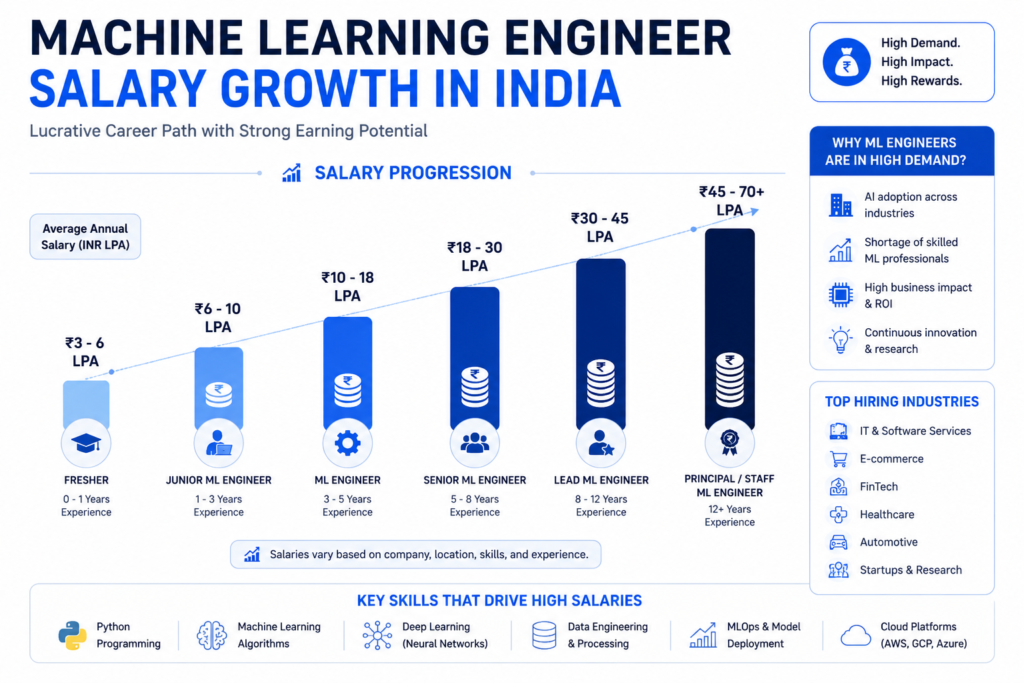
Salary depends on your project quality, math confidence, coding ability, and interview performance. Machine learning engineers usually earn more as they gain deployment and production experience.
Experience Level | Typical Salary |
Fresher | ₹5 LPA to ₹8 LPA |
1–3 years | ₹8 LPA to ₹15 LPA |
3–5 years | ₹15 LPA to ₹25 LPA |
5+ years | ₹25 LPA to ₹40 LPA+ |
Engineers who know MLOps, cloud deployment, and production systems usually grow faster than those who only build notebook models.
Portfolio That Gets Interviews
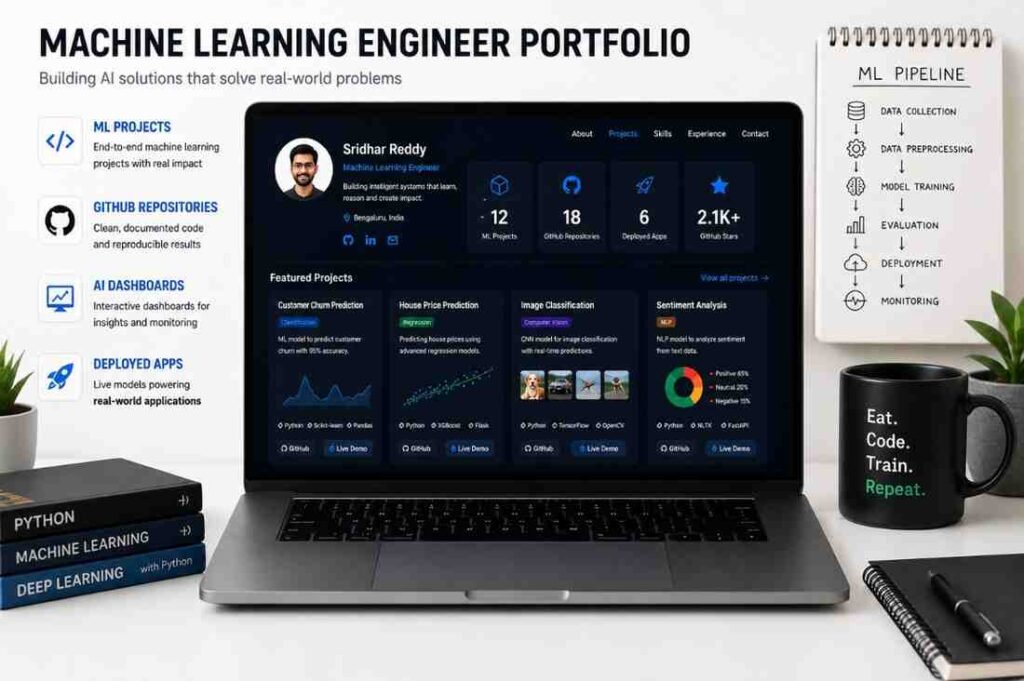
Your portfolio must show that you can solve real problems with data and models. Recruiters want to see end-to-end work, not only theory.
What to include
- Classification project.
- Regression project.
- Clustering or segmentation project.
- NLP or recommendation project.
- Deployed ML API.
- GitHub repository with clean documentation.
- A short explanation of business use case and outcome.
Portfolio checklist
- Explain the problem clearly.
- Show your data cleaning process.
- Mention evaluation metrics.
- Include charts and insights.
- Deploy at least one model.
- Keep code readable and organized.
Job Search Strategy
Your resume should show both practical ML work and engineering ability. Hiring teams want candidates who can build and ship models.
Resume keywords
- Python
- Machine learning
- Pandas
- NumPy
- Scikit-learn
- Statistics
- Feature engineering
- Model evaluation
- Flask
- FastAPI
- Docker
- MLOps
- Deployment
Where to apply
- LinkedIn Jobs
- Naukri
- Indeed
- startup career pages
- AI/ML job boards
- internship portals
Interview preparation
Be ready to answer questions like:
- What is the difference between supervised and unsupervised learning?
- How do you handle overfitting?
- What is feature engineering?
- How do you choose evaluation metrics?
- How would you deploy a trained model?
- How do you monitor a model after deployment?
30-Day Starter Plan
If you want to begin now, follow this simple plan.
Week 1
- Learn Python basics.
- Set up GitHub.
- Review statistics fundamentals.
- Practice simple scripts.
Week 2
- Learn Pandas and NumPy.
- Clean a small dataset.
- Create charts.
- Start basic analysis.
Week 3
- Learn a supervised ML algorithm.
- Build a simple model.
- Understand train-test split.
- Check evaluation metrics.
Week 4
- Build a small project.
- Package the model in an API.
- Create a GitHub README.
- Update your resume and LinkedIn.
Why Learn Machine Learning at Frontlines Edutech
Frontlines Edutech is a practical choice for students and working professionals who want regional support, structured learning, and job-focused training. The best programs combine Python, statistics, ML, deployment, and real project work in a way that makes job readiness realistic.
What to look for in training
- Strong Python and statistics foundation.
- Real machine learning projects.
- Deployment and API practice.
- MLOps awareness.
- Resume and interview support.
- Regional-language explanation if needed.
Frequently Asked Questions
1. How long does it take to become a machine learning engineer?
It usually takes 4 to 8 months of consistent learning to become job-ready, depending on your background and how much project practice you do.
2. Is machine learning engineering a good career in India?
Yes, it is a strong career because companies need people who can turn data into production-ready AI systems. It has strong salary growth and long-term demand.
3. Which skill should I learn first?
Start with Python, statistics, and data handling. After that, move into machine learning algorithms and deployment.
4. Do I need advanced math to become a machine learning engineer?
You need solid practical understanding of statistics and linear algebra basics, but you do not need a research-level math background to start.
5. What is the best specialization for beginners?
A general machine learning engineer path is a good starting point. If you like deployment and automation, you can later move into MLOps.
6. Can I get a job without experience?
Yes, if you have practical projects, a good GitHub profile, and one deployed model. Internships and portfolio work help a lot.
7. Which tools should I learn first ?
Start with Python, Pandas, NumPy, Scikit-learn, Jupyter Notebook, Git, and FastAPI or Flask.
8. Is machine learning remote-friendly ?
Yes, many ML and AI roles are remote-friendly because the work can be done with standard development tools and cloud collaboration.
9. What kind of projects should I show in interviews?
Show prediction models, classification projects, clustering work, an API deployment, and a clear GitHub repository with business context.