
Structured vs Unstructured Data: What Is the Difference?
Recommended Learning Path
Structured vs Unstructured Data
What Is the Difference?
Table of Contents
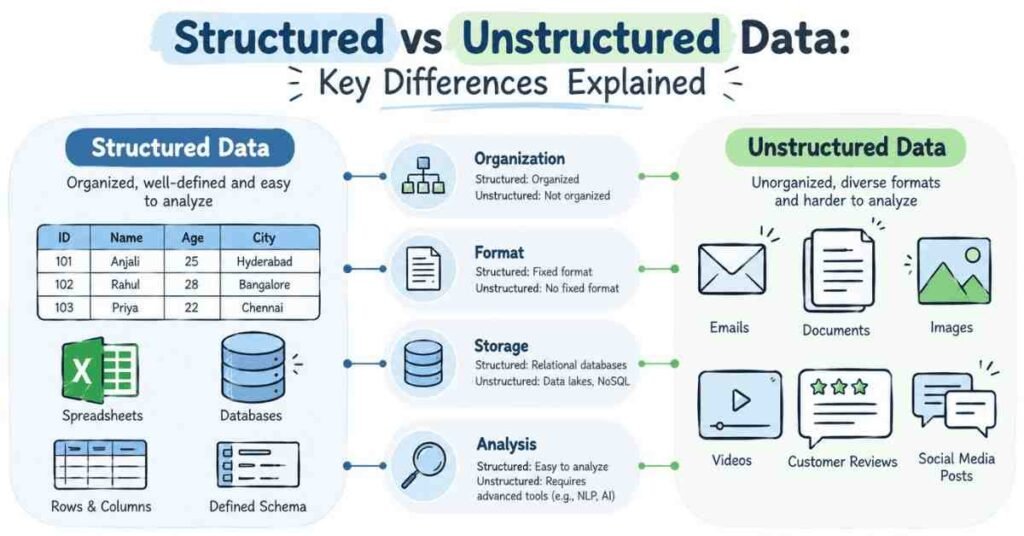
Before analysing data, it helps to understand what kind of information you are working with. A spreadsheet containing customer IDs and sales amounts behaves very differently from a folder containing customer reviews, PDFs, images, and call recordings.
This is the main idea behind structured vs unstructured data.
Structured data follows an organised, predefined format. Unstructured data does not follow the same fixed schema and may appear as free-form text, documents, images, audio, or video. Both can contain valuable information, but analysts usually process and analyse them differently.
Understanding this difference is one of the basic foundations of data analytics because the form of the data influences the tools, preparation steps, and analytical methods you may need.
Quick Answer: What Is the Difference Between Structured and Unstructured Data?
Structured data is organised according to a defined schema. It commonly fits naturally into fields, rows, and columns, making it easier to search, filter, aggregate, and query.
Unstructured data does not follow a fixed predefined schema. Examples include emails, reviews, PDFs, photographs, audio recordings, and videos. Extracting useful information from it often requires additional processing before conventional analysis can begin.
The difference is therefore not simply “numbers versus text.” Text can also be structured—for example, a fixed city column in a customer table.
Start Your Data Analytics Journey!
Explore Data Analytics Roadmap
What Is Structured Data?
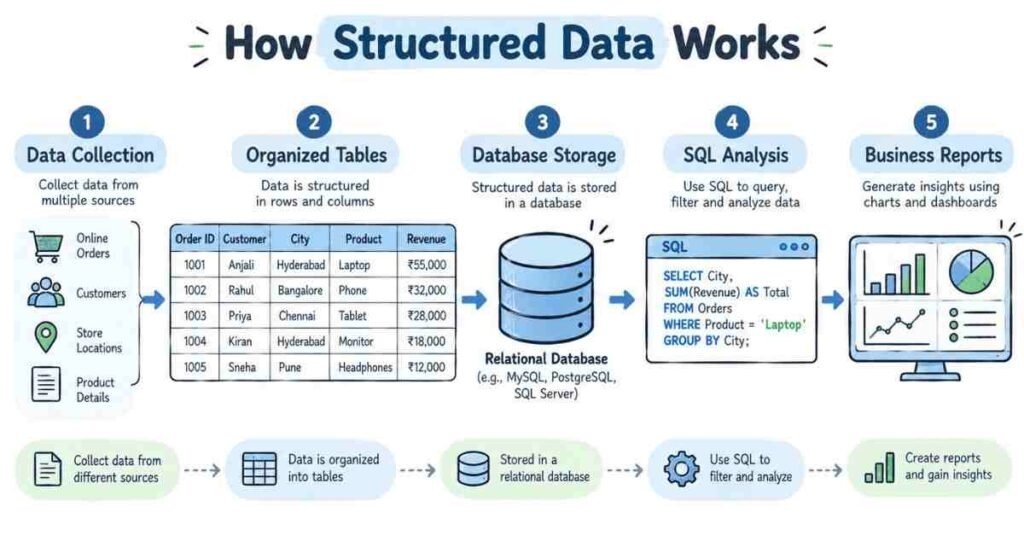
Structured data has an organised model that defines what each field represents.
Consider a sales table:
Order ID | Customer | City | Product | Revenue |
1001 | Ravi | Hyderabad | Laptop | ₹52,000 |
1002 | Anjali | Vijayawada | Monitor | ₹14,500 |
1003 | Kiran | Warangal | Keyboard | ₹2,200 |
Every row follows the same general structure. Order ID always identifies the order, City stores location information, and Revenue stores a numeric value.
Because the structure is known, an analyst can easily ask questions such as:
- What is total revenue?
- Which city generated the most sales?
- How many orders were placed?
- What is the average order value?
Structured information is commonly found in relational databases, spreadsheets, CRM records, inventory systems, and financial tables. SQL is widely used to query structured relational data.
What Is Unstructured Data?
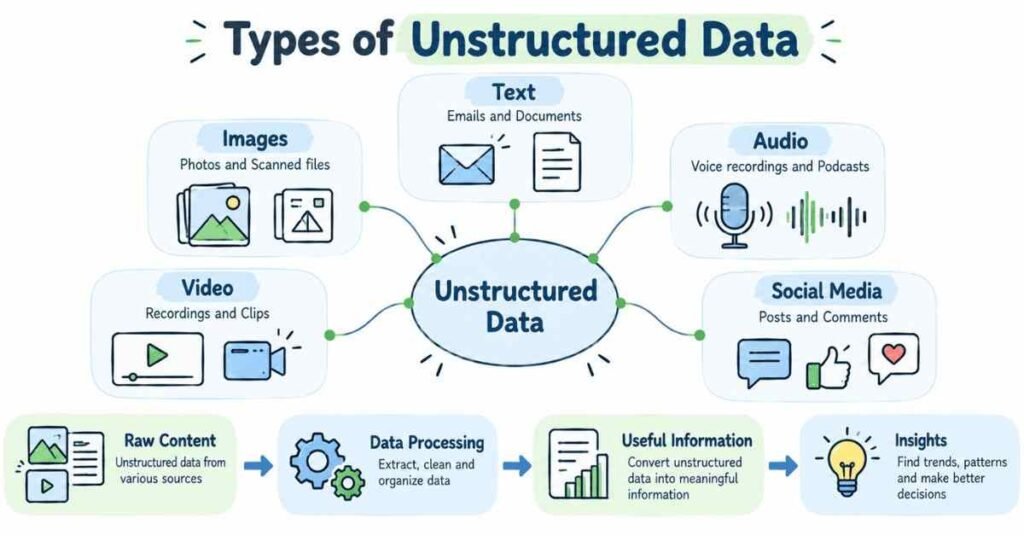
Unstructured data does not follow the same fixed field-based structure.
A customer review such as:
Delivery was quick, but the product packaging was damaged.
contains useful information, but it does not naturally arrive as separate columns for delivery satisfaction, packaging issue, and sentiment.
The same problem appears with:
- emails
- customer reviews
- Word documents
- PDFs
- social media posts
- call transcripts
- images
- audio recordings
- video files
IBM and Google Cloud both describe these formats as common forms of unstructured information.
Unstructured does not mean useless or random. It means the information does not arrive in a rigid schema that traditional tabular analysis can immediately use.
Structured vs Unstructured Data: Key Differences
Area | Structured Data | Unstructured Data |
Organisation | Predefined schema | No fixed predefined schema |
Typical form | Rows, columns, defined fields | Free-form text, documents, media |
Examples | Sales tables, customer records, transactions | Reviews, emails, PDFs, images, audio |
Querying | Often straightforward with SQL and BI tools | Usually needs processing or extraction first |
Analysis | Aggregation, filtering, reporting, dashboards | NLP, text analysis, image/audio processing, AI |
Storage | Often relational databases or warehouses | Often object storage, data lakes, file systems or NoSQL systems |
These are common patterns rather than absolute storage rules. AWS notes that technologies can support more than one data type depending on the architecture.
How Is Structured Data Used in Analytics?
Structured information fits naturally into many traditional analytics workflows.
Suppose a retailer has an order database containing customer ID, product, order date, quantity, revenue, and city.
An analyst can use SQL to retrieve records, Excel to perform quick calculations, or Power BI to create dashboards.
Questions such as monthly revenue, regional sales, average order value, and repeat-customer counts can be calculated directly because the required fields already have known meanings.
This makes structured data particularly convenient for reporting, business intelligence, financial analysis, inventory analysis, and KPI tracking.
How Can Analysts Work with Unstructured Data?
Unstructured information often needs an additional step before it can become part of conventional analysis.
Consider 5,000 customer reviews.
The reviews themselves are free-form text. If the company wants to measure customer concerns, the text may first need to be classified or transformed into useful fields such as:
Review ID | Sentiment | Topic | Product | Complaint Type
Natural language processing, machine learning, search systems, and modern AI tools can help extract information from text and other unstructured formats.
Once relevant features have been extracted, analysts can combine them with structured business data.
This is an important idea for beginners: unstructured information often becomes easier to analyse after useful attributes have been identified and represented in a more organised form.
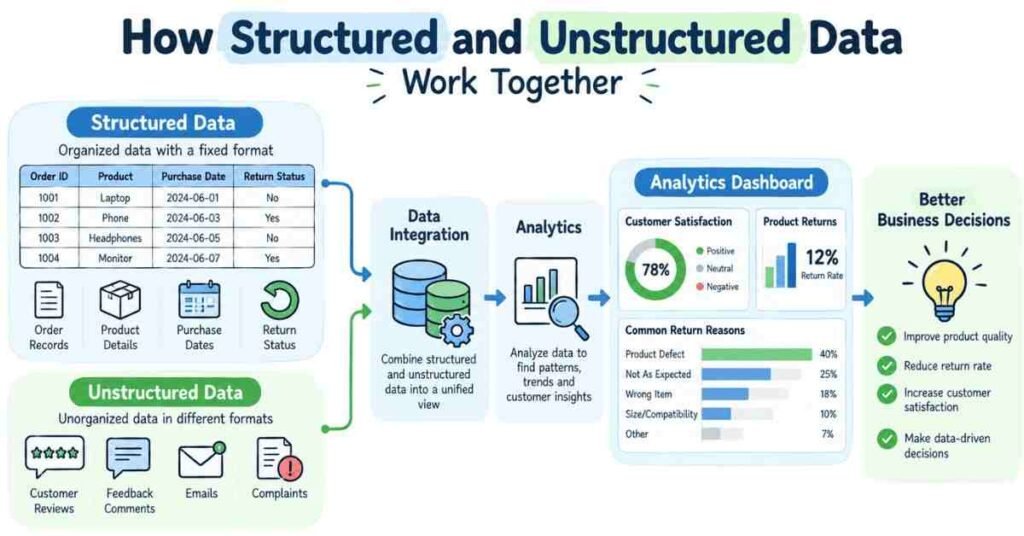
How Structured and Unstructured Data Work Together
A business problem rarely needs to remain limited to one type of data.
Imagine an e-commerce company investigating product returns.
Its structured information may show:
- product ID
- order value
- customer location
- return date
- return status
That data can tell the analyst which products are being returned most often.
But customers may also leave written comments explaining why they returned the products.
Those comments are unstructured data.
Analysing both can produce a stronger picture. Structured transaction records may show that one product has a high return rate, while review text may reveal repeated complaints about sizing or damaged packaging.
The structured information explains what happened. The unstructured information may provide additional context about why it happened.
What About Semi-Structured Data?
Not every dataset fits perfectly into only two categories.
Semi-structured data sits between structured and unstructured information. It does not follow a rigid relational-table schema, but it contains organisational elements such as tags, keys, metadata, or markers.
JSON and XML are common examples. IBM and AWS both describe semi-structured data as having some organisation without the strict schema associated with traditional relational data.
For beginners, the important distinction is:
Structured: fixed organisation
Semi-structured: flexible organisation with markers
Unstructured: no predefined schema
You do not need to master every storage technology before understanding this basic difference.
Prepare for Data Analytics Interviews
Read the Data Analytics Interview Guide
Common Misconceptions Beginners Should Avoid
One common mistake is assuming that all numerical data is structured and all text is unstructured.
That is not correct.
A database column containing customer names is text, but it is still structured because each value belongs to a predefined field.
Another misconception is that unstructured information cannot be analysed. It can, but it normally requires different preparation and processing methods.
Beginners should also avoid thinking that structured data is automatically accurate. A perfectly organised table can still contain missing values, incorrect entries, duplicates, or outdated records.
Structure describes how information is organised, not whether the information is trustworthy.
FLM Perspective: Identify the Data Before Choosing the Tool
A simple framework for beginners is:
Format → Structure → Question → Method
First, identify the format: table, document, text, image, audio, or another source.
Next, determine whether the information follows a predefined structure.
Then define the question you need to answer.
Only after that should you decide how the data should be prepared and which analytical tool is appropriate.
This prevents a common beginner mistake—choosing Excel, SQL, Python, or an AI tool before understanding the data itself.
For learners who want to build these foundations alongside Excel, SQL, Power BI, Python, statistics, and AI-assisted analytics, FLM’s AI Data Analytics course includes data fundamentals and different data types within its broader analytics curriculum.
Conclusion
The main difference between structured vs unstructured data is how the information is organised.
Structured data follows a predefined model and is relatively straightforward to query and aggregate. Unstructured data does not fit the same fixed schema and often requires additional processing before useful information can be extracted.
Neither type is inherently better.
A sales database can explain what customers purchased. Reviews, emails, or call transcripts can add context about what customers experienced. Modern analytics increasingly benefits from understanding how different forms of data can contribute to the same business question.
For a beginner, the first habit should therefore be simple: understand the form and structure of the data before deciding how to analyse it.
Frequently Asked Questions
What is structured data?
Structured data follows a predefined schema and commonly appears in tables with clearly defined fields, such as customer records, sales transactions, and inventory data.
What is unstructured data?
Unstructured data does not follow a predefined schema. Common examples include emails, free-form text, PDFs, images, audio, and video.
Is Excel data structured?
A well-organised Excel table with consistent columns and records is generally treated as structured data.
Are customer reviews structured or unstructured?
Free-text customer reviews are usually unstructured. Ratings or fixed-choice responses stored in defined fields are structured.
Is a PDF structured or unstructured data?
PDF documents are commonly treated as unstructured content, although information can be extracted from them and converted into structured fields for analysis.
Is JSON structured or unstructured?
JSON is generally considered semi-structured because it uses keys and organisational markers but does not require a rigid relational-table schema.
Can SQL analyse unstructured data?
Traditional SQL works most naturally with structured data. Unstructured content usually needs extraction, transformation, indexing, or specialised processing before conventional SQL-style analysis becomes practical.
Do data analysts work with both types of data?
Yes. The type of information used depends on the business problem. Analysts may combine structured business records with insights extracted from text, documents, or other unstructured sources.
Related Career Guides
Useful follow-up topics include:
- Data Analytics Roadmap for Beginners
- Excel Skills Required for Data Analysts
- SQL Learning Roadmap for Data Analytics
- How to Build a Data Analytics Portfolio
- Data Analytics Projects for Beginners
Turn Your Interest into a Data Analytics Career!