
SAP FICO Interview Preparation Guide 2026
Table of Contents
Part 1: SAP FICO Introduction and 30-Day Study Plan
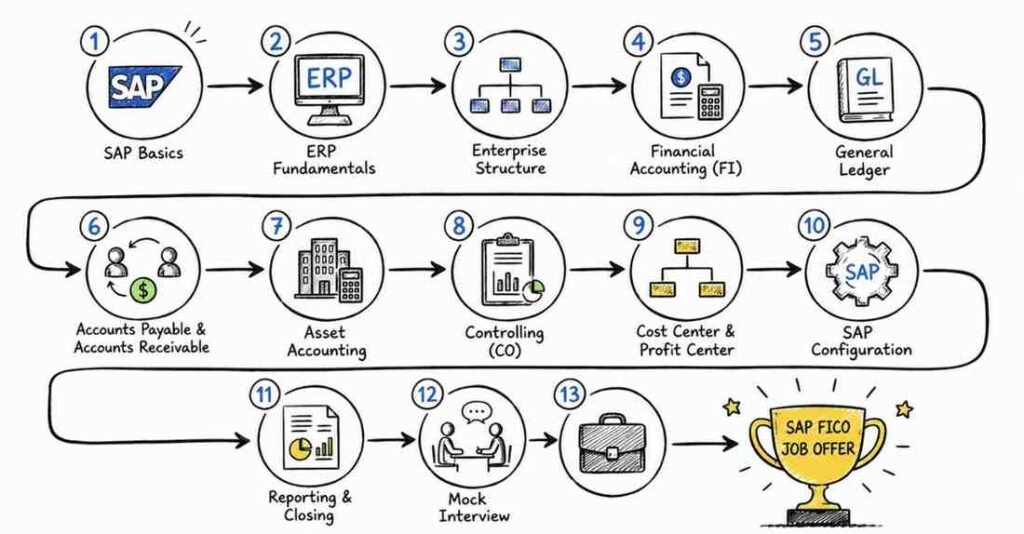
This part sets the direction for SAP FICO interview preparation. It explains what SAP FICO is, where it fits in business, and how to build a practical 30-day plan that gets you ready for interviews and real project discussions.
What this guide covers
This guide should move from SAP basics to FI fundamentals, CO, enterprise structure, posting concepts, configuration ideas, and finally interview preparation and career strategy. The goal is not just to memorize SAP terms, but to understand how financial processes work inside an ERP system.
Who this guide is for
This guide is useful if you are a fresher preparing for your first SAP FICO interview, an accounting or finance professional moving into SAP, or a candidate who already knows basic SAP terms but is not confident explaining FI and CO clearly. It is also helpful for anyone targeting functional consultant roles in finance and controlling.
What SAP FICO is
SAP FICO stands for SAP Financial Accounting and Controlling. It is one of the core SAP modules used to manage financial accounting, reporting, cost tracking, and internal controls inside an enterprise system.
Why SAP FICO matters
SAP FICO matters because businesses need reliable financial records, timely reporting, and a structured way to track costs and profitability. In real companies, SAP FICO is used for general ledger, accounts payable, accounts receivable, cost center accounting, internal orders, and profitability analysis.
Where SAP FICO fits
SAP FICO sits at the center of finance and controlling processes in an organization. It supports day-to-day accounting operations, month-end closing, financial statements, and management reporting.
Common interview focus
SAP FICO interviews usually check whether you understand the difference between FI and CO, core accounting objects, enterprise structure, posting concepts, and practical business usage. Many training courses also emphasize S/4HANA finance concepts and configuration topics, so it helps to know the broader environment, not just theory
30-day study plan
A practical 30-day SAP FICO plan is easier to follow when you split it into weekly goals.
- Week 1: SAP basics, finance overview, FI and CO introduction, and enterprise structure.
- Week 2: General ledger, accounts payable, accounts receivable, and posting basics.
- Week 3: Cost center accounting, internal orders, profitability analysis, and key controlling concepts.
- Week 4: Configuration review, real business scenarios, interview questions, and revision.
Daily study routine
A good daily routine is to spend time on concept reading, then practice explaining the topic aloud in simple language. You should also revise accounting terms and business flows so that you can connect SAP concepts to real finance work.
Revision focus
Revise what SAP FICO is, why it matters, where it is used, the main FI and CO areas, and the 30-day study plan before moving to SAP fundamentals and enterprise structure.
Part 2: SAP Fundamentals and Enterprise Structure
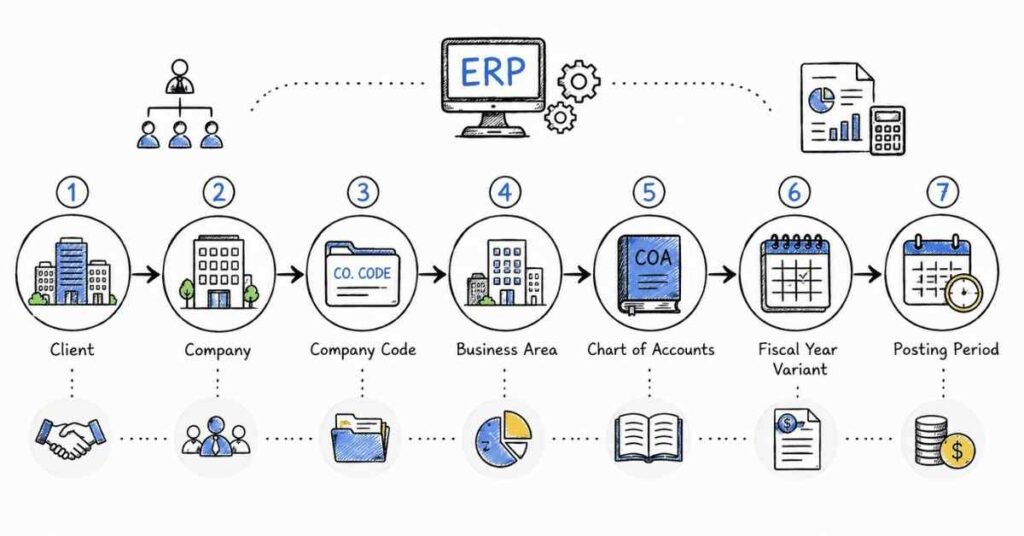
This part builds the foundation for the rest of the SAP FICO guide. It covers SAP basics, system concepts, and the enterprise structure you need before moving into FI, CO, postings, and configuration.
Questions 1–40
1. What is SAP?
SAP is an enterprise software platform used by companies to manage business processes. It helps integrate finance, sales, purchasing, manufacturing, and other functions in one system.
2. What does SAP stand for?
SAP stands for Systems, Applications, and Products in Data Processing. It is one of the most widely used ERP platforms in business.
3. What is ERP?
ERP stands for Enterprise Resource Planning. It is software that connects different business processes into a single system.
4. Why is ERP important?
ERP is important because it reduces duplicate work and improves data consistency. It also helps different departments work with the same information.
5. What is SAP FICO?
SAP FICO is the SAP module for Financial Accounting and Controlling. It is used to handle accounting, reporting, and cost management.
6. What are the two parts of SAP FICO?
The two parts are FI, which means Financial Accounting, and CO, which means Controlling. They work together but serve different business needs.
7. What is SAP FI?
SAP FI is the Financial Accounting component of SAP. It focuses on external accounting and legal financial reporting.
8. What is SAP CO?
SAP CO is the Controlling component of SAP. It focuses on internal cost tracking, management reporting, and profitability analysis.
9. Why do companies use SAP?
Companies use SAP to streamline processes, improve control, and get reliable business data. It also supports large-scale operations across departments.
10. What is an SAP module?
An SAP module is a functional area inside SAP that handles a specific business process. Examples include FI, CO, MM, SD, and HR.
11. What is a client in SAP?
A client is the highest organizational unit in SAP. It represents a self-contained environment with its own master data and configuration.
12. Why is the client important?
The client helps separate systems and data environments. It allows different business units or companies to work in the same SAP landscape safely.
13. What is a company code?
A company code is the smallest organizational unit for external accounting in SAP. It represents a legal entity that prepares financial statements.
14. Why is the company code important?
Because financial reporting in SAP FI is done at the company code level. It is one of the most important enterprise structure elements.
15. What is a company?
A company is a higher-level organizational unit that can group one or more company codes. It is often used for consolidation purposes.
16. What is the difference between company and company code?
A company is a group-level concept, while a company code is a legal accounting unit. Financial statements are prepared for the company code.
17. What is a business area?
A business area is an organizational unit used for internal segment reporting. It helps track financial results across parts of the business.
18. Why is business area used?
It is used to analyze performance by product line, region, or division. It gives extra reporting flexibility.
19. What is a chart of accounts?
A chart of accounts is a list of all general ledger accounts used by a company. It defines the structure of financial accounting accounts.
20. Why is the chart of accounts important?
Because it organizes all accounting transactions in a consistent way. It is central to financial reporting in SAP FI.
21. What is an operating chart of accounts?
An operating chart of accounts is the chart of accounts used for daily posting in a company code. It is the primary account structure for FI.
22. What is a group chart of accounts?
A group chart of accounts is used for consolidating multiple company codes under a common account structure. It helps reporting across companies.
23. What is a country chart of accounts?
A country chart of accounts is designed to meet legal reporting requirements of a specific country. It supports statutory accounting needs.
24. What is a fiscal year variant?
A fiscal year variant defines how a company’s financial year is split into periods. It can follow the calendar year or a different accounting year.
25. Why is fiscal year variant important?
Because SAP needs to know how to divide financial data into periods. This is essential for posting and reporting.
26. What is a posting period?
A posting period is the time window during which accounting entries can be posted. It helps control when transactions are allowed.
27. Why are posting periods controlled?
Because companies need to close accounting periods and prevent accidental postings into closed months. This supports financial discipline.
28. What is a fiscal period?
A fiscal period is a defined accounting time segment inside a fiscal year. It is used for reporting and closing.
29. What is a fiscal year?
A fiscal year is the accounting year used by the company for financial reporting. It may or may not match the calendar year.
30. What is a posting key?
A posting key controls whether a line item is debit or credit and what type of account can be posted. It is used in financial postings.
31. Why is posting key important?
Because it helps SAP identify how a transaction should be recorded. It is a core concept in document posting.
32. What is a document in SAP?
A document is a record of a financial transaction in SAP. Every posting creates a document number.
33. Why are documents important?
Because they provide a permanent audit trail for accounting entries. SAP finance work depends heavily on documents.
34. What is a document type?
A document type classifies financial documents in SAP. It helps separate different kinds of accounting transactions.
35. Why is document type used?
It helps with number ranges, reporting, and transaction control. It also makes accounting documents easier to manage.
36. What is a field status group?
A field status group controls which fields are required, optional, or hidden during posting. It helps standardize data entry.
37. Why is field status group important?
Because it reduces errors and ensures important information is entered correctly. It improves posting discipline.
38. What is a tolerance limit in SAP?
A tolerance limit defines the allowed difference or variation in transactions. It is used to control errors and exceptions.
39. Why are tolerances important?
Because companies need control over small discrepancies in accounting. Tolerances help manage approval and posting behavior.
40. What is a strong answer for SAP fundamentals questions?
A strong answer defines the concept clearly and connects it to accounting or enterprise use. Interviewers usually want practical understanding, not just textbook wording.
Revision focus
Revise SAP, ERP, SAP FICO, FI, CO, client, company code, company, business area, chart of accounts, fiscal year variant, posting periods, posting key, document type, field status group, and tolerance limits before moving to FI basics, G/L, AP, AR, and asset accounting.
Part 3: FI Basics, G/L, AP, AR, and Asset Accounting
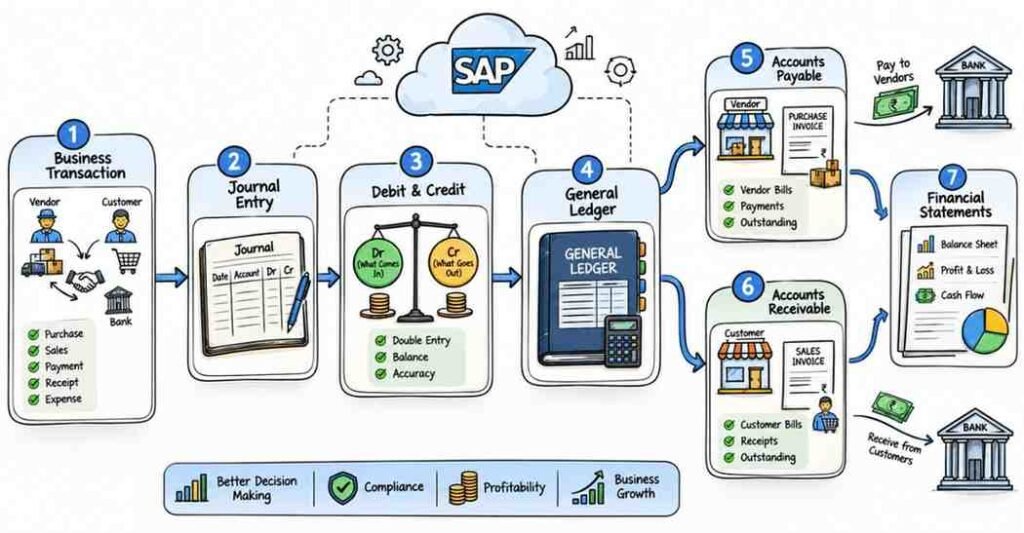
This part continues from Question 41 and covers the core SAP FI areas you will hear most often in interviews. It explains the main accounting components used for postings, vendor and customer transactions, and fixed asset management.
Questions 41–80
41. What is SAP FI?
SAP FI stands for Financial Accounting. It is used to record, process, and report a company’s financial transactions.
42. Why is FI important?
FI is important because it supports legal accounting and financial reporting. It helps companies maintain accurate books and compliance.
43. What is the General Ledger (G/L)?
The General Ledger is the main accounting record where all financial transactions are summarized. It is the central part of FI.
44. Why is the G/L important?
Because it gives the final financial position of the company. All key accounting entries flow into it.
45. What is a G/L account?
A G/L account is a specific account used to record financial transactions such as expenses, revenue, assets, or liabilities. Each account has a unique number.
46. What is the difference between balance sheet and P&L accounts?
Balance sheet accounts show assets, liabilities, and equity, while P&L accounts show income and expenses. They serve different reporting purposes.
47. What is a vendor account?
A vendor account records transactions with suppliers. It is used for purchases, invoices, and payments.
48. What is a customer account?
A customer account records transactions with buyers or clients. It is used for billing, receipts, and receivables.
49. What is Accounts Payable?
Accounts Payable is the part of FI that tracks money owed to vendors. It manages supplier liabilities.
50. What is Accounts Receivable?
Accounts Receivable is the part of FI that tracks money owed by customers. It manages customer collections.
51. Why are AP and AR important?
They are important because they control outgoing and incoming cash flow. They are core to day-to-day accounting.
52. What is a journal entry?
A journal entry is an accounting record that shows debit and credit postings for a transaction. In SAP, it is created as a document.
53. What is a posting in SAP FI?
A posting is the act of recording a financial transaction in SAP. It updates the relevant accounts and creates a document.
54. What is a debit?
A debit is one side of an accounting entry. Depending on account type, it may increase or decrease the balance.
55. What is a credit?
A credit is the other side of an accounting entry. Like debit, its effect depends on the account type.
56. Why must debit and credit balance?
Because every accounting transaction must follow double-entry principles. This keeps the books accurate.
57. What is a document number?
A document number is the unique number assigned to each posted accounting document. It helps identify and trace transactions.
58. Why is the document number important?
Because it supports auditing and transaction tracking. It is the reference point for posted entries.
59. What is a posting key in FI?
A posting key controls how a line item is posted, including whether it is debit or credit and which account type is allowed. It supports controlled posting behavior.
60. What is a reconciliation account?
A reconciliation account is a G/L account linked to subledger accounts like vendors or customers. It ensures subsidiary ledgers match the G/L.
61. Why is a reconciliation account used?
Because AP and AR subledger entries must flow into the correct G/L summary account. It keeps accounting aligned.
62. What is a special G/L transaction?
A special G/L transaction is used for postings that should be shown separately from normal receivables or payables. Examples include down payments and bills of exchange.
63. Why are special G/L transactions needed?
Because some transactions need separate treatment in reporting and accounting. They are not ordinary vendor or customer items.
64. What is dunning?
Dunning is the process of reminding customers about overdue payments. It is used in Accounts Receivable.
65. Why is dunning important?
Because it helps recover outstanding receivables on time. It supports collections management.
66. What is an invoice?
An invoice is a document requesting payment for goods or services. In SAP, invoices can be posted against vendors or customers.
67. What is a payment?
A payment is the settlement of an invoice or open item. It reduces what the company owes or is owed.
68. What is clearing in SAP FI?
Clearing means matching and settling open items against each other. It removes items from open status once paid or offset.
69. Why is clearing important?
Because it keeps accounts accurate and shows which items are still open. It is essential in AP and AR.
70. What is open item management?
Open item management means transactions remain open until they are cleared. It is common in vendor, customer, and many G/L accounts.
71. Why is open item management used?
Because it helps track unpaid or unsettled items. It improves account monitoring.
72. What is asset accounting?
Asset accounting manages fixed assets such as buildings, machinery, or equipment. It tracks acquisition, depreciation, and disposal.
73. Why is asset accounting important?
Because companies need to record asset values properly over time. It supports financial reporting and asset control.
74. What is a fixed asset?
A fixed asset is a long-term resource used in business operations. Examples include land, vehicles, and equipment.
75. What is depreciation?
Depreciation is the allocation of an asset’s cost over its useful life. It reflects wear, usage, or value reduction.
76. Why is depreciation important?
Because it helps show the correct value of assets in the books. It is a key accounting requirement.
77. What is an asset master record?
An asset master record contains the main details of a fixed asset in SAP. It stores information like cost, depreciation area, and location.
78. What is asset acquisition?
Asset acquisition is the process of bringing a fixed asset into the books. It can happen through purchase or internal creation.
79. What is asset retirement?
Asset retirement is the removal of an asset from the books. It can happen through sale, scrapping, or disposal.
80. What is a strong answer for FI questions?
A strong answer explains the accounting idea clearly and connects it to the business process in SAP. Interviewers want to see that you understand both the transaction and its accounting effect.
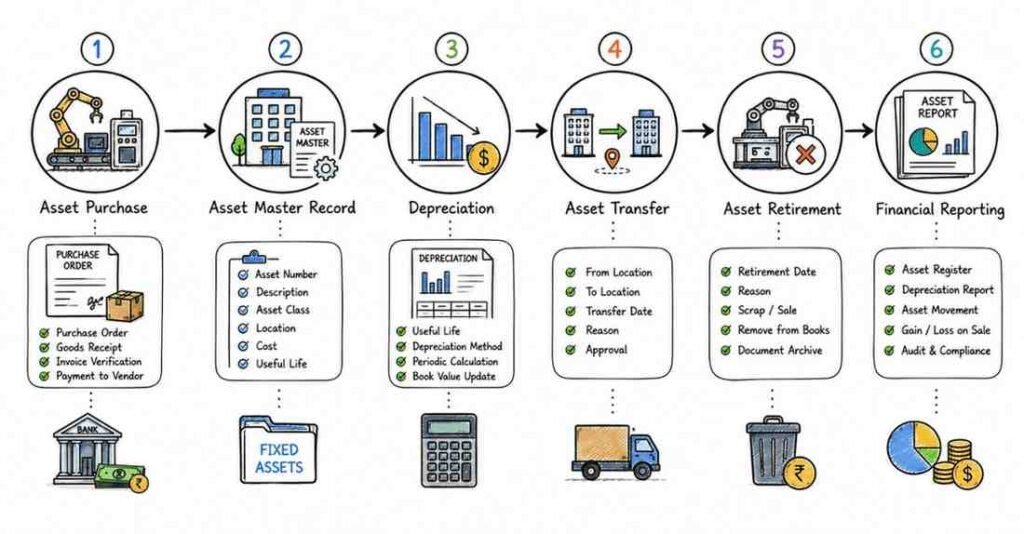
Revision focus
Revise FI, General Ledger, G/L account, balance sheet accounts, P&L accounts, vendor account, customer account, AP, AR, journal entry, posting, debit, credit, document number, posting key, reconciliation account, special G/L transaction, dunning, invoice, payment, clearing, open item management, asset accounting, fixed asset, depreciation, asset master record, acquisition, and retirement before moving to controlling concepts and cost accounting.
Master SAP FICO Step by Step
Part 4: Controlling Basics, Cost Objects, Profitability, and Period-End Concepts
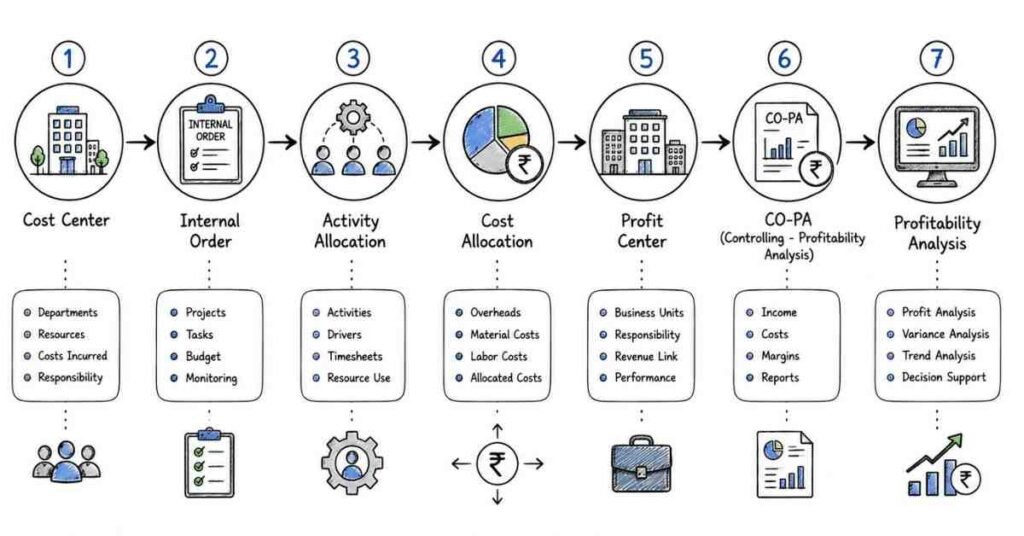
This part continues the SAP FICO guide with Question 81 onward. It focuses on SAP CO, cost tracking, internal reporting, and the concepts that help management understand where money is spent and earned.
Questions 81–120
81. What is SAP CO?
SAP CO stands for Controlling. It is used for internal cost tracking, planning, and management reporting.
82. Why is CO important?
CO is important because it helps management understand costs, profitability, and business performance. It supports internal decision-making.
83. What is the difference between FI and CO?
FI focuses on external financial accounting and legal reporting, while CO focuses on internal cost control and management analysis. They are closely linked but serve different purposes.
84. What is a cost center?
A cost center is an organizational unit where costs are collected and tracked. It usually represents a department or function.
85. Why are cost centers used?
Because companies want to monitor spending by department or responsibility area. They help control operating expenses.
86. What is a profit center?
A profit center is an organizational unit used to measure profitability. It helps analyze revenue and cost by business segment.
87. Why is profit center accounting important?
Because it shows which parts of the business generate profit. It supports internal performance evaluation.
88. What is an internal order?
An internal order is used to collect and monitor costs for a specific task, project, or event. It is often temporary.
89. Why are internal orders used?
Because certain costs need to be tracked separately from normal department spending. They help with project or event-level control.
90. What is cost element?
A cost element is used to classify costs in CO. It connects financial postings with controlling analysis.
91. What is the difference between primary and secondary cost elements?
Primary cost elements come from FI expense or revenue postings, while secondary cost elements are used for internal allocations inside CO. They serve different accounting roles.
92. What is cost allocation?
Cost allocation is the process of distributing costs from one object to another. It helps reflect how resources are consumed.
93. Why is cost allocation important?
Because shared expenses often need to be split across departments or activities. It gives a more accurate cost picture.
94. What is overhead cost control?
Overhead cost control means managing indirect costs such as administration, utilities, or support functions. These costs are often tracked through cost centers.
95. What is standard cost?
Standard cost is a planned or expected cost used as a benchmark. It helps compare planned cost versus actual cost.
96. What is actual cost?
Actual cost is the real cost recorded after a transaction occurs. It is used for comparison with planned or standard values.
97. What is variance?
Variance is the difference between planned, standard, or expected values and actual results. It helps identify performance gaps.
98. Why is variance analysis used?
Because management needs to know why costs or profits differ from expectations. It supports business control and decision-making.
99. What is profitability analysis?
Profitability analysis evaluates revenue and cost to understand which products, customers, or regions are profitable. It is often called CO-PA in SAP.
100. What is CO-PA?
CO-PA stands for Profitability Analysis. It helps analyze profitability from different business perspectives.
101. Why is CO-PA useful?
Because it gives management insight into which areas of the business are performing well. It supports pricing and strategy decisions.
102. What is cost of goods sold?
Cost of goods sold is the direct cost of producing or purchasing products sold to customers. It is an important finance and controlling measure.
103. What is a cost object?
A cost object is anything on which costs are collected, such as an order, project, or product. It helps track spending precisely.
104. What is planning in CO?
Planning in CO means setting expected costs, revenues, or activity values in advance. It is used for budgeting and control.
105. Why is planning important in CO?
Because actual results are more useful when compared with a plan. Planning creates a reference for performance tracking.
106. What is activity type?
An activity type represents a service or activity performed by a cost center, such as machine hours or labor hours. It can be allocated to other cost objects.
107. What is activity allocation?
Activity allocation means assigning the cost of a service or activity to another object. It is common in internal cost distribution.
108. What is period-end closing?
Period-end closing is the process of closing a financial or controlling period after all key entries are completed. It prepares the system for the next period.
109. Why is period-end closing important?
Because companies need controlled accounting cycles. Closing ensures the books are accurate before reporting.
110. What is month-end closing?
Month-end closing is the closing process performed at the end of each month. It often includes reconciliation, postings, and reporting.
111. What is year-end closing?
Year-end closing is the final accounting process at the end of the fiscal year. It supports legal and statutory reporting.
112. What is reconciliation in SAP?
Reconciliation is the process of ensuring different accounting records match each other. It helps confirm that FI and CO figures are consistent.
113. Why is reconciliation important?
Because mismatched numbers can cause reporting errors and audit issues. It is a key control step.
114. What is settlement in CO?
Settlement is the process of transferring costs from one object to another, such as from an internal order to a cost center or asset. It finalizes costs.
115. Why is settlement used?
Because temporary cost collectors need to pass costs to their final destination. It ensures proper accounting treatment.
116. What is overhead absorption?
Overhead absorption is the process of assigning indirect costs to cost objects. It helps include support costs in product or project costing.
117. What is a strong answer for CO questions?
A strong answer explains the business purpose of the object or process and how it helps control costs or profitability. Interviewers want practical understanding, not just module names.
118. What is a common beginner mistake in CO?
A common mistake is confusing cost center, profit center, and internal order. Another is failing to connect CO concepts to business reporting.
119. Why do FI and CO need to work together?
Because financial accounting records the legal transaction, while controlling analyzes the internal cost impact. Together they give a complete picture of business performance.
120. What should you remember before moving on?
Remember CO, cost center, profit center, internal order, cost element, primary cost element, secondary cost element, cost allocation, overhead control, standard cost, actual cost, variance, profitability analysis, CO-PA, cost object, planning, activity type, activity allocation, period-end closing, month-end closing, year-end closing, reconciliation, settlement, and overhead absorption before moving to configuration and business process concepts.
Revision focus
Revise SAP CO, cost centers, profit centers, internal orders, cost elements, planning, variance analysis, profitability analysis, settlement, and period-end closing before moving to configuration, document posting, and end-to-end SAP FICO processes.
Part 5: Configuration, Document Control, Integration, and SAP FICO Processes
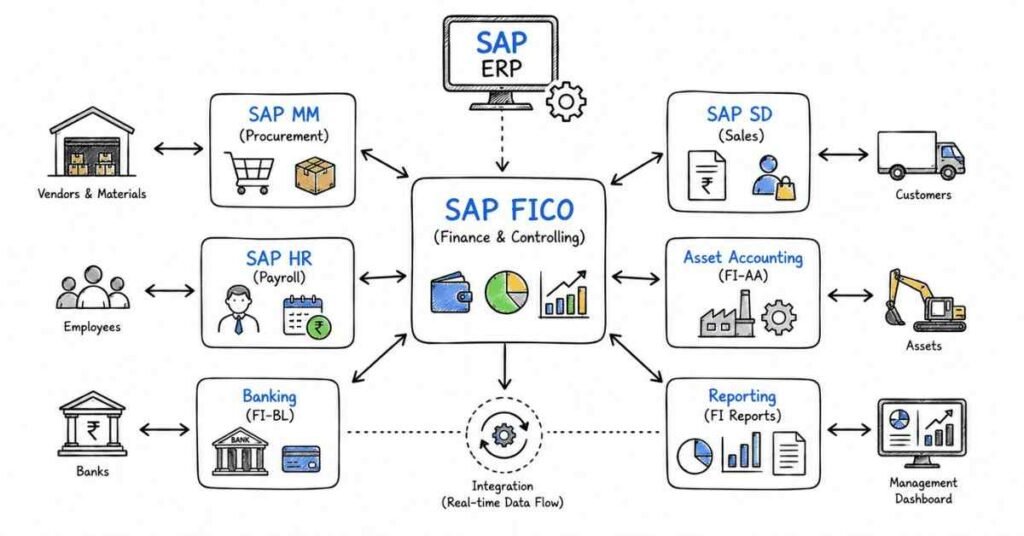
This part continues from Question 121 onward and moves into the practical setup and business process side of SAP FICO. It covers configuration concepts, document control, integration points, and the process logic interviewers often ask about.
Questions 121–160
121. What is configuration in SAP?
Configuration in SAP means setting up system rules and organizational settings to match business requirements. It is usually done through the IMG or customizing area.
122. Why is configuration important?
Because every company has different accounting and controlling rules. SAP must be configured correctly to support those needs.
123. What is the IMG?
IMG stands for Implementation Guide. It is the area in SAP used for configuration and setup activities.
124. What is SPRO?
SPRO is the transaction used to access SAP configuration settings. It is one of the main entry points for customizing.
125. What is document splitting?
Document splitting is a process that divides accounting documents by specific dimensions such as profit center or segment. It helps with detailed reporting.
126. Why is document splitting useful?
Because it supports segment reporting and better financial analysis. It helps businesses see values by dimension.
127. What is a field status variant?
A field status variant is a group of field status settings used to control data entry behavior. It helps define which fields are mandatory, optional, or hidden.
128. Why is field status control important?
Because it standardizes posting behavior and reduces user errors. It is part of transaction control.
129. What is account group?
An account group controls the creation and behavior of G/L accounts, customer accounts, or vendor accounts. It helps organize master data.
130. Why is account group used?
Because different accounts may need different number ranges or field settings. It improves master data control.
131. What is number range?
A number range is the sequence SAP uses to assign unique numbers to documents or master data. It avoids duplication.
132. Why are number ranges important?
Because every financial object must be uniquely identified. Number ranges help maintain order and traceability.
133. What is a reconciliation account used for in configuration?
A reconciliation account links subledger transactions to the G/L. It ensures AP and AR transactions update the correct summary account.
134. What is open item management in configuration?
Open item management is a setting that keeps items open until they are cleared. It is often enabled for vendor, customer, and selected G/L accounts.
135. Why is open item management important?
Because it helps track unpaid items and supports clearing. It is essential for receivables and payables.
136. What is tolerance group?
A tolerance group defines the allowed limits for posting differences or payment differences. It helps manage accounting exceptions.
137. Why are tolerance groups used?
Because businesses need rules for acceptable differences and approvals. They support posting control.
138. What is a posting period variant?
A posting period variant controls which periods are open for posting. It helps manage period closing.
139. Why is posting period control important?
Because companies must close books in an orderly manner. It prevents unwanted postings into closed periods.
140. What is integration in SAP FICO?
Integration means SAP FICO connects with other modules such as MM, SD, and HR. Financial postings often come from other business processes.
141. Why is integration important?
Because accounting does not happen in isolation. Business transactions in purchasing, sales, and operations must flow into finance.
142. How does FI integrate with MM?
When goods are received or invoices are posted in MM, FI accounting entries are created automatically. This keeps inventory and vendor accounting aligned.
143. How does FI integrate with SD?
When sales billing happens in SD, FI receives revenue and receivable postings. This supports customer accounting.
144. How does FI integrate with HR?
When payroll is processed in HR, relevant costs can flow into FI and CO. This helps capture employee-related expenses.
145. What is automatic account determination?
Automatic account determination is the SAP process of selecting the correct G/L account automatically during a transaction. It reduces manual posting errors.
146. Why is automatic account determination useful?
Because it ensures consistency and saves time. It is critical in integrated business processes.
147. What is asset accounting integration?
Asset accounting integrates with FI so asset acquisitions, depreciation, and retirements post correctly to the books. It keeps fixed asset records aligned with accounting.
148. What is a subledger?
A subledger is a detailed ledger for a specific area such as vendors, customers, or assets. Its totals flow into the G/L.
149. Why are subledgers useful?
Because they give transaction-level detail while keeping the G/L summarized. They support operational tracking.
150. What is a posting document in SAP?
A posting document is the record created when a financial transaction is entered. It stores the accounting impact.
151. What is clearing document?
A clearing document is created when open items are settled against each other. It confirms the items are no longer open.
152. What is a reversal document?
A reversal document cancels or negates a previous accounting document. It is used to correct errors.
153. Why are reversals important?
Because accounting mistakes must be corrected in a traceable way. Reversal maintains audit history.
154. What is a parking document?
A parking document is a document saved temporarily before final posting. It allows review and approval before accounting impact.
155. Why is parking useful?
Because it supports control and review in finance processes. It is often used in approval workflows.
156. What is a recurring entry?
A recurring entry is a repeated posting made on a regular schedule. It is used for rent, subscriptions, or fixed monthly charges.
157. Why are recurring entries used?
Because some transactions happen regularly and should be automated. It saves manual effort and reduces errors.
158. What is a foreign currency transaction?
A foreign currency transaction is a posting made in a currency different from the local currency. SAP must handle exchange rates correctly.
159. Why is foreign currency handling important?
Because global businesses often deal with multiple currencies. Correct conversion and valuation are essential.
160. What is a strong answer for configuration and process questions?
A strong answer explains both the control setting and the business reason behind it. Interviewers want to see that you understand how SAP is set up and how the process flows end to end.
Revision focus
Revise configuration, IMG, SPRO, document splitting, field status variant, account group, number range, reconciliation account, open item management, tolerance group, posting period variant, integration with MM/SD/HR, automatic account determination, subledger, posting document, clearing document, reversal document, parking document, recurring entry, and foreign currency transactions before moving to reporting, closing, and interview preparation.
SAP FICO Career Guide
Part 6: Reporting, Closing, Controls, and Interview Readiness
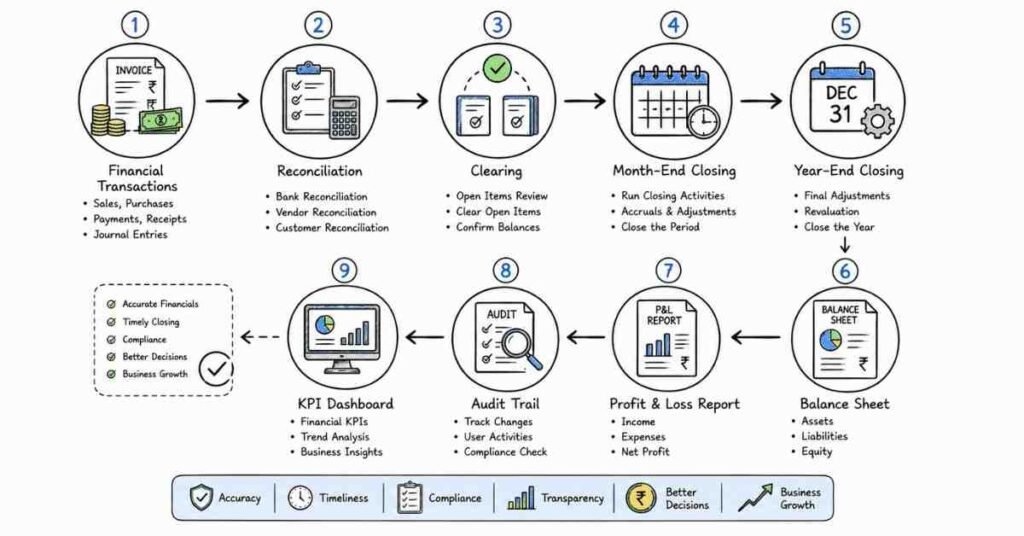
This part continues from Question 161 onward and focuses on reporting, period-end activities, controls, and the final interview-oriented concepts that complete your SAP FICO preparation. It also includes practical Q&A that help you explain finance processes clearly in interviews.
Questions 161–200
161. What is financial reporting in SAP?
Financial reporting in SAP is the process of generating reports that show a company’s financial position and performance. It includes balance sheets, profit and loss reports, and analysis reports.
162. Why is reporting important?
Because management and auditors need reliable financial information. Reporting turns accounting data into useful decisions.
163. What is a balance sheet?
A balance sheet is a financial statement that shows assets, liabilities, and equity at a point in time. It gives a snapshot of financial position.
164. What is a profit and loss statement?
A profit and loss statement shows revenue, expenses, and net profit or loss over a period. It measures performance.
165. What is cash flow reporting?
Cash flow reporting tracks how money moves in and out of the business. It helps monitor liquidity.
166. Why is cash flow important?
Because a profitable business can still fail if cash is poorly managed. Cash flow is critical for daily operations.
167. What is month-end closing?
Month-end closing is the process of finishing all accounting activities for a month. It includes reconciliation, postings, reviews, and report preparation.
168. Why is month-end closing important?
Because companies need accurate monthly results. Closing ensures records are complete before reporting.
169. What is year-end closing?
Year-end closing is the final accounting process at the end of the fiscal year. It prepares the books for statutory reporting and the next year.
170. Why is year-end closing important?
Because legal and financial statements depend on it. It is one of the most important accounting processes.
171. What is reconciliation?
Reconciliation is the process of checking that records match across systems or accounts. It helps confirm accuracy.
172. Why is reconciliation important?
Because mismatches can cause reporting errors and audit issues. Reconciliation is a key control step.
173. What is audit trail?
An audit trail is the record of changes and postings that shows what happened, when, and by whom. It supports accountability.
174. Why is audit trail important?
Because finance systems must be traceable. Auditability is essential for compliance.
175. What is a control in SAP FI?
A control is a rule or check that prevents errors or unauthorized actions. It helps protect the integrity of financial data.
176. Why are controls important?
Because accounting systems must be accurate and secure. Controls reduce risk.
177. What is approval workflow?
An approval workflow is a process where documents or requests must be approved before posting or completion. It adds control to business processes.
178. Why are workflows used?
Because important transactions often need review before execution. Workflows improve governance.
179. What is a variance report?
A variance report compares actual results against budget, plan, or standard values. It highlights differences.
180. Why is variance reporting useful?
Because management needs to know where performance differs from expectation. It helps guide decisions.
181. What is budgeting in SAP CO?
Budgeting in SAP CO is the process of planning expected costs or revenues. It supports financial control.
182. Why is budgeting important?
Because it provides a baseline for comparison with actual results. It supports responsible spending.
183. What is cost center reporting?
Cost center reporting shows costs collected and analyzed by department or responsibility area. It helps management monitor spending.
184. Why is cost center reporting useful?
Because it shows how each department uses resources. It supports internal accountability.
185. What is profit center reporting?
Profit center reporting shows revenue and cost by business segment. It helps assess profitability.
186. Why is profit center reporting useful?
Because it helps management identify strong and weak business areas. It supports strategic planning.
187. What is segment reporting?
Segment reporting shows financial performance for specific business segments. It supports external and internal analysis.
188. Why is segment reporting important?
Because large companies often need visibility by business line or geography. It improves transparency.
189. What is liquidity?
Liquidity is the ability of a company to meet short-term obligations. It depends on cash and near-cash resources.
190. Why is liquidity important?
Because even profitable companies need enough cash to operate. Liquidity is a basic financial health measure.
191. What is a KPI?
A KPI is a Key Performance Indicator. It is a metric used to measure business performance.
192. Why are KPIs important?
Because they help track progress toward business goals. They simplify decision-making.
193. What is master data?
Master data is the core data that stays relatively stable, such as vendors, customers, G/L accounts, and assets. It supports transaction processing.
194. Why is master data important?
Because bad master data can cause errors across the system. Clean master data is essential for reliable SAP processes.
195. What is transactional data?
Transactional data is the data created by business events, such as invoices, payments, and journal entries. It changes frequently.
196. What is the difference between master data and transactional data?
Master data defines the core objects used in the system, while transactional data records the actual business events. They serve different roles.
197. What is a strong answer for reporting questions?
A strong answer explains the report, its purpose, and the business decision it supports. Interviewers want to see practical thinking.
198. What is a common beginner mistake?
A common mistake is describing reports only as outputs without explaining their financial purpose. Another is confusing closing activities with reporting itself.
199. What should you do before an interview?
You should revise key FI and CO objects, practice explaining financial processes, and prepare examples of how SAP supports reporting and control. Clear explanation matters a lot.
200. What should you remember before moving to the final part?
Remember that SAP FICO is not only about transactions; it is also about control, reporting, and financial discipline. Strong candidates can connect process, configuration, and reporting into one answer.
Revision focus
Revise financial reporting, balance sheet, profit and loss statement, cash flow reporting, month-end closing, year-end closing, reconciliation, audit trail, controls, approval workflow, variance reporting, budgeting, cost center reporting, profit center reporting, segment reporting, liquidity, KPI, master data, transactional data, and interview preparation before moving to the final behavioral, resume, LinkedIn, and career strategy part.
Part 7: Advanced SAP FICO Concepts, Integration, and Interview Readiness
This part continues from Question 201 and covers the advanced topics interviewers often ask after the basics. It focuses on asset accounting, integration, closing concepts, controls, and practical interview confidence.
Questions 201–240
201. What is SAP asset accounting?
SAP asset accounting is the part of FI that manages fixed assets such as machines, buildings, vehicles, and equipment. It tracks acquisition, depreciation, revaluation, and disposal.
202. Why is asset accounting important?
It is important because companies need to record the value of long-term assets correctly. It supports accurate financial statements and compliance.
203. What is an asset master record?
An asset master record stores all important details of a fixed asset in SAP. It includes asset class, depreciation data, and organizational information.
204. What is an asset class?
An asset class groups similar assets together. It helps control account determination and depreciation settings.
205. What is depreciation?
Depreciation is the process of spreading an asset’s cost over its useful life. It reflects wear, usage, or decline in value.
206. Why is depreciation posted in SAP?
Because asset values must be shown accurately in accounting records. Depreciation supports correct reporting of asset value and expense.
207. What is an asset acquisition?
Asset acquisition is the process of bringing an asset into the books. It may happen through purchase, construction, or transfer.
208. What is an asset retirement?
Asset retirement is the removal of an asset from the books. It can happen through sale, scrapping, or disposal.
209. What is an asset transfer?
Asset transfer means moving an asset from one asset account or location to another. It is used when assets change ownership, class, or responsibility.
210. What is a subledger?
A subledger is a detailed ledger for a specific area like vendors, customers, or assets. Its balances flow into the general ledger.
211. Why are subledgers useful?
They provide detailed records while keeping the general ledger summarized. This helps with both operational tracking and financial control.
212. What is automatic account determination?
Automatic account determination is SAP’s process of selecting the correct G/L account based on configuration. It reduces manual accounting errors.
213. Why is automatic account determination important?
Because many business transactions must post to the correct account automatically. It improves consistency and speed.
214. What is integration in SAP FICO?
Integration means SAP FICO connects with other SAP modules such as MM, SD, and HR. Business transactions from those modules create accounting entries in FI and CO.
215. Why is integration important?
It is important because finance cannot work separately from operations. SAP integration keeps business and accounting data aligned.
216. How does FI integrate with MM?
When goods are received or invoices are posted in MM, accounting entries are created in FI. This ensures inventory and vendor records stay synchronized.
217. How does FI integrate with SD?
When billing happens in SD, FI records customer receivables and revenue postings. This connects sales activity with accounting.
218. How does FI integrate with HR?
When payroll is processed in HR, the related expenses can flow into FI and CO. This helps track employee-related costs.
219. What is period-end closing?
Period-end closing is the process of finalizing accounting activities for a month, quarter, or year. It prepares the system for the next period.
220. Why is period-end closing important?
Because companies need accurate and complete figures before reporting. Closing ensures books are properly updated.
221. What is month-end closing?
Month-end closing is the monthly version of period-end closing. It often includes reconciliations, postings, and report checks.
222. What is year-end closing?
Year-end closing is the final closing process at the end of the fiscal year. It supports annual financial reporting and audit requirements.
223. What is reconciliation in SAP?
Reconciliation means checking whether balances and transactions match across related accounts or modules. It helps confirm accuracy.
224. Why is reconciliation important?
Because differences between records can cause reporting and audit issues. Reconciliation is a key control step.
225. What is clearing?
Clearing is the process of matching open items against each other so they are no longer outstanding. It is common in AP, AR, and G/L.
226. Why is clearing important?
Because it helps identify what is still unpaid or unresolved. It keeps accounts accurate.
227. What is a posting document?
A posting document is the financial document created when a transaction is entered in SAP. It records the accounting impact.
228. What is a reversal document?
A reversal document cancels a previously posted document. It is used to correct mistakes in a traceable way.
229. What is a parking document?
A parking document is saved temporarily before final posting. It is useful when approval or review is required.
230. Why is document parking useful?
Because it supports control and review before accounting impact is created. It is often used in approval-based processes.
231. What is a recurring entry?
A recurring entry is a regularly repeated posting, such as rent or subscription charges. It helps automate repetitive accounting.
232. What is a tolerance group?
A tolerance group defines allowed limits for differences or posting exceptions. It helps control errors and payment differences.
233. What is a field status variant?
A field status variant controls which fields are mandatory, optional, or hidden during posting. It standardizes data entry.
234. What is a posting period variant?
A posting period variant controls which accounting periods are open or closed for posting. It helps manage period closing.
235. What is a strong answer for integration questions?
A strong answer explains how a transaction moves from one module to finance and why that matters. Interviewers want to know if you understand business flow, not just SAP terms.
236. What is a common beginner mistake in SAP FICO?
A common mistake is memorizing definitions without understanding the process flow. Another is failing to connect FI, CO, MM, SD, and HR.
237. Why do interviewers ask advanced SAP FICO questions?
Because they want to see whether you can handle real business scenarios and not just simple textbook questions. Advanced questions test practical understanding.
238. How should you answer process questions?
Explain the business need first, then the SAP object, then the accounting effect. A simple structure makes your answer stronger.
239. What should you do if you do not know an exact configuration detail?
State what you do know, explain the business logic, and be honest about the gap. Clear reasoning matters more than pretending certainty.
240. What should you remember before the final part?
Remember that SAP FICO interviews test concepts, process flow, and business understanding together. If you can explain accounts, integration, closing, and controls clearly, you will sound much more confident.
Revision focus
Revise asset accounting, asset master record, asset class, depreciation, acquisition, retirement, transfer, subledger, automatic account determination, integration with MM, SD, and HR, period-end closing, reconciliation, clearing, posting document, reversal document, parking document, recurring entry, tolerance group, field status variant, posting period variant, and interview strategy before moving to the final behavioral, resume, LinkedIn, and career strategy part.
Explore SAP FICO Career Paths
Part 8: Scenario-Based SAP FICO Questions, Whiteboarding, and Problem Solving
This part continues from Question 241 and focuses on how to think in real SAP FICO interviews. It covers scenario questions, clarification strategy, whiteboarding, bottlenecks, and practical problem solving.
Questions 241–280
241. What is a scenario-based SAP FICO question?
A scenario-based question asks how you would solve a real finance or accounting problem using SAP FICO. It tests reasoning, not just memory.
242. Why are scenario-based questions important?
Because real SAP work involves business situations, not isolated definitions. Interviewers want to see how you think through a process.
243. How should you answer a scenario-based question?
Start by clarifying the business need, then explain the SAP object or process, and finally describe the accounting result. A structured answer works best.
244. What should you clarify before solving a scenario?
You should clarify the company type, transaction flow, reporting needs, and whether the problem is in FI, CO, or integration. Clear requirements lead to better answers.
245. What is a typical SAP FICO scenario?
A typical scenario could be posting vendor invoices, tracking customer payments, controlling department costs, or setting up asset depreciation. These are common business situations.
246. How would you think about a vendor invoice scenario?
You would identify the vendor, invoice amount, G/L impact, tax impact if any, and how the invoice will be cleared. The process should reflect AP logic.
247. How would you think about a customer payment scenario?
You would identify the customer, the open receivable, the payment received, and how clearing will happen. This belongs mainly to AR.
248. How would you think about a department cost scenario?
You would identify the cost center, expense type, and posting source. The goal is to track the cost in CO.
249. How would you think about an asset purchase scenario?
You would identify the asset class, acquisition value, depreciation settings, and the posting to FI. Asset accounting and FI both matter here.
250. What is whiteboarding in SAP FICO interviews?
Whiteboarding means drawing the business flow, account flow, and module integration visually while explaining your answer. It helps structure your thinking.
251. Why is whiteboarding useful?
Because it makes complex business processes easier to understand. It also shows that you can organize ideas clearly.
252. What should a whiteboard answer include?
It should include the business process, key SAP objects, account flow, and any integration points. Keep it simple and logical.
253. What is a bottleneck in SAP FICO terms?
A bottleneck is a point in the process where accounting, approval, or data flow gets delayed. It can affect reporting or closing.
254. How do you identify bottlenecks?
Look for delays in postings, approval steps, reconciliation issues, or missing master data. These often slow down finance processes.
255. What is a control issue?
A control issue is a weakness in the accounting process that could cause errors, fraud, or reporting mistakes. SAP FICO controls are meant to reduce such risk.
256. Why are controls important in SAP FICO?
Because finance data must be accurate, traceable, and auditable. Controls protect the integrity of financial reporting.
257. What is failure handling in SAP FICO?
Failure handling means thinking about what happens if postings fail, data is missing, or integration breaks. It is important in real finance operations.
258. Why is failure handling important?
Because real-world transactions do not always run perfectly. A good SAP FICO professional should know how to recover and correct issues.
259. What is a common failure example?
A common failure is incorrect master data or a wrong account determination setting. That can cause posting errors or wrong financial results.
260. What is a fallback in SAP FICO?
A fallback is an alternative process used when the primary process fails. For example, a parked document may be used until approval is complete.
261. What is a strong answer for a scenario question?
A strong answer explains the business need, the SAP setup, the accounting result, and the control steps. Interviewers want practical reasoning.
262. What is a common beginner mistake in scenario rounds?
A common mistake is jumping straight to a definition without explaining the process. Another is ignoring the accounting impact.
263. How should you handle unclear requirements?
Ask questions, define assumptions, and explain how those assumptions affect the design. Do not guess silently.
264. How should you respond if the interviewer changes the scenario?
Adapt the process and explain how the SAP logic changes. Flexibility is an important skill.
265. What is a good way to practice scenario questions?
Practice with vendor invoice, customer payment, asset purchase, expense posting, and closing scenarios. Speak your answer out loud.
266. What is a strong interview habit?
A strong habit is to think step by step and connect every process to a business outcome. This makes your answer sound mature and practical.
267. Why do interviewers care about business understanding?
Because SAP FICO is business software, not just technical software. Understanding the finance process is essential.
268. What should you do when you do not know a setting?
Explain the business logic and say what you would verify in the system. Honesty plus reasoning is better than guessing.
269. What is a process flow?
A process flow is the sequence of steps from business event to accounting entry and report impact. It is central to SAP FICO thinking.
270. Why is process flow important?
Because FICO work is all about moving from business action to financial record correctly. The flow must be understood end to end.
271. What is the role of documents in process flow?
Documents create the audit trail for each transaction. They prove what was posted and when.
272. What is the role of master data in process flow?
Master data controls how transactions are posted and reported. Good master data is the foundation of reliable processes.
273. What is the role of integration in process flow?
Integration ensures other modules create the right financial impact automatically. That keeps data consistent across the system.
274. What should your answer always include?
Your answer should include the business case, SAP objects, accounting impact, controls, and any integration. That structure works well in interviews.
275. Why does scenario practice matter?
Because it builds confidence in real interview conditions. It helps you move from memorized answers to applied thinking.
276. What should you remember about whiteboarding?
Remember to keep the design simple, show the flow clearly, and add detail only if needed. Clarity is more important than complexity.
277. What is the value of structured thinking?
Structured thinking helps you answer any open-ended SAP FICO question more clearly. It is a very useful interview skill.
278. Why is communication important in SAP FICO interviews?
Because even if you know the concept, you must explain it clearly to show understanding. Good communication strengthens your technical knowledge.
279. What should you practice before the final part?
Practice scenario answers, whiteboarding, accounting flows, and integration-based questions. That will prepare you for realistic interviews.
280. What should you remember before the final part?
Remember that SAP FICO interviews test practical judgment as much as concepts. If you can clarify, explain, and connect the process to accounting outcomes, you are on the right track.
Revision focus
Revise scenario-based questions, vendor invoice flow, customer payment flow, department cost tracking, asset purchase flow, whiteboarding, bottlenecks, controls, failure handling, fallback processes, process flow, documents, master data, integration, and structured interview answers before moving to behavioral, resume, LinkedIn, and career strategy.
Part 9: SAP FICO Behavioral Questions, Resume, LinkedIn, and Career Strategy
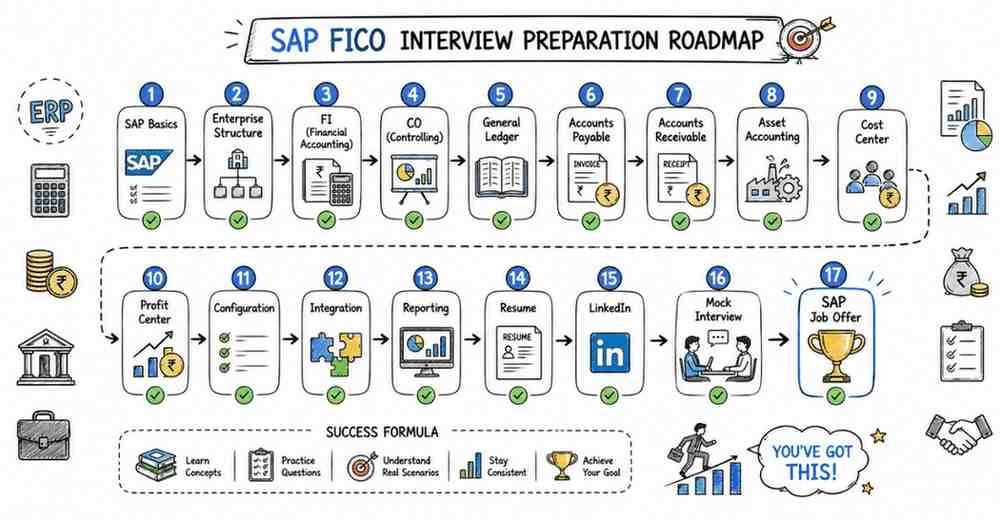
This final part helps you turn SAP FICO preparation into interview success. It covers behavioral questions, resume and LinkedIn positioning, salary framing in India, follow-up emails, and a practical closing checklist for your job search.
STAR method
The STAR method stands for Situation, Task, Action, and Result. It is one of the best ways to answer behavioral questions because it keeps your answer structured and outcome-focused.
Use STAR like this:
- Situation: Explain the context.
- Task: Explain your responsibility.
- Action: Describe what you did.
- Result: Share the outcome.
A good behavioral answer should sound calm, honest, and clear. Interviewers usually respond well when you show ownership and explain what changed because of your work.
20 behavioral questions
- Tell me about a time you solved a finance or accounting problem.
- Tell me about a time you improved a reporting process.
- Describe a time you worked with a difficult stakeholder.
- Tell me about a time you made a mistake and corrected it.
- Describe a time you explained a complex process simply.
- Tell me about a time you worked under pressure.
- Describe a time you had multiple priorities and had to manage them.
- Tell me about a time you improved data accuracy.
- Describe a time you handled a production or posting issue.
- Tell me about a time you improved a finance workflow.
- Describe a time you received feedback and used it.
- Tell me about a time requirements were unclear.
- Describe a time you made a trade-off in a project.
- Tell me about a time you learned a new SAP concept quickly.
- Describe a time you handled scope changes.
- Tell me about a time you influenced a decision without authority.
- Describe a time you resolved a user issue quickly.
- Tell me about a time you improved control or compliance.
- Describe a time you balanced speed and accuracy.
- Tell me about a time you turned a finance challenge into a learning opportunity.
50 AI self-preparation prompts
Use these prompts with AI tools to rehearse interviews, refine your answers, and tighten your project storytelling.
- Act as a SAP FICO interviewer and ask me 10 questions.
- Ask me behavioral SAP FICO questions using STAR.
- Improve my answer to “Tell me about yourself” for an SAP FICO role.
- Help me explain my SAP project in under 2 minutes.
- Help me explain my SAP project in under 5 minutes.
- Turn my project notes into an interview-ready STAR answer.
- Ask me scenario-based SAP FICO questions one by one.
- Challenge my answer to a FI posting scenario.
- Challenge my answer to an AP clearing scenario.
- Challenge my answer to an AR payment scenario.
- Challenge my answer to an asset acquisition scenario.
- Challenge my answer to a cost center posting scenario.
- Challenge my answer to a reconciliation scenario.
- Challenge my answer to a closing scenario.
- Challenge my answer to an integration scenario.
- Challenge my answer to a configuration scenario.
- Challenge my answer to a document reversal scenario.
- Challenge my answer to a foreign currency scenario.
- Ask me SAP FICO fundamentals questions.
- Ask me FI and CO questions.
- Ask me G/L, AP, and AR questions.
- Ask me asset accounting questions.
- Ask me closing and reporting questions.
- Ask me integration and process questions.
- Ask me configuration questions.
- Ask me scenario-based interview questions.
- Ask me control and compliance questions.
- Ask me failure handling questions.
- Ask me project explanation follow-up questions.
- Tell me where my project explanation is weak.
- Rewrite my answer to sound more professional and concise.
- Help me write stronger SAP FICO resume bullets.
- Suggest better SAP FICO keywords for my resume.
- Help me write a LinkedIn headline for SAP FICO roles.
- Help me write my LinkedIn About section for SAP FICO jobs.
- Ask me 20 rapid-fire SAP FICO questions.
- Ask me 10 FI scenario questions.
- Ask me 10 CO scenario questions.
- Ask me 10 integration questions.
- Ask me 10 closing and reporting questions.
- Ask me 10 controls and compliance questions.
- Score my answers for clarity and confidence.
- Convert my weak answer into a strong answer format.
- Help me answer “Why should we hire you?” for SAP FICO roles.
- Help me answer “Why SAP FICO?” convincingly.
- Help me write a thank-you email after an SAP FICO interview.
- Help me write a follow-up email after no response.
- Create a 7-day SAP FICO mock interview plan.
- Create a 30-day SAP FICO revision plan.
- Create a project explanation script for SAP FICO interviews.
Resume optimization
A strong SAP FICO resume should show finance understanding, process control, and SAP implementation or support exposure. It should not read like a generic software resume.
Useful keywords
- SAP FICO
- Financial Accounting
- Controlling
- General Ledger
- Accounts Payable
- Accounts Receivable
- Asset Accounting
- Cost Center
- Profit Center
- Internal Order
- Profitability Analysis
- Reconciliation
- Document Posting
- Reversal
- Clearing
- Configuration
- Integration
- Reporting
- Month-End Closing
- Year-End Closing
- Master Data
- Subledger
- Business Process
- S/4HANA Finance
- ACDOCA
- CO-PA
- GST
- TDS
Resume bullet examples
- Supported SAP FICO processes for general ledger, accounts payable, and accounts receivable activities.
- Assisted in financial postings, clearing, and reconciliation workflows.
- Worked on cost center and profit center reporting for internal management analysis.
- Helped configure or test SAP finance processes based on business requirements.
- Participated in month-end closing, document review, and reporting activities.
- Collaborated with finance users to improve data accuracy and process control.
- Reviewed integration points between finance and related business modules.
- Prepared SAP FICO documentation, testing notes, or support artifacts.
Resume summary example
SAP FICO-focused professional with interest in financial accounting, controlling, reporting, and business process support. Familiar with core SAP concepts such as general ledger, AP, AR, asset accounting, cost tracking, and period-end closing. Strong interest in process clarity, data accuracy, and practical finance problem solving.
LinkedIn optimization
LinkedIn should position you clearly for SAP FICO or finance-related SAP roles. It should match your resume, projects, certifications, and target title.
Headline examples
SAP FICO Consultant | Financial Accounting | Controlling | SAP S/4HANA Finance
SAP FICO Trainee | FI, CO, AP, AR, Asset Accounting
SAP Finance Enthusiast | Reporting, Reconciliation, Closing, Controls
SAP FICO Support Analyst | General Ledger | Cost Center | Profitability Analysis
About section example
SAP FICO-focused professional interested in financial accounting, controlling, reporting, and business process improvement. I enjoy working with SAP finance concepts such as G/L, AP, AR, asset accounting, cost centers, and closing activities. My strengths include structured problem solving, process understanding, and clear communication with business users.
LinkedIn checklist
- Use a clear SAP FICO or finance SAP role title in the headline.
- Add certifications, project highlights, and relevant tools.
- Keep the About section focused on strengths and target role.
- Keep resume and LinkedIn keywords aligned.
- Highlight any SAP practice projects, training, or internship exposure.
Project strategy
SAP FICO interviews often depend on how well you explain your finance or SAP project. Even if the project is from training, classwork, internship, or self-study, present it clearly and professionally.
What a strong project explanation should include
- Problem statement.
- Business process covered.
- SAP objects used.
- Your role and contribution.
- Configuration, posting, or reporting flow.
- Controls or challenges.
- Result or learning.
Project explanation structure
Use this flow in interviews:
- What was the finance problem?
- Which SAP FICO process was involved?
- What did you personally do?
- What challenges came up?
- What was the result or learning?
Salary guidance in India 2026
SAP FICO salary in India varies by experience, company type, city, and depth of functional or support exposure. Public salary sources show wide ranges, so treat them as directional guidance rather than fixed outcomes.
Directional ranges
- Freshers or entry level: roughly ₹3–6 LPA in many listings, with some roles extending a bit higher depending on skill and training.
- Mid-level: often around ₹6–12 LPA depending on role, project experience, and company type.
- Experienced and specialized roles: can go higher, and some public sources show averages and upper ranges reaching well above ₹15 LPA for stronger profiles.
Follow-up emails
A thank-you email should usually be sent within 24 hours and should be short, personalized, and professional.
Template 1: After interview
Subject: Thank you for your time
Hi [Interviewer Name],
Thank you for taking the time to speak with me about the SAP FICO role. I appreciated learning more about the team and the finance processes you work on.
Our discussion increased my interest in the opportunity, especially around [specific topic discussed]. I believe my experience in [relevant strength] would help me contribute effectively.
Thank you again for your time and consideration.
Best regards,
[Your Name]
Template 2: Follow-up
Subject: Following up on the SAP FICO interview
Hi [Interviewer Name],
I hope you are doing well. I wanted to follow up regarding the SAP FICO interview and thank you again for the opportunity to speak with the team. I remain very interested in the role.
If there are any updates on the hiring timeline, I would appreciate them.
Best regards,
[Your Name]
Final checklist
Use this checklist in the last month before interviews:
- Finalize 1 to 3 SAP FICO project explanations you can present clearly.
- Prepare a 60-second and 2-minute self-introduction.
- Practice at least 20 behavioral questions using STAR.
- Review FI, CO, G/L, AP, AR, asset accounting, closing, reporting, and integration.
- Practice speaking answers out loud, not just reading notes.
- Review scenario questions such as vendor invoice, customer payment, and asset purchase.
- Update resume with SAP FICO keywords and impact-focused bullets.
- Update LinkedIn headline, About section, and project highlights.
- Prepare salary expectations using India 2026 directional guidance.
- Draft thank-you and follow-up emails before interviews begin.
- Do mock interviews with spoken answers.
- Practice explaining one project in business language, not only technical language.
Revision focus
Revise the STAR method, behavioral questions, AI mock interview prompts, SAP FICO resume keywords, impact-based bullet writing, LinkedIn positioning, project storytelling, salary framing in India in 2026, thank-you emails, follow-up messages, and the final interview checklist before publishing the full SAP FICO interview guide.